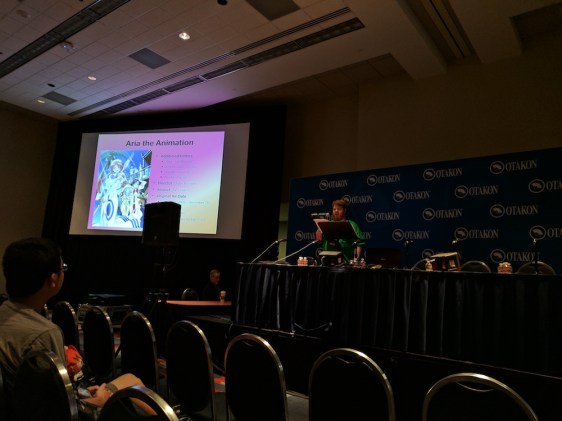
Teikoku State of Mind: Anime NYC 2017

When a brand-new convention decides to call itself “Anime NYC,” it’s practically asking to have the deck stacked against it. Running a first-year convention is no small task, doubly so if it’s in the heart of Manhattan. And with no reputation to go by, potential attendees may feel reluctant to try things out. Small attendance numbers can mean a lack of overall interest and the inability to justify the high costs of NYC, while large numbers means a greater chance of disaster striking if mismanaged. As a longtime resident of New York City, I’ve seen cons come and go, but somehow, someway, Anime NYC went so swimmingly that I almost can’t believe it was real.

General Impressions and Exhibitor’s Hall

Those who attended New York Anime Festival and the first few New York Comic Cons might recall what it was like to go through the Jacob Javits Center without feeling like sardines. Walking through Anime NYC felt reminiscent of that environment, as the con was fairly heavily populated but with plenty of elbow room to spare. Panel rooms were right next to the Exhibitor’s Hall, making transitions between checking out the goods and listening in on industry and fan talks. Special events were held in a Main Event Hall that was a fair distance away, though nowhere near as disorienting as, say, the Baltimore Convention Center where Otakon used to take place.

Because it was so easy to navigate (without the space feeling overly empty), I came out of the three-day con feeling satisfied yet unstressed. Usually one comes with the other due to the hustle and bustle of trying to get everything done, or because there’s so little to do at the event itself that boredom and lethargy set in. Anime NYC struck a Goldilocks-type balance with a schedule that thrilled but did not overwhelm body and mind.

A major contrast between Anime NYC and NYCC is that the latter is focused on being a general comics pop culture event, with a film and television presence that all but overshadows the “comic” in comic con. Anime NYC, on the other hand, is first and foremost concerned with anime and manga. A few features branched out from that core, such as the presence of Overwatch voice actors who were there to meet the fans and sell autographs, but this was certainly no “anime ghetto,” as fans took to calling New York Anime Fest when it began to be dissolved into NYCC.  For those who love anime and love a big convention feel but think New York Comic Con’s a bit too much, Anime NYC has potential to be a gathering point for anime fans in the tri-state area.

Concerts

Anime NYC featured two concerts that shone in different ways. The first was Anime Diva Night, while the second was the Gundam Thunderbolt Concert.

At Anime Diva Night, three Japanese musical guests performed as part of the Anisong World Matsuri. Two of the singers, Ishida Yoko and TRUE, are amazing vocalists in their own right, but the third, Yonekura Chihiro, was the reason I wanted to attend. She’s the voice of so many amazing anime themes over the years that it almost doesn’t compare. Notably, she sang the opening and ending themes to Mobile Suit Gundam 08th MS Team.

While having Yonekura alone would’ve sufficed in my case, all three did a wonderful job. Some singers sound significantly better in the recording booth than they do onstage, but this was not the case for the Anime Diva trio, who sounded incredible even though the makeshift Main Events Hall did not have ideal acoustics.

The concert had a somewhat unusual format. Rather than move from one act to the next, each performer would do a few songs, perform a duet with another, and then the newer singer would take over before the next duet. There were two rotations in total, with all three singers performing together at the start and end of the show. All of the group performances were cover songs of popular anime themes—”Cruel Angel’s Thesis,” “Moonlight Densetsu,” “God Knows,” etc.—while the solo acts were their signature songs. Yonekura did indeed sing the Gundam 08th MS Team opening, but also an old favorite of mine in “Will” from the anime Hoshin Engi (aka Soul Hunter). Highlights from the other two singers included TRUE performing the first Sound!! Euphonium opening and Ishida doing arguably her most famous song, “Otome no Policy” from Sailor Moon R.

There were a couple of songs that didn’t make the concert that I was hoping for: Yonekura’s “Yakusoku no Basho e” from Kaleido Star and Ishida’s “White Destiny” from Pretear, but it was a small loss for an otherwise amazing concert.

The Gundam Thunderbolt Concert was highly unusual compared to what typically happens at an anime con performances. Generally, they’re closer to Anime Diva Night, sounding like the j-pop or j-rock one expects out of anime. To have the Gundam Thunderbolt composer Kikuchi Naruyoshi lead a jazz band himself on saxophone was a truly rare treat, and it’s one of the most unique experiences I’ve had at an anime con. The closest equivalent I could think of was Kanno Yoko’s concert at Otakon 2013.

I am no jazz aficionado, but thanks to the concert, I felt as if I began to understand the almost primal appeal that jazz holds for listeners. As I listened, an analogy popped into my head: jazz is like constructing a human being from music. They can be loud one moment and quiet the next. They can be a mess of contradictions, yet still function. I’m unsure if this will send me towards checking out more jazz in the future, but my curiosity is definitely piqued.

I’ve been more or less referring to the Gundam Thunderbolt Concert as a “jazz performance,” but that’s not entirely accurate. To everyone’s surprise, the concert also included performances by the singers of some of the 50s/60s-style pop songs from the Gundam Thunderbolt anime. In the context of the series, the two main characters, Io and Daryl, are two soldiers on opposite sides of a war who each listen to music as they battle. Io is an intense man who loves equally powerful jazz, while the handicapped Daryl prefers softer ballads.

At the Gundam Thunderbolt panel, Kikuchi mentioned that these are basically his two favorite genres of music, and he thought both fit the characters well. Interestingly, while the Gundam Thunderbolt manga included jazz already, Kikuchi composed entirely new songs that he felt fit Io’s character better.

One funny coincidence of sorts when it comes to Kikuchi’s choice to add a golden oldies aspect to the Gundam Thunderbolt score is that one of the biggest names in classic mid-20th-century American pop, Neil Sedaka, once composed the theme songs to Mobile Suit Z Gundam in the 1980s. I’d be curious to know what Kikuchi would think about this.

Artist Alley

More than Exhibitors’ Halls, Artist Alleys at cons can be affected heavily by the space they occupy. Regardless of the artists’ skills, or the amount of people in the alley, a bad space can make an attendee want to leave as quickly as possible, while a good space encourages more browsing and exploring.

Anime NYC’s is probably the best I’ve ever seen. Held on the top floor of the Jacob Javits Center, natural light shined down on the entire Artist Alley from an entirely windowed roof. At times, it almost felt like an outdoor European boutique, which made it just a pleasant place to peruse.

I purchased a few items at the Artist Alley, mainly from Japanese artists (something of a rarity even at anime cons). One booth was ran by the wife and assistant (pictured above) of manga artist Ohno Junji, creator behind the manga for obscure titles Mobile Suit Gundam: Missing Link and Mobile Suit Gundam The Origin MSD: Cucuruz Doan’s Island. Unfortunately, the artist couldn’t attend himself. They were selling art packages from Ohno himself and his assistant, Ally Suwabe:

Ohno Junji

Ally Suwabe

Axel Rex is Ohno’s original web comic he drew for Kodanasha/Yahoo!! Comics from 2008 to 2009.

The other Japanese artist attending was Tatsuyuki “Mikey” Maeda, who’s worked for the past 10 years as a manga assistant. In a way, while manga artists themselves only attend cons sparingly, their assistants are even rarer. Maeda was selling a short guide called “Secrets of Manga: Basics of the Tools & Trade.” In it, he gives various technical tips to aspiring manga creators, the kinds of things that often get glossed over in favor of “character design” and “how to draw mecha.” The guide talks about differences in pen nibs (such as what you should use if you have a light touch vs. a heavy hand), how to effectively use white-out, and more. I highly recommend it.

Panels

Gundam Thunderbolt Panel

Panels are an important part of the con experience for me, though due to my schedule I could not attend as many as I would have liked. Still, the Gundam Thunderbolt panel was highly informative, as were the Inifini-T Force and LeSean Thomas panels.

Infini-T Force is a current 3DCG anime series crossing over the classic heroes of Tatsunoko Production—Gatchaman, Casshan/Casshern, Hurricane Polymar, and Tekkaman. The fact that Tatsunoko, one of the most influential anime studios ever, had a con presence at all was the main reason I decided to attend their panel. Overall, it was a fairly basic introduction to Tatsunoko, but I like that they conveyed a bit of the studio’s historical significance. They’re one of the most influential studios ever, pushing the limits of animation in Japan since their inception in the 1960s. They were also willing to discuss a bit of the reception Infini-T Force has received in Japan, such as the fact that the primary female character is a little contentious to Japanese audiences. This is also somewhat unusual for Japanese companies, and was somewhat refreshing.

The LeSean Thomas panel was a general Q&A, but was one of the highlights of Anime NYC. It was inspiring to see attendee after attendee express how Thomas inspired them to keep working at their art, and how his success as a creator of color gave them the courage to never give up. I previously interviewed him at Otakon 2016, and he does make for an excellent role model.

Cosplay

In this case, I’ll let the pictures speak for themselves:

In Conclusion

Given how much I’ve praised Anime NYC, it might seem like I’m a paid shill, but I assure my readers that this is not the case. The con was actually executed so smoothly that there’s little I can complain about that would be the fault of the convention itself. While I attended for free as press, even the weekend ticket was affordable, especially compared to New York Comic Con ($60 vs. over $200 to buy four 1-day NYCC passes).

At approximately 20,000 attendees, Anime NYC has already become one of the larger anime cons in the US. The convention appears to have done a sound job of attracting locals, and I’m curious to see how much more it can grow. If the convention keeps up this level of quality, I’d be happy and proud to call Anime NYC “home.”
 

Return to Genshiken: Volume 6 – Eyes as Black as the Abyss

Volume 6 of Genshiken is probably my favorite volume of manga ever. I think I’ve re-read it more than any other, so coming back to it for “Return to Genshiken” is almost like visiting an old friend.

At this point, it feels almost unnecessary to call it a transitional volume because it feels like every volume brings a major shift or two. This time, I’d say there are two especially significant events: the graduation of the old guard, and the first full dive into Ogiue’s head.

What is Return to Genshiken?

Genshiken is an influential manga about otaku, as well as my favorite manga ever and the inspiration for this blog, but it’s been many years since I’ve read the series. I intend to re-read Genshiken with the benefit of hindsight and see how much, if at all, my thoughts on the manga have changed.

Note that, unlike my chapter reviews for the second series, Genshiken Nidaime, I’m going to be looking at this volume by volume, using both English and Japanese versions of Genshiken! I’ll also be spoiling the entirety of Genshiken, both the first series and the sequel, so be warned.

Volume 6 Summary

Ogiue decides to try her hand at drawing a doujinshi for Comic Festival, but only after a series of wacky/traumatic mishaps. From cosplay to drawings of Sasahara and Madarame to getting caught red-handed with a bag full of doujinshi at ComiFes itself, Ogiue’s grudging acknowledgement of her fujoshi side is the very definition of reluctant. What’s more, Kasukabe thinks Ogiue has a twinkle in her eye for Sasahara, and refuses to believe otherwise.

Meanwhile, Keiko tries to get into Shiiou University despite years of neglecting her own education, Madarame has a nervous non-date with Kasukabe, and the classic trio of dudes finally graduate from college. Ohno feels a twinge of sorrow, but that’s eventually wiped away when she becomes the new president of Genshiken, with the hope of bringing about a true Society for the Study of Cosplay.

End of an Era, Dawn of a New Age

Madarame, Tanaka, and Kugayama are all classic images of otaku. Out-of-shape, awkward, and filled with trivia, they’re firmly in the camp of nerds who can never pass as “cool.” All three stick around to varying degrees for the rest of the first series and even in the sequel, but the fact that these “big children” are entering into the adult world is important for the tone of Genshiken. While all have made strides in previous volumes in different areas—girls, artistic progress, life in general—their graduation in hindsight feels like the moment when “more” might just be possible. They, and especially the younger members, are poised to break through the boundaries of the otaku identity, if only a little.

The buildup to graduation is filled with emotion. For example, when Madarame runs into Kasukabe chatting with friends on campus, a combination of his powerful crush on her and his general social awkwardness causes him to snub her. It’s such a painfully relatable scene, especially with how Kasukabe’s friendly “hello” gesture throws Madarame completely off guard. How could Kasukabe actually be that friendly? When did she even get that way? While re-reading Genshiken has helped me to see this change more readily, I recall it feeling almost out-of-nowhere the first time around.

Another moment comes from Ohno, who has a cloud of melancholy hanging overhead prior to the guys’ graduation. The reason is that, because she came back from abroad, she has to do an extra year at the university, and thus will graduate a year after Sasahara, Kasukabe, and Kohsaka. It’s a heartfelt moment where Ohno and Kasukabe grow even closer, albeit with Kasukabe promising to fulfill a cosplay request that she’ll eventually regret. What makes this moment hilarious in hindsight is that, as saddened as Ohno is here, she ends up delaying her graduation multiple times throughout Nidaime because she just doesn’t want to face adult society. Like Kasukabe, Ohno changes quite a bit over the course of Genshiken, sometimes so gradually that it’s notice. That doesn’t apply here, though, as Volume 6 is also when Ohno agrees to become the new Genshiken president so that she can shape it in her own cosplay-loving image. Later in Volume 9, Ohno even makes a comment that her character appears to have changed at some point, referencing her transformation from meek token girl otaku to confident motherly type.

Ogius Maximus

This volume is chock full of premium Ogiue content. It’s a constant barrage of scowls, dreams created and destroyed, misunderstandings, and burgeoning romance. What’s especially telling about Ogiue’s prominence is that we’re privy to her inner thoughts to a degree only a few other prominent characters share, such as Sasahara and Madarame. She has a brief moment in Volume 5, but this time it’s entire extended internal monologues that lay bare the true Ogiue lurking within.

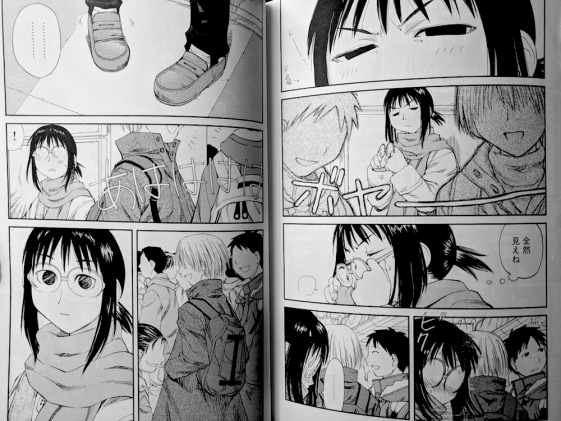
  We have Ogiue going to Comic Festival incognito, i.e. half a chapter devoted to showcasing Ogiue’s mix of anger towards others, anger at herself, and the sense that she just really want friends but is her own worst enemy. As she stomps through Tokyo Big Sight in her winter coat and high school-era glasses, a snarly pout adorning her face, you can see her giving into her basest desires, mirroring Sasahara’s first voyage to ComiFes (though this is certainly not Ogiue’s first rodeo). When Ogiue’s hovering around the rest of the club, the lonely look she gives as they laugh over in the distance is almost heartbreaking. The subsequent silliness of her bumping into Ohno and having her doujinshi spill out of her bag for all the world to see is dramady at its finest. In other words, Genshiken.

The breakdown of Ogiue’s defenses is a recurring theme in this volume, seen not only in her ComiFes disaster but also in her very first cosplay. Kasukabe, having noticed that Ogiue’s a little weak to pressure, uses this opportunity to try and get Ogiue to open up. Ogiue dressed as Renko from Kujibiki Unbalance is probably her most iconic moment. Not only has it been replicated on multiple occasions across various anime adaptations and decorative covers, but it’s the subject of Ogiue’s only full PVC figure (which I own, yes).

Sasa x Ogi Continues

In Volume 5, there’s a moment that I believe is the subtle beginning of Ogiue’s obsession with Sasahara x Madarame, and by extension the catalyst for her eventually falling for Sasahara. In Volume 6, Kasukabe’s actions nudge it towards greater prominence.

In one of the doujinshi planning scenes, Haraguchi reveals that he’s already made plans for Genshiken’s book (he wants to turn it into a big seller by bringing on a ton of high-profile guest artists). Sasahara keeps trying to politely refuse Haraguchi’s “kindness,” as his tendency as a non-confrontational person. However, as Haraguchi keeps pushing and pushing, eventually Sasahara’s expression grows stern (similar to how he reacts to his own sister). He puts his proverbial foot down, saying, “I will personally call all the guest artists you brought on board (without my consent) and turn them down.”

It’s potentially easy to miss, but immediately afterwards there’s a small panel with an Ogiue closeup, and she has the ever-so-slightest blush on her face. Without later context, it can just seem like she’s surprised or shocked at Sasahara’s change of behavior, but now it’s clear to me that this was the catalyst for her perception of Sasahara as a a “seme” character, and also her eventual attraction to him.

Back when I first read Genshiken, I was actually mildly skeptical towards the idea that Ogiue was interested in Sasahara just because Kasukabe said so. Both on a personal level and as a consumer of fiction, I’d groan at these situations. Just because someone looks at someone else once or twice didn’t mean romance is in the air!

Those situations still get overblown in my opinion, but as I’ve re-read Genshiken, it’s clear to me that the hints were there. It’s not that Ogiue is madly in love with Sasahara from the start, but that she begins to notice his finer qualities, and this grows into something more. This, I believe, is what Kasukabe truly notices, even if she misinterprets Ogiue’s drawing of Sasahara as aggressive top as a more typical from of affection.

Kasukabe really is the “matchmaker” of Genshiken, or maybe she just loves goading potential/existing couples. Whether it’s grilling Tanaka and Ohno, or it’s getting Madarame to quit waffling and pick a girl, her thrill at seeing her nerd friends get somewhere is actually one of Kasukabe’s most charming qualities.

The Ogiue Maniax Moment

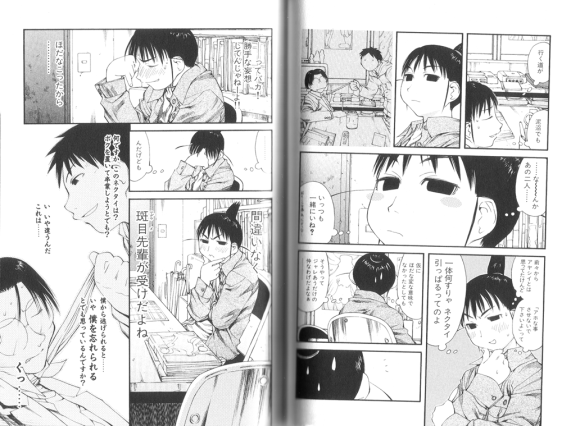
The top image in this post is probably favorite Ogiue scene ever. It’s where my original banner came from, and I’ve used it in posts such as “Explaining Decompression in Comics.” As Ogiue thinks about the logistics of a Sasahara x Madarame relationship, her mind wanders down deeper and darker rabbit holes. She tries to pull herself away, but she can’t. In an entire volume where page after page of Ogiue’s piercing eyes is like manna from heaven, this is like the main course.

Keiko Shows Substance

Ogiue and Keiko meet for the first time in this volume, and it’s hilarious to see how antagonistic they were at the time. Keiko softens up to everyone over time, even her older brother, but there’s just a certain pleasure I derive from seeing Keiko eventually call Ogiue “onee-chan.” She’s marrying her brother and Ogiue in her head before everyone else. But I’m getting ahead of myself.

Volume 6 is probably almost as big a deal for Keiko fans as it is for Ogiue fans; it’s when Keiko really begins to turn a new leaf. Even if we learn in the next volume that her attempts to get into Shiiou University are fruitless, and that she quits college entirely by Nidaime, she’s genuinely trying to be more than just a dumb, shallow girl. I get the feeling a lot of Keiko lovers wouldn’t be so keen on her if she had never changed, but that’s the magic of Genshiken.
Mebaetame Amateur Figure Hour

Starting this volume of Genshiken, the between-chapters extras get creative. This time around, it’s Tanaka’s blog where he shows off his design and construction of a figure from Kujibiki Unbalance. The most amazing thing about this is that it’s made using real photographs of an actual constructed figure. This then later factors into the end-of-volume special, when Tanaka accidentally drops the figure and breaks it. Someone actually built it for real, and I don’t think we’ll ever know if it was Kio himself, an assistant, or an acquaintance. Did he actually break his own constructed figure for the sake of a gag, or was there a stunt double?

Final Random Thoughts

This is the last we see of Kitagawa, the Club Council vice president. She ends up marrying her senpai. I kind of wish we saw where she was in Nidaime, but she was always a pretty minor character. On a personal note, I knew a guy who really liked Kitagawa, but he passed away a few years ago. Rest in Peace, Cortana.

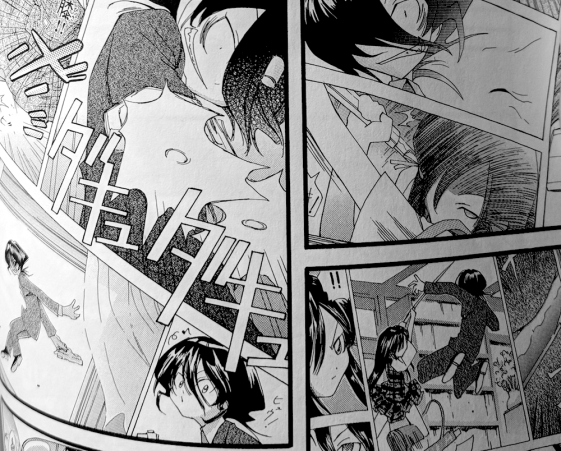
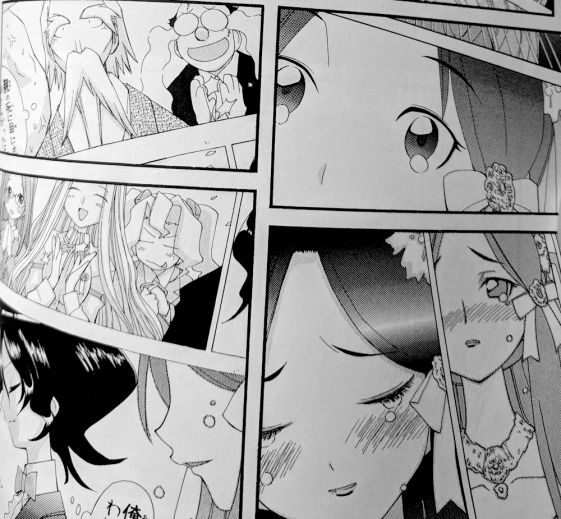
At graduation, someone is reading the end of Part 1 of the Kujibiki Unbalance manga. The pages shown are meant to be an indication of how far the story has gone, as characters portrayed as enemies earlier in the series are now getting married.

Kujibiki Unbalance in Volume 3

Kujibiki Unbalance in Volume 6

The end-of-volume special also features the crew hanging out post-graduation, and in one instance Sasahara and Madarame are checking the girls out. I like that there’s pretending that they don’t notice how attractive their clubmates are, though obviously they don’t say anything out loud. What sticks out to me here is Sasahara getting a little hot and bothered by Ogiue in a skirt. With Kasukabe, who’s dressed to kill in a short skirt and pantyhose, it feels like he’s seeing her as just “an attractive lady.” But with Ogiue, she’s wearing a pretty subdued outfit and a pretty long skirt. I’d like to think it’s that spice of beginning to actually have feelings for another, which turns even plain clothes into thrilling adventures in fantasy. In Volume 7, Sasahara really lets his imagination run wild, but that’s for next time.

The World is My Canvas, and Competition is my Art: Splatoon 2 Thoughts

The video game that has most occupied my attention lately is Splatoon 2. This comes as no personal surprise, seeing as I loved the hell out of the first one. The gameplay is mostly similar to its predecessor. The changes are mostly about quality of life. But even though both games are so similar, for some reason I find myself experimenting with the different weapons more in Splatoon 2.

My preferred weapon hasn’t changed since the first game: the N-Zap, modeled after the classic Zapper light gun from the NES. For me, t’s gone from a tool for Hunting Ducks to a jack-of-all trades tool whose relative lack of power can be made up for with smart movement and positioning. It’s also just accurate enough for me to effectively focus my fire, while still being forgiving enough to compensate for the fact that my aim is not that great. In Splatoon 2, the ability for it to quickly ink the ground synergizes well with the Ink Armor special, which temporarily lets the entire team take a few extra hits and survive. The N-Zap lets me support allies up close and from afar, and it fits like a glove. Finding the right weapon is just plain satisfying.

But much like characters in a good fighting game, the variety of weapons available, many quite different from each other, is part of the allure of Splatoon 2. Even if some weapons feel counterintuitive, there’s a certain thrill to trying to get into the right mindset for any given tool. When you’re using the Sloshing Machine, a bucket that launches spiraling volleys of ink, the focus is on using its overwhelming power and arching property to quickly kill, er, “splat” your opponent in unexpected places. Dualies are relatively short-range John Woo pistols that allow for unique evasive maneuvers. The Splat Brella is like a shotgun with as defensive shield, allowing players to pick off opponents while guarding allies.

Even weapons of the same class can be wildly different. The Dynamo Roller is the equivalent of trying to Falcon Punch everyone all the time, while the Carbon Roller focuses on mobility and turf coverage at the expense of battle strength. Sometimes using a different weapon means almost playing a different game, and every time I turn My Splatoon 2 on, I think, “Do I stick with the familiar, or try to transform my mind with another item?” Both ways are fun, doubly so when patches try to make everything worth using.

One of the major changes between Splatoon and Splatoon 2 is that the new special weapons–super moves, in other words–are significantly weaker. Where once they could flip a game upside down due to their sheer power, now they influence games in subtler, less pronounced ways. I think this might end up putting more emphasis on the main and sub weapons themselves, which contributes to weapon experimentation also being more fun.

In the end, gameplay is great, and all the modes are worth playing. My only complaints are shoddy Wi-Fi on the Switch (a common problem for the console), and the lack of the Squid Girl promotional outfit from the first Splatoon shirt.

No, really, give me my Ika Musume threads.

The Precarious Balance of Tradition and Progress: Sakura Quest

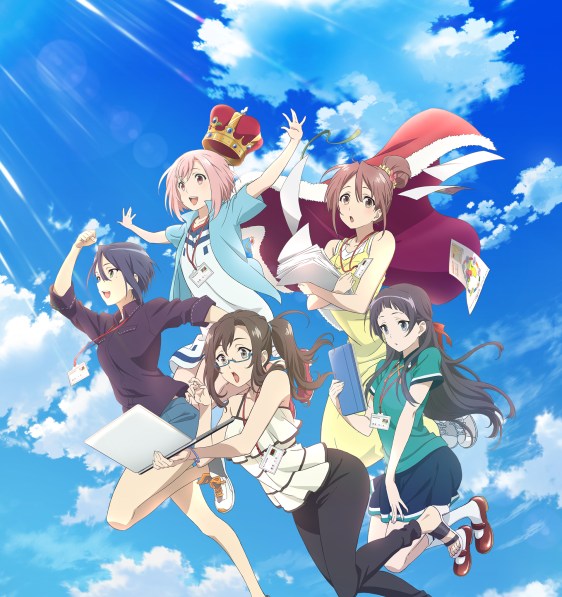
For years, the raison d’etre of the anime studio P.A. Works appeared to be creating intetesting settings as a pretense to showcase cute female characters. Whether it was True Tears, Hanasaku Iroha, Tari Tari,  or something else, they appeared to focus on personal relationships above all else. A more careful look, however, will reveal another major theme permeating many of their works: the declining population of rural Japan, and the complicated effects of tourism on this situation. Now, P.A. Works has doubled down on this idea in their new anime, Sakura Quest.

Koharu Yoshino is a young woman struggling to find work, when she’s been asked specifically by name to come work in the small, virtually forgotten town of Manoyama. Desperate for employment, she takes the offer, only to discover that it was a mistake. But the contract’s been signed, so now Yoshino—along with a group of other young women—are tasked with helping to revive Manoyama.

Much like one of their previous hits, Shirobako, the main cast of Sakura Quest is notably all adult-aged women as opposed to high school girls. When I interviewed P.A. Works at Otakon 2016, they expressed that they’d been wanting to do that as early as Hanasaku Iroha, but trends and the need to make a profit pushed them to stick with the reliable teenage formula. Now, with two series bucking that trend, it looks like they’re eager to challenge that status quo—at least in part.

The use of attractive girls to anchor Sakura Quest means that the series does not fully escape the market forces of young, attractive heroines, but in many ways it also does not pull its punches. Yoshino and the rest of the core cast, consisting of both those new to Manoyama and life-long residents, are confronted with difficult decisions that often leave their best plans only half-formed and arguably doomed to failure by the many considerations they must account for.

Central to this conflict is the contrast between valuing the traditions of Manoyama and its people, and when those traditions stifle the potential for the town to adapt and evolve. Trying to make tourism and local promotion work in a long-declining town is portrayed as a struggle where the gains are few and the solutions are rarely cut-and-dry, if available at all. The series is not necessarily a cynical one, but any progress comes in small steps.  This can be frustrating at times, but it grounds the show in more realistic expectations. After all, if the solution to the rural decline of Japan were easy, we’d probably have seen it by now. It also highlights the idea that, while gimmicks can boost tourism, this is a serious double-edged sword.

Sakura Quest is not one of those gripping anime that keeps you in suspense, or has you falling in love with the girls so hard that you feel compelled to buy their merchandise. It’s a pretty slow burn, and the characters will repeat their mistakes on more than one occasion. However, it’s a very satisfying work in its own way, as it challenges viewers to think about one of Japan’s major problems today, and the myriad factors that complicate it.

Save

Save

Gattai Girls 7: Shinkon Gattai Godannar and Aoi Anna

Introduction: “Gattai Girls” is a series of posts dedicated to looking at giant robot anime featuring prominent female characters due to their relative rarity within that genre.

Here, “prominent” is primarily defined by two traits. First, the female character has to be either a main character (as opposed to a sidekick or support character), or she has to be in a role which distinguishes her. Second, the female character has to actually pilot a giant robot, preferrably the main giant robot of the series she’s in.

For example, Aim for the Top! would qualify because of Noriko (main character, pilots the most important mecha of her show), while Vision of Escaflowne would not, because Hitomi does not engage in any combat despite being a main character, nor would Full Metal Panic! because the most prominent robot pilot, Melissa Mao, is not prominent enough.


This Gattai Girls entry is a bit unusual because I’ve already posted a review of the series before. Moreover, with a series like Godannar, I’ve already written extensively about the the portrayal of female characters because it’s all but unavoidable. If the prevalent fanservice wasn’t enough, there’s the fact that over half of the cast is women. While I’ll inevitably retread some old territory, this time around I’m going to focus more heavily on the main heroine of the story, Aoi Anna.

Godannar follows 17-year-old Aoi Anna, who’s engaged to burly, veteran robot pilot Saruwatari Gou in a May-December romance. Years ago, he rescued her from a monster attack, and eventually their feelings blossomed into love. But while she’s no slouch herself when it comes to mecha—she’s a prodigy who’s dreamed of fighting in a robot since childhood—Gou forbids her from becoming a full-fledged defender of the Earth. The reason? That’s how he lost his previous lover and trusty co-pilot. Still, Anna and Gou are humanity’s greatest weapons, as their robots combine into the mighty robot, Godannar Twin Drive, the “marriage of god and soul.”

From a characterization and narrative perspective, Anna’s story stands out in a way capable of overshadowing even the infamous double decker cheesecake of Godannar. Romance traditionally takes a backseat in many giant robot series, and when it does show up, such as in Macross, the two sides are often from different worlds, either metaphorically or literally. In Godannar, however, not only are Anna and Gou equal partners, but they have to work together as a team both personally and professionally. The cockpit becomes a second home of sorts, as they iron out their differences and fight the enemy. The series literally has relationship plot and mecha action resolve simultaneously, as if the two sides are permanently fused together, and it’s glorious. In a way, this is the story about the power of love, but it’s less “love defeats everything automatically” and more “love opens them up to resolve problems they couldn’t otherwise.”

In a certain sense, this heavy emphasis on relationships plays into the stereotype of girls only caring about guys, and one might even feel that Anna’s character is directly tied to her connection with Gou. While I think there’s some truth to that, I also find that Godannar‘s direct focus on its main couple (as well as many other couples throughout the series) is a big part of its, and by extension Anna’s, appeal. It’s basically a story about newlyweds who are also co-workers, and having to navigate that tricky interpersonal landscape. Through it all, Anna’s inner strength stands out. When Gou first tells her to stop piloting for her own sake, her response is that they have a duty to take care of each other as husband and wife. At one point, she feels herself unable to fight as Gou’s equal, but is able to find the motivation within herself to not back down in the end. By the end, due to unfortunate circumstances, she’s actually the one having to do the lion’s share of the work, to make up for what Gou can no longer do. Her strength, perseverance, and caring make her one of my favorite characters ever.

I’ve already made mention of it a couple of times, but when it comes to how women are depicted in Godannar, the series heavily sexualizes on a level where few others can compare. To say otherwise would be disingenuous. When the girls, including Anna, are piloting their robots, they’re in ultra-form-fitting suits that leave less than nothing to the imagination. During combat, their breasts jiggle to and fro as if made from some alien substance. Even when they’re in regular clothing, the fabric hugs every curve as if holding on for dear life. The camera angles can also be extremely voyeuristic. Even if I wanted to say, “You should really just ignore all this,” that’s pretty much impossible whether you’re into heavy fanservice or not. There’s an incredibly good series with some strong, well-written characters both male and female there, but it requires either an acceptance or tolerance of just a non-stop barrage of sexual imagery.

One last aspect of the series I want to talk about is the interesting way it addresses the topic of gender roles. In the second season of Godannar, the enemy monsters begin to utilize a different tactic. Instead of just trying to out-muscle Earth’s giant robot forces, they also evolve to spread a virus that specifically targets hot-blooded, macho men—the very people who are supposed to excel at being mecha pilots. As the men become increasingly unable to fight, the women, led by Anna, have to take a stand. On the one hand, this plays into the idea that men are supposed to be strong and tough (though it should be noted that a more masculine girl gets hit by the disease while a more effeminate playboy guy does not). On the other, it brings up the notion that hyper-masculinity can become a weakness to be exploited.

Godannar is a contradictory anime. Its unrestrained sexualization of the female body makes it seem like a series all about pure objectification of women, but at the same time its female characters, notably its main heroine Anna, are fully realized characters who have goals and dreams and a desire to stand on their own feet. They’re fleshed out as human beings, but also practically the embodiment of “temptation of the flesh.” But if marriage is a union of separate yet compatible beings, then Godannar is an unlikely marriage of disparate elements that somehow, some way, work to make something beautiful.

My Favorite Light Novel Anime

Light novel anime adaptations get something of a bad rap, but there are plenty of gems in that sea. If I were to list all of the light novel anime I thought were good, I’d have a pretty hefty list—big enough that even I’m surprised by looking at it. Instead, I’ve narrowed it down to a few, with reasons why I enjoy them so much.

1. My Youth Romantic Comedy is Wrong, As I Expected (aka My Teen Romantic Comedy SNAFU)

I’ve written at length on more than one occasion about why I think so highly about Youth Romantic Comedy, but every time I think about it I come back with even more reasons. This time around, an aspect that sticks out to me is how the series positions its central love triangle with a kind of thoughtfulness one might not expect.

Even though they all have significantly different perspectives on life, the characters’ contrasting viewpoints allow them to accomplish tasks that each of them alone could not. This extends to their love triangle. Where usually girls in these series are interested in the same guy for the same reason, Yui and Yukino are drawn to different qualities in Hachiman. Yui sees him as a good person deep down inside (whether he realizes it or not), and Yukino sees Hachiman as someone on a similar, socialization-shunning wavelength.

It’s good stuff.

2. The Disappearance of Suzumiya Haruhi

In general, I’m pretty fond of the Suzumiya Haruhi anime, even if it’s not viewed with as much reverence as it once was. The story of a girl who might very well be god of the universe without realizing it hits a lot of interesting notes. However, I put the film The Disappearance of Suzumiya Haruhi on a whole other level. The powerful emotions swirling around the characters—especially Nagato—as well as the tough decisions they have to make, just sticks with me in a way that not even the series’ other high points can. The only significant flaw of the movie, in my opinion, is that it requires viewers to have all the background context of the series prior to watching, but I think it can still probably do fine stand-alone.

For more of my thoughts, check out my review.

3. Humanity Has Declined

I sometimes forget that this series is based on a light novel because of how witty its satire can be. Taking place in a world where humankind is no longer the dominant race on Earth—instead supplanted by a race of fairies—it often showcases the folly of humanity by having their mistakes repeated in fast-forward by the fairies, who are somehow brilliant and imbecilic at the same time. The fairies can easily fashion new and highly advanced forms of science and technology, but are extremely prone to group-think, bandwagoning, and lack of foresight. It’s all too fitting that we as a species would get outdone by more extreme versions of us.

This is another series I’ve written a review for, which you can find here.

4. Kino’s Journey

If there’s one thing more recent light novel anime tend to lack, it’s a strong sense of atmosphere. Sure, they’ll have complex environments and elaborate magic systems, but they don’t capture the sense of a world in flux the way that Kino’s Journey does. Kino is a “traveler,” an unusual profession where she travels from one land to the next, learning about what each distinct culture is like. It’s a quiet and contemplative series, but at times can swell with tension and action. I’ve written a little about Kino’s Journey before, but only one of the short films.

I’m really looking forward to the upcoming new anime.

5. Slayers

While light novel anime are sometimes thought of as a more recent phenomenon due to the increased influx over the past 10-15 years, in my opinion the true grandmaster of the light novel adaptation is Slayers. Black magician Lina Inverse fancies herself a hero, but she’s more an agent of destruction, feared for her lack of concern for collateral damage. As she continues to make allies, she finds herself having to fight for the fate of her world, but not without keeping her characteristic wit, fury, and hungers both literal and metaphorical.

It was one of my gateway anime, and one of the first series that I was proud to own. Its mixture of humor, adventure, and dramatic development at the right moments makes it forever a classic in my mind. It’s one of the defining series of the 90s, and while its age often shows, I think it still has potential for wide appeal to a current audience.

This post was sponsored by Johnny Trovato. If you’re interested in submitting topics for the blog, or just like my writing and want to support Ogiue Maniax, check out my Patreon.


Save

Save

Save

Save

Save

Save

Save

Return to Genshiken: Volume 5 – Pride and Fujo Justice

Volume 5 holds a very special place in my heart—it was my first ever manga purchase when I studied in Japan, and my first real exposure to the character of Ogiue. As such, it’s one of the volumes of Genshiken I know best, but in re-reading it I’ve still managed to pick up on some things I hadn’t before!

What is Return to Genshiken?

Genshiken is an influential manga about otaku, as well as my favorite manga ever and the inspiration for this blog, but it’s been many years since I’ve read the series. I intend to re-read Genshiken with the benefit of hindsight and see how much, if at all, my thoughts on the manga have changed.

Note that, unlike my chapter reviews for the second series, Genshiken Nidaime, I’m going to be looking at this volume by volume. I’ll be using both English and Japanese versions of Genshiken! Also, I will be spoiling the entirety of Genshiken, both the first series and the sequel, so be warned.

Volume 5 Summary

Ogiue’s is one of the club’s newest members. After some spirited discussions/arguments” with Saki and Ohno about yaoi, she inadvertently reveals her true fujoshi nature. Her kink: BL inspired by shounen manga.

Madarame attempts to take on his greatest foe: premium clothing shopping. Although it nearly drains him of all will, he ultimately succeeds. Ogiue, following similar advice, does not.

Sasahara’s Comic Festival application is accepted, and Genshiken must fight through a meddling pest (Haraguchi), editor and artist tensions between Sasahara and Kugayama, and a fast-encroaching deadline on the way to their first vendor experience at a doujin event. In the end, they manage to make it in time. They even sell out of their Kujibiki Unbalance-themed doujinshi onsite, thanks in part to the cosplay/crossplay powers of Ohno and Kohsaka.

Ogiue Exposed

There’s a lot we learn about Ogiue in Volume 5. She’s indeed a fujoshi, in spite of her vocal disdain for them. She comes from the Tohoku region (and, as we learn in Nidaime, Yamagata specifically) when she panics and slips into her native accent. She’s also an artist, though we’ve yet to learn the significance of art to Ogiue (and how it ties into the trauma of her past). But there’s another major development in this volume that has major implications for the rest of the series.

Before I get into that, however, I do want to point something else out. Ogiue’s initial excuse when Kuchiki mentions that he caught her at a Scram Dunk event is that it was “for her little brother.” I never got around to it in my Nidaime reviews, but it turns out that she actually does have a little brother. The reveal happens in Volume 16, in a 4-panel comic where Ogiue and Sue visit Ogiue’s family home. A simple “Sis?” followed by “He’s my brother” is all it takes to finally know that the brother, at least, was not a lie.

The True Origins of Sasa x Mada

As an Ogiue fan, one of my favorite aspects of Genshiken is naturally her gradual acceptance of her fujoshi side, and her quiet obsession with Sasahara x Madarame yaoi is a part of this. While that particular thread comes to the fore in the next volume, I realized during my re-read that the seeds were planted in Ogiue’s head in Volume 5.

In one of the doujinshi planning scenes, Haraguchi reveals that he’s already made plans for Genshiken’s book (he wants to turn it into a big seller by bringing on a ton of high-profile guest artists). Sasahara keeps trying to politely refuse Haraguchi’s “kindness,” as his tendency as a non-confrontational person. However, as Haraguchi keeps pushing and pushing, eventually Sasahara’s expression grows stern (similar to how he reacts to his own sister). He puts his proverbial foot down, saying, “I will personally call all the guest artists you brought on board (without my consent) and turn them down.”

It’s potentially easy to miss, but immediately afterwards there’s a small panel with an Ogiue closeup, and she has the ever-so-slightest blush on her face. Without later context, it can just seem like she’s surprised or shocked at Sasahara’s change of behavior, but now it’s clear to me that this was the catalyst for her perception of Sasahara as a a “seme” character, and also her eventual attraction to him. When Sasahara is later arguing with Kugayama about getting the doujinshi done, and he refuses Ogiue’s help because he doesn’t want her picking up Kugayama’s slack, this also contributes to her fantasy image of Sasahara. It might also have “helped” that he made her cry, showing his gruff, masculine side, however limited.

As for Madarame as “uke,” right after Sasahara tells Haraguchi that emphatic “no,” Haraguchi turns to Madarame to ask if it’s really okay. Madarame then mentions that Sasahara is president now and it’s up to him to make the final decisions. I think this moment of deference towards Sasahara by Madarame is what plants the seed of “bottom-ness” in Ogiue’s mind, along with Madarame’s general behavior around Kasukabe.

Doujinshi Creation: From Passive to Active

Sasahara’s decision to participate in Comic Festival in the first place is a major pivot for Genshiken. Up to this point, they were an extremely passive club, where things sort of happened to them. Now, they’ve stepped into the field of creators; they’re making an active contribution to otaku culture, so to speak. This experience is also clearly what eventually leads Sasahara to becoming a manga editor. All of the back-and-forth with Haraguchi, having to know when too far is too far, and basically managing disparate elements of production to create a single complete product in a limited time span is portrayed as a tiring yet invigorating experience for Sasahara—and one that he’s pretty good at too. His personality is somehow a good fit for editorial work, especially in the manga sense of also having to manage artists.
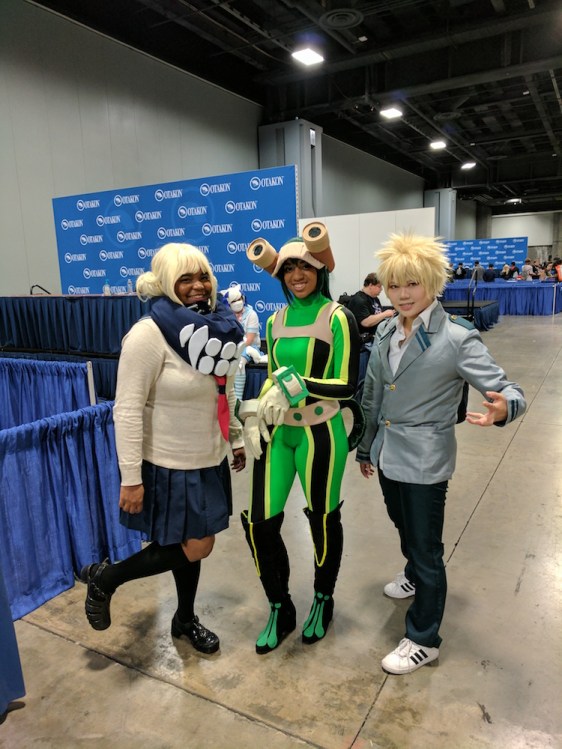
Speaking of passivity, the argument between Kugayama and Sasahara is too real. Sasahara basically accuses Kugayama of discounting his own ability to become a professional manga artist to protect his “flimsy pride.” In other words, Sasahara is saying that Kugayama is choosing to give up because it would feel even worse to try his hardest and fail. While the opposite mentality is encouraged in life and in movies, fearing failure is something that virtually anyone can relate to.

Saki in Transition

Saki, as much as she’s spending time with the Genshiken crew, is still in a period of transition between being absolutely new to the world of otaku and being fully accustomed to it, as she is in Nidaime. While she’s always the “normie” outsider in the series, there are a number of choice moments in Volume 5 that speak to her status being in flux.

When Saki is talking with Ogiue next to the gigantic pile of homoerotic doujinshi, she looks at one of them, gets suspicious, and then opens it up and has her supicions confirmed. If she were an otaku, or at least much more familiar with the stuff, she probably would’ve realized it immediately. Still, the fact that she noticed something was “off” speaks to the time she’s been in Genshiken.

At Comic Festival, Saki sees Kousaka in drag and is clearly taken aback. Back when I first read it, it seemed like she was about to say something sad, but knowing Saki better now, I get the impression that she was going to respond with something kinder, albeit still embarrassing. In Nidaime, she reveals that she has plenty of gay friends and friends who crossdress, which makes me wonder if Saki’s response was actually going to be more “If you’re into that sort of thing, I guess I can accept that,” before she’s interrupted by Kuchiki.

But she’s also learning, whether she likes it or not. In one of the post-ComiFes 4-panel comics, Saki mentions that having the Kujibiki Unbalance vice-president (Ohno’s cosplayed character) selling pornographic doujinshi of the president must be pretty strange. Ohno gets a look of surprise on her face that Saki has shown a small example of otaku-esque perception.

However, just as we think she’s adjusting, the otaku world smacks her right in the face. At the very end of the volume, she’s shown reading the doujinshi Genshiken put out and reacting with awkward disgust. It’s clear why: the doujinshi is lolicon (and the volume has a heavily censored version of it), featuring a young Chihiro and Ritsuko from Kujibiki Unbalance having an early sexual encounter. Ultimately, while the rest of the club is treating it like nothing big (and it’s likely powered by Sasahara’s general obsession with Ritsuko, as opposed to any specific age range), Kasukabe’s reaction is all too expected, and is likely the sort of thing that keeps her from ever fully embracing otaku subculture.

She never really interacts with Nidaime‘s resident shotacon, Yoshitake Risa, either. I wonder how that conversation might go…

Mebaetame

This time around, Genshiken’s small club doujinshi looks at the Kujibiki Unbalance anime, which, in case you didn’t know or forgot, was actually made. A lot of the screenshots are actually taken directly from the anime, but a few of them are actually drawn by Kio Shimoku to resemble a TV anime screenshot. I find that kinda funny.

Final Random Thoughts

Madarame and Ogiue’s fashion trips might have seemed like one-off adventures originally, but looking back it’s clear that their voyages made an impact. Madarame starts to dress at least a little better, especially after he starts to work professionally, but it still sticks even when he quits his job in Nidaime. As for Ogiue, she starts to wear better-fitting clothing, and after she starts dating Sasahara she becomes even more fashionable. By the time Nidaime rolls around, Yajima is actually kind of intimidated by how good-looking Ogiue is. That’s quite some progress for a girl who used to actively shun fashion.

Save

Save

Save

Save

Save

Save

Save

Save

Save

Save

Save

Save

Save

Save

Save

Save

Save

Save

A Belated Samurai Jack Season 5 Review

It’s been a long journey for fans of Samurai Jack. A cartoon that’s always been notable for its visual creativity, the original series ended abruptly, leaving viewers without any sort of resolution to the battle between Jack and his arch-nemesis Aku. 13 years later, Samurai Jack finally has a decisive conclusion to cap off Jack’s journey. This in itself makes the fifth and final season something special, but what makes this concluding chapter stand out even more is how the darker, more mature feel of these last episodes are not as effective without the more kid-oriented approach of the past providing context.

As explained in the opening each episode, 50 years have passed since Aku sent Samurai Jack into the future. During this period, Jack discovers that he does not age, possibly as a side effect of time travel. Jack at the beginning of the fifth season seems almost like a different character, worn down by the death and suffering of others and his inability to vanquish Aku and save the world.

In the old Samurai Jack, Jack only destroyed robots as a consequence of its kid-friendly rating. Stories could be mature, but they had to toe a certain line. In the final season, he is shown to confront the issue of taking mortal lives on numerous occasions. While the story of a man who tries his best not to kill being forced to do so is compelling enough, it works especially well because of that past history as a children’s show. Moreover, the 13-year gap between the previous season and the final one means that the show’s audience has also aged, and I imagine that this creates a degree of empathy towards Jack, even if it hasn’t been 50 years for us.

Originally, the plan from creator Genndy Tartakovsky Samurai Jack was to do a feature film that would finish the story. While that would’ve likely been good in its own right, and likely more in line with how the series was back then, I’m glad we got this version instead. Plenty of shows these days, from Full House to Twin Peaks, are doing this “years later sequel” thing, but I can say for sure that Samurai Jack doesn’t suffer for it. The final season is artistically and negativity ambitious, and any flaws in it are in my opinion forgivable.

Capitalizing on a New Home: Otakon 2017

“Howatto?! Washington ni?!”

-Jack King, Shin Getter Robo vs. Neo Getter Robo

Introduction: To DC

Otakon has always been my favorite anime convention. With its fan-oriented approach and variety of content, it always feels surprisingly intimate despite its sheer size (it’s generally the largest anime con on the east coast). This year marked a big change, as Otakon moved from its long-time home of Baltimore to Washington DC. It might not seem like that much of a difference—it’s only one extra stop on Amtrak—but for those of us who had grown fond of the previous venue, warts and all, Otakon was synonymous with Baltimore.

However, I will likely not be the only one to tell you that the new location is one of the best things to happen to Otakon. Subjectively, I still have an attachment to Baltimore. Objectively, outside of increased cost, pretty much everything is superior. The Walter E. Washington Convention Center is roughly double the size of the old Baltimore Convention Center, meaning less congestion. The adjacent hotel, the Marriott Marquis Washington DC, is bigger and more accommodating. The food choices are greater both inside and outside the convention center, and still fairly reasonably priced. For those who are especially cost-conscious, a Giant Foods supermarket within walking distance is an improvement over Baltimore’s 7-Elevens.

Thus, without even taking into account what happened at the con itself, this new setting certainly provided a more comfortable space for Otakon to put on a show. It was off to a good start right from the beginning.

Dealer’s Hall and Artist’s Alley

One of the best things about having such a large space for Otakon is that the Dealer’s Hall and the Artist’s Alley were easily navigable. Instead of having to wade through a sea of people in order to get anything done, actually going where I wanted to provided little challenge, aside from unfamiliarity with the new convention center. In terms of content, it’s pretty much what you can expect out of a large-sized con. In the Dealer’s Hall, large, official company booths acted as centerpieces with smaller booths on the sides selling figures, posters, manga, anime, and more. The Artist’s Alley had a wide variety of styles, with series such as Voltron, Yuri!!! on Ice, and Persona 5 being especially popular.

One of the hiccups in both areas was a lack of clear marking as to where you were. Booths had individual numbers, but sometimes they didn’t follow a consistent logic, and a lack of visible markings to tell you what row and column you were standing in made things worse. Fortunately, this was brought up at the Con Feedback panel at the end of Otakon, and it’s something they had intended but couldn’t get around to.

There are a couple of other challenges they’ll have to tackle for next year as well. First, the line to the Dealer’s Hall would occasionally get capped. This in itself isn’t unusual, but at one point a friend of mind mentioned that he couldn’t get in while I was already there. But when I looked around, the Dealer’s Hall was the opposite of congested. There was literally room to run around if I so choose. I later realized that it wasn’t the Dealer’s Hall itself that was the issue, it was the space leading to the Dealer’s Hall that was becoming a fire hazard. That’s something that should be addressed by 2018.

The Artist’s Alley also ran into an unfortunate bit of flooding due to a water main break on Saturday evening. A major factor in this was an enormous storm that hit DC. From what I saw, Otakon handled the situation fairly well, and there were no major injuries. This might just be a fluke accident for the first year, so I’ll give them the benefit of the doubt.

Concert: JAM Project/TM Revolution

This year, Otakon teamed up with the Anisong World Matsuri to bring a number of musical acts to DC. Because tickets cost money (unlike most anime cons), I could only see the Friday concert featuring JAM Project and TM Revolution. As a long-time fan of the former and someone who definitely enjoys the music of the latter, I can say with the utmost confidence that they did not disappoint. Both acts are known for creating not only songs that are good in and of themselves, but for embracing the anime they create music for and elevating them through their compositions. I first saw JAM Project at their US debut back at Otakon 2008, and it was a welcome return.

Both TM Revolution and JAM Project are really adept at making live performances special. Their voices ring out clearly, they get the audience involved, and by the time they’re done you end up feeling like you were part of something greater. Even a few technical hiccups during TM Revolution’s performance couldn’t dent the audience’s fervor.

Before the concert, I had bet on JAM Project and TM Revolution doing an encore together. Most likely, it would be JAM Project’s signature song, “SKILL.” They came through, and the collaboration was everything I hoped for.

For further thoughts on the concert, check out my post on Apartment 507.

The official set list for Otakon 2017 is as follows:

JAM PROJECT

1. Crest of “Z’s”
2. Hagane no Resistance
3. Garo ~Savior in the Dark~
4. The Brave
5. THE EXCEEDER
6. Hero
7. THE HERO!! ~Ikareru Kobushini Hiwo Tsukero~
8. Victory〜Gong
9. Rocks
10. Rescue Fire

T.M.Revolution
1. Inherit the Force
2. Invoke
3. ignited
4. Meteor
5. resonance
6. High Pressure
7. White Breath
8. Hot Limit
9. Flags
10. Sword Summit
11. Heart of Sword

ENCORE
1. SKILL (JAM Project x T.M.Revolution)

Panels

Due to a busy schedule this year and some mishaps on my part, I was unable to attend as many panels as I would have liked. However, this means I can talk about ones I did see in greater detail!

(I also didn’t have any panels this year. Better luck next time?)

The first was “Romance and Abuse in Shoujo Manga,” which looked at many of the bad boys of shoujo and how their behavior can reflect an often implicit hand-waving of abusive relationships. It looked at both works that ignore its characters’ abusive behavior towards their partners, as well as those that call the characters out on it. The presenter also took time to point out the difference between enjoying something as fiction vs. understanding how it would play out in reality, so it’s not as if it was an automatic admonishment of the audience’s tastes. I thought it was a strong panel overall, but it could be taken to the next level. Perhaps it could even go into understanding why the trope of the abusive boyfriend as lovable partner is so popular and occurs in so many well-received anime and manga.

I would also like to compliment the presenter on giving her stamp of approval to how the series Kiss Him, Not Me approaches the subject of abuse, because while the series is thoughtful in a lot of ways, its initially flippant handling of weight and beauty can really turn people away—even I was put off by it. The fact that the presenter used it as an example showed that she wasn’t trying to automatically write off certain series but was actively trying to figure out what messages these shoujo series send.

Another panel I attended was “Iyashikei: Animated Healing.” It focused on the so-called healing genre of anime and manga, explaining the emotionally therapeutic aspect of such works and why they garner such loyal fans. It was a very thorough panel that showed a wide variety of series that can be considered iyashikei, including both classics and genre-bending examples. One thing the panel didn’t get into but I would have liked to see was the tendency towards an assumed male viewership for healing anime. Still, it was well-presented and informative, and I’d look forward to checking it out again.

Screenings

I had the opportunity to see two films, one of which was a world premiere. I’ve written more extensive reviews for both.

In This Corner of the World

Eureka Seven Hi-Evolution 1

Interviews

I also interviewed a few of the illustrious guests at Otakon! This year, it was the dynamic seiyuu duo of Furukawa Toshio and Kakinuma Shino, as well as an interview with the director of Eureka Seven, Kyouda Tomoki.

Final Thoughts

The move to Washington DC is the best decision Otakon has made in years. There are very few drawbacks I can think of, outside of a sentimental attachment to Baltimore (and its delicious crab cake truck), but I know that my experience is not necessarily shared with everyone else.

Second, you want to hear other random thoughts about the con, I also appeared on a post-Otakon podcast over at Ani-Gamers. We recorded it right after the con closed on Sunday!

To end this report, here are some cosplay highlights, as is Ogiue Maniax tradition.

Save

Save

Save

Save

Save

The Star that Shines Brightest: Thoughts on the Aikatsu! Five-Year Anniversary Crossover

“Five years of Aikatsu! sounds strange. Sometimes, the series seems like it’s been around forever. Other times, I remember it as one of the many young upstarts nipping at Precure‘s “anime for young girls” throne. However my feelings sway, the reality is that the show is long enough now to have a mega crossover event.

In episodes 69 and 70 of Aikatsu Stars!, the characters if the latest series encounter their predecessors from seasons past. While there are plenty of interactions across the cast, the main focal point is how heroine Nijino Yume meets her protagonist senpai, Oozora Akari and Hoshimiya Ichigo.

One thing is crystal clear after these episodes: out if all three main characters, Ichigo is by far the most memorable and the most meme-able.

That’s not to say that Akari and Yume are bad characters or uninteresting. However, everything about Ichigo leaves an impression. Like in so many other franchises or enduring works, being the original confers a kind of aura of greatness. Whether it’s Amuro Ray from Gundam, Superman, or Cure Black and Cure White from Precure, there’s a sense of reverence for being the first.

But it’s not just being the inaugural protagonist that elevates Ichigo; it’s that she comes across as amusingly superhuman compared to the other two. Like Cure Black and Cure White in their own crossover specials, Ichigo is portrayed as the strongest. She scales cliffs with ease. Her skill with an axe is so notable that the crossover puts special emphasis on it. I’m fact, nowhere is the animation as lovingly handled as the tree-chopping scene, as the anime plays with dynamic angles, fluid animation, and perspective. Yume and Akari recede into the background in the face of Ichigo’s might.

If you look at the S.H. Figuarts figure for Ichigo, she actually comes with an axe. It’s an identifying element for fans. What would Akari and Yume come with? It’s less obvious. One might argue that they’re more subtle as characters, and that this is a strength, but even Cure Black and Cure White don’t overshadow their Precure successors this much.

It might sound like I’m being critical of the franchise for not developing its later heroines more, or of the crossover episodes for not doing a good enough job, but I’m not. I found the crossover episodes to be a fun celebration of all things Aikatsu! I especially enjoyed seeing the previous S4 (Yume’s senpai group before she got to the top of her school) and Soleil (Ichigo’s group) perform. It was also great to see my favorite, Ichinose Kaede. My thoughts on Ichigo are more of an observation.

On a final note, I thought the character designs for Aikatsu! and Aikatsu Stars! would clash more, but they really don’t. I think they made the original Aikatsu! girls’ faces a bit rounder to make the different casts more visually cohesive. This is generally the sign that a crossover knows what it’s doing.

This post was sponsored by Johnny Trovato. If you’re interested in submitting topics for the blog, or just like my writing and want to support Ogiue Maniax, check out my Patreon.