Best Anime Characters of 2017

BEST MALE CHARACTER

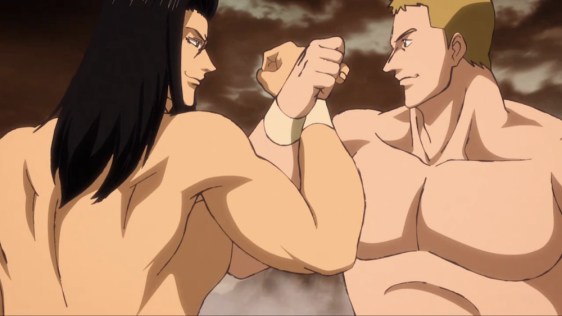
Kevin Anderson (Tiger Mask W)

Whether in anime or pro wrestling, when you look like Generic Background Figure #45, there usually isn’t much hope for someone to make an impression. Kevin Anderson (pictured right) defies the odds, even despite the most incredibly generic name. A member of the dastardly Global Wrestling Monopoly, he’s a frequent teammate of the mysterious and nasty Tiger the Dark. But while Kevin is indeed party to some of the nastier elements of GWM, he’s also a loyal friend in an environment where backstabs and grabs for power are par for the course. When Tiger the Dark is at his lowest point, Kevin stands by him. Even when Tiger the Dark abandons GWM, Kevin takes it more as a betrayal of their friendship and fights to bring him back over. Poor Kevin.

BEST FEMALE CHARACTER

Mauve (ACCA 13-Territory Inspection Dept.)

ACCA is the kind of series where you can never tell who’s on what side—sometimes not even the protagonist himself. In a cast full of intriguing characters, Mauve stands out for her striking presence. The director-general of ACCA, an independent watchdog group for the Dowa Kingdom’s government, she holds a lot of power and has to match wits with figures even more influential than her. Mauve embodies brains, beauty, and the idea that brains are beauty, and it’s telling that even our stoic hero, Jean Otus, finds himself a bit flustered around her.

Final Thoughts

I think the qualities that have stood out to me most about the anime characters of 2017 are exceed their trappings and their archetypes, and just a greater sense of cleverness overall. Sucy from Little Witch Academia seems nasty, but she cherishes friendship in her own bizarre way. Both Sakurai and Morioka from Recovery of an MMO Junkie recast the image of the MMO player without delving into wish fulfillment fantasy or rejecting previous characters outright. Cure Macaron from Kira Kira Precure a la Mode is a highly perceptive and aloof teenage heroine—an uncommon combination in that franchise. Kevin is a nobody jobber, but his sincerity is real. Mauve casts a huge shadow on the rest of the story, but it’s more in the sense of Legend of the Galactic Heroes-esque political maneuvering over “innocent honesty.” As more and more characters challenge expectations, I look forward to what 2018 has to offer.

Save

Save

Save

Save

Save

Save

Save

Save

Recovery of an MMO Junkie’s “Alternate NEET” and the Question of Responsibility

Recovery of an MMO Junkie is a charming anime about a romance that develops between two MMORPG players, only without the need to trap them in the game. It’s a refreshing series in many ways, with one notable reason being its portrayal of its NEET main heroine.

NEET (“Not in Education, Employment, or Training”) is originally an English term that migrated over to Japan and is one of the many terms used to describe Japanese youths as a way to admonish their lack of drive. In response to this negative image, many anime, manga, and light novels have NEET protagonists rise to the occasion, get the girl, and save the day. However, even when they’re portrayed as lovable losers who become winners in a new world, they still have that aura of initial failure about them.

However, Recovery of an MMO Junkie‘s main character, Morioka Moriko, is not portrayed as being a sad sack who never went anywhere. Prior to her becoming a NEET, she actually had a lucrative office career. While they never explicitly say why she quit, it’s implied that something about the job wore her down over time, and that she left it for her own sanity. Where other series’ NEETS are often presented as people who never even try to enter adult society, Moriko is someone who could have walked down that path but didn’t.

The reason Moriko being a former working adult is important is that NEETs, hikikomori, freeters, etc., are viewed as irresponsible and lazy, as if their lack of employment and romantic success falls squarely on their shoulders. MMO Junkie suggests that maybe there’s something wrong with the corporate and societal culture that grinds people down. It’s similar to the arguments we see about millennials, except it’s been going on in Japan for even longer.

The English title, Recovery of an MMO Junkie, can sound misleading. It’s not about an MMO player getting over her online addiction, it’s about an MMO player using an MMO for self-therapy to help her recover her life. When she worked, it was her nightly reprieve. When the job became too much for her, she needed more extensive healing. Even adults need time to recuperate mentally and emotionally.

It’s Time to Yule: Ogiue Maniax Status Update for December 2017

EDITPatreon has decided NOT to go through with the changes described below.

This month’s Patreon sponsor update is, funny enough, going to be about Patreon.

Before I go into detail, I’d like to give thanks to my Patreon sponsors.

General:

Johnny Trovato

Ko Ransom

Alex

Diogo Prado

Viga

Sue Hopkins fans:

Serxeid

Yoshitake Rika fans:

Elliot Page

Hato Kenjirou fans:

Elizabeth

Yajima Mirei fans:

Machi-Kurada

Recently, Patreon has changed the way it handles patron subscriptions and creator payouts. There’s some controversy over the exact intent behind this change too–Patreon claims it’s to increase consistency of payments, critics argue it’s a greedy move to extract more money. Either way, what it means is that many users might end up paying more. Where a $1 pledge once meant you pay $1, it now means $1.36 per creator you support.

If you want to keep supporting Ogiue Maniax at your current pledge level, feel free to do so. But if the extra financial burden from this Patreon change is too much, feel free to lower your pledge amounts as much as necessary–even to $0.

One thing I’m considering is lowering my rewards to compensate for this change, so patrons can get the same perks for the same amount. Tell me in the comments or on Patreon.

My favorite posts from last month:

Teikoku State of Mind: Anime NYC 2017

It’s been a while since New York City’s had a dedicated anime con. Check out my thoughts on Anime NYC (spoilers: it was fantastic).

10 Years After: Ogiue Maniax 10th Anniversary

Wherein I reflect on a decade of anime blogging.

Raspatat at Koshien: An Iconic Dutch Snack at Japan’s Most Famous Stadium!

A snack from my time in the Netherlands!

Genshiken Re-Read

Return to Genshiken: Volume 6 – Eyes as Black as the Abyss

My favorite volume of Genshiken, period.

Patreon-Sponsored

Aikatsu Stars! and Nikaido Yuzu, the Ultimate Kouhai/Senpai

I was asked to write about my favorite Halloween anime, only to realize that most of them are Precure episodes. Go figure.

Closing

Kio Shimoku announced a new manga. Am I going to review it on Ogiue Maniax? The answer is “very yes.”

Save

Save

Save

Japanese vs. English Yu-Gi-Oh!: How the Two End Up Being Almost Different Shows

Yu-Gi-Oh! is one of those prolific anime that needs little introduction to the world at large. Its cultural penetration is tremendous, and its characters and monsters are iconic. The Yu-Gi-Oh! anime is also a series from a bygone era of heavy localization for Japanese cartoons, and one consequence is that, in many ways, the show America received and then exported to the world is significantly different from the original. It’s a song and dance as old as anime in America, but the result is that audiences potentially come to enjoy each version for differing reasons as well.

The Japanese and English versions of Yu-Gi-Oh! (Yu-Gi-Oh! Duel Monsters in Japanese, to distinguish it from a previous anime by Toei) are not wholly dissimilar. They both feature over-the-top personalities fighting for their lives and dreams through a trading card game. But when looking at the presentation of characters, music, and duels, the two diverge significantly—perhaps to the extent that they could be regarded as two different shows—even when factoring out what would be called censorship, e.g. removing references to death or religion.

Characters

Characters between versions of Yu-Gi-Oh! are generally the same archetypes, but there are instances where they vary greatly. Anzu Mazaki is nowhere near as friendship-obsessed as Tea Gardner. Katsuya Jounouchi doesn’t have the Brooklyn accent, but he’s still kind of a delinquent with a heart of gold. The biggest example of character disparity is undoubtedly Seto Kaiba.

Viewers familiar with Kaiba’s English incarnation know him as an extremely arrogant bully who almost can’t help but simultaneously self-aggrandize and belittle others every time he opens his mouth. He also has an extreme skepticism towards the occult to the extent that even when transported to an ancient, illusory world, he maintains that it’s all holograms.

Japanese Seto Kaiba, while still arrogant, is nowhere near as condescending. Instead, he’s more curt in his speech, and comes across as a no-nonsense individual who has little time or concern for goals outside his own. He’s also extremely intense about the things he cares about, puts himself into every duel, and is more willing to believe in the unknown than his English counterpart. What’s more, while both have fierce rivalries against Yugi, the Japanese version is more willing to give respect where it’s due, even if grudgingly.

Neither is necessarily a better character, but the way they approach scenes with their different personalities shapes and transforms the overall feel of the anime. Scenes of Kaiba in Japanese that are about emphasizing his passion become scenery-chewing exercises in English. Characters in the English Yu-Gi-Oh! can come across as practically parodies of their Japanese versions (which, as an aside, makes Yu-Gi-Oh! Abridged all the more interesting).

Music

To a generation of Yu-Gi-Oh! fans, “It’s time to d-d-d-d-d-d-d-d-d-duel!” is a downright iconic refrain. The music in the English version is made to sound tough and cool, like whoever or whatever it accompanies is a ridiculous badass. Though the Japanese music can also be described with similar adjectives, it comes with another dimension—a sense of personal emotional weight.

Take for example the second opening, “Shuffle,” by Okui Masami (Revolutionary Girl Utena, Scrapped Princess). There’s energy and excitement, but also dread tinged with sorrow. When the chorus hits, there’s a swath of emotions telling the audience that the stakes are high. Those feelings come across, likely even if the listener doesn’t understand Japanese.

English Yu-Gi-Oh! has one opening theme, whereas Japanese Yu-Gi-Oh! has five distinct opening themes, so it’s possibly unfair to compare them when the latter has so many opportunities to change. But one element common to all the Japanese themes is a sense of melancholy mixed with power. While that is arguably just a product of the tendency for anime songs to add some sadness, it still means the Japanese series front loads the expectation that the story is an emotional trial.

Duels

Because of the character and music differences, the duels themselves take on distinct feels, despite the fact that they play out largely the same way in both languages. In English, the duels act as wild displays of the characters’ ridiculous personalities. When Kaiba or Yugi pull off some combo and win the game, it’s like the cherry on top of a cake of absurdity. When a character then explains the logic behind their actions (keep in mind that they pretty much make things up as they go along), the response I have is, “Sure. Whatever you say.”

In Japanese, however, because all of the characters carry a greater sense of personal conviction, and the music is filled with greater variations in emotion, the duels reflect those self-serious attitudes. Even though the actual moves and explanations are more or less similar to the English version, the Japanese characters deliver every word like it’s the most important thing in the world. When hearing them explain their actions, it’s easy to feel as if everything they say makes complete sense, even when it doesn’t.

Both versions create tension and end up in the same positions in terms of story, but what draws viewers in to keep watching the duels feels like the difference between an action game and an adventure game—similar in many ways, but different upon closer inspection.

So What?

Nostalgia plays a tremendous role in how Yu-Gi-Oh! is remembered. Those who grew up with one version or another might very well be as attached to them on a deep and personal level. The desire for the “original” can also fuel disagreement over which version is better. The fact that the Japanese version came first arguably positions it as the “true” story, even though it is adapted from a manga and has its fair share of filler arcs. But even when factoring out nostalgia and reverence for the original and/or “Japanese-ness,” the two versions are different enough that, if you were to re-dub the entire series with the same English voice actors but with a script and music closer to the Japanese version, the experience would be quite different. The English Yu-Gi-Oh! makes the series feel more like an exercise in excess and bombast. The Japanese Yu-Gi-Oh! leans more towards melodrama and intensity.

At a far enough distance, the distinctions made above between English and Japanese Yu-Gi-Oh! can seem trivial. Being built from the same core, they capture a lot of the same important points in terms of story and character. But it’s because the disparities appear mainly when taking a closer look that feelings about which iteration is better can be so strong. Viewers were treated to different sets of emotions and different images of the characters. One version does not wholly deliver the desired effect of the other, leaving those unfamiliar with the “other” either unsatisfied or intrigued.

A Food Analogy to Explain the Resistance Against Diversity in Comics (and Why Diversity is a Good Thing)

Marvel placing blame for its declining sales on its push for characters outside of the white, male archeype has provided the latest arena for critics and fans to come out for and against diversity in entertainment. Looking at the online discourse, however, I find that there are many championing diversity who have difficulty seeing why anyone would resist. A major part of the problem, I believe, is that there’s a failure to understand that the two sides are coming from unique points of view built on very different foundations.

The Story of Trans Fats

Here’s a food analogy (because I love food analogies).

For years in restaurants across the US, frying oil was reused over and over by default. Then it was discovered that this process produced what came to be called trans fats, and that these fats were more harmful to health than just frying in general. Because of this, every place began changing their practices and eliminating or minimizing the presence of trans fats.

In addition to the added expense of having to rethink how food is prepared, this transition came at arguably another cost: flavor. Fried food just tastes different when old oil isn’t being reused. If the reason for eating at, say, your favorite fried chicken joint was because of what that reused oil imparts to the meat and skin, it could have felt like an unnecessary sacrifice for “health.” Even though having food be healthier is unarguably a good thing (if people could eat versions of the food they do now that tasted the same but was better for the body, they would), health benefits are not necessarily what any given person will prioritize.

The Establishment of Critical Values Among Fans

This is where I think some of the contention over diversity in comics and media lies. While the notion of “I don’t mind diversity in my entertainment, I just won’t want it to turn into some SJW hugfest,” is an argument borne out of certain biases and blindness towards privilege, it’s also on some level based in the standards established in a given circle of media consumers. In this environment, there are criteria by which a comic or television show is judged as “good” or “bad,” e.g. narrative consistency. To a different audience, narrative consistency could be important too yet still take a backseat to something accepted as a “higher priority,” such as a visceral feel to romantic interactions. Personally speaking, different groups of fans I’ve interacted with can have wildly different elements they value, to the point that it can seem as if two groups are watching completely different things despite it being actually the same product.

In other words, the push-back against diversity isn’t only about right and wrong, but about what people are accustomed to—what they’ve accepted as truisms of the medium. When a given community is built and reinforced over time, certain values become stronger in turn. If the specific reason you ate fried foods was for the savoriness that trans fats provide, then no amount of “it can increase the risk of heart attack!” will placate you.

Old vs. New Criticism

To move this away from deep frying and towards actual examples from comics and entertainment, I present two examples. The first is the changing reception over British comics writers such as Alan Moore and Grant Morrison. The second is the increasing prominence of character-over-story manga series from around the early to mid 2000s.

In years past, Alan Moore and Grant Morrison were praised by comics fans as writing incredibly intelligent and mature comics. Works such as Watchmen (Moore) and Seven Soldiers (Morrison) are genre-defying/defining creations that present complex and cerebral arguments that challenge comics readers. However, a lot of their works involve anywhere from minor to heavy doses of misogyny, so if your priority is the positive portrayal of women above all else, then it might not matter how “smart” Moore and Morrison’s comics are. On the other side, if you’re from a community space that believes the intellectual elements of their comics are what define good comics, then misogyny might be viewed as a lesser complaint or a non-issue.

Somewhat similarly, manga scholar Ito Go has written that manga criticism was historically biased against manga that emphasize character over story. When manga began coming out in the late 90s/early 2000s that focused on the stylization of its characters above all else, these were considered “bad manga” by established critics. Ito, on the other hand, argues that this because of the values that have been built and reinforced around the cult of Tezuka Osamu (the most celebrated manga artist ever), and that the visual “realness” of characters (kyara, as Ito calls it) has been just as much a part of manga all along. Essentially, the idea is that the only reason why kyara-heavy manga is considered inferior is because of the ossification of the criteria for “good” manga. Yet, for those who still want strong story above all else, Ito’s point of view holds little weight.

Whether the contention is based specifically in diversity or not, the general tendency for a group of like-minded individuals is to assume certain truths and then build around them. Disagreement can happen within these parameters, and sometimes those boundaries can even be stretched or broken, but in time certain truisms develop. Attacking that structure or praxis from the outside can appear to an insider as if you’re saying “1 + 1 = 3,” even if what you’re expressing merits consideration.

Noticing the Problem

On a certain level, I believe that the resistance against diversity in comics and other forms of entertainment is because we’re in the middle of a paradigm shift. Where once comics fandom and criticism was built on a long established marketing focus on white, male, and straight readers, other groups are making their voices heard in ways that the entrenched fanbase can’t help but take notice. The reason that they didn’t notice in the past is because they were unaffected by it, plain and simple. Many likely didn’t even know there was a problem, and this is because the values emphasized and prioritized in that community left little room for diversity to be brought up except in very broad strokes. The sand is shifting underneath them, and it’s not surprising that some would double down on what they’ve learned to be true.

Return to Genshiken: Volume 6 – Eyes as Black as the Abyss

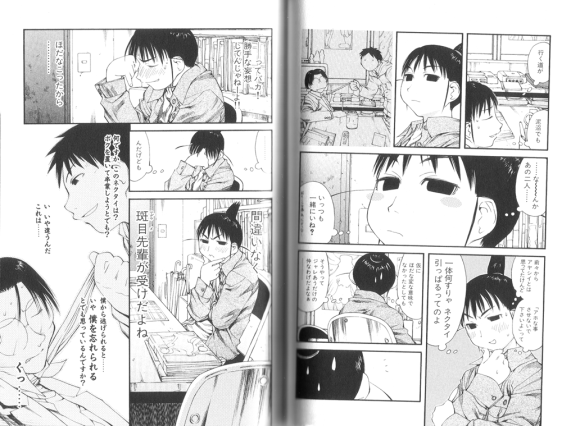
Volume 6 of Genshiken is probably my favorite volume of manga ever. I think I’ve re-read it more than any other, so coming back to it for “Return to Genshiken” is almost like visiting an old friend.

At this point, it feels almost unnecessary to call it a transitional volume because it feels like every volume brings a major shift or two. This time, I’d say there are two especially significant events: the graduation of the old guard, and the first full dive into Ogiue’s head.

What is Return to Genshiken?

Genshiken is an influential manga about otaku, as well as my favorite manga ever and the inspiration for this blog, but it’s been many years since I’ve read the series. I intend to re-read Genshiken with the benefit of hindsight and see how much, if at all, my thoughts on the manga have changed.

Note that, unlike my chapter reviews for the second series, Genshiken Nidaime, I’m going to be looking at this volume by volume, using both English and Japanese versions of Genshiken! I’ll also be spoiling the entirety of Genshiken, both the first series and the sequel, so be warned.

Volume 6 Summary

Ogiue decides to try her hand at drawing a doujinshi for Comic Festival, but only after a series of wacky/traumatic mishaps. From cosplay to drawings of Sasahara and Madarame to getting caught red-handed with a bag full of doujinshi at ComiFes itself, Ogiue’s grudging acknowledgement of her fujoshi side is the very definition of reluctant. What’s more, Kasukabe thinks Ogiue has a twinkle in her eye for Sasahara, and refuses to believe otherwise.

Meanwhile, Keiko tries to get into Shiiou University despite years of neglecting her own education, Madarame has a nervous non-date with Kasukabe, and the classic trio of dudes finally graduate from college. Ohno feels a twinge of sorrow, but that’s eventually wiped away when she becomes the new president of Genshiken, with the hope of bringing about a true Society for the Study of Cosplay.

End of an Era, Dawn of a New Age

Madarame, Tanaka, and Kugayama are all classic images of otaku. Out-of-shape, awkward, and filled with trivia, they’re firmly in the camp of nerds who can never pass as “cool.” All three stick around to varying degrees for the rest of the first series and even in the sequel, but the fact that these “big children” are entering into the adult world is important for the tone of Genshiken. While all have made strides in previous volumes in different areas—girls, artistic progress, life in general—their graduation in hindsight feels like the moment when “more” might just be possible. They, and especially the younger members, are poised to break through the boundaries of the otaku identity, if only a little.

The buildup to graduation is filled with emotion. For example, when Madarame runs into Kasukabe chatting with friends on campus, a combination of his powerful crush on her and his general social awkwardness causes him to snub her. It’s such a painfully relatable scene, especially with how Kasukabe’s friendly “hello” gesture throws Madarame completely off guard. How could Kasukabe actually be that friendly? When did she even get that way? While re-reading Genshiken has helped me to see this change more readily, I recall it feeling almost out-of-nowhere the first time around.

Another moment comes from Ohno, who has a cloud of melancholy hanging overhead prior to the guys’ graduation. The reason is that, because she came back from abroad, she has to do an extra year at the university, and thus will graduate a year after Sasahara, Kasukabe, and Kohsaka. It’s a heartfelt moment where Ohno and Kasukabe grow even closer, albeit with Kasukabe promising to fulfill a cosplay request that she’ll eventually regret. What makes this moment hilarious in hindsight is that, as saddened as Ohno is here, she ends up delaying her graduation multiple times throughout Nidaime because she just doesn’t want to face adult society. Like Kasukabe, Ohno changes quite a bit over the course of Genshiken, sometimes so gradually that it’s notice. That doesn’t apply here, though, as Volume 6 is also when Ohno agrees to become the new Genshiken president so that she can shape it in her own cosplay-loving image. Later in Volume 9, Ohno even makes a comment that her character appears to have changed at some point, referencing her transformation from meek token girl otaku to confident motherly type.

Ogius Maximus

This volume is chock full of premium Ogiue content. It’s a constant barrage of scowls, dreams created and destroyed, misunderstandings, and burgeoning romance. What’s especially telling about Ogiue’s prominence is that we’re privy to her inner thoughts to a degree only a few other prominent characters share, such as Sasahara and Madarame. She has a brief moment in Volume 5, but this time it’s entire extended internal monologues that lay bare the true Ogiue lurking within.
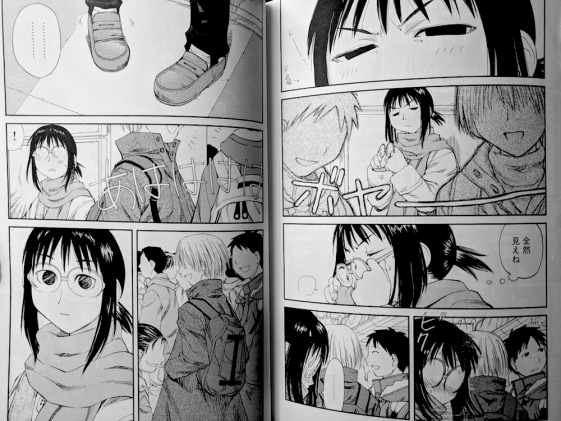
  We have Ogiue going to Comic Festival incognito, i.e. half a chapter devoted to showcasing Ogiue’s mix of anger towards others, anger at herself, and the sense that she just really want friends but is her own worst enemy. As she stomps through Tokyo Big Sight in her winter coat and high school-era glasses, a snarly pout adorning her face, you can see her giving into her basest desires, mirroring Sasahara’s first voyage to ComiFes (though this is certainly not Ogiue’s first rodeo). When Ogiue’s hovering around the rest of the club, the lonely look she gives as they laugh over in the distance is almost heartbreaking. The subsequent silliness of her bumping into Ohno and having her doujinshi spill out of her bag for all the world to see is dramady at its finest. In other words, Genshiken.

The breakdown of Ogiue’s defenses is a recurring theme in this volume, seen not only in her ComiFes disaster but also in her very first cosplay. Kasukabe, having noticed that Ogiue’s a little weak to pressure, uses this opportunity to try and get Ogiue to open up. Ogiue dressed as Renko from Kujibiki Unbalance is probably her most iconic moment. Not only has it been replicated on multiple occasions across various anime adaptations and decorative covers, but it’s the subject of Ogiue’s only full PVC figure (which I own, yes).

Sasa x Ogi Continues

In Volume 5, there’s a moment that I believe is the subtle beginning of Ogiue’s obsession with Sasahara x Madarame, and by extension the catalyst for her eventually falling for Sasahara. In Volume 6, Kasukabe’s actions nudge it towards greater prominence.

In one of the doujinshi planning scenes, Haraguchi reveals that he’s already made plans for Genshiken’s book (he wants to turn it into a big seller by bringing on a ton of high-profile guest artists). Sasahara keeps trying to politely refuse Haraguchi’s “kindness,” as his tendency as a non-confrontational person. However, as Haraguchi keeps pushing and pushing, eventually Sasahara’s expression grows stern (similar to how he reacts to his own sister). He puts his proverbial foot down, saying, “I will personally call all the guest artists you brought on board (without my consent) and turn them down.”

It’s potentially easy to miss, but immediately afterwards there’s a small panel with an Ogiue closeup, and she has the ever-so-slightest blush on her face. Without later context, it can just seem like she’s surprised or shocked at Sasahara’s change of behavior, but now it’s clear to me that this was the catalyst for her perception of Sasahara as a a “seme” character, and also her eventual attraction to him.

Back when I first read Genshiken, I was actually mildly skeptical towards the idea that Ogiue was interested in Sasahara just because Kasukabe said so. Both on a personal level and as a consumer of fiction, I’d groan at these situations. Just because someone looks at someone else once or twice didn’t mean romance is in the air!

Those situations still get overblown in my opinion, but as I’ve re-read Genshiken, it’s clear to me that the hints were there. It’s not that Ogiue is madly in love with Sasahara from the start, but that she begins to notice his finer qualities, and this grows into something more. This, I believe, is what Kasukabe truly notices, even if she misinterprets Ogiue’s drawing of Sasahara as aggressive top as a more typical from of affection.

Kasukabe really is the “matchmaker” of Genshiken, or maybe she just loves goading potential/existing couples. Whether it’s grilling Tanaka and Ohno, or it’s getting Madarame to quit waffling and pick a girl, her thrill at seeing her nerd friends get somewhere is actually one of Kasukabe’s most charming qualities.

The Ogiue Maniax Moment

The top image in this post is probably favorite Ogiue scene ever. It’s where my original banner came from, and I’ve used it in posts such as “Explaining Decompression in Comics.” As Ogiue thinks about the logistics of a Sasahara x Madarame relationship, her mind wanders down deeper and darker rabbit holes. She tries to pull herself away, but she can’t. In an entire volume where page after page of Ogiue’s piercing eyes is like manna from heaven, this is like the main course.

Keiko Shows Substance

Ogiue and Keiko meet for the first time in this volume, and it’s hilarious to see how antagonistic they were at the time. Keiko softens up to everyone over time, even her older brother, but there’s just a certain pleasure I derive from seeing Keiko eventually call Ogiue “onee-chan.” She’s marrying her brother and Ogiue in her head before everyone else. But I’m getting ahead of myself.

Volume 6 is probably almost as big a deal for Keiko fans as it is for Ogiue fans; it’s when Keiko really begins to turn a new leaf. Even if we learn in the next volume that her attempts to get into Shiiou University are fruitless, and that she quits college entirely by Nidaime, she’s genuinely trying to be more than just a dumb, shallow girl. I get the feeling a lot of Keiko lovers wouldn’t be so keen on her if she had never changed, but that’s the magic of Genshiken.

Mebaetame Amateur Figure Hour

Starting this volume of Genshiken, the between-chapters extras get creative. This time around, it’s Tanaka’s blog where he shows off his design and construction of a figure from Kujibiki Unbalance. The most amazing thing about this is that it’s made using real photographs of an actual constructed figure. This then later factors into the end-of-volume special, when Tanaka accidentally drops the figure and breaks it. Someone actually built it for real, and I don’t think we’ll ever know if it was Kio himself, an assistant, or an acquaintance. Did he actually break his own constructed figure for the sake of a gag, or was there a stunt double?

Final Random Thoughts

This is the last we see of Kitagawa, the Club Council vice president. She ends up marrying her senpai. I kind of wish we saw where she was in Nidaime, but she was always a pretty minor character. On a personal note, I knew a guy who really liked Kitagawa, but he passed away a few years ago. Rest in Peace, Cortana.

At graduation, someone is reading the end of Part 1 of the Kujibiki Unbalance manga. The pages shown are meant to be an indication of how far the story has gone, as characters portrayed as enemies earlier in the series are now getting married.
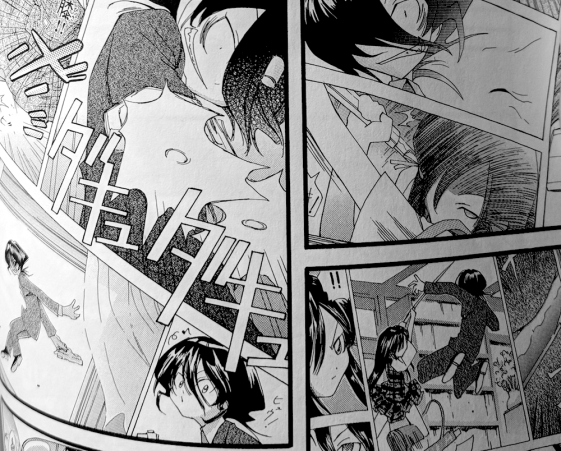
Kujibiki Unbalance in Volume 3
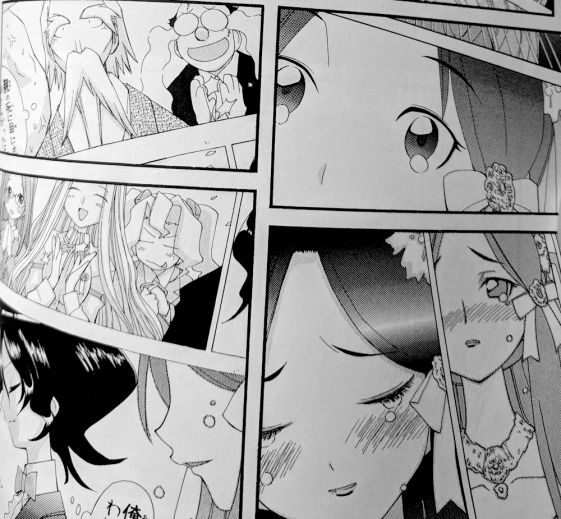
Kujibiki Unbalance in Volume 6

The end-of-volume special also features the crew hanging out post-graduation, and in one instance Sasahara and Madarame are checking the girls out. I like that there’s pretending that they don’t notice how attractive their clubmates are, though obviously they don’t say anything out loud. What sticks out to me here is Sasahara getting a little hot and bothered by Ogiue in a skirt. With Kasukabe, who’s dressed to kill in a short skirt and pantyhose, it feels like he’s seeing her as just “an attractive lady.” But with Ogiue, she’s wearing a pretty subdued outfit and a pretty long skirt. I’d like to think it’s that spice of beginning to actually have feelings for another, which turns even plain clothes into thrilling adventures in fantasy. In Volume 7, Sasahara really lets his imagination run wild, but that’s for next time.

Aikatsu Stars! and Nikaido Yuzu, the Ultimate Kouhai/Senpai

At first glance, Nikaido Yuzu in Aikatsu Stars! is not an especially unique character. She’s an energetic, bubbly character in a show filled with energetic and bubbly characters, in a genre (idol anime) conducive to energetic and bubbly characters. One or way or another, however, she comes to stand out over time, especially with the slight shift in her role between seasons from kouhai to senpai.

I previously wrote a little about how the heroine of Aikatsu Stars!, Nijino Yume, undergoes a similar transition. At the start of the series, Yume’s the new girl aiming for the top. By the time Season 2 rolls around, Yume’s at the apex as a member of the elite idol group S4. In contrast, Yuzu starts off already a part of S4, going from the youngest member to the oldest between seasons. But unlike Yume, who has to get used to being looked up to, Yuzu’s personality and approach to life transitions almost seamlessly.

To the former members of S4 who graduate, Yuzu is a bundle of youthful enthusiasm. But to the younger members of S4 who come in after her, Yuzu is an eccentric wise man of sorts, her decisions seemingly bizarre but ultimately with some underlying purpose or reasoning—even if Yuzu herself doesn’t quite know what that is herself. This balance is on display in episode 67 of Aikatsu Stars!, when Yuzu sets up an elaborate treasure hunt on Aikatsu Island.

Yuzu tells the participants, many of whom are her underclassmen, to find a treasure that’s so well hidden that even she can’t remember its true location. As one hint after another comes up to help the hunters along, there’s a certain sense that they’re not just clues, but philosophical ideas about what it means to live. In a twist straight out of “The Purloined Letter,” the actual treasure is revealed to have been disguised as an overly obvious giant treasure box-shaped prop at the very beginning, and the treasure within is…friends. Literally. Out of the enormous box comes the three former members of S4. In that moment, between S4 girls new and old, Yuzu is simultaneously the wide-eyed “kid” and the experienced “adult,” so to speak.

Compare this to Yazawa Nico from Love Live!, a character known for being older but acting younger. Nico’s cutesy behavior is meant to contradict the fact that she’s a third-year in high school, and lets her act as a foil to the young-but-mature Nishikino Maki. Yuzu, on the other hand, isn’t really a “contradiction”; she just “is.” Her actions and behavior fit, whether she’s dispensing advice or giving it, because they reflect a generally positive approach to life that’s all about excitement without being beholden to “newness.”

Aikatsu Stars! is generally a fairly lighthearted show bordering on the wacky, and Yuzu fits well within that universe. Energetic and bubbly she may be, but those are surface qualities that open up to a sense of loyalty and adventure, rendering her a unique figure. She’s the kind of character who could thrive in any degree of prominence, whether main, side, or even background figure.

This post was sponsored by Johnny Trovato. If you’re interested in submitting topics for the blog, or just like my writing and want to support Ogiue Maniax, check out my Patreon.

Ukiyo-e and the Concept of Anime Sameface

One of the common criticisms of character designs in anime and manga is that characters often have the same face with variations in hair, clothing, and accessories to set them apart. This is viewed sometimes as lazy, or a sign of a lack of skill or talent, in other words a crutch in lieu of true character proficiency. However, in a number of instances it can be argued that “samefaces” aren’t the same at all, that subtle variations such as the angle of the eyes can suggest enormous differences between two characters.

While sameface certainly isn’t absent outside of Japanese pop culture, I’ve begun to wonder if Japan’s own art history has contributed to not only its presence but also its acceptance. I’ve taken a cursory look at ukiyo-e recently, and one thing that strikes me is that portrayals of both men and women, especially attractive individuals, tend to use very similar kinds of faces, with greater attention paid to—you guessed it—hair, clothing, and accessories.

I’m well aware that there’s a tendency to try and force a connection between ukiyo-e and manga, and I don’t intend to go that route. Stylistically, the two are very different, even if ukiyo-e is a kind of predecessor in terms of being a popular, mass-produced art that emphasized reveling in momentary pleasures. Hokusai manga doesn’t really have anything to do with manga, and the panel progression of manga isn’t really present in ukiyo-e. Also, there is actually quite enormous variation in the depictions of people in both ukiyo-e and manga when you look at the broader picture. That being said, in terms of character design and the priorities present in ukiyo-e I suspect that there’s some lineage at work that seeps into manga on some level.

Utamaro_(1793)_Three_Beauties_of_the_Present_Time.jpegUtamaro (1793): Three Beauties of the Present Time

What stands out to me about portrayals of women in ukiyo-e is the amount of attention paid to the hair. While the faces remain absolutely unrealistic (much like manga and anime but in the opposite direction in terms of proportions and what is aesthetically appealing), women’s hair in ukiyo-e prints are frequently rendered with such loving detail to the point of being in some ways hyper-realistic. Similarly, kimono are given bold colors and patterns, and so at first glance what distinguishes two women is everything but their faces.

There are a couple of other things that crop up when reading about ukiyo-e that wouldn’t sound out of place if the discussion were anime or manga. First, while many women in ukiyo-e were portrayed similarly, what was considered the image of the “ideal woman” changed as the years passed by. Second, small variations in facial features and expressions could mean all the difference between a “stereotypical” design and a “realistic” one.

How does this relate to an idea such as kyara moe, where characters’ stories are told almost entirely in how they look and through collectively accepted meanings behind visual elements? When looking at a series like Love Live!, it can seem to an outsider like the girls are just the same template, but those unique features relative to each other make a world of difference.

Of course, all of this is a very preliminary impression. Feel free to prove me ignorant in the comments!


The Dilemma of Casting an Esports Grand Finals

No matter the game, whenever an esports grand finals rolls around, there’s contention as to the best approach for commentary. What is the best style of casting for the later stages of a tournament, when the audience tends to be the largest and the matches themselves tend to be the most high-level?

I don’t think there’s one true answer, because it really depends on the objective of a given tournament. Rather, I want to highlight to the esports-viewing audience what makes this such a difficult balancing act, and why commentary that does not cater to their own tastes is not necessarily bad or inferior.

The Top 8 and above matches of tournaments tend to get the highest amount of viewers. This means there are more non-experts watching. They might still be fans, but there’s a good chance that they’re not going to know the nitty gritty of the game. Things that a more experienced player and ardent viewer might recognize with little effort might fly completely over their heads. In this case, one sensible solution would be to cater to a relatively more casual audience. You might have to explain some of the more complex aspects of the game, or perhaps ignore or simplify them so that these viewers aren’t overwhelmed with information they can’t understand.

However, those final matches are also typically where the highest amount of skill is displayed between competitors. While earlier rounds might be filled with one-sided victories or lesser players making mistakes, by the time it hits grand finals there is a strong chance that the play will be on another level. If the accompanying commentary aims more for the larger, more casual part of the audience, it potentially alienates the more hardcore fans who want to know the small details. If a tournament wants to show the full depth of their game, it might be necessary for commentary to be more complex and high-level.

If going by a pure numbers game, the “obvious” solution is to aim for the larger, more casual audience, but there are a few monkey wrenches that need to be taken into account. The casual-hardcore dichotomy can be rather nebulous. Some fans who are casual might want to feel like they’re part of the hardcore audience, and the best way to give them that impression is through commentary. A “true expert” at a game probably does not need a commentator to tell them what’s going on, so they might find technical explanations tedious for the opposite reason that the casual viewer might dislike them. In that case, the dry delivery of top-level knowledge of a player like Mew2King can be more appealing, especially to fans of those players.

Depending on the game, there might be no such thing as a “casual fan.” After all, esports has a general issue with not being as obvious in terms of goals and objectives as traditional sports—compare looking at the score in basketball vs. trying to interpret who’s ahead in League of Legends without having any prior knowledge of either.

Professionalism is another factor. As esports scenes grow, a lack of professionalism might drive away new viewers, but at the same time a slick, polished product might come across as too sterile to maintain interest. Suffice it to say, different people want different things from commentary. There are so many conflicting values that some tournaments have even tried having alternative streams to cater to casual audiences, but that potentially leads to an inconsistent presentation for a tournament.

Any tournament, big or small, wants to put its best foot forward. The problem with reconciling all of these different factors is that no one commentary can possibly cover them all, not even a team where each commentator specializes in something different. Some consider play-by-play to be the most important. Others believe that emphasizing the human drama between the players is key. Others want deep analysis of every situation. Ultimately, it requires some sort of compromise, and I think it’s important to see it not as a concession or a loss of quality. Criticism of commentary is justified and should even be encouraged, but it should come with the awareness that one’s own perspective exists among many.

Spirit vs. Letter in Social Media Harassment Policies

Social media platforms have been under fire by critics recently due to the way they’ve let radical groups take advantage of their platforms to attack and discredit others. People on Twitter are harassed, receiving death threats and worse, yet their harassers remain unbanned. Facebook has suffered from the inundation of fake news created by Russian propagandists, as well as racist advertising using their own ad system. A recent article by Sarah Wachter-Boettcher, titled “Facebook treats its ethical failures like software bugs, and that’s why they keep happening,” argues that Facebooks’s approach lacks a true human dimension, and fails to account for the subtle and nuanced ways that people end up using social media. In other words, using a wack-a-mole method to deal with this ignores, unintentionally or otherwise, the underlying issue of people being attacked online.

I concur with this sentiment, but would like to add something. It’s not just that treating problems like racist ad targeting as bugs or glitches is the wrong way to go, but that trying to govern social media platforms with hard and fast rules creates a rigid system that inevitably lends itself to loopholes that can be exploited.

I recently had a few discussions with friends and acquaintances, all programmers and software engineers. In one discussion, I had a small debate with a friend, who argued that laws should not be open to interpretation—what says, goes, ideally. Having “wiggle room” makes things messy. In another, the subject of self-driving cars came up. Among many of the programmers (but not all, mind), there was a shared stance that giving humans more control than self-driving cars would be to open up the efficient and organized traffic of the future to the unpredictable and poor decision-making of the average driver. Additionally, any problems that occur due to the incompleteness of the self-driving AI could be solved after they arise.

I don’t mean to stereotype programmers as all having a certain way of thinking or a certain set of beliefs (you’ll find them on all sides of the political spectrum, for example), but there’s a certain desire for the human-created mechanics of the world to make consistent, logical sense that I find common to programmers—i.e. the main people driving social media platforms such as Facebook and Twitter behind the scenes. A faith (or perhaps desire) in these systems, and the idea that they can just increase the granularity of their rules, instead of trying to take a more humanistic direction, leads to holes that can be exploited.

No matter what parameters Twitter puts in for defining harassment, people will always find ways to attack others without “technically” breaking the rules. This, I believe, is the reason so many people appear to be unjustly banned while other accounts that spew hate and encourage online attacks can manage to stay active. One side is likely ignorant of rules X, Y, and Z, while the other deftly skirts them. Intent, something that requires a closer analysis, is left by the wayside.

Krang T. Nelson, a Twitter user named after a certain cartoon warlord from Dimension X, recently tested these limits. In a Vice article, Nelson describes how he decided to troll white supremacists by crafting the most intentionally absurd tweet possible, about “antifa supersoldiers” planning on beheading white parents and small business owners. Not only was it a clearly tongue-in-cheek call-out of alt-right talking points, it was also loaded with buzzwords that white nationalists actively look for. Nelson then discusses how the white nationalist movement understands the ways to take advantage of Twitter’s policies, and that they used this knowledge to get him (temporarily) banned over a facetious remark. Here, we see clear evidence that the groups known for Twitter harassment also know how to exploit its technicalities and parameters for their own ends.

Adhering to the letter and not the spirit of policies and laws is what fuels the abuse of online social platforms. Having actual people at all levels checking to see how Twitter, Facebook, etc. are being used, and relying not on hard and fast rules, is where things need to change. Granted, having “wiggle room” in rules means they can be exploited in a different way, but overly strict interpretations are also clearly not working.