Love Live! and the Four Tendencies

I recently read The Four Tendencies by Gretchen Rubin, a self-help book about how to better understand certain facets of oneself and others. While it’s been helpful in my personal life, I also noticed that it can be an informative way to understand characters and character interactions in fiction. Often, characters are designed relative or in contrast to those around them, and seeing how they respond to each others’ expectations can shed a lot of light on those dynamics. For this blog post, I decided to take a look at how the four tendencies can apply to to the cast of the original Love Live! School Idol Project.

An explanation of the four tendencies can be found on Rubin’s blog:

In a nutshell, it distinguishes how people tend to respond to expectations: outer expectations (a deadline, a “request” from a sweetheart) and inner expectations (write a novel in your free time, keep a New Year’s resolution)…

  • Upholders respond readily to outer and inner expectations (I’m an Upholder, 100%)

  • Questioners question all expectations; they’ll meet an expectation if they think it makes sense–essentially, they make all expectations into inner expectations

  • Obligers meet outer expectations, but struggle to meet expectations they impose on themselves

  • Rebels resist all expectations, outer and inner alike

So let’s take a look at the girls of μ’s!

First-Years

Hanayo is a questioner. At first, she seems like an obliger because she’d been unable to fulfill her childhood wish to become a school idol, but that’s more because she was convinced she couldn’t. Once persuaded, she fully embraces the idea. Same goes for taking over as president of the school idol club. When she does have a strong stance, such as rice being the best food in the universe, Hanayo is stalwart.

Rin is an obliger. Her main reason for becoming a school idol is to help Hanayo; otherwise, she’s relatively undisciplined if left to her own devices. She believed for most of her life that she couldn’t/shouldn’t wear skirts and dresses, but that’s more because she projected the standards of others onto herself. Only when the other μ’s girls give her new expectations to fulfill—that she can wear them and that she is beautiful—does she change her mind.

Maki is a questioner, and not just because her signature catch phrase is “What the heck?! You’re not making sense.” Left alone, Maki is extremely self-motivated and fulfills inner expectations easily—as seen in her goal of studying medicine, and when she writes a song for μ’s prior to joining. However, she won’t do anything she doesn’t think is off-base. Of course, sometimes that logic is “this would benefit Santa Claus”…

Second-Years

Honoka is a rebel. While it might seem unusual for the team leader to be the rebellious type, it’s clear that Honoka’s inner fire only blazes when something truly interests her, especially if others think she can’t do it. Her starting a school idol group is in itself the product of defying outer expectations. At the same time, she completely shirks both inward rigor if left to her own devices unless, again, it’s something she cares about from deep within.

Umi is a textbook upholder through and through. If her unmatched self-discipline and desire to ensure everything goes right wasn’t enough evidence, her love of schedules, regimens, and pie charts guarantee that she can’t be any other tendency. Her fear of having carefully laid plans go awry also points in this direction.

Kotori is an obliger. Considerate and prone to indecision, she’s at her best when supporting Honoka and Umi’s decisions. Even her costume-making seems motivated more by the positive expectations of others. Her alter ego, the legendary Akiba maid Minalinsky, is the result of her trying to work on her confidence—by being in a customer service job where she has to project strength and ease.

Third-Years

Nico is a rebel. She does what she wants, when she wants, unless she decides for herself that something is the right choice. She might seem like a questioner based on how much she researches proper idol etiquette, but it’s clear that she lives and dies even more by her passion. Before μ’s, she was always fully convinced she could be a school idol; it’s just that her drive and desire to actually keep it up was sapped by the resignation of her old partners. When μ’s calls her in to join them, she quickly falls back into her self-proclaimed role of “super idol.”

Eli is an upholder. Whether in μ’s or the student council, she still shows a strong sense of responsibility to both herself and those who need her. Mature and strong-willed, Eli will get everything done that she can, but on her terms. Eli also definitely isn’t a people pleaser, and believes in tough love as only a former Russian ballerina can—as seen when she first confronts the rest of the girls with what it means to truly be able to dance.

Nozomi is an obliger. On the surface, she looks like more like a rebel, but her backstory reveals that she values friendship above all else. Nozomi can be aloof because she’s suppporting Eli, and to a lesser extent the rest of the girls. In fact, Nozomi explains that seeing Eli essentially refuse to show any weakness is what drew her to befriending and helping Eli.

Overall

Doing this exercise made me realize are some of the vital distinctions between characters and how they behave. For example, while RIn might be seen as generally stronger than Hanayo due to her energy and fun-loving personality, you can see how their different responses to both outer and inner expectations shows that they complement each other in important ways. Of course, fiction doesn’t wholly map onto reality, and the four tendencies framework isn’t exactly a rigorous scientific study, so it’s not like these interpretations are set in stone. If you think certain characters better fit different tendencies than I’ve categorized, I’d love to see you responses!

A Look at Precure Popularity

I’ve been looking at various Precure polls lately, in part due to a desire to see how a franchise that’s 15 years old is remembered. The polls I consulted were Japanese character rankings from 2015, 2016, and 2017 as compiled by user insight_led, as well as a more recent one from the Japanese-language anime news site Anime! Anime! Being a decade and a half old means opinions can change over time (or according to the age of the voters), which is what I normally would expect, but there are some surprises.

Character Popularity

Looking at the Naver rankings, here are the top 10 characters from each year, along with the tallies each one accrued, based on comments on social networking sites like Twitter and Facebook. Also, kids were not included in the votes; if that core audience was allowed to vote, there’d likely be a significant difference.

2015 (Go! Princess Precure airs)

  1. Cure Beauty (1,541)
  2. Cure Marine (1,224)
  3. Cure Passion (1,107)
  4. Cure Twinkle (750)
  5. Cure Pine (624)
  6. Cure Happy (580)
  7. Cure Ace (575)
  8. Cure Lovely (489)
  9. Cure Peace (440)
  10. Cure Heart (432)

2016 (Maho Girls Precure airs)

  1. Cure Beauty (20,041)
  2. Cure Happy (15,580)
  3. Cure Marine (12,824)
  4. Cure Peace (12,682)
  5. Cure Passion (8,107)
  6. Cure Twinkle (7,750)
  7. Cure Heart (7,432)
  8. Cure Lovely (6,999)
  9. Cure Scarlet (6,890)
  10. Cure Miracle (6,619)

2017 (Kira Kira Precure a la Mode airs)

  1. Cure Happy (12,450)
  2. Cure Beauty (11,394)
  3. Cure Marine (8,924)
  4. Cure Peace (8,804)
  5. Cure Passion (6,409)
  6. Cure Flora (6,102)
  7. Cure Lovely (5,877)
  8. Cure Heart (5,322)
  9. Cure Blossom (5,285)
  10. Cure Chocolat (5,180)

Based on these three rankings, what surprises me is how little recency bias actually seems to influence results. Cure Beauty and Cure Marine are consistently top 3, even as the total counts fluctuate. There appears to be something enduring about both of those characters, which is all the more interesting because they’re 1) in unrelated series 2) almost polar opposites in personality.

For Cure Beauty, the reasons generally given for her popularity are that she’s an ideal combination of strength, intelligence, and beauty. Out of all Precures, Beauty most closely matches the yamato nadeshiko (traditional ideal Japanese woman) in both looks and demeanor, so I wonder how much that’s a factor.

When it comes to Cure Marine, however, the queen of comedic intensity defies expectations for why fans come to love Precure characters in the first place. As mentioned in those rankings, while pretty every other character generally gets comments like “I want to be her” and “I want to be with her,” Marine’s are mostly “I wish she were my best friend.” Seeing as Marine is my favorite Precure character, I’d like to think the Japanese fans also just have incredibly good taste.

Show Popularity

According to the Anime! Anime! poll, the top 3 most beloved Precure series are as follows:

  1. Go! Princess Precure
  2. Futari wa Pretty Cure
  3. Heartcatch Precure!
  4. Kira Kira Precure a la Mode
  5. Smile Precure!
  6. Maho Girls Precure!
  7. Fresh Pretty Cure!!
  8. Yes! Pretty Cure 5 Go Go!
  9. Yes! Pretty Cure 5
  10. Futari wa Precure Max Heart
  11. DokiDoki! Precure
  12. Suite Precure
  13. Futari wa Pretty Cure Splash Star
  14. Happiness Charge Precure!

It should be noted that given the purpose of the site, the general audience for Anime! Anime! would skew towards older and more interested in anime as an industry. One goes there to read essays about and interviews with creators, as well as following general anime news. That’s why I think it’s no coincidence that the most popular iterations of Precure are 1) the original pioneer 2) the series with (in my opinion) the strongest narratives and overall messages. What I’m more surprised about is how well this top 3 aligns with my personal tastes. I consider Heartcatch and Go! Princess to be #1 and #2, respectively, and the unrefined, yet innovative quality of the first Pretty Cure to be a big part of its charm.

While the character rankings and the series rankings are from two different sources, I find it remarkable that character popularity and series popularity don’t really line up. Based on my personal experience, this isn’t a complete shock, but I think it really goes to show that memorable characters can exist almost apart from their sources. Cure Heart is a top 10 (out of 51) character, but Doki Doki! Precure is a bottom 5 (out of 14) show, according to the above sources. It’s also interestingt to me that Cure Marine comes out ahead here. She’s considered a top 3 character, and Heartcatch Precure! is seen as a top 3 show.

Go! Princess Precure is considered the best Precure anime, but interestingly enough, it also has among the worst toy sales out of the entire franchise.

Go! Princess Precure is third from bottom

One might assume that a greater focus on quality storytelling might conflict with how one of the purposes of Precure is to sell toys, but this is not necessarily the case. According to the chart above, the most successful Precure in terms of merchandise sales is actually Heartcatch Precure! There’s perhaps a challenge in being able to achieve high marks in both, but it’s not impossible. The fact that one doesn’t seem to have any bearing on the other is simultaneously reassuring and daunting.

Conclusion (or lack thereof)

I’m not a statistician and I don’t pretend to be. I’m also unsure if there are any truths deeper than what I observed, like how Cure Marine is the Nintendo Switch of Precure (doesn’t compete directly with other Precures and is the better for it), and that toy sales and show quality almost exist on separate planes.

So in closing, Heartcatch Precure! and Cure Marine are the best. Fight me.

Liked what you read? Why not take a look at my Patreon or Ko-fi?


Aikatsu! and Idol Franchise “Experiences”

As Aikatsu Friends! inches ever closer, I find myself thinking about the longevity of Aikatsu! as a franchise. By this October, it’ll be a whopping six years old—a lifetime when it comes to children’s anime. Where other similar series have tried to compete, few have managed to hang on as Aikatsu! has. One of its closest competitors, Pretty Rhythm, eventually pivoted towards the male-idol-centric King of Prism series. Either by outlasting or outmaneuvering other idol series, Aikatsu! feels as if it’s conquered its own niche—though the exact nature of that niche is what I’m trying to figure out.

There are, of course, key differences between Aikatsu! and other idol character franchises. Series like King of Prism and Idolish 7 utilize male idols in a desire to capture a different market. Love Live! and The iDOLM@STER feel like they skew older. Macross Delta and Symphogear have idols as thematic flourishes as part of a greater science-fiction story. They cover various demographics, as well as various degrees of idol presence. Yet I feel there’s another element of difference that isn’t accounted for, as if Aikatsu! and Love Live! occupy different compartments of mental space, at least personally.

While this is only a tentative thought exercise for the sake of categorization, if I had to describe that difference it would be as the following: With Love Live! or The iDOLM@STER, I’m most interested in how the idols will react, but with Aikatsu! I’m most interested in the actions they’ll take. The way I phrased it makes it seem as if it’s a contrast between more passive characters and more active ones, but that’s not quite right. Instead, it’s more that the girls of Love Live! seem to draw their appeal from the way they behave and influence each other, while the girls in Aikatsu! feel as if they influence the environment around them.

Perhaps the reason I see Aikatsu! different is because of the fans and how they express their love for the series on social media compared to other idol anime lovers. Other series appear to celebrate cuteness and style. Fans of Aikatsu! revel in an aura of power and excitement. At the heart of this fan output remains the indelible images of Ichigo, that very first Aikatsu! heroine, as she climbs those cliffs and wields that axe. It’s as if Ichigo and her successors reshape and navigate the land while other idols move through it.

This post was sponsored by Johnny Trovato. If you’re interested in submitting topics for the blog, or just like my writing and want to support Ogiue Maniax, check out my Patreon.

Black Panther and Anti-Colonialism

In my view, Black Panther might very well be the best Marvel film ever—a stance the majority of moviegoers seem to agree with, given its astounding critical and commercial success. The movie’s strengths are many. It’s a compelling story about two black men on opposite sides who both want what’s best for their people. Its diverse range of characters and its lush environments work to portray its setting as a living, breathing, and evolving entity. Black Panther celebrates black identity while pointing to the injustices of history and the daunting challenge of fighting to change things. But one point that sticks out to me in particular is the way it holds a mirror up to reflect our ugly assumptions on the effects of colonialism in the world.

These days, I think the majority of people have been taught that colonialism was responsible for a lot of harm in the world. Whether it was the slave trade, the subjugation of subordination of entire peoples, or just the exploitation of resources, European nations forcing other cultures to conform to their “superior” standards left scars around the world. At the same time, the general narrative states that, while these were certainly problems, there were ultimately many positives to the whole endeavor. Technology progressed, especially with the industrial revolution. Cultural exchange became commonplace (albeit in a lopsided manner). Europe, i.e. white people, gave the world much, and we’re supposed to believe that it was for the best.

Black Panther calls out that notion of Europe being the birthplace of modern technology somehow justifying its conquering ways. The film is set primarily in Wakanda, an old African nation founded on a near-endless supplies of the miracle metal known as “vibranium.” Because of this advantage, Wakanda developed isolated from the rest of the world while also advancing science and technology to the point of surpassing every other country on Earth. In other words, Wakanda is an African nation entirely without white influence. The image of the “native” or the poor African villager who wears donated t-shirts and jeans does not exist here, as that is founded on the persistent idea that European influence removed the “savagery” of Africa, that African cultural markers are backwards and embraced merely out of inertia or personal history.

Instead, Wakanda is a place where technology and tradition walk hand in hand. So when characters are dressed in non-Western clothing surrounded by soaring skyscrapers unlike any other, it is not presented as some kind of incongruous image. When T’Challa the Black Panther engages in ritual combat for the throne the day after he got off his cloaked airship, it feels completely natural. Moreover, because Wakanda has never tried to conquer or control other nations, this means its growth and development did not come from pillaging other cultures. Black Panther and its portrayal of Wakanda run counter to the narrative that what colonialism did was perhaps necessary for us to get to a better world. While not without its own problems (and in fact its isolationist policies are a major plot point in the film), it gives people of all races and histories the opportunity to look an alternative world and to imagine a better tomorrow.

Wakanda, vibranium, and the Black Panther might all be fictional, but they have the power to inspire thought and action. Could we ever reach a place where the world progresses without the seeming need to exploit others? The only way to find out is to try and make it happen.

Movie Madness: Ogiue Maniax Status Update for March 2018

Is it possible to see too many movies in a single month? It looks like I’ll be testing that out. Not only is it the start of the 2018 New York International Children’s Film Festival, but we’ve got the recently released Black Panther along with Pacific Rim: Uprising, Isle of Dogs, and A Wrinkle in Time. I’m a bit concerned about the sheer quantity overwhelming my ability to engage with each movie, but we’ll see how it pans out.

As a general rule, disengage before you start to feel yourself burning out. This applies to not just anime or entertainment, but even work. Managing your health mentally, emotionally, and physically to the best of your abilities!

In other news, I’ve started a Ko-fi page for Ogiue Maniax. It’s basically an online tip jar, ideal for those who want to support Ogiue Maniax now and then, but either won’t or can’t commit to a Patreon sponsorship.

So from now on, my monthly list of supporters will include both those from Patreon and from Ko-fi.

General:

Johnny Trovato

Ko Ransom

Alex

Diogo Prado

MagiGold

Sue Hopkins fans:

Serxeid

Hato Kenjirou fans:

Elizabeth

Yajima Mirei fans:

Machi-Kurada

My favorite posts from February:

“I Go High, You Go Low”: Hashikko Ensemble

Kio Shimoku’s new manga! Expect to see this every month for the foreseeable future.

Join the Bakery: Kira Kira Precure a la Mode

Another Precure series concludes. How does this one stack up to its predecessors?

The Legacy of a Knight. Mazinger Z: Infinity

The 2018 sequel/revival of history’s most important super robot. A must-see for giant robot fans.


Patreon-Sponsored

The Unreality of Virtual Youtubers

Thoughts on the success spawned by Kizuna A.I. and those who followed her.

Closing

Watch A Place Further than the Universe. It’s not just “girls doing something,” it’s “girls getting something done.”

The Unreality of Virtual Youtubers

If you haven’t heard of virtual youtubers, they’re a recent phenomenon that might be the ultimate intersection between anime fandom’s love of cute girls and the ever-rising prominence and allure of youtuber as identity/occupation in Japan. Virtual youtubers are quite similar to regular old youtubers in that they’re online video hosts who use charismatic and often energetic performances to entertain fans, but their difference is most easily understood by watching:

While a number of the virtual youtubers out there play up the idea that they’re robots, AI, or some kind of existence outside of normal reality, one thing I find noteworthy is that they don’t have quite the same sense of appeal through artificiality as a Vocaloid. Hatsune Miku and Megurine Luka don’t sound like anything like a normal human being, but that is precisely what makes them memorable.

With virtual youtubers, there’s still a very human component behind the voice and video filters that you can feel come through to varying degrees; at the very least, there’s a sense of human-esque imperfection conveyed, as opposed to the uncanny valley of Vocaloids. Kizuna AI has a very smug, almost Yazawa Nico-like attitude that can come back to bite her in the ass. Kaguya Luna sounds like she’s always on edge, and the fact that she sounds like she’s being recorded in a garage hints at the reality behind her. Ojisan’s youtuber persona is a cute, small fox girl, but he doesn’t even try to hide his identity as an older man.

The conveying of “humanity” even comes across in small, subtle elements. You’ll see Kizuna AI videos featuring lots of clear cuts—a common style for youtubers, especially for the more bombastic types. At the same time, she constantly has this windswept appearance that doesn’t make sense (see her ribbon fluttering constantly!), but it makes her appear more active and lively.

Perhaps the biggest thing about the virtual youtuber concept is that it’s simply not meant to cater to the same audience as idols, virtual or otherwise. They can be good singers, but they don’t have to be. They convey a sense of closeness, but they inevitably keep a greater distance because the performative aspect of the virtual youtuber is more obvious. Toeing the line between natural and unnatural is part of why anime characters in general capture so much attention, and virtual youtubers also take advantage of this.

This post was sponsored by Johnny Trovato. If you’re interested in submitting topics for the blog, or just like my writing and want to support Ogiue Maniax, check out my Patreon.

Fan Fan Fine: Ogiue Maniax Status Update for February 2018

It’s February, also known in these parts as “new Precure time!” Satou Junichi (Ojamajo Doremi, Sailor Moon, Princess Tutu) helming the new Hugtto Precure! means I’m eagerly anticipating it, though I’m trying not to get my hopes too high up. As much as I love his shows, he’s not infallible or anything.

Whether you’re celebrating Valentine’s Day, the Lunar New Year, or some other holiday, I’d like to thank the following Patreon sponsors for their support.

General:

Johnny Trovato

Ko Ransom

Alex

Diogo Prado

Viga

Sue Hopkins fans:

Serxeid

Hato Kenjirou fans:

Elizabeth

Yajima Mirei fans:

Machi-Kurada

My favorite posts from January:

Down-Home Food Therapy: Atari no Kitchen!

A food manga I’ve been enjoying for a quite a while, I finally got around to writing about it!

A Strong Foundation: How the Japanese Smash 4 Tournament Format Helps the Community

A detailed look at what I believe are the underlying reasons behind Japan’s noted character diversity at high levels of competitive play.

“We’re Just Like You!”: The Empathy Scam of the Alt-Right

A post on a more serious topic: how the alt-right’s use of internet memes and subculture might act as false masks to lure in frustrated young men.

Return to Genshiken

Part 7 of my Genshiken re-read delves into the depictions of love and lust in my favorite manga.

Patreon-Sponsored

The Past and Future of Anime Blogging

I wax nostalgic about anime blogging but also how it’s positioned versus other mediums.

Closing

I’m high off of watching EVO Japan 2018 and seeing both Asuka and Shinsuke Nakamura win the Royal Rumbles. I’m also hyped for the new Kio Shimoku manga coming out this month.

May your February be as inspired.

Love and Lust. Return to Genshiken: Volume 7

Volume 7 is the point where Genshiken starts focusing much more heavily on Ogiue’s story, for better or worse (guess which side I’m on!). As the only character at this point who has a powerfully emotional backstory (though I wouldn’t have minded learning about the others in their younger days), it makes sense, even if it pulls the manga away from its more laid-back origins.

What is Return to Genshiken?

Genshiken is an influential manga about otaku, as well as my favorite manga ever and the inspiration for this blog, but it’s been many years since I’ve read the series. I intend to re-read Genshiken with the benefit of hindsight and see how much, if at all, my thoughts on the manga have changed.

Note that, unlike my chapter reviews for the second series, Genshiken Nidaime, I’m going to be looking at this volume by volume, using both English and Japanese versions! I’ll also be spoiling the entirety of Genshiken, both the first series and the sequel, so be warned.

Volume 7 Summary

It’s the dawn of a new age for Genshiken, as Ohno now leads the club. However, an awkward scene with Kuchiki drives away all prospective members, aside from Sasahara’s sister Keiko (who doesn’t even attend the school). This means the balance of the club has shifted to actually have more women than men.

Ogiue’s troubles are only beginning, as she finds out she’s been accepted for Comic Festival. Given her outward hatred of fujoshi, the idea that she’ll be putting out a BL doujinshi frightens her. However, thanks to a pep talk by Ohno, she begins to move forward, though Ohno also uses this as an opportunity to get Ogiue into some mildly skimpy cosplay. Sasahara sees this, and later begins to fantasize about Ogiue, and the other girls in the club (including Keiko!) pick up on the small, yet smoldering sparks between the two.

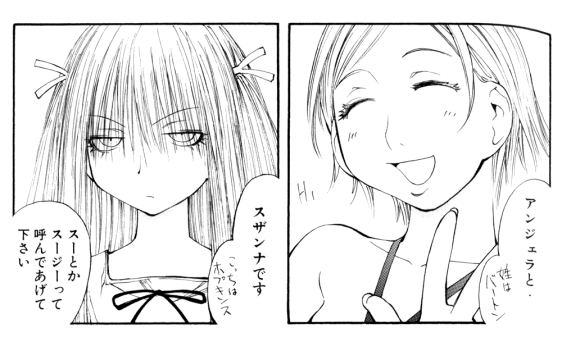
Ohno and Kasukabe begin plotting to get the two closer, which ends up with her bringing her American friends, Angela Burton and Susanna “Sue” Hopkins, to ComiFes as a way to get Sasahara and Ogiue to be at the event together alone. The two actually begin to hit it off (to the point that it overwhelms Ogiue a little), but a chance encounter with two hometown women from Ogiue’s past—people she hesitantly calls “friends”—clearly induce emotional anguish in her. A confusing moment with Sue at first helps Ogiue calm down, only for her to flash the most hardcore page from Ogiue’s own doujinshi in front of Sasahara—the last person she wanted to show it to.

Sasahara, meanwhile, has his own non-romantic troubles, namely being unable to find work. He’s decided to pursue a career in manga editorial, but keeps getting rejected. Finally, he lands at a dedicated freelance editorial company and uses his experience with Kugayama and Ogiue to finally land a job.

The volume ends with Ohno and Kasukabe setting up a club trip to the resort town of Karuizawa, where they intend to finally get Sasahara and Ogiue together.

Is Kuchiki “Okay?”

Kuchiki’s character is being “that guy”: the one whom the other members barely tolerate because they don’t want to drive out because they either 1) don’t want to get too aggressive 2) have empathy for someone so socially awkward. It’s an understandable situation for anyone who’s had experience with a social circle full of dorks.

Given what’s happened with women and the rising tide against sexual harassment, however, Kuchiki’s character becomes increasingly hard to swallow. It’s not just that he’s got lascivious behavior, and it’s not just that he fails to respect personal space, but that he actively tries to creep on the girls, including attempting to peep on them bathing. Even Nidaime, with its female-centric cast, shows the ladies of Genshiken pretty much enduring Kuchiki’s existence and waiting for him to graduate.

I don’t fault Genshiken for this, simply because it does a good job of reflecting the reality of anime clubs in the 2000s and before. Not only is Kuchiki portrayed as being too spineless to actually threaten them, but it’s not like Genshiken rewards or praises the character. And yet, I have to wonder if a socially conscious series made in 2018 would even let him through the front door, so to speak.

Kuchiki’s not all bad, as he does try to defend Ohno’s cosplay from that one thief, but it’s arguably just an example of having a worse villain make a milder one look better. Sasahara sticking up for him and treating him like a human being does help Kuchiki grow a little bit, but is Sasahara’s kindness accidentally a form of complicity? It’s made more complex by the fact that it’s also one of Sasahara’s best qualities, and what helps him get his editor job. A later chapter in Nidaime has an in-love Ogiue praising this very quality of Sasahara, and even here in Volume 7 you can see her being somewhat smitten by that accepting demeanor. It’s perhaps the fate of the moderate force to sometimes not do enough.

Ogiue’s Right to Love

Volume 7 is where the layers of Ogiue begin to peel away, revealing not just a self-hating fujoshi, but one marred by trauma. The first time I read this volume, it wasn’t entirely clear where it would go, but re-reading while fully aware of Ogiue’s past actually makes it kind of heartbreaking. Her anxieties creep to the surface in many of her interactions, and as her feelings for Sasahara get stronger, it’s clear how much her experiences weigh on her mind.

One of the big moments comes when Ogiue is talking to Ohno about having to make a doujinshi for ComiFes. In it, she directly mentions that she’s drawn doujinshi before, and that she hates herself for being a fujoshi. Looking back, the idea that Ogiue has experience drawing more extreme material only makes sense, but I recall it being a bit of a revelation back when I first read it. This conversation is also the first true indication of Ogiue and Ohno having become friends. Before that, there was still a noticeable amount of animosity between them, and I believe here is where it begins to die down a bit.

Ogiue’s blushing profusely as Sasahara smiles at her is incredibly adorable but also complicated. You can feel the inner turmoil raging inside of her as she questions whether she should be happy. Also, I think her switch from a Haregan [i.e., not-Full Metal Alchemist] doujinshi to a Mugio x Chihiro Kujibiki Unbalance one is an early sign of her secret Sasahara x Madarame drawings.

The Society for the Study of Getting Turned On

There’s something very real and refreshing about the way Genshiken portrays sexual desire. The fact that it’s not limited to the male characters also means Genshiken goes a long way in showing women as beings with sexual desire. The approach isn’t like the hyper-eroticism of a fanservice series or a pornographic title and it doesn’t revel in the lasciviousness of its characters carnal wants, but it also doesn’t shy away from showing their libidos at work in public and private contexts.

Nothing shows this better than when Kasukabe drags Kohsaka off so that they can “do it ten times.” Immediately after, Keiko informs her brother that she’s not staying over that night, and Madarame decides it’s his cue to leave too. Keiko and Madarame, having the hots for Kohsaka and Kasukabe respectively, are clearly thinking similarly about how to “remedy” the situation in private. You can practically feel their hormones being barely contained.

Then the manga cuts to Sasahara playing an erogame while thinking about Ogiue in cosplay. It implies that he’s going the same route as his little sister and Madarame, but the fact that he’s thinking about Ogiue (and not Kasukabe) is significant. The Ogiue cosplay moment happens in the previous chapter, which means Sasahara had Ogiue on his mind the entire time. Let’s also not forget that the guys in the club were willing to use the other girls as masturbatory material, so this shows how much Ogiue’s been encroaching on Sasahara’s psyche. This obviously isn’t the first sign that Sasahara’s into Ogiue, but it certainly is one of the most vivid. Later, when they have a ComiFes planning meeting with Ohno, Sasahara’s brief glances at Ogiue show much his mind’s image of Ogiue still persists.

Angela and Sue

As we know from the end of Nidaime, Madarame eventually ends up with Sue. It’s kind of funny that he’s the first guy she meets in Genshiken, as if it was all a long play into the most classic of romance tropes.

I always found Angela and Sue to be fairly realistic, if exaggerated portrayals of American fangirls, but I think that it’s become even more the case as time has passed. Maybe it’s my greater exposure due to social media like Twitter, but Angela’s willingness to just announce her fetishes without hesitation seems not that unusual. Then again, Yoshitake from Nidaime is built from a similar cloth; the only difference is maybe level of sexual experience (Angela is clearly sexually active, while Yoshitake is very much not).

In Volume 7, Sue has a certain grumpiness about her, even as she becomes attached to Ogiue. However, Ogiue is pretty surly herself. I wonder if the softening up of Ogiue leads to Sue becoming less harsh as well.

It’s also funny to think about the fact that, at the time of Genshiken, Sue’s combination of Asuka reference (“Anta baka?”) and Ruri reference (“Baka bakka”) was like, anime nerd knowledge 101. Now, I think it wouldn’t be unusual for the typical fan, Japanese or otherwise, to not have it click immediately.

Final Random Thoughts

The between-chapter specials this volume include Sasahara and Madarame discussing preliminary Kujibiki Unbalance designs. Those drawings are clearly from a younger Kio Shimoku, as it’s the same style as the first chapter of Genshiken! Kio’s aesthetic changes are amusingly visible as a result.

As Sasahara is thinking dirty things about Ogiue, there’s a Gundam model kit box in the background. I think it’s a Sazabi.

In Sasahara’s job interview, he talks about how Kujibiki Unbalance has changed so much since the original cast graduated, to the point that it doesn’t even feel it’s the same series anymore. At the time, it feels like it might have been referencing the graduation of Madarame, Kugayama, and Tanaka, but now it seems to reflect Genshiken Nidaime even more—almost as if Kio doubled down on this idea for the sequel. We know he’s a guy who likes to get referential with his series, but I wonder if Nidaime is even more meta than any of us realized.

Cardcaptor Sakura and the Alternative Canon: What is the “Clear Card Saga” Anime Following?

When the Cardcaptor Sakura: Clear Card Saga anime announced, one of the questions asked was, would it be following the canon of the manga or the anime? Although the two versions share many similarities, there are also some notable differences between them. Now that the new TV series has been out for little while, it’s evident that they’re acknowledging the old anime…but I have my suspicions that this wasn’t always the case.

One of the tell-tale differences between the two iterations of the original Cardcaptor Sakura is how they end. While both involve an exchanging of teddy bears as an expression of mutual love and a temporary separation as Syaoran returns to Hong Kong, the anime has this happen at the airport, while the manga’s version takes place as Syaoran is riding the bus to the airport. Also, while the anime has them reunite in the second film, the manga immediately follows this with a timeskip where Syaoran shows up to greet a now-middle school-aged Sakura. This is roughly the point where Clear Card Saga starts.

Prior to the premiere of the Clear Card Saga TV series, there was a special OVA released as a way to bridge the old and new anime. As seen above, this OVA takes its cues from the manga by having the bear exchange take place at the bus, and then transitioning to the middle school timeskip. With this, I assumed the matter was settled. The Clear Card Saga anime would definitely be sticking closer to the manga.

Then episode 1 hit, and things didn’t quite line up.

When Syaoran shows up again in the manga and OVA, he’s wearing a Tomoeda Middle School uniform. In the new anime, he’s wearing street clothes. Maybe this is just a timing or aesthetic issue. Perhaps it doesn’t make sense for Syaoran to have a uniform after just moving back. Maybe the fact that they show Sakura at school before meeting Syaoran means he couldn’t be there (because she or one of her friends would’ve inevitably noticed him walking around in uniform). Either way, here is a discrepancy from the manga.

But they also flashback to the teddy bear exchange, and it’s at the airport! That’s a scene that explicitly calls back to the anime and not the manga. Maybe they just did that for the convenience of the people who watched the old anime.

The smoking gun comes in episode 2, when the characters are having lunch together at school. During their conversation, Tomoyo asks Syaoran how Meiling is doing. The reason this is a big deal is that Meiling never shows up in the manga. She’s an anime-original character, and one of the many elements used to turn a 12-volume manga into a 70-episode anime. Whatever the case may be, we have clear unequivocal acknowledgement that the old anime’s events are either partially or wholly canon in the Clear Card Saga anime.

So why make that OVA? I suspect that it served multiple functions. First, it might’ve bridge the gap between series, as mentioned above. After all, it’s been about 15 years. Second, it could’ve been used to get the staff and actors used to working on Cardcaptor Sakura again. Third, I really do think the anime was going to follow the manga more strictly, as a way to keep things simpler, but that they changed their minds at some point. If this were the case, maybe it was because they realized many had only ever seen the anime, and thus would be confused by the differences.

While the old anime appears to be canon for the new show, the question remains as to how much will actually be different from the Clear Card Saga manga. Referencing Meiling is one thing, but what about having her show up? Will the new anime have more clear cards than the manga, just like it’s predecessor? And what of the fact that Sakura’s dad is a partial reincarnation of Clow Reed—a fact revealed in the manga but never in the anime?

Personally speaking, I wouldn’t mind seeing Yukana reprise her role as Meiling and treating us to some Kung Fu fighting.

A Strong Foundation: How the Japanese Smash 4 Tournament Format Helps the Community

Introduction: Japan, Land of Hidden Bosses

If there’s anything that the Japanese Smash 4 competitive scene is known for, it’s a high average skill level across its player base, as well as a great amount of character diversity. Many of the world’s greatest character specialists come from Japan—Ranai and his Villager, Kameme and his Megaman, Shuton and his Olimar, and a whole slew of powerful Duck Hunts. A lack of monetary prizes is frequently cited in online discussions as a reason why so many Japanese character specialists exist, but I think that’s just a starting point and not a sufficient explanation by itself.

On occasion, fans will point to the extremely volatile rankings at Japanese tournaments as proof of Japan being a haven for character specialists, while others will counter that the average format of Japanese tournaments (Best of 1 round robin pools, followed by Best of 3 double elimination often even into grand finals) is inherently inconsistent. However, while this inconsistency might be a strike against the tournaments themselves providing reliable results, I think the format Japan uses is actually a key factor in helping its player base grow and improve compared to the common formats elsewhere (double elimination throughout, starting Best of 5s much earlier in the bracket), especially when it comes to creating those intimidatingly strong character loyalists.

The Mother of Invention

One of the reasons Japanese tournament matches tend to be so much shorter than their North American and European counterparts is time constraints. Often times, these events last only one day at venues that cannot allow them to stay later. They’re working with what they have. Yet if you look at how they use that limited time, it’s clear that the format is designed to give all players the most amount of playtime possible. Best of 1 round robin means that, even if you don’t make it out of pools, you potentially get to face a far greater number of opponents than the two you would encounter in a double elimination bracket. Everyone, even the worst players, get to gain real experience against more characters and more play styles.

Fostering Young Lions

Top players in Japan seem to prefer the “Western” style more because it favors them—as the best, their skill gets better rewarded the longer the sets are. While not going in that direction works against the best of the best, it’s also clear that the Japanese tournaments are meant to be as hospitable to newbies as possible. In addition to the round robin format initially, there’s also something called the “B-class tournament,” which is a separate bracket for all of the players who didn’t make it out of pools. In other tournament formats, less skilled players are usually given a chance to improve by dedicating a section for non-tournament “friendlies.” The B-class bracket is an opportunity to continue to play in a tournament-style setting.

When Japanese Smash 4 tournaments first began, there was even a question of whether or not to restrict the stage selection to Omega stages—flat levels without any platforms—only because it was the only stage type available on Nintendo’s default online competitive format, For Glory. While the Japanese scene ultimately went away from this idea, it shows a desire to cater to newcomers. Combined with extremely reliable high-speed internet that makes Japanese online play better than other parts of the world, this means Japanese tournaments are a good environment for those who are considering transitioning from online play to offline events.

Best of 1: “Random?”

Another aspect to consider is that the Best of 1 format itself might help advance player improvement. Although Best of 1 matches are not preferred for showing who can win consistently, it does foster certain skills that longer formats do not, as once pointed out by fighting game commentators UltraChen. A player can’t wait until the second set to try and figure out their opponent; they need to do it now. Super Battle Opera, once Japan’s most prestigious fighting game tournament, used a Best of 1 format, and its players adapted to it. While a Best of 5 match shows who can adapt the best over a longer period, Best of 1 forces players to learn how to adapt extremely quickly, which in turn teaches them how to “gamble” better when the chips are down. This might be why Japan is somehow known for both more reserved play and riskier (but not necessarily aggressive) styles as well.

What’s more, the inconsistency of Best of 1 pools might actually help in giving more players experience as well. If the very best players advance every single time, this means that the lesser players do not get to feel what it’s like to move up the bracket and face increasingly tougher opponents. With the “randomness” of Japanese tournaments, many more players get to feel what it’s like to be in a Top 16 or Top 8 against the country’s best.

Conclusion

The Japanese format is geared towards expanding the Smash 4 tournament scene by being an inviting space for players of all stripes. Best of 1 pools and B-class side tournaments not only allow all competitors both strong and weak to experience a variety of players and characters, it allows character loyalists and champions (two groups which do have crossover!) to level up at a higher rate. Shorter matches also foster a certain type of adaptation, and the inherent volatility potentially gives many more players to get accustomed to playing at later stages of a tournament. Whatever the ultimate goal of a given player, the Japanese tournament format provides the foundation for a strong player base.