In my continuing quest to write small articles on all of the μ’s girls of Love Live!, I’ve written something on Nishikino Maki. I know she’s a popular one, so I hope I do you Maki fans justice.
In related news, the English version of Love Live! School Idol Festival just added songs from both Aqours (the stars of Love Live! Sunshine!!) and A-RISE. I’ve been eagerly anticipating A-RISE’s arrival (Kira Tsubasa is a favorite character of mine), so I’m hoping to get her for my account.
I count myself among the many who loved Mega Man 9 and Mega Man 10. The retro revivals of one of my favorite video game series of all time, they had the great gameplay, catchy music, and cool boss characters that I came to cherish from Mega Man as a whole. However, something always felt a bit off about them, like a meal that’s almost perfect, and I stated as such in my review of Mega Man 10 when I said that the game is poor at giving moments of respite to the player.
I recently read an interview between the original creator of Mega Man, Kitamura Akira, and the manga artist behind Mega Man Megamix, Ariga Hitoshi. They discuss a variety of topics and I highly recommend checking out the entire interview, but one comment in particular stood out to me, given my experience with the newer Mega Man games:
Kitamura: Making the last enemy encounter in the wave easier was a key idea. It leaves the player with a softer impression of the game’s difficulty. I think the reason that people don’t replay games—even good ones—is that when they remember playing the game, their minds go back to the extremely difficult parts and enemies, and then replaying the game starts to seem like tedious work. I wanted the player to feel like he was improving at the game too, and that was another reason to make that last enemy easier, I think.
Upon reading that, it all made sense. Mega Man 9 and 10 are really fun and exciting games, don’t get me wrong, but I’ve come to believe that they catered a little too much to that hardcore retro gaming audience that cherishes older NES-era games precisely because of their notorious difficulty and seemingly unforgiving gameplay. I’m not surprised that this is the direction they went, as it is those kinds of players who are the most ready and willing to dive into something like a Mega Man revival. I don’t even think it was all a bad thing, because the tighter and more complex and difficult level designs were something I found to be exhilarating, but what Kitamura says (about how people don’t replay games when it starts to seem like tedious work) strikes a chord. I know that Mega Man 10 implemented an easy mode to cut away some of the tension and difficulty, but the levels are clearly designed without them in mind, and it’s a constant reminder that you are playing a “lesser” version.
If I were to go back and play these two games, I would probably spend most of my time doing boss rushes because I love that sort of thing, but when I remember that obnoxious spike wall leading to the mid-boss of Jewel Man’s stage (or was it Jewel Man himself?), I sigh and lose the will to go through such ordeals. Maybe if that wasn’t such a “gotcha” moment, and maybe if there weren’t so many of those moments, then I would remember them even more fondly than I do now.
—
If you liked this post, consider becoming a sponsor of Ogiue Maniax through Patreon. You can get rewards for higher pledges, including a chance to request topics for the blog.
Between showers, fools, and lambs, April is a month of change and transition. It’s only appropriate then that I try to evolve as well! As always, it’s with the help of my friends and Patreon supporters that I continue to try and improve Ogiue Maniax:
General:
Johnny Trovato
Ko Ransom
Alex
Diogo Prado
Sasahara Keiko fans:
Kristopher Hostead
Yoshitake Rika fans:
Elliot Page
Hato Kenjirou fans:
Elizabeth
Yajima Mirei fans:
Machi-Kurada
So, the first change I’m making is a small adjustment to my schedule. Since 2010 I’ve generally structured my weekly posting schedule to be posts on Tuesday and Friday with at least the occasional lighter post on Sunday, most typically a Fujoshi File entry. However, I’ve noticed that most of my readers come in on Sunday, and to give my lowest-impact content at that point feels like a shame, because if you’re coming to Ogiue Maniax I believe it’s to read something interesting. Because of this, I’ve decided to switch Sunday to being a main posting day, with either Tuesday or Friday being less heavy. I’m still on the fence on which one to use, but most likely it’ll be Friday. I hope you enjoy the change, and of course, if you miss the post it’s always there in the archives.
A second possible change is adding another series other than Genshiken for me to review regularly. The title is Kimi xxxru Koto Nakare(“You Can’t Do That”), the new monthly manga by Okachimachi Hato (creator of one of my favorite manga, Fujoshissu!) about a high school romance between a male idol and a female celebrity comedian. The question is, how should I cover it? To help me with this, I’m using a handy dandy poll:
Keep in mind that this is just for feedback and the winning answer won’t necessarily determine what happens. Also, I mistakenly thought it was a weekly manga, so a previous Patreon post of mine mistakenly had weekly options.
As for what’s happened on the blog over the past month, the biggest event for Ogiue Manaix and all current Genshiken readers definitely has to be the latest manga chapter, which concludes the Madarame harem story. I won’t say much more, so go check it out if you’re curious as to what goes down and my thoughts on it. Also, I need to point out that a funky translation of Chapter 122’s contents has been going around, and it provides an inaccurate image of the characters. In response to this, I’ve also translated a couple of small but vital excerpts from the chapter in the hopes of clearing up the confusion.
Speaking of reviews, I also finally updated the Reviews section of the blog. I neglected it for about…a year and a half? orz
I also talked last month about my concern over stagnating as a writer. My smart and ever-perceptive friend David Brothers gave me some advice in response to one of my Apartment 507 articles on Yandere characters, which is that I should think about putting more of myself into my writing. I think that ever since I’d gone in a more academic direction it’s improved Ogiue Maniax in a number of ways. At the same time, that sort of more casual and personal feel, while still present I believe, might not be as apparent. Sometimes I have to be more friend than teacher.
Three final comments:
Shout outs to Abadango for winning Pound 2016 using 99% Mewtwo (with a dash of Meta Knight). It’s the first major tournament in Super Smash Bros. for Wii U that has been won by a Mewtwo.
Some cool and mysterious fellow recently published an academic article about the science fiction manga 7 Billion Needles in the journal Japan Forum. If you’ve got access and that’s your sort of thing, maybe check it out?
This past weekend was the final Love Live! concert for the original μ’s girls. Love Live! forever! Hanayo banzai! Also, sorry about the April Fool’s joke (not sorry).
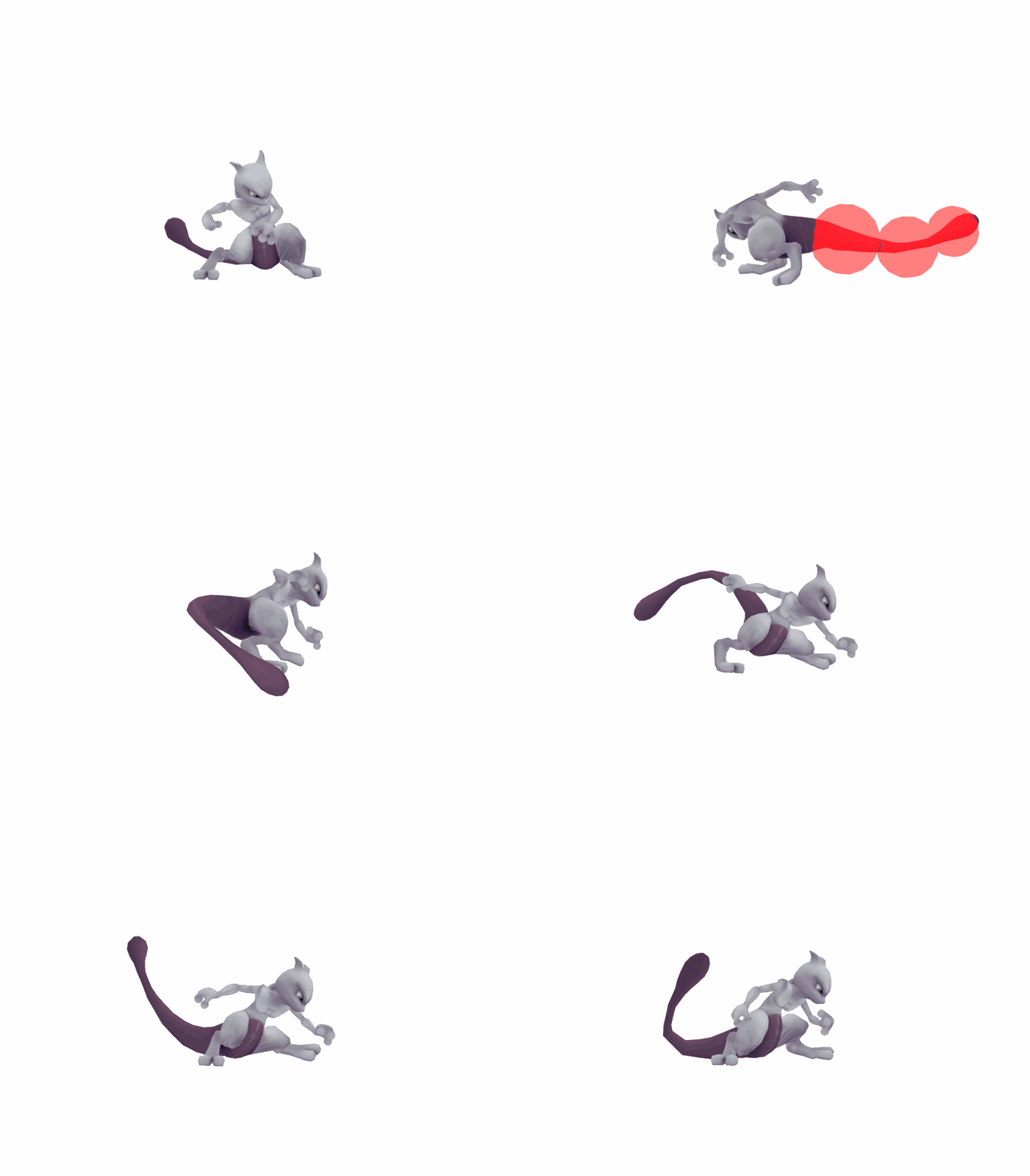
This past weekend was the international Super Smash Bros. tournament known as Pound 2016. There, in the stacked, 500-man bracket for Smash Bros. for Nintendo 3DS & Wii U, a Mewtwo took home the gold for the first time ever at a major event. To a Mewtwo player such as myself, this is undoubtedly the most significant result thus far in the history of the game.
The player behind Mewtwo was Abadango, who at this point is a well-known name in the Smash 4 competitive community. He’s used a great number of characters throughout the life of Smash 4, and whether it’s been his creative Pac-Man, his dangerous Wario, his punishing Meta Knight, or now his Mewtwo, Abadango’s play turns heads. As someone who values deadly powerful combos and setups, the recent litany of improvements to Mewtwo have made the character an enticing choice for Abadango, though he has also expressed concern on his stream over its unforgiving nature. Nevertheless, Mewtwo’s worked out for him. Cutting through a sea of difficult opponents including VoiD’s Sheik and Ally’s Mario, Abadango made Mewtwo look deceptively simple, but anyone who knows the character is well aware that Mewtwo is anything but.
Mewtwo’s history in Smash 4 is a wild one. Designed from Day 1 to be a “glass cannon,” a character that is strong offensively but light and easy to KO, Mewtwo has benefited both from dedicated players pushing the character forward (such as LoF Blue, Mew^2, Killer Jawz, Rich Brown, and The Reflex Wonder) and from the “hand of God,” as the Genetic Pokemon might be the most buffed character in Smash 4. Mewtwo is now faster, hits more reliably, combos better, and more. The number of improvements that have been bestowed upon Mewtwo are nothing small, though it’s worth pointing out that among many fans of Smash for the past three months (since the buffs started happening) that people still doubted Mewtwo’s prowess. How could Mewtwo possibly be truly good, when the character is still very large, extremely light, and easy to juggle? The answer is, with an amazing versatile kit that allows Mewtwo to exert pressure at almost every point during the game.
Don’t underestimate Mewtwo’s Down Tilt
Even in its darkest days, I never believed Mewtwo was truly a terrible character. Due to the unforgiving nature of its design (second lightest character in the game), Mewtwo makes you feel terrible for your mistakes. One wrong move and you can end up questioning your own existence. A Mewtwo played to perfection would still have been a force to be reckoned with even before the patches, but reaching that point and maintaining it was easier said than done. Now, I believe that a sub-optimal Mewtwo is still going to feel the sting of their mistakes (only Mewtwo now has more tools to avoid those mistakes in the first place), while a refined Mewtwo is easily high or even top tier. The fact that the top Mewtwo players present such a range of play styles—aggressive, defensive, technical, slippery, mind game-oriented—shows just how much potential the current Mewtwo holds.
That said, I think that the biggest change to Mewtwo that has come with the improvements both in the players and in the character is that Mewtwo now has access to a powerful ingredient that it lacked previously: fear. At first, Mewtwo could not instill fear in opponents, and that meant Mewtwo was always on the back foot because of how easy the character is to KO. Now, things are different.
It’s not just any fear, however, but more of a fear that’s mixed with the sweet scent of opportunity. When you fight Mewtwo, and you’re on your last stock while Mewtwo has a 60% lead, you’re aware of how good Mewtwo is at dealing damage and sealing stocks.
Then you remember, Mewtwo’s light and easy to kill. Opportunity knocks. “All you need to do is capitalize on one or two mistakes and the game isn’t just even, it’s arguably in your favor due to the weight disparity!”
The temptation is there, but so is the terror. Case in point, in an interview after winning the weekly tournament Wii Bear B-airs, LoF Blue mentioned that he switched from Sonic the Hedgehog to Mewtwo because the threat of Mewtwo’s myriad kill options forces the opponent to play differently at key moments.
A similar pressure is also placed onto the Mewtwo players, who are aware of how fragile their character is. If you’re down as Mewtwo it’s possible to make it back, and all you need to do is to not get hit, ever. A good Mewtwo draws strength from this tension, from teasing that glimmer of hope while still emanating a threatening aura.
If you’ve decided to pick up Mewtwo after Abadango’s win, I have one piece of advice for you: Be prepared to cry into your oatmeal as you die at 65% off of one critical mistake. Half the battle is a mental one. You have to maintain your composure as you’re getting bodied, or else the psychological damage you take just gets worse and worse. If you still stick with the character even after all that abuse (or maybe you’re kind of a masochist), then you’ll find a strong ally.
Also, if you’re interested in learning more, check out Dabuz (the best Rosalina in the world) and his analysis of Abadango’s Mewtwo:
—
If you liked this post, consider becoming a sponsor of Ogiue Maniax through Patreon. You can get rewards for higher pledges, including a chance to request topics for the blog.
Coinciding with Anime Boston, this weekend, March 25-27, 2016, coincides with the first ever Love Live! School Idol Festival tournament, titled “School Idol Festival Score Challenge & Thanksgiving 2016. Given this occasion, a few questions come to mind. First, how sound is LLSIF as a competitive game (are we indeed “esports”)? Second, how many people will show up? Third, are people actually viewing this more as a tournament, or more of a gathering of like-minded fans?
Rhythm game tournaments have over the years been a staple of arcades and anime cons alike. Right beside the fighting games of Chinatown Fair were the sounds of stomping and eurobeat from Dance Dance Revolution, Beatmania, and other games of their genre. One big difference between LLSIF is that luck is a heavy component of the game, and this potentially hampers its competitive depth.
Not to say that luck automatically precludes or is counter to skill (because it doesn’t), but between being a free-to-play mobile game that encourages you to funnel money into what is essentially a gashapon machine (or a blind booster pack, to take a term from trading cards), and the fact that given cards have effects that trigger at random, a lot is left up to probability.
Compounding the issues of luck, actually, are things that involve no element of chance whatsoever. There is an upper limit to how skilled one can be in School Idol Festival, in the sense that perfect play is simply hitting all of the notes, well, perfectly, and this can be accomplished even with a randomized note distribution. If there are theoretically perfect teams (different for each tournament song, I’d imagine), then it actually all comes down to how often those card effects will trigger for individual players.
Does all of that matter, though? While I have not asked those who are personally attending Score Challenge & Thanksgiving 2016, I have to wonder how many are actually motivated by the desire to win. Perhaps in the backs of their mind they realize that the perfect game is at the same time all but obtainable yet shackled at the feet by that specter of probability. In that case, it becomes more about displaying one’s skills, to show that one has the fingers or thumbs to impress and astound.
In the world of competitive games, “waifu devotion,” that is to say an inclination towards beautiful female characters is very real. Whether the ladies are the best characters in the game or the bottom rung, players will stand by their girls. Love Live!, with its all-female cast of charmingly unique characters, is waifu central, and many who play LLSIF are empowered by this mentality. This does not even fall along heteronormative lines, either. Female Love Livers have their waifus just as male fans do, and the range of their affection goes anywhere from empathic to platonic to lecherous. On some level, I don’t think that hunger for victory is the sole motivating factor behind even LLSIF’s most competitive players.
That last question I asked, about whether this will be more of an actual tournament or more of a gathering in the eyes of attendees, is something of a trick question. Aside from a few exceptions, pretty much all game tournaments, big or small, esports or otherwise, inevitably carry with them some degree of a festival-like atmosphere. The larger the total attendance, the more likely this is to happen, because people know that they are in the company of comrades, at least on some level.
In other words, I hope all of you attending have the times of your lives.










 OGIUE MANIAX