The Fujoshi Files 143: Kaori

Name: Kaori (カオリ)
Alias: N/A
Relationship Status: Dating
Origin: Happy Fujoshi: Sono Onna, Kusarimono ni Tsuki

Information:
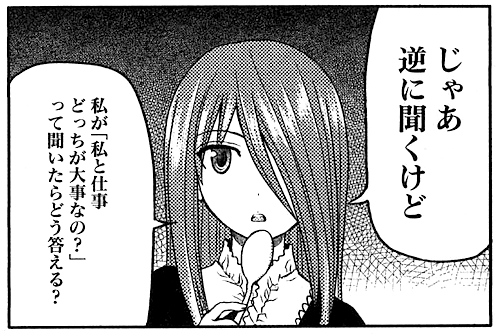
Kaori is an adult fujoshi with a very particular pairing logic that her boyfriend finds difficult to understand. For example, pencils are uke because their markings are enveloped by erasers, while teachers are always uke as well unless they’re mad scientist types in glasses.

When asked to describe the difference between her attraction to her boyfriend and to yaoi, she mentions that yaoi is like a dessert in that she has a separate “stomach” for it.

Fujoshi Level:
Once, Kaori did not eat for three days because she kept spending all her money on BL doujinshi instead.

Goku vs. Javert: Voice, Performance, and Interpretation

I’m not big into musicals, but after watching the Les Misérables film and seeing all of the criticism of Russell Crowe’s Javert (especially in terms of the quality of his singing), I began looking into the Javerts from Broadway, most notably Philip Quast, who was used for the 10th Anniversary performance. While Quast is clearly a more powerful singer and better at acting through his singing (as opposed singing along with acting), what stood out to me was the sheer difference in Crowe’s and Quast’s interpretations of the character of Javert.

Quast’s Javert is supremely confident in both himself and his sense of justice, with the idea that, as the story progresses, he begins to lose his philosophy of absolute righteousness. Crowe’s Javert, in contrast, comes across as someone who is constantly at war with himself, fighting against the fact that he is “from the gutter too.” What amazes me about this, as perhaps someone who’s spent arguably too much time with anime and manga and not enough with other media, is that the same lyrics, the same script and dialogue, could result in such different characters.

In thinking about this in terms of recorded media, I have to think about the position a particular work has to have in order to get to this point where multiple interpretations of a character can exist based on the same core script. Sure, remakes happen, whether it’s anime, film, or something else, and American superhero comics are known for re-inventing characters through the different minds of new creators who revisit or take on older properties, but it’s not quite like having a stage play (or a movie that tries its hardest to be faithful to a stage play), where having new actors, new people to give their voice and mannerisms to the same character and script, is expected.

Dragon Ball is one of the most famous manga and anime ever, and between Dragon Ball Kai, Dragon Ball Super, Resurrection ‘F,and more, its characters have been coming back stronger than ever. In fact, Kai had all of its dialogue re-recorded even though the story was Z’s. In a way, that idea of having different interpretations despite the same script happened, only most of the voices were the original cast, and it’s more seeing how experience has changed them.

Where the “actor interpretation” idea might exist in anime is, perhaps, the act of dubbing. For most who grew up with the English voices of Son Goku (most famously at this point Sean Schemmel), Nozawa Masako’s original Goku portrayal is extremely jarring, her shrill voice sounding much less masculine than their image of Goku. Because Dragon Ball is so internationally successful, that also means that it and similarly popular works (Pokemon, One Piece) all give these potentially very different experiences due to how the same (or similar) script is communicated through dozens of languages. English-language Goku and Japanese-language Goku are in a way very different, and I can only imagine that Spanish, Chinese, and Arabic Goku are all going to bring variations even though they share the same basis.

If you liked this post, consider becoming a sponsor of Ogiue Maniax through Patreon. You can get rewards for higher pledges, including a chance to request topics for the blog.

How Many Curtains Does It Take to Get to the Truth of Anime Production?

One of the recurring endeavors in the study of anime and manga has been to remove some of the aura from Tezuka Osamu. Rightfully one of the most influential figures in anime and (especially) manga history, it’s not so much about questioning whether Tezuka had any impact on Japanese popular culture but to what extent the attributions given to him (either by others or himself) are necessarily accurate. Did he really create the first anime (no) or the first TV anime (no)? Did he really invent shoujo manga (the answer is also no)? However, amidst the pursuit of the truth, this brings to mind the question of how much one is willing to peel back the veils of illusion that go into the production of art and media, to look at the creators themselves, and perhaps to take away even their brilliance in favor of treating them and their works as mere people and products.

What inspired this post was the book Anime: A History by Jonathan Clements, which aims to study anime as objects, created and sold, and in doing so reveal a side of anime’s history that isn’t merely about lauding the successes or pointing out obscure, overlooked works. As much as one might argue that this is removing the “magic” from anime, there’s nothing wrong with this approach, especially if one is in pursuit of a more factual type of truth. In fact, it’s not so much that the veneer of fantasy has been peeled away from the anime or the creators that has me writing this post, but rather about the degree to which another might accuse me of doing the same thing through this blog.

One of the aims of Ogiue Maniax from the very beginning has been to get people to think more about anime and manga, to explore why one might love anime in a certain way. To this extent, I’ll talk about different themes in series but I’ll also bring up both creators and audience in a mix of modernism vs. postmodernism that I don’t necessarily think needs to be resolved. I’ll go to panels at Otakon and lament the lack of audience for Maruyama Masao, who is one of the greatest troves of anime production knowledge in existence (though maybe now that he’s been parodied in Shirobako this might change things) and question why people pay so little attention to the creators. And yet, is that so different from what Clements does in his book?

While Clements strips away the aura from the creative process a bit in order to question the self-congratulatory aspects of creators and studios, am I stripping away the fantasy of the anime as a story in and of itself, the narrative as entity that wishes for people to engage it on some level as inherently real? Do even the people who follow voice actors do this same thing in their own way? And perhaps most importantly, should these contrasting stances all be considered under the same umbrella of “fandom,” or are they distinct enough to need more specific categories?

If you liked this post, consider becoming a sponsor of Ogiue Maniax through Patreon. You can get rewards for higher pledges, including a chance to request topics for the blog.

Ogiue Maniax Talks Otakon on the Space Opera Satellite Podcast

goldran-hiddencell

I was recently on PatzPrime’s Space Opera Satellite podcast to recap and review the highlights of Otakon from the mecha fan’s perspective. Joining us were also Tom Aznable, Hazukari, and Ashe Blitzen.

Have a listen

Go! Princess Precure and the Flames of Atonement

WARNING: This post contains Go! Princess Precure spoilers

There’s a recurring problem in the Precure franchise, which is basically a post-resolution amnesia to any significant narrative climax. This is especially evident when a new Cure is introduced or an evil character turns to the side of good, complete with a new human guise free of all of the old visual cues that marked her as being on the side of “evil.” In the process, these girls usually not only take the spotlight because they’re so new and exciting, but their newer forms are so fully integrated into their now-human lives that it’s like the show wants you to forget their past.

As a result, while the prospect of a turncoat who sees the light is generally thrilling, the addition of this new Cure to the main team often comes with a small helping of fear and dread. When Go! Princess Precure first introduces its evil rival character, Princess Twilight, the possibility that she would become the fourth Precure in this new series was already there, but the following questions would come up while watching. First, will this new character overshadow the old girls. Second, will the series act as if she’d always been everyone’s best friend?

22 episodes later, we have our answers. Twilight is really Towa, a princess who was kidnapped and brainwashed when she was a little girl, and Cure Flora, Cure Mermaid, and Cure Twinkle are able to rescue her and restore her memories. Thus begins the potential process for Twilight to essentially be “Cure-washed,” but Go! Princess Precure rather impressively makes the misdeeds of Towa’s past a part of her story and her struggle. Even after being rescued and having her original appearance restored (Twilight had long white hair while Towa’s hair is red and done in elaborate curls), Towa is shown to still be in Twilight’s original dress, and the switch away from this outfit is actually a plot point in Episode 23. Even more indicative of the show’s desire to not forget about “Princess Twilight,” however, is Towa’s transformation into Cure Scarlet.

When Towa transforms into a Precure, there are a number of interesting visual cues that she seeks not to totally divorce herself from her problematic past. First, the villains of the series have pointed elf ears, and when Towa becomes Cure Scarlet she also retains this feature. Not only that, but the transformation sequence actively emphasizes the shape of her ears.

Second, her her hair goes from being a bright red to a pale pink, closer to the white of her Twilight form.

Finally, the ever-present fire in her transformation sequence, though a different color from the flames used when she was evil, are so powerful and overwhelming that they appear sinister and frightening. While past fire-themed Precures also had blazing infernos bursting forth from their bodies, in the case of Cure Scarlet it’s almost as if they’re hinting that she’s liable to commit arson. Of course, that’s not the actual point of the transformation, but it again points to a character who might be “good” but hasn’t necessarily forgotten or ignored her wrongdoings, even if they were arguably beyond her control.

The overall result is a character that I’m looking forward to seeing develop. While there’s no guarantee that she won’t end up overshadowing the rest of the characters, I have greater faith in Go! Princess Precure because of how consistently impressive and high-quality the series has been up to this point.

If you liked this post, consider becoming a sponsor of Ogiue Maniax through Patreon. You can get rewards for higher pledges, including a chance to request topics for the blog.

Working!!: Ogiue Maniax Status Update for August 2015

The #1 thing I want to talk about for this month’s Patreon status update is that as of late I’ve gotten really bad at regularly updating the Patreon page. People who frequent the blog are likely well aware that Ogiue Maniax updates frequently, but I end up neglecting the actual Patreon page itself, resulting in large swathes of updates at once. It’s not the best way to do things and for that I have to apologize.

Even so, I’m glad so many of you have been sticking around. Due to various time constraints I can’t devote quite as much attention to the blog as I like, but I still try to get out my thoughts on anime, manga, games, and other topics.

This month’s special Patreon sponsors are:

Ko Ransom

Alex

Johnny Trovato

Anonymous

This month, one of my Patreon-sponsored posts was from Johnny and was about making time for your hobbies. It’s as much a reflective piece as I come to realize what it means to be truly, truly busy as it is advice, and I also think it’s worth reading if you’ve ever felt burnt out on your hobbies or fear that you might be heading towards burn-out.

The other post was actually private at the behest of the sponsor. What do people think of this idea? Normally, what would happen is that a Patreon-sponsored post would be there for all to see and discuss, but if people want something more private and in-depth on a personal level, I’m willing to consider it.

Also, I’ve been writing a bit more about games and game design philosophy, even though I’m not a game designer. For example, I wrote a post about the relationship between balance and faithfulness to source material in Super Smash Bros. Would readers like to see more, or less of these? Keep in mind that ultimately the decision rests with myself, but I do appreciate the input.

Park Romi Can’t Lose: Otakon 2015

I found Otakon 2015 to be something of an unusual beast, in the sense that a normally fierce dragon might seem uncharacteristically docile. At first I thought that this might be due to my unusual circumstances. While in years past I was able to attend Otakon all three days, this year I had to skip out on Friday. However, rather than it affecting my perspective in an adverse way, I realized it actually made a truth all the more clear: attendance was significantly down compared to previous years, from an average of 33,000 over the past five to about 28,000 for 2015. This is why, when I began my Otakon attendance on Saturday, what would normally be the most heavily populated day of the con was…surprisingly easy to navigate.

Given the continuous growth of Otakon prior, this might all come as a surprise. However, after discussing it with some friends and fellow fans, we came up with a few possible reasons. First, the music guests this year were not A-List, and this would mean that the attendees who normally came to Otakon for the concerts might have skipped out. Second, and probably more importantly, Baltimore was in the news not so long ago, and as many anime con attendees are fairly young. It would not be surprising to see parents fearing for their children’s lives, even if they allowed them to attend Otakon in years past.

Thus, less traffic, less tension, though for those who did make it, a relatively more relaxing experience… unless you were going for the Romi Park autograph line. In that case, it was probably a no holds barred slugfest with the winner getting the right to hear Ms. Park recite a line by Edward Elric, Shirogane Naoto, or any of her other famous roles. To the victors, it would of course have been worth it.

Park Romi’s Wild Ride

I was originally not planning on attending the Saturday press conference for Park Romi. At the last second I changed my mind, and it turned out to be the best voice actor press conference I’ve ever seen. Normally, seiyuu tend to give very safe answers. All of their characters are their favorites, they can’t give too many production details or insider secrets, and overall it’s just an opportunity for them to promote themselves in a benign, marketable way. With Romi, her personality gave the impression that she would never be able to play that safe route, even if she tried.

She talked about blacking out while auditioning for Air Master after uttering the most fierce battle cry. She pointed out how she loves Syrup from Yes! Pretty Cure 5 Go Go and the fact that he’s a walking contradiction (a penguin that flies, that’s innocent yet also cynical). She mentioned going to the karaoke box to wear her voice out in order to portray the pain and trauma that drives Edward Elric in every situation (she described him as her most difficult role ever). She even talked about what it was like to grow up Korean in Japan. Throughout the Q&A, what impressed me the most is that we gradually got a well-rendered image of Romi as a person and a voice actor. As someone who’s always felt a little bit on the outside, perhaps due to her upbringing and ethnic background, she’s been able to connect to characters who do feel a little off, or feel like they go against the grain. She mentioned always playing villains as if they’re the heroes in their own mind, and it pretty much all clicked into place.

One thing that many people will probably be talking about for years to come is that “Edward Elric” is a HUGE Adventure Time fan, a show where she voices the main character Finn for the Japanese dub. Normally one might think of this as a promotional ploy, but her passion for it was oozing. I heard at the previous panel on Friday that she mentioned her favorite show she’s worked on is Adventure Time. When asked what show she’d like to do more work on, the answer was Adventure Time. Which characters does she like the most? Finn, and Lemongrab. In her own words, “I like violence.”

I was able to ask her one question, which had to do with her work on the anime Ojamajo Doremi:

Ogiue Maniax: You play the role Majo Ran on Ojamajo Doremi. What was it like working on the show and with Director Satou Jun’ichi?

Romi: It was a fresh-feeling place there. Lots of cute girls!

Satou was a man who was very deep. He put a lot of thought and passion into everything he did. He was like a big brother type. But he did care a lot about details. Details, details, even more details. So you can guess that the recordings took many, many hours. (In English) Many, many hours.

However, the absolute highlight of her press conference was when Alain from the Reverse Thieves asked what it was like to work with director Tomino Yoshiyuki on the series Turn A Gundam. Tomino, who appeared at New York Anime Festival back in 2008, is famous as being a rather eccentric personality, and it’s always interesting to hear stories about him. Romi Park added to the legend of Tomino by describing to us her experience working with him on not just Turn A Gundam but also a previous show, Brainpowered.

During the recording for episode 1, Park recalls delivering the main character Loran’s famous line, “Everyone, come back here!” as he shouts to the moon, imploring his people to return to Earth. After first delivering the line, Tomino BURSTS through the door of the recording studio and begins to shout at her, to put more emphasis into it. “HERE! HEEEEERE!” he shouted, as he had his arms stretched out to the side. In episode 2, when Loran hits his privates accidentally, and Park delivered an unconvincing impression of it (having no direct experience), Tomino came bursting through the door again, exclaiming to her that this particular kind of pain is extremely intense but fades quickly. What was most telling about this was the fact that the Japanese MAPPA staff that was on the sidelines (Romi was here as promotion for the anime GARO) could be seen snickering, unable to fully control their laughter.

A few hours later, I also had a chance to interview Gundam X director Takamatsu Shinji, who had also worked with Tomino before, to add to the bizarre portrait of the creator of Mobile Suit Gundam. You can read that interview here.

Panels

Otakon is famous for its strong programming track, full of passionate fans who do extensive research in preparation for their panels, as well as industry panels aware of the fact that Otakon attendees tend to be savvier. For me, it’s one of the absolute highlights of going to Otakon every year, though this year I was only able to attend a few. And yet, from what I heard, I wasn’t alone.

It turns out most of the panels this year were either mostly full or at max capacity, which is rather unusual because generally only the biggest guests and the well-known, charismatic panelists get that much attention. To give a clearer image, usually the Studio MAPPA panel is sparsely populated. 10, maybe 20 people tops who know what a wonderful guest Maruyama Masao (founder and former head of Studio MADHouse, current MAPPA founder and president) is, and how insightful his responses are, but this year I heard that the MAPPA panel was impossible to get into. Now, keep in mind that this is also the year where attendance was down (early reports say the attendance was over 28,000 whereas Otakon these past few years has seen attendance records of over 30,000), a situation that brings up quite a few questions about the demographics breakdown for Otakon attendees, as well as their behavior.

Could it be that the Otakon attendees who normally would have made that extra 2,000+ wouldn’t be the ones attending panels? Perhaps the less famous music acts also meant people looked for something else to do and filled the panel rooms instead. Maybe the overall audience has been getting older and more appreciative of panels. In the specific case of MAPPA this year, it might be the case that people have begun to appreciate them more after they released two high-quality action/fantasy shows (GARO the Animation and Rage of Bahamut: Genesis), and I’ve heard that the success of SHIROBAKO and its reference to MAPPA founder Maruyama Masao (“Marukawa Masato”) was a significant factor as well.

In terms of fan panels, I attended both of the Reverse Thieves’ panels this year. I consider them good friends, but it’s not simply because I know them that I decided to sit in. They do good work and always capture the audience’s attention. Most importantly, they encourage people to check out anime they had no idea about, and expanding people’s knowledge about anime and manga is something i’m always for. Between the new “I Hate Sports: A Sports Anime Panel,” and their staple “New Anime for Older Fans,” the fact that these panels filled rooms with both people and their delightful reactions shows that fans aren’t stubborn when it comes to looking for shows beyond what’s familiar to them; they just need the right guides to get through the darkness and the seemingly infinite possibilities that come with the new slew of titles every year.

I also attended Mike Toole’s “Bootleg South Korean Anime” panel, though sadly could not attend its spiritual companion ran by another individual, “DPRKartoon: Anime from North Korea” (see above comment about panels filling up more quickly this year). Mike is known for being an excellent presenter, and he showed his chops not only in this panel but also his moderation for the Discotek Industry panel immediately afterwards, though I felt like the South Korean Anime panel wasn’t as tightly tuned as I’ve come to expect from a Mike Toole panel. Nevertheless, it exposed me to the unique history of Golden Bat in Korean animation, a superhero from the pre-manga kamishibai era of Japan, whose later anime was allowed to air in Korea in spite of bans on Japanese media because Korean staff had worked on the show. When a later iteration of Golden Bat appeared in Korea, he resembled a certain much more famous Bat-themed superhero, except that this “Bat-like Man” (though Golden Bat originally looked more like Ghost Rider with a cape) flew, laughed like a maniac, and show lasers from his fingers.

Otakon was the inaugural industry panel for Discotek Media, and I had to attend to know just what kind of minds were responsible for licensing Mazinger Z AND Shin Mazinger. It turns out, the aforementioned Mike Toole works for them, though he cites the owner of Discotek being a fan of good ol’-fashioned violent cartoons as a major contributing factor. The panel reminded me that I need to own Horus: Prince of the Sun, and even though I’m not a huge Gaiking fan or anything, the announcement of its licensing drew me towards it, rekindling my old desire to watch “all of the robot anime.” What was perhaps most impressive about the panel was finding out that they got an artist to faithfully recreate the bad-looking American Street Fighter cartoon art for their DVD box set. Given how badly that often turns out (have you seen the old boxes for the 80s Teenage Mutant Ninja Turtles cartoon?!), I am truly impressed that it looks so great and terrible at the same time.

One set of panels I did not attend due to advice given to me was the panels run by Pony Canyon for their new shows. Bringing directors known for their extensive and storied catalogues, it turns out that questions were restricted to only being about the shows they were there to promote. As someone who loves exploring the history of anime and picking creators’ brains, that was an instant turn-off. I hope that Pony Canyon learns their lesson for next time.

One More Panel: Mine

Last year, due to time constraints and fear of not finishing my thesis, I decided to skip out on preparing panels for Otakon. This year I submitted a couple, and fortunately the one I really wanted to do made it through. That was “Great Ugly Manga,” inspired by my love of 81 Diver, and the fact that the concept of “bad-good” is still relatively foreign to a manga-reading audience (though less so a comics-reading audience in general). I worked with super ultra manga expert Ed Chavez (who also has an appreciation for the awesomely ugly), and together we worked to try and convey the idea that sometimes “bad” artwork enhances the impact of a manga, whether intentionally or not. The panel ran a bit quickly, finishing early, which makes me wish we packed it with more stuff, but that’s a lesson learned for next time. I do really want to do the panel again.

Artist Alley/Dealer’s Room

I came to Otakon this year a little more prepared to spend money on trinkets and goodies, but ended up getting less than I expected, which is probably best for my wallet. Of the purchases I made, the one that sticks out most is an excellent little double-sided charm from Suzuran, which now adorns my recently-purchased smartphone. In terms of official merchandise, most of my purchases actually came from the Pony Canyon booth. I did not go for their extremely expensive bluray sets, especially because $75 per disc sounds absurd to my ears, but I like the shows that they’re involved with a lot, and wanted to support them in a way they might potentially understand. I came away with a t-shirt and poster of Sound! Euphonium, as well as a CD from Rolling Girls, both anime that I highly recommend. As an aside, I also ended up with a free Love Live! School Idol Movie poster for some reason I still don’t quite understand. Will I frame it and carry it with me to the New York premiere of the Love Live! movie? Only time will tell.

The Real Hero of Otakon 2015: Crab Cakes

So anime is cool and all, and Otakon is the largest anime convention on the east coast, but Baltimore is supposed to be known for their crabcakes, and it’s supposed to be a part of the Baltimore experience to eat some awesome ones. Unfortunately, in the past the ones I had were more decent than incredible, but this all changed when a truck decided to carry some of the best crab cakes ever, and parked itself in front of the hotel I was staying at. To describe how good Flash Crabcakes are is to mention that I regret more than ever the fact that Otakon is leaving Baltimore in a couple of years. I also learned that things named Flash tend to be amazing, whether it’s the superhero, the Starcraft player, or indeed the super lump crabcake. The program that spawned Animutations gets a pass for its accomplishments, even if it’s become a bit senile and deranged.

Countdown to the Beginning of the End

Despite the fact that this Otakon didn’t seem quite as outright exciting as previous ones, I came away from it having two of the best interviews/press conferences I’d ever conducted. It was truly a pleasure to pick the brain of two industry veterans, and my only real regret was not being able to attend any Maruyama Masao panels due to scheduling conflicts.

I also left this year’s Otakon aware of the fact that only one year remains in Baltimore. While I think the move to a larger convention center in Washington, DC is probably the right move, I do feel some concern for the city of Baltimore itself. After all, Otakon is a huge money maker for them, and even if attendance was down, there’s a difference between losing 5,000 tourists and losing 33,000, all of whom want to eat in the area. Will there be another convention that tries to fill the vacuum left by Otakon? The battle for MD/VA begins.

Best Duo

Best Couple

Bester Couple, Oooooh Yeahhhhhh

The Fujoshi Files 142: Yajima Izuki

Name: Yajima, Izuki (矢島いづき)
Alias: N/A
Relationship Status: Dating
Origin: Happy Fujoshi: Super Strong Girl!

Information:
Yajima Izuki is a career woman dating a man working at the same company. A fan of shounen manga, she likens her boyfriend to Nagare Ryouma from Prince of Tennis and refers to a fujoshi’s willpower and endurance as Kinnikuman’s “Burning Inner Strength.” Izuki also has Kira Yamato from Gundam SEED as her cellphone’s wallpaper.

Fujoshi Level:
At work, Yajima once photoshopped a picture of her boyfriend with another man.

Otakon 2015 Interview: Takamatsu Shinji

This is an interview with director Takamatsu Shinji from Otakon 2015. Takamatsu as worked on many anime including Gundam X, the Brave (Yuusha) series

First question. Most Gundam series had romance but didn’t have it as a strong focus. Gundam X is a series that put the romance at the very forefront, and it was in some ways the main focus. Why was this decision made for this series?

It’ll be a long story!

I wanted to make something that was Gundam but not Gundam. One rule of Gundam X was to get out of Gundam and to be meta about Gundam, to do things that were not like “Gundam.

Before that, about a decade prior, you worked on Z Gundam and Gundam ZZ. What was your director Tomino Yoshiyuki, and how would compare his style to yours?

Well, I did grow up watching Gundam myself, and by the time I started to work at Sunrise Mr. Tomino was in the position of being a great director, so it was a scary prospect working with Tomino.

During Z Gundam I was production management, so I reported directly to him, and I was scolded by him every single day. There were days when I was scared about everything.

Romi Park is also at this event, and she gave a similar description of Tomino that is not inaccurate compared to yours.

However, Ms. Park worked with Mr. Tomino much later than I did, and if you look at Mr. Tomino at the time of Z Gundam, he really was off the wall.

You’re also very well known for your work on the Brave series, and you worked on many of them. What was the main reason you returned to the Brave series for so many years?

The first director of the Brave series, Yatabe [Katsuyoshi], brought me onto production for the show, and I worked on a little bit of Gundam in between. So, there was a hiatus for me, but otherwise I started from beginning to end for the entire series. And I got my debut as a director from the Brave series, so I am very much fond of the Brave series.

Might Gaine was my debut as a director, so I am particularly fond of it.

In that case, I have an interesting question to follow up with.

The Brave series is known for being very toy and merchandise-heavy but also having good storytelling, as well as in some cases the staff resisting the merchandising aspects of the Brave series. Two famous examples I know are a hidden cel in Goldran which sarcastically talks about it’s supposed to be a robot that’s easy to make into toys, and how Might Gaine’s ending is a criticism of the toy industry.

What were your and the staff’s feelings at the time, and how did the toy companies such as Takara react?

That’s a very deep and vexing question!

So when I was getting started with Might Gaine, I was told that there’s just supposed to be good and bad, and all I had to do was to have toys that featured good guys and bad guys who would just battle. The staff really felt we need to show some kind of resistance, and that that wouldn’t just be the end of the show. And by staff, I mean myself.

You did not work extensively on Gaogaigar, but I have to ask this question. Do you have any details you can share as to why Project Z never got off the ground?

That I don’t know about!

That’s okay! Moving on, another similar series you worked on was Chousoku Henkei Gyrozetter, which was based on an arcade game. How would you compare working on Gyrozetter vs. working on the Brave series?

Gyrozetter was based on a video game, so while the look and feel of the show may be similar to a giant robot show, production of the show was otherwise completely different.

Unlike previous shows, the robots came from video games, so it wasn’t really needed as a tangible object, and I thought we could have done more with that.

I did grow up watching toy merchandise-based shows and I did think about what if the robot were a toy, but that wasn’t reflected in the show. That would be my regret. I talked about the resistance to merchandising intent of the toy companies for your earlier question but I actually love toys.

Last question. In regards to Cute High Earth Defense Club Love!, people have talked a lot over the years about the idea of a magical boy series. Whenever anyone brings up magical girls, someone asks, what about magical girls? What was the motivation behind finally putting that into reality?

The producer pitched it to me, and I thought, wouldn’t it be fun to work on something no one’s ever done before? And it turned out to be fun. (laughs)

Thank you!

Thank you.

A Cheeky Angel: Genshiken II, Chapter 114

It’s finally Angela’s turn to spend some alone time with Madarame in Chapter 114. Looking as if she’s going to do something wildly inappropriate, especially for a shrine, but in fact it doesn’t amount to anything more than hand-holding and longing stares. However, what would normally be considered fairly chaste interactions are in fact evidence of Angela’s absolutely diabolical nature when it comes to winning a man. At the same time, Keiko and Yajima are on their own, but to describe them as oil and water is to not quite do their dynamic justice. Keiko quickly realizes that Yajima likes Hato, and wonders how she can use that information.

When I first saw Yajima start to talk about how much she disliked Hato’s crossdressing to Keiko, my only thought was, “Yajima!!! Don’t do it!!! You don’t know what you’re getting into!” Yajima is too much of an open book and Keiko is already extremely perceptive as it is, so it’s no wonder Keiko figured it out rather quickly. With this knowledge, one has to wonder if Keiko will try to pair the two together, somewhat like Yoshitake, except for her own ulterior motives as opposed to maintaining overall harmony as Yoshitake desires. Though, Keiko and Yoshitake cooperating sounds rather frightening, and I look forward to possibly seeing more.

That brings us to the main feature of Chapter 114: Angela and how she has basically done her research. In the past, she mentioned that what she wants most is for Madarame to fantasize about her on those lonely nights, because doing so will conflate lust with love in Madarame’s virgin otaku mind, and will make Angela that much more desirable to him. In her last attempt, she took an extremely aggressive approach, basically attempting to throw Madarame off the diving board when he had never stepped into the kiddie pool. This time, rather than trying to get Madarame to touch her breast, she directs his hand towards her face, and thus encourages him to stare into her eyes as she gives a warm, inviting smile. However, because of the close call last time, perhaps because of everything Madarame’s been through since they last met, and because Angela decided to wear an extremely bold and unrealistic outfit that accentuates her superior figure compared to the others (generally speaking), she is letting Madarame’s imagination do the work. Angela is essentially taking advantage of the otaku mindset to water the seeds of wild and uncontrollable urge she had originally planted in Madarame’s head way back.

Otaku, especially the typical kind of Madarame’s generation, are confronted with two images of romantic love interests in anime, manga, and games. The first is the sweet and innocent childhood friend, the pure girl who’s all about long walks and blushing profusely. The second is the highly physically attractive type who somehow doesn’t realize that she’s the center of attention when it comes to guys. A lot of times, these two characters overlap (you can even argue that Ohno starts off as this type), and Angela is actively playing both roles. She’s the sexual dream who’s also now shown her “maiden” side, and Madarame is encouraged to connect fantasy A with fantasy B. Probably any guy given this information would have a similar reaction, but because Madarame is who he is, it’s 10x more intense. In a way I feel like Angela’s actions directly confront what an otaku is, or was supposed to be.

It’s also telling that Angela immediately gives Kuchiki the cold shoulder. She isn’t “easy,” but rather just knows what she wants.

The last thing I want to talk about this chapter is, of course, Ogiue. Though she’s not the spotlight of this chapter in any way, she does have an interesting moment with Yoshitake. As Yoshitake falls into tour guide mode, she claims that it’s just her and Ogiue spending time alone together. In order to emphasize this, Yoshitake whispers sweet nothings in Ogiue’s ear, and by sweet nothings I mean history trivia that would directly appeal to Ogiue’s fujoshi side.

We’ve seen Ogiue blush in many different ways, but I don’t think it’s ever quite been like this.