While browsing Netflix one day, I came upon the movie Mewtwo Strikes Back EVOLUTION: a remake of the first Pokémon movie originally from the late 90s. Out of curiosity, I decided to look at the language settings to see what was available, and was surprised to see Japanese audio among the options.
This is a fairly big deal because the US release of the first movie never came with Japanese as an option, and it was from a time when dubs would substantially alter the contents of the original. While both the Japanese and English versions of Mewtwo Strikes Back are clearly meant primarily for kids, the differences are enough to practically make them two different movies.
I watched EVOLUTION with Japanese audio and English closed captioning (an actual subtitle track was unavailable), and to my surprise, it actually translates a majority of the script faithfully. Gone are the attempts to “explain” mysterious moments from the film—there’s no legend of “healing tears,” for example. And rather than the antagonist Mewtwo being a grievance-filled villain out to start his “reign” over the world, they’re back to being the traumatized soul who “strikes back” at the world because of a deep existential crisis. I am serious when I say that Mewtwo is literally the best character in the entire anime because of the complexity of their character, and I’m happy that people get to see that now. For those watching in Japanese, Ichimura Masachika reprises his role as Mewtwo, and his performance remains unbelievably good. Ichimura’s background is actually in theater acting (he was the very first Japanese Phantom of the Opera), and his veteran skill shows.
I said the script was mostly faithful, though, and that’s because a few things do not match up.
The opening and ending songs are still the ones used in the dub version even when you watch in Japanese, so I sadly did not get to hear the new rendition of one of my favorite songs, “Kaze to Issho ni.” At the very least, the new ending song is better than what used to be there in the dub.
The biggest departure comes from the fact that the English script retains the dub’s version of Mewtwo’s speech at the end: “I see now that the circumstances of one’s birth are irrelevant. It is what you do with the gift of life that determines who you are.” It’s not a bad sentiment, but it is significantly different from the Japanese, where Mewtwo is much more ambivalent to the very end. In Japanese, they talk about how the clones are alive, and they will continue to live—somewhere.” The difference in sentiment feels like it comes down to America’s valuing of being a master of your fate vs. Japan’s love of the ephemeral and imperfect (to overly simplify things), but I wish at least this version could have stuck closer to the original. Given how the rest of the script is so close, I suspect that those in charge felt that the dub line is inextricably tied to perceptions of the movie in English.
Aside from the translation comparison, the rest of the film just feels like an experiment they decided to throw out there. The CG is all right but unspectacular, and a number of action scenes feel longer than they did before (sometimes to the detriment of the pacing). Overall, the original holds up a bit better in Japanese, but having a version that’s 80% more accurate in English is something I’m just glad to see.
The last time I wrote about Smash Bros., it was to give my thoughts on the concept of character complexity. Since then, the developers have declared Smash Bros. Ultimate balance changes are more or less done, so outside of discoveries from the community itself, there likely wouldn’t be anything new to discuss. But that’s exactly where new tech has arisen, namely in the form of what has been coined the “slingshot.”
Building off of a few seemingly disparate techniques found earlier in the game’s competitive life, the slingshot was introduced to players at large thanks to Smash Bros. tournament organizer GIMR, who also runs the biggest Smash stream around, VGBootcamp. I’ve put his video above, as he explains it better than I can, but to sum it up: The slingshot is a technique that purposely uses the cumbersome buffer system in Ultimateto allow characters to juke while facing the opponent.
Even in this early stage, there are many reasons I feel that the slingshot is a net positive for me personally and Smashers in general. I’ll admit that prior to this announcement, I hadn’t really touched the game in months. But now, I find myself grinding the inputs trying to see what I can learn, and it’s exciting. Also, as GIMR begins to show in the video, it has immediate benefits for both of my mains, Mewtwo and Mega Man.
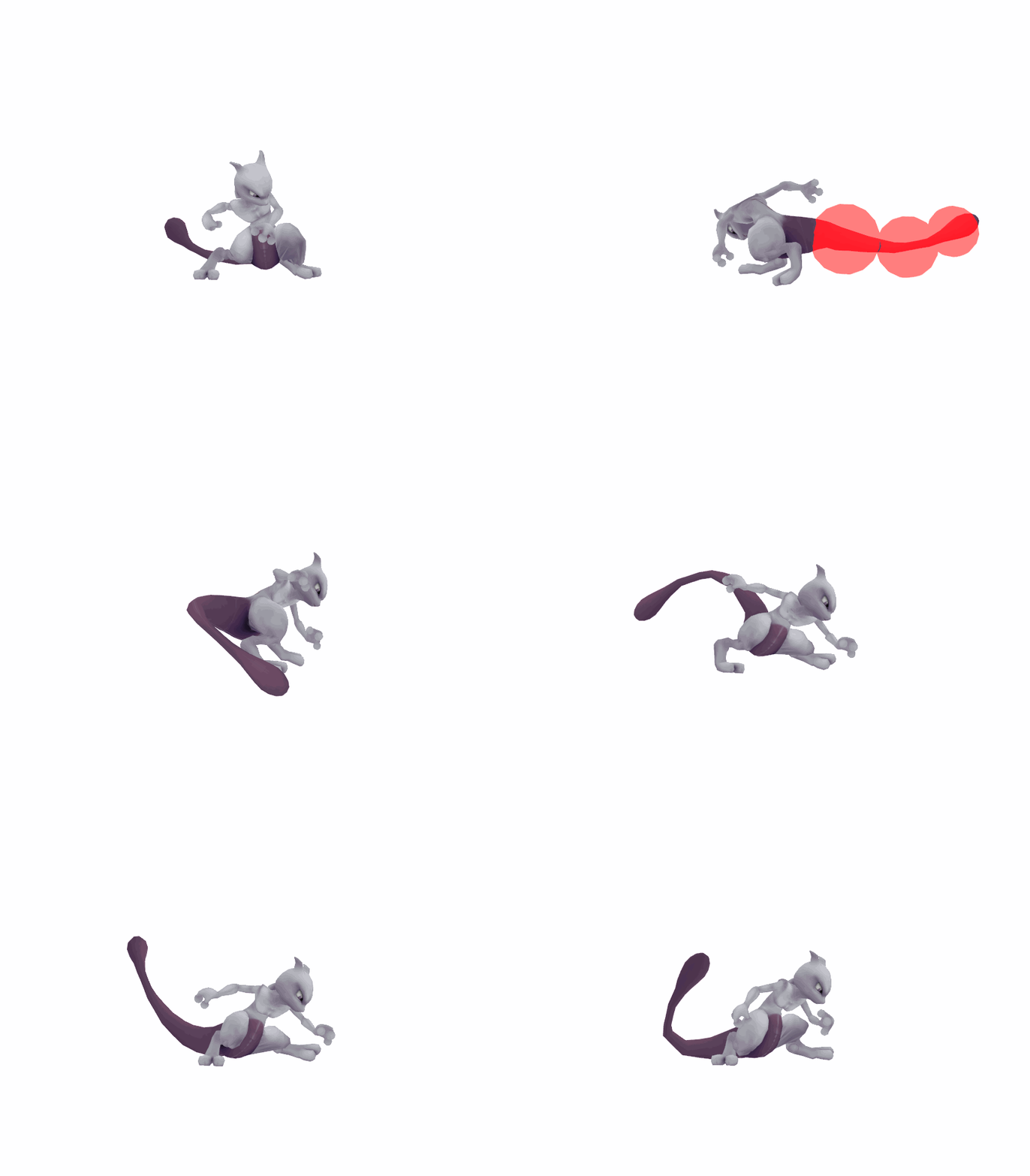
I predict that slingshot will benefit Mewtwo immensely. While it’ll make the character more vulnerable to shield pressure, Mewtwo never dealt with it well anyway, so nothing much will change on that end. On the flip side, being able to mitigate that pernicious tail hurtbox that has plagued Mewtwo throughout Ultimate through quick turnarounds is itself a major boon. But Mewtwo also sports specific physics that seems ideal for slingshots and the way it instantly boosts characters to max air speed: a combination of low initial air speed but also the third highest max air speed in the game. It doesn’t help when Mewtwo is being juggled, but on the ground, I think it’ll be a fundamental change to the character.
Mega Man is different in that he has extremely high air acceleration and a strong (though not Mewtwo-level) max air speed. Although I think he potentially won’t benefit quite as much, the slingshot looks like it’ll still be a great asset. The tech will add an extra trick to his already strong and wiggly neutral, and I can see every move of his being useful with this new trick.
My only worry is that in a game where out-of-shield options are already bad, things might get a whole lot worse. But with the added layers I predict the slingshot will open, it’s going to make for a more dynamic experience.
After messing around recently in Training Mode in Smash Ultimate, I made an interesting and useful discovery regarding Mewtwo: a simple move I’ve begun to call the “Shifted Teleport.”
How to Do It
In Ultimate, if you dash or run at a ledge or platform edge but let go a little before you actually hit it, you’ll stop at the ledge instead of running off the platform. As your character halts their forward movement, they’ll usually go through a small stopping animation, like a skid or similar.
In the case of Mewtwo, it’ll either start to lean their body up out of a dash, or do a little spinning animation out of a run. During this animation, if Mewtwo performs a Teleport, the game will not consider Mewtwo to be starting the teleport from the ground. Rather, because of how Mewtwo’s body is shifted forward a bit, it’ll be as if Mewtwo is Teleporting from the air, and this influences how Mewtwo exits the Teleport as well.
In the video above, you can see the difference between simply Teleporting when teetering at the ledge (Mewtwo comes out of the Teleport grounded vs. using a Shifted Teleport (Mewtwo is considered slightly above the ground and therefore gets the extra bit of a distance).
The Second Piece of the Puzzle: Teleport Shortening
The extended Teleport is a practical utilization of the Shifted Teleport, but there’s more. First, let’s look at another technique available to Teleport characters called “Teleport Shortening” or “Short Warping,” as demonstrated on Youtube by a user named Kaiser:
Essentially, if you pick the direction of your Teleport using the c-stick instead of the control stick, you exit the Teleport at a slightly shorter distance, no matter which direction you pick. The timing is a little strict, but far from impossible to pull off. As demonstrated in the video guide, this can help with things like ledge canceling, i.e. using Teleports to slip off ledges as an advanced movement technique.
Here’s a video I uploaded showing how Shortened Teleports can help out Mewtwo on Kalos:
Notice how Mewtwo was falling off and dying, but with Shortened Teleports, things turn out differently. Also note that the angle to do these was straight down on the c-stick, 270 degrees. No need for fancy obscure angles or anything, which is a huge boon for players like me who aren’t good at being so consistently precise on the stick.
Shifting + Shortening = Even More Possibilities
Now, what happens when you combine Shifted Teleports with Shortened Teleports? Here’s one result—an easy ledge-trump method from on stage:
If you tried this from a standing position and a normal Teleport, you’d simply stay on the ground. If you do the shifted Teleport but non-shortened, you fall to your doom. It’s only by combining the two that this is possible.
Going back to ledge cancels, Mewtwo has a much more difficult time pulling them off than Palutena, and often risks self-destructing when trying. Part of this is that Mewtwo’s Teleport is much more unforgiving in terms of the precision of angles required to successfully ledge cancel. For someone like me who’s bad at consistently hitting those angles, it can feel too daunting to even attempt. But in the video below, all you have to do is hit the c-stick straight down during a Shifted + Shortened Teleport, and you get this reliable ledge cancel down-air on Battlefield (also works on Small Battlefield).
Advantages of Shifting your Teleport
Shifted Teleports take a bit of time to set up due to the necessity of dashing and stopping, but I think it comes with a lot of benefits even before you factor in all the tech possible.
It allows for easy spacing of these techniques, because all you need to remember is “dash at ledge” instead of “stand at this exact spot, or else.”
Prior to the Teleport, you’re still considered grounded, so there’s less of a risk compared to being in the air or off-stage.
You’re facing forwards (as opposed to backwards), which can be helpful depending on the situation.
If done from a platform, you can safely threaten the ledge from a farther position.
You can always choose not to do the Shifted Teleport and do any number of other options: shield, jump away, etc. It’s fairly non-committal.
More Research Needed
I’ve only tested Shifted Teleports a little bit, so I think there’s a lot more to discover. For one thing, this isn’t exclusive to Mewtwo, and I’ve found that the shift you get from dashing at ledges affects at least Sheik and Pikachu. There are also other stages to practice on.
I’ll be uploading all future Mewtwo clips (including all of the above) into a Youtube playlist, so it should be easy to keep track. In addition all the Shifted Teleport stuff, I even have a couple other things:
In a surprising move, the current Pokémon TV anime (called Pokémon Journeys in English and simply Pocket Monsters in Japanese) recently brought back the original super legendary, Mewtwo. And not just any Mewtwo, but the one who debuted over 20 years ago as the Viridian City Gym’s trump card. Mewtwo is my favorite character in all the anime, so there’s a personal thrill to seeing its return, but there’s added significance as well: the continued acknowledgement of the canonicity of events in and connected to the first film, Mewtwo Strikes Back, and an emphasis that what has happened over the anime’s long history still matters.
The Pokémon anime tends to play a little fast and loose with its canon, resulting in strange discrepancies, especially when it comes to the divide between the films and the weekly series. Aside from Mewtwo Strikes Back, whose plot ties directly into the TV anime, it’s always unclear—likely intentionally so—whether the events of the other movies actually “happened.” This isn’t unusual when it comes to films based on popular anime—nearly all the Dragon Ball Z movies are non-canon, and the popular movie-only character Broly had to be reintroduced into that universe in a canonical entry, Dragon Ball Super: Broly.
In the world of Pokémon, this has meant that, despite the fact that certain legendary Pokémon are meant to be the only one of their kind, Satoshi (Ash Ketchum) has encountered multiple versions. After he helped a telepathic Lugia save the world in Revelation-Lugia, he would later encounter a different one that could not communicate psychically and, in fact, was trying to raise a child (Lugia is not supposed to be able to breed). Even Mewtwo, whose whole story is that it is a one-of-a-kind artificial creation made to be unmatched in combat, would see a second distinct version show up in the 16th movie.
In the recent episode, there is no mistaking that the Mewtwo seen is the original. When it first appears, Mewtwo slowly descends as ominous background music from Mewtwo Strikes Back and the Mewtwo Lives TV special can be heard. When Mewtwo speaks, its gruff yet soulful masculine voice is that of the original actor, Ichimura Masachika, as opposed to the feminine voice of the 16th movie Mewtwo’s Takashima Reiko. And when Satoshi and Goh lay eyes on Mewtwo, their reactions couldn’t be more different: whereas Goh is shocked by seeing something unfamiliar, Satoshi and Pikachu immediately recognize the Genetic Pokémon and even say its name.
However, it’s not as if Mewtwo and Satoshi start to recall their two encounters. Mewtwo doesn’t even say anything about already knowing Satoshi, and Satoshi doesn’t bring anything up beyond that initial recognition. While this might be frustrating to fans who’d like to see a more concrete nod to Mewtwo and Satoshi’s connection, I think the current anime is trying hard to balance a lot of different paradoxical elements that exist within Pokémon and Satoshi himself. He’s somehow both the veteran with years of experience under his belt and the plucky young amateur who has much to learn—perpetually 10 years old for over 20 years. Satoshi’s many adventures have happened (including at least one film), but he’s also still meant to be an audience-representative character for young viewers tuning into the anime for the first time, even as Goh fulfills a similar role (though his character is closer to a scholar or researcher). Furthermore, by having Satoshi not say much, it reinforces the idea that he hasn’t let his previous experiences get to his head. A similar moment happens in the second episode of the current series, where Lugia speaks to Satoshi (and only Satoshi) telepathically, hinting that this one might just very well be the one we see in the second movie.
Trying to fully reconcile the Pokémon anime canon would be a foolish endeavor because it’s only as consistent as it needs to be in any one moment. Satoshi is forever a challenger, even as he wins championships. But given what the anime is trying to be, a long-running series that wants to feel both familiar and new at the same time, it’s not a bad place to be. And seeing the original Ichimura-voiced Mewtwo n the year 2020 is a nostalgic and thrilling experience. Mewtwo’s appearance speaks to the idea that the past of Pokémon still matters even as we continue to move into the future.
Between showers, fools, and lambs, April is a month of change and transition. It’s only appropriate then that I try to evolve as well! As always, it’s with the help of my friends and Patreon supporters that I continue to try and improve Ogiue Maniax:
General:
Johnny Trovato
Ko Ransom
Alex
Diogo Prado
Sasahara Keiko fans:
Kristopher Hostead
Yoshitake Rika fans:
Elliot Page
Hato Kenjirou fans:
Elizabeth
Yajima Mirei fans:
Machi-Kurada
So, the first change I’m making is a small adjustment to my schedule. Since 2010 I’ve generally structured my weekly posting schedule to be posts on Tuesday and Friday with at least the occasional lighter post on Sunday, most typically a Fujoshi File entry. However, I’ve noticed that most of my readers come in on Sunday, and to give my lowest-impact content at that point feels like a shame, because if you’re coming to Ogiue Maniax I believe it’s to read something interesting. Because of this, I’ve decided to switch Sunday to being a main posting day, with either Tuesday or Friday being less heavy. I’m still on the fence on which one to use, but most likely it’ll be Friday. I hope you enjoy the change, and of course, if you miss the post it’s always there in the archives.
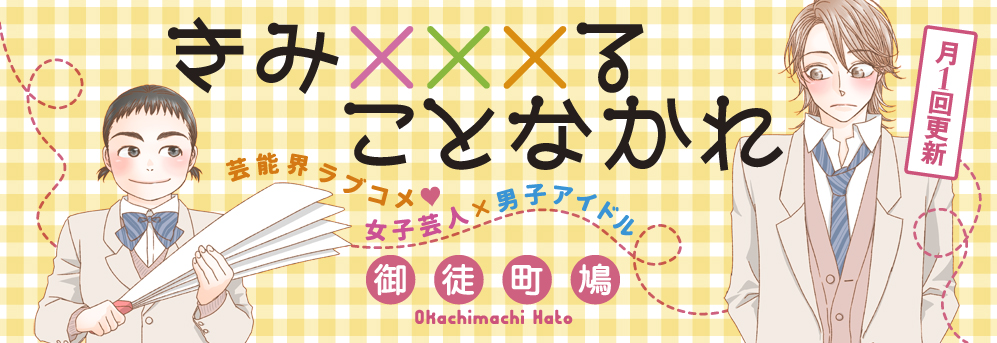
A second possible change is adding another series other than Genshiken for me to review regularly. The title is Kimi xxxru Koto Nakare(“You Can’t Do That”), the new monthly manga by Okachimachi Hato (creator of one of my favorite manga, Fujoshissu!) about a high school romance between a male idol and a female celebrity comedian. The question is, how should I cover it? To help me with this, I’m using a handy dandy poll:
Keep in mind that this is just for feedback and the winning answer won’t necessarily determine what happens. Also, I mistakenly thought it was a weekly manga, so a previous Patreon post of mine mistakenly had weekly options.
As for what’s happened on the blog over the past month, the biggest event for Ogiue Manaix and all current Genshiken readers definitely has to be the latest manga chapter, which concludes the Madarame harem story. I won’t say much more, so go check it out if you’re curious as to what goes down and my thoughts on it. Also, I need to point out that a funky translation of Chapter 122’s contents has been going around, and it provides an inaccurate image of the characters. In response to this, I’ve also translated a couple of small but vital excerpts from the chapter in the hopes of clearing up the confusion.
Speaking of reviews, I also finally updated the Reviews section of the blog. I neglected it for about…a year and a half? orz
I also talked last month about my concern over stagnating as a writer. My smart and ever-perceptive friend David Brothers gave me some advice in response to one of my Apartment 507 articles on Yandere characters, which is that I should think about putting more of myself into my writing. I think that ever since I’d gone in a more academic direction it’s improved Ogiue Maniax in a number of ways. At the same time, that sort of more casual and personal feel, while still present I believe, might not be as apparent. Sometimes I have to be more friend than teacher.
Three final comments:
Shout outs to Abadango for winning Pound 2016 using 99% Mewtwo (with a dash of Meta Knight). It’s the first major tournament in Super Smash Bros. for Wii U that has been won by a Mewtwo.
Some cool and mysterious fellow recently published an academic article about the science fiction manga 7 Billion Needles in the journal Japan Forum. If you’ve got access and that’s your sort of thing, maybe check it out?
This past weekend was the final Love Live! concert for the original μ’s girls. Love Live! forever! Hanayo banzai! Also, sorry about the April Fool’s joke (not sorry).
This past weekend was the international Super Smash Bros. tournament known as Pound 2016. There, in the stacked, 500-man bracket for Smash Bros. for Nintendo 3DS & Wii U, a Mewtwo took home the gold for the first time ever at a major event. To a Mewtwo player such as myself, this is undoubtedly the most significant result thus far in the history of the game.
The player behind Mewtwo was Abadango, who at this point is a well-known name in the Smash 4 competitive community. He’s used a great number of characters throughout the life of Smash 4, and whether it’s been his creative Pac-Man, his dangerous Wario, his punishing Meta Knight, or now his Mewtwo, Abadango’s play turns heads. As someone who values deadly powerful combos and setups, the recent litany of improvements to Mewtwo have made the character an enticing choice for Abadango, though he has also expressed concern on his stream over its unforgiving nature. Nevertheless, Mewtwo’s worked out for him. Cutting through a sea of difficult opponents including VoiD’s Sheik and Ally’s Mario, Abadango made Mewtwo look deceptively simple, but anyone who knows the character is well aware that Mewtwo is anything but.
Mewtwo’s history in Smash 4 is a wild one. Designed from Day 1 to be a “glass cannon,” a character that is strong offensively but light and easy to KO, Mewtwo has benefited both from dedicated players pushing the character forward (such as LoF Blue, Mew^2, Killer Jawz, Rich Brown, and The Reflex Wonder) and from the “hand of God,” as the Genetic Pokemon might be the most buffed character in Smash 4. Mewtwo is now faster, hits more reliably, combos better, and more. The number of improvements that have been bestowed upon Mewtwo are nothing small, though it’s worth pointing out that among many fans of Smash for the past three months (since the buffs started happening) that people still doubted Mewtwo’s prowess. How could Mewtwo possibly be truly good, when the character is still very large, extremely light, and easy to juggle? The answer is, with an amazing versatile kit that allows Mewtwo to exert pressure at almost every point during the game.
Don’t underestimate Mewtwo’s Down Tilt
Even in its darkest days, I never believed Mewtwo was truly a terrible character. Due to the unforgiving nature of its design (second lightest character in the game), Mewtwo makes you feel terrible for your mistakes. One wrong move and you can end up questioning your own existence. A Mewtwo played to perfection would still have been a force to be reckoned with even before the patches, but reaching that point and maintaining it was easier said than done. Now, I believe that a sub-optimal Mewtwo is still going to feel the sting of their mistakes (only Mewtwo now has more tools to avoid those mistakes in the first place), while a refined Mewtwo is easily high or even top tier. The fact that the top Mewtwo players present such a range of play styles—aggressive, defensive, technical, slippery, mind game-oriented—shows just how much potential the current Mewtwo holds.
That said, I think that the biggest change to Mewtwo that has come with the improvements both in the players and in the character is that Mewtwo now has access to a powerful ingredient that it lacked previously: fear. At first, Mewtwo could not instill fear in opponents, and that meant Mewtwo was always on the back foot because of how easy the character is to KO. Now, things are different.
It’s not just any fear, however, but more of a fear that’s mixed with the sweet scent of opportunity. When you fight Mewtwo, and you’re on your last stock while Mewtwo has a 60% lead, you’re aware of how good Mewtwo is at dealing damage and sealing stocks.
Then you remember, Mewtwo’s light and easy to kill. Opportunity knocks. “All you need to do is capitalize on one or two mistakes and the game isn’t just even, it’s arguably in your favor due to the weight disparity!”
The temptation is there, but so is the terror. Case in point, in an interview after winning the weekly tournament Wii Bear B-airs, LoF Blue mentioned that he switched from Sonic the Hedgehog to Mewtwo because the threat of Mewtwo’s myriad kill options forces the opponent to play differently at key moments.
A similar pressure is also placed onto the Mewtwo players, who are aware of how fragile their character is. If you’re down as Mewtwo it’s possible to make it back, and all you need to do is to not get hit, ever. A good Mewtwo draws strength from this tension, from teasing that glimmer of hope while still emanating a threatening aura.
If you’ve decided to pick up Mewtwo after Abadango’s win, I have one piece of advice for you: Be prepared to cry into your oatmeal as you die at 65% off of one critical mistake. Half the battle is a mental one. You have to maintain your composure as you’re getting bodied, or else the psychological damage you take just gets worse and worse. If you still stick with the character even after all that abuse (or maybe you’re kind of a masochist), then you’ll find a strong ally.
Also, if you’re interested in learning more, check out Dabuz (the best Rosalina in the world) and his analysis of Abadango’s Mewtwo:
—
If you liked this post, consider becoming a sponsor of Ogiue Maniax through Patreon. You can get rewards for higher pledges, including a chance to request topics for the blog.
This month I’m happy to say that the Ogiue Maniax Patreon is currently at almost $100, thanks to my generous patrons both new and old. Even getting close to the three-digit mark is kind of like a dream, and I hope to continue to provide interesting content for my readers.
This past month, I’ve gotten around to making a number of posts I’ve been planning for a while, most notably my review of the fujoshi friendship manga Fujoshissu!, my first look at DLC character Mewtwo in Super Smash Bros. for Nintendo 3DS & Wii U, and my review of the anime about anime, SHIROBAKO. In the case Fujoshissu! I’d been anticipating writing the review of years.
This month’s special Patreon sponsors are:
Ko Ransom
Alex
Johnny Trovato
anonymous (not Capital A “Anonymous”)
One of my contributors wanted to remain anonymous, but because they fulfilled the “Decide My Fate” tier, I wanted to mention them as I am writing a special post this month. As always, if you’d like to request a topic for me to write, you can pledge $30 or more to my Patreon. If you don’t want to or can’t contribute that much every month, you can always change the amount to something lower, or force a maximum limit on how much you give.
For this month, I’d like to ask what people want to see out of my rewards and goals. I understand that my goals and sponsor rewards aren’t exactly world-shattering, and while I’m certainly not willing to sell myself out, I’m curious as to what people would like to see. Perhaps Skype conversations once a week on any topic? Post requests with unique twists? Drawing requests? I’m not sure if I’d be able to do everything, but I’d like to at least offer more.
In terms of milestones, I’m open to suggestions. How would people feel about a tongue-in-cheek negative review of Genshiken and/or the character review of Ogiue?
Upon hearing Mewtwo in Super Smash Bros. for Nintendo 3DS & Wii U for the first time, I was convinced that they had brought back the original actor, Ichimura Masachika, from the film Mewtwo Strikes Back. However, it actually turns out to be someone doing an excellent imitation (with the help of a voice filter), and whose acting chops are impressive in their own right. While the new actor Fujiwara Keiji might not have the cred of being an established theater actor like Ichimura is (he’s most famous for playing the titular character in the original Japanese Phantom of the Opera), you might know him for some of the following roles:
Ladd Russo in Baccano!
Nohara Hiroshi in Crayon Shin-chan
Kuzuhara Kinnosuke (Biker Cop) in Durarara!!
Holland Novak in Eureka Seven
Maes Hughes in Full Metal Alchemist (both original and Brotherhood)
Ali-al Saachez in Mobile Suit Gundam 00
Hannes in Attack on Titan
Jake Martinez in Tiger & Bunny
I actually had my suspicions because Mewtwo makes certain sounds in the new Smash Bros. that I don’t recall from Super Smash Bros. Melee, but I chalked it up to my own faulty memory. It’s also a lot more difficult to hear because only the Japanese version has voiced victory quotes. It was the same in Melee, except you could change the language settings there to Japanese, which is how I and a lot of other people learned that Mewtwo had victory quotes in the first place.
Here are videos of the old and new voices for you to compare:
Old (ignore the skins; they’re from a mod)
New
And for fun, here’s a video of Ichimura Masachika as the Phantom of the Opera:
—
If you liked this post, consider becoming a sponsor of Ogiue Maniax through Patreon. You can get rewards for higher pledges, including a chance to request topics for the blog.
It’s been six months since Mewtwo was announced as a downloadable character for Smash 4, but it’s felt more like a lifetime. With the vague arrival date of “Spring 2015” and not a single image beyond a basic character model, information was scarce, and it left Mewtwo fans such as myself starving. Then came the April Nintendo Direct, which not only showed Mewtwo in action and gave an April 28th release date (April 15th for people who registered both games through Club Nintendo), but also revealed the return of Mother 3 hero Lucas as well as a worldwide poll asking who you want in Super Smash Bros. Suffice it to say, it’s been crazy.
(More on the poll in the future. Stay tuned!)
That brings us to today. As one of the many people who bought and registered both the Wii U and Nintendo 3DS versions, I’ve had the privilege of getting early access to Mewtwo, and I’d like to give my impressions. This comes from the perspective of someone who used the character avidly in Super Smash Bros. Melee (though not so much in a high-level competitive sense), as well as a long-time fan of Mewtwo as a character.
On an aesthetic level, Mewtwo looks so much better than it did in Melee, with body proportions closer to more recent depictions (taller, smaller head, etc.), as well as much more detailed animations. Though all of Mewtwo’s moves are more or less the same as they were back in the Gamecube era, they all have an extra bit of flair that really captures the essence of the character. When Mewtwo does a back throw, it effortlessly lifts the opponent through its telekinesis and, with its eyes closed as if it’s discarded a piece of trash, launches them. The voice, which I know was a bit of a concern for people, is actually just the same as its Melee voice, veteran theater actor Ichimura Masachika. Actually, it’s literally the Melee clips re-used, only that we don’t get the option of changing the game language to Japanese and hearing Mewtwo speak actual lines. I’m not totally against English dubs, but a part of me would have been a bit sad if this had been replaced.
In terms of gameplay, the first thing I want to say is that it actually took me less time to figure out how Mewtwo is supposed to function as a character than it did for me to learn Mega Man, who has been my primary character (the spotlight will now be shared between Blue Bomber and Genetic Pokemon). Once you get a sense of Mewtwo’s attributes, including its attacks, its speed, and its weaknesses, its game plan becomes clear. Mewtwo is a glass cannon, with an overwhelmingly powerful offense contrasted by being one of the lightest characters in the game who’s also one of the largest targets out there.
Especially coming from the perspective of a Mega Man player, Mewtwo’s attacks flow together incredibly well. A lot of its attacks, namely down tilt, up tilt, Side Special (Confusion), and Down Special (Disable) are designed to set opponents up for juggles or follow-ups. There aren’t very many reliable combos from Mewtwo, but a lot of the character is about forcing 50/50 guessing situations that favor you in terms of reward, and you can do things like Confusion -> down tilt, dash attack, forward air, second jump into up air. If you’re not someone who plays and found that a bit confusing, just know that Mega Man by comparison is lucky to get more than 3 hits on an opponent while juggling.
Another feature of Mewtwo’s is that it’s actually much faster on the ground now compared to Melee, and both the range and power of its attacks have been increased. Dash attack in particularly is affected positively by this new-found speed and range, as it’s easy to catch someone landing with it, pop them up in the air, and start a juggle. Mewtwo also now sports some of the most tremendous and reliable kill power in the game. Shadow Ball has more kill power than Samus’s Charge Shot and can be spammed more reliably than Lucario’s Aura Sphere. Up Smash comes out quickly and is absurdly strong, KOing many opponents off the top at about 90%. Forward Smash and Down Smash are slow but powerful, and their weak points can be mitigated through setups such as Confusion and Disable. In particular, if you Disable someone at about 80% and charge a smash attack, they’re almost assuredly going to get taken out.
Mewtwo also eats shields for breakfast, and it’s kind of frightening to see just how effective it is at whittling them down. Many characters have attacks that can either destroy shields or do massive damage to them, but none are quite as reliable and effective as Mewtwo’s Shadow Ball. Its only real weakness is that it takes a while to charge, but once you have it at full power, it has positive effects whether it hits or is blocked, and its erratic trajectory can make it difficult to avoid through dodging. Even if it doesn’t hit anything, Mewtwo can act quickly out of the move allowing follow-ups, and for those characters that love to reflect projectiles, Mewtwo now has a properly-working Confusion that can send it right back for a game of Ocarina of Time-esque volleyball.
Of course, it wouldn’t be Mewtwo without some strong throws, and it sports some of the best around. All of them do significant amounts of damage, somewhere between 9-11%. Back throw is a decent kill move, and up throw is the strongest in its class. With a good amount of rage (in Smash 4, characters become stronger as they take more damage), up throw can KO most opponents between 120-140%. While that might not seem too impressive, and it’s actually weaker when compared to Melee, it’s important to remember that, unlike many other killing throws (which are mostly back throws), Mewtwo’s is reliable at pretty much any point on the stage, instead of requiring you to be closer to one side or the other.
That’s Mewtwo on offense. Mewtwo on defense is another matter, as it is actually one of the lightest characters in the game, even easier to KO than Mr. Game & Watch. Combined with its large frame, it takes attacks easily, and doesn’t have many moves that can keep it from being juggled. Somewhat similar to Mega Man, Mewtwo’s main game plan is to drift towards the edges to avoid follow-ups, and thankfully a combination of excellent air speed, huge jumps, and the best teleport in the game means that it can often escape. However, because Mewtwo is so frail, it sometimes doesn’t matter, as a stiff breeze can send it reeling. In other words, the basic principle of Mewtwo is to deal a crazy amount of damage before the opponent gets the chance to touch you, otherwise you’re probably in trouble. In this way, Mewtwo somewhat resembles Akuma from Street Fighter, another character known for having high damage and low health.
Regardless of how good Mewtwo is as a character in the end, the collective effect of all of this is that Mewtwo feels more representative of the character’s original concept. In the original Pokemon games, Mewtwo is among the strongest in the game, with insanely high offensive stats and relatively good defensive stats. In an effort to promote game balance, the creators of Smash 4 clearly decided to make these aspects more extreme by giving it such terrible defenses, but I think this plays into Mewtwo’s character more than what it had in Melee, which generally amount to having a few decent moves wrapped up in a bunch of terrible qualities. Now, at least those terrible qualities are equally met with terrifying potential on offense. Destroy or be destroyed.
I do find it kind of interesting that the two characters I picked are the ones that are deceptive in terms of size to weight ratios. Mewtwo is very large and extremely light, while Mega Man is much heavier than he looks. It also means that their game plans are also somewhat opposite, as Mewtwo is a very unforgiving character while Mega Man can be afforded more mistakes. Whether they complement each other or succumb to the same issues, only time will tell.
—
If you liked this post, consider becoming a sponsor of Ogiue Maniax through Patreon. You can get rewards for higher pledges, including a chance to request topics for the blog.



 OGIUE MANIAX