
 For the life of me, I’ve always had trouble with musical concepts like rhythm and beats. Even though I was in a couple of band classes as a kid, and even when I’ve tried to read up on it or look up videos, I just couldn’t wrap my head around these things. But recently, I think that’s starting to change, and I actually have manga to thank.
I recently began reading a new hip hop dancing-themed series called Wondance. Because that genre of dance is likely unfamiliar to many readers, the manga uses its main character as a way to introduce ideas. Kotani Kaboku is a basketball player with a speech impediment who discovers that dancing might just be a way for him to express himself, and he even applies some of his b-ball knowledge to his new interest.

In Chapter 4, titled “After-Beat,” Kaboku’s dance teacher talks to her class about a crucial difference between the music they might be accustomed to (J-Pop, anime songs, etc.) and the kind they’re dancing to now (hip hop, R&B, and funk)–what part of the beat the music (and thus the dancing accompanying it) emphasizes. If a basic beat is “1-2, 3-4,” then pop music tends to emphasize the “1” and the “3” while hip hop emphasizes the “2” and the “4.” The “2” and the “4” are called the “after-beat. To put it differently, if the beat track of a song goes “bumm-chh, bumm-chh,” the “chh” is the after-beat.
For anyone who’s into music and dance, this is probably child’s play, but this one page was actually the catalyst for me to actually “get” ideas that I knew of but could never actually understand. That simple explanation above, as well as the demonstration of dance moves at the bottom of the page, opened up a window I thought would be forever inaccessible. I listened to both anime songs and hip hop, my ears now aware of that difference in emphasis. When I watched videos teaching about beats, I had a better notion of what they were saying.
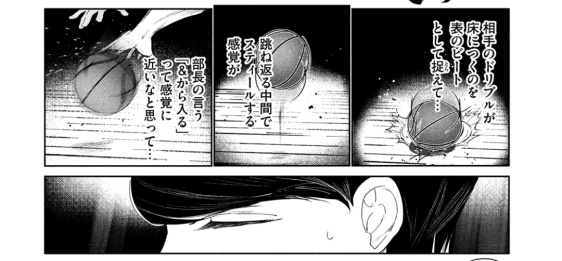
There’s even a moment from Chapter 3 of Wondance that subtly introduces these ideas, and in hindsight it’s actually brilliant. Kaboku notices something about the rhythm of hip hop dancing, and he compares it to dribbling in basketball: if the rhythm of the basketball is down-then-up, then hip hop feels like the “up” is being emphasized, and it’s the prime moment to make a steal. In other words, the ball hitting the floor is the “bumm” and the ball returning to the hand is the “chh.” When I remembered that scene, it hit me like a sack of potatoes.
While I highly doubt that I can ever truly feel the beat as so many others can, or apply it to something like rap or dance, I feel like a new world has opened up to me. It’s almost like learning a new language. I also think it might say something about me that it took reading a comic in a foreign language to finally comprehend something as pervasive as music, but maybe that’s part of the beauty of comics. And between Wondance in manga and Tribe Cool Crew in anime, I hope we see this genre continue to grow.


 Every year, New York Comic Con is a torrent of color and energy squeezed into a space that will barely fit everyone inside. But I’ve gotten fairly accustomed to it after so long, and at this point it’s basically an annual ritual. But eight months removed from the last NYCC in 2018, I still think about the
 OGIUE MANIAX