Spring 2013 Mecha Anime Retrospective (Majestic Prince, Gargantia, Valvrave)

Last spring marked an unusually robot-heavy season of anime where three mecha shows, Gargantia on the Verdurous Planet, Ginga Kikoutai Majestic Prince, and Valvrave the Liberator, took three different angles each of which had their own unique appeal. I originally wrote about them as a package, so now with all three shows finished (aside from the fact that Gargantia has another series on the horizon) I figure it’s best to look back on them all at once.

Ginga Kikoutai Majestic Prince, which had a strong tokusatsu or even 90s anime feel to it, ended up progressing almost as expected, but without it being tedious or losing something in the process. In shows like Majestic Prince, there’s usually some sort of humble beginnings, in this case the main heroes being the “losers” of their class, and comedy gives way to a more serious story as the narrative progresses until it ends up in a giant space battle. It’s par for the course, but while I can’t say Majestic Prince will change the way we think about giant robot anime, I do find that the show is a little bit of everything, nothing in particular that screams, “Wow, this is amazing!” but lots of minor things done well which make for an overall satisfying experience, and a more consistently forward-moving story compared to Gyrozetter. It’s a popcorn anime, something you might show to an anime club or a group of friends to relax, where you find yourself gradually more invested by the final string of episodes. Because of this, Majestic Prince is the show I simply have least to say about, though I do want to point out that it has one of the most memorable death lines ever. You’ll know it when you hear it.
Although Majestic Prince isn’t a show I can talk about too extensively in terms of conceptual or thematic depth (it skims the surface of topics like genetic engineering and human behavior at the very mosy), Gargantia on the Verdurous Planet is the strongest of the three shows in terms of both its ideas and how it presents them. Its initial format, where Ledo, a boy from another galaxy who knows only war, is exposed to the everyday lives of the Earth characters and their concept of family, acts as a part of the science fictional exploration of its world and which become the backdrop for the show to reveal its secrets was somewhat of a source of disagreement and controversy. As people wondered how the story would turn out, there were both complaints that Gargantia spent too much time focusing on the daily lives of characters and that it too much time on its narrative drama. Personally, I think it ended up striking a very nice balance, as we got to learn about the culture of Earth away from the galactic war which they were ignorant of (perhaps for the better), but when it came time to get “serious,” the show effectively used the context it established to make the circumstances and solution directly connected to the characters’ “everyday.”

Significantly, the series did not do the predictable thing and “bring the war to the people.” Instead, it brought the philosophy and ideas which came out of the eternal state of war in which mankind out there in space had become accustomed to, and challenged the people of the Earth (as well as the lead Ledo) to confront and address them. The everyday lives of the characters became the very “weapon” by which they could defy the way of thinking imposed by the world Ledo comes from, and I think there’s a lot to think about in that regard.

Out of the three anime, however, I suspect Valvrave the Liberator will, if not be the most memorable show, stick around the longest in the overall consciousness of anime fandom, though not necessarily for the best reasons. The rape scene in Valvrave is going to remain infamous, and it’s something which is impossible to ignore but also shouldn’t define the entire show. I really think the creators of the show wanted to use it for dramatic purposes but didn’t quite understand what they were getting themselves into, evidenced by the fact that they eventually just drop the subject after some questionable followups. Whether that’s better or worse than keeping at it, I’ll leave you to decide that, but one thing I will say is that having the victim still be in love with her attacker doesn’t inherently make for a bad or “harmful” story, as Watchmen manages to deftly incorporate something similar into its narrative and point out the difficulties associated with such a circumstance.

I was once asked why I kept up with Valvrave even though the show has a lot of odd and nonsensical twists to it, and I explained that the appeal of the show for me was about seeing if Valvrave was trying to celebrate the power of youth or criticize it. Even within the same episode it became difficult to tell if the show was saying, “Kids are the future, a source of new ideas and ideals,” or, “Kids are so damn stupid! Man, I can’t believe we let them touch anything!” I think by Season 2 it leaned more towards the former, but never entirely, and to its credit I think the second season was a huge improvement on the first, as its ridiculous qualities were focused down into a clearer direction while still remaining just as strange. Overall, I think the show turned out okay in the end even with the issues mentioned, if only because it managed to use its social media aspect to great effect, and shows a kind of tempered idealism. It also has a more satisfying conclusion than the Gundam 00 movie despite being fairly similar, but I’m not really sure why I feel that way.

It’s difficult to judge the effect of having so many mecha shows close together has had on anime, if any at all, but it is true that a number of new giant robot shows premiering in 2014, from Captain Earth to the bizarrely named Buddy Complex. I think what I liked most about having each of these shows is that even through their ups and downs, Majestic Prince, Gargantia, and Valvrave all manage to maintain their identities as shows, with developments, characters, endings, and themes which keep the mecha genre from feeling like “more of the same.” None of them are really similar in any way, and I hope this trend continues.

The Fujoshi Files 89: shrshr

Name: shrshr (シルシル)
Alias:
shr-chan (シルちゃん)
Relationship Status:
Single
Origin:
gdgd Fairies

Information:
shrshr is a fairy who lives in the Fairy Forest alongside her friends, pkpk and krkr. Energetic and cheerful, shrshr frequently brings up topics of conversation with pkpk and krkr, usually questioning some everyday assumptions, though the discussion typically spirals out of control. In addition to chatting with her friends, shrshr also practices (usually out of control) magic with them in the ”Room of Mental and Time” and peers into other worlds using the “Magic Spring Dubbing Lake,” where they fill in the voices for the people/things they see.

shrshr seems strangely familiar with a number of human anime, at one point wearing a scouter to detect power levels, and making multiple references to “Seiya” and “Cloths.” She also once transformed a gator-whacking game into a naked muscley men-whacking game.

Fujoshi Level:
Upon using the Magic Spring Dubbing Lake and seeing two men kiss in front of a gorilla, shrshr instantly identified one of them as an “uke” and pointed out that she loves this sort of thing. Afterwards, she even suggested doing a doujinshi about this, though for some strange reason spoke of a context “outside of gdgd Fairies.”

Future News: Cure Heart Restores Pulse of Japanese Economy


precuredreams

A trailer for the new Precure crossover is out, and it reveals that they visit the Dream World where you get to live out your dreams. The above screenshot shows a bunch of the main heroines and their aspirations, and they’re mostly in line with what we know about them already.

  • Saki wants to be a baker, like her parents.
  • Nozomi wants to be a teacher, just like mascot sidekick/love interest Coco.
  • Love wants to be a dancer, which we see her work on throughout her series.
  • Tsubomi, who loves flowers, wants to be a florist.
  • Hibiki wants to be a concert pianist, which is part of her general character arc in her series.
  • Miyuki wants to create picture books, which is one of her defining features.
  • And last but not least, Mana wants to be PRIME MINISTER OF JAPAN.

I know everyone else’s dream jobs are cool and all, and full of effort and wonder and something we assume they’d be amazing at given their never-give-up attitudes, but I feel like Mana’s is on another scale. Of course, just like the others it’s an extension of her identity in her own series (Mana is class president in Dokidoki! Precure), but even so that is some serious ambition for a girl in middle school, or a boy for that matter. She’s even able to imagine being selected by the National Diet.

precuredreams-mana-small

The more I watch Dokidoki! Precure, the more I think Mana is probably the best true “leader” character out of all the protagonists in Precure. She’s not my favorite in her series or in Precure as a whole, but just from this trailer she impresses me even more. On some level, I wouldn’t be surprised if they actually end her series 30 years in the future and she actually is Prime Minister.

A Message from Another Time: Genshiken Nidaime OAD

Volume 15 of the Genshiken II manga came out in Japan recently, and with it a limited edition featuring an OVA (or OAD as they call it) where they animate a couple of chapters from the original Genshiken. Covering Sue’s stay over at Ogiue’s apartment and the group’s new year’s shrine visit, it’s a part of the story that should be completely familiar territory to Genshiken fans, and watching it has made me want to both consider its role or purpose as the first Nidaime OAD and think a little about the story itself.

When you think about it, this OAD didn’t have to be the new year’s shrine visit, but it is in many ways the most appropriate given Nidaime. Ogiue’s trauma and the trip to Karuizawa would have been too long and arguably too heavy for this. The graduation in the last chapter of the original Genshiken would have been nice but is of course more of a finale than anything else. The no-dialogue chapter would have been an interesting part to adapt, but that would negate the entire new set of voice actors they’ve brought in. With the new year’s shrine visit, however, you get various threads which lead directly into Nidaime, particularly what’s been covered by the anime. Ogiue shows her softer side, which plays into her role in the second series. Sue expresses her desire to study in Japan, thus setting the stage for her increased prominence. The forlorn romance of Madarame is in full swing here, expressed almost painfully in its silence. Though Genshiken is in a sense full of turning points, this is a pretty major one in hindsight.

In terms of adaptation from manga to anime, I find it interesting that the characters were made to look like in the original series. It seems like a no-brainer but they had to do things like switch to older hairstyles and even styles of dress in order to capture the visual sense of how different the club was back then. In fact the entire mellowness of the OAD really stands out, and I imagine for anyone who watches it after having only experienced Nidaime, they would notice first and foremost the relative lack of bombastic energy. Even the references are from a different period of otakudom (“Sit, Nekoyasha!”).

One minor but noticeable change has to do with the fact that Ogiue has her default Series 1 hairstyle in the OAD, which is subtly different from the hair she wore to the shrine in the manga. There, instead of having the horizontal “antennae” on the sides of her head, Ogiue has more pronounced tufts of hair over her ears, and most likely creating another set of character design sheet just for this one-off Ogiue hair would have been too difficult or time-consuming. What’s important is that this specific hairstyle was not a fluke or a shift in judgment in the manga, as Kio Shimoku specifically drew Ogiue with that hair on the the limited edition cover of Genshiken Volume 15. Given her dress-up for Sasahara’s graduation a few chapters later, I feel like the purpose of this hairstyle was to show Ogiue trying to pretty herself up a bit (which in turn extends from a longer trend of her getting more fashionable after talking to Kasukabe).

If there’s one thing I really took away from  watching this, however, it would be a case of self-reflection, so I hope you’ll forgive me as I indulge in some introspection.

When Ogiue is drying Sue’s hair, she talks about how she’d like to be more like Sue, who isn’t afraid to be an otaku and to just be herself, which Ogiue has been trying to learn. This process Ogiue undergoes in the series is part of why she’s my favorite character, and it’s something I’ve tried to live by as well, to my benefite even, but as I get older I increasingly feel this pressure to not display my otaku-ness so openly. It’s not something I try to hide, but I realize that it’s important to know that sometimes other people won’t quite understand, and explaining who you are and why you love the things you do requires a certain sociability and deftness with words which often escape me. On some level, I worry that the essential advice of “be yourself” is something I’ve begun to creep away from even though it’s been so important to me.

Also, because I’ve managed to become more social and more comfortable over the years, I think what I basically am afraid of is becoming the very person I swore I never would, that person who passes judgment on others for being weird or socially awkward, not because I want to but because I might have lost touch with that feeling. That said, if I’m actively concerned about this, then that’s maybe for the best because it means I haven’t forgotten that idealism even if it doesn’t work out, well, ideally.

Best Anime Characters of 2013

For this year I’ve introduced an extra category to make things fair for the rest of the competition.

OGIUE CHIKA SPECIAL AWARD

This year marked the return of Genshiken to anime, and with it the re-introduction of the character whose very passion and turmoil became the cornerstone of this blog. Ogiue Chika has changed much since I deemed her the best female character of 2007, and Ogiue we see in Genshiken Second Season is not the same as the one which struggled with accepting her fandom. However, it is this very transformation within her which continues to inspire me, knowing that, as her eyes and her expression have softened over time, they increasingly reflect the growth and maturation of otaku culture, and of the positive influence of Genshiken. As Ogiue thrives, so does the club which changed her life, and it fills my heart with joy and discovery to continue to be witness to it. I would write more, but I think that I’ve already said more than enough.

BEST MALE CHARACTER

Armin Arlert (Attack on Titan)

Some of my favorite male characters are guys who are ones willing to take the supporting role, guys who defy the macho stereotypes which continue to haunt characterizations of men in media. Armin reflects this in spades, but I find that he is also great at contributing to how we perceive ideas like power, intelligence, passion, independence, and cooperation. Of the core group in Attack on Titan, Armin is clearly the “brains,” but it’s a specific type of brilliance which allows him to think on a more deeply conceptual and abstract level, and what impresses me most about Armin is this strength in combination with his weaknesses, and how he and his comrades  make up for each others’ weaknesses. Armin is highly observant, a clever strategist, and open to new ideas, but can be extremely hesitant, and to see him embrace his talents in the midst of despair and to take inspiration from Eren and Mikasa is one of my favorite qualities of his character. In a way, this is actually an award for the character interaction for Attack on Titan.

BEST FEMALE CHARACTER

Ichinose Hajime (Gatchaman Crowds)

I don’t think I’ve ever dwelled as long on a pick for best female character as I did this year, but in the end I feel there is no character more deserving than Hajime. To describe her is to engage in contradiction, a character who seems to defy all standards of anime characterization while adhering closely to them.  To talk about her role as the lead of Gatchaman Crowds is to realize that there are few who so utterly represent the concept of a main character as Hajime does, because Hajime is Gatchaman Crowds. Somehow Hajime is a protagonist who’s also a scene stealer, a presence which seemingly warps space around her and embodies all of the quirks which make the show special. Hajime shows that being positive doesn’t mean being naive, that conflict resolution through dialogue and and open mind can be just as thrilling as watching someone throw a punch, and that you can be stubborn about being open-minded. Hajime is simply a force of nature.

Final Thoughts

I find that as much as we like to think that anime is over and done, and continue to repeat that sentiment every year, that innovation (or something like it) continues to happen even in the areas most conventional. To hear that Gatchaman Crowds is ostensibly a remake of a 1970s anime classic is to bring to mind nostalgia grabs and numerous references to the old, or perhaps even a meeting of old and new generations, but Gatchaman Crowds largely defies all of those expectations. Attack on Titan is the big hit to the extent that it feels as if it has surpassed Naruto in its heyday, but even though both are of the ultra mainstream shounen battle manga demographic, Attack on Titan defies numerous trends through its bleak setting and the decidedly unglamorous position even its most important characters find themselves in, yet somehow this is also the source of its popularity. For both Attack on Titan and Gatchaman Crowds, I find that Armin and Hajime truly reflect how different and special each of their series are. Both are not the type to solve problems through violence first, but neither are they characters who are immobilized by the weight of responsibility or ones to abandon society physically or emotionally. They truly feel like characters who are a part of contemporary culture, yet will probably remain timeless.

Anime Secret Santa – Everyday Adventures of the Animest Couple: Acchi Kocchi

This review is a part of the Reverse Thieves’ 2013 Anime Secret Santa Project.

When anime fans throw around the term “slice of life,” they’re generally either enormously broad in its usage (anything that concerns non-fantastical events is slice of life!) or they’re talking about a certain type of slow-paced anime which due to the popularity of certain titles has become largely associated with a cast of primarily girls doing cute things. Acchi Kocchi falls more in line with the latter category, but where often such shows largely eschew the Y-chromosome, Acchi Kocchi decides that guys too can engage in relatively low-key hijinks without pillaging the secret garden of girlish innocence.

Acchi Kocchi follows a group of friends in high school, primarily a quiet, diminutive girl named Miniwa Tsumiki and her crush, a stoic boy named Otonashi Io. Though a lot of the show involves the characters doing silly things, the primary thrust of the humor is about highlighting the mutual feelings between Tsumiki and Io, and the seeming inevitability that they will become a couple (if they aren’t one by default already). Within this context, the gags can range from heartfelt to absurd, like a mix of Precious Moments cards and Roadrunner-esque slapstick. The humor never quite goes beyond the level it hits in Episode 1, so if you’re looking to experience increasingly powerful laughs it’s not going to happen but if you’re satisfied at that point you’ll remain content.

One thing of note is that the show enjoys making fighting game references. Not sure where that comes from but it’s appreciated.

Romance in this type of anime is not unusual, but it’s generally between two girls, and that’s even when putting aside the highly ambiguous shows which invite interpretation as yuri from the fans. Hidamari Sketch has Sae and Hiro, Kiniro Mosaic has Aya and Youko, Yuruyuri is…basically those combinations times ten. This is not a criticism of same-sex relationships in anime, more an observation about the perhaps surprising lack of heterosexual pairings, which Acchi Kocchi manages to not only include but accomplish in an entertaining and refreshing fashion.

I think that often the worry with a boy-girl romance in these shows is that one will act as the audience stand-in and the other will be the ideal (or ideally flawed) potential significant other, but Acchi Kocchi is more like if both of them were their respective anime ideals for the opposite sex. Tsumiki is small and cute, often portrayed with cat-like features, and is sort of like a fusion between Konata and Kagami from Lucky Star. While this is maybe more expected, Io’s low-key personality is less about being bland and generic and more about being an almost butler-esque bishounen. A lot of the gags involving Io involve him speaking with such natural and unconscious suaveness that the girls around him swoon. They’re quite the anime power couple.

My favorite character by the way is the scientist Katase Mayoi. While I could say quite a bit about how her quirky personality appeals to me, I think this screenshot explains it well enough.

Overall, I definitely enjoyed the show, and while it never felt entirely fresh it wasn’t stale either. Pleasantly humorous with a unique take on familiar territory in a genre which thrives on familiarity, Acchi Kocchi can be a nice change of pace for those who enjoy their so-called slice of life shows but want a bit more variety.

Call from Mighty No. 9, a Focal Point of Projected Ideals

mightyno9-call-e

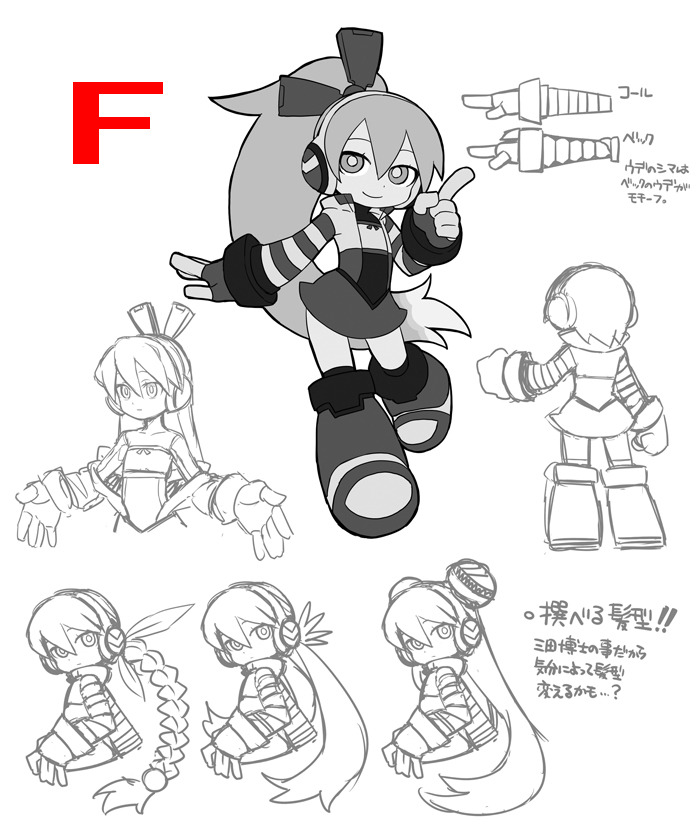
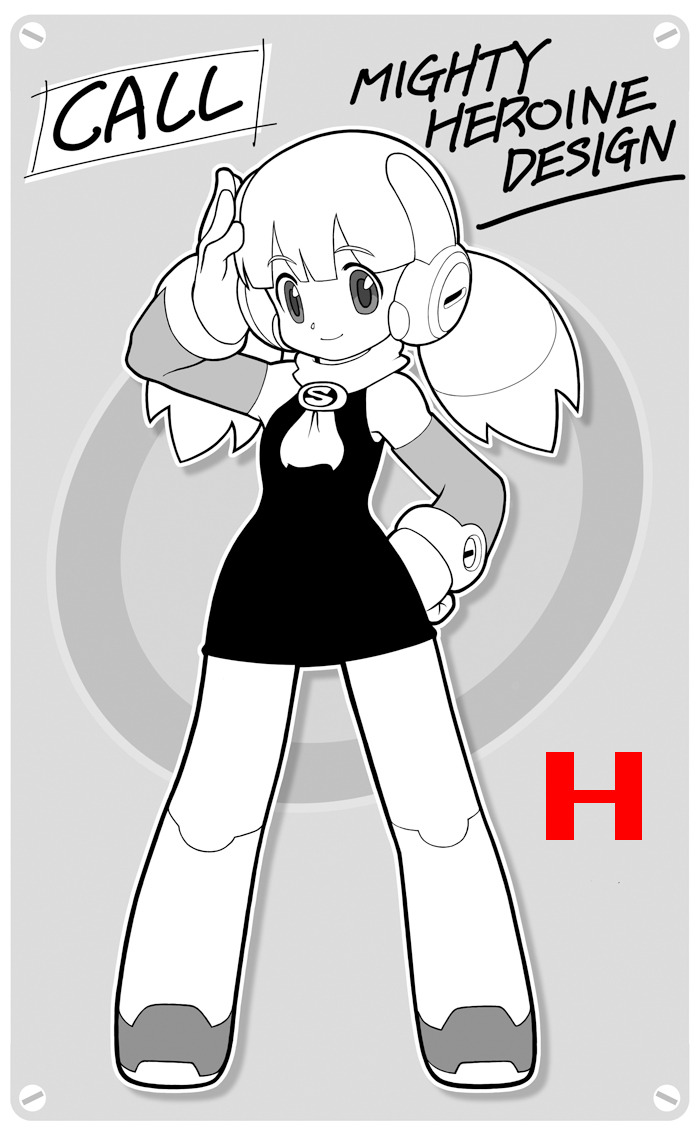
Given the success of its Kickstarter, it’s highly likely that you’re already aware of Mighty No. 9. The brainchild of Inafune Keiji, co-designer of Mega Man, it’s very much a successor to Mega Man, starring a robot with variable powers named Beck. While there are plenty of things to discuss when it comes to Mighty No. 9, one of the more fascinating topics is the “Roll” of the game, a female character named Call. Garnering enough fan support for a “Call gameplay stage” stretch goal to be reached, what is curious about Call is that her popularity was achieved well before we knew really anything about her.

From the very beginning of the Mighty No. 9 project, it was announced that there would be this female supporting character. However, she had no definitive design (though a few possibilities were shown), no determined color scheme, and very little information about her background or personality. Even her actual name was a later addition to the campaign, while these were the only notes eventually provided about her:

  • Call is a female robot originally created by Dr. White’s friend, Dr. Sanda, to help assist him with his research; she somehow avoided being infected by the virus causing all the other robots to go berserk and has pledged to help Beck.

  • Call was not imbued with the human characteristics that make Beck unique, so she’s more of a pure robot — as you might imagine, this contrast can lead to some interesting differences and misunderstandings whenever they interact!

And yet, even with this utter lack of information about Call, she developed a fanbase, such that the vote to decide what will become her finalized look has become a big deal among Mighty No. 9 fans.

mightyno9-call-f

A common answer these days for this sort of thing involves referencing Hiroki Azuma’s database narrative concept in a reductive fashion by pointing to how disparate features such as blue hair or a tsundere personality act as patchwork parts to create characters appealing to otaku, but I don’t think you can even refer to Call’s initial concept as a “database character.” It was less of a database and more of a less-than-1kb .txt file, and I think Call’s popularity actually comes from something else entirely.

mightyno9-call-h

My own guess is that the reason Call gained fans before we really knew anything about her is that her basic position, as a female character in a new video game which has as one of its guiding principles heavy interaction with the community during development, made her an open canvas for fans’ perspectives. Whether fans see Call as someone to potentially relate to, or an opportunity to establish a strong female character who can go a step beyond Roll in Mega Man, or even just as “the cute girl,” Call’s initial lack of features combined with faith in Inafune and the staff of Mighty No. 9 allowed people to project onto Call their various ideals. In this prototype state Call fans see in her the very best.

The Fujoshi Files 87: Akai Ringo

Name: Akai, Ringo (赤井林檎)
Alias: N/A
Relationship Status: Single
Origin: Okami-san & Her Seven Companions

Information:
Akai Ringo is a high school student at Otogi Academy in Otogibana City, where she works for the “Otogi Bank,” a school organization which helps with student requests in exchange for future favors. Patterned after Little Red Riding Hood and ending all of her sentences with the syllable “no,” Ringo exudes an image of youth and innocence. In reality, Ringo is a “rotten apple” with a cunning and manipulative personality, albeit loyal to her friends.

Ringo is best friends with her fellow Otogi Bank member, the wolf-like Ookami Ryouko, while supporting Ryouko’s burgeoning relationship with the timid Morino Ryoushi. Her feelings towards Ryouko are somewhat complex in that she would be very comfortable with a romantic relationship, but does not desire her normally otherwise. Ringo is also the half-sister of Shirayuki Himeno, a poor but beautiful fellow student who cares for seven younger siblings.

Fujoshi Level:
Akai once created a fictionalized movie where Ookami, Morino, and she fight the three terrorist Tonda brothers. The story called for the pig-like brothers to do possibly indescribable things to each other as the result of a penalty game.

I Heart Ira x Mako

I’m not really a big “shipping” sort of person, but I love the idea of having the giant Gamagoori Ira and the hyperactive Mankanshoku Mako from Kill la Kill as a couple. So far, the show’s featured various interactions between them, and the surprising level of respect Ira shows for Mako as well as Mako’s own ability to catch Ira off guard makes them come across to me as “equals” even if you can’t call them opposites. They do both operate heavily on loyalty, so maybe they have some similarities after all.

If only Mako had kept her 2-star uniform and its delightful delinquent-ness, they’d be a pretty fearsome combination. Of course there’s always still hope for them to bring it back.

Though, don’t ask me how that masochism stuff is supposed to fit in.

Coppelion Anime, Smooth and Round

I’ve come to the conclusion that the Coppelion anime feels like the Coppelion manga with its edges filed down. I don’t mean just that they’ve removed all references to nuclear radiation, or that if you add up all of the elements of each version that one is more “serious” than the other, but that there’s a distinct difference in presentation.

Though the manga is more overt with its criticisms of nuclear energy, at least at first, it’s also wackier in a lot of ways. Amidst the tragedy, characters make wild and contorted faces almost like they’re One Piece characters, and there’s even more fanservice to boot. Aoi, who comes across as more cutesy in the anime, has a greater degree of comic relief in her in the manga, and I think it just has to do with that sense of exaggeration.

Here’s Aoi in the anime:

And here she is in the manga:

Also note the difference in Ibara’s facial expressions.

I think in some ways, this difference in feel does more to change the contents of Coppelion than even the censoring, like the wackiness adds a certain element of permeating ugliness to the story which helps to foreground the social and environmental issues a bit more. That might just be my personal preference though, and I find as the show gets into the second arc it starts to adapt the original material better.