Diamond City Lighting It Up: Ogiue Maniax Status Update for February 2022

Happy New Year (again!) to all who celebrate the lunar calendar and the Year of the T-T-T-T-Tiger.

As the Omicron variant (hopefully) peaks at varying times, I’m naturally spending a lot more time indoors—even more than usual. A new anime season has made things easier, with returning favorites like Attack on Titan, Demon Slayer, and Princess Connect! Re:Dive, as well as interesting new stuff like The Kodama’s Lazy Life and Tribe Nine. I’m also catching up on Ranking of Kings, which I’d heard such good things about, and there are still a few shows like Slow Loop I’m planning to check out.

I’m also delving into the world of Webtoons a bit more with Higashimura Akiko’s A Fake Affair (perfect for Valentine’s Day maybe) as I also read through her autobiographical series Blank Canvas. Her stuff is amazing, and I will almost always recommend Higashimura works. I’m relatively inexperienced when it comes to Webtoon stuff, so I’m open to suggestions.

My webspace is still down, and the administrators appear to be MIA. It’s kind of a pain, but this blog is old enough that trying to find every image I uploaded during my earlier years and switching to new hosting might not be feasible. If I get to the point where I’m supposed to renew, well, that’s another matter.

In the meantime, here are my biggest Patreon members, who help keep Ogiue Maniax going.

General:

Ko Ransom

Diogo Prado

Alex

Dsy

Sue Hopkins fans:

Serxeid

Hato Kenjirou fans:

Elizabeth

Yajima Mirei fans:

Machi-Kurada

Blog highlights from January:

Shining in the Sea of Stars: Hakaioh – Gaogaigar vs. Betterman Part 3

My review of the final Gaogaigar vs. Betterman novel. Especially worth a read if you’ve played Super Robot Wars 30.

Monsters Growing: Rokudou no Onna-tachi Final Review

A full-series review of one of my favorite manga in recent memory, a delinquent harem manga that rises well above its premise.

Encanto is Too Real

Disney’s latest feature film hits hard on a personal level.

Hashikko Ensemble

Chapter 48 is the final chapter of Kio Shimoku’s high school music manga series! See how it all ends.

As a result, Kio Shimoku’s Twitter in January was a lot of talk about Hashikko Ensemble.

Apartment 507

Thoughts on the new season of Demon Slayer.

Closing

Every so often, I think about revamping my Patreon, as it’s been kind of stagnant in terms of approach for quite a few years now. One issue is that this is not my full-time job, and I don’t know how much I could actively devote to running it, so I’m hesitant to promise or aim for anything big. Would people be interested in Patreon-only content?

Shining in the Sea of Stars: “Hakai-oh – Gaogaigar vs. Betterman Part 3” Novel Review

WARNING: SPOILERS FOR THE FIRST AND SECOND GAOGAIGAR VS. BETTERMAN NOVELS

Hakai-oh: Gaogaigar vs. Betterman Part 3 brings the story of the Gaogaigar universe to a close, and what a journey it’s been. 24 years after the original TV series, we finally know the fates of all our brave heroes, and the tension and excitement never let up through this massive third volume. It truly does feel like the end of a long journey.

(Seriously, this thing is a monster compared to the first two.)

King of Kings

To start, since the release of Part 2, something major has happened to Gaogaigar vs. Betterman: It’s gotten an official name! The novels didn’t get licensed; rather, it became one of the titles in Super Robot Wars 30, where it was announced in English as King of Kings: Gaogaigar vs. Betterman. The term “Hakai-oh” is quite tricky to translate without sounding awkward and retaining enough of the meaning of the Japanese, and I find this to be an incredibly good compromise that also makes sure to pair well with the classic King of Braves Gaogaigar English title. It also gets translated as Conqueror-King in dialogue. Note that I call it Hakai-oh in the title mainly for consistency with my previous reviews, but I like these translations enough to use them for this review.

Gaogaigar vs. Betterman being in SRW30 also means that’s how most English speakers are likely experiencing the story, but there are a number of notable differences. So this review (as well as the previous two) might be worth checking out just to see how this plotline was originally handled.

The Story

Part 3 starts off with some of the Gutsy Galaxy Guard restored to their normal selves, with many dangerous and notable exceptions remaining. These “Conqueror’s Thralls” (previously translated as Hakai Servants) are still under the powerful influence of Triple Zero, which Mamoru, Guy, and the rest now understand to be not only the source of The Power, but the energy produced from a dying universe during a Big Crunch. The Thralls seek to bring everything to “provenance”—a reset to oblivion—leading to some fierce and emotionally difficult battles. Meanwhile, the Somniums still act according to their own beliefs, but their mysterious ties to humanity are tested, and their true motives are revealed. Mamoru and Ikumi’s Gaogaigo, Guy’s Gaofighgar, and more must be braver than ever before if they want to free their friends and ultimately fight against the Conqueror-King Genesisc Gaogaigar. But as they discover in their struggle, courage might just be the antidote to Triple Zero.

A Universe Unto Itself

I’m being something of a broken record at this point, but more than ever, the way in which the novel draws upon the entirety of Gaogaigar lore is still one of my favorite aspects. There’s enough explanation so that those who don’t have a degree in Braveology can still follow along, and it never feels overly reliant on nostalgia or old ideas. 

How does Mikoto being part-Zonuda affect her as a Thrall? What does Guy’s evoluder biology say about his potential future? How does the time dilation that impacted the old GGG affect their relationships with their friends and family back on Earth? The Somniums can fuse with each other to form Betterman Cataphract, but how far can they take it? All those questions are asked and answered while never losing sight of the main story, the fight against the King of Kings.

Even the climax towards the end of the novel is a huge nod to the final episode of the original TV series, one that feels like a progression rather than a retread, and builds upon an overall satisfying experience. 

The Best Battles Ever?

If there’s one thing that Gaogaigar is known for, it’s amazing fights. Even in pure prose without the benefit of animation, this still applies. I’m even tempted to call these particular fights the best the franchise has ever seen, and it’s largely because of how each one feels unique from the others, the way the stakes keep building up, and the desperate solutions that they need to find. How can they compete with Commander Taiga, whose stalwart leadership provided the backbone of GGG? The Goldion Crusher was their ace in the hole in the conflict with the 11 Planetary Masters of Sol in Gaogaigar FINAL, so what hope do they have when faced with a Silverion Crusher wielded by a terrifyingly powered-up Conqueror King J-Der? 

In each case, there’s the exciting push and pull so characteristic of Gaogaigar battles, but there’s also the sense that the characters are doing all they can to strategize, persevere, and fight. There’s a moment in one of the later battles where they creatively utilize the technology that allowed Gaogaigar to upgrade its Protect Shade and Broken Magnum into the Protect Wall and Broken Phantom, and Guy’s uncle Liger contemplates how, unlike most everything else they use, this was a purely human invention by Guy’s father, Leo. In Liger’s view, the Wall Ring and Phantom Ring are representative of humanity building upon and contributing to the boon of alien technology they received from Galeon so long ago—a fusion of Earth and Green-Planet science, not unlike Gaogaigo. It’s a beautiful moment.

And perhaps most importantly, the final volume answers whether “vs.” means “team up” in the Dynamic Pro tradition, or “confrontation” in the more conventional sense. The answer is a creative one.

Romance

While there are many couples and would-be couples in the Gaogaigar universe, it’s never been the focus in any real way. Here, though, the topic takes center stage in what feels like a pay-off. Whether it’s Mamoru and Hana as childhood sweethearts, the forged-in-combat bond of Soldat J and Renais, the central romance of Guy and Mikoto, or the more down-to-Earth and relationship of Keita and Hinoki, everything pretty much comes to a head here. All of them are entertaining to read, and I’m especially fond of how J’s versions of care and compassion tie into his warrior ethos—nothing like handing your girl your finishing move so she can wield it herself.

Issues

One criticism I have is that the series is 100% heteronormative in its romances. I’m not saying that they needed to reveal that Ikumi or some other character was gay or anything, and I understand that all of the above relationships are basically tying up loose ends from Gaogaigar and Betterman, but it’s still nevertheless something missing that could show that time has truly moved forward. I don’t think this omission makes Gaogaigar vs. Betterman bad or unenjoyable, but I find it’s worth pointing out.

I also think that the Betterman parts are significantly more confusing than the Gaogaigar sections. This might be because that series is less fresh in my mind, but one big difference is that most of the Gaogaigar-side characters come from the TV series and OVA. In contrast, while the human side of Betterman sees a large number of returning faces, the Somniums (the titular Bettermen) are for the most part new characters, and so it feels like there’s less to latch onto.

The last thing I’ll mention here is that the series has kind of a complex relationship with its portrayal of characters with disabilities. There’s great emphasis on how the scientific and technological efforts made have given those with disabilities the opportunity to lead lives they might not have been able to otherwise, and that what fuels this is largely love and compassion. At the same time, you have characters like Guy who, even in his previous cyborg form, comes across more as a “supercrip.” I’m not an expert in this subject, so I’d be interested in hearing others’ takes on this matter.

Favorite Touches

This is where the SPOILERS abound, so I’m putting a WARNING right here.

I’ve already touched on a number of things that stick out in my mind, but I want to elaborate a bit more on them here. It’s mostly the battles.

The aesthetic of the Silverion Crusher is nothing short of magnificent, with the Crusher resembling a giant flaming King J-Der head like it’s the most terrifying dullahan ever. The battle against it also has many moving parts that feel necessary because of what an overwhelming adversary it is. Gaogaigar fans know the sheer destructive force that is the Goldion Crusher, and the way they have to basically attack the units that spread out to create the hammerhead in order to prevent it from fully deploying, or else it’s game over. The way the fight comes down to Guy and Ikumi battling J and Renais in order to purify them also has a feeling somewhat akin to the final battle in Gurren-Lagann

The struggle against Conqueror-King Genesic is chock full of astounding elements, such as the fact that the fight is led by Gaogaigar (Guy), Gaogaigo (Mamoru and Ikumi), and Gaofighgar (now controlled by Renais) working together to take it on, with King J-Der and Kakuseijin V2 for support. In other words, it’s triple Gaogaigar vs. Genesic. As they fight, they manage to break apart Genesic’s Final Fusion, but then have to fight the separated but individually sentient Genesic Gao MAchines all at once, resulting in an additional challenge.

You may be wondering how it’s possible that vanilla Gaogaigar is part of this fight, but its core is actually the original Galeon pulled from the past by the Somniums. What’s more this Gaogaigar ends up combining with Betterman Cataphract to form Musou Gaogaigar, or Dream Armor Gaogaigar. The narration mentions that you could alternately call this Gaogaigar’s “Great Gattai,” making a reference to other Brave series combinations like Great Exkaiser and Great Might Gaine. 

Then, in that same struggle, we see the aforementioned use of Phantom Ring technology. More specifically, it’s actually about turning the “Global Wall” that helped restore electronic communications back to the Earth and switching it to a “Phantom Mode.” The very fact that the Global Wall was sitting there as a pseudo-Chekhov’s gun filled me with a kind of fiery joy—it had already played a role, but here was a second and even bigger one that feels both out of nowhere and logically consistent. That’s actually kind of this whole novel series in a nutshell. 


In a similar vein, King J-Der ends up combining with Earth’s technology to form the amazing-sounding Dimension Ten-TImes Pliers, which is King J-Der with Dimension Pliers for fingers. I want to see this in an actual animation so badly.

And during the climax, when it’s time to form Final Gaogaigar for the last battle, it’s not just Guy fusing with Genesic Galeon, but all the Genesic Gao Machines having fusions with other characters. It’s a lot like the finale of the TV series, where the Brave Robots have their AIs installed into the regular Gao Machines because they’ve been disabled by Mikoto-as-Zonuda. Goldion Armor and the Goldion Finger attack (essentially a giant hand consisting of Goldion Hammers for fingers) is amazing, but the thematic full-circle from the fully fused Final Gaogaigar stands out even more.

After all the fighting, we’re treated to an epilogue and an extra story. In them, we see how Mamoru and Hana have a child named Tsubasa (gender unknown), but also that Guy and Mikoto will accompany Galeon and the J-Ark crew to explore the universe. In other words, Guy is going back to his original dream of being an astronaut, and I think it’s such a beautiful way to end his story.

The “FINAL” Word

I love that these novels exist. While I wish this could have been animated from the start and given the treatment it truly deserves, the story told in these pages soars in ways that make me smile and have pride in being a Gaogaigar fan. If Gaogaigar vs. Betterman is a love letter, then it’s one that turns a romance into a marriage, and embodies everything great about the universe of its characters and heroes. In the afterword, both the original director who supervised these novels, Yonetani Yoshitomo, and the series author (who actually wrote for the TV anime way back), Takeda Yuichiro, approached these novels with the sense that they would cap off the story of Gaogaigar as a whole. I would never be against a sequel, but the fact that we the fans even got a conclusion is more than I could have hoped for, let alone having it end so well.


The Ongoing Dream of a Truly International Super Robot Wars

In recent years, the Super Robot Wars franchise has been looking hard at international fans, and that has been reflected in part by the mecha that show up in it. In interviews for Super Robot Wars T and Super Robot Wars 30, the game’s director mentions that titles like Gun x Sword and J-Decker were, in part, nods to fans outside Japan. It reminds me of how different Japanese giant robot series became the spark of inspiration in different parts of the world, as well as how I once had my own half-formed idea for an American-fandom-centric SRW. Together, all of this makes me want to entertain the notion of a truly international SRW that puts the entire spotlight on those anime and manga that introduced countries to mecha and maintain that enthusiasm.

Shows like Golion, Grendizer, Transformers, Groizer X, etc. Furthermore, I’d like to see the roster be even broader than that. In that respect, limiting it to things that can connect to anime might even be too narrow. Ideally, a game like this would include Robot Taekwon V and The Iron Giant.

One question that arose as I engaged in this thought exercise is whether series that were heavily localized should come in their original Japanese forms or their adaptations. Should Golion and Dairugger be two separate titles, or should they be joined under the Voltron banner? Then it hit me that Super Robot Wars is all about modifying plot details to make crossovers work. Thus, you could split the difference between the Japanese and the American versions, and just find a way to make Golion and Dairugger connected within the new storyline.

There are giant robot fandoms around the world with their own idiosyncrasies, and I’m actually a bit sad that I don’t know them all. I wish I was an experienced polyglot so I could explore these communities and memories in greater depth. I think the real reason I’d love to see an international SRW is because I want something that celebrates these histories.

Thinking About “New Romantic Sailors”

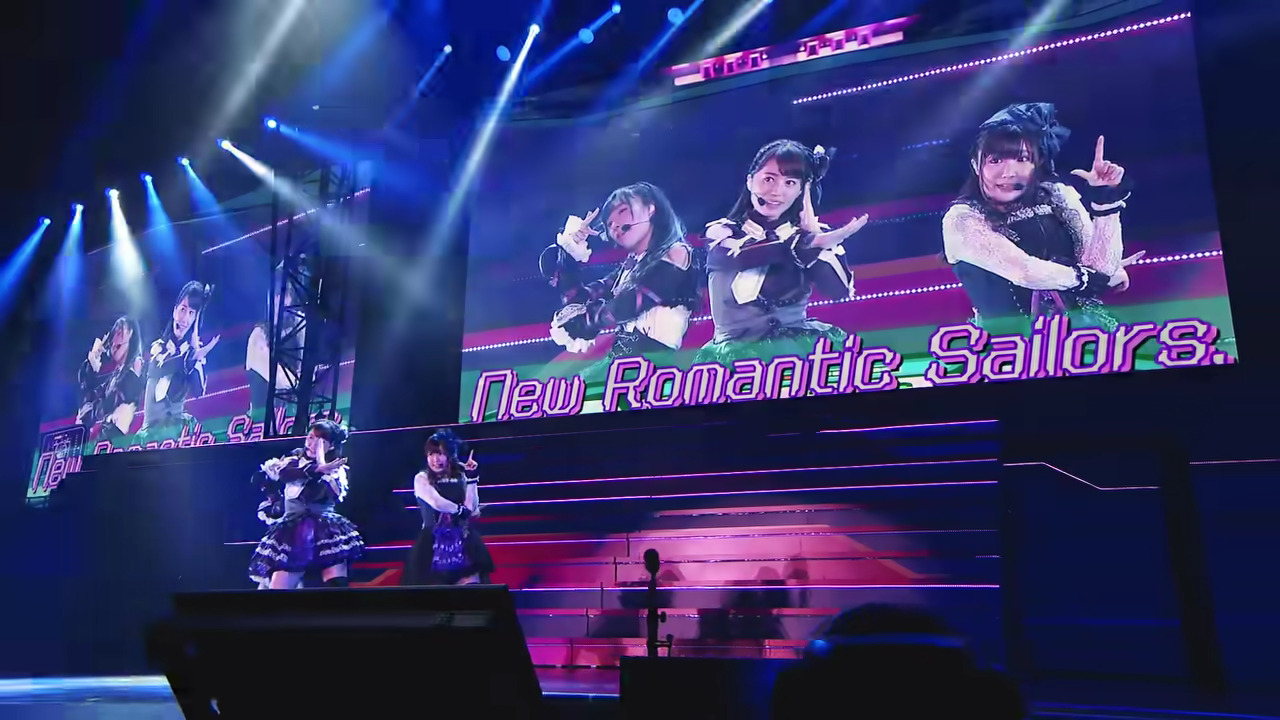
Of the many Love Live! Sunshine!! songs, “New Romantic Sailors” is a favorite of mine. Not only is it just a catchy tune, but the fact that I got to see Guilty Kiss perform it at Anime NYC over two years ago makes it a special memory. But what really makes it stick out in my mind is the choreography for live performances, specifically the poses in the above image that they take. 

On the left is Kobayashi Aika, the voice of Tsushima “Yohane” Yoshiko, a character who calls herself a “fallen angel” and her fans “little demons.” Aika just screams chuunibyou, like she’s trying hard to convey how dark and mysterious she is, or as if she’s about to break into villainous laughter any second.

In the middle is Aida Rikako, the voice of Sakurauchi Riko. Her arms, crossed at the wrists, are reminiscent of the “Specium Beam” seen in Ultraman. Riko is a bit of a closet otaku herself, but it also sets up one of the signature moments of “New Romantic Sailors,” when Riko shouts, “Riko-chan Laser Beeeeeeaaaam!”

And on the right is Suzuki Aina, the voice of Ohara Mari. In other songs, Aina also does a finger-gun, and it speaks to Mari’s background as an Italian-American who also sometimes dresses like a cowgirl. Associating Americans with guns feels a little on-the-nose, but it’s also kind of fair.

“New Romantic Sailors” full song

I think this stuff is probably obvious for more hardcore Love Live! fans, but I just wanted to write about it to show my appreciation for its cleverness. What I really love about these poses is the fact that they’re all similar yet unique—each one’s a cross-arm pose, but the differences between them exemplify each character’s persona perfectly. Often, it feels like the dance moves for Love Live! songs don’t necessarily speak to each individual character’s traits, yet “New Romantic Sailors” has it in spades.

What a Trip: Sonny Boy

To call Sonny Boy an unusual anime is to make one hell of an understatement. When you start off with a setting of high school kids stranded in some isolated world while possessing superpowers, it seems like it’s gonna be some variation on Lord of the Flies. But Sonny Boy goes beyond even the expectations it sets for itself narratively while aesthetically occupying a realm that feels both hyperreal and surreal.

It’s incredibly hard to describe Sonny Boy, as it’s rarely ever clear what’s an important plot detail, what’s more for flavor, and where the latter might transform into the former. The series seems to focus on the notion of “possibilities,” but even that term seems to brush up against the contradictions within itself. It’s a combination of vast and unpredictable dimensions, along with the expansive yet narrow minds of lost teenagers. It’s like Twin Peaks with a heavy focus on high school drama.

I hesitate to make any concrete statements about takeaways, but one thing I felt by the end is the contrast between infinite potential unrealized as a kind of metaphor for youth, and the need to go beyond that world to actually get something done. That potential is valuable, but fear of losing it hurts people more than one might expect.

Sonny Boy is probably worth a watch again. Maybe it’ll help me process the series better. It feels like there’s so much underneath that surface.

The Winter of Our (Dis)Content: Ogiue Maniax Status Update for January 2022

Happy New Year! As I say that, 2022 is off to an unusual start.

On the blog side, there’s been an issue with many of my older posts because the web hosting I used for many of the images has been down for the past month (and possibly more). I hope I can get it fixed sooner rather than later, but the hosting has been unresponsive. Fortunately, most of the content is primarily text, so even as many of the illustrative pictures are not displaying, there’s still plenty to read, if you want to check out the archives.

But of course, any and all web space woes pale in comparison to the unprecedented level of infection that the Omicron variant of COVID-19 has brought. Last month, I wondered if I might have to temper my expectations about seeing loved ones in this environment, and that has turned out to be a pretty big understatement. For those living in places with record spikes in infection, I hope you can stay safe and well. Please, please get vaccinated (and boosted if you can), wear a good mask (N95, KN95, KF94, FFP2), and exercise discretion (especially indoors). We can still live our lives, but we should cherish the health of the people around us. While Omicron seems to have a greater ability to infect vaccinated people, it can still be the difference between an unpleasant day and your final one.

I order my masks from Bonafide Masks, but you can get KN95s at a Staples or equivalent shop.

Thanks to my patrons here in 2022, especially the following.

General:

Ko Ransom

Diogo Prado

Alex

Dsy

Sue Hopkins fans:

Serxeid

Hato Kenjirou fans:

Elizabeth

Yajima Mirei fans:

Machi-Kurada

Blog highlights from December:

Going Beyond Limits, for Better or for Worse: Anime NYC 2021

My review of Anime NYC 2021 and all its ups and downs. Also check out my convention review of Pompo the Cinephile!

Daitetsujin 17 and the Wonderful Clunkiness of Tokusatsu Soul of Chogokin

A preview of the next Soul of Chogokin figure turns into an analysis of how the toy line handles live-action series.

Fan vs. Fandom

Thoughts on the difference between being a fan of something and participating in a fandom, inspired by someone close to me.

Hashikko Ensemble

Chapter 47 turns out to be the second-to-last! Can’t wait for next month.

Kio Shimoku’s Twitter in December saw him reminiscing about older times.

Closing

In much lighter news, the winter anime season is starting up! I’m still trying to finish stuff from the fall, but in the meantime, I’ve decided on my favorite characters of 2021. Who do you think reigned supreme?

Best Anime Characters of 2021

BEST MALE CHARACTER

Ikari Shinji (Evangelion 3.0+1.01: Thrice Upon a Time)

For as many strong and unique characters as there were this year, there’s really only one right choice for me.


Shinji was never my favorite Evangelion character. However, seeing his transformation from the original TV series all the way to the final Rebuild of Evangelion movie feels nothing short of profound. It’s almost unfair to compare him to other characters because of this long arc of this through multiple versions, but the way he finally comes into his own after 25 years of being the poster child for emotional and psychological turmoil in anime makes what was already a lasting impression into something even more enduring. The boy became mythology in the most unexpected way.

BEST FEMALE CHARACTER

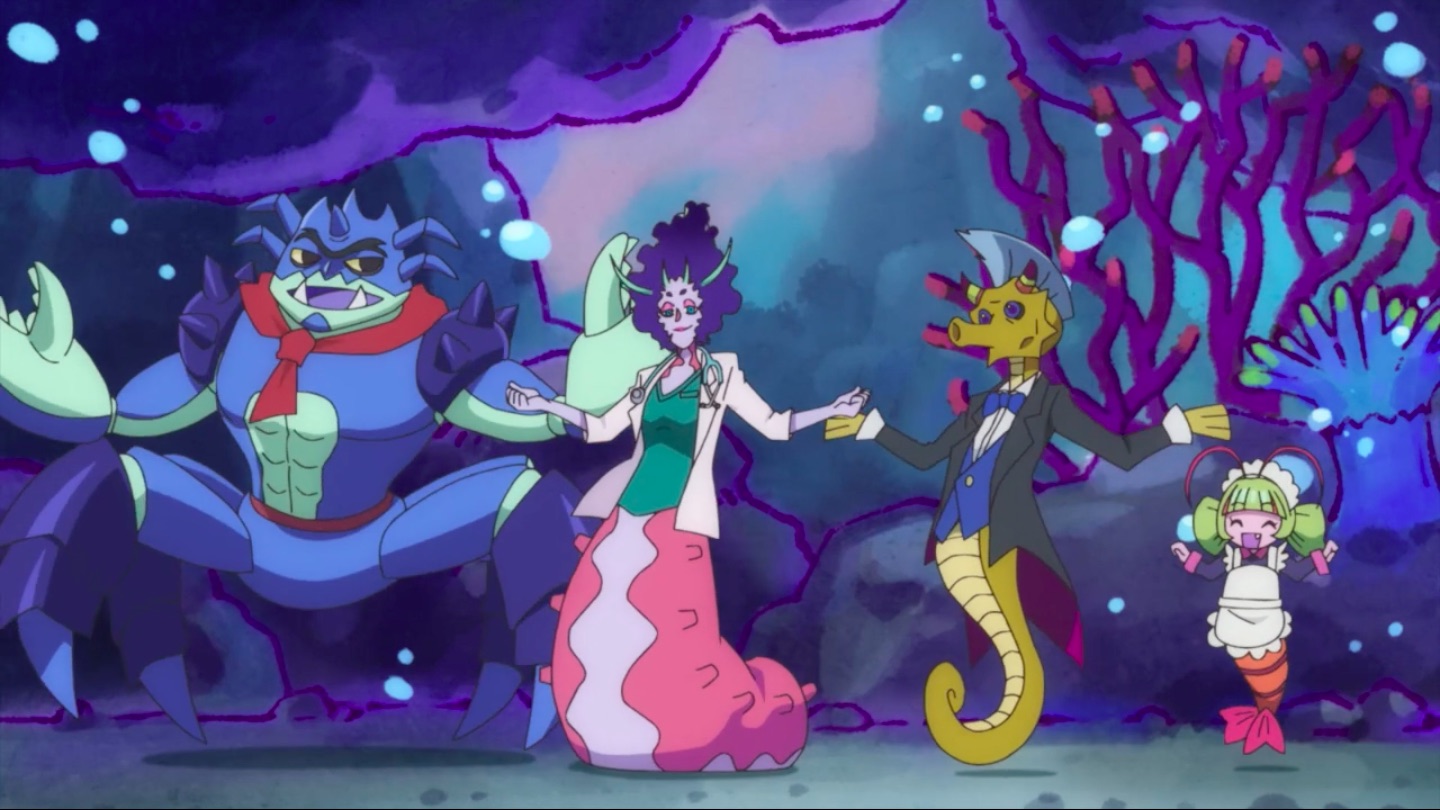
Laura (Tropical-Rouge! Precure)

In the Precure franchise, there are rarely characters of Laura’s disposition. A mermaid with ambition to become the next queen of the seas, Laura is a haughty and proud sort whose closest equivalent is Milk from Yes! Pretty Cure 5. One part of what makes her work as a character is that she fluctuates between earned and unearned confidence, and her friends are there to teach her when the latter occurs. 

But what I think seals the deal for Laura is the fact that she overcomes one of the most common pitfalls of mid-season Cures, which is losing much of her original identity once she joins the team proper. While she gains legs and learns how to live in human culture, her mermaid origin still plays a significant role and gives an extra facet to her character. Laura has to navigate the worlds of both land and sea, and that process is both endearing and hilarious.

Final Thoughts

There was no shortage of strong characters this year, but in the end, I felt that both Shinji and Laura both showed an immensely satisfying amount of growth in their own ways. For Shinji, it’s arguably unfair to be tapping into something with as much history as the Evangelion franchise, but it really feels like Eva has the closure it needs, and it comes courtesy of the Third Child(ren) himself. Laura meanwhile all but perfects the “unusual sixth ranger” by making sure the show doesn’t forget what made her an interesting character in the first place. 

I won’t say who they are, but a few characters got real close to taking the top spots. Some of their stories are still ongoing, so we’ll see if they make it to the top of the list in 2022.

P.A. Works and the Home-Renovation Spirit

Some time ago, I wrote a kind of light and frivolous observation: What if the home renovation shows were given a kind of isekai twist? Because both genres are built on reliable tropes and wish fulfillment, it could work. What I later came to realize is that there are already anime out there that capture some of that same spirit as a Fixer Upper or Home Town, and they’re “most P.A. Works shows.”

While P.A. Works anime like Sakura Quest and the recent The Aquatope on White Sand aren’t focused on sprucing up individual houses, they do often tackle or at least address an increasingly prevalent problem that home renovation shows are also built around: decreasing populations in small towns as people move to bigger cities to find opportunities and birth rates decline. This is a recurring issue in both Japan and the United States in particular, and has led to the decline of rural areas as they can’t hope to compete with more urban ones. Much like how Home Town remodels homes to try to breathe life into Laurel, Mississippi, so too does P.A. Works create events from scratch like Hanasaku Iroha’s once-fictional Bonbori Festival as a way to try to start traditions—because they have to begin somewhere, right? Sakura Quest meanwhile is explicitly about this topic, and the characters actively strategize on how to bring people back to a half-way abandoned town.

The cause is just, and it would be great if these approaches could make a difference, but there are underlying issues that TV shows, fictional or otherwise, can only do so much to fully fix. For the US, one major problem is the poor health infrastructure (and infrastructure in general) that forces even those who might not want to leave non-urban areas to try to chase employment down in the hopes of, if not getting health insurance through work, at least making enough money to afford it. In Japan, a lack of economic opportunities and a sexist society that still looks at career-oriented women with suspicion means that the rural regions of Japan are filled with empty and abandoned houses as a brain drain occurs. 

I wonder if the two sides could learn from each other. Perhaps P.A. Works can do an anime all about renovating homes in a town, while maybe HGTV or whatever can try to make a program that pulls the camera back a bit and looks at infrastructure issues beyond single homes per episode. If there’s some way to make both work, I’d love to see the result. 

The Drama of the Stage: Kageki Shojo!!

I love pretty much everything about Kageki Shojo!! It’s not the first anime about aspiring actors, and it’s certainly not the first to be inspired by the Takarazuka Revue, but it combines elements of both in a way that makes every episode an emotional journey.

Watanabe Sarasa is a teenage girl who has just been accepted into the Kouka School of Musical and Theatrical Arts, which trains students to become future members of the all-female troupe known as the Kouka Revue. It’s no easy feat getting in, let alone making it through the program, but Sarasa has a couple of unique traits that cause her to stand out: her towering height compared to the other students, and her background connected to the traditionally all-male kabuki theater, which brings a different flair to her performances.

Kageki Shojo!! Inevitably reminds me a lot of the classic Glass Mask, especially with how much Sarara’s ability to embrace her roles and mimic others is reminiscent of Kitajima Maya. However, while I hardly remember any of the characters in Glass Mask outside of the major ones, virtually every side character in Kageki Shojo!! makes a powerful impression. Each girl brings their own perspective and baggage to the Kouka School, such that even the notion of “pursuing success” can differ immensely in terms of how each character defines it, and what they perceive their own strengths to be.

The students’ backstories (and current stories for that matter) can also get quite dark at times, with topics like sexism, neglect, predation, and bulimia being explored. Impressively, the series balances both its heavier and lighter elements without trivializing the former or making the latter feel inappropriate.

The anime ends at 13 episodes, but there’s clearly more manga that can be adapted. I can’t wait for a second season, should it ever come o

Going Beyond Limits, for Better or for Worse: Anime NYC 2021

ANIME NYC HAS REPORTED A CONFIRMED CASE OF THE COVID-19 OMICRON VARIANT. IF YOU ATTENDED ANIME NYC, GO GET A COVID-19 TEST. 

One year ago, New York City was still reeling from the COVID-19 pandemic. Vaccines had not yet begun to roll out, and many of the annual traditions we expected had to be put on hold—possibly even indefinitely. Though not seen in the same rarefied light as Thanksgiving, Christmas, or New Year’s, Anime NYC had become an annual outing for my friends and me. I was sad, though understanding, that 2020 had to be canceled.

Anime NYC is right in my backyard, tends to have some interesting Japanese industry guests, and the fact that it has thrived in one of the toughest convention cities (see the defunct Big Apple Anime Fest and New York Anime Festival, among others) meant I’ve felt a strong desire to support the event—lest it go away and be substituted by unscrupulous scams and the like. When Left Field Media announced that Anime NYC 2021 was on, I was filled with both excitement and trepidation. 

Lines, Crowds, and COVID Mitigation

Vaccination rates are generally high in NYC, and we have a general mandate for indoor venues. However, the situation was different even compared to Otakon three months ago, thanks to the rise of the Delta variant, the colder weather, and concern over waning efficacy of vaccines. In the end, I decided to attend, thinking that there might be a drop in attendance that would give plenty of breathing room. After all, New York Comic Con 2021 in October saw lower numbers, right?

Not so. Anime NYC 2021 was packed with fans extremely ready to revel in the convention experience. In fact, attendance was up compared to 2019—from 46,000 to 53,000. By comparison, New York Comic Con saw a drop from 260,000 to 150,000. 

I find that this contrast highlights the difference between having a larger but relative more casual and mainstream audience versus a hardcore base ready to go wild. The former will see better results in the good times, but the latter will ride with you even when it gets bad. I suspect this has less to do with loyalty towards Anime NYC itself and more to do with passion for anime and manga in general, but the results are the same.

Anime NYC 2021 was from Friday, November 19 to Sunday, November 21. It was clear that the showrunners knew how big the lines were going to get, as they began sending out alerts encouraging as many people to grab their vaccination wristband and badge on Thursday before the con. However many heeded their advice, by the time Friday rolled around, it was clearly not enough. The con opened at 1pm, but people were lining up since 9am, packed together outside in fairly cold weather, all while being unsure of whether they were on the right line. In previous years, this would have been a nuisance. With COVID-19 around, I could only hope that people kept their masks on and were smart about it.

As a press attendee, I had the benefit of being able to avoid the brunt of these problems. However, what should have been a five-minute process of “getting in” turned into almost half an hour as I was told three different things by three different people as to how to get my wristband and get into the Jacob Javits to get my press badge. So while I was fortunate to not have gotten the worst of the lines, the small taste I had made me aware of how much worse it probably was for the attendees on Friday. Saturday and Sunday seemed more organized, but I don’t know how much it alleviated any issues.

In addition to better communication and maybe even the ability to line up indoors, I have to wonder how much of the problem is that the Thursday badge pick-up hours only go to 6pm. Anime NYC is very much a commuter con, and I imagine many people are working or going to school from 10am to 6pm. Even in pandemic times, New York is still often the city that never sleeps.

Omicron Variant

Of course, the elephant in the room in hindsight is the news that one attendee had a case of the new Omicron variant of COVID-19. Any sort of precautions were inevitably taken without knowledge of its existence, but excuses also don’t treat infections. Thankfully, none of the people I know personally who attended Anime NYC (including myself) have tested positive, but between reports that the Omicron variant spreads more easily and that the person who was found to have it may have spread it to half of a group of 35 friends, it’s clear that there needs to be an extra layer of vigilance.

Take mask compliance, for example. I found it to be mostly there, but it felt like people got more and more lax. All the classic errors of masking were there (not covering the nose, taking it down to talk, not wearing it all). While this is partly on those attendees who flouted proper mask usage, I would like to have seen better enforcement by the con itself. Even the simple act of providing free masks at the con could go a long way.

Dealer’s Hall

The Dealer’s Hall felt like any other at a professionally run big con, but I did notice one thing in particular: People seemed very, very eager to buy stuff. It was as if two years’ worth of pent-up desires to purchase came crashing to the surface. So not only was it packed each day, but attendees were behaving like the money they had was burning holes in their wallets. Because of my wariness over COVID-19, I went in and out, trying to avoid staying in there for too long.

That said, I did purchase a few things with the intent of making them part of my convention memories, so I understand that sentiment. I got an official May hoodie from Guilty Gear Strive, nabbed some new manga, and found a booth that actually sold old Japanese movie brochures. I picked up one for God Mars and a couple for Goshogun.

Other highlights of the Hall included the HololiveEN booth where you could take photos with cut-outs of all the EN girls (including from the inaugural generation), a tribute wall to the late Miura Kentaro, author of Berserk, along with a New Japan Pro-Wrestling booth where you could hit the actual NJPW ring bell.

Panels

One of my favorite things about anime cons are the panels. While Anime NYC isn’t anywhere close to the amount of content you’d get from something like Otakon (and it’s clearly not the con’s priority), there was at least a panel track when you wanted to sit and listen.

Due to other engagements, I was unable to attend the Aramaki Shinji panel. I was told it was informative and even went over some of his work on American cartoons (M.A.S.K., Pole Position), though it seemed like Aramaki had less time than he thought.

Hololive Council

I’ve been getting more and more into Virtual Youtubers over the past couple years, and so I was looking forward to HololiveEN Council’s con debut at Anime NYC.

One of the running jokes among the fandom is that Hololive English group streams tend to be pretty “scuffed,” and this was certainly no exception. The panel started roughly half an hour late, and there were technical issues throughout, such as audio delays. Still, it was good to see the Council get their moment in the sun at a convention, and they were entertaining nevertheless. While the panel was focused on HoloCouncil, HoloMyth (the first generation of HololiveEN) made a cameo with some messages for their kouhai.

One big difference compared to other Hololive conventional panels I’d seen online was that there was less interactivity with the live audience. Namely, much of the interactions were scripted and questions were taken from Twitter rather than a live audience, which was a tad disappointing but also understandable given the size of the crowd and the inevitable technical difficulties. Overall, it felt like a very managed experience, possibly because it was sponsored in part by the Consulate General of Japan in New York. Also, while the interactivity wasn’t as high, the fans in the audience tried to bridge that gap. It was easy to notice who got the most enthusiastic fans—Ouro Kronii’s “Kronies” certainly wear their preferences on their sleeves.

Afterwards, I got some Hololive merch thanks to a friend: A Ceres Fauna button!

New Japan Pro-Wrestling Strong Spirits

While there weren’t many guests who flew in from Japan this year, one surprising appearance came from New Japan Pro-Wrestling’s “Switchblade” Jay White, leader of Bullet Club. He was there to promote NJPW’s new mobile game: New Japan Pro-Wrestling Strong Spirits. 

Jay mentioned that this was his first-ever convention appearance, and he was pretty much a natural at entertaining the crowd. My favorite thing was his insistence that he was the sole reason NJPW sold out Madison Square Garden a couple years ago, and every time he said it, a large and obnoxious image of this fact would flash on screen. 

Although I had a good time , part of me regrets going to this panel because I should have expected an audience of wrestling fans to be loud and care little about the risks of COVID-spreading associated with yelling. One person in particular was loud, maskless, and insisted on shouting constantly. I also had the sense that the fans love bringing attention upon themselves.

As for the game itself, “bizarre” is how I would describe it. Unlike so many other wrestling games, it uses all existing video footage for moves, as well as green-screened video of the wrestlers during turn-based move selection. The developer of the game (from Bushiroad) even said they had to clear rights for the footage in 150 countries. There was also an example of training to improve your wrestler’s stats, and the key point here is that it also has live footage of your chosen NJPW wrestler, this time getting sweaty in the gym. This, I believe, is where the real appeal of the game might be. It will also predictably have a gacha component, but the developer claims it won’t be pay-to-win.

GKIDS

I’ve long known GKIDS for their involvement with the New York International Children’s Film Festival, but they’ve also been putting out some excellent titles on home video lately. GKIDS was there because many of their films were having American or east-coast premieres at Anime NYC. While I was unable to see most of them, I was glad to find out that they’re pretty much all getting limited theatrical releases, notably Hosoda Mamoru’s Belle in January and Pompo the Cinephile in Spring 2022. I was able to see Pompo at the con, and you can read my review here.

At the panel, I found out how successful Promare has been, which is quite a bit. It’s the reason the film keeps getting re-screenings in theaters while others do not.

Cosplay

I didn’t take many cosplay photos this year, but I wanted to at least share a couple.

Final Thoughts

In spite of an inevitable lack of Japanese guests and trepidation over the pandemic, Anime NYC came back at a time when people were champing at the bit to do something in person again. I had a decent time at the con, but seeing the crowds made me realize a truth about this new era: More success means more precautions are necessary if we don’t want worse-case scenarios happening. I hope that whatever fallout occurs due to the Omicron variant, it becomes an outlier rather than a standard of conventions.