I wrote a post about the eccentric heroine of Dagashi Kashi over at Apartment 507. You can find out why Hotaru might be my character of the year, and why her role as a sheltered dagashi heiress is so interesting to me.

I wrote a post about the eccentric heroine of Dagashi Kashi over at Apartment 507. You can find out why Hotaru might be my character of the year, and why her role as a sheltered dagashi heiress is so interesting to me.

To follow up my post on Yazawa Nico, I’ve written an analysis of Sonoda Umi for Apartment 507.
She really is a wonderful character.
One of the big bugaboos of Japanese to English translation has been the use of untranslated words. Whether it’s senpai (“upperclassman”) nakama (“comrade”), or the utterly fictitious zankantou (“colossal blade”) the question of whether words should be left as is or fully adapted to English rages in arguments between fans, translators, and everything in between. Of course, there are no solid rules, and determining where in this spectrum your translation should fall is very much a case-by-case basis. However, what intrigues me about this debate is that, when you look at the Japanese language and how it’s used in anime, advertisements, and more, there is a very intentional sprinkling of foreign words with the clear idea that they are used for their exoticism.
The show that actually got me to think about it was, of all things, Show By Rock!! Here are the first lines of the opening:
Ren’ai inochi VERY VERY HAPPY!
Yuujou inochi hajikeru JUMPING!
Bouken inochi dokidoki OK?
Seishun ouka COM’ON READY? LET’S GO!
I’m leaving it untranslated just to show the clear use of English vs. Japanese. They didn’t have to use English words but they did. Similarly, let’s look at the popular One Punch Man opening:
ONE PUNCH!
(THREE! TWO! ONE! KILL SHOT)
Sanjou! Hisshou! Shijou saikyou
Nan dattenda? FRUSTRATION Ore wa tomaranai
One concession is that a lot of these words are very simple, like “HAPPY” and “JUMPING.” They’re not terribly complex and don’t carry a great deal of cultural baggage like senpai (though one might argue that ren’ai (romantic love) being originally a concept introduced from Europe to Japan falls into that range). However, I think where the actual big cultural difference comes from is that Japan has been open to receiving a lot of foreign words and maintaining them as emphatically foreign, as opposed to fully integrating them into the language. So while English has its fair share of Japanese loan words, from sushi to karaoke, they don’t maintain as much of their exoticism. It’s just a very different environment for sentences and words themselves.
What’s funny is that English wasn’t always this way, especially when it was not the lingua franca of the world. Prior to World War II, French was the most dominant language in diplomacy, and (correct me if I’m wrong!) throwing in French words with the expectation that only a few would understand it was not uncommon among the educated. Of course, this is different from the use of “HAPPY” and “JUMPING,” but I do think that the English language’s ubiquity leads to the sense in us users that it doesn’t have to bend to the will of others.
Translating to English often assumes that English is important. That sounds like a no-brainer, but what I mean specifically is that English speakers value their own native language so highly that it comes across to some extent as a rejection of foreign influence. France today for example is known for trying to keep foreign words out of its language, preferring to take existing French words and modify/combine them accordingly to eschew the need for new loan words.
I’m not saying translators who do not use senpai or whatever are imperialists anymore than I think that using nakama means someone is fetishizing Asian culture. Moreover, the exotic aspects of English usage in Japan come with their own sets of considerations and concerns. Rather, the seeming need for everything to be transformed into English might say something about how we as English speakers look at ourselves, and that this differs depending on how we individually approach that self-reflection.

I’ve written a post about Myriad Colors Phantom World over at Apartment 507, and its similarities to anime of the 90s such as Slayers and Saber Marionette J. What do you think? Is Phantom World a “1990s anime in 2016 clothing?”
Thanks to One Punch Man, I’ve been listening more to JAM Project as of late. I love how JAM Project takes anime music so seriously, and their desire to create actual “anime music” about the shows they sing for is admirable. However, the more I listen through their catalog, the more I miss one of their original founders, Mizuki Ichirou.
For fans of anime music, Mizuki Ichirou possibly needs no introduction. The voice behind almost countless theme songs, his work in titles such as Mazinger Z, Babel II, Golion (aka Voltron), and Kamen Rider X earned him the moniker “Emperor of Anime Songs.” In 2000, he became one of the founding members of JAM Project, taking a less active role a few years later.
Other members have come and gone from JAM Project, namely Sakamoto Eizou, the lead vocalist of the heavy metal band Anthem, and Matsumoto Rica, a singer who’s also famous for being the voice of Satoshi (Ash) from Pokemon. They also lent their own unique voices to JAM Project in interesting ways, but something about Mizuki Ichirou’s singing is different.
Unlike the younger members of JAM Project, Mizuki’s vocal style invokes a different era of music, culture, and of course anime. It’s deep, memorable, and reminiscent of a Frank Sinatra-style crooner, only he’s singing about Mazinger Z’s Rocket Punch. When you placed him alongside his fellow JAM Project members, it would add something unique, something classic, to their sound.
Above are two versions of JAM Project’s “Hagane no Messiah,” one without Mizuki and one with. I think hearing them side by side really shows what the “Aniking” added to the band.
This post was sponsored by Johnny Trovato. If you’re interested in submitting topics for the blog, or just like my writing and want to be a patron of Ogiue Maniax, check out my Patreon.
—

This might not be a universal feeling, but I think there’s nothing quite like your first emotional and heartrending anime. It could be something as simple as Pokemon, or something more known for its sense of tragedy, such as Kanon. Perhaps it comes from Japan’s literary tradition of valuing the ephemeral, or maybe it’s something more modern, but as you watch more anime, you start to notice trends in how sadness is portrayed, how characters are used to facilitate this sorrow. Though you don’t necessarily get tired of these trends, after a while recognizing the trend can cause the sheen to come off the anime model.
Garakowa -Restore the World- is a recent film from A-1 Pictures that I’m compelled to describe as “a standard interesting anime.” It doesn’t quite do the movie justice, as I think it’s actually a solid piece with a strong story, characters, and lots of interesting ideas to chew on, but there’s an odd sense of familiarity I get from the work.
At the center of the future setting of Garokawa are two antivirus programs, visualized as teenage girls named Dual and Dorothy. Their sole task is to protect their computer world containing vast archives of human history, known as the “box of knowledge,” by deleting any memories that have been infected, at least when they aren’t butting heads with each other (it’s why you don’t install two different antivirus software!). During one virus-purging, they encounter a mysterious other program named Remo, who seems to possess all of the human traits that are simply absent in Dual and Dorothy, and the three form a bond that leads them to the truth of the world.
Garakowa‘s atmosphere is like a cross between Madoka Magica, Corrector Yui, Reboot, and She, the Ultimate Weapon, in that there are elements of magical girl anime mixed with the idea of a world inside a computer, a looming sense of tragedy, and a grand scale whose exact dimensions are intentionally ambiguous. This might be more obvious when looking at the Japanese title, Garasu no Hana to Kowasu Sekai, or “the Glass Flower and the Crumbling World.” The official translation, by the way, is the odd-sounding Vitreous & Destroy the World. However, what makes Garokawa simultaneously not the most daring and original work while also filled with material worth contemplating is the way it creatively utilizes its science fiction setting alongside its emotionally resonant moments.
The first element that really stood out to me about the film was the idea of personifying the conflict that occurs when multiple antivirus programs are installed. The way it’s presented here, with the anime trappings of magical girl accoutrements and cute girls, is to be expected to a certain extent. However, even as it’s reminiscent of the OS-tan craze of personifying computer operating systems in the early to mid-2000s and even as it draws upon the power of moe, yuri, and a kind of sensuality, the story of Garakowa also somewat implicitly justifies their human appearances.
From there, the part of the movie that really stays with me (outside of some spoilers I’m choosing not to divulge) is the idea that Dual and Dorothy cannot taste food or understand human behavior even as they’re modeled after humanity. In particular, in a scene straight of Urasawa Naoki’s Pluto, Dual contemplates Remo’s advice that, if you think that something is delicious, it feels like it will become delicious (Atom in Pluto says something similar). While it might all be in my head, I feel like that interaction sets up this idea that the antivirus programs are part of the greater presentation of humanity that is the box of knowledge. Even if they aren’t able to directly feel human emotions or sensation, they can at least exhibit a record of the ideas. If the box of knowledge is a kind of catalog of human history, then perhaps Dual and Dorothy are just as much a part of that purpose.
Overall, Garakowa is a very “anime” film in terms of its combination of science fiction, attractive female leads, and heart string-tugging narrative that contextualizes an everyday environment as something larger than life. It’s the kind of work where I feel someone who has less exposure to Japanese animation, or at least anime of this variety, could be strongly affected by its ideas, characters, world, and presentation, but it’s also enjoyable for long-time fans. Garakowa -Restore the World- is actually available for free on Crunchyroll, so it might be worth your while.
What happens when Sanrio, the company behind Hello Kitty, creates a franchise aimed at men? The result is Show By Rock!!, an anime that’s an eclectic mix of seemingly contradictory visual aesthetics that somehow manages to bring it all together through clever humor, a heartfelt story of music and friendship, and a surprising amount of story.

Hijirikawa Cyan is a high school girl too shy to join her school’s music club. While lamenting her lack of courage and playing on her cell phone (Show By Rock!! was originally a mobile game), she gets transported to the world of Myumons, half-animal people who share a love of music. She meets a talking guitar named Strawberry Heart, has to fight a giant hideous monster attacking a concert, and ends up staying on the other side and joining a small band called Plasmagica. Along with their ambitious leader and lead guitarist/vocalist Chuchu, tsundere bassist Retoree, and enigmatically cheerful drummer Moa, Cyan learns to gain confidence in herself and her love of music and saves Midi City in the process.
Though I might be biased as I am probably in that target audience of guys who like cute things, what I think draws me to this show is just how well it executes that cuteness in various capacities. I think often when it comes to how cuteness is utilized in anime, especially when trying to aim it at adult male fans, it can come across as a little too willing to revel in adorableness for its own sake, or to attach it heavily to tragedy. With Show By Rock!!, I actually hesitate to call a show like it “moe,” because there’s a different quality at work, a combination of silliness and seriousness that makes the anime feel closer to the morning cartoons that air alongside something like Precure than they would Hidamari Sketch, despite Show By Rock!! itself being a late-night anime.
I think I get this sense most from the show’s opening, “Seishun wa Non-Stop,” which is fun and addictive and the kind of introduction that I actually chose not to skip every episode. That, and seeing the glasses magically dissipate from Cyan’s head at the beginning of the opening is somehow hypnotic.
The moment that sealed the deal for me in terms of liking Show By Rock!! comes quite early on, in episode 2. During a scene when all of the girls of Plasmagica are discussing their reasons for joining the band, the camera closes in on each of their faces to reveal their actual reasons and not the innocent ones they’ve given on the surface. I don’t want to spoil the moment, but Moa’s reveal is so out of left field and hilarious that, even though I put the show on hold for months before finishing it, her inner thoughts stuck with me throughout my break from Show By Rock!! What’s even better is that it pays off in a later episode.

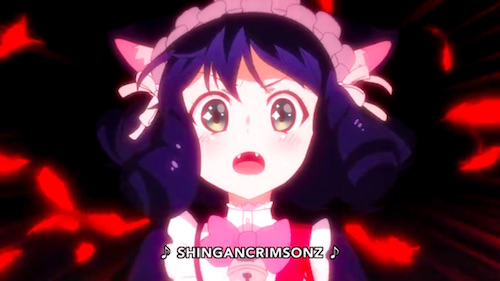
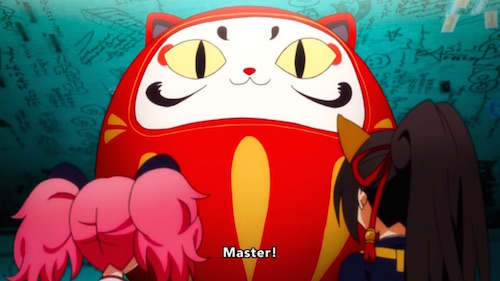
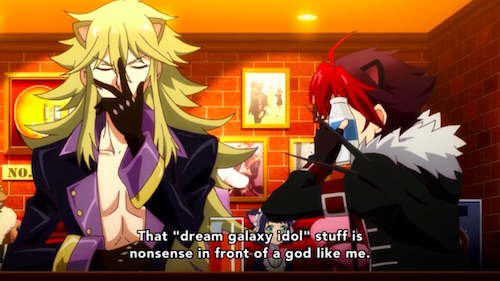
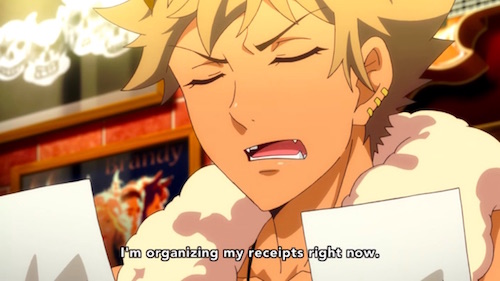
That moment is one of many indicators that Show By Rock!! is actually quite well-paced, with early hints at characters’ histories being built upon, a good sense of weight and understanding when it comes to the challenges each of the characters have to go through, and an extremely solid cast of supporting characters. While I can’t help but be fond of Tsurezurenaru Ayatsuri Mugenan, an Enka-themed band led by a woman in a giant cat daruma, the real stand-out side characters have to be SHINGANCRIMSONZ, a visual kei band with the most humorously overwrought members possible, chuunibyou types taken to the next level (plus one realist who nevertheless believes strongly in the power of music). If anything, even if you’re not a fan of hyper cute designs, you might just stay around for the SHINGANCRIMSONZ antics.


Going back to the idea of Show By Rock!! being a strange mix of various visual styles, this can be seen in the fact that the members of SHINGANCRIMSONZ are drawn closer to the bishounen archetype than an attempt to reconcile their designs with the cutesy look of the Plasmagica girls. However, it works because they’re in many ways just as adorable and fun to watch as Cyan and the rest. Another facet of this blending of styles is the use of 3DCG and transformation into Sanrio-esque mascot characters during performances. It can be jarring, especially when watching this series for the first time, though it’s not extremely different from the heavy use of CG dances in girls’ shows such as Pretty Rhythm. In fact, while it isn’t quite up to the level of 2D animation employed by Studio Bones, the 3D animation in Show By Rock!! is actually quite solid.

At only 12 episodes, Show By Rock!! is a quick and easy watch. I don’t think it’ll rock anyone’s foundations, but the characters are charismatic, the overall narrative leads up well, and the music is catchy. If there’s a way to describe it based on other music anime, I’d say it’s like 50% Sound!! Euphonium, 50% Macross 7. Don’t believe me? I guess you’ll have to check it out.

I wrote a post over at Apartment 507 looking at the nostalgia for the Showa period that seems to be cropping up in anime. Leave a comment either here or there and tell me what you think!

After Happiness Charge Precure! failed to live up to its potential, I had hoped that the next series in the long-running Precure anime franchise would fare better. Fortunately, Go! Princess Precure wildly exceeded my expectations to become one of my favorite iterations of the popular magical girl anime. From the serious to the silly, Go! Princess Precure hits a homerun.

Go! Princess Precure follows Haruno Haruka, a teenage girl who dreams of becoming a princess. As a small child, she met a handsome young prince named Kanata who inspired her to hold onto her love of princesses, in spite of discouragement by others. In the present day, as Haruka comes to the prestigious “Noble Academy” with the goal of learning what it means to be a “true princess,” she finds out that monsters have begun to attack the school, preying on everyone’s hopes and aspirations. Haruka becomes a “Precure,” a magical warrior with the power to defend against the forces of Dysdark, and is soon joined by two other girls, Kaido Minami and Amanogawa Kirara, who also use their dreams to fight back.
Princess fever has taken over amidst the enormous popularity of Frozen in Japan, and Go! Princess Precure asks, “What is a princess?” While this question (as well as the thematic flourish of the series) can potentially be criticized on a surface level as sexist and regressive, a closer look shows that Go! Princess Precure aims to claim the concept of the princess as a symbol of hard work and kindness towards others. To this point, a major villain of the series, the powerful Princess Twilight (no relation) even confronts Haruka (Cure Flora) with the idea that one can only be born a princess, and while she’s technically more correct than Haruka in terms of how it works in real life, Go! Princess Precure shows how Haruka, Minami (Cure Mermaid), and Kirara (Cure Twinkle) strive to embrace the idea of a “princess” as being the product of one’s effort. In other words, according to Go! Princess Precure, being a princess doesn’t make you a better person. Rather, being a better person who strives for their dreams and helps others is the key that allows any girl to become a princess all on their own.

Not only is Go! Princess Precure strong thematically, it’s just an incredibly solid show in general. In terms of animation, it has some of the finest fight sequences in all of Precure as early as episode 1, and while it rises and dips in quality as is typical of a year-long anime, its overall consistency as well as its high points are notable. The outfits and character designs are all on point (In terms of narrative, the series benefits from an entertaining main cast with well thought out character development. Flora’s story at the half-way point connects to that greater theme of “princess” self actualization. Kirara as the donut-loving fashion model eager to speak her mind is one of the most unique Precure characters ever (I voted her as my favorite among the Princess Precures for this reason). The supporting characters, though not quite on the level of Heartcatch Precure!, grow admirably throughout the series as well.
Perhaps most notably, when the anime introduces a fourth Precure late into its run, she does not overshadow the rest of the cast. It’s a common problem for shows like Precure or Super Sentai, where in an effort to push the new character and her toys she ends up practically taking over the show. Honestly, I can’t recall a single bad episode.
Go! Princess Precure might be quite the hard act to follow. Whether it’s in comparison to the rest of Precure or as an anime all on its own, Go! Princess Precure is simply an outstanding work that embodies a lot of what is best in children’s shows and the magical girl anime genre. I highly recommend anyone, even those skeptical of mahou shoujo, to take a look.

—
If you liked this post, consider becoming a sponsor of Ogiue Maniax through Patreon. You can get rewards for higher pledges, including a chance to request topics for the blog.
With Go Princess! Precure finally over, I feel like this is when the winter anime season truly begins. I hope that you’ll enjoy coming along the ride with me.
I’d like to thank the following Patreon supporters this month.
General:
Johnny Trovato
Ko Ransom
Alex
Diogo Prado
Yoshitake Rika fans:
Elliot Page
Hato Kenjirou fans:
Elizabeth
Yajima Mirei fans:
Machi-Kurada
In particular, I’d like to welcome back Johnny Trovato. He was the source for many past topics through Patreon, including posts on the Tokyo Olympics and Censorship, Touhou vs. Kantai Collection, and the rise and fall of Saimoe. If you’d like me to write about a specific topic on Ogiue Maniax, it’s a perk you can get for the highest reward tier on Patreon.
This past month has brought a lot of interesting changes for me. Outside of Ogiue Maniax, I recently started contributing articles to a site called Apartment 507. They were looking for someone who communicate with the hardcore Japanese pop culture fans that comprise their audience, and I’ve been happy to oblige. The main reason I got this gig was because of my efforts on Ogiue Maniax, so I am grateful to my readers here for reminding me of the value of writing and that, simply put, anime and manga are awesome.
I decided not to include those posts on the Patreon page itself because they’re not technically being supported by my patrons, but I have been linking to them on the blog itself. Just look for the [Apartment 507] tag in the title if you’re wonder which posts are which.
As for the blog proper, I think I’ve written some of my best work this past month. I wrote a response to another blogger where I talk about some of the problems that come with evangelizing sakuga, a review of the powerful new film The Anthem of the Heart, and of course the latest Genshiken chapter review. If you haven’t been keeping up with Genshiken, or even if you have, this chapter is a big deal, so I recommend you check it out! By the way, I’ve noticed that my Genshiken reviews are some of my most popular posts. I guess that shouldn’t come as a surprise but I’m actually really happy that I’ve established myself as a source for interesting insight into Genshiken.
January also marked the return of the Fujoshi Files with a historic Fujoshi #150. I have to confess that these might get more sporadic as I don’t have as much time to research fujoshi-themed anime and manga as much as I used to, but I do strongly believe that we’ll hit #200.
In addition, I decided to do something a little different and interview a Super Smash Bros. for Wii U competitive player. Earth, the world’s best Pit, is actually also a mahjong and The iDOLM@STER fan, so I had to ask him a few questions.
The last thing I want to say is that I’ll be traveling to Japan in May! I’ll be releasing posts the whole way through, and when I get back I’ll have plenty more to talk about. And yes, I will be getting all of the dagashi (have you been watching Dagashi Kashi? I highly recommend it).