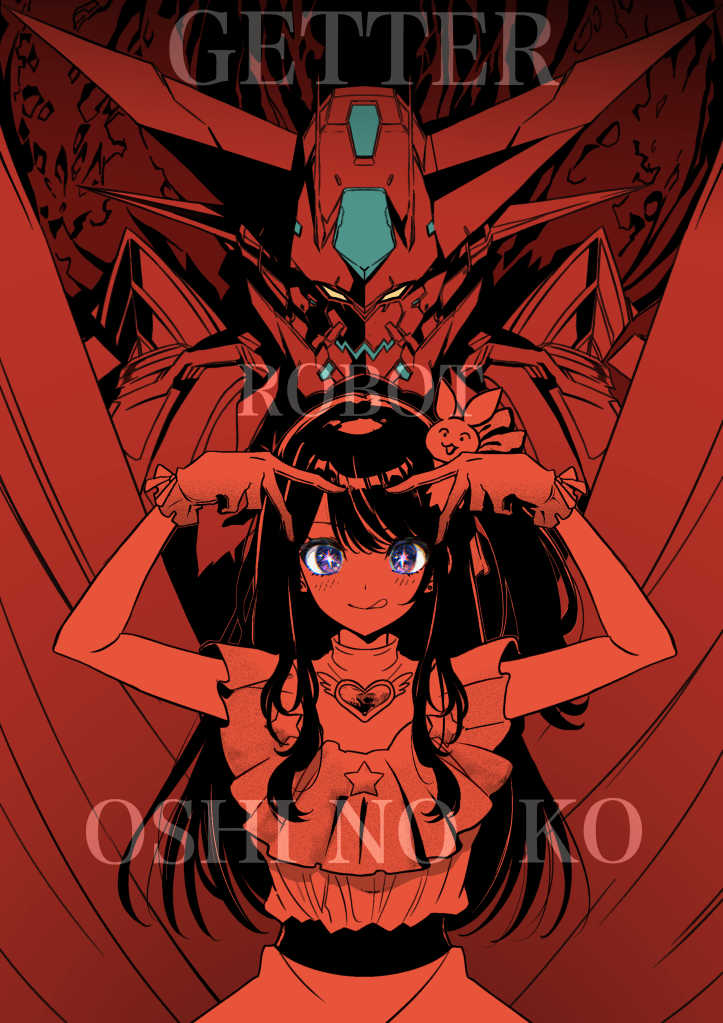
For those who don’t quite get the joke, this is a mashup of the anime opening themes for 2023’s [Oshi no Ko]and 2000’s Shin Getter Robo vs. Neo Getter Robo. The two songs, “IDOL” and “STORM,” share a similar build-up during their respective choruses that makes one transition into the other almost seamlessly, with only a tweek to the tempo being necessary.
As a fan of both (the latter of which I watched during my formative years as an otaku), it makes me happy to see these two shows and their respective theme songs getting love. More than that, it made me think about a few things.
First, I’m actually kind of surprised that so many people have a fondness for Shin vs. Neo. I know Getter Robo is just part of the bedrock of anime and the mecha genre, but I had always assumed Shin vs. Neo was just known in the little corner of the fandom I had occupied. Glad to see people have a sense of nostalgia for it, though that does make me feel old.
Second, if this is how newer anime fans discover Shin vs. Neo, then so be it. I hope they enjoy seeing a shirtless man beat a dinosaur soldier into submission, in addition to all the robot action. At the very least, the fact that this joke incorporates more footage of the anime means it’s able to show itself off better than Fighbird and the aforementioned pigeon meme.
Third, it’s a bittersweet reminder that one of the singers of “STORM,” Mizuki Ichiro, passed away earlier this year. IAs one of the elder statesmen of anime music, he might have very well leaned into this, and we might have legitimately gotten a cover of this. At the very least, Kageyama Hironobu and the rest of JAM Project are all around, and they are definitely game to perform memes (see their cover of “Okkusenman.”)
I think what I ultimately really like about Getter no Ko is that it showcases both series well. Their original content doesn’t get lost in layers of obfuscation, and I hope anime fans are able to experience and appreciate both.
Kio drew his first original 18+ doujinshi, called It’s All Your Fault, Sensei, which is now available on FANZA and DLSite under the circle name ぼたん堂. Content note: It is futanari on cis girl, and in terms of depictions of sex goes well beyond anything shown in Spotted Flower.
Those who have been following Kio’s Twitter account might recognize one of the girls, as he drew an earlier version of her around the New Years in a bunny outfit.
Kio mentions that had he wanted to draw what happens between Sasahara and Ogiue on the couch, it would have been “something similar,” though the original tweet has been deleted, so it’s not clear if he’s referring to his doujinshi or the fact that Not-Sasahara and Not-Ogiue are in bed together in the side chapters.
A doujinshi cover of Ritsuko from Genshiken Volume 1.
From Genshiken Volume 4, reviews of different routes in the Kujibiki Unbalance visual novel. Madarame reviewed Renko’s, Sasahara Ritsuko’s, Tanaka Izumi’s, Kugayama Kasumi’s. Kio agrees with a commenter that Ootani Ikue (voice of Pikachu) fit the character perfectly.
According to Kio, drawing ero manga is sort of the opposite of regular manga, and that’s what made it tough for him when planning it. In regular stuff, his thought process is paneling -> text -> art, but for pornographic stuff it’s art -> text -> paneling.
As a Virtual Youtuber, Inugami Korone has always been known to march to the beat of her own drum. From doing flips and cartwheels during the biggest Hololive events to squealing with glee over a fishing game getting ported to the Switch, you never quite know what to expect from her. Even knowing this, however, nothing could have prepared me for one of the special guests at her 4th Anniversary Concert: mecha anime singer Taira Isao.
I both saw and heard Taira as he came in on the second verse of the Galaxy Gale Braiger opening, and my jaw dropped. In a world where a cameo by a VTuber from a rival company is a big deal in itself (something Korone also included), to have such an established name and fan favorite is a boss move like practically no other. And on top of that, I would have expected at most to see him on the screen behind Korone, but there he was, standing next to her and sounding as amazing as ever.
Taira is not necessarily the biggest name among musicians of giant robot anime, but the songs he has under his belt occupy a sweet spot: somewhat obscure, beloved by hardcore fans, and actually incredible tunes. Other songs he’s performed are the openings to Trider G7, Daiohja, and Ideon, the last of which he also sang with Korone. In fact, Taira first became aware of Korone specifically because she sang “Fukkatsu no Ideon” during her 2022 birthday concert.
A number of significant names in anime and game music have collaborated with Hololive, but Taira is perhaps the most personally significant thus far. Owing to my love of giant robots and my more recent interests in VTubers, I maintain an unorganized Youtube playlist called the rather self-explanatory “Virtual Youtubers Singing Giant Robot Anime Songs.”
But my fondness for the singers of Taira’s generation has been with me for 20 years. Back in the mid-2000s before Youtube even was a thing, I was enthusiastically discovering and discussing video clips of live performances of musicians like Mizuki Ichiro, Kageyama Hironobu, and indeed Taira Isao. Through these concert videos, I bonded with friends online; in fact, this is how I first came to know my fellow mecha enthusiast and mahjong partner-in-crime, Dave, before we ever met offline. To see Taira show up with Korone, still snazzily dressed and still looking incredibly good for his age, feels like a culmination of various bits and pieces of my own history as an anime fan.
Even now, I find myself re-watching the 4th Anniversary performances of Braiger and Ideon music, and it actually reminds me of how I felt whenever a really good character trailer happened in Smash Ultimate. I’d watch the reveals over and over again to relive the excitement of the initial reveals, and to just remind myself that they’re real. It makes sense when you think about Tairas’ performance with Korone being a similar kind of hype crossover.
How will Korone top herself next time? I’m looking forward to seeing what less-traveled road she takes.
February has arrived, and that means new Precure, of course. It’s this odd exception in that February debuts have been typical of the franchise, so I have it on my mind—especially because it’s the 20th anniversary [I’ve been informed that Precure is actually only 19, so oops.]. I still remember seeing the original Futari wa Pretty Cure being mentioned in an English-language anime magazine, and noticing the large combat boots and floppy socks they wore. It’s been a part of my fandom for two decades now, and while I don’t have plans to write a retrospective, I wonder if I should. At the very least, expect a review of Delicious Party Precure.
Moving on from a two-decade-old magical girl juggernaut, I’d like to thank my Patreon subscribers!
Many VTubers have extremely busy designs, but one notable exception comes from a surprising source: a Japanese beverage company.
Kio Shimoku
Kio actually retweeted one of my posts this month!!!
Closing
I learned along with everyone else that Love Live! School Idol Festival is shutting down to make way for the sequel game. Given this information, it’s all too perfect that I finally managed to achieve my goal. Will I play the new game? I really don’t know—it depends on how much time I have and what the gameplay looks like.
WARNING: SPOILERS FOR SEASON 1 OF GUNDAM: THE WITCH FROM MERCURY
I know I probably shouldn’t do it. Sunrise is notorious for fucking up a good thing by meddling midway, and Mobile Suit Gundam: The Witch from Mercury has been good. Yet, even if I regret in the long run giving this show praise, I want to lay out my thoughts now, especially after an intense and shocking season finale.
Gundam: The Witch from Mercury is the first major Gundam anime to feature a female protagonist. While there have been heroines before like Christina Mackenzie in 0080: War in the Pocket and Hoshino Fumina in Gundam: Build Fighters Try, no one has been as prominent as Suletta Mercury. It’s a milestone that can easily be mismanaged, but the creators have done an amazing job not just with her portrayal, but also constructing a world that is a significant departure from typical Gundam while also feeling true to the spirit of Gundam and addressing modern concerns.
One of The Witch from Mercury’s biggest adjustments to the lore of Gundams-as-mecha is simple but profound: In this universe, Gundam technology was not originally designed for war. Rather, it was meant to help people with disabilities, and was only made into weapons through the greed of others. The world is dominated by corporations operating from space at the expense of those on Earth, touching upon a very relevant concern about the unchecked power of the moneyed.
It’s within this context that Suletta stands out in contrast to her peers as she enters school for the first time. When we first see her (outside of the traumatic childhood events of Episode 0), she’s a nervous mess of a teen who has never interacted with kids her age, and whose only friend is her Definitely-Not-a-Forbidden-by-Law-Gundam, the Aerial. She seems to have the power to persevere in spite of her anxiety, carrying an innocent-yet-powerful sense of right and wrong. She wants to both make friends and do good, and the wrench she throws into the systems in place at her school is a big one.
The school setting is also something of a first for a main Gundam series, and the way it’s handled is beautiful. While on the surface it makes The Witch from Mercury look like it’s trying to mimic a popular trend, the show successfully does two things to make this work.
First, it presents the school as an unusual place with unusual rules: a place to train students in the use and management of mobile suits, which also features a formalized mecha-dueling system that participants can use to wager and settle disputes. It seems silly, but it’s also contextualized as a kind of sheltered space to protect/mold the rich kids of the corporations running the world and give them advantages to further leverage their positions. This is precisely what Suletta gums up by becoming the “groom” for the “bride” of the school, Miorine Rembran—the daughter of the CEO who owns the school.
Second, it takes those setting elements of the school and uses them to drive home certain themes and metaphors. The Witch from Mercury has often been compared to Revolutionary Girl Utena, and while the abstract symbolism and allegories aren’t as robust and dominant here, they still carry a lot of weight. Not only are the yuri vibes undoubtable and a more overt step into that territory, but the duels are very revealing about each character and their motivations. The balance is very reminiscent of G Gundam.
So when the other shoe drops in Episodes 11 and 12 as a real battle begins, it really highlights what an isolated environment the school really is. Duels are playtime and ways to establish hierarchy. Combat is where lives are lost. The competition between corporations is only one factor when the tensions between Earthians and Spacians can lead to such death. And when Suletta emerges as being surprisingly okay with murder (for the “right” reasons, like saving people), her lack of hesitation is downright frightening. It’s why Miorine’s reaction at the end is so powerful. She and Suletta worked out their emotional differences and trust issues, but now here’s an unexpected side called “Suletta can literally smash someone into a bloody stain and not bat an eye.” It really is like Utena and Anthy switched spots.
A few weeks ago, I wrote about the similarities between Suletta’s mom and Char Aznable, and how they go beyond the masks. I was mostly thinking about their presentations and mannerisms, but this has made me realize there’s a vital aspect of Char’s character I didn’t look at enough: the unwavering desire for revenge. And so it begs the question—what would Char do of he has a child? The likely answer is “shape them into a bringer of vengeance.”
I hope The Witch from Mercury can live up to the greatness we’ve already seen. Please let this one get through okay. The next time I write about this series, I imagine it’ll be as a Gattai Girls entry.
Yesterday, I watched the Hololive COUNTDOWN LIVE 2022▷2023. It involved 3D concert performances by a variety of members including two of my faves, the currently COVID-stricken Haachama and the on-hiatus La+ Darknesss. I highly recommend it, especially the crossover sections between the girls of Hololive and the boys of Holostars. This clearly takes some inspiration from Japan’s long-standing end-of-year musical event, Kohaku Uta Gassen, but I’ve never actually watched it.
Looking back, it didn’t hit me how long the past year felt until I saw Kio Shimoku mention that Hashikko Ensemble concluded back in January of 2022. At times, it’s like the days move by all too quickly, and other times, it’s like they slow to a crawl. I can’t tell at this point how much of it is the prolonged funk of the pandemic and how much is just me getting older.
But here we are at the start of 2023 and the Year of the Rabbit, at least if we’re going by the solar calendar. Whenever I think about it, I find myself remembering a certain old flash video from the 2000s. Thankfully, someone uploaded it to Youtube, so I can inflict it on a new generation.
January’s Patreon subscribers are looking good. Thank you, everyone, and here’s to another fine (?) year.
This is partly an analysis of how different fans have different expectations for their VTuber faves, and partly an excuse to post more videos of La+ Darkness’s amazing dancing skills.
At the start of the year, I feel myself wondering if I should be doing more both with Ogiue Maniax and outside of it. One thing I’ve thought about is starting a Substack, but I have no idea how I might divide my writing. In my head, there’s no real differentiation between “regular” posts and “premium” ones, and I’d probably have to figure out some way to make it worthwhile. One possibility is to break off the VTuber stuff into its own dedicated area in case it’s becoming too intrusive, but I don’t think it’s that bad currently.
I could also do premium posts on Patreon, but that sort of runs into the same issue. If anyone wants to see that sort of content (or if you even hate the idea), feel free to leave a comment. I think I care less about the money at this point and wonder more about how to promote Ogiue Maniax in 2023. All the old ways seem to be vanishing (and Twitter is constantly on the verge of collapse because of its moronic new boss), and I still haven’t caught up.
Whichever ways things go, though, I hope you’ll keep reading.
“Char clone” is a fan term to describe a certain character archetype in Gundam. It references Char Aznable from the original Mobile Suit Gundam, and is typically used with a constellation of certain traits: some combination of a rival to the protagonist, who’s masked, morally gray, and mysterious. But while Char clones are practically a given at this point in the franchise, Prospera Mercury from Gundam: The Witch from Mercury might be the most Char of them all.
While Prospera Mercury is indeed a masked character, she’s also unique in that she’s the mother of the heroine, Suletta Mercury. And this isn’t a Darth Vader–esque secret either: Suletta knows she’s her mom, and Prospera even takes off her mask on a regular basis. At this point in the story, they haven’t fought, and there’s nothing saying that they will in the future. Prospera doesn’t have a noteworthy color scheme, she isn’t battling her daughter on a regular basis, which might appear to disqualify her from the ranks of Char clones. But what she does have is body language and a cryptic/veiled way with words that immediately brings to mind the Red Comet himself.
Prospera “Momznable” Mercury is voiced by Noto Mamiko, who’s famous for her gentle voice. Yet, every time she speaks, I can practically hear Char’s actor (the inimitable Ikeda Shuichi) reciting those lines. And every time Prospera is shown interacting with others, it’s like I can picture Yoshikazu Yasuhiko (the original Gundam character designer), drawing her making those exact physical expressions. It’s uncanny, probably intentional, and gives me goosebumps.
Other Char clones have the visual trappings or follow the tropes. Be it Zechs Marquise, Schwarz Bruder, Lancerow Dawell, Mr. Samurai, Harry Ord, Raww Le Kleuze, McGillis Fareed, or others, they look and act the role of the Char. But Prospera Mercury captures the soul of Char, and it makes her the most intriguing figure in all of The Witch from Mercury.
It’s poetic coincidence that the man who sang the Mazinger Z theme would die the same year as the man who composed it. Mizuki Ichiro, aka Aniki, the Emperor of Anime Songs, died at age 74 after a bout with numerous health issues. It’s especially sad that what took him ended up affecting his greatest gift: his voice. But rather than dwell on sorrow, I think it’s important to celebrate what made Mizuki one of the all-time elder statesmen of anime music: the undeniable passion that he imbued in everything he sang.
I’m not going to cover his life and history because that’s already been done elsewhere. Rather, like with Watanabe Chuumei, I want to explore my own history with the songs of Mizuki Ichiro.
I can remember exactly how I first heard Mizuki’s 70s singing: On a VHS fansub there was extra space at the end, and the fansubber had placed some old anime openings. And among them were Mazinger Z, Combattler V, and Steel Jeeg. At the time, my appreciation for retro stuff was a bit mixed, as I found all those songs to be varying degrees of hoaky—though the intensity of Mazinger Z in particular stood out. If anything, I at least preferred the music from the then-modern sequels such as Shin Getter Robo Armageddon and Shin Getter Robo vs. Neo Getter Robo. Of course, Mizuki was also a singer for those OVAs as well, and I think something clicked in me as a result. He was one of my gateways into classic anime.
I gradually transitioned into having a greater love of old school anime songs, and I remember watching videos of live concerts that featured Mizuki alongside greats such as Sasaki Isao, Kageyama Hironobu, Taira Isao, Kushida Akira, Horie Mitsuko, and MIQ. And while Mizuki wasn’t as prolific as in his heyday, he could still deliver. When paired with Horie in particular, the two could make some real magic, such as in Dangaioh and Godannar.
It was also around this time that I learned about one of Mizuki’s greatest creations: JAM Project.
There are two basic strains of anime music: Songs made for anime and songs placed into anime. Neither means a tune is automatically good or bad, but in 2000, the art of making theme songs dedicated to the anime had long been an increasing rarity. After all, using a 90-second opening as a commercial for a new single has its practical uses. But Mizuki is one of the greatest examples of the first style—the kind where you shout the robot’s name and all the attacks and talk about how they defend justice—and he formed JAM Project, a band that still celebrates anime songs meant for anime. Though members have come and gone, including Mizuki himself, the roster over the years is a veritable Justice League of anison: Kageyama “Dragon Ball Z” Hironobu, Matsumoto “Pokemon” Rica, Kitadani “One Piece” Hiroshi, Endoh “Gaogaigar” Masaaki, Yoffy from the band Psychic Lover, Fukuyama “Nekki Basara” Yoshiki, Okui “Utena” Masami, Brazilian singer Ricardo Cruz.
And even among these younger singers whose styles were more modern, Mizuki could hold his own. In fact, whenever I listen to the JAM Project songs featuring him, I’m struck by how his old-fashioned sound added an extra layer of depth. Whether it’s “Soul Taker,” “Hagane no Messiah,” or “Koutetsushin Jeeg,” Mizuki’s voice provided a sense of history like only a handful of people ever could. Additionally, although he wasn’t part of JAM Project by the time Super Robot Wars Alpha 3 came out, the game made him the voice of the ultimate enemy, Keisar Ephes. I think that says so much about the respect given to him for his contribution to anime, tokusatsu, mecha, and so many parts of Japanese pop culture. I eventually got to see JAM Project at Otakon 2008, but by that time, Mizuki had long been out of the group. I regret not being able to see him in concert, but am grateful that I could experience his music at all. Playing Super Robot Wars 30 this past year, I found myself continuing to listen to his iconic themes.
Among my manga tweets and retweets about Mizuki is an abbreviated translation I did for Nagai Go’s message to Aniki. I think I’ll leave off with it, as it sums up everyone’s feelings well.
“We owe Mizuki for guiding the Mazinger Z theme song to becoming such a big hit.
Through 50 longer years of Mazinger Z, its continued popularity was ensured thanks to Mizuki. Every time, he would never let up, singing the theme with love and soul—that was his power.
He was someone who always went all-out, bringing out high spirits. This was the case for his stage performances, of course, but even when we got together normally, he was cheerful and humorous.
He cherished his fans, and he’d always bow his head from how he felt.
Thank you, Mizuki Ichiro. I pray for your passage into the next world.”
I’m riding high off of three things: recent elections defied expectations, the VTubers of holoX have just been celebrating their one-year anniversaries, and it’s been 15 years of Ogiue Maniax! It’s hard to believe each one for somewhat different reasons, but I’m hoping I can carry this joyous monentum through this month and into the eventual new year.
Here are my Patreon subscribers for December 2022! Thank you to everyone.
I reviewed a lesser-known 1970s giant robot anime, now available via Discotek.
Kio Shimoku
If there’s anything to take away from this month’s tweets, it’s that Kio Shimoku loves Royal Space Force: The Wings of Honneamise.
Apartment 507
Looking at Akiba Maid War through the lens of 1999 Akihabara.
Closing
As with every year, I’m going to be rating the anime characters I think are the best of 2022. It is unbelievable how tough this year’s field is. I feel like the top candidates would have won in virtual every other year had they been eligible.
I first encountered Astroganger while watching a collection of robot anime throughout the decades. There it was, right after the black-and-white 1960s Tetsujin 28 and right before Mazinger Z. But there’s a reason Japan puts those other two on massive pedestals and considers Astroganger a weird relic that’s more meme fodder than anything else: the show comes across as dated even within the context of its time period, especially because it debuted just two months before Mazinger Z. Even watching the openings (both of which are sung by the legendary Mizuki Ichiro), you can see how much more impactful and eye-catching one is over the other.
Is Astroganger really that bad, though? The answer I’ve come to is “no.” While it’s not stellar, the show holds up fairly okay watching it in 2022.
The story of Astroganger is that the Earth is being invaded by aliens called Blasters, who want to take all the oxygen for themselves. The only force powerful enough to stop them turns out to be Ganger, a sentient robot made of “living metal,” who can become even stronger when merged with a young boy named Hoshi Kantaro. Both Ganger and Kantaro have ties back to the far-off planet of Kantaros, which was devastated by the Blasters, and together, the combination fights robot monsters using kicks, punches, slams, and other physical moves.
Astroganger pushes few envelopes and its writing often glosses over things in ways that assume kids won’t notice or care, but it also does present its story with tension and drama in ways that I can imagine young viewers at the time would love. The series has that basic superhero appeal of a secret identity, but on a child rather than an adult. The show is extremely episodic overall, but it generally feels like a gradual escalation of challenges for Kantaro and Gangar, so that threats in later episodes are presented as bigger deals than in earlier ones. That said, the final episode’s adversary feels weirdly anticlimactic, which is then made all the stranger by the fact that the conclusion is extremely climactic.
The fights are where the series feels like it came so close to being something more, but ultimately falls into an “Eh, decent” range. Many of the battles revolve around either Ganger overcoming the opponent through sheer strength and willpower or figuring out some weakness. However, many times, the “trick” is essentially told to Kantaro by his scientist dad, or it seems to come out of nowhere. For example, while fighting a robot in one episode, Ganger goes, “I’ve figured it out. Your weakness is your hands!” He then proceeds to rip them off, and the robot explodes—except nothing about the information presented either by words or action indicates that the hands were the Achilles’s heel. Both the willpower fights and the “strategic” fights remind me of mediocre pro wrestling matches: they can be fun, but they’re also lacking in some ways, and you’re not supposed to think too hard about it.
Knack, the studio behind Astroganger, is also infamous for Chargeman Ken: an anime with five-minute-long episodes that are so bad and bizarre that they’ve become the butt of many jokes online. Astroganger often looks cheap at times, but it’s nowhere near as dire as Chargeman Ken, which it actually predates. In fact, some stories in Chargeman Ken now come across to me as taking episode plots from Astroganger and shoving their contents into a questionably digestible bite-size experience in a manner reminiscent of Homer Simpson.
This includes the notorious episode “Dynamite in the Brain.” The Astroganger version is less pathologically amoral, but it’s still kind of weird, which tracks.
Another aspect Astroganger shares with Chargeman Ken is its decidedly unimpressive antagonists. The Blasters are pretty generic alien beings who are all interchangeable, and the only way you can tell who’s in charge is because their leaders are named and visibly numbered “Blaster 1” and “Blaster 2,” like it’s Bananas in Pajamas. Dr. Hell and Baron Ashura they are decidedly not.
I give all these criticisms, but I do want to note that in terms of excitement and entertainment, Astroganger would probably give most American cartoons throughout the 70s and 80s a run for their money. The fact that it has a fairly decisive finale (albeit odd in many ways) is something I can appreciate. In many respects, the show holds up okay. Not great, but okay.
PS: I’ve recently learned that Astroganger was quite popular in the Middle East, to the extent that an interview with a famous Arabic voice actor lists Astroganger as the main title he’s known for. It’s also a beloved work in Syria, and the final episodes actually moved people to tears. The official upload has all sorts of comments by people from that region talking about how much they loved the show. If we ever get an international Super Robot Wars, I would like to see Astroganger alongside Grendizer, so that such a game could show its appreciation to the Middle Eastern fans who love these anime.