Love Live! Sunshine!! and the Complexities of Anime Tourism

Love Live! Sunshine!! Real Escape Game in Numazu

Love Live! Sunshine!! is a media-mix property whose purpose, apart from pushing its stars and profiting from a match of anime fandom and idol fandom, is to promote tourism to the region around the city of Numazu in Japan. What I find fascinating about its approach, however, is that it not only encourages people to visit Numazu, but also reflects and tries to address many of the problems facing Japan in terms of the link between sustaining population, community, and business.

There are three main issues brought up in terms of population in Japan in recent years. First, and the one that gets the most attention, is declining birth rates. Whether it’s “herbivore males” or the difficult choice many women have to make between starting a family and having a career, theories abound as to why fewer Japanese people are having children. Second is the post-3.11 decline in tourism; a nuclear meltdown scares off not just international visitors, but those from within Japan as well. Third, and perhaps the most familiar to people around the world, is people moving out of rural areas into urban ones, leaving the old towns a shadow of their former selves with little new blood coming in.

Flying Witch

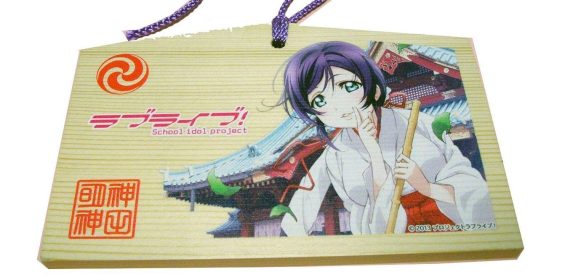
The ways in which anime have been used in response to these problems are myriad. Famously, the popularity of the anime Lucky Star led to people visiting the very shrine featured in the show, Washinomiya Shrine. The first Love Live! School Idol Project anime had a similar effect on Kanda Myoujin Shrine in Akihabara, where the character Nozomi works. But there are also anime which try to show the splendor of Japan whether directly or not. I don’t think it’s a coincidence that Flying Witch was made into an anime a few years after 3.11 when Japan was trying to revive tourism to the affected Tohoku region. Taking place in Aomori (a prefecture in Tokyo), Flying Witch features lovingly crafted shots of picturesque landscapes as if to say, “This area is lush with life.” The studio P.A. Works used the series Hanasaku Iroha to create the fictional “Bonbori Festival” and then bring it into the real world. Their more recent work, Sakura Quest, is an anime explicitly about trying to deal with a declining population in a small town through tourism and promotion.

Official Love Live! Wish Board from Kanda Myoujin Shrine

Love Live! Sunshine!! takes place in the small town of Uchiura, near Numazu. Much like the first franchise, the main characters’ school is threatened with closure due to declining attendance rates. The girls, inspired by the group known as μ’s (from the original Love Live!) attempt to replicate the latter group’s success in saving their own school, and form their own idol group called “Aqours.” Already, it’s clear how Love Live! Sunshine!! touches upon issues of population movement and tourism, but it’s especially notable when comparing the series to its predecessor.

Consider where the two properties take place. The μ’s girls of the original Love Live! are centered around Akihabara, which is both the spiritual center of otaku in Japan and, as a result, already a popular tourist destination. The Aqours girls of Love Live! Sunshine!!, on the other hand, are situated near Numazu, which has a population of under 200,000 as well as a recent history of absorbing nearby towns—a major plot point in Sakura Quest and a potential future for Uchiura. Unlike Akihabara, Numazu is hardly world-famous. And yet, if Love Live! had started differently—if it had decided to go with Numazu from the start—then I don’t think it would’ve reached its original success. Much like AKB48, it relied on the notoriety of Akihabara to build itself up, and is now paying it forward, in a certain sense. Love Live! used tourism, and now tourism is using Love Live!

Love Live! Sunshine!! can be seen as another arm of the “Cool Japan” concept, which uses Japan’s fame as a symbol of cultures both traditional and popular to promote itself at home and abroad. It appears to be succeeding, at least in the short term. In fact, over at Apartment 507 where I also write, one of the most popular posts is a guide to visiting Numazu. But as Gundam director and Anime Tourism Association chairperson Tomino Yoshiyuki has warned, short term success is not enough; permanent change is necessary, even if it’s to come from anime. The fact that Love Live! went from being supported by pop culture to being a pop cultural influence that can potentially make a change is a big deal, and I’m curious to see if this experiment has any long-term impact that goes beyond the cute idols of Aqours.

Save

Save

[APT507] School Idols vs. Pro Idols: The Hints of Sobering Reality in Love Live!

Something that’s stuck with me for a long time is the distinction that Love Live! makes between idols and school idols. I find that it hints at the harshness of the idol industry, though in a very, very indirect way. I wrote a short article on it over at Apartment 507, if you’re curious.

Save

Trinity Tempo: The Idol Franchise Where Money Literally Equals Success

tritem_index_3Anime-style idols (and of course idols in general) have been of the most enduring trends in current Japanese pop culture. Between franchises like The iDOLM@STER, Love Live!Ensemble Stars, and King of Prism by Rhythm, more and more pop up seemingly every week. Trinity Tempo is one such franchise, but what makes it unique is the degree to which it takes the AKB48 “vote with your money” concept to the next level. That’s because Trinity Tempo exists almost purely in terms of merchandise, with nothing else to anchor it.

Ever since AKB48 and their annual elections, the idea of idols competing against each other with fan support has been prominent within that world. Fans vote by getting CDs because one purchase equals one ballot, and the idea is that the more you love your favorite idol the more you will buy buy buy. Currently a little over a year old, Trinity Tempo‘s premise is that different schools compete against each other in idol competitions, and you get to determine who wins by buying merchandise for your favorite team. You literally get to influence how the overall story progresses by spending cash on character-specific goods, with certain items giving you more “votes” than others.

“Where does Trinity Tempo come from?” you might be asking. The iDOLM@STER began as a game with visual novel elements. Love Live! got its start as a series of songs. All of these properties aim for the media mix, with anime and manga adaptations, coverage in magazines, and more, but they tend to have at least one or two initial starting points. After all, how would you know who your favorite characters or what your favorite songs are?

The answer is… there is nothing. No CDs. No anime or manga or games. Trinity Tempo exists almost purely in “merch space,” where potential fans are supposed to be drawn into it based primarily on their attraction to the concept and the characters themselves. Since release there has been at least one Drama CD, but that’s about it.

I think this speaks to the idea presented by Azuma Hiroki that fans take bits and pieces of characters, worlds, and stories and merge them together in what are known as “database narratives.” I’m oversimplifying the idea, but I think it can be argued that Trinity Tempo aims to commercialize the otaku desire to gather these fragments together on a level even beyond something like Kantai Collection. Whether or not they’ll succeed in the end remains to be seen.

If you liked this post, consider becoming a sponsor of Ogiue Maniax through Patreon. You can get rewards for higher pledges, including a chance to request topics for the blog.

The Long Arm of Anime History

Anime: A History by Jonathan Clements is a good book that tries its best to call out the rewriting of past events by both the victors and the defeated. While this can detract from the magical aura that surrounds anime and the joy of experiencing anime as more than just a struggle between industry, profit, and glory, it does highlight one recurring trend that shouldn’t be forgotten—many times, when we think of some trend or change as emerging fully formed during a given period of interest, its threads can be traced back much earlier.

One thing that always comes to mind is something that Gundam director Tomino Yoshiyuki mentioned back at New York Anime Festival 2009, which was that while Gundam started courting female fans much more actively in later years (notably with Gundam Wing), it was the girls who were the biggest fans of the original 1970s work. While things have certainly changed since then, Gundam Wing also did not emerge as some kind of “sudden” targeting of a female audience.

Similarly, when it comes to Clements’ book, one example he gives has to do with the idea that the video game industry is a significant contributor of “brain drain,” that is to say a unidirectional flow of talent from anime to games. While this is often viewed as a symptom of the last decade or so, a product of the mainstream lucrativeness of the contemporary video game industry, Clements points out (on page 194) that this was already occurring in 1992, which would be during the age of the Sega Mega Drive and the Super Famicom. Thus, the battle to keep newer and more rapidly expanding entertainment sectors from drawing away the best of the best is not a relatively new phenomenon, but an ongoing quest.

One last thing I’d like mention is the fact that this brain drain is partially attributed not just to video games’ international mainstream success, but the fact that Tezuka Osamu himself undercut the cost of animation in Japan decades prior in order to get it onto Japanese television. This undervaluing of anime, known as the “Curse of Tezuka,” is what necessitates projects such as the Animator Dormitory Project, an annual fund to provide housing for animators in an industry that pays very little (by the way, that Indiegogo ends today!). To see anime change in the future is perhaps to understand the long reach of past decisions.

If you liked this post, consider becoming a sponsor of Ogiue Maniax through Patreon. You can get rewards for higher pledges, including a chance to request topics for the blog.

The Open-Ended Nature of Aikatsu’s “Idol Activities”

This post was sponsored by Johnny Trovato. If you’re interested in submitting topics for the blog, or just like my writing and want to sponsor Ogiue Maniax, check out my Patreon.

aikatsu-group

There have been many attempts over the years to dethrone the Japanese children’s entertainment juggernaut that is Precure, but while Precure is squarely in the realm of the “fighting magical girl,” most of its challengers are themed around mahou shoujo’s sister genre: pop idols. This includes Pretty Rhythm, PriPara, Lil Pri, and the subject of today’s post, Aikatsu!

Aikatsu! began in 2012 as a multimedia franchise consisting of games, manga, and anime. The animated television series, created by Sunrise (of Gundam fame), follows Hoshimiya Ichigo, a girl who enters the idol training school Starlight Academy after being inspired by its top star, Kanzaki Mizuki. Together with her best friend and idol fan, Kiriya Aoi, and others she meets along the way, they engage in idol katsudou, or “idol activities.”

aikatsu-obaripose

Sunrise at this point is well known for another popular idol anime, Love Live!, and despite the fact that they don’t share that much staff, the two shows are similar in feel. Both have an overall lighthearted sense of fun and engaging character interactions combined with learning and personal development. Both feature bizarrely comedic moments (the episode where Ichigo gets into an “Obari Pose” and chops down a christmas tree is famous). Both series are also so entertaining in these respects that the actual “idol performance” moments are comparatively less interesting.

aikatsu-helpmeobiwan

However, one curious aspect of Aikatsu! that differentiates it from Love Live! (and many other anime) in terms of narrative is that Ichigo and the other idols don’t seem to have a concrete goal to aim for. The girls in Love Live! want to save their school and then win the Love Live. Naruto wants to become Hokage. Ichigo’s motivation is this vague sense of “becoming an idol,” but by the first few episodes she already is one more or less, and there just seems to be this general sense of forward progress. This is also what differentiates it from other more episodic works, or series such as Hidamari Sketch.

Aikatsu! has just enough on-going threads in the background and pays attention to its characters’ growth that the series carries a nice sense of continuity. Aoi becomes the mascot for a crepe company in an early episode, and after that you can always see a copy of the advertisement poster featuring her in Aoi and Ichigo’s room. The show also drops hints that Ichigo’s mom is a former idol, and as I continue to watch the series I’m just anticipating that moment where Ichigo discovers the truth. Every time her mom appears on screen, I think, “Will this be it?!” That desire to see Ichigo’s realization is actually one of my main motivations for continuing to watch.

dokidokiprecure-phones

There’s one last element of Aikatsu! I want to discuss. More specifically, it’s a theory pertaining to Aikatsu!‘s relationship with Precure. When watching Aikatsu!‘s core cast, I could not help but be reminded of the cast of Doki Doki Precure!, which came out in 2013. While the characters are different enough to not feel like copies of each other, Mana’s blonde hair and pink color scheme in her transformed state resembles Ichigo’s, Rikka (blue) plays the role of the more level-headed and smarter best friend just like Aoi, Alice resembles Arisugawa Otome (orange) not only in name but also in appearance, and Makoto’s occupation as an idol (as well as her serious personality) feels akin to Mizuki. I suspect that Doki Doki Precure! may have taken some inspiration from Aikatsu! but I can’t be certain of this. That said, I recently checked out some of the character design notes for Doki Doki Precure! and noticed that Cure Sword (Makoto)’s design originally had longer hair, which would make her more stylistically similar to Mizuki from Aikatsu!

Aikatsu! has been a series on my radar for a while, that I had only briefly engaged with, but given just how entertained I’ve been by it I definitely want to watch more and talk more about it. Expect future posts, maybe?

I’m Backing the Anime Project CHUYA-DEN on Kickstarter

I believe that the best children’s anime, and perhaps the best children’s entertainment in general, carries a sense of weight that does not try to go far above their heads. More than a matter of simply “maturity,” it’s about giving children respect and understanding that they are thinking, feeling beings who experience the world, and this also results in works that can be enjoyed by adult as well. The best moments of series such as Pokemon and Digimon follow this vein, and this is also the impression I get from the latest Kickstarter anime project, CHUYA-DEN: The Night and Day Chronicles.

CHUYA-DEN follows three children who get embroiled in the conflict between day and night youkai, and must fight to save the world from darkness. After watching the Kickstarter video, I decided to back the project almost immediately. This might seem a bit odd given that details of the story are sparse and the staff for this project aren’t industry superstars, but just from that small introduction a number of things stuck out and impressed me.

First, is the overall atmosphere of the world being portrayed. With its Arietty-esque portrayal of common, everyday objects such as cooking stoves as giant artifacts, combined with the brightness of its characters and the darkness of night, I could feel a sense of importance in what the characters are trying to accomplish.

Second, is the fact that the creators of the studio responsible for this project, WAO World, are valuing CHUYA-DEN as a wholly original project not shackled by the demands of a toy industry or other such sponsor that demands sales of merchandise above all else. As much as series such as PokemonDigimon, and Precure have their heartfelt moments, their ties to toy and game companies always require a bit of sales-pitching, and I see CHUYA-DEN as something that exists along a similar wavelength without always having to defer to that sort of merchandise-oriented marketing.

Third, and for me the most important point, is that CHUYA-DEN appears to greatly value a sense of introspection in its characters and world while still maintaining itself as a children’s show. There’s a line in the trailer that says, “All you feelings inside are battles you must fight,” and that sense of conflict being as much internal as external is the same feeling get from my favorite children’s anime, titles such as Heartcatch Precure! and Battle Spirits: Shounen Toppa Bashin.

The project has 4 days to go, and is currently at over $50,000 of its stated $100,000 goal. If you’re interested in it for the same reasons as me, or perhaps even different reasons all your own, why not take a look?

If you liked this post, consider becoming a sponsor of Ogiue Maniax through Patreon. You can get rewards for higher pledges, including a chance to request topics for the blog.

How Many Curtains Does It Take to Get to the Truth of Anime Production?

One of the recurring endeavors in the study of anime and manga has been to remove some of the aura from Tezuka Osamu. Rightfully one of the most influential figures in anime and (especially) manga history, it’s not so much about questioning whether Tezuka had any impact on Japanese popular culture but to what extent the attributions given to him (either by others or himself) are necessarily accurate. Did he really create the first anime (no) or the first TV anime (no)? Did he really invent shoujo manga (the answer is also no)? However, amidst the pursuit of the truth, this brings to mind the question of how much one is willing to peel back the veils of illusion that go into the production of art and media, to look at the creators themselves, and perhaps to take away even their brilliance in favor of treating them and their works as mere people and products.

What inspired this post was the book Anime: A History by Jonathan Clements, which aims to study anime as objects, created and sold, and in doing so reveal a side of anime’s history that isn’t merely about lauding the successes or pointing out obscure, overlooked works. As much as one might argue that this is removing the “magic” from anime, there’s nothing wrong with this approach, especially if one is in pursuit of a more factual type of truth. In fact, it’s not so much that the veneer of fantasy has been peeled away from the anime or the creators that has me writing this post, but rather about the degree to which another might accuse me of doing the same thing through this blog.

One of the aims of Ogiue Maniax from the very beginning has been to get people to think more about anime and manga, to explore why one might love anime in a certain way. To this extent, I’ll talk about different themes in series but I’ll also bring up both creators and audience in a mix of modernism vs. postmodernism that I don’t necessarily think needs to be resolved. I’ll go to panels at Otakon and lament the lack of audience for Maruyama Masao, who is one of the greatest troves of anime production knowledge in existence (though maybe now that he’s been parodied in Shirobako this might change things) and question why people pay so little attention to the creators. And yet, is that so different from what Clements does in his book?

While Clements strips away the aura from the creative process a bit in order to question the self-congratulatory aspects of creators and studios, am I stripping away the fantasy of the anime as a story in and of itself, the narrative as entity that wishes for people to engage it on some level as inherently real? Do even the people who follow voice actors do this same thing in their own way? And perhaps most importantly, should these contrasting stances all be considered under the same umbrella of “fandom,” or are they distinct enough to need more specific categories?

If you liked this post, consider becoming a sponsor of Ogiue Maniax through Patreon. You can get rewards for higher pledges, including a chance to request topics for the blog.

Let’s Talk About the Smash Ballot

Ever since the April 1st Nintendo Direct, one of the biggest talking points in the gaming community has been the Smash Bros. Fighter Ballot, which asks everyone who they’d want to see duking it out with the likes of Mario, Pikachu, and Marth. You can tell it’s a big deal when actual video game companies are pushing their own characters explicitly or implicitly, whether that’s Shantae, Sol Badguy, Gunvolt, the Giana Sisters (who began as clones of the Mario Bros), or Banjo-Kazooie. My vote has been cast, and if you’re on the fence as to who might be interesting, I made a few posts last year detailing characters that I think would be cool in Smash Bros. along with their movesets.

King K. Rool

Great Puma

Princess Daisy

Geno

(Or you could vote for NiGHTS).

Readers might find it odd that I’m talking about the Smash Ballot so late after it was first announced, as all of the news sites, blogs, and forums, were on that like white on rice in Hanayo (Love Live! for Smash?! Think about it), but I intentionally delayed my post on it to emphasize one of the most surprising and noteworthy aspects of this poll. Though it began in April, the deadline is October 3rd, which is the anniversary of Super Smash Bros. for Nintendo 3DS. That’s six months for people to make a decision, which means that this isn’t some flash in the pan popularity poll that goes up for a week to gauge interest in that specific moment, but rather a genuine question as to which characters have captivated generations of Nintendo fans in such a way that we want to see them slam plumbers and princesses into the abyss.

Not only that, but it was revealed that Nintendo is willing to take even 3rd-party suggestions, which opens it up to just gamers in general. As crazy and as impossible as it likely is, could someone like Master Chief or Scorpion make it into Smash Bros.?

I think one of the reasons why being in Smash Bros. is such a big deal is not only the idea that your favorite character appears in a crossover fighting game, but that the series as a whole has done such justice to its characters, at least for the most part (seriously, Ganondorf, where are your projectiles?!). Just look at Mega Man, Solid Snake, and Sonic, all of whom are not Nintendo properties but were given so many visual, aural, and gameplay cues that make them feel as if they’d been ripped straight from their original games. Mega Man’s crisp movement feels almost just like the NES, Snake’s explosives made him a unique experience in Brawl, and Sonic drives people nuts with his spinning hit-and-run style that makes every person feel as if they were shouting, “I HATE THAT HEDGEHOG!”

Not to say that other crossover games and the like don’t give characters their due. In fact, Mortal Kombat X probably has the best portrayal of Jason in any video game ever (not that there’s much competition). However, I think what Smash Bros. epitomizes above all else is just deep respect for the characters involved. To become a Smash Bros. character is to know you’re something special, or perhaps a time-saving clone, but it’s an honor unlike any other, and if video game characters were real it’d probably be like winning an Oscar.

In Case You Forgot, I Love Both Anime and Food

I’ve written a blog post on Sailor Moon as my introduction to Japanese food over at the Waku Waku +NYC official blog. If you’re interested in me waxing nostalgic and rambling the way you expect out of Ogiue Maniax, take a look.

Sailor Moon Was My Gateway into Japanese Food

I’ll be a regular contributor to the Waku Waku +NYC blog from now on, so look forward to more posts from there in the future. As always, I will continue to devote myself to Ogiue Maniax as well.

If you’re curious, Waku Waku +NYC is an upcoming Japanese popular culture festival from August 29-30 in Brooklyn, NY. Unlike a lot of anime cons and Japanese events, this one looks to more thoroughly integrate food with Japanese anime, games, fashion, etc. If you’re even half as interested in eating and watching anime as I am, it might be worth your while.

Stress and Inspiration and Animation: SHIROBAKO

shirobako-aoi

shirobako-director

With a lovable cast of characters, in-depth look into the world of anime production, and numerous references to famous creators and works,  SHIROBAKO has been a darling of the internet anime fandom, particularly among those who consider themselves to be, if not among the most informed anime fans, then at least those who desire to be more informed. While SHIROBAKO is not the first anime to delve closely into its own industry, I believe it is the first full-on 26-episode television series to do so, and this allows it to show multiple facets that are involved when making anime, while also giving them room to breathe and to garner appreciation.

SHIROBAKO centers around Miyamori Aoi, a young animation production assistant at Musashino Animation Productions (aka Musani), a once-renowned anime studio that is trying to rebound and recover its reputation. Back in high school, Aoi and her friends in the school’s anime club created their very own animated short, with the hope of someday working together professionally to create it for real, which has led them each into different areas of the anime industry: 3DCG, voice acting, writing, 2D animation, and of course production. As each of them deal with their own struggles in trying to get closer to their dreams, which include wondering if anime is right for them after all, Aoi and the others learn about what it takes to make an anime, and all of the joy, stress, and sleepless nights that go into it.

P.A. Works, the studio behind SHIROBAKO, has a reputation for producing very specific sorts of works. Whether it’s True Tears, Tari Tari, or Hanasaku Iroha (which I love), many of their shows involve cute high school girls and a lot of emotional drama. It’s a formula that works for some but is like poison to others, and with SHIROBAKO we have a work that successfully toes the line between the two. These aren’t high school girls but rather young professionals, and though many of the women in the anime are purposely designed to be attractive, there’s more than enough focus on anime production that the show hardly feels like a cute girl/melodrama delivery system. In a way, because of how taxing anime production is (as has been revealed in numerous articles and interviews over the years), a bit of melodrama doesn’t seem surprising between people fighting back their tears so that they make an absurd deadline.

A more cynical part of me thinks that the girls are there to an extent to be the gateway to introduce those anime fans obsessed with cute girls to what goes on behind the scenes, and that the series in general is very much designed to promote the anime industry and encourage people to join. It’s also a problem that they don’t really acknowledge the enormous component that is the anime industry’s outsourcing of in-between animation to other countries including Korea, the Philippines, and India. However, there’s no denying that the series is rife with genuine information to learn and appreciate, and that the characters, regardless of their base intent have convincing personalities and stories as to why they’re in the art and business of making anime in the first place.

shirobako-midori

shirobako-misa

For the record, my favorite characters are Imai “Diesel” Midori (one of Aoi’s old club mates who possesses a strong desire to write for anime, a thirst for research, and an ever-enthusiastic personality), Toudou Misa (another club mate who works in 3DCG and has to decide if she wants to play it safe with her career or take a chance), and Sugie Shigeru (the oldest veteran animator at Musani who, while enormously skilled, doesn’t quite fit into the current era because he “can’t draw moe”).

As mentioned at the beginning of this review, SHIROBAKO is rife with references to both real people and real anime. Aoi’s favorite series is Mountain Hedgehog Andes Chucky, based on Mountain Rat Rocky Chuck. One episode centers around the importance of the Idepon films, or Space Runaway Ideon. Numerous posters seen in the background throughout the series include parodies of Casshern, Lunlun the Flower Child, Ghost in the Shell, and much, much more.

shirobako-gachorn

shirobako-musani

As for people, this is probably what gets people to scramble to anime production staff lists the most. The above-mentioned Sugie is based either on MADHouse founder and animator Akio Sugino, legendary animator Mori Yasuji, or some combination of the two. The real identity of Musani president Marukawa Masato is blindingly obvious to anyone who’s been to Otakon in Baltimore and attended a panel by MADHouse and MAPPA founder Maruyama Masao. Evangelion director Anno Hideaki and voice actor Itou Shizuka are among the many, many real industry veterans to appear in slightly altered forms in SHIROBAKO. Combined with the anime parodies it makes for a somewhat addicting game of “figure out the reference” that, unsurprisingly, appeals to a lot of fans who have devoted themselves to learning about anime.

The day after I finished SHIROBAKO I had a thought: often times when it comes to anime or other forms of media that fictionalize a given craft, technology, or profession, people who are deeply involved in those areas can easily nitpick these series in terms of accuracy. While I don’t have firsthand experience in the anime industry (though I’ve done a bit of work as an animation production assistant myself), I almost feel as if SHIROBAKO is defying the “well actually’s” of the world to say something. Who better to talk about creating anime than the people who create anime? Perhaps the answer is those whose voices haven’t been covered. Maybe we’ll next get a series from the perspective of the in-betweeners.

SHIROBAKO is available on Hulu and Crunchyroll.

PS: I recently found out that the Japanese terms for in-betweens and moving images in general are the same: douga, just like what you see in Nico Nico Douga. Nooo, this isn’t confusing at all.

If you liked this post, consider becoming a sponsor of Ogiue Maniax through Patreon. You can get rewards for higher pledges, including a chance to request topics for the blog.