Kio Shimoku Twitter Highlights July 2021

Once again, here are more interesting Kio Shimoku tweets for the past month. Not many drawings in July!

Works-Related

This is a small honor for me: Kio Shimoku quoted one of my tweets!

VIZ is releasing a Japanese Star Wars tribute artbook, and Kio’s work is in it. Kio mentions that his vision for his drawing was “What Kio Shimoku would like to draw.” The result is a bunch of Episode I characters.

Quoting this anatomy drawing, Kio recalls working on Kagerowic Diary. At the time, a friend asked him why he drew the girls with such muscular backs, and Kio’s response was that he just thought it’d be a good idea.

Kio announced the latest chapter of Hashikko Ensemble with a picture of Mai (good taste).

To fight off exhaustion, Kio went to the convenience store to buy a Red Bull only to discover that they have extra-long Red Bull cans now. Not only that, the long cans were actually sold out.

Other

Kio was invited to be a critic for Day 1 (August 14) of an otaku-themed music event called the Secondary Culture Choir Festival. He’s honored and flustered.

This is a tweet thread about Shin Evangelion. Because I haven’t seen this movie, I’m hesitating to translate it without proper context, but one thing Kio mentions is that he was really into the theory that Asuka and all the other characters from Evangelion Q were the characters from the old Death, Rebirth, and End of Evangelion films. I will probably revisit this once I’ve seen the film next month.

Kio is looking forward to Miss Kobayashi’s Dragon Maid

He also likes—no, loves—KonoSuba.

In light of the death of Nasu Masumoto, the author of the Zukokke series of children’s books, Kio reminisces about his own experience reading them. He talks about how as a kid, they were the greatest: a mix of the real and the absurd that went between horror, fantasy, science fiction, and the everyday. He and his classmates would get caught up in imagining their own adventures.

A photo Kio took of some clouds.

Kanon Indeed: Hashikko Ensemble, Chapter 42

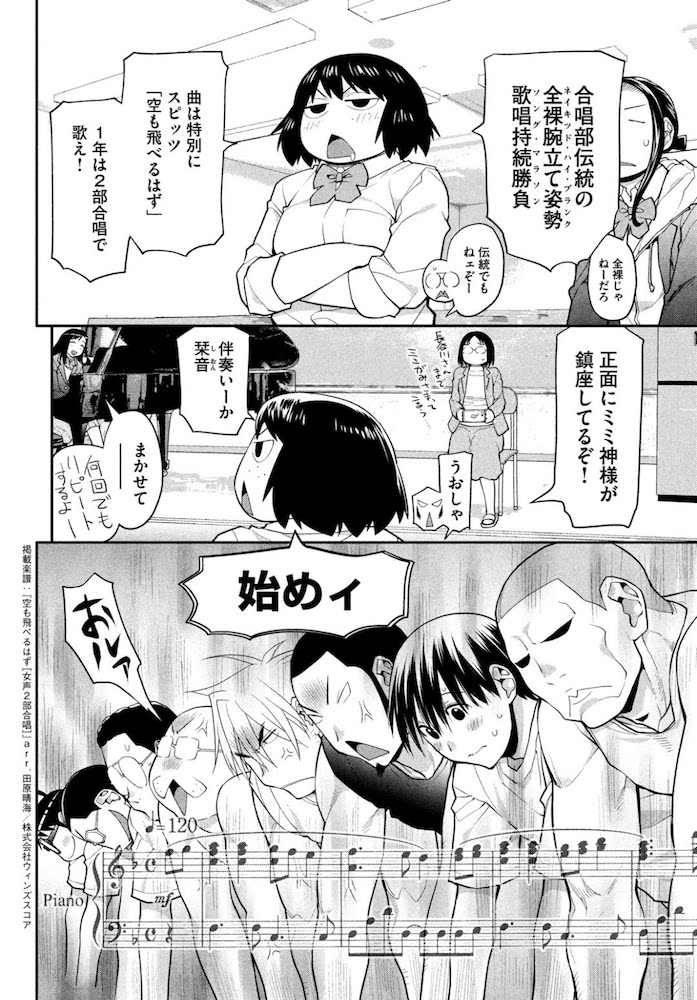
Kozue commences a competition among the boys to do push-ups while singing

The Chorus Appreciation Society bolsters its ranks, but not all is smooth sailing.

Summary

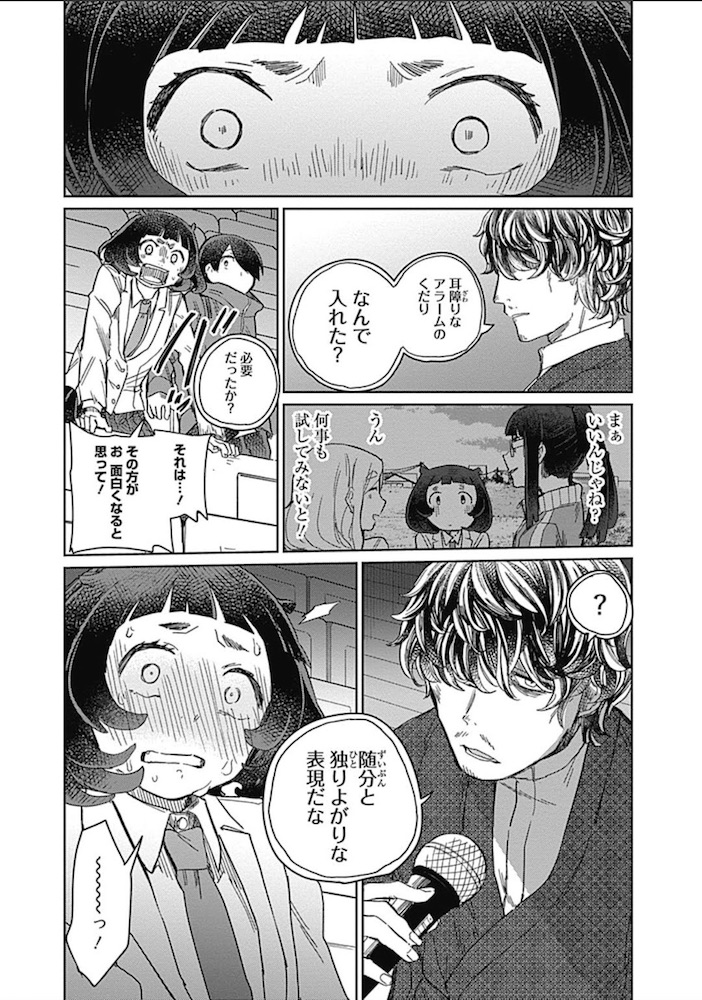
In a small change of pace, this chapter is largely from the point of view of Kanon. Despite the big win and Kozue’s fiery speech, the only students who have decided to join the Chorus Appreciation Society are Tsuyama’s crew (aka the Tsuyamars) because Mimi-sensei is their advisor. And right as Kanon is resigned to not participating more actively because this Appreciation Society is guy-focused, Kurotaki Mai shows up both asking to join and clearly having her eyes on Akira. 

After some exercise (during which Kozue explains that theirs is basically an athletics club in terms of physical conditioning), things escalate into a competition between the current guys and the Tsuyamars to see who will be part leaders. In particular, Tsuyama and Kousei have a particularly fiery rivalry, on account of their both being baritones and delinquents quick to violence. Thanks to the conditioning of the veteran members, they all retain their spots, but within the little conversations happening, Kanon senses an increased awkwardness from Jin to Akira.

Kanonical Perspective

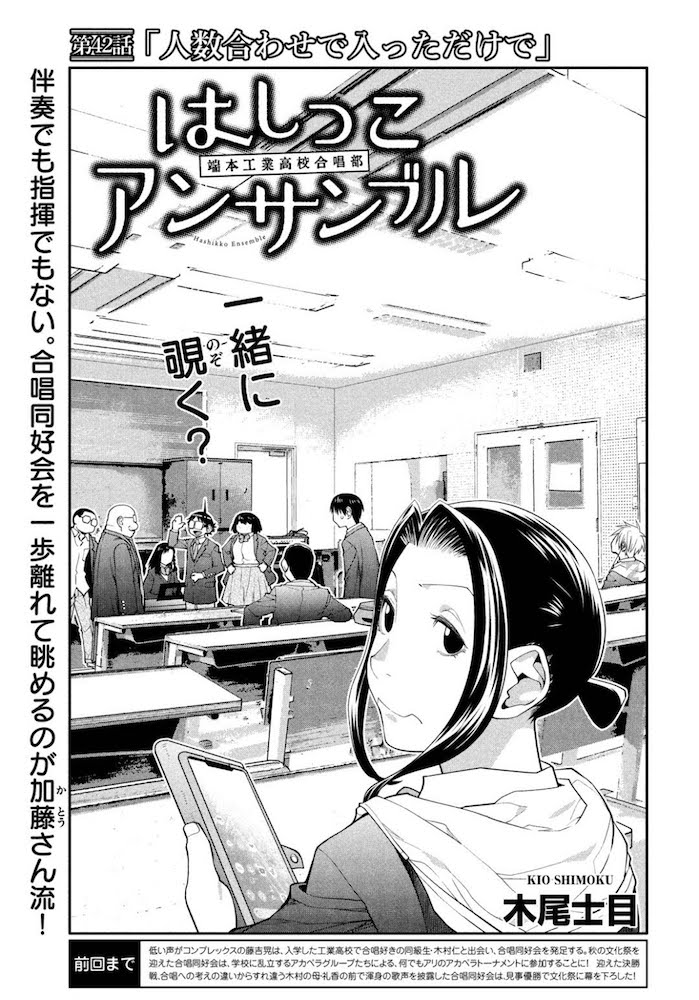
Kanon looks back toward the reader while sitting in the back of the clubroom

I’m appreciative of the fact that Kio was willing to switch things up and give Kanon a spotlight of sorts. So far, she’s largely been the relatively normal friend of Shion and Kozue, and one might uncharitably call her “boring.” But in addition to the manga emphasizing that she’s feeling a greater desire to participate more actively in some way, Kanon is also shown to have the keenest eye when it comes to social dynamics. She immediately recognizes Mai as the girl with a huge crush on Akira. She notices a greater closeness between Shion and Kousei, as well as Jin and Kozue. And, as mentioned, she can tell that Jin’s viewing Akira differently—though it’s not certain if she’s making the connection to Jin’s mom publicly recognizing Akira’s talent in front of her son.

I’ve compared Kozue a bit to Kasukabe Saki from Genshiken because of their no-nonsense attitudes, but because of Kanon’s ability to recognize shifting relationships, I think she might fit that role better in certain respects. The fact that Kozue is kind of an oddball in her own right also means that she can’t play the straight man the way Saki would. Perhaps Kanon is more like a less abrasive Sasahara Keiko? In any case, I’d like to see at least a few more Kanon-centric chapters in the future—perhaps even one where she’s the actual center instead of just the POV character.

Mai Joins the Party!

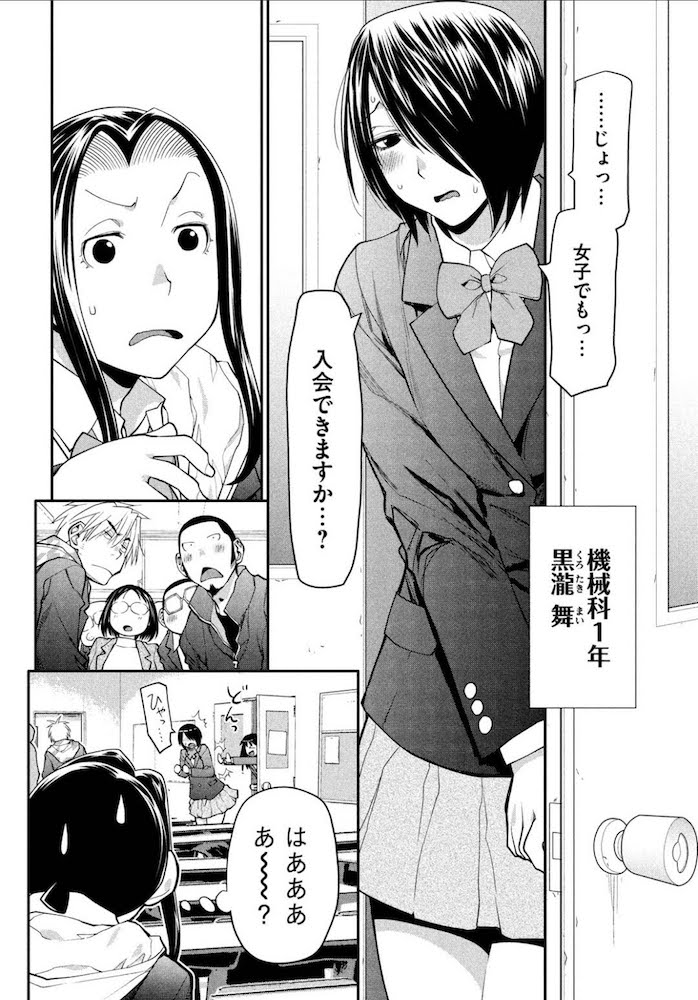
Kurotaki Mai asks if they’re accepting female members

Ever since her introduction, I have been hoping and predicting that Kurotaki Mai would eventually join the club, and now it’s finally happened. But while she’s been a potential love interest for Akira from the get-go, I really did not expect her to be waging an active campaign for his affections! As Kanon notices, not only does Mai enter the clubroom with a clear intent and purpose (even making a beeline straight for Akira), but she went as far as shortening her skirt. I think a part of me might be a little too used to a certain greater level of old-fashioned indirectness in these story situations, but I welcome whatever this is.

Kanon is surprised to see Akira react so casually and obliviously to Mai turning up the charm, to which she begins to wonder if Akira is into “bratty” girls like Shion and Himari. Kanon is portrayed as being especially observant, but I’m not certain she has an accurate peg on him, and I still believe Mai has a chance. Also, I like how right towards the end of the chapter, we get a little glimpse into more of Mai’s personality when she urges Akira and Ogawa to keep competing. While Ogawa is willing to forfeit because he has no particular desire to be the part leader for the bass section, Mai responds with, “Huh…? But there’s no point if this isn’t a serious competition?” It’s as if she wants Akira to live up to her lofty and romantic expectations of him. In other words, we’ve got another weirdo in the group, and that means my fondness for Mai only grows stronger.

Songs

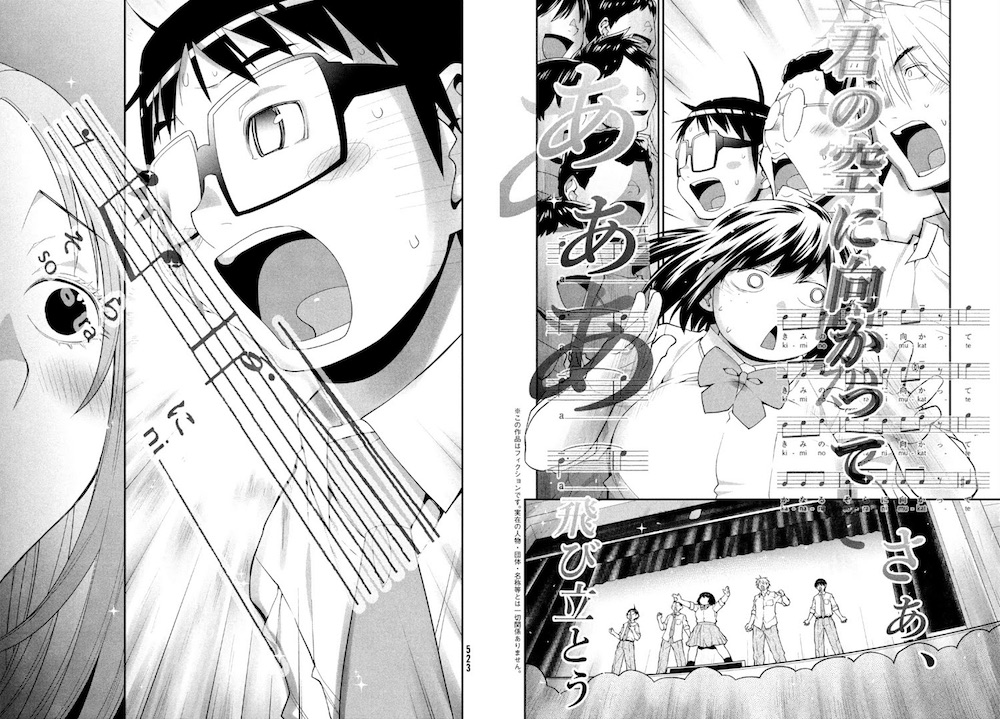
This month’s sole song is “Sora mo Toberu hazu” by Spitz. It’s only natural, because of Mimi-sensei’s love of the band and, in turn, the Tsuyamars’ worship of Mimi-sensei.

Final Thoughts

First, I think this manga is going to get even better now that we’ll be seeing more Mai. I might be biased, though.


Second, while it barely got mentioned in this chapter, I’m really expecting a greater exploration of Jin’s new tension when it comes to Akira. The idea of intra-club volatility is new to Hashikko Ensemble—not only with Jin and Akira or Tsuyama and Kousei, but also Mai and Shion—and I’m looking forward to seeing what kinds of drama and silliness arise. 

Oh, What Could Have Been: Maku Musubi Final Review

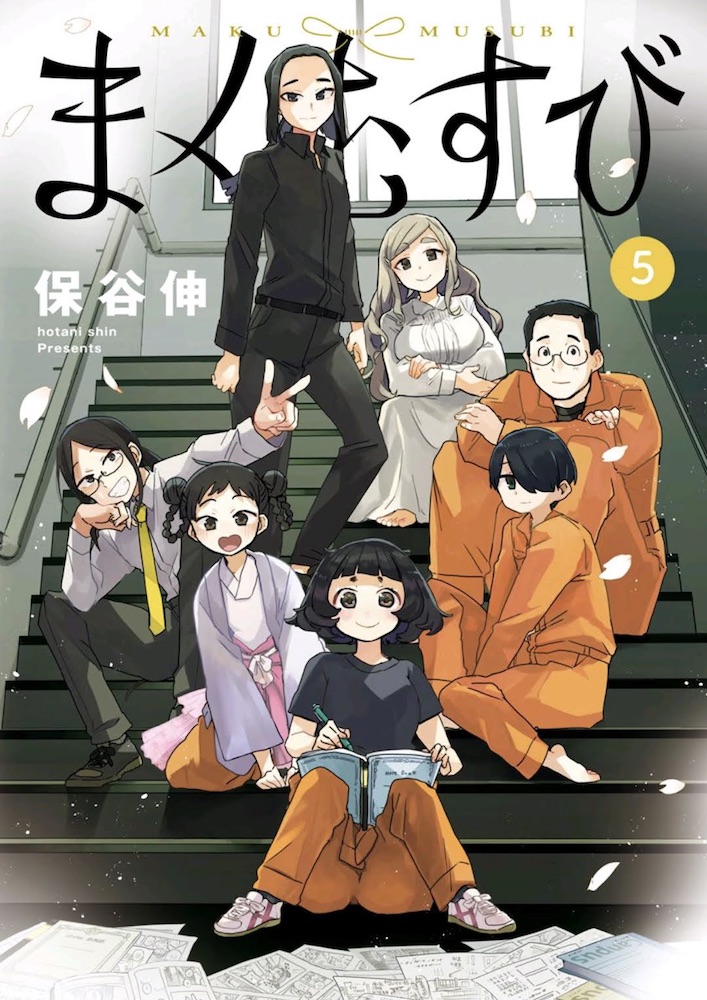
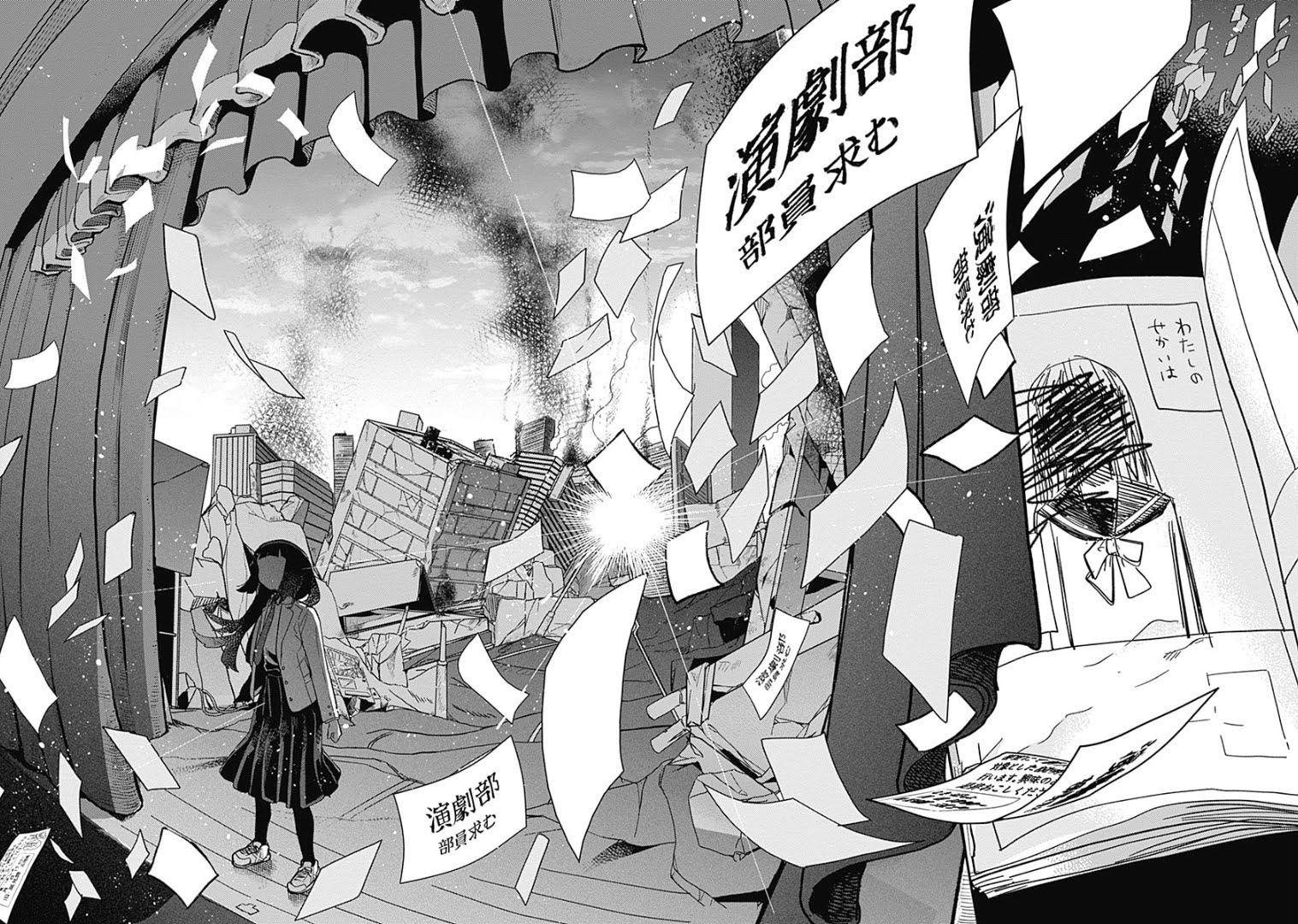
Maku Musubi by Hotani Shin is a manga that hooked me instantly. Its story—that of a high school girl who abandoned her dreams of becoming a comic artist but finds new life creating scenarios for theater—resonated with me because of its exploration of its protagonist’s creative process, and it made me want to read more. 

The series ended up being five volumes total, and my takeaway is that the series is great fun from start to finish, but feels like it was cut short and prevented from reaching its true potential.

In Maku Musubi, heroine Tsuchikure “Musubi” Sakura and her clubmates are working towards competing in competitions against other schools. They even attend a joint-school event where different drama clubs gather for what is essentially a practice run with professional critique. This little arc is great: it emphasizes the eccentric yet compelling nature of Sakura’s scripts, and also introduces an extremely harsh judge whose cold-blooded reviews of every performance provide a “villain” of sorts that challenges everyone to rise to the occasion. The judge clearly recognizes Sakura’s potential, her inability to meet his high standards makes her screenplay a “disappointment” in his eyes. But then they never truly get to any competitions, and so we never see them get to the first true step of their main goal. 

The manga has plenty going for it despite this lack of resolution, and its main focus in the final chapters on the club president’s unpleasant past with the former members who left prior to the first chapter brings out all of the things that make Maku Musubi interesting to read: character introspection, depictions of club-life camaraderie, and a flair for the dramatic (literally). Still, it feels like Musubi’s story could have gone so much further. Her creative struggle could have grown into something even more impactful if given the chance.

Manga isn’t an easy area to succeed in. I’m reminded of another title I reviewed years ago called Haru Polish which, like Maku Musubi, clearly stops earlier than was intended. But when  you look at manga about acting, it’s hard to end things at the right time. Glass Mask is notoriously long—around five decades old with no finish in sight. Now Playing finishes at four volumes when it felt like it had more left in the tank. Act-Age was doing great until the author’s sex crimes forced that series to be canceled. I don’t know if the theatre genre in manga is cursed or what.

I hope Hotani Shin ends up doing another manga, and that they’re able to make as big and beautiful a series as they hope. In the meantime, Maku Musubi was a great ride.

Ju-shin Ly-ger: Ogiue Maniax Status Update for July 2021

Summer 2021 anime is just beginning, and there are plenty of shows I’m looking forward to. Chief among them is Getter Robo Arc, bringing the classic giant robot franchise into the 2020s. I definitely plan on reviewing it once it’s done, but I’m curious to see how it does with a modern-day anime audience.

Speaking of robots, Bandai just announced the GX-100 Soul of Chogokin: Gaiking and Daikumaryu. Coming in at 82,500 yen and measuring about 750mm, it is going to be an impressive hunk of diecast metal. I’m not a super big fan of Gaiking, but I’m looking forward to all the toy reviews.

Also, check out this GX-100 celebration stream featuring Sasaki Isao, singer of Yamato, Gaiking, Getter Robo, and many other classic themes.

Before getting into the posts from the past month, I’d like to thank the following Patreon sponsors:

General:

Ko Ransom

Diogo Prado

Alex

Dsy

Sue Hopkins fans:

Serxeid

Hato Kenjirou fans:

Elizabeth

Yajima Mirei fans:

Machi-Kurada

Blog highlights from June:

20th Century Boys: Pandemics, Conspiracies, and Cults of Personality

How the Urasawa Naoki manga is eerily more relevant than ever before.

BNA: Brand New Animal, Assimilationism, and the Myth of the Model Minority

This series from 2020 continues the trend of socially conscious furry anime.

Little Lady, Big Meals: Kozuma no Kobito no Kenshin Recipe

One of my favorite manga authors, the creator of Mogusa-san, has a new series!

Hashikko Ensemble

Chapter 41 brings the Culture Festival tournament arc to a powerful finish, as well as some surprising insight into the Kimura family.

Kio Shimoku’s Twitter account through June featured a lot of insight into his older work.

Apartment 507

Pui Pui Molcar!

Closing

I mentioned last month that I am fully vaccinated, and it’s given me a new sense of security and freedom I didn’t have before. However, now we have a new COVID-19 variant, the Delta variant, wreaking devastation around the world. It’s also getting a foothold in the US, and I find myself nervous that I’m getting a little too complacent and worrying about trying to neitheo over- or undercompensate for the current situation. Having to balance the psychological happiness that comes from doing things again with some sense of normality with awareness that we are in no way close to getting out of this pandemic reminds me of all the conscious decisions I’ve had to make these past 18 months, and the toll it can take.

That being said, I plan on being at Otakon next month. I’ll be fully masked, and playing it as carefully as I can short of canceling. I hope it’s the right choice.

Kio Shimoku Twitter Highlights June 2021

These are tweets from manga author Kio Shimoku from June 2021 that I found notable and informative. They include a number of early sketches from Genshiken, and his dreams of having a vacation home just for building model kits.

Genshiken and Related Drawings

Though he can’t quite remember, Kio presumes this is Ogiue practice from Genshiken. He thinks he made her too loli in these drawings.

Original Sue design from Genshiken. Kio thinks she comes across differently here.

Early Madarame. Kio thinks he captured the spirit of the character well. Character descriptions on the drawing include: close-cropped hair, thin, lolicon, high-energy, glasses, and likes fighting games. Originally, he was supposed to be the best at fighting games among the group, and his preferred main was Nakoruru from Samurai Shodown. The notes also describe him as being essentially the leader of the club despite being a second-year, and also that he likes to tease others.

(What I find interesting is that the fighting game skills went to Kohsaka, and that the character gained a lot more vulnerabilities in the actual manga. Those flaws are part of why people like Madarame, and here we see sort of what could have been.)

Ogiue autograph boards, the purpose for which Kio doesn’t remember.

By the way, if anyone has the actual final versions of these, I would like to make a deal.

Sketches of anime directors Ikehata Takahashi and Mizushima Tsutomu. Both worked on Genshiken anime.

A rough manuscript of a manga Kio was planning before Genshiken. It would have been an action series featuring magical sage powers (senjutsu).

The wife’s ex from Spotted Flower, crossdressing as part of a prank on the editor character.

Giant Robots and Model Kits

A custom design for a Zeong. Kio feels like he still doesn’t have what it takes to make this work.

A 20-year-old photo Kio took of a model kit he built. The robot is the L.E.D. Mirage from Five Star Stories, and the photo was taken with a non-digital camera. Airbrushing was probably involved.

Kio saw Mobile Suit Gundam: Hathaway’s Flash. Even though the Universal Century timeline has been around for a long time, the film is full of imagery he’s never seen before: what first class looks like for civilian space travel, a military mess hall that’s like a food court, the terror of having to move around the legs of mobile suits in combat. He was glued to his seat while watching..

A 1/144 model kit of the Waff from Gundam: The Origin. It’s the only airbrushed Gundam model Kio has, and he likes how it’s small but still looks chubby. 

Kio’s first tank model kit: the Panzer IV Ausf.D from Girls und Panzer. Kio mentions not really knowing how to do weathering, and that he used the darkest paint from the Waff on this kit as well. He also likes how sharp the details are.

The first thing that Kio thinks of when he sees the term “plastic model training camp” is Plamo Kyoushirou, the proto–Gundam Build Fighters manga. He recalls wanting to be like the characters taking the kit boxes out and saying, “I’m gonna make the Dougram!” and “I’ve got the Real-Type Zaku!” 

After he became an adult, he started collecting them to his heart’s content. It’s why he wants an extra vacation home, so he can have room for all the kits—though actually, he has so many he can’t add any more. But model kits keep on evolving, and he wants to keep up.

Kio continues to describe his dream of a lodging just for model kits that would have all the equipment and features needed to build kits, and stacks of manga to read. Then, he and the others there would go out at night for drinks.

After someone mentions that the possibility is closer than he might think, the conversation mentions a Wonder Festival dealer named “Backyennew.” Kio responds that he knows this garage kit maker.

Responses to Other Works

Kio recalls this crossover drawing between different Shounen Sunday characters. After trying to remember what happens on the next page, a follower answers that it was a kind of fourth-wall breaking moment where they mention that the other manga authors said to do this.

Kio watched the anime film Pompo: The Cinéphile, and thinks it’s a really interesting movie. He talks about how important the editing process is, and recalls that back when he worked on Gonensei [The Fifth-Year], he tried to cram every idea in. For that reason, the progress the character Gene makes as a first-time director is impressive.

By the time of Genshiken, Kio knew how to edit down better, though he actually just took the cut material and turned them into extras in the collected volumes.

The director of Pompo, Hirao Takayuki, is happy that Kio “of Genshiken fame” tweeted about the film. Hirao says he read Gonensei, and that the pain from that manga is still with him today. Kio gives him a big thank-you, mentions how young and inexperienced he was at the time of Gonensei, and compliments Hirao for the highly technical edits. Kio also says the movie being shorter is a good thing, and that he still want so get the second half of the limited-edition extra booklets.

…And here he is with both extras.

Kio says that even though he only read a little bit, Uncle from Another World is a manga that made him think that he’d like to see it as an anime.

In order to get all the limited-edition goods, Kio went to see Shin Evangelion four times. The fourth time around, he felt he could just sit back and enjoy the movie.

Hashikko Ensemble

Kio points out that this song, “Ame” (Rain) from “Mizu no Inochi” (The Life of Water) is mentioned in Volume 3 of Hashikko Ensemble.

Kio went to see this mini concert by the Oedo Coraliars. He was blown away by the harmonizing.

Until next time!

Finishing Strong: Hashikko Ensemble, Chapter 41

Akira singing as the audience (including his mom) stares on while impressed

The end of the current arc paves the way for the next!

Summary

As the Chorus Appreciation Society’s finals’ performance continues, the boys pour everything they have into their singing, Kozue has actually begun conducting the audience more than the singers on stage. With a strong finish, the Chorus Appreciation Society is declared the winner of the Culture Festival’s singing competition.

Soon after, Jin and the other members confront his mom, Reika. After a brief pause, Reika goes up to the group…only to focus on Akira, rather than her son. She remarks that Akira has talent, and that he should contact her because she knows a good music teacher for him. Jin is stunned into silence.

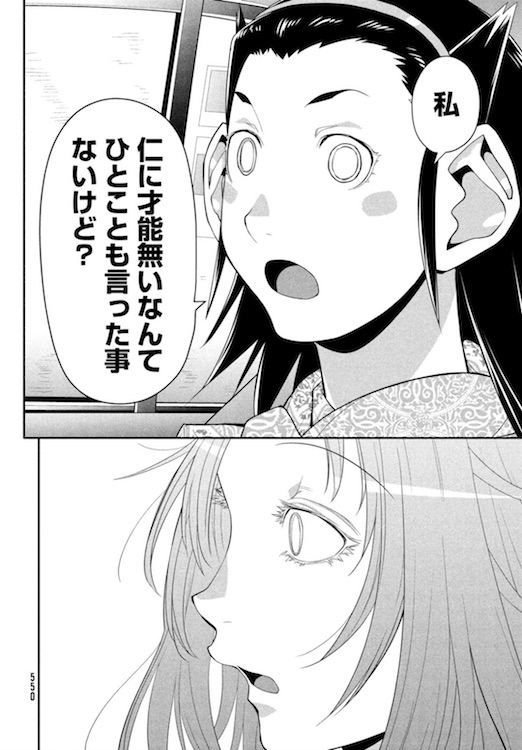
Later, as Reika and Yumerun are leaving by car, Yumerun comments that she thinks Jin has actually improved a lot. She asks why Reika thinks Jin has no talent, to which Reika responds that she never said any such thing. Rather, what she has meant to say is, why would someone with his talent join a chorus or choir, where people go to hide their lack of ability? When asked why she’s never said this outright, Reika answers that calling your own kid talented is embarrassing.

“Relative” Talent

Reika: “But I’ve never once said Jin has no talent.”

The way Jin’s mom really feels about him is something of a revelation, and like the characters themselves, I completely misinterpreted the situation. But I had also previously wondered about whether Jin truly is “untalented” or if he’s just holding himself to a ridiculously high benchmark in Reika, and I believe we have our answer here. Simply because Jin has to study and learn what comes intuitively to his mom, he perceives himself as needing to make up for some deficiency. 

On some level, Jin might be what you call a Larry Hemsworth—an exceptional individual who assumes they’re unexceptional because he constantly compares himself to others close to him who arguably shine even more. But also like Larry, who believes his being a pediatric surgeon pales in comparison to his three brothers’ acting skills, the question of who’s more talented between Jin and Reika is subjective. Jin’s ability to break music down, analyze it scientifically, and put it into practice is amazing in its own right, but he seems to be unable to see it from that perspective.

It remains to be seen whether Reika’s glowing words about Akira create a rift between him and Jin, but I doubt that it’s going to result in any sort of high drama. Perhaps like his mom, though, Jin might be surprisingly indirect in specific situations—as in her conversation with Yumerun in the car.

Yumerun and Jin

The audience getting into the song, and Yumerun seemingly being captivated by Jin’s singing

The chapter has a moment where Yumerun is looking at Jin perform, and she seems to be quite taken by him. They’re childhood friends, and she seems to have some sort of unusual fondness for the guy, but given that everyone is blushing all the time in Hashikko Ensemble, it can be kind of hard to tell what’s romance and what’s not. However, given their history, I feel like something may develop…or at least turn into some Boa Hancock and Monkey D. Luffy situation like in One Piece: a comedically one-sided love where the lack of reciprocation is more due to empty-headedness than incompatibility.

To the Next Story

The image of Akira wowing the audience with his powerful bass feels like a turning point of some kind. His classmates already knew he had a deep voice, and he’s sung in public on multiple occasions at this point, but I predict that he’s gonna gain a whole new reputation after this.

The likely thing is that we’re going to see enough new members join them for the Chorus Appreciation Society to gain proper Chorus Club status, and I expect there to be familiar and unfamiliar faces alike. In my view, Mai is the most likely one, but I think there are probably going to be some real curveballs in there. Might there be any unnamed audience members from this even who will end up as recurring characters?

Songs

“The Wings of Mind” continues and concludes from the previous chapter.

Final Thoughts

Great artwork in this chapter. I continue to enjoy the fact that the portrayals of singing feel intense but don’t go deep into the realm of exaggeration. Not that I mind it in general, but I think it works well for the relatively subdued quality of Hashikko Ensemble.

Also, I don’t think I recall this event being called the “Hashi High Acapella King/Anything-Goes Decisive-Battle Tournament,” but maybe I just glossed over it. In any case, I give props to Kio Shimoku’s first-ever tournament arc. 

Little Lady, Big Meals: Kozuma no Kobito no Kenshin Recipe

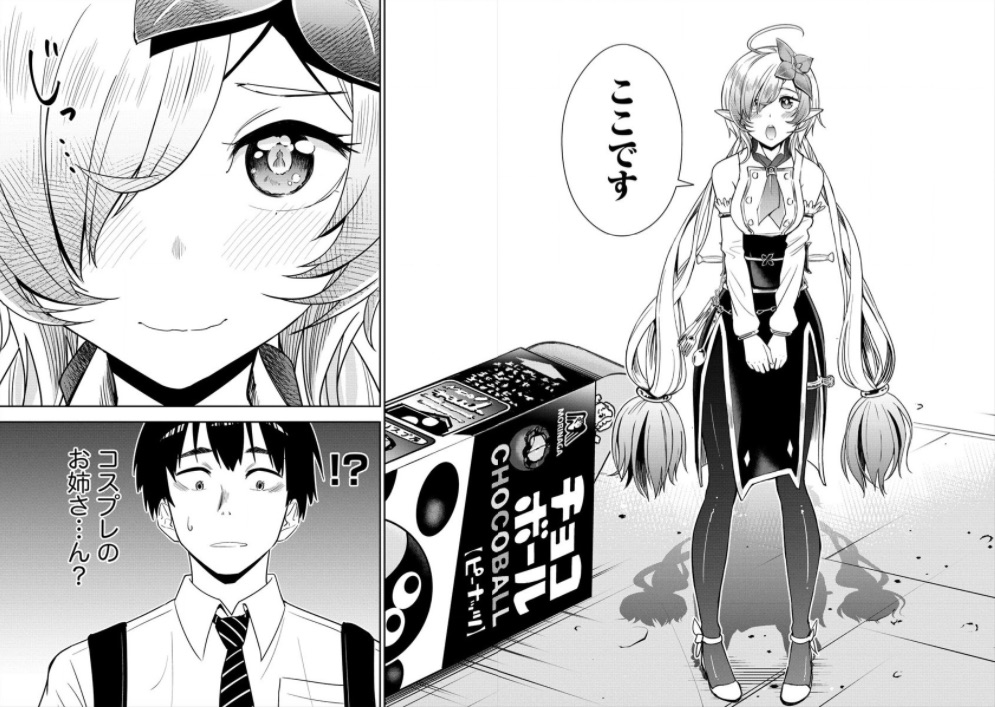
The author of Mogusa-san, one of my favorite manga in recent memory, has a new series out. Kozuma no Kobito no Kenshin Recipe by Ootake Toshitomo tells the story of a down-on-his-luck salaryman named Oomori Shizuru and a 15-cm tall pixie named Mint, who shows up with the intent of becoming Shizuru’s wife and cooking him delicious meals. The series, whose title translates roughly to My Pixie Wife’s Recipes of Devotion, combines two things Ootake has focused on in his relatively short manga career: exquisitely drawn food and oddball romances.

One big change from Ootake’s other manga—Mogusa-san, Mogusa-san Fights Against Appetite, and Teasobi—is that Kenshin Recipe isn’t published under Shueisha’s Young Jump label. Instead, it’s serialized in the web-only Comic Gamma Plus, which is under Takeshobo: a publisher arguably most famous for its mahjong magazines and manga. Essentially, the Takeshobo audience tends to skew older, and this is evident just from Shizuru being 27 years old instead of a high school or college student. However, Kenshin Recipe’s focus on cuteness means it’s not nearly as horny as many of its Comic Gamma Plus peers.

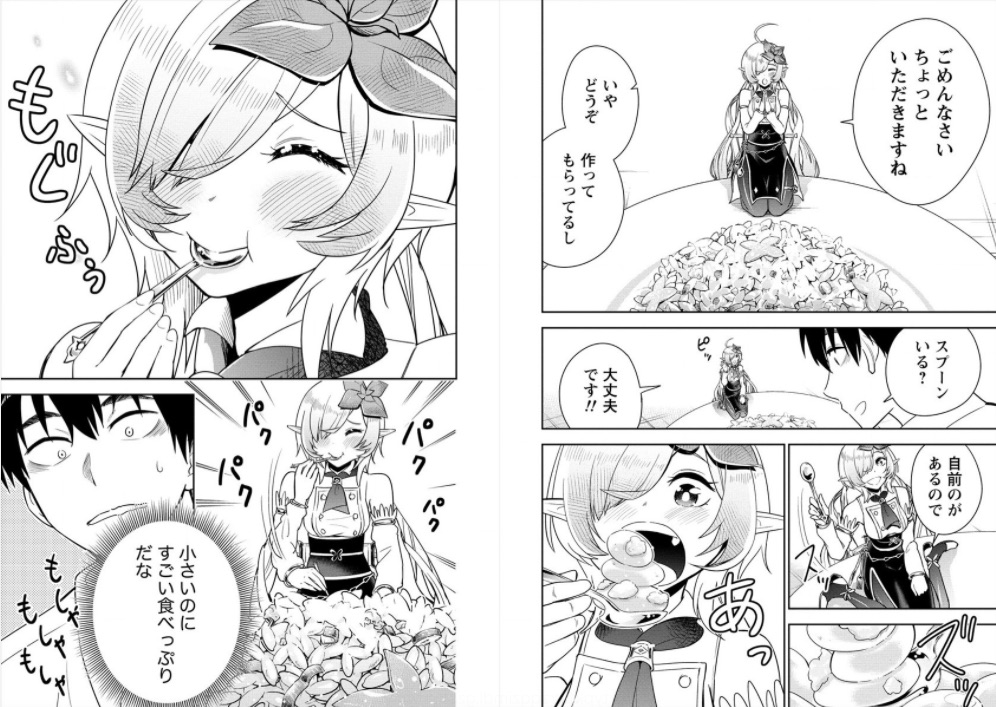
The highlight of the series thus far has to be the cooking scenes. Mint is around six inches tall, yet she has to use Shizuru’s human-sized cookware. Kenshin Recipe shows the way she gets around this: by casting a disinfectant spell on herself and doing everything from headbutting eggs to utilizing fire-resistant clothing to climb inside a frying pan. Ootake knows how to draw food and make it look good, and this provides a perspective on dish preparation that’s both fun and different.

Mint is the linchpin of the series, and while she’s no Minori Mogusa, she has her own unique charms. Putting aside those who are really into fairies and/or wives making home-cooked meals, one thing that stood out to me was Mint’s reasons for wanting to marry Shizuru in the first place. Having long observed him from afar as he left work every day, his sad figure at dusk made her want to protect him. It’s simple and silly, and even has a bit of wish fulfillment thrown in, but I rather enjoy the bit of agency given to the pixie.

There are plenty more opportunities for absurdity, and I’m eager to read more of Kozuma no Kobito no Kenshin Recipe. Based on Ootake’s past works, though, the truly entertaining parts are going to come when he introduces an expanded cast. It’s his strength with ensembles that brings his work from good to great.

20th Century Boys: Pandemics, Conspiracies, and Cults of Personality

I never read 20th Century Boys until this year, but in some ways, I’m glad I waited this long.

Warning: SPOILERS

20th Century Boys in 2021

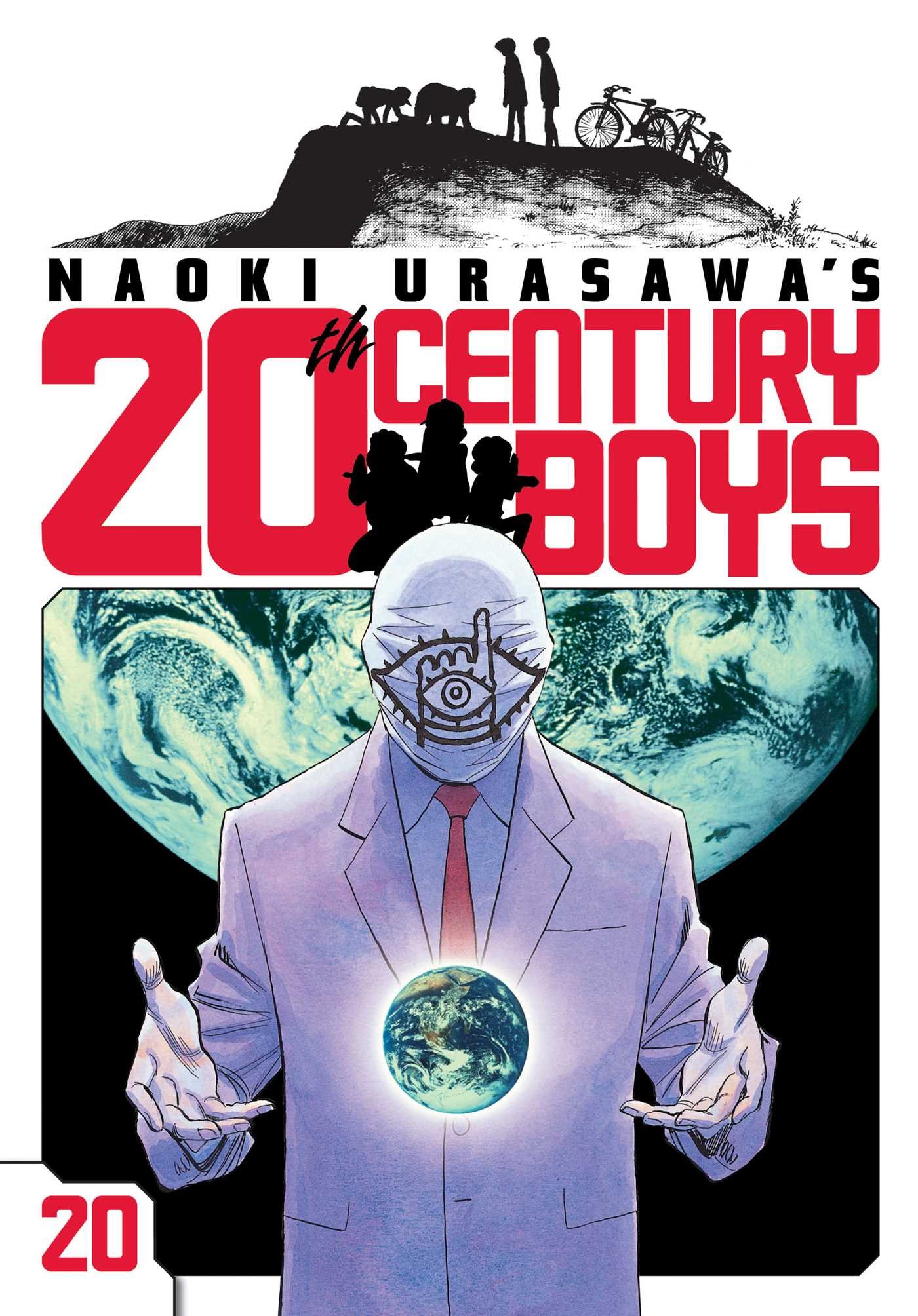
A manga by the award-winning author Urasawa Naoki, 20th Century Boys (published from 1999 to 2006) is a decades-spanning mystery about a man named Endo Kenji and his childhood friends, whose innocent elementary school antics are resurfacing in bizarre and dangerous ways. A Book of Prophecy they wrote around 1970 with far-fetched doomsday predictions about plagues that seem to be coming true, and at the heart of this conspiracy is an enigmatic and politically powerful cult leader known as the Friend. But while the Friend’s identity is unknown to all, there’s a hint that Kenji should know who he is: the Friend’s symbol is exactly the same as one Kenji and his friends came up with when they were kids.

Although conspiracies, cults of personality, and apocalyptic disease are not that unusual in fiction, these elements resonate particularly strongly in 2021. Between QAnon, authoritarians such as Bolsonaro and Trump, and then COVID-19, there are a lot of parallels between what happens in 20th Century Boys and what has transpired in reality. There’s a certain poetic element to a series revolving around The Book of Prophecy seeming to tell the future in itself, but whatever farseeing power it might have possessed are less interesting to reflect on than its portrayals of human behavior. What struck at my core from reading 20th Century Boys was not merely the presence of all these current dangers, but the all-too-real psychological reactions we’ve seen actually take place in the world.

QAnon vs. the Friendship and Democracy Party

One vital difference between QAnon and The Book of Prophecy is that the former has not been substantiated in any way, whereas the latter’s predictions are actively made true through the machinations of the Friendship and Democracy Party led by the Friend. Regardless of actual success rate, however, the two bear some fundamental similarities. In one scene in 20th Century Boys, the character Manjome Inshu recalls how he came to know and support the Friend. Manjome, who has a history of being a snake-oil salesman, is one of the people responsible for giving the Friend his messiah-like aura to his followers. At one point, they use a rope and pulley to make the Friend seem like he’s levitating—a flimsy trick that could have been undone by a bit of swaying. However, not only does the audience buy it hook, line, and sinker; even one of the assistants who literally helped hoist the Friend up by rope starts to believe the man can fly. Manjome, thinking to himself, comes to a realization: the people are just looking for something to believe in. Like QAnon, the Friend’s following is not about logic, rationality, or even trying to understand the world through one’s emotions. It’s working backwards from a conclusion because of a particular desire to see the world a certain way, and to feel like one has a part in its transformation. 

Donald Trump vs. the Friend

When it comes to the Friend’s authoritarian nature and god complex, the commonalities between him and Trump stood out to me from the very beginning. However, when the Friend’s identity is finally revealed, their resemblance only gets stronger. The Friend, as suspected, was part of Kenji’s childhood circle, but one who viewed Kenji with utter disdain. The Friend—a boy obsessed with anime, manga, and other children’s entertainment of the time—accrued knowledge, things, and experiences as a way to impress his classmates. Yet, it was Kenji who seemed to capture the attention of the other kids. The Friend was so hellbent on one-upping Kenji that, when a planned trip to the 1970 World Expo in Osaka fell through, he decided to just lie and fabricate journal entries for school as if he had actually attended the event. The wounds of failure remain so open and painful to the Friend that even in the mythos provided to his followers, it’s canon that the Friend Definitely 100% Attended the Osaka Expo and It Was Amazing.

Other clues point to a man with the mind and maturity of a little boy as the mastermind. Many of the hints about who he really is require knowledge of his childhood hobbies because they inevitably reflect what the Friend values. In this sense, 20th Century Boys is somewhat like Ready Player One, which also plays on the idea of pop culture trivia being key to everything, though in the case of 20th Century Boys there’s no Gary Stu power-fantasy protagonist. Also, prior to the big identity reveal, one character manages to get a close look at the Friend and is able to sketch his appearance from memory. When drawing the Friend, the character remarks that even though the Friend is clearly not a child, his face looks as if the man has never aged emotionally—a description that also seems to get ascribed to Trump.

In Too Much and Never Enough: How My Family Created the World’s Dangerous Man, the author Mary L. Trump (a psychologist who’s also the niece of the former US president) explains that Trump is unable to let go of grievances. Every slight he’s ever felt sticks with him forever—as shown by an anecdote of how Donald’s older sister recalling a story of him getting a bowl of mashed potatoes dumped onto his head for being a bully still seems to hurt the man well into adulthood. He has spent a lifetime constantly trying to get others to believe that he’s the richest, the smartest, the handsomest, and the best person in the world, and even becoming the leader of the strongest nation on Earth wasn’t enough to placate that selfish desire. With the Friend, his being overshadowed by Kenji became a deep psychological scar, and he uses that motivation to reach a similar place. If you erased my memory of the publication history of 20th Century Boys and told me that the Friend is a reference to Trump, I would believe you. But that’s not the case, and what we’re left with, in retrospect, is a very accurate portrayal of how someone with the most vile qualities could win the hearts and minds of others and remain just as terrible. 

COVID-19 vs. Bloody New Year’s Eve and Beyond

The spread of deadly disease is a recurring horror in 20th Century Boys, though in the manga’s case, it is a biological weapon utilized by the Friend to achieve his goals. I’m not going to get into much detail here, but I think the example I give is going to make it clear why 20th Century Boys ends up being a curiously ominous work when it comes to human psychology. In one scene, a scientist character is trying to make a colleague of hers—one who is responsible for developing new viruses for the Friend—understand at heart just how many people died from the virus they spread on “Bloody New Year’s Eve,” the name for the traumatic events of December 31, 2000. So what are these overwhelming casualties brought on by the virus? What is this horrifying statistic that defies human understanding? 

150,000. 

That number was meant to shock and horrify when it was written. But COVID-19 has killed nearly 600,000 people in the United States, and it has taken the lives of nearly 4 million people worldwide. “150,000 deaths” was a pie-in-the-sky notion dreamed up by a manga author, and we in the real world now see that as the “early days,” when the infection rate hadn’t gotten so out of hand. 

The trauma of the coronavirus is going to stick with us for a long time. 

A Compelling Warning

There’s much more to 20th Century Boys than simply being prophetic, and it’s a superb manga in terms of art and storytelling. Nevertheless, the way its narrative relates to these difficult times makes it all the more powerful. What should have been a suspenseful piece of fiction with an examination of humanity now feels closer to a documentary with a foreboding warning of how easily the human mind can be warped by a diet of bad information. I hope we’re able to heed its messages.

Nazuna Insomniax: Call of the Night

Kotoyama’s Dagashi Kashi is one of my favorite manga of the past ten years. So, when I saw a couple years ago that they started another manga, I jumped at the chance to give my early impressions of their new title: Yofukashi no Uta. Since then, I kept reading in Japanese while doubtful that it would get licensed in English, but that’s exactly what happened! 

Released by VIZ, Call of the Night (as it’s now called) is a laid-back yet moody story that’s subtly charming while defying expectations.  The story revolves around Japanese boy named Yamori Kou, who wanders his town at night due to a general feeling of dissatisfaction, and Nanakusa Nazuna, an immortal vampire girl who’s not big on creating undead progeny and would rather have fun her own way. Kou decides that he wants to become a vampire, but it’s not just a matter of having his blood sucked—he also has to fall in love with Nazuna for it to work. Thus, in order to fulfill his goal, Kou must learn to understand his own feelings and to find what it would take for love to enter his heart.  

Not Just a Vampire Story

I think it’d be all too easy, and even unfair, to write off Call of the Night as just another vampire story. Personally, I’m not a big fan of the genre, but I think the way Kotoyama approaches the concept and builds his story to include it gives more than enough for those who just want an interesting manga regardless of its supernatural trappings. In addition to the basic vampire-oriented jokes (Kou’s blood is apparently super delicious), it’s just a really clever and poignant character study that touches on the balance of joy and malaise, as well as the burden of social expectations. One defining contrast between Kou and Nazuna is that the former is comfortable talking about romance but blushes at anything remotely dirty, while the latter is the exact opposite. Anytime a conversation veers towards sex, Kou quickly tries to change the subject, while Nazuna can’t stand thinking about love. 

That’s the foundation for a lot of the humor in the story, but there are other amusing moments as well. For example, the topic of cell phones comes up, and Nazuna replies that she has one already. However, Nazuna’s phone turns out to be one of those gigantic Zack Morris-style portable bricks, hinting that she’s at least a couple decades older than Kou despite her appearance. The presence of “outdated” items like the cell phone and even wristwatch walkie-talkies lend a certain nostalgic atmosphere to the series in general, somewhat like how dagashi plays a role as old-fashioned candy in Dagashi Kashi.

Future Volumes

I’ve read past the first volume that’s currently out in English, but without spoiling too much, there are later developments that add some interesting wrinkles. The addition of new characters familiar with Nazuna expands her world and her identity more, such that her story gets fleshed out to a greater degree. She already isn’t quite your typical vampire, but the story goes on to further emphasize that. 

While I have some of the books in Japanese, I plan on getting all of them in English going forward. Kotoyama makes some fine manga, and I hope that they find success outside of Japan as well.

Tan-June: Ogiue Maniax Status Update for June 2021

Last year at this time, it felt like the world might not ever be the same again. This past month, I became fully vaccinated.

While I’m still exercising caution in a lot of different ways (including wearing a mask in public), the extra safety a COVID-19 vaccine has provided has helped tremendously to alleviate some of the psychological pressure I’ve been feeling since 2020. For the first time in a long while, I feel like I can grasp some sense of the normal again. I’m still undecided if I want to attend the recently confirmed Otakon 2021, though.

I just hope that we actually learn from the mistakes we’ve made on a social and political level, and that we must create a better “normal” than the one that resulted in a global catastrophe powered by greed and willful ignorance. I’m fortunate to be in a place where I could obtain a vaccination after a year and a half of keeping safe, as not everyone has been able to do that. The real failures—whether they’ve been in the US, Japan, Brazil, Sweden, China, India, or elsewhere—are the consequences of poor leadership above all else.

I can’t make anyone get the vaccine, and availability varies from place to place, but I hope everyone does what they can to at least protect themselves and those they care for.

Thank you to June’s Patreon sponsors, with special gratitude to the following.

General:

Ko Ransom

Diogo Prado

Alex

Dsy

Sue Hopkins fans:

Serxeid

Hato Kenjirou fans:

Elizabeth

Yajima Mirei fans:

Machi-Kurada

Blog highlights from May:

Miura Kentaro, Berserk, and the Pursuit of Perfection

Thoughts related to the untimely passing of the author of Berserk.

Miss Nagatoro and the Teasing Girl as Goldilocks Archetype

An exploration of the appeal of teasing girls.

Witch Hat Atelier: The Fantasy of Science, the Science of Fantasy

My review of one of the best fantasy manga around.

Hashikko Ensemble

Chapter 40 continues to have Jin’s mom, Reika, steal the show.

And here’s more from Kio Shimoku’s Twitter account.

Closing

I just learned that Zettai Karen Children is ending soon after 17 years. It’s amazing to see a series that ran for seemingly forever actually reach the finish line. Authors and artists, take care of yourselves!