A part of me understands that years are really just arbitrary designations of time, but I still feel a sense of relief that 2020 is officially behind us. I’ve never experienced anything like it, and I desperately hope that current and future generations learn the lessons we need about the important of healthcare, of helping those who are marginalized, and understanding that while competition is a part of humanity, it should not define us to the point of mutual destruction. Leave the power fantasies of invincibility to isekai anime, and let’s help one another out.
I also want to draw special attention to the Georgia runoff elections that will determine control of the US Senate. If you’re registered to vote there, you have the power to shape the future in your hands. If we want to establish even the chance for a future that benefits those in need rather than those addicted to power, this is our best opportunity for the next two years.
Anyway, thanks to the following Patreon sponsors at the start of 2021:
My initial impressions on the augmented-reality anime figure line.
Closing
On a less somber note, it’s the year of the ox, and we’re seeing a lot of cow cosplay anime fanart. I’d say something about being careful about NSFW pieces, but I get the feeling most people are currently at home.
Heartache and bracket upsets abound in Hashikko Ensemble, Chapter 35.
Summary
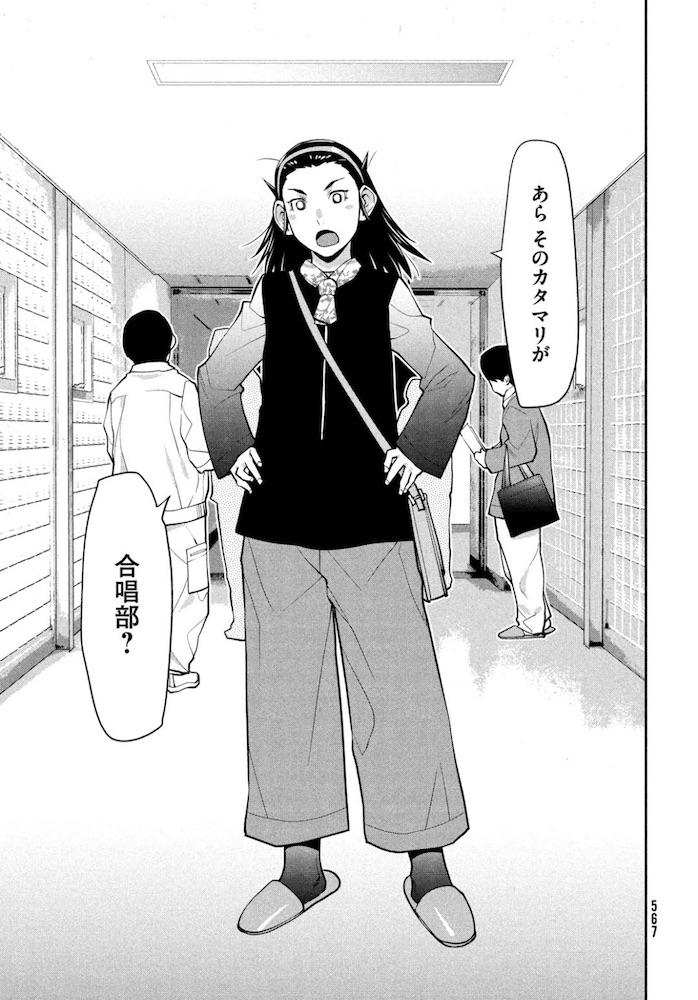
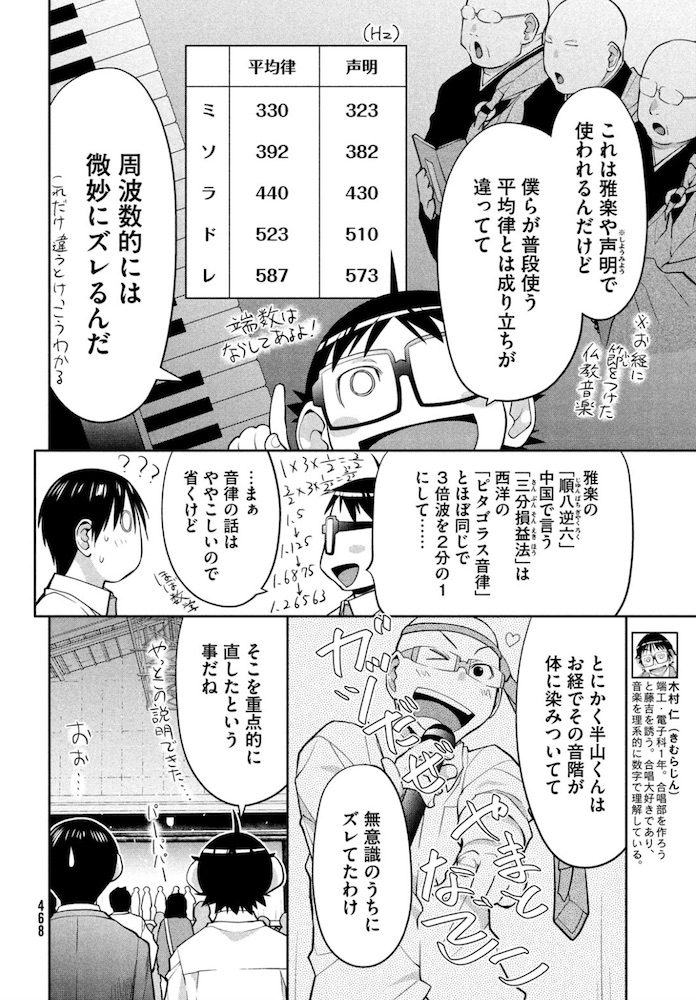
After being rejected by Kousei, Shion is emotionally devastated. Yukina asks why Kousei would word his rejection so harshly, while Jin correctly (and inappropriately) brings up Kousei’s mom as the reason he doesn’t like to deal with girls. At the same time, seeing Shion confess to Kousei has put Akira into a funk, which impacts his singing as a part of Tsuyama’s group in the school music competition (once again, Akira got roped into participating with them as well). Combined with a lack of practice and a focus on girls over music, the “Tsuyama All Stars” are defeated by a group of otaku singing an iDOLM@STER song.
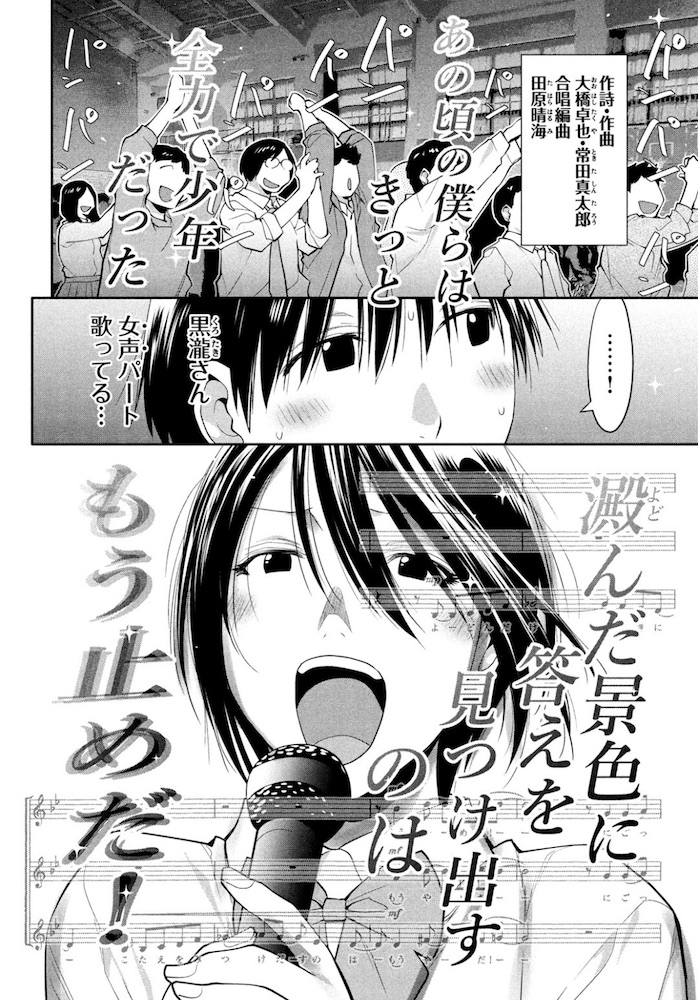
Dropping out in Round 1, all of their girlfriends instantly reject them as losers, and Tsuyama is on the verge of kicking Akira’s ass. However, Kurotaki Mai steps in to defend Akira by pointing out that Tsuyama and company’s song choice betrayed them, as they clearly lacked the conviction they showed when singing a Spitz cover at the previous competition against the Chorus Appreciation Society. The Tsuyama crew then realize the “error” of their ways and go back to worshipping Mimi-sensei. But Mai also criticizes Akira, and relays something that Jin taught her: the low notes are the foundation of harmonizing, and as possessors of deep voices, they’re vital to the success of their respective groups’ performances.
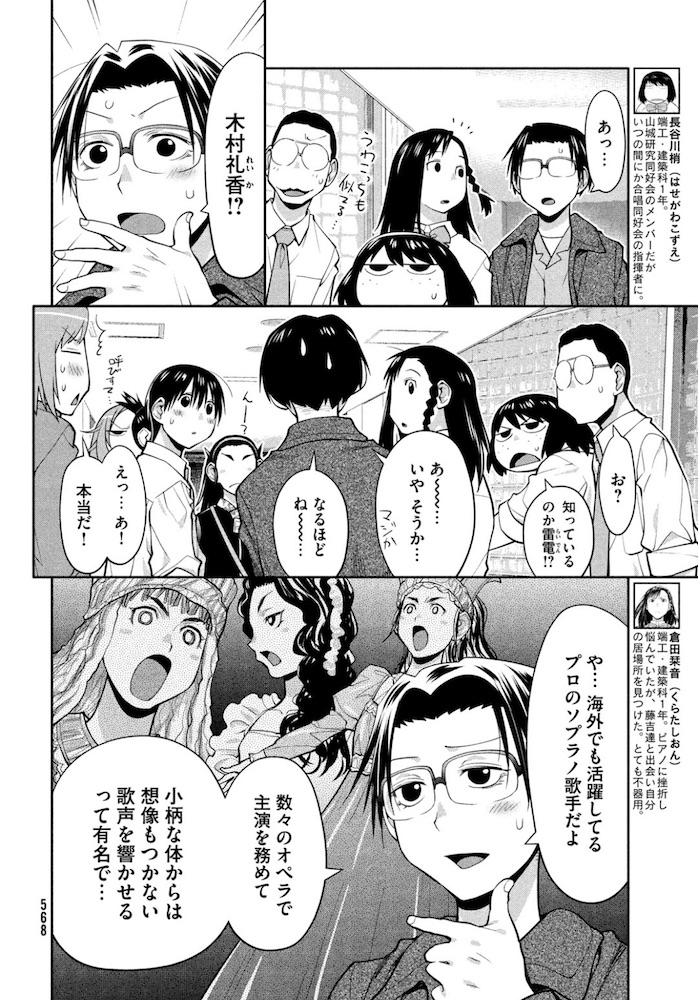
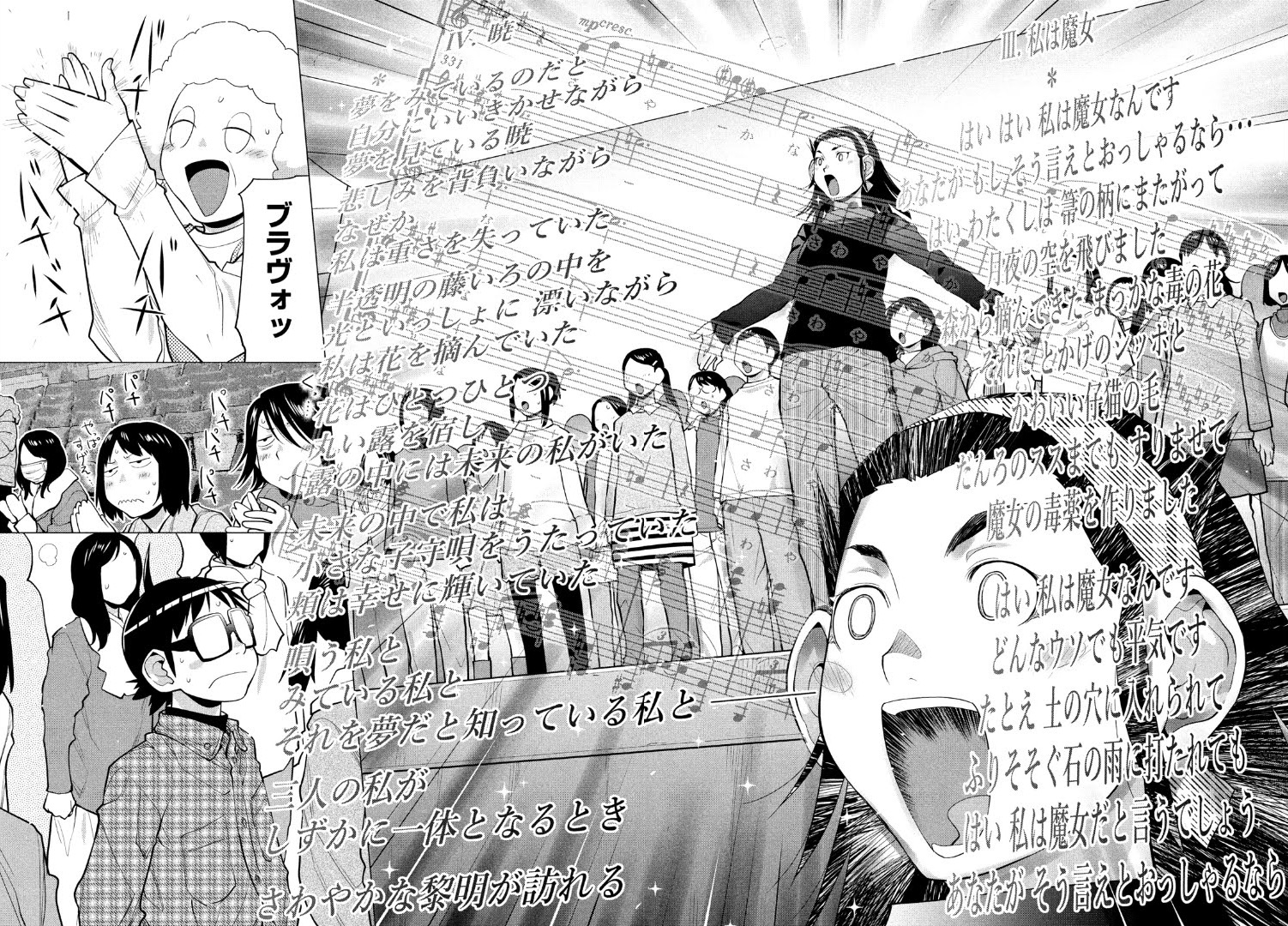
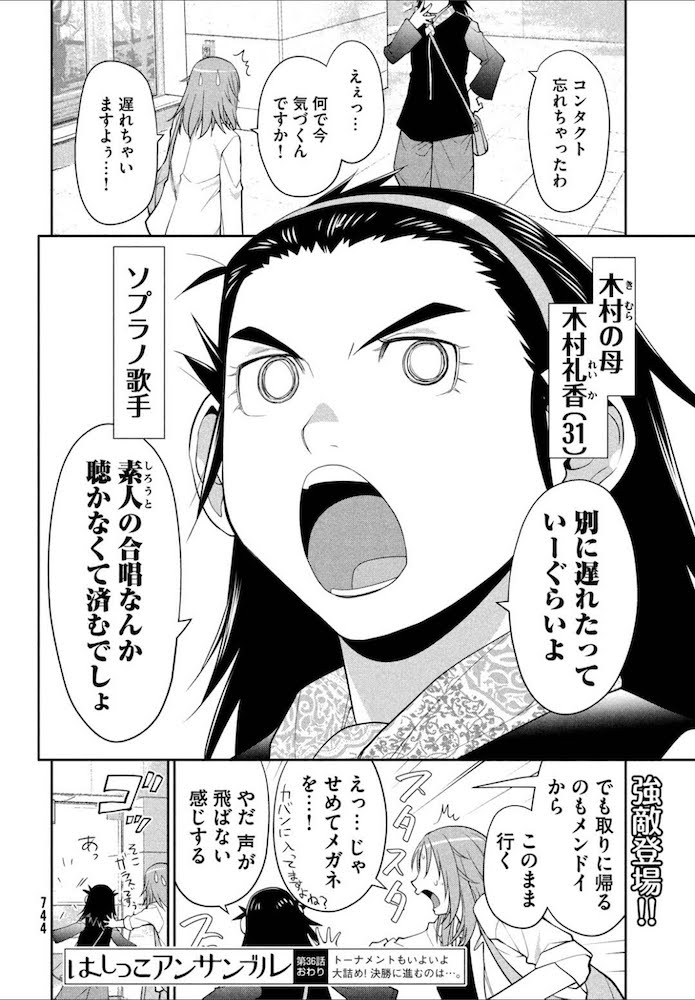
But right when everyone expects the Light Music Club to win their round, they’re actually beaten by a mysterious masked group calling themselves “Basso Masters.” Who are they, and why are there 52 of them?!
Oh, Mai
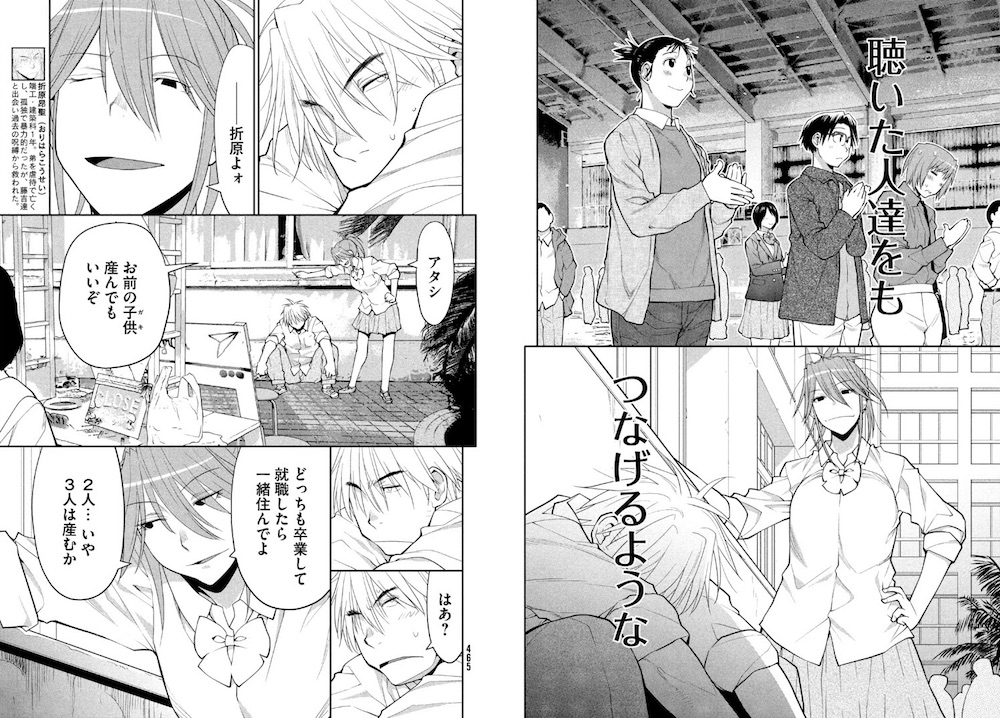
With all the romantic drama coming out over the past few chapters, it’s no surprise that a look into Mai’s inner thoughts would reveal that she has feelings for Akira as well. Sure, all the blushing and gratefulness since her introduction into Hashikko Ensemble was a pretty strong hint, but after giving Akira advice, she thinks to herself, “Liking someone who likes someone else…It happens all the time.” In a different context, it might come across as more ambiguous, but then it’s followed up by Himari seeing everything and reacting with a thought of her own: “…Ugh. Looks like she’s gonna be a real pain.” Himari is clearly seeing something there, though I’m still not sure how Himari herself feels. Being Akira’s childhood friend, is there something more? The love web somehow gets more defined and more convoluted as the story continues.
Meanwhile, Akira’s mom is there in person and seeing this tangled web of emotions in action, thrilled at her darling son experiencing the ups and downs of youth. As with the last chapter, I love how supportive she is, and when I think about something like Genshiken, the sheer parental presence in Hashikko Ensemble sticks out all the more.
Shallow Love
It’s ironic that Tsuyama’s crew, the ones who made it look like music was the key to dating success and the most visible symbol that the school had changed, were mercilessly tossed aside by their girlfriends and are now back to square one. It’s a humorously tragic moment, simple in its brutality, but also speaking to the dangers of romance through prestige. Both the guys and the girls involved likely got into it for shallow reasons, though in what ways they were shallow changed. I could see Tsuyama and the others jumping at the very first opportunity to have some cute girlfriends, while the girls merely liked the cool cache brought to them by dating these guys. When Mai is telling them off, she mentions that their song choice was clearly made in order to please their girlfriends, who know nothing about music and shouldn’t have been such a significant factor.
It’s implied that their devotion to Mimi-sensei was on a whole other level, and that whatever they were feeling for their girls just wasn’t quite the same. I feel sorry for Mimi-sensei for having to deal with them again, and it’s not exactly a happy ending, but i am amused by how confused she is in the aftermath.
Jin Is Never Smooth
Some chapters ago, I wrote about how I think he’s supposed to be a non-neurotypical person, which came through in his inability to understand the more emotional and subjective aspects of music. Now, he seems incapable of reading the room, and loudly blurts out something that hits at Kousei’s greatest sore spot: his neglectful and abusive mother. I can’t quite recall if Jin has all the details about Kousei’s life, but just about anyone else would have known to keep quiet about it. Although nowhere near as terrible, Jin doesn’t have the best relationship with his own mom, and I wonder how much his social awkwardness (whether or not it’s due to a psychological or physiological condition) contributes to that tension.
Songs
Tsuyama All Stars: “Pretender” by Official Hige Dandism
Team “Promise” (a bunch of otaku): “Yakusoku” (Promise) from The iDOLM@STER
Half Monks: “Guts Daze!!” by Ulfuls
Electrical First-Years Acapella Group: “Cruel Angel’s Thesis” by Yoko Takahashi (electronic version using Vocaloid software)
Light Music Club: “Ai Uta” (Love Ballad) by GReeeeN
Basso Masters: “Daichi Kinshou” (Hymn of the Earth) from the cantata “Tsuchi no Uta” (Song of the Land)
I appreciate that the competition has a nice mix of genres and sources—including pop, rock, anime, and classical—from across the decades. The performances themselves also showcase different ways to make music, and I would love to see the electronic version of “Cruel Angel’s Thesis” if this ever got made into an anime.
You can find the above songs, along with previous references, in my Hashikko Ensemble Youtube playlist.
Final Thoughts
A group of 52 singers showing up incognito is sure to cause a stir, but it also makes me wonder if they’re actually another school in disguise—maybe Nishigafuchi. The combination of their song choice and their sheer numbers makes me think they’re not from around these parts.
When I was first really getting into anime, it seemed as if the classic 1970s giant robot franchise Getter Robo was in the middle of some sustained renaissance. Whether it was 1999’s Change! Shin Getter Robo: Armageddon, 2000’s Shin Getter Robo vs. Neo Getter Robo, or 2005’s New Getter Robo, it felt as if another anime was always just around the corner. But then the well dried up (albeit not necessarily for other popular classic robots), and it’s been 16 years since. But finally, in 2021, we’ll be seeing a new entry: Getter Robo Arc, based on the manga by Nagai Go and Ishikawa Ken. Notably, this might also end up being the first fairly straightforward adaptation of a Getter Robo manga, and the first to try and really get close to Ishikawa’s art style.
The funny thing about the various Getter Robo anime is that there has never been a straight adaptation of any of the manga. You might be thinking of a long shounen fighting series ending up with a filler arc or three, but I’m not even talking about that. Rather, since the original inception of Getter Robo, the relationship between the many manga and anime have been an odd one. The first Getter Robo manga and the first Getter Robo anime debuted around the same time in 1974, but whereas the former depicted its heroes as virtual psychopaths, the latter portrayed them as relatively kid-friendly good guys. 1991’s Getter Robo Go took similar diverging paths with Ishikawa’s drawings being relatively unchanged and the anime adapting its character designs to a late 80s/early 90s look.
The later works were not much different. Change! Shin Getter Robo: Armageddon and Shin Getter Robo vs. Neo Getter Robo both take elements from throughout the franchise’s history and try to show a more action-packed style reminiscent of Ishikawa’s art, but neither quite goes all the way, balancing 21st-century anime designs with a throwback feel. What’s more, the two aren’t even meant to be connected to each other. New Getter Robo is in a similar boat, being a reboot of sorts that brings some of the insane personalities from that original 1974 manga, but changing just about everything else. This trend is par for the course with Dynamic Pro properties, be it Devilman, Mazinger, Cutie Honey, or anything else. “Canon” and “faithfulness” are distant concepts in this arena.
However, that’s also what makes the initial images for the Getter Robo Arc anime stand out all the more. Both the promo image and the trailer seem to exude a roughness that immediately calls to mind Ishikawa’s aesthetic, where trying to create eye-pleasing shots comes second to pushing a kind of gritty intensity. It’s understandable that anime want to try to grab audiences with more appealing character designs, but here we have Gou, the guy on the promo image, feeling like he almost fell straight out of the manga and onto a poster. If the animators at Studio Bee can really pull off making the anime adaptation look Ishikawa as hell, I will give them all the props in the world.
PS: Kageyama Hironobu was a guest at Anime NYC 2018, and during the Lantis Matsuri concert he actually sang “HEATS,” the opening to Change! Shin Getter Robo: Armageddon. Now, the Getter Robo Arc anime is bringing the song back as “HEATS 2021,” and I have to wonder if Kageyama knew back then that he would be called upon to revive that old banger.
Every month, I review the newest chapter of Kio Shimoku’s manga Hashikko Ensemble. Because it’s music-themed and a lot of real-world pieces play both major and minor (no pun intended) roles in the series, I usually include a list of whatever songs are referenced.
I’ve decided to begin compiling as many of these songs as I can in a Youtube playlist so that everyone can get an understanding of what the characters are talking about, and what the songs they sing sound like. You can find it here:
Not all songs featured in Hashikko Ensemble are on the playlist—did you know that children’s music isn’t allowed to be added to Youtube playlists anymore? But I think it’ll potentially enhance the reading experience.
There are many areas in which we can judge anime and manga. We can talk about animation quality, narrative consistency, excitement factor, or even just emotional resonance. Recently, I’ve come up with a system that I think provides a new perspective on how we view titles—I call it the Vegeta Level.
Named after the Prince of All Saiyans from Dragon Ball, determining a work’s Vegeta Level starts with a simple question: “How many Vegetas are in this?” In other words, are there any characters who embody—in part or in whole—the qualities of Vegeta, and if so, how many of these characters are there? Vegeta qualities include but are not limited to: short, spiky hair, intense, arrogant, a rival status, current or former villain with a smidge of emotional development. Sometimes, there’s an intangible quality where you can’t quite say why they’re a Vegeta, but you can definitely feel it.
A series with a relatively high Vegeta Level can have one extreme Vegeta, or it can have so many partial Vegetas that they add up to one or more whole Vegetas. The degree to which each Vegeta quality is present can also factor in. For reference, Vegeta himself is 10 out of 10 Vegetas.
The genesis of this idea actually came from the volleyball anime Haikyu! When I first started watching, one of my recurring thoughts was, “There sure are a lot of Vegeta-like characters in this show.” Hinata and Nishinoya are both short, spiky-haired hotheads with something to prove. Kageyama is a scowling and hyper-competitive “king.” Tsukishima has all the arrogance in the world. And then, as you expand to the other teams, the number of Vegetas only grows—see Bokuto to some extent, and especially Hoshiumi. There’s Vegeta-like energy in all of them.
Even though there’s a clear standard for this metric—Vegeta—there’s still room for subjectivity. In a sense, how you perceive a Vegeta is as much based on how you see Vegeta, whether you’ve actually read/watched Dragon Ball or not. Bakugo in My Hero Academia is very clearly a Vegeta, but how Vegeta is he? One could argue that only Vegeta should be a 10 out of 10, but Bakugo is so nasty and angry and has such a character arc that he might be considered just as Vegeta if not moreso.
So let’s work through an example. Dragon Ball is clearly at least Very Vegeta due to the man himself. Are there any other Vegetas? Technically, there are literal relatives of Vegeta in here, but this is more about personality and archetype. Of his kin, his dad King Vegeta is probably around an 8/10, and Future Trunks (but not modern-day Trunks) is more like a 6/10. Among antagonists/rivals, Tienshinhan, Cell, Piccolo, and Frieza are all fairly Vegeta—I’d say about 4/10, 5/10, 6/10, and 7/10 respectively. From that rough look, that’s 49 Vegeta points. Again, it’s not wholly objective, much like the star rating system in professional wrestling, so there’s room for argument.
So what use does the Vegeta Level have? Well, if you like Vegeta, it’s probably a great way to find a series that interests you. But also, Vegeta as a character is so embraced not just by fans but also shounen manga in general, and I think the presence of Vegeta-like characters are a way to give a series an extra edge without necessarily making it “edgy.” That being said, an all-Vegeta series would make for about the edgiest thing ever.
Does such a series exist? One friend suggested to me at least one series that could outstrip it: The Sopranos. According to him, practically every character in that show is a high degree of Vegeta.
Food for thought: Could there theoretically be a work with a Vegeta Level that’s over 8000 or 9000?
On the other end of what I hope is the biggest and most important election of my lifetime, I feel a mix of joy and nerves. I also begin to wonder if there is a need for me to continue to bring politics into my writing here, only to realize the answer: of course there is. That being said, one of the goals of Ogiue Maniax has always been to encourage people to think through the lens of anime and manga, so I’ll strive to strike a better balance moving forward. Let’s just say that the last two months were more of an emergency call to action, and even then, it’s only one step in a long journey to a more just and equitable world.
Part of the last month or two has also been me realizing how many Japanese creators are being sucked in by right-wing conspiracy propaganda, which puts me at different degrees of empathy with Harry Potter fans, but I think I might leave that for a full blog post. Or not.
Last month marked 13 years since I began Ogiue Maniax, and it’s probably the heaviest anniversary post I’ve ever written, in no small part due to everything that has happened in 2020. COVID-19 literally changed the way I blog (even if the actual content might not be so different), and it feels strange to head into December—normally a time where I spend time away while reflecting on anime and manga as well as my personal life—while hyper-aware of the fact that things are simply Not Normal this year.
As 2020 comes to a close, I want to thank my Patreon sponsors, especially the following:
General:
Johnny Trovato
Ko Ransom
Diogo Prado
Alex
Dsy
Sue Hopkins fans:
Serxeid
Hato Kenjirou fans:
Elizabeth
Yajima Mirei fans:
Machi-Kurada
And while my Patreon rewards are such that I only include people above a certain pledge amount every month, I want to give a special shout-out to those who’ve supported me for a long time who choose not to have their names on public display. I really am grateful.
The competitive escalates in an unexpected way in Hashikko Ensemble, Chapter 34.
Summary
After the Rugby Club’s surprisingly strong rendition of a Radwimps tune in the high school’s cultural festival singing competition, the Chorus Appreciation Society fires back with a performance of their own. They win handily, showing the fruits of their training camp. However, even though the Rugby Club captain accepts the results, he has one last request as a third-year soon to graduate: he wants to challenge Jin to an arm wrestling competition!
Jin accepts, but thinks it should be a best-of-three. Sora (the guy who confessed to Kozue) immediately challenges Kousei, and Yukina (who was last year’s school-wide arm wrestling champion) jumps in to be the third participant for the Chorus Appreciation Society. The impromptu matchup ends with a 2-1 victory for the Chorus Appreciation Society, with Jin putting in an impressive but ultimately losing effort against the Rugby Club captain. Reactions differ among the crowd, ranging from hype to Yumerun’s utter disinterest.
As Yukina is celebrating the win and talking with Kousei, Shion can’t help but think that they look great together. Suddenly, she sticks her arm between them and confesses directly to Kousei: “I like you. Go out with me?” Kousei’s response: “What? No.” That rejection is also the title of the chapter.
Yukina’s Turbo Controller
I genuinely thought that Yukina’s arm wrestling prowess wouldn’t really factor into the story beyond some displays of strengths, but here we are, with a sudden arm wrestling match. It almost makes regret making an Over the Top reference already. The surprise is welcome, however, and it adds to something I really enjoy about Hashikko Ensemble: the series is somehow both extremely predictable and unpredictable at the same time, and where those cards fall seems to just make for a more enjoyable manga most of the time.
All this arm wrestling talk also makes me think of my childhood playing the Track & Field II arm wrestling minigame. Whenever any arm wrestling happens in media, I just think of the background music and the grunting faces.
The Performance
As the guys are singing, Takano-sensei makes mention of how much they’ve all improved (as well as Kozue’s excellent conducting). In particular, she remarks about their successful balancing of both the lyrics-heavy nature of J-pop with getting the right musical accents. She also uses a couple terms that I think are worth noting—mostly for my sake, as someone who’s not musically inclined.
The first is legato, which is singing in a smooth and connected way; the opposite of staccato. It is not, in fact, simply a Trigun villain.
The second is syncopation, which is singing on the weak beats.
The general idea, from what I can tell, is that they’ve managed to adapt a J-pop tune into something that utilizes the musical training they’ve all been going through. I wonder if the goal is to strike a middle ground between doing appealing songs to get more members and doing something technically impressive for Jin’s mom and her high standards.
Romantic Perceptions
It’s poetic that Akira has these dramatic nightmares about Kousei and Shion, but to Shion, Kousei and Yukina are the picture-perfect couple. There’s a self-consciousness at work in each case, where one sees themselves as somehow not looking “right” for their love interest.
I feel like this is a fear that Kio Shimoku tends to express and explore in his works. In Gonensei (The Fifth-Year), one of the core conflicts is how the boyfriend feels a level of inadequacy because he couldn’t graduate at the same time as his girlfriend, and the two drift further apart. In Spotted Flower, the husband similarly panics when he just lays eyes on his wife interacting with her ex-boyfriend, believing that he pales in comparison, despite the fact that he and his wife just had a daughter. I don’t think it’ll be anywhere near as dark and ugly in Hashikko Ensemble, but I’m interested in seeing how the love web continues to get tangled.
The chapter further contrasts how Shion and Yukina each see Kousei—the former as a strong hero and the latter as an adorable underclassman. As Yukina watches the performances, she recalls happening upon Kousei practicing his singing in private. Unbeknownst to Kousei, Yukina actually sat hidden behind a staircase, listening to him the whole time. It’s as if both girls have feelings because they’ve managed to see what’s on the inside, only it’s two different aspects of the “real Kousei.” If I had to give a preference, I like Kousei/Yukina, only because it’s more hilarious.
When the Tsun and the Dere are Indistinguishable
Right before the arm wrestling match begins, Kozue tells Sora to do his best. When he gets trounced by Kousei, she thinks, “Ah. Figures it was impossible.” While I originally thought that there was a possibility that Kozue might end up on a date with Sora reluctantly, it now looks like she might actually feel something for him after all. I don’t know if you’d call this tsundere, as I think that Kozue doesn’t have that characteristic loss of control of her own emotions, but maybe the childhood friend connection is real. Also, we haven’t seen what Sora looks like shirtless, but maybe he has the buffness she looks for in guys.
Or maybe being into musclemen is more of a fantasy fetish and not something she necessarily wants in a partner.
Songs
This month’s song is “March 9” by Remioromen, which the Chorus Appreciation Society performs against the Rugby Club.
Final Thoughts
During their performance, Akira’s mom is in the crowd. I don’t know why exactly, but seeing her cheer her son on and react like such a doting parent really sticks with me. Perhaps it’s just the way she seems so wholeheartedly excited about her Akira doing this new and different thing by getting into singing. I can sense the love in their relationship.
Here Is Greenwood is a title I’ve long heard of but pretty much knew nothing about, other than the vague sense that it was popular with girls. Based on the name and an image or two, I thought it might have been a fantasy series.
Having finally watched the 1991 OVA, it turns out that Here Is Greenwood is actually a shoujo high school comedy about a bunch of weirdos in a dorm. My impression: there really aren’t many series like it in recent memory. The closest I can think of is Honey and Clover, but even that series doesn’t have quite the same level of quiet absurdity.
When I look at humor in anime over the past two decades, it usually goes in two directions: either mellow and low-key or balls-to-the-wall extreme. Those qualities manifest in different forms, whether it’s Hidamari Sketch or Pop Team Epic, but a work usually picks its lane and sticks to it. Here Is Greenwood, on the other hand, has a kind of slow-burn humor of a more down-to-earth anime, but its characters and situations are all over the place. Whether it’s a main character in love with his sister-in-law, the dude who looks like a lady, the Snidely Whiplash-esque plots of a rich upperclassman’s vengeful cousin, or a literal ghost that no one seems terribly shocked by, there’s a sense that both normal and abnormal blend together into a mellow taste.
The OVA is unusual in that it’s not a sneak-peek at the manga or a more liberal adaptation of the manga. Instead, it takes a nine-volume manga and condenses it into a mere six episodes, operating more like a ” best hits” compilation. The anime makes more sense once you know that, but I also know what anime fandom was like in the 1990s, when Here Is Greenwood was on Blockbuster Video shelves. Knowledge about anything related to anime and manga was sparse, nowhere near the wealth of information we have today. Many OVAs were confusing and open-ended, and the result was tons of fandom speculation and musings. I could totally see someone trying to fill in the blanks of Here Is Greenwood armed with only their imagination (and a few 4th-wall-breaking mentions of the manga in the anime itself) to construct their own mental manga. I could also picture those six episodes defining what “anime humor” meant in fans’ minds, like extrapolating an assumed picture of a period in history based on some anthropological items.
I think Here Is Greenwood largely holds up, though there are a few questionable red flags in the year 2020 (notably a joke about touching a kid). In general, the series stands in contrast to the pacing of comedy today, but that also gives it some extra charm.
It’s no secret that politics and the health of the United States has been on my mind these past few months, and now we’re a mere two days away from Election Day. I hope that this is the most important election of my life, because I don’t want to imagine another presidency worse than this past four-year ordeal. For those who have already voted, either by mail or through early in-person voting, I hope you remained safe. While I am deeply horrified at the idea of Trump getting another term, I respect the exercise of democracy as long as all who are rightfully eligible are afforded the same opportunity.
Please bear with me as I express my strong beliefs about this election.
Long-time readers may know that while I could touch on a lot of related topics in years previous, my specific political beliefs were rarely ever front and center on Ogiue Maniax. However, the 2016 election changed something in me, as I came to feel that my distanced academic outlook did not do enough. While I still believe in robust dialogue aimed at finding common ground, I’m much more aware of the fact that right-wing extremism is a dangerous part of the current landscape, whether that’s attempting to recruit kids through video games, voter suppression, or outright violence. I changed my policy of allowing any and all relevant comments to a blog post because there’s a difference between disagreement and merely wearing a facade of civil discourse as a means to push ridiculous ideas. I recently deleted a comment that started with the notion that “wokeness” is ruining anime because it’s an extension of a general right-wing corrosion of Youtube as a whole.
As for Trump himself, I’m going to say straight-up that he needs to be stopped if the United States is to survive, literally. We cannot take even more negligence and death rates when it comes to COVID-19. We cannot take a man who purposely sabotages the US Postal Service in the age of a pandemic and in an election year. We cannot take a man who will sell out the US to the highest bidder, a man who abandons allies to the slaughter and allows bounties on American soldiers. We cannot take a man who thinks climate change is fake yet also believes windmills cause cancer. The Paris Climate Accord is crucial to the well-being of not just the US but the entire planet, and if the country does not rescind our withdrawal, we are headed straight for catastrophe upon catastrophe. Most importantly, we cannot take more damage from the Republican Party, which has enabled this would-be dictator to escape responsibility just because they use him as a battering ram to get more federal judges into the system, including three Supreme Court justices.
To all readers in the US, if you see voter intimidation at your polling place, contact the Election Protection Hotline.
A thorough look at how the notion of constant freedom plays heavily into competitive Smash Bros., and how it contrasts with the ability to be “very wrong” in other fighting games.
Fierce (?) competitors lie in wait in Chapter 34 of Hashikko Ensemble!
Summary
The school’s cultural festival has suddenly turned into a battle of the bands, and the Chorus Appreciation Society is in a 16-band bracket to see who comes out on top. Among the groups participating are a number of familiar faces: Kurotaki Mai (the deep-voiced girl who once saved Akira), Tsuyama’s crew, Mimi-sensei and a group of teachers (with Takano-sensei on piano), and even the Rugby Club that tried to recruit Kousei.
During this, Shion is visibly bothered by Yukina’s presence and closeness with Kousei, all but confirming her having romantic feelings for him. But when Kozue asks why Yukina’s into Kousei, her answer absolutely flabbergasts Shion: “Cuz he’s cute.”
Mai’s band wins, and the teachers forfeit their match because all they really wanted to do was put on a single performance. The Rugby Club is going directly against the Chorus Appreciation Society in the first round, and to everyone’s surprise, one of the players, Sora, asks Kozue to go out with him if the Rugby Club wins. She agrees but only as a form of rejection—she actively encourages the audience to reject their opponents and Sora’s convenient love story in the making. However, the Rugby Club turns out to be better singers than she anticipated, meaning it might not be such an easy win after all.
A School Tournament?!
It’s not surprising to see tournaments happen in Hashikko Ensemble. After all, if they’re going to eventually be in bigger events, the Chorus Appreciation Society is going to have to see some long competitions. However, this is quite different from the more refined environment and structure of the M-Con, the inter-school event they had previously they participated in as an exhibition.
I really like this direction, particularly that the series has suddenly become more about music in an interesting way by having music fever take over the school and generate all this excitement and energy. Also, while it’s indeed looking to be a tournament arc after all, “winning” seems less important than having all the characters reach their personal goals. Looming overhead is the powerful shadow of Jin’s mom (despite the fact that she hasn’t even shown up yet), and in a sense, she’s the real boss fight.
Love Bonanza
The increasing presence of romance in Hashikko Ensemble is all but undeniable. It’s not even that Shion’s interest in Kousei is clear as day now, but also the strange love polygon that now exists between her, Akira, Kousei, Yukina, and maybe even Mai. What’s more, there’s also the lovey dovey couple team (Yukio feat. Mayomyon) metaphorically tossing hearts into the air, and a public confession to Kozue from the kid who tried to warn his classmates about her judo skills?! And the latter’s going to be the most pressing plot point leading into Chapter 34?!
It’s not nearly as messy a relationship web as good ol’ Spotted Flower, but it sure is getting increasingly complicated.
Knowing this manga, I could see Kio swerving the readers by having the Chorus Appreciation Society lose in Round 1, and having Kozue reluctantly start dating Sora. There’s maybe one path of hope for the rugby player, which is that a person can earn Kozue’s respect through skill and power. In this chapter, she basically gushes over Yukina’s high proficiency in a huge array of industrial skills (including gas and arc welding, crane operating, etc.), so if the poor guy can show similar prowess (in singing or otherwise), maybe he can impress her. That said, it’s probably more realistic to see Kozue be into Yukina.
Divergent Feelings
I was thrilled to see Mai show up again in this chapter—doubly so to see her singing. All signs have pointed to her becoming a more important character as the series went on, and while it’s still uncertain that she’s going to join the Chorus Appreciation Society, I’m still rooting for it. There’s also the matter of her previous interactions with Akira, and while he has Shion on the brain currently, I could see a future where these two get together instead.
I think Hashikko Ensemble has been emphasizing how different potential relationships can potentially end up being in terms of interpersonal dynamics. Chapter 33 highlights this by the ways that Shion and Yukina each view Kousei; the former sees him as brave, cool, and strong, while the latter looks at him like a cute underclassman. When picturing those two possible couples, they’re just so fundamentally different. But this is also the case imagining Akira with Shion versus Akira with Mai, which has a similar dynamic of two very different individuals on the one hand, and two very similar people on the other.
Songs
This time, I’ve included each of the groups participating in the tournament this chapter, followed by what song they perform.
Nighttime Festival Club 2.1:“Itoshii no Ellie” (“Beloved Ellie”) by Southern All Stars
Noi Majo (Kurotaki Mai’s quartet):“Hakujitsu” (“White Day”) by King Gnu
Yukio feat. Mayomyon: “Shibuya at 5 o’clock” by Suzuki Masuyuki and Kikuchi Momoko (You might recognize Suzuki as the singer of the opening to Kaguya-sama: Love Is War)
Teachers’ Angel (Mimi-sensei + other faculty): “Boku no Koto” (“About Me”) by Mrs. Green Apple
Rugby Club A Capella Group: “Zenzenzense” (“Past Past Past Life”) by RADWIMPS (as heard in Your Name)
Final Thoughts
Back in the pre-pandemic times, I used to go karaoke somewhat often. One of the most common songs among one of the groups was actually “Zenzenzense.” This chapter makes me want to learn all these other songs and bring them out someday. May there be a future where we can karaoke to our hearts’ content.