As autumn comes around once more, and the summer hear theoretically wanes (oh, that climate change), I’d like to say “thank you” to my supporters on Patreon and ko-fi.
General:
Johnny Trovato
Ko Ransom
Diogo Prado
Alex
Sue Hopkins fans:
Serxeid
Hato Kenjirou fans:
Elizabeth
Yajima Mirei fans:
Machi-Kurada
Highlights from August:
At Otakon 2019, got the opportunity to interview with two Japanese voice acting greats, Furuya Toru and Inoue Kikuko. Both of them went great, and I highly encourage everyone, but especially Gundam fans to read them.
This month’s blog coverage is kind of dominated by Otakon, but that’s sort of an inevitability with it being such a big event, and one where I feel that I get the best coverage for interviews and the like. My plan is to do more anime and manga reviews/analyses, as well as a few unexpected topics.
I’m also considering simplifying my Patreon sponsor tiers, as the number gags I introduced to reflect Genshiken fandom might make the whole thing too unwieldy for newcomers. If anyone has thoughts on this, I’d like to hear.
I forgot to mention it last month, but the series has a Twitter account @hashikko_music. Also, Volume 3 is coming out September 20th!
With that out of the way, on to Chapter 19 of Hashikko Ensemble, titled “God is Dead.”
(I was thinking of adding the chapter title in these reviews. What do you think?)
Chapter Summary
The Hashimoto Chorus Appreciation Society has left Nishigafuchi, and they’ve taken away different lessons. Mimi-sensei discovers that the M-Con doesn’t require conductors, so her training and practice were unnecessary. Shinji finds out that extensive singing can really work out the stomach muscles to the point of pain. And Shion is reminded of how the memory of squeezing Mimi-sensei’s boobs is the key to her keeping her grip soft when playing piano.
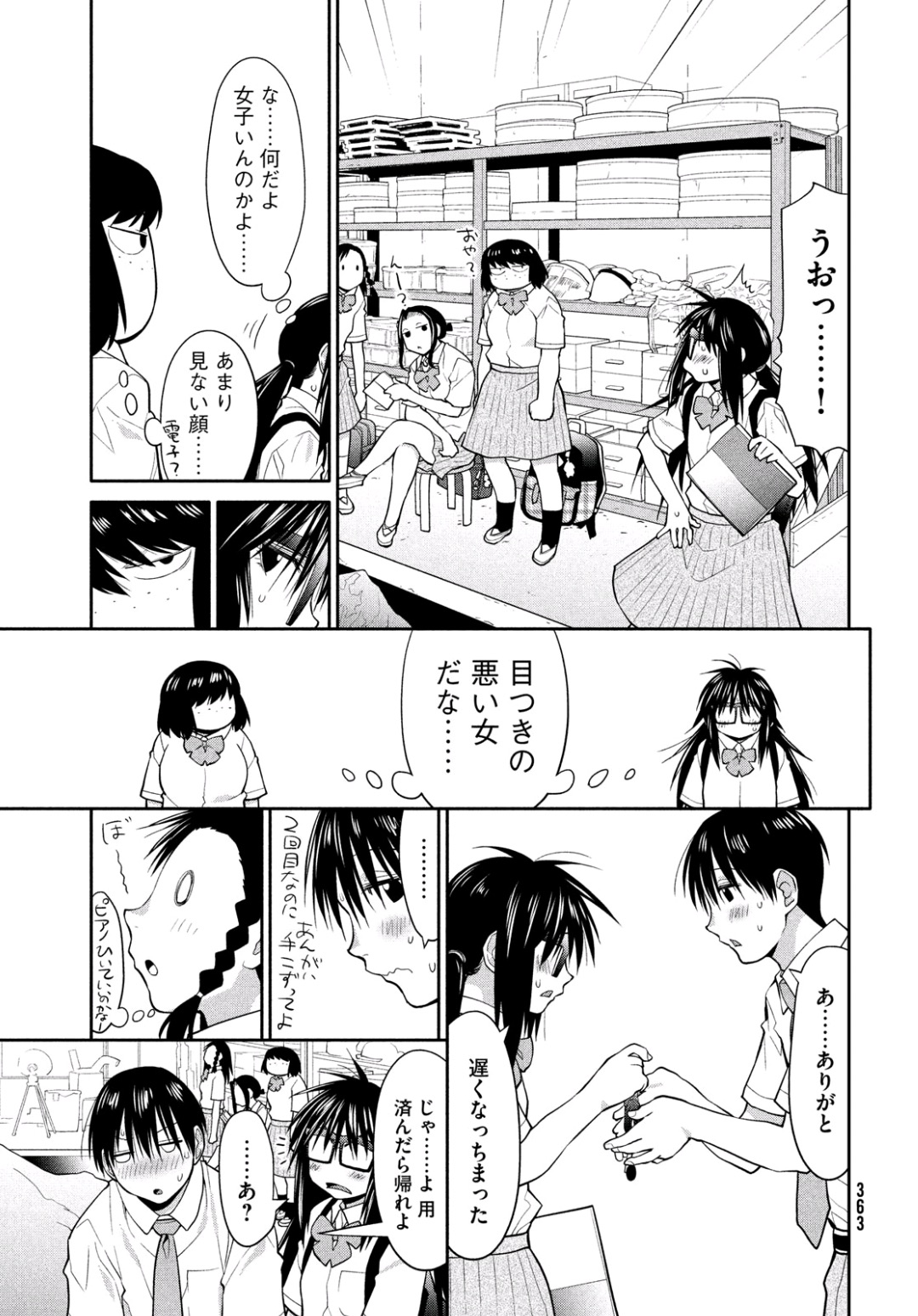
In the clubroom, as Jin explains to everyone Nishigafuchi’s ability to minimize the amount of noise in their singing, Himari makes an appearance to deliver Orihara’s earphones, which she’s finally repaired. However, Himari is shocked to see the number of girls there, and after some awkward fumbling while handing over the earphones to Akira, the sheer amount of blushing going on triggers Hasegawa’s romance radar.
Meanwhile, as Mimi-sensei is advising the Volleyball (she wears many hats at school), we’re introduced to a kind of unofficial Mimi-sensei fan club. Its four members hold a grudge against the Chorus Appreciation Society because they’ve heard a rumor that one of the members has squeezed Mimi-sensei’s breasts, though they assume it’s one of the guys. They confront Akira and threaten him to tell them their target’s identity, but Akira, not wanting Shion to get hurt, decides to pretend that he’s the culprit.
However, Hasegawa interrupts and claims that Orihara is the one they’re looking for, even exaggerating the story to be extra obscene and extra gropey to troll them. Hasegawa reasons that they wouldn’t mess with Orihara, and this would end their whole endeavor. Unfortunately, she turns out to be very wrong, and one of the members tries to get into a fight with Orihara. Not long after, a teacher bursts into the faculty office and informs Mimi-sensei of a rumor that she was raped by Orihara, which causes her to do a literal spit take.
The Mimi-sensei Fan Club
The four members–Muro, Naga, Ouga, and Tsuyama–all seem to resemble animals, but I can’t for the life of me figure out if it’s supposed to be a specific reference. They don’t seem to fit Journey to the West, Momotaro, or the Four Symbols. If anyone knows what they could be, I’d be interested to know.
In addition, I like that the chapter points out how this little quartet is viewed with some disdain by other members of the school. They kind of come off as creeps, and you can practically hear the utter loathing in the voices of the Volleyball Club members when the four visit the club’s practice just to see Mimi-sensei. One of the members even calls Mimi “Mimi-kami-sama,” and they’re all obsessed with her large breasts, even more than the rest of the boys in the school. For some reason, they like to compare her boobs to different insect-like creatures, including pillbugs and large crustaceans known as Bathynomus giganteus. Doesn’t exactly sound hot, but…
Shion is the closest thing Hashikko Ensemble has had to antagonists thus far, so I have to wonder if they’ll somehow fulfill that function. Knowing the manga, though, I bet at least one or two (if not all of them) will somehow end up joining the main cast.
Another New Character! What Could It Mean?
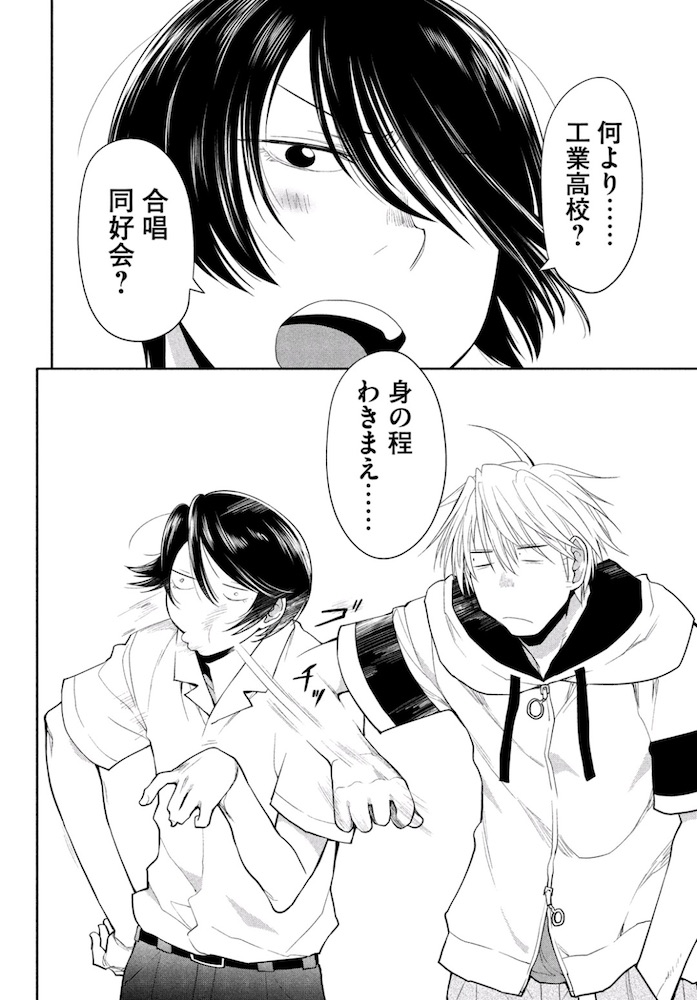
The reason why Hasegawa is able to rescue Akira in time is because another classmate, Kurotaki Mai, mentioned the incident. Apparently, she relates to Akira because she also has an unusually deep voice, though Hasegawa thinks it might be something more. In fact, between Mai and Himari, Hasegawa has the impression that Akira is some kind of unrealized Casanova.
Speaking of Himari, I was wondering when she would show up again. The fact that she reacts with such shock at the amount of girls in their clubroom makes me wonder if she’s more nervous around other girls than guys. There’s a lot we still don’t know about her, but she does come across as shy and reticent.
There’s an amusing gag where both Hasegawa and Himari think of the other as looking mean, despite or perhaps because the two have different personalities. Is that another friendship in the making? And could Mai’s deep voice somehow land her in the Chorus Appreciation Society?
Deep Breath Languages and Non-Integer Overtones
I wonder what languages count as ones that require deep breaths. I only speak a few languages myself, and I can’t seem to think of any of them as requiring extensive use of deep breaths or strong use of stomach muscles. It’s a topic I’m fascinated to learn more about–I just wish I knew where to start!
Jin also explains that the key to the beautiful harmony that Nishigafuchi is capable of has to do with “non-integer overtones,” a term I don’t fully understand, but seems to imply an unusual harmonics of some kind. As Shion comments, it’s a difficult word even in Japanese (非整数次倍音, hiseisuujibaion). It appears to be more common of a term in audio engineering, which also speaks to Jin being the biggest sound nerd there is. I guess you could describe him as an audiophile, but that word doesn’t quite fit all the way, as he cares less about audio equipment and more about the science of sound and its interactions with the art of singing.
Wonder Cooooore!
There’s a weird gag in this chapter where the word “Wonder Coooore” keeps getting censored. It turns out that Wonder Core is an exercise machine promoted on Japanese TV.
It’s advertised around the world, including in the US through the Home Shopping Network, but it’s not nearly as funny or interesting.
Songs
No songs this month. Only conflict!!!
Final Thoughts
It’s a minefield to touch on the topic of rape in a joking matter, even if it all comes out of an elaborate misunderstanding (plus intentional obfuscation). I have faith that Kio won’t do anything truly in poor taste, but I still wanted to express some concern. We’ll have to see with the next chapter.
Otakon has long been the anime convention I look forward to most every year. I like how it’s always had an great balance between fan and industry where neither side feels neglected, as well as a panel track that encourages in-depth exploration of topics. This year was no exception, with both great guests and a variety of interesting fan panels. Otakon has also settled into the Walter E. Washington Convention Center quite comfortably at this point, and I have few if any complaints about the logistics of the actual location. The only gaffe I will point out is that there’s still a good deal of miscommunication when it comes to autograph lines, but other than that, it was pretty smooth sailing.
With that said, on to the rest of the con report!
Interviews
I conducted interviews with two voice actors at Otakon: industry veteran Inoue Kikuko (Belldandy, Aina Sahalin, Kazami Mizuho) and legend Furuya Toru (Amuro Ray, Tuxedo Mask, Pegasus Seiya). They’ve been getting some traction on Japanese Twitter, which I find thrilling.
As an aside, I love the press area at Otakon in DC. Not only is it a prime cosplay photography space, making it a lively aspect of the con, but it’s so much more convenient than the old one, and makes it significantly easier to schedule activities.
Panels
Frequent Otakon guest and anime industry super veteran Maruyama Masao had a couple of panels where he went through pretty much every anime he’s ever produced. Most of it was fairly mainstream work from his three studios—Madhouse, Mappa, and M2—but there were a few rare gems like a short by Rintaro and Otomo about them bicycle racing each other. He also mentioned at what point he first started working with various directors and creators. Another thing I came away with was how the sex-and-violence-laden Kawajiri Yoshiaki OVAs of the 80s and 90s had hilarious trailers that would abruptly shift from non-stop action to claiming a beautiful love story was in there, complete with cheesy romantic pop.
Anime in Non-Anime was a fun and entertaining panel from Anime World Order‘s Gerald. Not only was it full of laughs, especially when it came to the news coverage of the Naruto run for the Storming Area 51 Facebook group, but it put into perspective how deceptively large the anime industry really is in terms of reach.
Am I Too Old for This? was a pleasant surprise. Rather than being nostalgic commiseration or an empty pep talk, the panel was an informed look at how the concept of adulthood can coexist with the seeming childishness of fandom. The main takeaway was that managing responsibility, whether that’s taking care of yourself or others (or acknowledging when you need help from others), is the contemporary benchmark of adulthood, and that fandom is compatible with this. There was also an important point about not revealing your power level immediately to uninitiated acquaintances, because you have to deal with the reality of how anime fans are perceived in general society.
Animation in Anime by Evan Minto and Nate A.M. was a varied look at both the history and implementation of conveying the illusion of movement in Japanese animation. I think the panel did a good job of dispelling the notion that there is only one good way to animate, and detailing how the particular challenges of animating in Japan (primarily budget and labor issues) resulted in creators having to do more with less. I wonder how many people came out of it eager to learn about legendary animator Kanada Yoshinori, whose distinct style lives on in the likes of Obari Masami, Studio Trigger, and others.
In 20 Years Ago: Anime in 1999 Daryl Surat of Anime World Order looked back on the year 1999, and the fact that it’s been twenty years alarms and frightens me. Regardless of my own insecurity over the passage of time, it was an effective panel at putting anime’s history into perspective. Some tech hiccups interfered with the panel somewhat, but it didn’t impact the overall enjoyment. He also showed a willingness to not put creators on an unnecessary pedestal, as he called out a famous director who likely exploited one of his voice actors.
My Panels
Nine years ago, I did a panel about this blog’s namesake, Ogiue from Genshiken, and since then, I hadn’t touched my favorite manga as a panel topic prior to Otakon 2019. But thanks to a series of rereleases of Kio Shimoku’s older manga, I was inspired to do a panel that didn’t just cover Kio’s most famous title but his entire manga career. Thus was born Genshiken & Beyond: The Works of Kio Shimoku.
Creator spotlights are not the most popular panels, so there wasn’t a large audience at first, and the next panel being JoJo’s meant those seated at the end weren’t necessarily there to see me, but I think I accomplished what I wanted in going over Kio’s varied and daring manga works. To my pleasant surprise, I even won over a harsh critic on the Otakon feedback forums.
I had a second panel as well, Star-Crossed Alien Lovers…in Robots! with Patz from The Cockpit and Alain from Reverse Thieves. It was a more relaxed panel than my Kio one, and was built around looking at various robot anime that highlight romance amid conflict. My hope is that the panel got people thinking, even a little.
For those who attended my panels, thank you, and I hope to see you next year. I’ve got some ideas in the works…!
Bradio Concert
Having watched the anime Death Parade and enjoyed its high-energy opening theme, I was looking forward to Bradio’s live performance at Otakon, and it delivered in spades. Their attitude and presentation drew me in, and their unique jazz/funk/disco-fusion style is hard not to enjoy. I loved the hell out of every song, and it’s clear the crowd did too, as I could see people practically compelled to dance to the groove. Bradio’s irresistible music is made all the better by the singer’s excellent vocals and sheer range—he pretty much did one song entirely in falsetto without losing any power.
I would see Bradio again, no doubt.
As an aside, I stopped in briefly for the Nujabes Tribute Concert, but wasn’t able to stay long enough to get a good idea of it overall.
Other Notes
I briefly stopped by the Saturday Morning Cartoons subtitled video room. Along with the dubbed video room, the idea was to replicat watching anime from the 90s with commercials. I watched Sailor Moon in Japanese, and like with so many other shows with a merchandise engine behind them, there were tons of Sailor Moon commercials during the actual show. I also got to see a commercial starring the best video game mascot ever: Segata Sanshiro. If I had more time, I would’ve liked to stay there a bit more.
Also, shout-outs to the dealer’s room booth that was selling Precure, Doremi, and classic magical girl stuff I got this fine piece of Princess Comet/Cosmic Baton Girl Comet-san merchandise, and I was definitely tempted to get more. A rare find!
The two main heroines of the manga We Never Learn have a dilemma. Each is a natural genius in a specific field, but both of them want to specialize in a subject that is their Achilles’ heel. If they play to their strengths, they will have easier lives, and they might even change the world. But their hearts lie in their weak areas, leading to a conflict potentially familiar to many: what’s “best” for them isn’t necessarily what will make them “happiest.”
I think elements like this are why the series has succeeded in maintaining my interest. It’s an understandable struggle that goes beyond the basic harem fanservice qualities of the manga and anime, and while exaggerated for comedic purposes, is something that plenty of people both inside and outside of Japan have to deal with. Do you pursue the impossible dream, do you aim for stability, or do you try to find a middle point? If you achieve less but enjoy the struggle more, is it worthwhile?
It’s clear that We Never Learn supports is characters long-odds pursuits, even as the culture around the manga often says otherwise. I’m not entirely sure if there’s a deeper message overall, but it’s at least one that resonates with anyone who’s had to deal with the conflict between inner hopes and outer expectations.
What should have been a delightful month of convention goodness took a turn for the sorrowful due to the deaths and injuries inflicted upon Kyoto Animation. Recent news has mentioned that their server data was recovered intact and that most of their old series are archived elsewhere, granting a silver lining to an otherwise dark and cloudy July. It’s no replacement for the loss of so many lives, but it’s something.
In terms of the blog itself, I’m back from Otakon, and you can expect a couple of interviews with Japanese voice actors Furuya Toru and Inoue Kikuko, as well as an overall con report.
Thank you again to my sponsors on Patreon and ko-fi.
General:
Johnny Trovato
Ko Ransom
Diogo Prado
Alex
Sue Hopkins fans:
Serxeid
Hato Kenjirou fans:
Elizabeth
Yajima Mirei fans:
Machi-Kurada
Highlights from July:
In honor of Kyoto Animation, I’m spotlighting the two posts I wrote this past month related to them.
Another sad moment also hit when Geoff “iNcontrol” Robinson of StarCraft fame died suddenly at the age of 33. I never met him personally, but I felt it harder than I expected to.
Hashikko Ensemble
Chapter 18 is a breakthrough moment for the Chorus Appreciation Society.
My thoughts on the heroine of Magical Girl Lyrical Nanoha.
Closing
On the upside, the new Smash Bros. character is out, and he’s a ton of fun. The randomness of some of his moves is causing a good deal of debate, and I’m considering writing something about him with respect to this minor controversy.
Also, EVO starts today, with Smash Bros. Ultimate as the Sunday main event! What a time we live in.
Can Akira overcome himself and finally sing in front of an audience alongside his peers? That’s the big question of Chapter 18 of Hashikko Ensemble.
Summary
Still at Nishigafuchi High School’s elite Chorus Club, Jin has declared that the Hashimoto High School Chorus Appreciation Society will put on a small performance of their own in front of the other school’s members. Orihara is against it, having noticed that Akira didn’t sing during their prior practice. Still, Hashimoto ends up going along with it anyway.
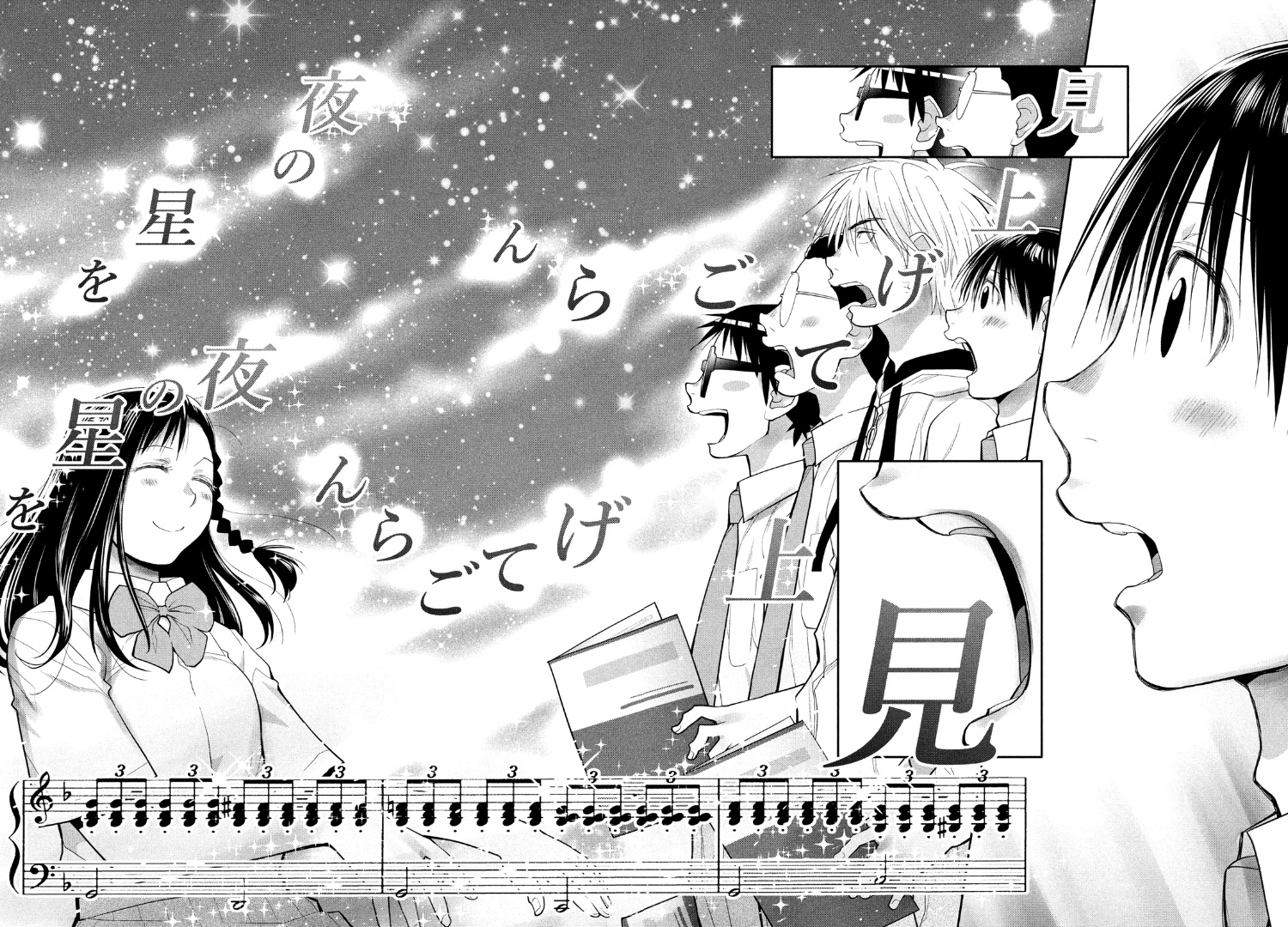
While there are clear strengths to the group, notably Jin’s singing and Shion’s piano-playing, it’s clear to the members of Nishigafuchi that they’re still not organized as an ensemble—it’s like four different people merely singing at the same time instead of together. Even then, it’s not really four, as Akira continues to stay quiet to the extent that Orihara takes over the entirety of the bass part. But as his club mates continue to sing, even Akira’s timidity begins to recede inch by inch, until he comes in at the very end, unifying the various sounds for a brief moment. Akira inadvertently matches the subject of their song, a star that’s small but manages to shine.
Akira Did It
As I read through this chapter, I really wanted to see Akira overcome his fear, but I genuinely didn’t know if he would. Page after page, they kept singing while Akira kept his mouth closed, and I found myself cheering for him to break through this wall. When it finally happened, I almost felt like I wanted to grab him by the shoulders, and yell, “You did it!!!”
Between suggesting Hashimoto sing in front of Nishigafuchi and encouraging Orihara to just do the bass part himself if need be, Jin is the main reason Akira is in a position to do more than lip sync. Putting him on the spot like that can seem somewhat mean, but I’d like to think that Jin notices Akira’s genuine desire to sing. Just having attention on Akira wouldn’t work, so it’s crucial that Akira be surrounded by his club mates putting their all into their performance—an open invitation to join them.
I believe Jin is clever and cunning enough for all this to be his plan. He can act naïve at times, and in certain ways he is, but there’s a sharp mind behind those eyes.
Culmination of Ideas
Near the end, when Akira finally joins in, Jin’s thinks about how everything is come together for their group. In doing so, he brings up a lot of the terms that have come up in previous chapters—high-pitched tones, low-pitched tones, overtones, and singer’s formant. It’s as if this chapter is there to bring together all these concepts, and to show that the Chorus Appreciation Society has managed a breakthrough. The rough direction that the series has been taking has tightened up.
I read a bit more about singer’s formant—the ability for a singer to sound louder than an accompanying orchestra despite that seeming impossible—and realized that a less technical explanation works in introducing the idea. Essentially, singer’s formant is what opera singers are trained to have, and Akira more or less has this quality to his voice without any sort of practice required. It’s his nine-tailed fox, one might say.
Four in Unison
An interesting thing about the art in this chapter is how it shows the characters at different angles in a way that emphasizes how uncomfortable Akira is, as well as how they’re all over the place as a group. The key angle, however, is when they’re facing left, as it gradually goes from being only able to see Jin and Shinji, to an imagine situation of all four silent, to eventually Akira joining in and completing the group. It’s not easy to convey the impact of a song through image and text alone, but I can really feel that unity and harmony (pun somewhat intended) in the spread above.
Songs
The only song this chapter is “Miagete Goran Yoru no Hoshi o” (Behold the Nighttime Stars) by Kyu Sakamoto. It’s the song they’re planning on singing for the MHK competition.
Final Thoughts
Akira seems to have finally found himself. Now I’m just wondering if his childhood friend Himari is eventually going to sing as well, or if she’s going to be outside the club forever.
I also continue to be entertained by Andou, the sadistic soprano. At the beginning of the chapter, she mentions wanting to here Hashimoto’s performance, but it’s clear that she’s motivated by a desire to see them flounder. To her, something like an out-of-tune band that knows how bad they’re doing is probably the ultimate pleasure. The core group of Hashikko Ensemble is plenty quirky, but this makes it seem like there’s a whole ocean of weirdoes out there.
Fukumoto Nobuyuki, best known for gambling manga such as Akagiand Kaiji, has started a new mahjong series one year after the end of Akagi, which ran for nearly 27 years in Kindai Mahjong magazine. There’s a twist at the end of the first chapter, however, so read on if you want to know.
It doesn’t happen every year, but this July is going to see Anime Expo and Otakon. If you’re into anime cons, this is a double-edged sword. As I get older, I’m worried I might not have the energy for both.
What do you think of these symbols of budget anime merchandise?
Closing
I have two panels at Otakon this year, and I hope you’ll be able to make them. I’ll make another post closer to Otakon so that it’s fresher in people’s memories, but make sure to mark “Star-Crossed Alien Lovers…in Robots” and “Genshiken and Beyond: The Works of Kio Shimoku” on your Otakon schedules!
We learn a lot—maybe too much—about Nishigafuchi’s students in Chapter 17 of Hashikko Ensemble.
Summary
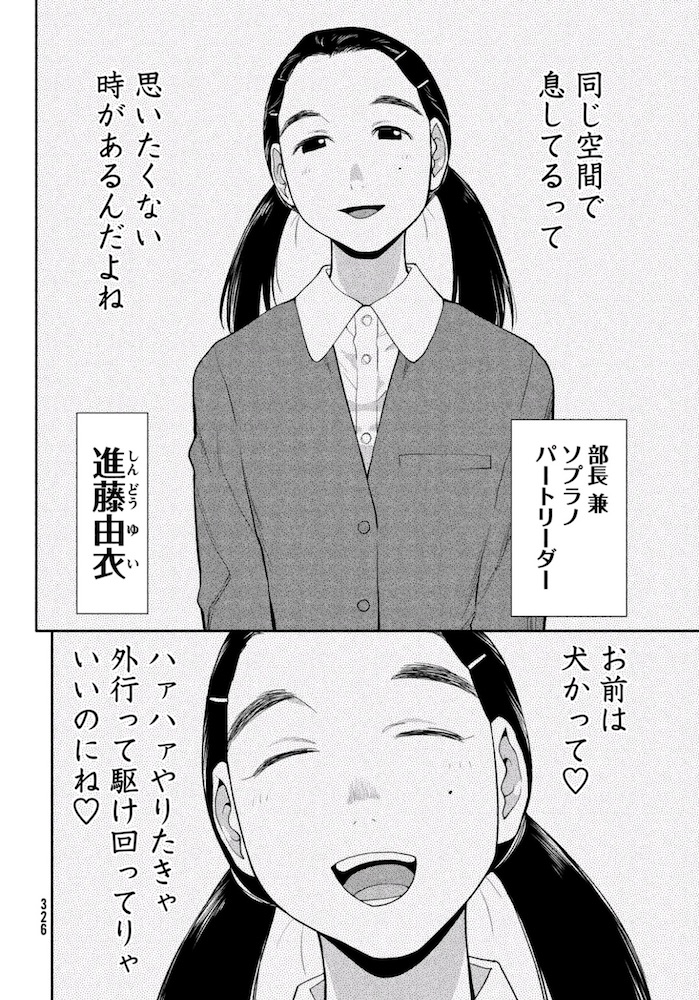
Nishigafuchi lead tenor Saiga (first name Shinnosuke) is in a funk, and the reason is that Shindou Yui, the lead soprano. Shindou mentioned that she sometimes doesn’t want to thing about how they’re breathing in the same space, and that with the way he keeps panting, he should just run around outside like a dog. To prove himself, he plans on challenging Jin to a competition, but gets punched in the mouth by Orihara instead. Shinji wonders if Orihara did it to defend Jin, but Orihara claims it was because he wanted to sing more Brahms. The punch actually makes Saiga want more because it reminds him of Shindou’s sadistic behavior.
Instead of competing, Jin actually helps Saiga with his singing and breathing (so he didn’t have to breathe the same air as her!), and the results are noticeable. Even Shindou is impressed, though she’s no slouch herself. Afterwards, Saiga goes up to Shindou and asks her…if she can be his master. Shindou happily gives him commands like a dog, everyone is confused (especially Kurata), and the Nishigafuchi adviser awkwardly comments that there are all kinds of relationships these days.
As they’re singing, however, Akira doesn’t, and his old middle school classmate Sadamoto notices again. But before he could say anything, Jin asks if the Hashimoto Chorus Club could perform for everyone on their own. Will Shinji finally sing here?
All Kinds
In the last chapter, Nishigafuchi student Andou described Shindou as appearing gentle but actually having a nasty tongue, and she certainly lives up to reputation. I figured that would be the case, but she far exceeds my expectations. I have to wonder if it’s like an entire club of masochists who enjoy the verbal lashing.
Meanwhile, Orihara’s punching Saiga (potentially) in defense of Jin is kind of a serious tsundere move by way of delinquent behavior. Maybe Orihara really does see him as a friend.
Great Teacher Kimura
According to Jin, Saiga tries too hard to keep his head from lifting up and tries to create too much space in his mouth—things that are generally considered good form in singing, but an area where Saiga overcompensates. The consequence is that the surrounding throat muscles to be overly tense and rigid, and this results in him breathing oddly while performing. To Jin, this might be why Shindou made her dog comment.
To help all of the tenors with this, Jin has everyone do an exercise where they “play catch” with their voices. The idea is that they breathe out like you’re trying to form a parabola, and like it’s coming out the top of your head—like they’re “throwing” their voice to the other team.
Jin is thus portrayed as someone who can teach even an elite singer from an elite school, and it furthers the idea that he’s on another level when it comes to understanding sound and music. It’s not clear what his power level is, but when Saiga challenges him, I was expecting a shounen manga moment where Jin can show his stuff and make clear the size of the disparity between them, but it didn’t happen. Yet.
Songs
Referenced last chapter too, they sing Johannes Brahms’s “O Heiland, reiß die Himmel auf, Op. 74, No. 2.”
Final Thoughts
Is Jin purposely requesting a Hashimoto-only performance so that Akira will feel more comfortable singing, or does he have a different motivation?
Also, Kurata’s utter bewilderment over the Saiga-Shindou thing is the cutest thing.
I was asked by my long-time Patreon sponsor Johnny Trovato about my thoughts on “The effect of budget figurines (like Banpresto sells for $20 each [2,000 yen]) on the anime figure scene.” My first reaction to this was simply, “Figures are expensive, man.” That pretty much sets the stage for my opinion on the subject. They fulfill a necessary space in the grand scheme of anime merchandise, but they could always be better–not in terms of quality but rather honesty.
Personally, I prefer to get higher quality figures even if it means I have fewer overall. The Banpresto figures tend not to have the best paint jobs or face sculpts, and pricier figures just have more attention to detail that I appreciate. I don’t typically go for the most costly ones, though, unless I really, really want it.
But the balance between quantity and quality is different from person to person, and figures can end up being an absurdly expensive hobby. I’ve known people like that, and I’ll be upfront when I say that I don’t think I’ll ever make enough in a year to comfortably keep that up. So in that respect, Banpresto figures are a nice compromise. They’re not going to be the best, but they’re not supposed to be. They’re a valid option for people who want figures but simply can’t or won’t pay for more. And unlike trading figures, which is designed to be a bit of a gamble (you never know which one you’re gonna get!), you know what the figure is going to be.
The problems with $20 anime figures come from two things, both related. First, their true purpose is as prizes for crane games in Japan. While there are apparently ways to master crane games and obtain them for reasonable prices, most people will probably end up spending more, perhaps even without success. Second, one of the big differences between more expensive figures and less expensive ones is whether you can look at the actual figure itself. Higher quality merchandise has clear packaging that lets you see what you’re buying, whereas the Banpresto stuff is hidden in opaque boxes covered in promotional photos that try to hide the flaws as much as possible. This is intentional but also disingenuous, as it potentially tricks people into getting a figure they wouldn’t have otherwise. In a sense, seeing them unboxed and on display at an anime con is a better thing, but in those cases they’re often marked up.
Ultimately, I don’t think Banpresto’s $20 figures are inherently a bad thing, and they definitely serve a part of the anime fandom that should be catered to. I just wish there wasn’t a degree of deception baked into the whole thing.

 As autumn comes around once more, and the summer hear theoretically wanes (oh, that climate change), I’d like to say “thank you” to my supporters on Patreon and ko-fi.





 OGIUE MANIAX