Make It Happen: Hashikko Ensemble, Chapter 3

Small steps lead to lots of self-resolution in Chapter 3 of Hashikko Ensemble.

Summary

Jin has discovered that Akira has a natural Singer’s Formant, and wants more than ever to sing with him despite the fact that Singer’s Formant isn’t terribly practical in an ensemble because it can drown out voices out. What’s more, Akira can’t seem to replicate it! So Jin tries to find a way to trigger it, including putting himself in harm’s way and finding a room where Akira will feel comfortable. Neither go as planned, but one important development through all this is that Akira genuinely wants to sing now!

Bass of the Diamond

The fact that Singer’s Formant is considered impractical in a vocal ensemble is all the more intriguing because of Jin himself. Since Chapter 1, it’s been established that he’s a loud singer—a point further reinforced in this chapter. When Jin starts singing along with the school rugby team and actually overpowers all of them simultaneously, it shows his lungs are a cut above the rest. Could it be that while Singer’s Formant typically overshadows other singers in groups, that Jin can “keep up” with and possibly complement it? Is this like a baseball manga with an ultimate pitcher and an ultimate catcher (no BL puns outright intended)?

The Atypical School Setting

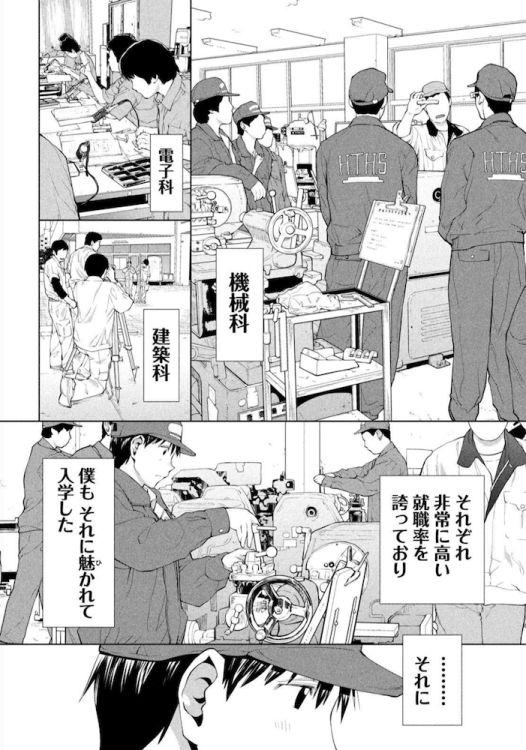
Manga set in high schools are a dime a dozen, but the background emphasis of their school as a technical and engineering school feels refreshing. It hasn’t played a major role yet, but it’s just different enough from the vaguely define manga norm and just prominent enough that it makes me curious about the school as a whole. Seeing boys and girls joking around but also trying their hands at different areas like woodworking gives a certain sense of realism that can sometimes feel lost in the idealized school settings of other manga.

In Genshiken, we don’t even really know what characters’ majors are. Here, we’re clearly seeing the kind of education they’re getting, even if it’s not the focus of the story.

Students and Teachers

In this chapter, as Jin continues to try and find a club adviser, we find out that one of the teachers is into classical music… because of Sound! Euphonium. There’s something charming about seeing not just teens or students being affected by anime but full-fledged adults as well.

Hanmoto (the buddhist priest’s son) talks about how he would fend off Orimura (the guy who almost punched Jin for taking his earphones), in order to get a hug from “Mimi-sensei.” That seems to be Kitano-sensei from last chapter—maybe Mimi is her first name? I’m either case, it appears that Kitano-sensei has a reputation; her physical endowment is not lost among the boys.

I also keep wondering if guys like Hanmoto will actually join, or if they’ll remain side characters.

Songs

No new songs this month! There’s only the Hashimoto Technical High School’s official song.

Final Thoughts

There’s a scene where Jin sees an old classmate who’s joined the rugby club despite being downright scrawny. Akira’s thoughts in response—if he can do it, maybe I can too!—highlights that Akira is actually surprisingly positive. It’s as if he’s previously fooled himself into thinking he easily gives up, but there’s a fire inside.

Breakthrough: Return to Genshiken – Volume 8

We’ve reached the climax of Genshiken series 1, and the moment that all Ogiue fans cheered for. How does one of the most famous otaku confessions in manga history still hold up?

What is Return to Genshiken?

Genshiken is an influential manga about otaku, as well as my favorite manga ever and the inspiration for this blog, but it’s been many years since I’ve read the series. I intend to re-read Genshiken with the benefit of hindsight and see how much, if at all, my thoughts on the manga have changed.

Note that, unlike my chapter reviews for the second series, Genshiken Nidaime, I’m going to be looking at this volume by volume, using both English and Japanese versions! I’ll also be spoiling the entirety of Genshiken, both the first series and the sequel, so be warned.

Volume 8 Summary

The Genshiken members are on a trip to the resort town of Karuizawa, when a drunken girls’ night in causes Ogiue to reveal her past to the other girls. It turns out that Ogiue had a boyfriend named Makita in middle school, but after she  drew a BL doujinshi starring him and his best friend, and Makita transferred to another school presumably after seeing it. This is the source of Ogiue’s hatred of herself and her fujoshi side.

Sasahara is left to take care of Ogiue during her hangover, and ends up confessing to her, only to be rejected, because Ogiue “can’t date men.” At the prompting of Kasukabe and Ohno, Sasahara goes after her, where she reveals that she’s been drawing doujinshi of him and Madarame this whole time, and is suffering from immense guilt over being unable to stop herself. Sasahara, instead of recoiling in fear and horror, shows understanding and support, which convinces Ogiue to invite him over to her place after the vacation with the goal of putting everything on the line. After having him read the doujinshi starring himself and seeing him accept it, the two finally get together and consummate their relationship.

After a cute but awkward early stage, the two are fairly comfortable together. However, Ogiue runs into a couple of other hurdles. First, she’s rejected from Comic Festival, which tanks her confidence. Second, the Manga Society she unleashed havoc on back when she was much, much angrier. Visited by some old members, namely a Kansai girl named Yabusaki who also draws, it turns out that Yabusaki’s been garnering jealous eyes in the Manga Society herself, and that Yabusaki’s friends see a friendship with Ogiue as a way to benefit both parties. The two begin to get along…sort of?

Ogiue’s Past Revealed

As Ogiue gives her drunken rant (by way of flashback), one takeaway is just how serious her trauma is over her time with Makita—it’s enough to consistently give her nightmares. I once got the chance to submit a question to Kio Shimoku as to why her eyes changed over the course of the series, and he mentioned that her character originally necessitated those eyes. I wonder if it signifies her no longer being victim to her own bad dreams.

Nakajima is a fascinating character. It’s clear to me that she was jealous of either Ogiue or Makita, but the extent of her involvement in actually bullying Ogiue remains ambiguous. I think this shows more Ogiue’s mind in turmoil than any absolute truths, that she lost trust in Nakajima, but also faith in the assumption that Ogiue herself was a good person. Based on the character’s appearances in Nidaime, it’s obvious Nakajima wants to mend bridges with Ogiue, but her own personality gets in the way. Maybe both Ogiue and Nakajima are cursed with standoffish personalities.

As for Makita himself, I find it significant that he never really shows up, not even in Nidaime, even though Nakajima makes a couple of appearances. I think this is to show that there’s a part of Ogiue’s past she’ll never be able to directly confront, and that she’s ultimately okay with this. Then again, I figured that was the case with Madarame’s unrequited love for Saki and that eventually got resolved, so maybe if Genshiken had more volumes it would’ve happened eventually. Another point about Makita is how he contrasts with Sasahara. Makita was (assumedly) so bothered by the doujin that he transferred school. Sasahara took it head-on. Again, while he doesn’t seem like he should be a seme character, one can see how Ogiue would interpret him as such.

The Confession, Part 1

I consider Sasahara’s confession to Ogiue and the subsequent fallout to be the most magical part of Genshiken, and not simply because of the fact that it’s the big romantic climax. There’s just so much in terms of the characters’ personalities, histories, and quirks intertwining over an extended period. The confession essentially comes in parts, starting with a stock “I like you, and I want to protect you” line straight out of some dating sim. Sasahara’s willingness to back off at what he takes as a rejection is a flaw of his, but also one of the qualities Ogiue admires in him. Then, when Ogiue blurts out that she been drawing a hardcore comic of him with Sasahara, she’s trying to drive him away with all her might, afraid that getting closer would hurt them both.

I remember the degree to which Ogiue took Sasa x Mada was a pretty big surprise back when I first read it. Now, it’s been so long and been such a part of Ogiue’s character as to feel natural.

To Ogiue’s surprise, Sasahara sees the good in her, and this gradually opens Ogiue’s eyes to the idea that, just maybe, she should accept and embrace herself. Ogiue’s struggle this entire time has been based on the feeling that her desires and her conscience are in direct conflict, when they need not be. She’s afraid of hurting Sasahara, but what if her actions simply don’t bother him? It’s a compatibility issue, not a fatal flaw that denies her companionship.

The Confession, Part 2

When they decide to meet at her apartment, the tension is thick with both nervousness and sexual energy. It rightly feels like they’re on the verge of something big after so long. But I think the key to it all is in Sasahara’s line: “I can feel your overwhelming love for your characters,” in reference to the BL-ized versions of himself and Madarame. Those words free Ogiue. Her drawings come from a place of passion.

Seeing Sasahara grapple with the fujoshi mindset, and Ogiue having to explain it to him, is also pretty fascinating. After reading through her doujin, he asks her if she also has feelings for Madarame, which Ogiue denies. There’s something different about the way she uses each of them for inspiration. It feels as if she takes the qualities that make her like Sasahara and exaggerates them for fiction, but for Madarame it’s that his “uke” qualities make him excellent as a character first and foremost.

That’s if we’re talking Ogiue, at least. As the sequel shows, sometimes Madarame as imagination fodder and subject of affection can come as a package. Perhaps Hato is meant to tap into that aspect of Madarame, and to show that there are simply a lot of different people in the world.

Returning to the subject of Ogiue, she tries to prompt Sasahara into being more aggressive, which Sasahara tries to live up to with awkward (yet effective?) results. It’s funny to see Sasahara from this point forward actively put on that more aggressive personality when I’m romantic situations with Ogiue, because it clearly comes from a desire to thrill and excite her. It’s very fitting for their characters.

Once their feelings are known, the two immediately go into sex, which I think is actually kind of wild. Sure, they’re horny college students who also obsess over drawn pornography, but to go from that degree of pussyfooting to just (offscreen) pants-off carnal desire makes me think of a hose previously being held back suddenly letting loose (ifykwim). From this point on, Sasahara and Ogiue are not only boyfriend and girlfriend, but this can also be seen as a major stop along the way in their respective careers as editor and artist because Sasahara essentially gave a “review meeting” about Ogiue’s Sasa x Mada doujin. It’s shown to be a pretty constant source of tension between the two, but one that’s ultimately minor in the face of their love for each other.

The Manga Society

I’m very impressed looking back at how the Manga Society girls (Yabusaki, Asada, Katou) are able to make such a strong impression after such a brief appearance. You get a sense of how they relate to each other, what the club environment was like, and the girls themselves are just plain memorable.

One thing I find funny is that, at this point, Asada Naoko didn’t have an actual name. At most she’s referred to as “Nyaako” in the Volume 9 doujinshi extra by some of the artists. Asada actually comes from the Genshiken 2 anime credits, and Naoko is from Nidaime, which retconned Nyaako into being her nickname—a play off of “Naoko.”

They also drop that tidbit about Ohno and Katou knowing each other. One thing I find interesting is this idea that true bonds can be formed through shared kinks. I don’t think that notion has gone away, but I have to wonder if making that aspect of oneself more visible to the public (“horny on main” as they say it these days) makes it so that aspect of oneself is no longer as revealing or telling of one’s true self. Basically, maybe showing one’s kinks isn’t as much of a soul-bearing activity if it’s never made private in the first place.

Final Random Thoughts

There’s a very memorable scene I had ironically almost forgotten about: on the train home from the zoo, Ogiue basically tells Sasahara that “their date isn’t over yet,” which makes Sasahara shift his bag to hide his erection. While Genshiken often deals in literal fans of drawn pornography, these moments of sensual realness stand out all the more because of it.

That zoo, by the way, is based on Tama Zoo, which is a short train ride away from Chuo University (the school that visually inspired Genshiken‘s Shiiou University). I actually went there when I studied abroad in Japan!

Bruno Sammartino in Tiger Mask: A Brief Cameo

Wednesday, April 18, 2018 marked the passing of a legend. One of the most influential pro wrestlers of all time and longest-running WWE champion Bruno Sammartino died at age 82. Before WrestleMania, before the national expansion of the WWF, Bruno was the flagship wrestler for that company.

It just so happens that the same day as Sammartino’s passing, I was reading the original Tiger Mask manga, and who would show up in Volume 6 but the Italian Strongman himself.

The Tiger Mask manga, published beginning in the 1960s, was known for showcasing real professional wrestlers, such as Classy Freddie Blassie and Angelo Poffo, alongside fictional ones.

In the above scene, Giant Baba (a Japanese wrestling legend in his own right) is describing the best American wrestlers to another character. He ranks the top three as 1) “Human Power Plant” Bruno Sammartino 2) “Iron Claw” Fritz von Erich 3) “Great King Thunder” Gene Kiniski. (4 is the fictional Mr. Question. You may have seen him in Tiger Mask W!)

The nicknames are directly translated from the Japanese; I have no idea where “Human Power Plant” comes from. Amusingly, “Great King Thunder” seems to be a creative interpretation of Gene Kiniski’s actual nickname “Big Thunder”—the Japanese word for “great king” is daioh; literally “big king.”

Rest in peace, Bruno Sammartino. You’ve been immortalized in more ways than one.

One Step Off: Ogiue Maniax Status Update for April 2018

It’s time once again to look back on a month of blogging, and to give my gratitude to my supporters on Patreon and from Ko-fi. Thanks to the following!

General:

Johnny Trovato

Ko Ransom

Alex

Diogo Prado

Sue Hopkins fans:

Serxeid

Hato Kenjirou fans:

Elizabeth

Yajima Mirei fans:

Machi-Kurada

I have to apologize this month, as I was supposed to have written and posted my re-read review of Genshiken volume 8 in March. Unfortunately, I came down with a bad cold towards the second half of the month, and rather than try to force it out I decided to delay it to this month. It’s actually mostly finished and requires largely final touches. Because of this, the final re-read for Volume 9 will be delayed to June.

You might have noticed that I avoided posting this past Sunday. As some might surmise, it was to avoid the chaos that is April Fool’s. I didn’t have any sort of chicanery at the ready, so I didn’t want anything I published to seem disingenuous. I do kind of miss making April Fool’s gags, though, so maybe next year.

On another related note, I’m currently trying to figure out if I should switch to a lighter posting schedule, given my real-life work schedule and my relative dissatisfaction with the quality of my writing as of late. I’ve always valued my consistency and my willingness to (more often than not) just let pieces go rather than sit on them forever. However, recently, I’ve felt that many of my blog posts don’t have the amount of spark, inspiration, and insight that I prefer. Fewer posts per week (i.e. one or two instead of two or three) makes sense on the surface, but I’m worried that having so much wiggle room could make me slack off.

The other concern is my Patreon. I want to make sure there’s enough content to keep justifying it, and I have to wonder if one to two weekly posts is actually enough. If you have any thoughts on either of these matters, feel free to leave a comment. I’d love to hear it.

It’s not really doom or gloom; it’s a desire to not stagnate. In any case, here are my favorite posts from March:


Kio Shimoku and Genshiken Trivia Courtesy of “Mou, Shimasen Kara”

Following Chapter 1 of Hashikko Ensemble was a special interview with the man Kio himself. There’s a lot to learn from it!

A Look at Precure Popularity

Thoughts and musings on the varying popularity of Precure and its characters throughout the years. Spoilers: Cure Marine is amazing, Heartcatch Precure! is the best. No, really.

Defying Assumptions. Fujoshi-style: Kiss Him, Not Me

My final review of a really good fujoshi-themed manga.

Hashikko Ensemble

Chapter 2 of Kio Shimoku’s new music manga. It’s filled with potential.

Patreon-Sponsored

Aikatsu! and Idol Franchise “Experiences”

Aikatsu! feels rather unique to me, and I try to explore why.

Also, while I didn’t quite consider them my favorite posts for the month, I did review quite a bit from the New York International Children’s Film Festival. Check the NYICFF tag out! I might get around to more of them this month!

Closing

Can Ogiue Maniax make the impact I desire? What shows of the Spring 2018 anime season will get reviewed on the blog? Find out…some time!

The Fujoshi Files 177: Arai Tamako

Name: Arai, Tamako (新井珠子)
Alias: Tama-chan (珠ちゃん)
Relationship Status: Single
Origin: Barakamon

Information:
A middle school student and resident of Gotou Island near Kyuushuu, Arai Tamako is an aspiring manga artist who wishes to be published in a shounen magazine. However, unlike the typical manga for a shounen publication, Tamako combines an eccentric art style and bizarrely violent content that one might see in a more avant-garde magazine. She is best friends with Yamamura Miwa, with whom she occasionally bickers but also teams up with to tease the weak, be they younger or older. Tamako also has a younger brother, Aki, who is more level-headed.

Tamako discovered BL by accident at a younger age, and though she claims that side to be a small part of her general interest in manga, she is afraid of the other residents of Gotou Island finding out the truth. On top of that, the arrival of master calligrapher Handa Seishuu to the island has sparked her fujoshi imagination, especially when it comes to the (imaginary) relationship between him and high schooler Kido Hiroshi.

Fujoshi Level:
Though Tamako originally struggled to suppress her fujocity, over time she has increasingly let it slip through. She reaches the point where she is on some level trying to assert her fantasy in reality by suggesting somewhat openly to Seishuu and Hiroshi that something should happen.

Ensemblers Assemble: Hashikko Ensemble Chapter 2

It’s the second chapter (and the first regular-sized chapter) of Shimoku’s new manga!

Summary

Kimura Jin wants members for his chorus club, and he’s asking the quiet yet unusually deep-voiced Fujiyoshi Akira to join. Akira’s reluctant, but Jin has a proposition: if he can help Akira speak more loudly, Akira will join the club. Akira tentatively agrees.

But while Jin calls it an ensemble “club,” it’s more of an “appreciation society” at the moment—the distinction being that a group only gets club status if it has five or more members and an advisor. Jin’s first choice for advisor, Takano-sensei, refuses because she’s more of a violin specialist than a vocal one.

Jin’s also not the only one trying to get a club off the ground, as a friendly (?) rival in Hachida Shinji, who has dreams of forming a “mountain castle club.” Shinji is skeptical of Akira’s chances of speaking at a normal level, to which Jin replies that Akira’s body will understand.

As the three continue to talk/argue, they run into the Class 5 teacher, Kitano-sensei, who’s lecturing a blond delinquent-looking student named Orihara. Unbeknown to Kitano, Orihara is actually wearing noise-canceling earphones. Jin pulls out of Orihara’s ears to have a listen, prompting Orihara to start swinging at Jin, which then causes Akira to instinctively yell out. His voice is so deep and resonates so much that it astounds everyone. Jin’s first thought: Akira has “singer’s formant,” i.e. the ability to sing both loudly and clearly, which usually only comes with musical training.

Story in Motion

So now we’ve established the initial goal, and it’s the classic “getting enough club members” story—a tried and true trope that I don’t mind one bit.

If things go as typically expected, Orihara is on track to becoming a member. I have to wonder what his for might be, both character-wise and voice-wiser. Hachida Shinji is a potential member as well. Maybe they’ll pull the “combined club” trick, a la Chuunibyou demo Koi ga Shitai with its “eastern magic and napping society.”

Shinji

As an aside, the idea of a club dedicated to studying mountain castles is tremendous, and I hope Shinji gets his wish.

I also think Kitano-sensei will be their advisor, but that might just be wishful thinking. Her brief appearance has already made me a fan. She’s adorable!

Another character I think is going to make a splash is a female classmate named Hakamada. In this chapter, Jin asks her what music she’s listening to, and something about the way she’s framed says to me that she’ll be significant somehow.

Jin is a Character

The way that Akira ends up yelling out plays perfectly into Jin’s notion that he’ll understand what to do “with his body”—as in almost by instinct. But is Jin actually the calculating type? He sure doesn’t seem that way. And yet, he’s also the one who offered Akira exactly what he wants.

Jin might look like a typical anime otaku, but he really is a music otaku through and through. He carries around a device to measure the number of Hertz in people’s voices and appears to have both a technical and intrinsic understanding of singing. What’s more, he hears an anime song and thinks “Ghibli? Disney? Eva?” as opposed to something more hardcore.

Jin’s vocal range really is absurd. It was established in the first chapter, but here he basically shows that he can cover most of the guy parts (as well as some girl parts) and only really needs Jin for the deepest registers.

By the way, Akira is actually a bass, not a baritone! I madea mistake in my description last review. Chalk that up to me having no real music knowledge.

Singer’s Formant

Speaking of being a total newbie when it comes to music, I’m still not entirely sure I understand Singer’s Formant. As far as I can tell, certain sounds don’t carry as well, so singers train to be able to project loudly and clearly over even orchestras in large spaces. Correct me if I’m wrong!

I also found this video, which might help explain things better.

Songs

If you’re wondering what that “anime” song is that Jin is asking about at the beginning, it’s. “Trancing Pulse” by Triad Primus from The iDOLM@STER Cinderella Girls.

Final Thoughts

Actually, a lot of teachers are introduced quickly in this episode and they all seem full of personality. I’m looking forward to seeing which ones become more prominent as the manga progresses.

Until next time!

Like this post? Feel free to check out my Patreon, or leave a tip at my Ko-fi.

Movie Madness: Ogiue Maniax Status Update for March 2018

Is it possible to see too many movies in a single month? It looks like I’ll be testing that out. Not only is it the start of the 2018 New York International Children’s Film Festival, but we’ve got the recently released Black Panther along with Pacific Rim: Uprising, Isle of Dogs, and A Wrinkle in Time. I’m a bit concerned about the sheer quantity overwhelming my ability to engage with each movie, but we’ll see how it pans out.

As a general rule, disengage before you start to feel yourself burning out. This applies to not just anime or entertainment, but even work. Managing your health mentally, emotionally, and physically to the best of your abilities!

In other news, I’ve started a Ko-fi page for Ogiue Maniax. It’s basically an online tip jar, ideal for those who want to support Ogiue Maniax now and then, but either won’t or can’t commit to a Patreon sponsorship.

So from now on, my monthly list of supporters will include both those from Patreon and from Ko-fi.

General:

Johnny Trovato

Ko Ransom

Alex

Diogo Prado

MagiGold

Sue Hopkins fans:

Serxeid

Hato Kenjirou fans:

Elizabeth

Yajima Mirei fans:

Machi-Kurada

My favorite posts from February:

“I Go High, You Go Low”: Hashikko Ensemble

Kio Shimoku’s new manga! Expect to see this every month for the foreseeable future.

Join the Bakery: Kira Kira Precure a la Mode

Another Precure series concludes. How does this one stack up to its predecessors?

The Legacy of a Knight. Mazinger Z: Infinity

The 2018 sequel/revival of history’s most important super robot. A must-see for giant robot fans.


Patreon-Sponsored

The Unreality of Virtual Youtubers

Thoughts on the success spawned by Kizuna A.I. and those who followed her.

Closing

Watch A Place Further than the Universe. It’s not just “girls doing something,” it’s “girls getting something done.”

Defying Assumptions, Fujoshi-style: Kiss Him, Not Me

Kiss Him, Not Me (aka Watashi ga Motete Dousunda in Japanese), a manga about an overweight fujoshi who suddenly finds herself with a harem of handsome classmates after losing weight, recently concluded in Japan. For those who might have been alarmed by the seeming shallowness of the initial premise, I believe this series to be worth a second look. Instead of a series centered on fat-shaming and mocking female anime fans, Kiss Him, Not Me is thoughtful, intelligent, and emphasizes the importance of self-image, all while remaining delightfully humorous.

I can definitely see why readers might have been worried at first, because I was as well. It’s true that most of protagonist Serinuma Kae’s suitors initially are drawn to her due to her dramatic “makeover”—the result of her favorite character’s death causing her to not eat. The apparent shallowness and lack of concern over how the series might interact with perception of eating disorders made me wary, but as the series went on, I found that it addressed my criticisms almost without fail.

While many of her suitors are taken in by her dynamite body, one in particular is an exception. Most of them initially cannot recognize Kae post-weight loss, but it’s her senior in the history club, Mutsumi, who immediately knows who she is—as if Mutsumi had been viewing her as a human being all along. Eventually, all the other guys understand that it’s her personality that makes Kae beautiful, but Mutsumi’s presence is the first sign that body positivity is an underlying message in the manga.

Throughout the series, Kae’s weight yo-yos for humorous effect, showing that it’s just as easy for her to regain all her weight as it is for her to slim down. This might make it seem like Kiss Him, Not Me is either dealing in weight gain/weight loss fetishism, or emphasizes a certain body type as being “authentic,” but there’s even a plot point dealing with that subject. When a new character claims the old, chubby version is the “real Kae,” it’s an opportunity for the manga to tell a story about the perils of tying identity to appearance.

In general, Kiss Him, Not Me shows that it puts more consideration into its themes than one might expect at first glance. I don’t intend to spoil the ending, but I will say that the series stays strong even as it concludes. The finale feels a bit rushed (as if the series needed to wrap up sooner or later), but it’s not nearly enough of a blemish to ruin all of the positives and positivity this manga offers.

Like what you read? Check out my Patreon and Ko-fi!

Kio Shimoku and Genshiken Trivia, Courtesy of “Mou, Shimasen Kara”

Over the past year, the manga magazine Monthly Afternoon has featured interviews in comic form with its own serialized manga authors through the series Mou, Shimasen kara. Afternoon Gekiryuu-hen by Nishimoto Hideo. This past month’s issue puts the spotlight on Genshiken and now Hashikko Ensemble creator, Kio Shimoku, so I’ve taken the liberty of summarizing all of the Kio factoids in it.

-For the first time ever, Kio actually reveals his “face” (albeit in manga form). He’s known for being a private person, but he decided show himself through this manga. He reasons, “I’m over 40 now, so what does it matter if I show my face or not?”

-Kio used to work analog, but has been an all-digital artist ever since Jigopuri. He does everything, from thumbnails to color, all on his Wacom. He doesn’t customize his pen or brush settings much.

-He almost never uses assistants. Kio had one assistant on Genshiken Nidaime and none for Hashikko Ensemble, his new series. For those who don’t know, this is highly unusual.

-Kio got the inspiration for Hashikko Ensemble because his daughter joined a vocal ensemble, and he happened to listen to an all-male group.

-He was never a musician, but knew a local group, so he did do some singing for them about once a month, and even had a voice trainer. He’s a second tenor, which was the basis for Akira’s baritone in Hashikko Ensemble. Kio has a fairly deep voice himself, so he decided to exaggerate it for the manga.

-Once, in school, he saw two kids harmonizing on the way to class, providing further inspiration. “I want my manga to make readers want to sing.”

-Kio was in the softball club in elementary school, the judo club in junior high where he was the captain, and the art club in high school.

-He submitted his first manga in high school, for Shounen Sunday. It was about a high school student who works at a used bookstore and discovers an ancient text that he then tries to decipher.

He drew a lot when he was kid, and was an otaku in middle school, where he imitated Doraemon, Kinnikuman, and Captain Tsubasa.

-However, he stopped drawing between 4th grade of elementary and the start of middle school. This was because he was really into Miyazaki Hayao as a kid, and when he couldn’t copy Miyazaki successfully, he got depressed and stopped trying for those few years.

-In middle school, he helped a friend out by drawing backgrounds for his manga, only for Kio to realize he was also better at drawing the characters too. One day, when he tried to draw Miyazaki characters again, he noticed he had gotten way better.

-He wanted to be an animator, but Ghibli only wanted people 18 and up. Once, he created a manga based on the Laputa novel in a couple of notebooks.

-In college, he majored in Japanese art because he thought the pencil and brush skills would translate to manga.

-Kio’s dad worked at an insurance company, and while he wasn’t flat out against Kio’s aspirations, he would constantly ask him to consider the risk of being a manga creator. This made Kio want to quickly win a manga reward, to help his parents accept it.

-The school he went to had a club called the Society for the Study of Modern Visual Culture, becoming the inspiration for Genshiken. Surprisingly, however, Kio was actually only a member for half a year. He didn’t quit because if anything in particular, he’s just not good with group activities.

-Despite what it might seem, the Genshiken characters are not based on any real life counterparts.

-In response to the realism of his characters, Kio says he tries to convey a sense of “presence” with them.

-Kio feels Genshiken came at the perfect time, matching the zeitgeist of the era. However, it makes him feel like a one-hit wonder. If Hashikko Ensemble fails, he’s going to feel enormous pressure.

-He didn’t attend a technical high school so he needs more research. One of he authors of Mou, Shimasen kara. did, and the other has a sister who attended one, so they try to help out.

Thoughts

Kio’s done a lot!! He sort of seems like a renaissance man.

That bit of surprise aside, it is fascinating finding out just how many aspects of his own personal life and career have made their way into his manga. The attending a Genshiken-like club is one thing, but it’s notable that he was in the judo club and then the art club—just like Hato. He also converted to using a tablet monitor for manga at some point—just like Ogiue. While his characters aren’t based on any real people in particular, he takes bits of himself and places them in his creations. While not stated outright, I think it’s pretty clear that Jigopuri (which is about raising a baby) is the product of firsthand experience.

Like this post? Feel free to check out my Patreon, or leave a tip at my Ko-fi.

“I Go High, You Go Low”: Hashikko Ensemble Chapter 1

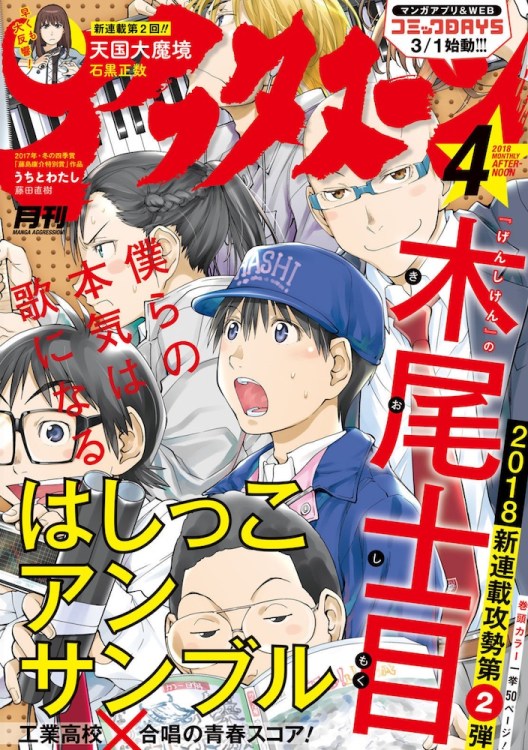
Genshiken author Kio Shimoku has debuted a brand-new manga series this month, and it’s a bit of a departure from the otaku-centric tribulations of daily life that he’s known for. Fan that i am, I’ve decided to start doing monthly reviews for it, much like my previous Genshiken Nidaime posts.

Summary

Fujiyoshi Akira and Kimura Jin are new students at Hashimoto Technical High School. Akira sports an unusually deep voice that cracks when he tries to raise it, so he generally avoids speaking if he can help it. Jin is anything but quiet. Notorious throughout the school for his undaunting enthusiasm and his loud, boisterous tunes between classes, Jin wants to recruit fellow students to form a vocal ensemble.

When Jin notices Akira’s exceptional baritone, he sees Akira’s voice as the perfect complement to his own alto-soprano range, and becomes dead-set on having Akira join, all while unaware that Akira was actually a singer himself in middle school before his voice changed. While Akira is reluctant, he ends up having second thoughts for one major reason—Jin thinks he knows how to fix Akira’s voice.

A Dynamic Duo

Although Hashikko Ensemble has only just begun, the concept of a pair that’s greater than the sum of its parts has me intrigued. It’s not exactly new territory, with titles like Haikyu!! and Kuroko’s Basketball among the more famous, but I am curious to see how this turns out in a non-sports, non-shounen narrative.

Making Akira’s voice extremely deep is a simple yet unorthodox character choice. While I’m no expert on singing manga, my experience is that main characters in such series tend to stand out because they can sing extra high (such as in the manga Shounen Note) or powerfully. It’s also uncommon, despite the commonness of teenage settings in manga, for the voice-cracking that comes part and parcel with puberty to actually come up in series.

One aspect of Akira that isn’t entirely clear is whether his reticence over his voice is because of the attention he receives from the other students (who inevitably remark how “manly” it sounds), because it’s a painful reminder of when he could sing, or some combination of the two. Whatever the reason, it helps to give Akira a strong sense of character and presence, despite his fairly generic appearance and demeanor.

In contrast, Jin stands out tremendously. Because of the way he looks, comparisons with Onoda Sakamichi from Yowamushi Pedal feel inevitable, but two differ in two important ways: Jin seems immune to embarrassment, and he’s a “music otaku” rather than an “anime otaku.” There’s something about a guy who so overwhelmingly looks like a dork while being utterly fearless in the face of his peers that instantly appeals to me. It’s what I aspired to be in my teenage years, so I find Jin quite admirable. As for what being a music otaku means, Jin has a scientific understanding of sound and voices, speaking of vocal cord vibrations and decibels, which is why he believes he can help Akira.

“Ensemble” Cast

While the main focus of this opening chapter is Akira and Jin, there are plenty of side characters with potential to enrich the story. As with Kio’s other series, realistic portrayals of human relationships look to be one of Hashikko Ensemble’s strengths, and I look forward to seeing how the cast at large develops. From the first chapter, the stand-out character has to be Hanzan, the wisecracking son of a Buddhist temple who actually wore a wig to school on day one just so he could reveal his bald head during class introductions.

One factoid about their high school is that boys outnumber girls by about 11 to 1. I have to wonder if this will play a major role in the story, or if it’s just for realistic flavor. I wouldn’t mind seeing some female characters join the cast (there’s already one who shows up briefly), but would also be fine if it remains guy-centric.

Songs

Originally, I was going to list every song that shows up in this chapter, only to realize that Jin sings so much that the number of tunes encroaches into the double digits, and I’ll leave it to someone who’s more of a music buff in general. Here’s a sample:

Hashimoto Technical High School Anthem

“My Grandfather’s Clock” (Japanese version). English lyrics by Henry Clay Work, originally performed by Johnny Cash.

“Te no Hira o Taiyou ni” (Sun in the Palm of My Hand). A children’s song originally featured on the weekly television program Minna no Uta in 1962.

“Kanade” by Sukima Switch.

“HEIWA no Kane” (Bell of Peace) by Okinawa Yukihiro.

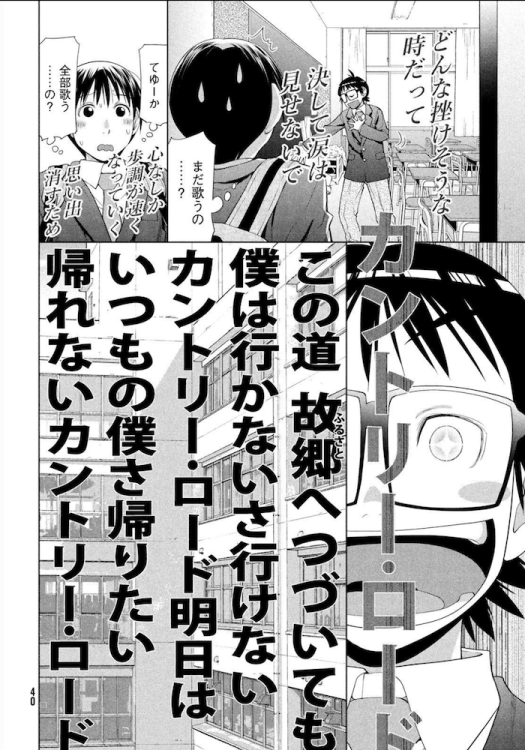
“Country Road” (Japanese version) by John Denver. This is the version from Whisper of the Heart.

“Country Road” is particularly significant to the story, as it’s the point where Akira is finally drawn in by Jin’s singing—particularly Jin’s ability to handle traditionally women’s roles.

Final Thoughts

This series definitely has potential, and I don’t mean that just because I’m a Kio Shinoku fan. It’s somehow both low-key and energetic at the same time, reflecting the different personalities of its two central characters.

There’s another manga that also runs in Monthly Afternoon titled Mou, Shimasen kara: Afternoon Gekiryuu-hen, which features interviews with other Afternoon manga creators. This month’s is Kio Shimoku, and in it he mentions being especially invested in Hashikko Ensemble because he doesn’t want to be a one-hit wonder after Genshiken. I hope Kio finds new success with this manga.

As for the rest of that interview, it’ll be the focus of my next blog post. SEE YOU NEXT POST.

Like this post? Feel free to check out my Patreon, or leave a tip at my Ko-fi.