
Surprising even to me, it turns out Dragon Ball Super is actually really good. I’ve written a small post detailing how Dragon Ball Super has improved upon its predecessors. Take a look!

Surprising even to me, it turns out Dragon Ball Super is actually really good. I’ve written a small post detailing how Dragon Ball Super has improved upon its predecessors. Take a look!
February might be Valentine’s Day Month, but how much I’ll actually discuss romance on the blog remains a mystery even to me!
Whatever the situation, I know that if I were in Japan, I’d be giving giri choco to my Patreon sponsors.
General:
Johnny Trovato
Ko Ransom
Alex
Diogo Prado
Viga
Yoshitake Rika fans:
Elliot Page
Hato Kenjirou fans:
Elizabeth
Yajima Mirei fans:
Machi-Kurada
Given that this will be the tenth year of Ogiue Maniax, I decided last November to do a Genshiken series 1 re-read. I’ve started with Volume 1, and you should expect to see them come out every other month. (I would have said bi-monthly but that phrase can also mean “twice a month,” so…) I’ve already felt like I’m stepping back into a different world, so I’m looking forward to the next article too.
Speaking of Genshiken, I also wrote a little post comparing Kasukabe Saki to Love Live‘s Nishikino Maki. The latter’s cooldere attitude reminded me of Madarame’s fantasy version of the former.
Perhaps the most important post I’ve written this month is on the subject of butts in anime. In it, I detail increasing presence of large rears in Japanese animation, and put forth my own hypothesis on why this has occurred. The seeds of this post have been germinating in my head for a very long time, even before Ogiue Maniax ever began. If you want to see more content like this, let me know. I just hope it doesn’t take me another 10 years to write one!\
I was also sad to see the end of Soredemo Machi ga Mawatteiru aka And Yet the Town Moves. It’s a very unique series in a lot of ways, and I look forward to seeing what the artist does next.
On the video game side, I’ve written a couple of posts thinking about what how players view competitive games, and what they can potentially do to both bring in a bigger audience and keep them from running away in fear.
As for this month’s Patreon-sponsored post, I looked at the subject of babies in anime and manga. My rating of babies is based on how much they make their parents suffer, I guess. If you have a subject you really, really want me to write about, it’s just a one-time $30 pledge.
If you’re wondering why I have it at that price, it’s just because I don’t necessarily want the blog to consist primarily of requests as opposed to my own ideas. That being said, I am considering maybe offering a poll with three or four topics that can be voted on with Patreon pledges. Is this an idea readers would be on board for?
Overall, I think this was a pretty solid month. I don’t have a wholly solid idea of what’s going to come next, but it might be a bit less review-heavy compared to this one.
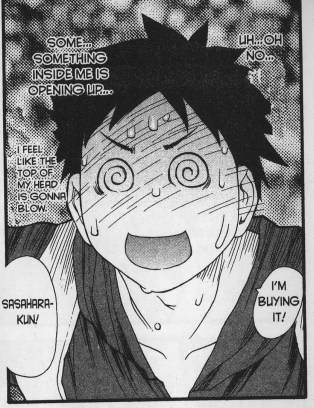
Welcome to the very first “Return to Genshiken,” a new series of posts where I revisit the very first Genshiken manga series. For those unfamiliar with Genshiken, it’s a series about a college otaku club and their daily lives. Originally concluding in 2006 before restarting in 2010 and finishing once again in 2016. A lot has changed about the world of the otaku, so I figured it’d be worth seeing how the series looks with a decade’s worth of hindsight.
Note that, unlike my chapter reviews for the second series, Genshiken Nidaime, I’m going to be looking at this volume by volume. I’ll be using the English release of Genshiken as well, for my own convenience. Also, I will be spoiling the entirety of Genshiken, both the old and the recent manga, so be warned.
Volume 1 Summary

Sasahara Kanji is starting as a freshman at Shiiou University, a college in the Tokyo area. He wants to join an otaku club, and after some false starts winds up in a club called the Society for the Study of Modern Visual Culture, or “Genshiken.” While he believes himself to be nowhere near as hardcore as the other club members, he discovers that he fits in well with the laid back atmosphere. As he learns the ropes about the otaku life, he’s also joined by other new members, including cosplayer Ohno Kanako, the usually handsome supernerd Kousaka Makoto, and Kousaka’s non-otaku girlfriend, Kasukabe Saki.
Back in Time

I must say, reading the first volume of Genshiken really is like going through a time warp. Not only is the visual style of the manga starkly different compared to how it ends up by Volume 21, but the aesthetic of the characters the Genshiken members themselves are obsessed with is a trip down memory lane. During this period, Genshiken makes references to series like To Heart and The King of Fighters, and the world of the otaku just seems…smaller somehow.
In one chapter, Tanaka is examining a garage kit of a cute girl model, and he remarks that female characters’ faces are getting rounder and cuter as of late. Keep in mind that this was back in 2002, before the K-On!‘s and the Bakemonogatari‘s of the world came along, the time of series like Star Ocean EX. Character designs like Lina Inverse from Slayers and Deedlit from Record of Lodoss War were still holding strong.
It’s also notable that the character profiles included between chapters bother to list each person’s “favorite fighting game character.” Fighting games still exist today, but it should be noted that they began to die out around 2003 before being revived in 2009 with the launch of Street Fighter IV. I think we’re catching the tail end of the fighting game craze.
Perhaps the most major difference between Genshiken and Nidaime is that the latter mainly focused on fairly contemporary references in order to emphasize that its values were more current. In contrast, the original Genshiken, by starting at a point where years and years of otaku history preceded it, draws from the previous decades in order to establish its characters and their preferences.
Memories Refreshed
There are a lot of things that happen in Volume 1 that I pretty much forgot, and a lot of things that, having recently finished Nidaime, stand out as likely reference points for the second series.
I did not remember that Sasahara joins Genshiken because Kohsaka scares him from the Manga Society. Given how close they become later on, it’s almost surprising to go back and see just how intimidating Kohsaka appears to Sasahara. It makes sense: Sasahara is a meek fellow, and he’s suddenly confronted with this idea that guys like him might populate the Manga Society. And just in general, most of the main cast of awkward nerds—Sasahara, Tanaka, Madarame, Kugayama—get really uncomfortable when it comes to regular-looking guys.
Going forward to Nidaime, it frames how Yajima feels upon entering the club all those years later. While Sasahara felt threatened by Kohsaka alone as a kind of living contradiction, Yajima sees herself as being practically surrounded by Kohsakas. Ohno is attractive. Ogiue is very attractive. Yoshitake’s surprisingly fashionable. Hato is Hato.
While I thought Madarame’s lamentations over all the sex talk in Chapter 125 was more of a general callback to how the club used to be, I find that it’s actually specifically in reference to the guys overhearing conversations from others about how much sex they have that can be found in Volume 1. If you just read Volumes 1 and 21 back-to-back, it is a stark contrast that the characters would go from freezing up and sweating nervously when some fellow talks about doing three girls in one day, to Sasahara and Tanaka both mentioning how they wish they had more sex with their girlfriends. Similarly, the way Madarame freezes when he sees Kohsaka and Saki kiss for the first time is possibly the long setup to the fact that he’s too passive to even get something started with Sue even after they start going out.
Another moment i had forgotten the exact details for was the very first Kujibiki Unbalance discussion we ever see. First, I had no idea that Kujibiki Unbalance is supposed to be a shounen manga, given its makeup. Second, the characters talk about the fact that the school in Kujibiki Unbalance is supposed to be a mix of various real schools—a self-aware nod to how Shiiou University is itself an amalgam of real schools.
Saki the “Time Bomb”

In this volume, the manga refers to Saki as a “time bomb” whose effects influence Genshiken in unforeseen ways. Looking back, this statement is more profound than I think even the author Kio could’ve imagined. She fundamentally changes a great deal about the club over time. It’s because of her that the members of Genshiken grow and evolve themselves as people, beyond the otaku stereotypes to varying degrees.
Outside of the possible exception of Sasahara, whose sister Keiko is very much the “gyaru” type, Saki is Genshiken’s biggest exposure to the “normal” world before the members start graduating. Because of her, Ohno goes from shy wallflower to mother figure for younger otaku. Madarame changes himself as he discovers his feelings for her. Ogiue learns to open up as well. She is a force for change in the club, and one might even argue that she’s the real protagonist of Genshiken, at least initially.
I also noticed that the presence of the real world outside of Saki is much more prevalent in Volume 1. The aforementioned bro talk situations happen. Saki herself gets hit on by guys looking for a quick fling. As the series continues, that realm fades from view until Saki is the primary example of it. And even then, Saki herself changes as she gets acclimated to being friends with otaku.
Comic Festival
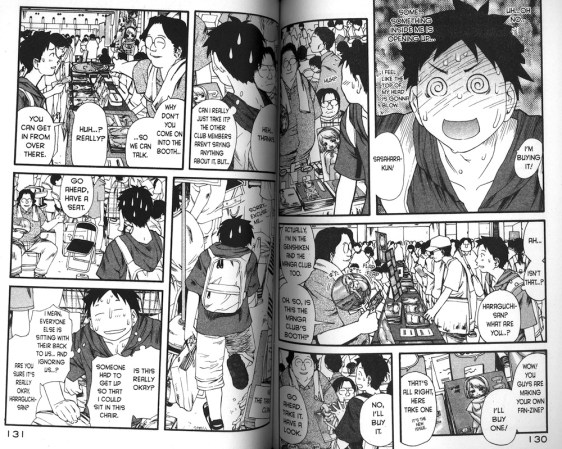
I recall that, prior to my discovering Genshiken, my main exposure to the idea of “Comic Market” came from two anime: Comic Party and Nurse-Witch Komugi-chan. Suffice it to say, that’s kind of a strange combination. While Comic Party had a couple of Kuchiki-esque creepers, it was mostly portrayed as a fairly tame event. With Genshiken, however, seeing the final barrier of Sasahara’s shame come undone gives the full doujinshi-purchasing experience. In a way, doujin events are where you confront your true self, and see what values lie within. What are your real priorities? What fundamentally tickles your fancy? It’s a time for reflection.
Before Kuchiki, There Was Haraguchi
I think there’s a common feeling throughout Genshiken fandom that Kuchiki is an unnecessary element. Who wants to read about a guy with the absolute worst social skills, whose behavior is grating and downright pathetic? However, in Volume 1 Kuchiki has yet to appear. Instead, within early Genshiken exists the character of Haraguchi, and in many ways he provides an interesting contrast with Kuchiki.
Haraguchi is portrayed as an opportunist who likes to lord it over others. A member of all three otaku circles (Anime Society, Manga Society, Genshiken), it’s implied that each group barely tolerates him. Haraguchi works by making connections and ingratiating himself to those who “matter,” and he’s viewed as a leech who mooches off the success and passion of others. Haraguchi is that guy who gives orders without ever actually contributing, and the result is that no one in the universe likes him.
A similar dislike of Kuchiki is certainly prevalent, but for as much as can be said about Kuchiki’s flaws, being a manipulative person isn’t one of them. He’s obnoxious, lacks self control, has a tendency to give TMI, and perpetually irritating, but he’s also absolutely honest and upfront about who he is and what he enjoys. I think it’s ultimately why he’s allowed to stay with the club. Kuchiki is a man of innumerable faults, but he’s not a scumlord like Haraguchi.
Art in Progress

As I looked for the best image to include in this post, something hit me: the panel layout in Volume 1 is much less refined and elegant than what it would become. While there’s a nice sense of variation in terms of panel size, the composition isn’t as strong, the borders are rather rigid, and the pages don’t flow nearly as well. I’ve looked ahead a couple of volumes and it mostly seems the same, so I wonder if there’s a point at which it truly changes.
Actually, when looking just at the differences between chapters in Volume 1, the art style already begins moving towards the more familiar Genshiken style. As the series begins, the character designs are more similar to Kio’s previous works, and by the end of the volume they’re definitely getting softer. The difference between Chapter 1 and Chapter 2 is significant enough that I suspect they were drawn months apart. That’s what happened with Nidaime, where the pilot chapter still had the feel of Jigopuri.
Final Aside
I thought the portrayal of underage drinking was a Nidaime thing. Apparently not! It happens wit Kasukabe and Kohsaka right from the start.
Save
NOTE: This post is NOT SAFE FOR WORK
Introduction
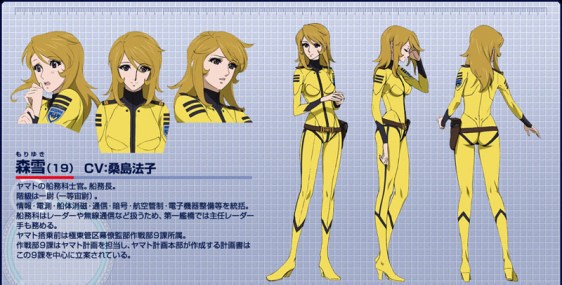
For as long as there has been fanservice in anime, there has been an emphasis on rear ends. Few things are more associated with anime (for better or worse) than the panty shot, and the form-fitting suits in works such as Neon Genesis Evangelion and Ghost in the Shell have helped to bring posteriors to prominence. However, I believe that buttocks have not remained static over the course of anime’s history and that, over the past 10-15 years, we have reached a point where big butts are “in.” The purpose of this post is to show this gradual change in tastes while also positing some possible reasons that this change has taken place.

Name: Nogi Kiyona (乃木樹衣奈)
Alias: N/A
Relationship Status: Single
Origin: Nudist Beach ni Shuugaku Ryokou de!!
Information:
Along with her friend and fellow otaku Inui Shizuha, Nogi Kiyona attends a school trip to a nudist beach. There, she makes carnal discoveries alongside Shizuha.
Fujoshi Level:
Nogi is particularly a fan of male idol BL.

Recently, the Love Live! School Idol Festival rhythm game began featuring a new comics series within the English-language app itself: a 4-panel comic series called Ten Fes: Transfer Student Fesival. Its premise is that, rather than focusing on the expected stars of Love Live!, these manga put the spotlight on the lesser-known girls exclusive to the game. Whereas once these characters’ stories were told in only the briefest vignettes, they might now have the chance to really show off their charms.

I once expressed a desire to see these “Normal Card” characters fleshed out more than they currently are, and I feel that Tenfes, while not an absolute game changer, is significant in this respect. To understand the potential impact it can have, it’s important to look at a rival fictional idol franchise: The iDOLM@STER.
The iDOLM@STER is devoted to having every one of its idols, be they the original ensemble from the first game or new ones created for their mobile apps, feel like a star. Love Live!, on the other hand, went as far as to create a new set of core girls to focus on, while the lower tier from School Idol Festival remain as essentially “fodder,” cards sacrificed to level up the ones that “matter.” Although being featured in short gag manga isn’t quite the same as getting to star in a full-fledged show like what happened with The iDOLM@STER Cinderella Girls, it still gives a chance for these “lesser” Love Live! characters to be characterized in more than just brief vignettes you earn within the game.
I’m not the kind of person who can thrive off of just sparse character descriptions. Even when it came to the main stars of Love Live!, I needed the anime. I could not feel any particular attachment to them when they were merely faces with semi-long descriptions. Also, while properties like Touhou and Kantai Collection can get away with it because all of its characters are equally barebones, the fact that this massive rift exists between the central casts of Love Live! and the School Idol Festival-exclusive girls makes that much more difficult.
Ten Fes allows for greater opportunities to portray interactions and relationships between the “common” characters. In isolation, these girls can only provide so much interest, but if they’re reacting to each other, playing off of each other, and maybe even butting heads with each other, then it gives them the chance to establish a lasting presence and build fan bases of their own.
Babies in anime and manga serve many differing purposes. They can mark the passage of time, or a transition into a new stage in life. In series for young girls, they’re often a way for children to emulate their parents. Whether they’re a source of comedy, an adorable presence, and evil force in the world, the role of the baby is myriad and generally based on the audience being served. Among these varied works, the baby portrayal that tends to catch my attention the most are the ones that get a little “real.” These depictions aren’t necessarily trying to portray the entire baby-raising experience, but they will bring up the inherent difficulty in bringing up a small child. Even when they’re doing it for laughs, there is a sort of sobering effect that can potentially apply to all ages and demographics.
 The first baby that comes to mind is Hana in Ojamajo Doremi. In the second season of the magical girl franchise, titled Ojamajo Doremi ♯ (“Sharp”), elementary school girl Doremi receives a magical witch baby from a tree. From one season to the next, she and the other girls take care of her. In many similar series, such as Doki Doki! Precure, the baby is often just there for cuteness factor, or maybe to sell a few baby-themed toys. Doremi plays it differently.

In one episode, Doremi, generally a clumsy girl, is having immense trouble taking care of Hana. She gets so frustrated by it, and the fact that the other girls are scolding her for doing a poor job, that she runs home to her mom looking for comfort and understanding. Instead, her mom slaps her (off-screen), and basically says, “If you get hurt, you just feel bad. If there’s no one to take care of Hana, it’s a matter of life and death.” In that moment, Doremi’s mom makes a crystal-clear point about how literally helpless an infant is, as well as the responsibility and strength absolutely required for their sake. Hana still acts the part of the precious anime baby, but even as a burgeoning witch with immense magical powers, reality sets in.

However, if we’re talking harsh depictions of the mental and physical toll babies can take on their parents, then one need look no further than Jigopuri: The Princess of the Hell. A short, two-volume manga by the author of Genshiken, Kio Shimoku, Jigopuri follows a young widowed mother named Ayumi and her newborn child, Yumeko. In contrast to the older characters, who all have a more typical moe look, Yumeko is drawn strangely hyper-realistically. The manga portrays raising Yumeko as a harrowing experience. Ayumi occasionally wishes ill on her own daughter due to the stress she causes, and feels immensely guilt over it. In one chapter, as Ayumi attends a meeting for new mothers, she finds out that others occasionally look at their children with disdain as well, which gives her immense joy and relief.
Unlike Doremi, which targeted an audience of young girls presumably into the idea of playing pretend-mama, Jigopuri ran in a magazine targeting adult otaku, Monthly Afternoon which might be why it wasn’t terribly successful. It’s just not the kind of thing otaku are expected to know or care about. I find it kind of funny that a series targeting small children could deliver a serious message about raising children and then go on for two-three more years, while adult men rejected a similar message.
Nevertheless, I think that attempt to confront a reluctant or perhaps ignorant audience of certain truths or circumstances is what I find appealing about the “real” baby, even if seeing an infant girl with invisibility powers as per JoJo’s Bizarre Adventure Part 4 garners more laughs. In fact, I think of Spotted Flower, another Kio Shimoku manga about an otaku and his pregnant wife (who gives birth in the second volume) is kind of a do-over of Jigopuri. Even though it runs in more of a josei magazine, Rakuen: Le Paradis, it’s a compromise of sorts. Perhaps just as Hana is a magical baby with fun powers, having an otaku father can settle it into a more comfortable place.
—
This post was sponsored by Johnny Trovato. If you’re interested in submitting topics for the blog, or just like my writing and want to support Ogiue Maniax, check out my Patreon.

On occasion I’ve had to explain to those unfamiliar with Love Live! the appeal of Nishikino Maki. While terms like “beautiful” or “cooldere” kind of get the point across to an extent to those who already know her, I’ve found that they still don’t quite do the trick for people outside the fandom. However, I’ve recently thought up a comparison that I think works well, provided that you have some experience with Genshiken. Maki, in esssence, is like Kasukabe Saki—or more specifically, the “moe” version of Saki that Madarame once envisioned.
In the extra at the very end of Volume 9 of Genshiken (the finale of the first series), the characters are discussing why Saki isn’t “moe.” They talk about how she essentially has no weaknesses, that she’s just an extremely capable person overall. Even her boyfriend agrees that Saki isn’t moe. Then, Madarame has an idea: the only way Saki would be moe is if she was a virgin.
While this might bring to mind the issue of “purity,” it’s more that being a virgin would be a chink in the armor of Saki’s all-powerful self. She would be this smart, no-nonsense woman who just knows how to get things done, but her relationship advice would come not from personal experience. By being a virgin, she’d have that essential vulnerability that would bring her into moe territory.
When it comes to Love Live!, being a virgin isn’t any more or less special from on character to the next, as it’s implied that all of the main girls don’t have sexual experience (no matter what fans think/hope). However, the idea of an overall intelligent, talented girl with a firm head on her shoulders who is also naive in certain respects and easily flustered by embarrassing things is right in the same territory as “Moe Saki.” Within Nishikino Maki exists both the girl who keeps Nico in check, and the girl who believes in Santa.
Side Note: While Maki is basically Moe Saki, I bet Madarame’s favorite Love Live! would be Nico. 2D is different from 3D, after all.
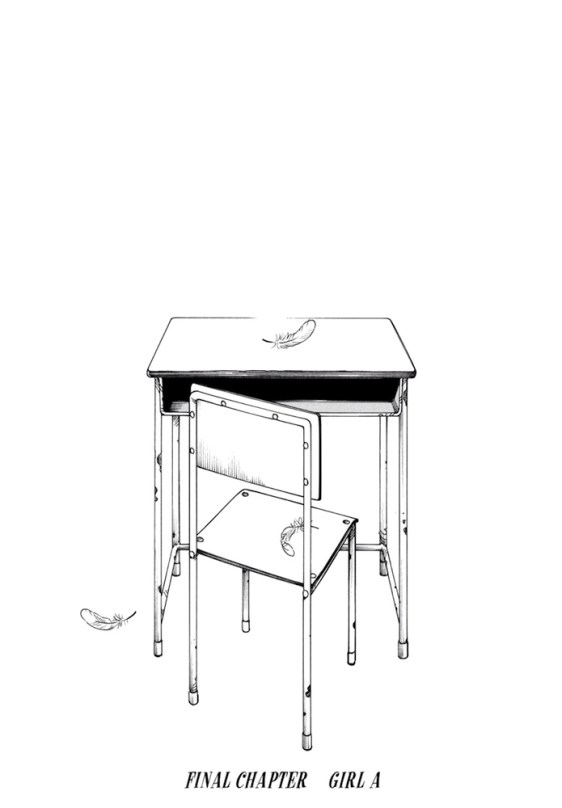
Soredemo Machi wa Mawatteiru (“And Yet the Town Moves”) recently concluded its 11-year manga run in Japan. Even to the very end Soremachi captures the souls of the town members who populate its setting, telling their stories with a kind of quirky levity.

The premise of Soremachi is as follows: Arashiyama Hotori is a high school student, a clutz, an aspiring detective, and (ostensibly) a maid at a cafe. However, this is less a “maid cafe” and more a “cafe that happens to have waitresses dressed as maids.” With only the most nebulous notion of the maid cafe as the focal point of many of its stories, Soremachi proceeds to explore the lives of its characters. From occult mysteries to unrequited teenage love triangles to old men arguing about the past, the manga basically plays fast and loose with its narrative, but the consistent charms and personality traits of its eclectic cast always keep it a joy to read.

So how does an open-ended manga such as Soremachi close the book on its story? The answer is that it finishes much as it began: frivolous and free-wheeling in its continuous portrayal of an occasionally bizarre “everyday,”
Warning: Ending Spoilers
In the penultimate chapter of Soremachi, Hotori appears to be visited by a higher-dimensional being. This is not the first time that Hotori has seemingly encountered otherworldly entities. From angels to time travelers to aliens, somehow Hotori’s life has continued to remain fairly mundane. However, this time the visitor gives Kotori a challenge. The following day, there is going to be a typhoon, and Hotori has to choose between saving everyone in town but vanishing from history in the process, or stay alive but sacrifice 3,000 lives in her place.
In the final chapter, Hotori’s classmates are all discussing that there appears to be something wrong with their memories. For some reason, they all seem to remember a classmate, possibly a girl, who was cheerful and energetic. Suddenly, Sanada and Tatsuno, Hotori’s two closest friends, spot a girl on the other side of the building. They follow her, and…
It’s revealed that they were rehearsing a play. Hotori did not sacrifice the memory of her existence, and everything about the mysterious girl lingering in their minds was from the script, which Hotori wrote. They’re chasing her down because she hasn’t written the ending yet, to which Hotori replies that, essentially, if the climax was made dramatic enough, then an ending would naturally follow. The chapter, and the series, ends with Hotori as author-surrogate proclaiming:

While the conclusion of Soremachi might feel at first to be a cop-out, given that there were plot threads that could have seen resolution, I think it’s all too appropriate for the series. Much like the lackadaisical attitude the manga and its characters took towards its own premise of a “maid cafe,” having a last chapter pretty much negate the gravitas of the previous one, and then turn into a “non-ending” is very indicative of a series about a town that keeps moving. Also, because many of the smaller subplots were able to resolve in the chapters leading up to the end, the series unwinds in a satisfying way.

My only complaint in the end is not enough of my favorite Soremachi character, Kon Futaba. This is no fault of the manga itself, because she’s actually in it very often, even a couple of chapters from the finish. She’s just amazing, is all.
Further Reading:
And Yet the Digital Manga Moves: Soremachi is Back
Soremachi Creator Ishiguro and His Two Biggest Influences
The Year of the Rooster has arrived, but given the tumultuous nature of 2016 it’s hard to be…cocksure.
Bad jokes aside, it’s time to look backwards and forwards. And as we enter this new year, I’d like to once again express my gratitude towards my Patreon sponsors.
General:
Johnny Trovato
Ko Ransom
Alex
Diogo Prado
Viga
Yoshitake Rika fans:
Elliot Page
Hato Kenjirou fans:
Elizabeth
Yajima Mirei fans:
Machi-Kurada
You might have noticed things being kind of different. Half on a whim, half as a result of ruminating on the dated look of Ogiue Maniax for the past year, I decided suddenly to change the look of the blog. While I think ultimately it’s the content that matters, I got the feeling that people were turned away by the fact that the site looks like it’s from a decade ago (which it pretty much is). This is actually the first aesthetic change I’ve made in a very long while. The last time was when I moved from Blogspot to WordPress back in 2007!
I’d like to know you think about the new look, so feel free to drop a comment. In fact, don’t be afraid to tell me what you’d like to see out of Ogiue Maniax. I can’t accommodate everyone, of course, but I’m still keen on finding out what my readers think.
Given that the end of the year just passed, the blog has been full of reflective articles and the like. Check out my picks for best anime characters of 2016, read my Anime Secret Santa review of Queen Millennia, and take a look at what’s in the final volume of Genshiken. I also took a picture showing off in part one of my Christmas gifts: Nendoroid Shidare Hotaru from Dagashi Kashi!
I also finally got around to reviewing the first volume of the fantastic Ojamajo Doremi16, the light novel sequel to the beloved early 2000s magical girl anime. And leading off from November’s post on the latter part of the original Aikatsu!, I wrote something about Aikatsu Stars!
And over at Apartment 507, I discuss both the end of Sabagebu! and what this bizarre survival game-themed manga brought to shoujo manga, as well as some of my favorite anime openings that came at the tail end of 2016.
The last article I’d like to mention is my very first of the new year, about the manipulation of time in adapting manga to anime. I think it’s a good way to start off 2017, personally.

