
I wrote a post about the eccentric heroine of Dagashi Kashi over at Apartment 507. You can find out why Hotaru might be my character of the year, and why her role as a sheltered dagashi heiress is so interesting to me.

I wrote a post about the eccentric heroine of Dagashi Kashi over at Apartment 507. You can find out why Hotaru might be my character of the year, and why her role as a sheltered dagashi heiress is so interesting to me.

Name: Serinuma, Kae (芹沼花依)
Alias: Ekka (えっか)
Relationship Status: Single
Origin: Kiss Him, Not Me!
Information:
Serinuma Kae is a high school student whose dramatic weight loss as a result of the trauma of her favorite anime character dying gives her an inadvertent makeover. Afterwards, she attracts the attention of a number of boys (and even a girl) at her school. At first unrecognizable to even those close to her, Kae’s devotion to her favorite pairings and series at first overwhelms her potential suitors (especially her extensive merchandise collection), but they all come to accept it sooner or later, especially given the genuine passion she exudes for her yaoi pairings.
Kae’s favorite series are Mirage Saga, which is home to her dearly departed favorite character Shion, and later Katchu Love, an anime about a samurai armor that can transform into a handsome man. She shares her fujoshi hobbies with her best friend Nakano Amane, as well as one of her suitors, Nishina Shima.
Fujoshi Level:
Kae’s fondness for Katchu Love and the pairing of hero Sametora Hyakka and his armor Akane may or may not have caused the angry spirit of the real Sametora to achieve peace and pass on to the afterlife.

The trip to Nikkou winds down with a final stay at Yajima’s family home. Yoshitake presses Madarame to make a decision about who to date, but as each potential partner makes their case (or has their case made for them), Madarame is still hesitant to pick. However, when Kuchiki suggests that it be done by lottery if Madarame doesn’t care one way or another, Madarame chooses not to leave it in fate’s hands and declares that he will make his decision…next chapter.
Is it at long last the end of the Madarame harem arc? Will he end up with anyone or perhaps no one at all? Will Genshiken actually have Madarame choose, or will it be a Naruto-esque string of chapter titles each more final than the last?
Personally speaking, the harem aspect itself, the fact that four individuals are attracted to Madarame to varying degrees, is less interesting in terms of who ends up with who, and more in terms of its opportunities for characterization. This includes characters both inside and outside of the harem.
One of Yoshitake’s recurring traits is that she always has the group dynamic in mind. Much of the reason she wants Madarame to just choose already is because she’s worried about the relationships, the friendships, that exist among the members of Genshiken. The longer Madarame takes, the more these threads get frayed, but at the same time she wants the decision to be a real one, not a spur of the moment fancy. That’s why she arranged the whole Nikkou kujibiki dating scheme in the first place.
Angela is an impossibly attractive blonde American who encourages polygamy, having the least to lose due to the distance between the US and Japan. She has an interest in Madarame, but is more about having a good time. Sue, as Ogiue puts it, is Madarame’s ideal character: a blonde loli who’s also fluent in both “Japanese” and “otaku.” However, even after her confession it’s clear she still isn’t entirely sure what she wants their relationship to be. Hato is a “girl-boy” straight out of a visual novel, but interestingly enough is still espousing the potential pitfalls of a homosexual relationship to ground Madarame in reality. They all carry some element of wish fulfillment that borders the realm of perverted imagination with some counter-balance in the fact that they’re all actually human.

In contrast, Keiko’s points out that she’s the most similar to Saki out of all of them, and this hits Madarame like a ton of bricks. While that makes Keiko in a way the most “realistic choice,” her words also carry an element of fantasy to them. She is the closest to fulfilling Madarame’s unrequited love for Saki, the most profoundly grounded woman he has ever met. The fact that Madarame reacts so intensely to Keiko’s words shows that he still holds a torch for Saki, and perhaps even suggests that his indecisiveness towards both accepting and rejecting others is a product of a desire to be wanted but also to want someone like Saki.
It’s surprising that Keiko of all people objects to Angela’s “harem ending” suggestion, stating that she’d rather not be involved at all if that’s how it’s going to end up. She wants to try a monogamous relationship, and she’d rather be single than deal with some fantasy otaku arrangement. Given that Keiko is not above seeing more than one guy at a time, I think it might say something about how Keiko sees Madarame as an opportunity for some stability, and further puts into relief the differences between her and the rest. At the same time, being an approximation of Saki isn’t actually being Saki, so in a sense Keiko becomes the most “ideal” choice of all. Of course, she certainly doesn’t see it that way, and I wonder if she in fact sees herself as what Madarame ultimately needs.
Madarame, as much as he acts like anyone would do because he’s just a dorky, desperate otaku, is suddenly against the idea when it’s suggested that he pick randomly when Kuchiki brings it up. Madarame is neither totally noble nor utterly selfish, and the realization that he cannot just keep the harem in stasis as is common in long anime and manga series ultimately forces him to try and choose on his terms rather than leave it up to luck. I think somewhere in his decision is the belief that having the choice made for him is utterly irresponsible and would lead to more harm than good, while also clarifying that he clearly does not see all of them the exact same way. In the end, actions have consequences, and I look forward to seeing how this plays out.
To end off, this month’s Ogiue moment is more of an Ogiue focus than anything in a long while. As briefly alluded to above, Ogiue gets really invested in presenting Sue as the best possible choice for Madarame, even going so far as to say that this is Madarame’s once in a lifetime chance to be with this girl of his dreams. What’s really notable about her behavior in this instance is that Ogiue has never really come across as being particularly invested in the Madarame/Sue combination even if she does believe it’s the right choice. It feels like there’s something more at stake here. Is it being able to finally get Sue to abandon the “Ogiue is my wife” joke (probably wouldn’t happen)? Does she truly believe that Madarame and Sue are best for each other? Does she want to give Sue some happiness? Whatever the case may be, I quite enjoyed seeing Ogiue’s fire.

—
If you liked this post, consider becoming a sponsor of Ogiue Maniax through Patreon. You can get rewards for higher pledges, including a chance to request topics for the blog.
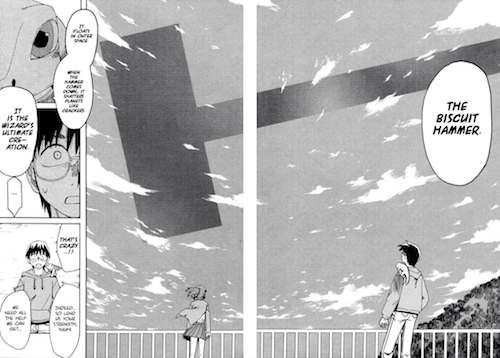 Hoshi no Samidare by Mizukami Satoshi, known in English bizarrely as Lucifer and the Biscuit Hammer (and sometimes The Lucifer and Biscuit Hammer) is an odd manga. Ostensibly a story about a boy who gets mystic powers in order to fight an evil golem-creating wizard, The Lucifer and Biscuit Hammer sports an eccentric cast of characters, an even stranger goal for its main characters, and a convoluted sense of narrative progression that somehow only adds to its appeal.
Amamiya Yuuhi, who has all the appearance of a typical high school kid, wakes up one day to find a talking lizard. The lizard, Neu, informs Yuuhi hat he is a knight who must protect their princess from an evil wizard and save the world from the dreaded Earth-shattering “Biscuit Hammer,” a huge mallet hanging over the planet visible only to those with profound despair. However, the princess, Asahina Samidare, is fiercely powerful, possessing beyond superhuman strength, and has her own agenda. Calling herself a demon lord (the titular “Lucifer”), Samidare seeks to stop the Biscuit Hammer because she in fact wishes to destroy the planet herself, and Yuuhi becomes her loyal servant in her cause. Overall, the series can be viewed as a kind of sekai-kei (world-style) manga, stories where the fate of the world rests on a “you and me” relationship.
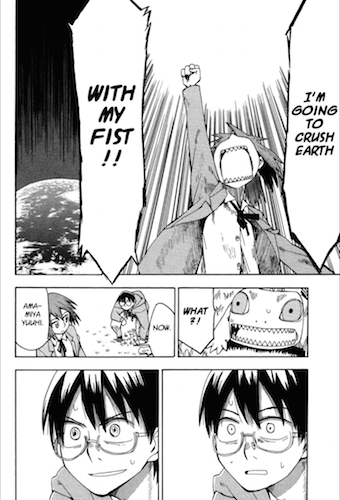
When I say that this manga’s sense of progression can be confusing, what I mean is that often times it seems as if the stakes of their battle seem both all-important and frivolous at the same time. Most of the characters have unusual personalities that position them somewhere between delusional and disillusioned, trapped by their own immaturity, but many of them grow over the course of the series. Their fight to foil the wizard and his Biscuit Hammer involves taking on progressively stronger and stronger golems as if they were video game bosses, but then sometimes a friend or ally will die in battle. The emotional weight of the deaths are expressed as quite significant and serious, and yet the question of whether they’ve made any real progress (or how progress can be defined) is ambiguous. It might sound frustrating, but it gives Lucifer and the Biscuit Hammer an odd charm. If anything, it feels akin to a more optimistic and lighthearted Bokurano. While that series is about as fun and happy as a mass suicide, there’s a similar sense of characters grasping at the darkness.
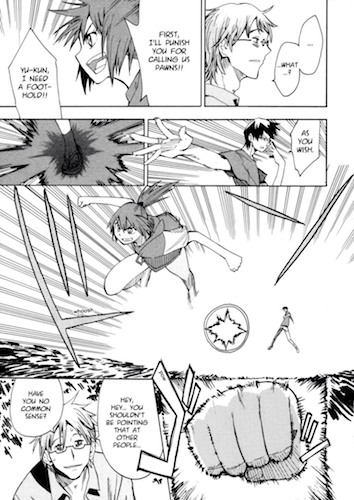
The art in Lucifer and the Biscuit Hammer has an unrefined quality to it, where characters appear a bit flat and the world feels frayed and uneasy. However, I believe that this also helps to give the manga that shaky sense of progression that makes it such an interesting story. The manga also does a good job of playing with and presenting its characters’ powers, especially given the versatility of their core ability. Each character is capable of using a “holding field,” a mass of dense energy that can be used in a variety of ways, including creating stepping stones in the air, being thrown as a spear, and more. It can be a difficult thing to make look interesting, yet the action scenes have weight and impact.
Overall, I find that Lucifer and the Biscuit Hammer is not so much an addictive series that has you hungering for the next chapter, but is rather one that invites you to slowly observe its seemingly by-the-numbers premise of fighting and power ups. From there, it draws you in by portraying each character’s struggle and a unique sense of stasis that seems to permeate its world and its story, making its introspective qualities feel that much more as if they’re coming from a place that ignores time and space.
—
If you liked this post, consider becoming a sponsor of Ogiue Maniax through Patreon. You can get rewards for higher pledges, including a chance to request topics for the blog.

Name: Sennokimi
Alias: N/A
Relationship Status: N/A
Origin: Moehime
Information:
Hailing from the Heian Period, Sennokimi is a part of the inner circle of Chuuguu, the Empress of Japan. Together, she and the others read literature from throughout the land about male-male relationships.
Fujoshi Level:
Nothing is known about the extent of Sennokimi’s fujoshi inclinations, though being a member of Chuuguu’s inner circle means she is at least considered very appreciative of it.

This month’s chapter of Genshiken Nidaime is about anal sex. No, I’m not kidding. Yes, my title for this post is awful.
Last chapter, after an emotional discussion between Hato and Madarame, Hato runs away. At the advice of Ogiue (who knows a thing or two about a situation like this), Madarame goes after him. As the two talk once more, Madarame explains that he does feel something for Hato (especially after that incident at the hotel), but as he goes into detail about the idea of being with a fudanshi, Hato brings up an important question. Is Madarame truly ready for what “Hato x Mada” really means? After discovering that the rest of the club was eavesdropping (a Genshiken tradition!), Madarame decides that he’ll have to “think about it,” and their date continues.
You can see my immediate reaction to this chapter in the tweet above. While Genshiken has gone many places, I never quite expected it to arrive at this point. Suffice it to say, I’m both surprised and impressed in a multitude of ways. I have to compliment Kio for being willing to take the story this far, and to do so in a way that makes sense for the characters of Genshiken. What also stands out to me about Chapter 120 is the way in which clarifies the conversation between Madarame and Hato in Chapter 119, whereby Madarame finally and much more clearly understands Hato’s concerns. In Hato’s own words, being with Hato consists of having to encounter a series of “landmines.”
Last chapter, Hato expressed the idea that Madarame doesn’t seem to understand what it means to be in a homosexual relationship. This chapter, Hato lays it out. First, Madarame mentions how he’d have to get used to the idea of being seen as a “sou-uke,” a total bottom, as is the trend among Genshiken’s BL fans. Second, Hato reminds Madarame that Hato is not like Ogiue: he’s not a fujoshi but a fudanshi, a guy. Third, he brings up the idea of Mada x Hato, and how he’s prepared for the possibility, which fazes Madarame a bit. Then, finally, he brings up “Hato x Mada.” As realization slowly dawns upon Madarame, the impact of that epiphany on Madarame is, in my opinion, a prime example of what I love about Kio’s storytelling through manga.

Madarame confesses that he hadn’t even thought about “Hato x Mada.” Right there, it becomes clear that Madarame hasn’t actually contemplated the prospect of being with Hato all the way through. Not only that, but it makes perfect sense given just how Madarame has approached the idea. In Chapter 72, Madarame mentions having played games with “girl-boy” characters, and that, because of the censorship and the effeminate appearances of the characters in those games, it’s not that different from heterosexual fare. In other words, Madarame has always seen himself in the “man’s role” so to speak, and the sticky, naked realities of having a mutually satisfying relationship with Hato was just completely outside his realm of imagination until now.
I don’t read very much BL or gay manga, but I get the feeling that these sorts of nitty-gritty details aren’t so common in stories unless they’re particularly explicit or raunchy. Not only that, but given the purpose of those stories, I believe the end result is usually what is expected. In contrast, it’s not clear where Madarame will end up. Of course, correct me if I’m wrong.
The fact that Madarame doesn’t just completely shut down and break away from Hato might say just as much in favor of Hato’s chances, as does Madarame asking the question of whether Hato x Mada would involve Hato in women’s clothes. However, I suspect that the story might actually be heading in a direction where, although the two have a kind of emotional or spiritual connection, Madarame might ultimately not want a physical one. Keiko even brings this up at the end, saying that the body itself will ultimately be the deciding factor (which she believes is in her favor, even with Angela around). In a way, this might be even more ideal for the fujoshi of Genshiken, just because it could be interpreted as a love beyond the trappings of flesh.

I have two more things to say about this chapter. First, we finally learned just what happened when Hato’s other selves, the BL fangirl floating in the sky as well as the Kaminaga version, “merged” with Hato. Obviously he didn’t really have magic ghosts with him. Rather, it was symbolic of him accepting all of his passions, that he can be into both “Mada x Hato” and “Hato x Mada.”
Second, at the beginning of the chapter when Ogiue is talking to Madarame, she mentions how Sasahara accepted everything about her. Just that one gag panel where she ends her sentence in a heart as she blushes profusely is actually one of Ogiue’s most adorable moments ever. As an Ogiue fan, it is quite satisfying.

—
If you liked this post, consider becoming a sponsor of Ogiue Maniax through Patreon. You can get rewards for higher pledges, including a chance to request topics for the blog.

Name: Tomoe (十萌)
Alias: N/A
Relationship Status: Single
Origin: Moehime
Information:
Tomoe is a voracious reader and highly imaginative writer living during the Heian Period. Having an interest in BL (before the term existed as such), she not only regularly creates works of guy on guy pairings, but befriends a group of youkai who are also mostly into yaoi. In addition to creating works of that specific genre, Tomoe also writes regular fiction, notably “Collection of Rice Water.” She loves stories of men in adverse circumstances.
Tomoe’s tastes in BL vary, but she is especially interested in pairings where the older or senior individual is on the bottom. This can be seen in her pairing of the younger scissor merchant x older paper merchant, as well as writing stories where the Emperor is an uke. However, at one point, in order to enter the inner circle of Chuuguu, the Emperor’s wife, and gain access to her group’s collection of BL fiction, she writes a story about the Emperor and a pirate boy.
Fujoshi Level:
At times, Tomoe becomes so devoted to her pairings of real people that she will arrange for them to meet by “coincidence,” such as ordering scissors and paper from their respective merchants and timing it so that they run into each other.

Over the years, I’ve talked about some interesting manga about food and drink, but a good number of them haven’t been available in English. Fortunately, if you have a hankering for seeing the joy of cooking (and eating!), then Sweetness and Lightning is there for you.
Sweetness and Lightning follows a high school teacher and single dad, Inuzuka Kouhei, who is too busy to cook meals for his daughter Tsumugi. This has transformed into a daily habit of buying bento for her as an easy way to provide delicious meals, but when Tsumugi starts to miss eating as a family, Kouhei looks for a way to make up for his lack of culinary skills. With the help of one of his students, Iida Kotori he begins to learn about preparing homemade meals and experience the wonder of watching his little girl’s eyes light up after tasting a delicious dish.
Thus far, the series follows the same formula, but a lot of care is put into the characters’ facial expressions as they both work through the trouble of cooking and the satisfaction of enjoying the fruits of their efforts. The series isn’t as over-the-top as Yakitate!! Japan in that Sweetness and Lightning lacks those extreme reaction shot moments, but the two food manga share a similar sense of all-encompassing excitement. It also comes with a recipe at the end of each chapter.

My favorite character is probably Kotori. I think it mostly has to do with her intense eyes and her constant desire to eat, two of my favorite traits.
Sweetness and Lighting is available on Crunchyroll Manga with a premium subscription.
—
If you liked this post, consider becoming a sponsor of Ogiue Maniax through Patreon. You can get rewards for higher pledges, including a chance to request topics for the blog.
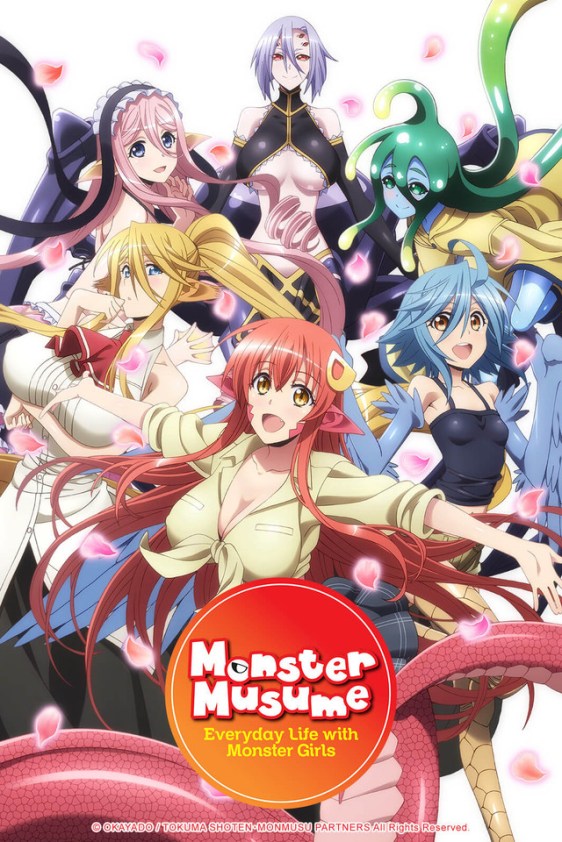
I wrote another post over at the site Apartment 507 about Monster Musume. This time, I go over what I think makes Monster Musume a special series. Warning, the post might be NSFW.
And yes, I am planning on making a Fujoshi File for Zombina.
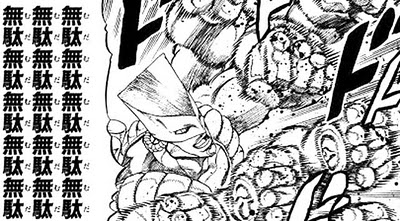
A few months ago on Twitter, a number of manga translators and readers threw their hats into the ring to discuss the persistent issue of “authenticity” vs. “localization.” The central point of argument was whether the fact that the English translation of the JoJo’s Bizarre Adventure manga kept antagonist Dio Brando’s signature catch phrase untranslated (MUDA MUDA MUDA MUDA / USELESS USELESS USELESS USELESS) is a sign of faithfulness, Japanophilia, or something else entirely.
There’s no real right side to all of this. As the Reverse Thieves explained well, there are many facets to consider, and translation is more an art than a science. For example, people who argue that translations should be as localized as possible so as to remove the sense that it comes from another language would assume that the primary audience is a broad, general readership. What if it isn’t, however? Academic translations for instance tend to be filled with footnotes and marks and other things because you’re supposed to be fully explaining the nuance of meaning through translation.
What’s even more fascinating, however, is seeing the problem of translation from the English to Japanese side, and the challenge that is posed to English translators in Japan. For example, let’s look at one of the on-going controversies within this greater Japanese to English translation debate: whether or not to include Japanese honorifics in English translations. After all, while “-san” might be already known to fans of Teenage Mutant Ninja Turtles and other similar works, for the most part it’s the realm of the manga fan, so to speak. When the decision is made to remove them, a translation either has to compensate for the loss of immediate information pertaining to how two characters relate to each other through a more liberal translation, or ignore that aspect entirely.
What about English to Japanese? From that perspective, the problem is completely flipped around. Suddenly you go from a language with no honorifics to one where they’re a part of everyday life. Let’s take a movie like Gone with the Wind. How would you translate Rhett Butler’s speech? The official translation has him use “Ore,” possibly to show that he’s both masculine and skirts standards of politeness and pomp. Is that the right decision?
If you were in charge of translating Gone with the Wind to Japanese, what honorifics would Rhett have to use when talking to other characters, if any? Would they change over the course of the movie? The change or removal of honorific usage to determine the progression of a relationship between two characters is a classic trope of manga and anime, and something English translators have to be constantly wary of (as is switching from last name to first name), but here with Gone with the Wind it’s potentially something that the translator has to build into the story where it once did not exist. The decision could be made to ignore honorifics specifically, but then a lot still has to be done to adapt characteristics and speech patterns to particular personalities. Rather than having to subtract, the English to Japanese translator has to consider additional components if they want to go for a “natural”-sounding language. Or do you just get rid of them all because it takes place in the US, or to show again that Rhett doesn’t have much use for politeness?
Of course, that’s not to say that Japanese to English translators also don’t have to create what ostensibly isn’t there to get the meaning of a line across. In both cases, there are things to be gained and lost in the decision to interpret lines in certain specific ways.
There are even multiple different translations of Gone with the Wind, each of them taking different liberties. Rhett’s famous “Frankly my dear, I don’t give a damn,” has been variously translated as 「俺には関係ない」(Ore ni wa kankei nai, “This has no relation to me”) and 「俺の知った事か」(Ore no shitta koto ka, “I have nothing to do with that”). Notably, both do not bother to preserve the cultural meaning of “damn,” nor the “Frankly my dear” part. The frankness is in the lack of formality and the general implied rudeness of the sentence construction.
Suffice it to say, translation isn’t easy, and the decision to keep or remove cultural elements is a unique challenge that perhaps few other fields have to contend with. Whether you’re a translator or just a reader, it might be helpful to express how you feel about the work that goes into translating.
—
If you liked this post, consider becoming a sponsor of Ogiue Maniax through Patreon. You can get rewards for higher pledges, including a chance to request topics for the blog.

