The third Gundam: Reconguista in G film continues the trend of breathing new life into a less beloved Gundam series. The edits make it noticeably easier to follow than the TV series, although I do acknowledge that the story is rarely ever straightforward or presented plainly, and this is a sticking point and the reason G-Reco is fairly divisive.
But as I watched Gundam Reconguista in G Part III: Legacy of Space, I had an epiphany of sorts that I think helps explain this split opinion. Namely, the key to understanding G-Reco is to get into the minds of individual characters. I understand how this sounds a little obvious (plenty of stories are about achieving personal goals), but what I mean is that character actions can seem inscrutable until you actively try to get into their heads.
The story as of Part III: As alliances and allegiances have shifted since Part Iand Part II, Earth’s great continent-states now send forces into space to meet with Towasanga, a nation on the other side of the moon, created by the descendants of the humans who settled in space colonies in the Universal Century era. Not only do Towasangans have access to technology unobtainable by those on Earth, but the Towasangans see themselves as arbitrators between the Earth and the far-off colonies of Venus Globe, which provide to the Earth the photon batteries needed for it’s civilization to function, and thus see the need to equip themselves for conflict amidst the increasing tensions on Earth. Bellri Zenam, still thinking about the deaths he’s seen and caused, tries to figure out what he should do and where he fits into the big picture.
One of the big differences between G-Reco and other Gundam series is that there aren’t two major sides, like Federation vs. Zeon or Earth Alliance vs. ZAFT. Rather, there are multiple governments and factions: Ameria, Gondwana, Towasanga, Capital Tower (which is then further divided into the Capital Guard and the Capital Army). These groups are then comprised of singular people who think independently and have their own ideas of right and wrong, which results in G-Reco being more confusing when you think primarily in terms of who is on what side and which side is winning, because these positions are always in flux. Rather, the important thing is actually to understand what motivates each character and how it affects their decision-making.
Bellri, for example, is initially driven by his opposition to the Capital Army and its inherent militarization of what is supposed to be a neutral defensive force. Upon meeting Aida Surugan, he’s also moved by his own horniness. By the third movie, he’s also filled with regret—both from having accidentally killed his own teacher in mobile suit combat and learning why having a thing for Aida is a bad idea—and his actions reflect this. Bellri constantly tries to avoid dealing lethal damage, but also isn’t so naive that he thinks he shouldn’t do anything. When he loudly shouts that he’s about to fire and does a purposely bad job of aiming, one gets the sense that he’s trying to deliver warning shots that are nevertheless real and dangerous.
The Char Aznable of the series, Captain Mask, is motivated by something very different: improving the standing of his people. As a descendant of that Kuntala, people raised to be human livestock when food was abysmally scarce on Earth, Mask’s kind are still discriminated against. It’s little wonder why he’d be so willing to ally himself with the powerful and influential. To Mask, it’s all a means to a noble end.
So when the forces of Towasanga show up, and many seem to have pursuit of glory in mind, it highlights their hypocrisy and elitism. Particular attention is paid to the female commander Mashner Hume and her boytoy, Rockpie Geti, who are overly eager to mix business with pleasure. It’s as if the film is trying to say that the only thing that’s worse than ignoramuses perpetuating war on Earth is ignoramuses who live in space who are supposed to know better and perpetuate war anyway. Still worse is the man who consciously exacerbates all this: Cumpa Rusita, the leader of the Capital Army.
I will admit that I remember little of this section from the TV series, but the slightly condensed nature of the film brings with it better pacing that makes certain events feel less abrupt. The restoration of Raraiya’s memories now comes across as strange yet reasonable, like it takes going into space to jog her memories. Bellri learning why he shouldn’t be hot for Aida also has a realness to it, as he’s shortly after shown to be struggling with some serious emotional turmoil (and his insistence on calling her Big Sis from then on feels a bit like a self-reminder).
The next parts of G-Reco are originally where the series went from okay to great for me, but I’ve also read that Tomino plans on doing some heavy changes to the end. As Bellri and Aida reach Venus Globe in Part IV, I’d like to see how it might reshape my experience. For now, it’s still a fun and contemplative ride.
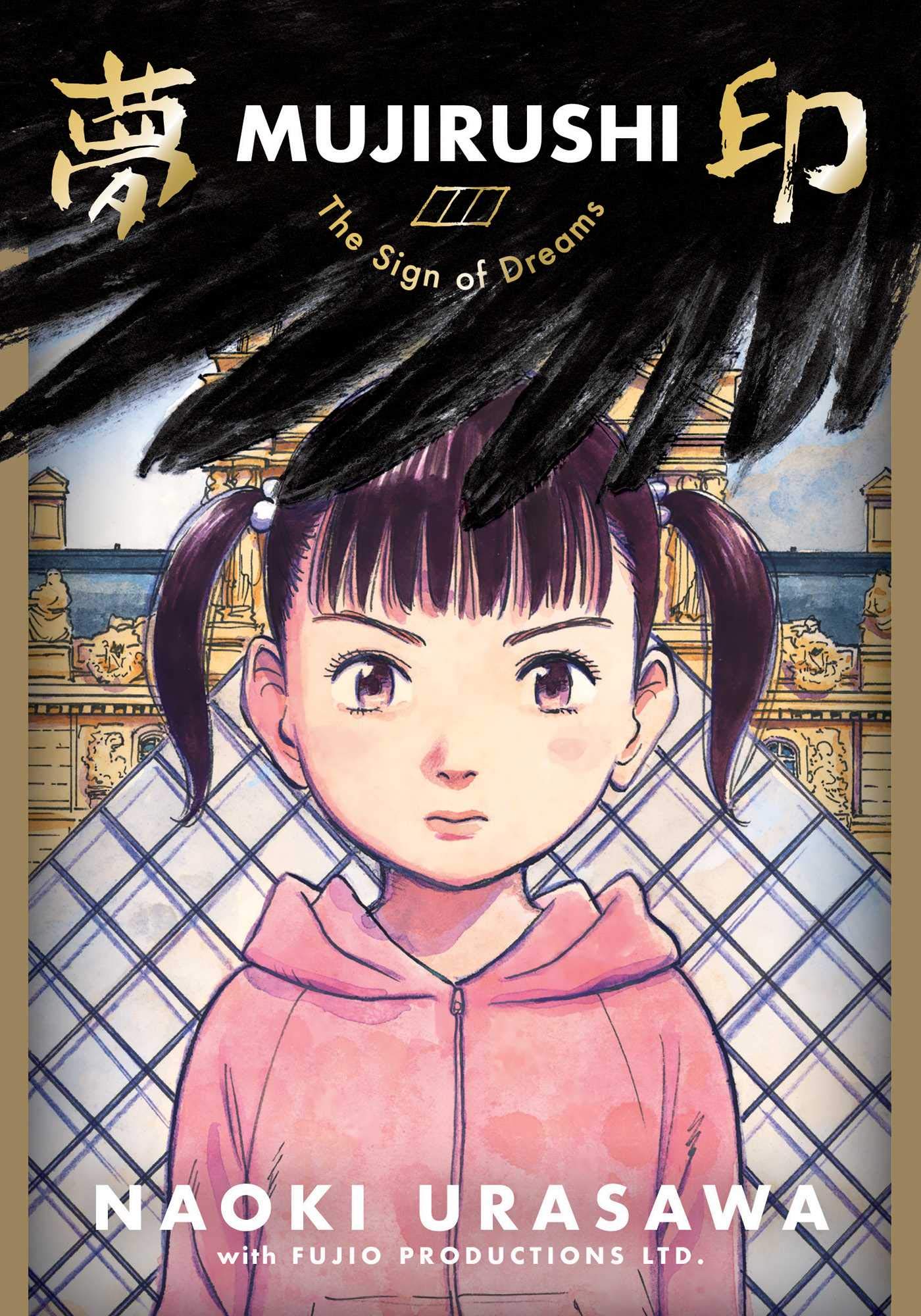
I’ve read my fair share of Urasawa Naoki. Between Monster, Pluto, and 20th Century Boys, I hold the manga author in high esteem, and generally assume I have a decent sense of his style. But I’m not sure anything could quite prepare me for Mujirushi: The Sign of Dreams.
The story centers around a father and daughter who have fallen on hard times after the dad makes a series of bad decisions. Desperate to get out of crushing debt, the two happen upon a mysterious fellow with extremely large front teeth and an overwhelming obsession with France known as the Director. This fellow convinces the father to participate in a plan that supposedly should give them both what they want, leading to a trip to France and the Louvre that only brings more unexpected turns.
It sounds like a pretty reasonable story, but one thing that makes Mujirushi different is that the Director is none other than Iyami, the most famous side character from the Osomatsu-kun franchise whose “SHEEH!” exclamation became a cultural phenomenon. As described by Urasawa himself (and even discussed in the early episodes of the modern-day revival sequel Osomatsu-san), Iyami was explosively popular in the 1960s—even more than the brothers themselves. An American equivalent would be something like having Steve Urkel show up as a central character in an otherwise unrelated movie (though Urkel did have his own France moment…)
I also want to mention that this manga features a weird female parody of Donald Trump named Beverly Duncan, whose face ends up playing a major role in the story, and it makes me wonder why Urasawa decided to throw this in. My best guess is that he simply wanted to draw Trump’s characteristic punchable grin because it makes quite the visual impact.
The manga is actually part of a collection of French, American, and Japanese comics made to celebrate the Louvre; readers might be familiar with the JoJo’s Bizarre Adventure take known as Rohan at the Louvre. When taken in this context, I can’t help but be amazed that Urasawa would weave one of Japan’s most pre-internet memetic characters into a story about French culture in the popular imagination, as if to say that the mere concepts of “France” and “the Louvre” exist in many individuals’ minds through the loud proclamations of a Francophile character. In many ways, it gives me similar vibes to 20th Century Boys and its obsession with Japanese pop culture of the mid-Showa period (Friend’s character in particular), as if Mujirushi is a story about France for the Japanese people who grew up in that period. Mujirushi thus ends up being as much a look at how people learn of and experience France as it is the Louvre itself. In that sense, while it’s not a sweeping psychological mystery like so many of Urasawa’s titles, its intersection of nostalgia, culture, and memory fits right into his oeuvre.
The Universal Century’s fight between the forces of the Earth Federation and the space-dwelling Zeon is both the foundation of Gundam and also, at times, the albatross around its neck. After 1988’s Char’s Counterattack closed the book on the central rivalry between Amuro Ray and Char Aznable, future Gundam anime would for decades do everything but provide a direct sequel. Gundam F91 and Victory Gundam set their stories decades after the events of Char’s Counterattack, other works like 0080: War in the Pocket and Gundam: 08th MS Team are side stories adjacent to Amuro’s story, and G Gundam launched the concept of alternative-universe Gundam—titles that take the name and basic aesthetics but are worlds unto themselves. This all changed with 2010’s Gundam Unicorn, also known as Gundam UC.
As a sequel to Char’s Counterattack, can get pretty deep into the weeds. For example, to understand the power of the Unicorn Gundam and its heavy incorporation of Psycho Frames and its NT-D system (short for Newtype Destroyer) is to be invested in the lore of the Universal Century timeline. Newtypes are people who have gained extrasensory abilities in response to humankind’s expansion into space, and their subsequent weaponization of leads to the development of both aforementioned technologies; the former is a way to fully utilize their mental and emotional power (and which was once the key to saving the Earth), while the latter is a counter to such abilities. However, while these world-building elements can get complicated, they also provide a rich backdrop for Banagher and Audrey’s stories of confronting the crimes of their forefathers.
SPOILERS BEGIN HERE
Much like the later Mobile Suit Gundam: Hathaway, Gundam Unicorn is based on a novel, but it’s also the first franchise novel to be adapted into a part of the main canon. Taking place shortly after the Earth narrowly avoided having the Luna II asteroid base dropped on it, Gundam Unicorn tells the story of Banagher Links, a student living in a space colony who gets wrapped up in a strange conspiracy after encountering a girl calling herself Audrey Burne. The head of Banagher’s school and head of the Vist Foundation, Cardeas Vist, is the most powerful man in Banagher’s colony, and his immense influence over the Federation has to do with the latter’s fear of something known as “Laplace’s Box.” When a mobile suit battle breaks out in the colony, Banagher’s psychic desire to protect Audrey leads him directly to Vist and the mysterious Unicorn Gundam, a weapon that serves as the “key” to Laplace’s Box. Why the box has such a hold on the Federation and how characters reconcile with their family histories and ties to the history of the founding of the Universal Century are central to the story of Gundam Unicorn.
By the end of the first episode, Banagher discovers that he’s actually the estranged son of Cardeas Vist, and shortly after sees his dad die before Vist gives him exclusive access to the Unicorn Gundam—and with it, a bridge to a secret that terrifies the Federation top brass. In the next episode, Audrey reveals her true identity: She is Mineva Lao Zabi, the last surviving member of Zeon’s original royal family whose leaders steered a fight for independence into a militaristic fascist regime. These central characters, both with deep roots in the two respective warring sides, are continuously challenged to look long and hard at the privileges they’ve received on the backs of the fallen. Their situations are contrasted with another character, Riddhe Marcenas (the son of a Federation politician), who desperately tries to maintain the status quo in order to avoid disrupting the familiar world he’s known.
Banagher is the protagonist, but Mineva is the stand-out character in so many ways. For those already familiar with the history, Mineva is familiar as the innocent baby daughter of Dozle Zabi, who perished fighting the original Gundam in the first anime. The monstrous-looking Dozle was ironically the most righteous and pure-hearted of the Zabis (albeit while still being guilty by association of Zeon’s atrocities), and his selflessness and loyalty are what allowed Mineva to escape with her mother. As the last Zabi, she is revered by the remnant Zeon forces, and she has a regal bearing that speaks to her status. Now on the verge of adulthood, however, Mineva sees her mission as atoning for the sins of the Zabis.
The ultimate direction taken by Banagher, Mineva, and eventually even Riddhe is what I would summarize as “Do good with the advantages you have.” None of the power they possess, whether physical or political, is bloodless, but they decide to reveal the truth that lies behind Laplace’s Box despite the fact that its contents could potentially flip everything upside down. Laplace’s Box turns out to be a monument containing the very first Universal Century charter, previously thought to be lost in a terrorist attack. While something so ceremonial should not be so revelatory, it turns out that this original charter contains a clause surreptitiously removed in later versions:
“In the future, should the emergence of a new space-adapted human race be confirmed, the Earth Federation shall give priority to involving them in the administration of the government.”
In other words, the Federation government was supposed to have enshrined the equal treatment and political representation of the space-born, but purposely revoked it in secret in order to rule over the Spacenoids. This action is revealed by Mineva to all as a successful move to consolidate power, its obfuscation of the truth arguably being the first catalyst that would lead to the One Year War and the continued bloodshed between Federation and Zeon. I have to wonder if this is also meant to be the catalyst that leads to the decline of the Federation that we see in later sequels like F91 and Victory.
The series does not absolve Zeon of their crimes through this, and Mineva outright states that her family is guilty of much tragedy, but that this is about spreading the real history of what transpired and to open the path for a better future. I can’t help but think of the current situation in the US and the attempts to ban the teaching of its racist past and present in an attempt to indoctrinate children into a blind patriotism. I understand that both the novel and anime predate this current unfortunate phenomenon, but nevertheless it feels more relevant than ever. Perhaps it ties into Japan’s own ongoing struggle with rewriting its history books to hide the things its wartime government inflated on its own people and those throughout Asia.
There’s a lot of meat I didn’t even touch upon, and all of it has a lot to say about war, peace, society, and justice. While Gundam Unicorn is really dedicated to trying to fit neatly in the canon of Gundam, it’s also a solid and compelling science fiction anime in its own right. Somehow, its lessons feel more relevant than ever.
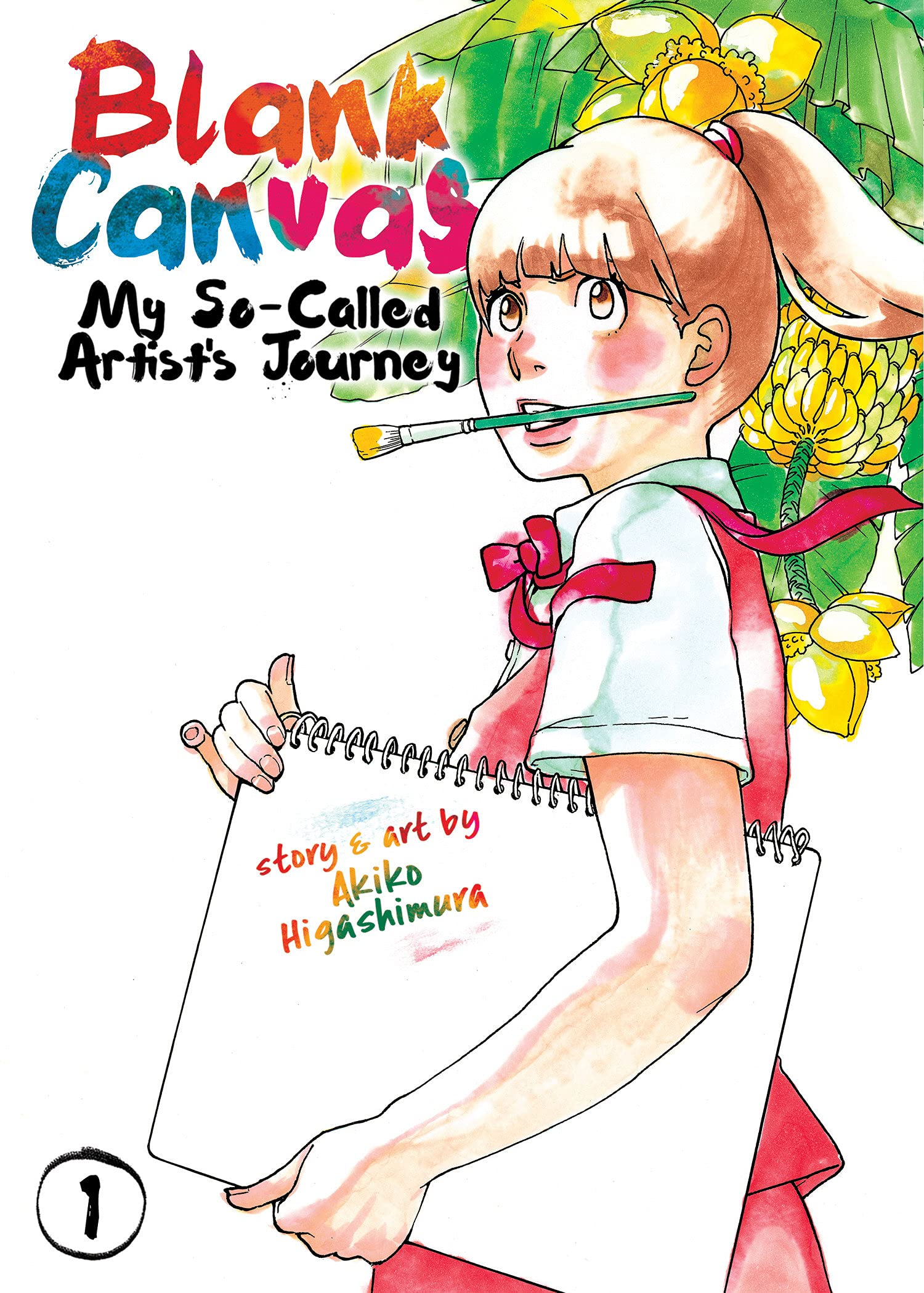
I love the works of Higashimura Akiko. Whether it’s Princess Jellyfish, Tokyo Tarareba Girls, or even the recent Webtoon A Fake Affair, her stories about women feel utterly authentic even as they can sometimes dip into the realm of the fanciful. But Blank Canvas: My So-Called Artist’s Journey is a little different from these other titles: an autobiographical series about how Higashimura herself became a renowned professional manga artist. Rather than some self-aggrandizing memoir, however, it declines to pull its punches by conveying the sacrifices she made, for better or for worse, to get to where she is.
Titled Kakukaku Shikajika (“And So On and So Forth”) in Japanese, Blank Canvas traces Higashimuta’s path starting from her days as an overconfident high school student assured that she’ll be the next big manga artist. Her plan to get into an art college and use that as a platform to launch her career leads Higashimura to her first art teacher, Hidaka-sensei: an expectations-defying hothead of an old man who runs his own independent class and constantly pushes his students to just keep drawing no matter what. From art lessons to art school to her first published manga and more, Higashimura lays out the strange-but-profound relationship the two of them share.
I myself attended a fine arts school but ultimately did not end up in a career directly tied to that particular world, and there are definitely elements of Blank Canvas I can relate to—particularly in terms of remembering the greater talent and hard work that I would see in my peers. I may even still have trouble honestly assessing how much of the opportunity I squandered versus how much it benefited me, but when I read Higashimura, I can feel the harsh yet fair weight of her self-assessment, as she emphasizes just how much Hidaka’s teachings stuck with her. Through the ups and downs of Higashimura’s artistic life, including a mentally and emotionally draining struggle between her “fine arts” side and her “manga” side, her teacher’s lessons (both in life and in art) crop up as both sources of inspiration and dread.
Hidaka-sensei is definitely a character, and reading it made me think about how differently people can be built both inside and out. Hidaka-sensei is portrayed as someone who would berate and even physically hit his students, but was nevertheless confident that anyone who put in the time with him would improve. The mix of faith and Spartan training is an odd combination, and I could see it being actively harmful to certain types of artists. Yet, Higashimura makes it clear that this helped her greatly, even if she didn’t always want to admit it.
The series also provides insight into the kinds of manga that influenced Higashimura, and it makes me interested in looking deeper at the shoujo magazine that inspired her the most: Bouquet. If the series found in Bouquet are part of the reason we got the artist of Princess Jellyfish and all these other great titles, they’re even more worth reading in their own right.
Blank Canvas is complete at five volumes, and its combination of levity and brutal honesty are hard to forget. I feel like it’s just as likely to convince someone to become a comic artist as it is to get them to rethink that career choice, but more importantly, it’s a gradual and thorough processing of all a life has to offer—the beautiful, the ugly, and the realization that it’s easy to mistakenly assume which is which.
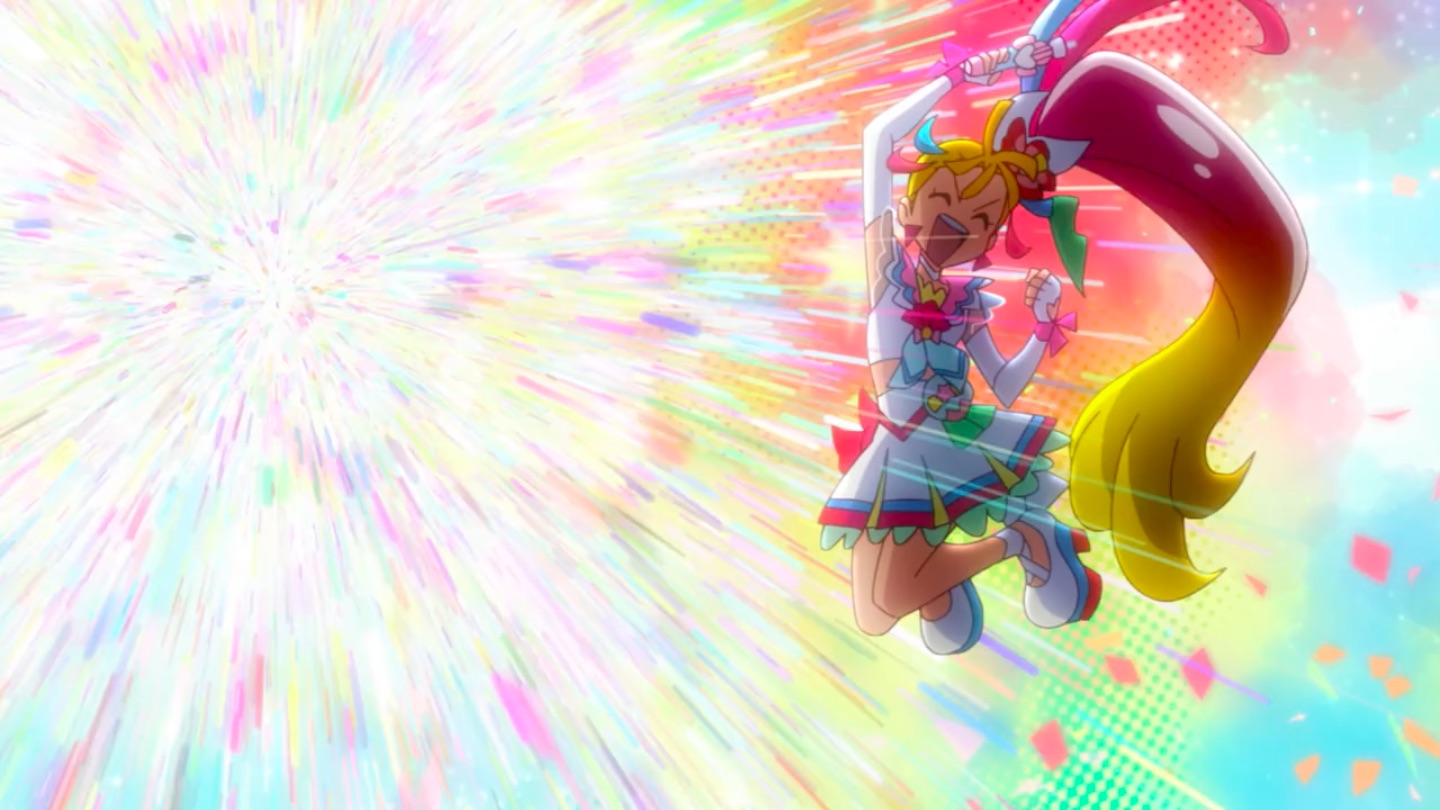
Precure is not exactly what you would call a dark franchise. While it’s capable of addressing serious ideas and can communicate mature messages, the brightly colored heroines and generally upbeat tone bring a certain expected level of happy enthusiasm. Even within this context, 2021’s Tropical-Rouge! Precure is by far the most energetic Precure series to date. From its delightfully spastic opening to its ever-active and ever-cheerful protagonist, the show radiates positivity. But Tropical-Rouge! also proves itself to be capable of tackling tough subjects and giving hope to viewers that they can take steps towards their dreams, whatever those may be.
Premise, Motifs, and Themes
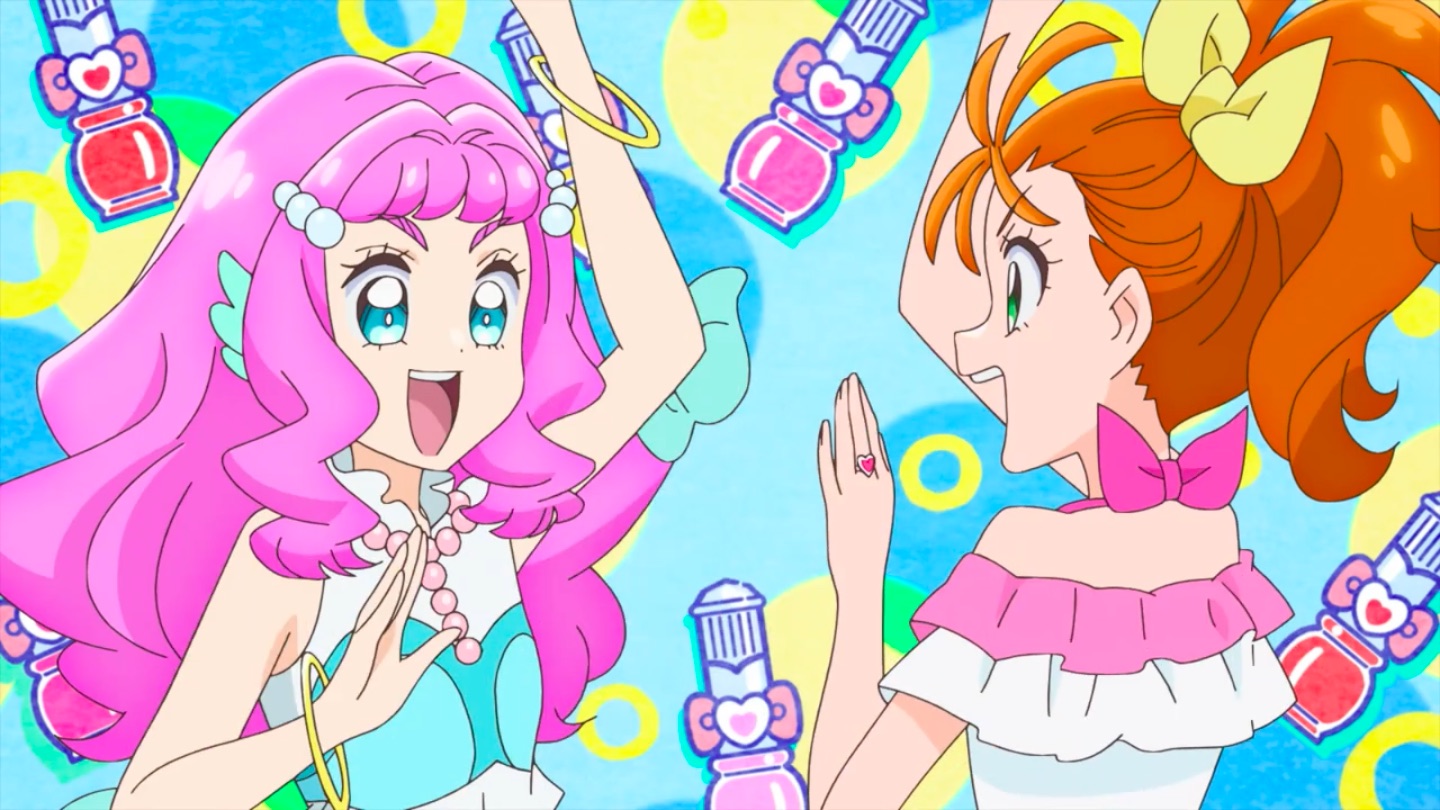
Middle schooler Natsuumi Manatsu has spent most of her life on a tropical island, but has recently moved to Aozora City to live with her mother. There, she encounters a real-live mermaid named Laura, who aims to become the next queen of her people by finding one of the legendary Precure: warriors who can stop the dreaded Witch of Delays from stealing people’s Motivation Power. Manatsu turns out to have what it takes to be a Precure, and transforms into Cure Summer to defeat the Witch’s Yaraneeda monsters. Full of pep like no one else, Manatsu has always wanted to do all that she can, and now that includes being a Precure. As she recruits others in school to become fellow Cures, they form the Tropical Club, a kind of “do anything and try everything” group that’s eager to help others.
Tropical-Rouge! Precure is mostly episodic, so the series operates mostly as a showcase for its cast’s distinct personalities with some occasional Big Plot or Character Development moments that give a bit of forward momentum to the narrative. The primary motifs are makeup and tropical imagery, while the main theme is the struggle between finding the inner will to go and just do “stuff” and feeling the desire to put things off in ways that prevent people from resolving issues in their lives. Not all of it meshes together neatly (the makeup aspect can often feel tacked on), but the way each character navigates the motivation/delay dichotomy makes for a robust cast with complex feelings who have more dimensions to them than their frenetic presentation in the opening might suggest.
Characters and Motivations
Of the main cast, there are those who try to figure out what path they want to take but are having trouble figuring out what speaks to them, and there are those who know full well what their goals are but are prevented from moving forward.
The fashionable Suzumura Sango (Cure Coral) and Manatsu are examples of the former, with Sango gradually learning that not every dream needs to involve being in the spotlight. Manatsu, for her part, is one of the best executions of a “heroine without a concrete direction” I’ve seen in anime. It’s often easy for that kind of personality to feel flimsy or emphasize their generic “everyman” qualities, but the message conveyed by Manatsu is simple and profound: Even if you’re not sure what you want to be when you grow up, you should at least do what you want most in the moment. You remain motivated by staying true to yourself, and the learning process is a reward in itself.
Meanwhile, the athletic Takizawa Asuka (Cure Flamingo) and bookish Ichinose Minori (Cure Papaya) are great examples of those who feel their dreams may be last. As revealed later in the series, Asuka had a falling out with a friend that led her to stop pursuing tennis, and their soured relationship stems from a disagreement over how to react to an injustice done to you when your decision can affect others. Minori wants to be an author, but a bad experience with her old literature club has led her to put down her pen—and has her worried that she’s limited by her focus on reading about the world instead of experiencing it.
The stand-out character to me is Laura; I even picked her to be one of my best of 2021. Laura’s charming-yet-abrasive personality regularly steals the show in more ways than one, and I love how her identity as a mermaid isn’t forgotten or minimized over time. At the same time, you really get the sense that not all mermaids are like her, and that her confidence and ambition are wholly her own. And unlike the others, she understands perfectly well what her dream is (becoming queen) and will do all that she can to achieve it, but the lessons she learns about ambition and sacrifice end up being surprisingly profound and defy the notion that you should be forced to choose the path that causes the fewest waves (no pun intended).
And amidst all these different dynamics, what’s impressive is how Tropical-Rouge! animates its characters such that their general roles are emphasized while avoiding having them fall too neatly into their designated archetypes. Manatsu’s a whirlwind of expressiveness, but she isn’t just blindly optimistic, and this comes across in the fact that her reactions, both happy and sad, are nevertheless big. Minori, in contrast, is often not as outwardly emotional as the others. However, one gets the sense that she has a rich inner world, and that she isn’t stoic—she merely doesn’t react as powerfully on the surface. In this way, the characters feel multifaceted but also easy to understand even for younger viewers.
Best Precure “Villains” Ever?
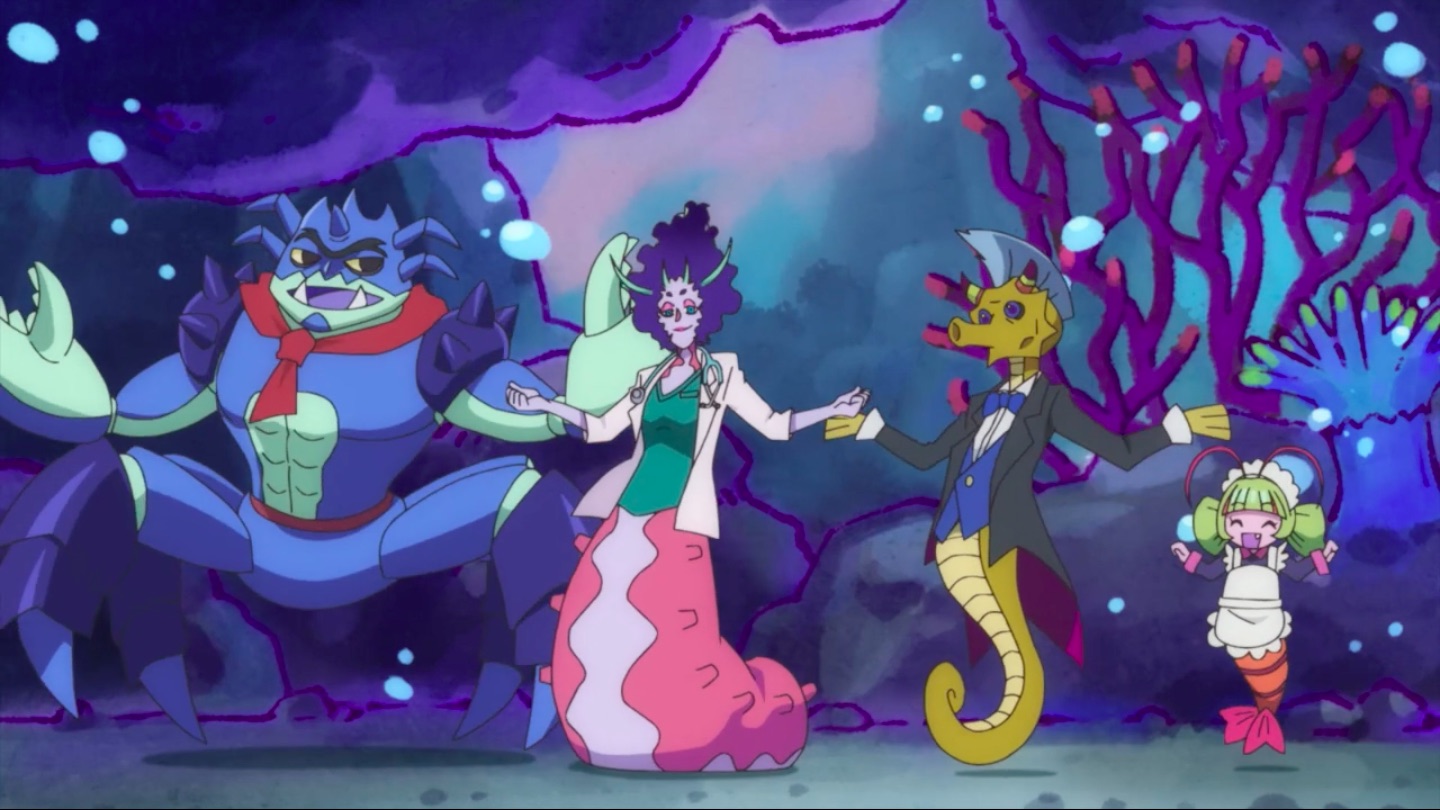
The strength of the cast even extends to the antagonists. The Witch of Delays’s henchmen—including Chongire the crab chef, Elda the (extremely adorable) shrimp maid, and Numeri the sea-cucumber doctor—are some of the most entertaining villains ever, and it’s mostly because they’re not that dedicated to their cause.
All of them come across as stealing Motivation Power from people because that’s part of their conditions for serving the Witch, and they’d really rather be doing what they were originally hired for—or in the case of Elda, play with dolls because she isn’t that into being a maid either. Seeing Chongi-re stop a fight because he needs to go check on something cooking really says it all, and what I love about that is it gives the bad guys a bit of depth while contributing to the generally lighthearted nature of Tropical-Rouge.
Final Thoughts
Tropical-Rouge! Precure is the kind of series whose unbridled energy can be both empowering and exhausting, like having a friend who’s eager to contact you anytime to see if you’re up for going out. They have a million possible plans, and you’re not sure where they lead, but one thing becomes clear as you try to find your way. That is, there are many possible paths to take—gentle ones, steep ones, straight ones, winding ones—and none are necessarily wrong as long as they encourage continued movement.
“Moving water never grows stale,” as the saying goes, but neither does the water need to be a rushing current. Between Manatsu, Laura, Sango, Akira, and Minori, viewers can witness a variety of different personalities and how they handle the unique challenges that face each of them—as well as how they can help one another along.
“Schoolgirls engaging in team tournaments” is a fairly specific yet common premise in manga that I really enjoy. Whether it’s a beloved series like Bamboo Blade or underdogs canceled early like Haru Polishand Hana Kaku, I’m always up for stories in this vein. On top of that, I’ve also found a casual interest in reading up on and researching martial arts in recent years. So when I saw Mabataki Yori Hayaku!! (Faster than a Blink!!), a manga about a girls’ sport karate club with cute art and solid action, it immediately felt like something right up my alley.
Kohanai Himari, a perpetually clumsy girl with a caring heart, is inspired to join her school’s karate club after a girl retrieves Hima’s umbrella from a guy who swiped it on a rainy day. Everyone—including Himari herself— thinks she’s a hopeless case, but the club’s veterans notice that there might be more to Himari than meets the eye. While she’s lacking in athleticism, knowledge, and experience, Himari has unusually sharp and perceptive vision—an X-factor that might turn her untapped potential into something more.
I’ve read four volumes so far, and one thing I really like about Mabataki Yori Hayaku is how slowly and gradually Himari improves, and how she isn’t just an overnight sensation. Not only are there girls physically more capable than she is, most are also more practiced and dedicated. She still feels very much like the underdog in all situations, and not the shounen hero kind who will pull out their secret technique and turn it all around. But the manga shows how her initial hesitant steps into the world of karate get larger and larger—as her enthusiasm grows, the confidence shows in her body.
The other characters also range from endearing to entertaining to compelling, whether it’s clubmates or rivals. The club president is a surprisingly rough-and-tumble sort who loves karate but has family issues with her sister. Another girl in the club, the razor-toothed and twin-tailed Izawa Sora, has both experience and a disdain for those who don’t take karate seriously, a feeling that we eventually learn hits all too close to home. A couple of characters from other schools see Himari’s latent potential, and they want to bring it out. No one seems boring so far, though one girl is the requisite “explain for the newbies” character, and there are times (especially when their hair is down) that it can become difficult to distinguish between characters. However, the characters are still generally expressive and memorable.
The artwork itself also goes a long way in conveying that character charm, especially when it comes to the portrayal of karate itself. There’s a dramatic sense of action that exaggerates just enough without feeling like it’s parodying sport karate, which is about landing light hits in a points-based system, unlike full-contact karate. The author, Funatsu Kazuki, actually has more experience drawing horny titles, though that largely doesn’t factor into the art in Mabataki Yori Hayaku!!—kind of tough when literally every girl is in a baggy gi. That said, the thirst does occasionally shine through, especially in the high kicks.
As for the decision to use sport karate instead of full-contact, it reminds me of the criticism sport karate can get for not being like a “real fight.” But this is actually depicted as an appealing quality, and it’s one of the reasons gentle Himari decides to take up karate in the first place. This is a series about competition, but no one wants to prove they’d win on the streets.
Whether Himari grows into a champion or not, following her journey is entertaining and uplifting. Now, if only this series doesn’t end too early.
48 chapters later, friends compete for the first time in this conclusion to Hashikko Ensemble.
Summary
It’s shortly after the start of the new school year at Hashimoto Tech, and all the clubs are presenting to recruit first-years. While the freshmen predictably look a little too rough-and-tumble to sing chorus/glee-style, Jin declares his confidence that they’ll find new members.
The chapter jumps back one month in time to White Day, where the last chapter left off. Akira and Jin both sing “Kanade” by Sukima Switch, but unlike the previous two times they’ve done this song together, this time they’re in a one-on-one “exhibition match.” For those familiar with Jin, especially Yumerun, it’s highly uncharacteristic to see Jin singing against someone rather than with them. At the end, with no clear victor, Jin proudly announces that he’s going to apply for music college just like Akira. Smiling, Jin calls Akira his rival, to which Akira happily agrees.
Then, Jin reciprocates Kozue’s romantic Valentine’s chocolate with a White Day chocolate of his own, and says he likes her too. Kozue is happy, but notices Yumerun staring daggers into her, leading to a bit of off-panel comedic fury.
The story then shifts forward again to the recruitment, and the group is going to be next on stage. Shion is nervous because all of her work to pass her classes has made her extremely competent at all that vocational work, but made her forget how to play. Kousei just says that she has to play decently, and it’ll be fine. The other members notice that they’ve gotten a bit closer, while Mai wishes she had the courage to give Akira chocolate.
As the announcer calls for them, Akira and the others come out to the audience as the official, full-fledged Chorus Club. The freshmen notice that there are an unusual number of delinquents in it—as well as girls—before the club starts their song.
Concluded or Canceled?
Having Hashikko Ensemble all end here feels both well-timed and abrupt, and the actual answer is that it’s a little bit of both. On Twitter, Kio Shimoku said that he was told to begin wrapping up at the start of the Culture Festival arc, and he was able to get enough time to finish that arc and wrap things up, ending the series at Volume 8. It’s not quite the same, but it reminds me a bit of what happened to the original Mobile Suit Gundam: It was slated to be a 52-episode series, only to be canceled early and revised to be a 39-episode show, but the staff managed to convince the higher-ups to at least make it 43.
That, in turn, makes me think of that old Genshiken anime episode preview where the characters talk about how so many great series got canceled early—like Gungal (Gundam) and Dizner (Layzner). Madarame turns it around and says that maybe it’s the opposite, and a series is only truly great if it gets canceled.
I feel that Hashikko Ensemble is a story that had plenty more room to grow, and I would have enjoyed seeing them at least get to the end of high school, if not further beyond that. Still, there was at least enough room to resolve things well enough, and the main thrust of the relationship between Akira and Jin ends at an interesting and uplifting point.
Unrequited or Unseen?
Of the many romantic threads in the series, It’s funny that Jin x Kozue was the only one that resulted in a definitive couple. Hashikko Ensemble largely didn’t dwell on their relationship, and a lot of their interactions didn’t even indirectly hint at the subject. This can be chalked up to their personalities—Kozue is not prone to flights of fancy, and oblivious Jin probably didn’t even think about romantic love at any point in his life until Kozue’s confession. Giving the least prominent romance closure but not the others feels like a troll of sorts, but one I welcome for it’s unexpectedness.
And even then, others are somewhat open-ended. Kousei and Shion appear to be closer, and that development is likely a direct response to Shion proving that she can successfully perform the physical labor tasks involved in passing her classes—and by extension someday live the kind of life Kousei envisions for himself. Mai regrets not confessing to Akira, but it’s not like there was any sort of rejection. In the world of the story, they’ve still got at least another couple of years. If this were a series that had people writing fanfiction about it, this would probably be a prime topic.
Learning to Be Selflessly Selfish
It feels appropriate that things would essentially boil back down to Akira and Jin. What’s fascinating is the journey they both took to get here.
The lesson Jin learns in the end is one that runs almost opposite of what is typical in anime and manga. Stories are often about someone discovering the power of teamwork, but what Jin needs in order to grow is the capacity to individually compete and outperform. His match against Akira isn’t about trying to win, but to see if he can actually use his singing as a tool to raise himself rather than support another. To go from “teammates” to “rivals” is, again, sort of counter to the standard narrative of manga about high school clubs.
As Akira states in his thoughts, he’s grateful for all he’s gained thanks to Jin. He originally was woefully self-conscious about the deep voice he suddenly developed in middle school, and it was something he sought to hide and minimize. But Jin encouraged him to go out of his comfort zone and embrace the bass in his voice, and here, Akira brings not only his gratitude but everything Jin ever taught him.
Poetically, Jin himself turns out to have been forced outside his comfort zone by Akira’s rapid progress, which is how we get to their relationship in the final chapter. Rather than the student becoming the master, the two recognize each other as true equals.
Songs
As stated, the last and only song for Chapter 48 is “Kanade” by Sukima Switch. As with every time “Kanade” appears, I’ve linked the official music video above, but there’s a very special treat this time as well.
Kio actually uploaded a version of “Kanade” that’s supposed to be an approximation of how the song would sound as a duet performed by Akira and Jin! According to his tweets, Kio stated that he made it himself because it didn’t exist, and that he accomplished it with the help of a couple music programs.
One thing I never really did with all these Hashikko Ensemble reviews over the years is provide analyses of the lyrics for the various songs used in the manga. This was partly for space and time reasons, but they often add meaning to each chapter, so it has been a bit of a glaring omission.
For this final chapter, I think it’s worth looking at “Kanade” and what the song is saying. The lyrics are largely about someone getting close to a person and guiding them, only to see them growing into an adult and changing. But even though things aren’t going to be the same, they’ll use their voice to protect the other.
How fitting for Akira and JIn, and perhaps the entirety of Hashikko Ensemble. So much of the series is about the characters finding support in one another, and watching them grow beyond what anyone expected.
Final Thoughts
The series is ending literally one month short of its fourth anniversary, and looking back, there are many questions about Hashikko Ensemble left unanswered and open to exploration. Mai, who ended up becoming my favorite character, never got enough time to fully shine, but I appreciate the fact that she ended up becoming a more prominent character towards the end. I also have to wonder if Jin’s mom was introduced during the Culture Festival because Kio knew the manga was set to finish. It feels somewhat like an appearance that resulted from things having to wrap up, and a longer series might have had her shadow (rather than her physical self) loom in the background for a greater amount of chapters. Would Jin ever learn that his mom thinks highly of his singing ability? I could see it going either way.
Hashikko Ensemble is notably different from pretty much all of Kio’s previous works in the way that there’s a concrete underlying goal for its cast. Whether it’s Genshiken or any of the series that have preceded or followed it, Kio’s stories have always been more about exploring character relationships in spaces devoid of strong ambition. Hashikko Ensemble is very much about the characters and how they connect with one another, but the theme of music and an in-story goal of forming a proper club (and a proper chorus) means that there’s a good deal of forward momentum that’s absent in Kio’s other manga—with the arguable exception of Kujibiki Unbalance. Seeing that relatively more “focused” Kio Shimoku manga makes me wonder how things would go if he took it a step further, maybe even into a more adventure-type work, or something like palace intrigue.
Akira, Jin, and the rest are so charming and authentic as characters. Their personalities contain both simplicities and complexities, and as they grow, they gain new dimensions while remaining true to their cores. It reminds me of past Kio series to be sure, but there’s a kind of enthusiasm that I think is indicative of the high school setting—a mark of youth and the potential that lies ahead. Yet, with all the adult figures in the background, there are characters even those who feel far removed from their younger days can relate to. The fact that Kio actually joined Twitter as this serialization was happening even lends an air of trying to communicate with an audience that’s both younger and older. It’s not TikTok, but maybe that’d be a step too far.
Hashikko Ensemble ends up feeling like it has the perspectives of both teens in the midst of their days and adults looking at youth in action, and that interaction has been a joy to read.
Encanto gave me an existential crisis, a first for a Disney film.
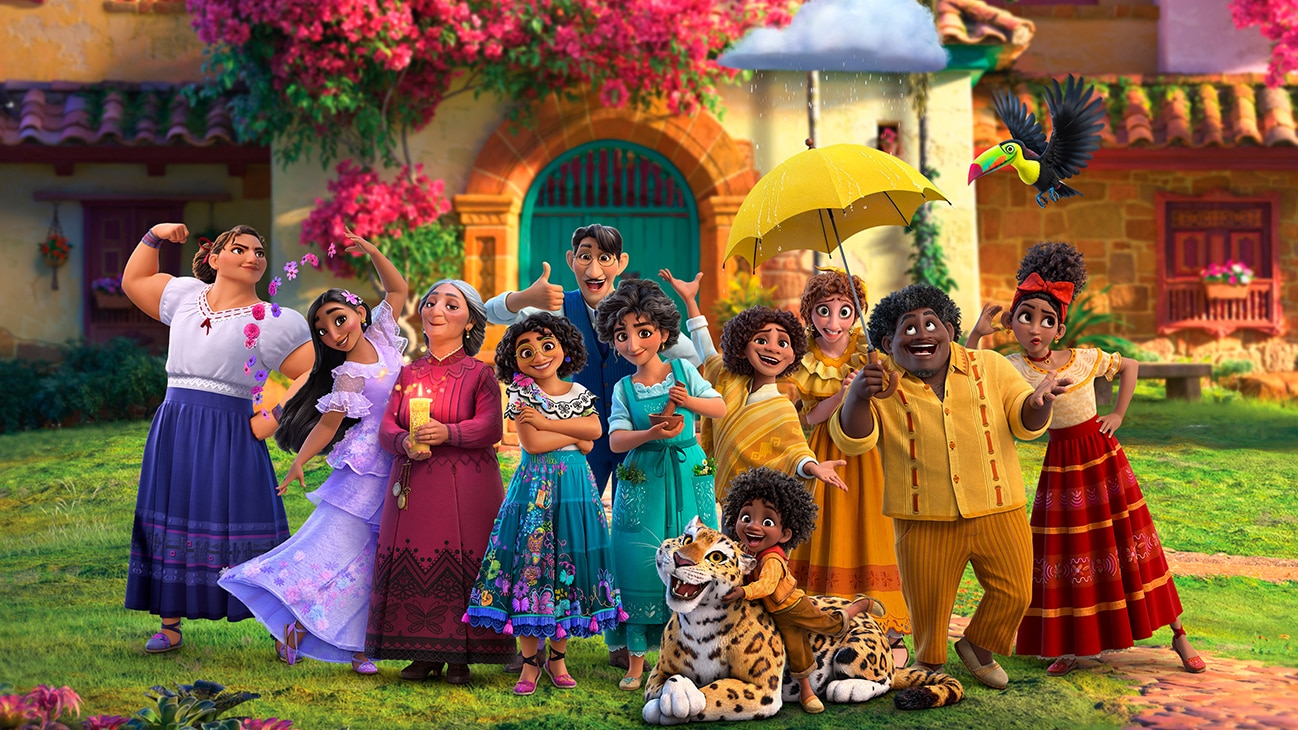
Its story centers around a family with supernatural powers called the Madrigals who have been the spiritual center of their town for generations. Each member of the Madrigals is bestowed a “gift” by a magic candle when they come of age, going all the way back to the family matriarch, Abuela (“Grandmother”), who received the candle through some unknown miracle while escaping from her hometown—and through the noble and tragic sacrifice of her beloved husband. The protagonist of the story is Mirabel, one of Abuela’s granddaughters, who is the only Madrigal to not have a gift. But when Mirabel begins to see what looks like a premonition about the destruction of their house and their magic, she takes action to solve the mystery, and in doing so, learns more about her family than she—or anyone else—ever knew.
The story of the “non-special” person who is surrounded by incredibly talented people and goes on to do big things doesn’t seem all that unique, and plenty of similar narratives never felt like a chest-wrenching experience to me. But the way in which the genuine mutual love between Mirabel and her family carries a vein of patronizing concern over Mirabel’s lack of conventional ability (by Madrigal standards) hits a little too close to home. It’s that complicated extra layer underpinning the interactions between Mirabel’s immediate and extended family, where a desire to help Mirabel ends up hurting by inadvertently reinforcing the idea that she’ll never be good enough, which makes the film wallop like a sack full of bricks.
But the film also has plenty of joyful highs, especially as Mirabel gradually breaks through the invisible barriers that obfuscate the state of her relatives’ emotional wellbeing. The emphasis on family is anything but shallow, and the simple yet profound truths about every character lend credence to the idea that the notion of the ideal and picturesque Madrigals is neither entirely true nor entirely false. The pressure to live up to greatness is heavy. And as for the eponymous uncle from the film’s hit song “We Don’t Talk About Bruno,” for me his story strikes closest to home.
What is also eminently relatable as someone who is descended from immigrants who had to basically start anew in an unfamiliar land is the story of the cultural gap that forms as each successive generation must deal with the challenges that lie ahead. Abuela’s priorities are the result of the circumstances that shaped her, and it makes me reflect on my own ancestors’ hardships—though not without pondering why the generational divide can be so very steep.
I don’t hate Encanto for making me feel all sorts of ways. Quite the opposite, in fact. It’s a powerful and authentic rollercoaster of emotions that reflect a family with a complex history, and I appreciate that a lot. I think it can sometimes be easy to think that those who have those feelings of inadequacy brought upon by familial pressure are alone, and it’s comforting to see such a story play out on so grand a stage.
WARNING: SPOILERS FOR THE FIRST AND SECONDGAOGAIGAR VS. BETTERMAN NOVELS
Hakai-oh: Gaogaigar vs. Betterman Part 3 brings the story of the Gaogaigar universe to a close, and what a journey it’s been. 24 years after the original TV series, we finally know the fates of all our brave heroes, and the tension and excitement never let up through this massive third volume. It truly does feel like the end of a long journey.
(Seriously, this thing is a monster compared to the first two.)
King of Kings
To start, since the release of Part 2, something major has happened to Gaogaigar vs. Betterman: It’s gotten an official name! The novels didn’t get licensed; rather, it became one of the titles in Super Robot Wars 30, where it was announced in English as King of Kings: Gaogaigar vs. Betterman. The term “Hakai-oh” is quite tricky to translate without sounding awkward and retaining enough of the meaning of the Japanese, and I find this to be an incredibly good compromise that also makes sure to pair well with the classic King of Braves Gaogaigar English title. It also gets translated as Conqueror-King in dialogue. Note that I call it Hakai-oh in the title mainly for consistency with my previous reviews, but I like these translations enough to use them for this review.
Gaogaigar vs. Betterman being in SRW30 also means that’s how most English speakers are likely experiencing the story, but there are a number of notable differences. So this review (as well as the previous two) might be worth checking out just to see how this plotline was originally handled.
The Story
Part 3starts off with some of the Gutsy Galaxy Guard restored to their normal selves, with many dangerous and notable exceptions remaining. These “Conqueror’s Thralls” (previously translated as Hakai Servants) are still under the powerful influence of Triple Zero, which Mamoru, Guy, and the rest now understand to be not only the source of The Power, but the energy produced from a dying universe during a Big Crunch. The Thralls seek to bring everything to “provenance”—a reset to oblivion—leading to some fierce and emotionally difficult battles. Meanwhile, the Somniums still act according to their own beliefs, but their mysterious ties to humanity are tested, and their true motives are revealed. Mamoru and Ikumi’s Gaogaigo, Guy’s Gaofighgar, and more must be braver than ever before if they want to free their friends and ultimately fight against the Conqueror-King Genesisc Gaogaigar. But as they discover in their struggle, courage might just be the antidote to Triple Zero.
A Universe Unto Itself
I’m being something of a broken record at this point, but more than ever, the way in which the novel draws upon the entirety of Gaogaigar lore is still one of my favorite aspects. There’s enough explanation so that those who don’t have a degree in Braveology can still follow along, and it never feels overly reliant on nostalgia or old ideas.
How does Mikoto being part-Zonuda affect her as a Thrall? What does Guy’s evoluder biology say about his potential future? How does the time dilation that impacted the old GGG affect their relationships with their friends and family back on Earth? The Somniums can fuse with each other to form Betterman Cataphract, but how far can they take it? All those questions are asked and answered while never losing sight of the main story, the fight against the King of Kings.
Even the climax towards the end of the novel is a huge nod to the final episode of the original TV series, one that feels like a progression rather than a retread, and builds upon an overall satisfying experience.
The Best Battles Ever?
If there’s one thing that Gaogaigar is known for, it’s amazing fights. Even in pure prose without the benefit of animation, this still applies. I’m even tempted to call these particular fights the best the franchise has ever seen, and it’s largely because of how each one feels unique from the others, the way the stakes keep building up, and the desperate solutions that they need to find. How can they compete with Commander Taiga, whose stalwart leadership provided the backbone of GGG? The Goldion Crusher was their ace in the hole in the conflict with the 11 Planetary Masters of Sol in Gaogaigar FINAL, so what hope do they have when faced with a Silverion Crusherwielded by a terrifyingly powered-up Conqueror King J-Der?
In each case, there’s the exciting push and pull so characteristic of Gaogaigar battles, but there’s also the sense that the characters are doing all they can to strategize, persevere, and fight. There’s a moment in one of the later battles where they creatively utilize the technology that allowed Gaogaigar to upgrade its Protect Shade and Broken Magnum into the Protect Wall and Broken Phantom, and Guy’s uncle Liger contemplates how, unlike most everything else they use, this was a purely human invention by Guy’s father, Leo. In Liger’s view, the Wall Ring and Phantom Ring are representative of humanity building upon and contributing to the boon of alien technology they received from Galeon so long ago—a fusion of Earth and Green-Planet science, not unlike Gaogaigo. It’s a beautiful moment.
And perhaps most importantly, the final volume answers whether “vs.” means “team up” in the Dynamic Pro tradition, or “confrontation” in the more conventional sense. The answer is a creative one.
Romance
While there are many couples and would-be couples in the Gaogaigar universe, it’s never been the focus in any real way. Here, though, the topic takes center stage in what feels like a pay-off. Whether it’s Mamoru and Hana as childhood sweethearts, the forged-in-combat bond of Soldat J and Renais, the central romance of Guy and Mikoto, or the more down-to-Earth and relationship of Keita and Hinoki, everything pretty much comes to a head here. All of them are entertaining to read, and I’m especially fond of how J’s versions of care and compassion tie into his warrior ethos—nothing like handing your girl your finishing move so she can wield it herself.
Issues
One criticism I have is that the series is 100% heteronormative in its romances. I’m not saying that they needed to reveal that Ikumi or some other character was gay or anything, and I understand that all of the above relationships are basically tying up loose ends from Gaogaigar and Betterman, but it’s still nevertheless something missing that could show that time has truly moved forward. I don’t think this omission makes Gaogaigar vs. Betterman bad or unenjoyable, but I find it’s worth pointing out.
I also think that the Betterman parts are significantly more confusing than the Gaogaigar sections. This might be because that series is less fresh in my mind, but one big difference is that most of the Gaogaigar-side characters come from the TV series and OVA. In contrast, while the human side of Betterman sees a large number of returning faces, the Somniums (the titular Bettermen) are for the most part new characters, and so it feels like there’s less to latch onto.
The last thing I’ll mention here is that the series has kind of a complex relationship with its portrayal of characters with disabilities. There’s great emphasis on how the scientific and technological efforts made have given those with disabilities the opportunity to lead lives they might not have been able to otherwise, and that what fuels this is largely love and compassion. At the same time, you have characters like Guy who, even in his previous cyborg form, comes across more as a “supercrip.” I’m not an expert in this subject, so I’d be interested in hearing others’ takes on this matter.
Favorite Touches
This is where the SPOILERS abound, so I’m putting a WARNING right here.
I’ve already touched on a number of things that stick out in my mind, but I want to elaborate a bit more on them here. It’s mostly the battles.
The aesthetic of the Silverion Crusher is nothing short of magnificent, with the Crusher resembling a giant flaming King J-Der head like it’s the most terrifying dullahan ever. The battle against it also has many moving parts that feel necessary because of what an overwhelming adversary it is. Gaogaigar fans know the sheer destructive force that is the Goldion Crusher, and the way they have to basically attack the units that spread out to create the hammerhead in order to prevent it from fully deploying, or else it’s game over. The way the fight comes down to Guy and Ikumi battling J and Renais in order to purify them also has a feeling somewhat akin to the final battle in Gurren-Lagann.
The struggle against Conqueror-King Genesic is chock full of astounding elements, such as the fact that the fight is led by Gaogaigar (Guy), Gaogaigo (Mamoru and Ikumi), and Gaofighgar (now controlled by Renais) working together to take it on, with King J-Der and Kakuseijin V2 for support. In other words, it’s triple Gaogaigar vs. Genesic. As they fight, they manage to break apart Genesic’s Final Fusion, but then have to fight the separated but individually sentient Genesic Gao MAchines all at once, resulting in an additional challenge.
You may be wondering how it’s possible that vanilla Gaogaigar is part of this fight, but its core is actually the original Galeon pulled from the past by the Somniums. What’s more this Gaogaigar ends up combining with Betterman Cataphract to form Musou Gaogaigar, or Dream Armor Gaogaigar. The narration mentions that you could alternately call this Gaogaigar’s “Great Gattai,” making a reference to other Brave series combinations like Great Exkaiser and Great Might Gaine.
Then, in that same struggle, we see the aforementioned use of Phantom Ring technology. More specifically, it’s actually about turning the “Global Wall” that helped restore electronic communications back to the Earth and switching it to a “Phantom Mode.” The very fact that the Global Wall was sitting there as a pseudo-Chekhov’s gun filled me with a kind of fiery joy—it had already played a role, but here was a second and even bigger one that feels both out of nowhere and logically consistent. That’s actually kind of this whole novel series in a nutshell.
In a similar vein, King J-Der ends up combining with Earth’s technology to form the amazing-sounding Dimension Ten-TImes Pliers, which is King J-Der with Dimension Pliers for fingers. I want to see this in an actual animation so badly.
And during the climax, when it’s time to form Final Gaogaigar for the last battle, it’s not just Guy fusing with Genesic Galeon, but all the Genesic Gao Machines having fusions with other characters. It’s a lot like the finale of the TV series, where the Brave Robots have their AIs installed into the regular Gao Machines because they’ve been disabled by Mikoto-as-Zonuda. Goldion Armor and the Goldion Finger attack (essentially a giant hand consisting of Goldion Hammers for fingers) is amazing, but the thematic full-circle from the fully fused Final Gaogaigar stands out even more.
After all the fighting, we’re treated to an epilogue and an extra story. In them, we see how Mamoru and Hana have a child named Tsubasa (gender unknown), but also that Guy and Mikoto will accompany Galeon and the J-Ark crew to explore the universe. In other words, Guy is going back to his original dream of being an astronaut, and I think it’s such a beautiful way to end his story.
The “FINAL” Word
I love that these novels exist. While I wish this could have been animated from the start and given the treatment it truly deserves, the story told in these pages soars in ways that make me smile and have pride in being a Gaogaigar fan. If Gaogaigar vs. Betterman is a love letter, then it’s one that turns a romance into a marriage, and embodies everything great about the universe of its characters and heroes. In the afterword, both the original director who supervised these novels, Yonetani Yoshitomo, and the series author (who actually wrote for the TV anime way back), Takeda Yuichiro, approached these novels with the sense that they would cap off the story of Gaogaigar as a whole. I would never be against a sequel, but the fact that we the fans even got a conclusion is more than I could have hoped for, let alone having it end so well.
Rokudou no Onna-tachi by Nakamura Yuji is an unusual delinquent harem manga whose ability to embrace and rise above its basic premise has made me a fan through and through. The series concluded this year, and though it’s the kind of story where I could see the ending from a mile away, that doesn’t really impact how enjoyable it is to read. It’s a rare case of a manga that rarely falters and keeps getting better right to the finish.
Rokudou follows Rokudou Tousuke, a wimpy high school boy who uses a family spell to become more popular with girls but gets an unexpected consequence: The spell only works on “bad girls,” and number 1 among them is a human wrecking crew named Himawari Ranna, who’s practically an avatar of violence and destruction. While the series starts off as mostly gags, it quickly grows into a story about forging lasting bonds and finding the best version of yourself. Rokudou, like so many shounen protagonists, is all about the power of friendship, but even though the art is often unserious, the heart is definitely there. Rokudou genuinely cares for others, and he’s a surprisingly well-developed protagonist for a series that didn’t necessarily need it.
In my previous review, I likened Rokudou to Krillin, with Ranna a cross between Android 18 and Goku due to the relative chasm in power levels. But if Rokudou is the Krillin, then his success comes from the idea that just because you’re not the strongest doesn’t mean you’re not strong—especially because there’s more than one way to be strong. Even if he’ll never have what it takes to win the biggest battles, Rokudou wants to make a difference where he can, while also having the desire to improve where he can. And so when he does learn to throw hands, it’s like he’s both protagonist and side character simultaneously, and it doesn’t feel like a weak compromise. As the opponents get stronger—the final arc has Rokudou and pals up against full-on organized crime—so too must the good guys step up.
At the climax of the story, the question that has driven the series presents itself one last time: Could Ranna possibly care for, or even about, Rokudou if the charm spell were to lose its effectiveness? Was the unlikely bond they formed nothing more than an illusion? The answer is much like what happened with Lord Zedd and Rita Repulsa in Mighty Morphin’ Power Rangers: It may have started as an artificial love, but it became real over time. To the credit of Rokudou no Onna-tachi author, Nakamura Yuuji, this development feels more than earned by both Ranna and Rokudou.
Whether it’s being serious or silly or even both at the same time, this manga feels right. I’m glad to have stuck with it, and I hope that it’s remembered fondly as a series that combined its hodgepodge of tropes into something beautiful and hilarious.








 OGIUE MANIAX