[Anime NYC 2019] Tomino’s Movie Magic: Gundam Reconguista in G Part I: Go! Core Fighter

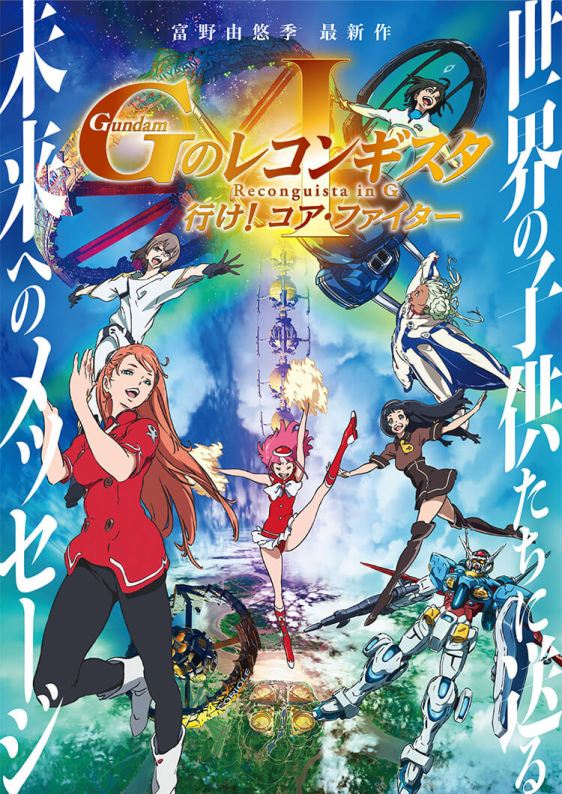
At Anime NYC 2019, I attended the screening of Gundam Reconguista in G Part I: Go! Core Fighter, the first of five planned compilation films based on 2014’s Gundam: Reconguista in G TV series. It was one of the events I was looking forward to most at the convention, and not only because legendary Gundam director Tomino Yoshiyuki was there.

I am a staunch defender of G-Reco because I believe that in spite of its flaws, it has a strong anti-war message which surpasses even the original Gundam‘s in certain respects. Its setting, in an era after the original Gundam timeline, shows what war is like when the cataclysmic devastation of the past is all but forgotten, for better or worse. But I acknowledge that G-Reco did not exactly take the world by storm, as it could be a confusing series, and Tomino’s  “throw you in the deep end” style of no-context dialogue did it no favors.

Thus, I came into the screening with the hope—albeit a tentative one—that these new movies could clean up the rough edges of the series enough to get its ideas and themes across effectively to a wider audience. After all, for every Mobile Suit Gundam trilogy, which is in many ways superior to its source material, there’s a Mobile Suit Z Gundam: A New Translation, which feels sloppily put together. However, I immediately noticed that the film is much clearer and easier to follow, allaying my fears.

There are two simple but major choices that make this first G-Reco film less convoluted. First is the decision to condense the series into films in the first place. Second is the heavier use of internal monologue to make character motivations more obvious.

Many of the scenes and plot points relevant to one another in the TV series could be episodes apart, and by the time something came up again, it was easy to forget what information had been communicated already. But in the movie version, everything is more tightly packed together such that ideas and threads are fresher in the memory. It’s easier to see how various aspects of the world-building fit together, and what potential they hold as the story unfolds.

In regards to characters’ inner minds, the TV series suffered from what seemed like constantly inconsistent actions from characters. They’d switch sides, kill those close to them seemingly without much regret, and just be generally difficult to follow or comprehend. The hero, Bellri Zenam, was especially obtuse. Now, however, there are multiple new scenes of characters expressing either through thought (and sometimes even voice) just how they’re feeling and how it’s affecting their decisions. While the film is still characteristically Tomino and can be full of puzzling dialogue, having it be undergirded by these inner monologues helps to prevent the characters from coming off as sociopaths.

The biggest surprise to me is how much better I understood the character of Noredo Nug, Bellri’s friend and possible love interest. Noredo believes in Bellri’s goodness even more than the man himself does, and she’s willing to defend him in this regard even when he won’t do it himself.

Before the screening began, Tomino said that everyone who came for a Gundam movie will be disappointed because this isn’t Gundam. It seems like a tongue in cheek comment, but I think he really meant it in a way. The message he’s trying to convey through G-Reco is trying to target a new audience that isn’t entrenched in the existing Gundam cultural juggernaut—most likely, that’s what stuff like Gundam UC is for.

Because I’ve seen the TV series, it was impossible for me to go in with fresh eyes Still, I strongly feel that this first G-Reco film is a much more refined work, and while it can still be a challenge to follow at times, it is a major step up. I also just recently rewatched Gundam F-91, and that movie just falls apart a third of the way through, whereas Go! Core Fighter was enjoyable and thought-provoking throughout. Provided nothing goes horribly awry with the sequels, I believe that the Mobile Suit Gundam Reconguista in G films will be the definitive version.


I’m Happy to Have Chihayafuru Season 3

The Chihayafuru anime is back after nearly six years, and I’m just thrilled. Rarely is there a series that so deftly balances interpersonal drama, the excitement of competition, and the effective portrayal of its characters through both of those aspects.

Chihayafuru is about playing karuta, a game based on matching cards to recited poetry. It looks like the kind of thing kids would play when they’re bored, and it is. However, the series does such a convincing job of making competitive karuta look like a fierce and deep game, and it does so without necessarily needing to go for an over-the-top presentation. There’s nothing like ancient Go ghosts, basketball powers, or ultra mahjong luck. The “powers” aren’t otherworldly, but rather play styles based on individual traits and personalities, with just a slight dramatic flair. Chihaya, the heroine, doesn’t have superhuman ears, but the idea that she has better hearing, and that it pushes her toward a more aggressive style makes sense. Her old friend Arata’s memorization is uncanny, but not beyond the realm of mortals, and the fact that his grandfather was a former king of karuta gives him ample reason to have spent time on the game.

When the series introduces new characters and potential rivals, it rarely feels contrived or as if certain characters are clearly there to take the loss. Whether they’re former queens, players from other high schools, or even small children, they feel very human, both through their personal motivations and idiosyncrasies, as well as through their play. A lot of series bank on having large casts, but Chihayafuru‘s maintains an intimate feel.

Here’s to another season, and the hopes that we’ll be getting lots of emotional intensity and bad t-shirts.

(All hail Shinobu.)


Bite Me: Yofukashi no Uta Initial Impressions

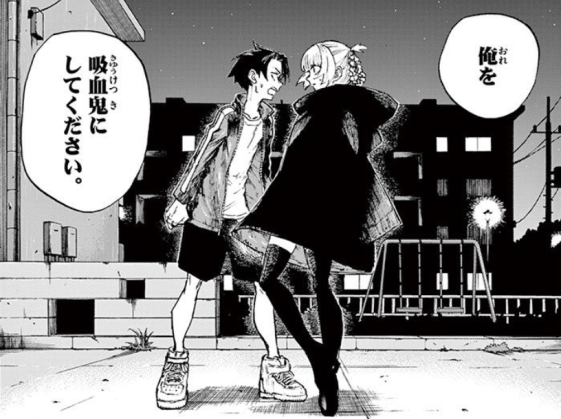
Kotoyama, the author of Japanese snack-themed manga Dagashi Kashi has a new manga: Yofukashi no Uta (“Song of Staying Up Late”), named after a song by the band Creepy Nuts. Eschewing a specific focus on a product or gimmick this time, Yofukashi no Uta maintains a similarly entertaining and humorous format of back-and-forth banter, a mysterious girl who seems out of this world, and a boy who feels stuck in place.

Yamori Kou has been having trouble sleeping lately, as if he’s missing something. His malaise causes him to inadvertently push friends away, and he wanders around at night aimlessly. He meets a girl, Nanakusa Nazuna, who seems to enjoy the evening hours with a cheerful and gregarious attitude, but who turns out to be a vampire. Nazuna gets a taste of Kou’s blood, which turns out to be unusually delicious, and after some conversation, Kou decides he wants to be a vampire himself. However, in order to be turned, he must fall in love with her.

The basic dynamic between Kou and Nazuna is that Kou is okay talking about romance but gets easily embarrassed when discussing raunchier topics, whereas Nazuna is the opposite. Their contrast is fairly similar Kokonotsu’s and Hotaru’s from Dagashi Kashi, but without the focal point provided by candy as a consistent topic. I admit that I do miss the dagashi talk, but I also understand that that can’t just retread old ground. And the way Kotoyama writes character interactions is still charming, so it’s in good hands.

One big difference between Yofukashi no Uta and Dagashi Kashi is chapter length. Whereas the latter tended to be only about eight pages or so, the former is more standard shounen manga size. It gives the manga more room to breathe, and I’m curious to see how Kotoyama does over time with more space.

I’m going to try and keep up with the series however I can. With Volume 1 on sale in Japan November 18 (along with a Dagashi Kashi collection of artwork), it’ll be a great opportunity.


Ooh, Where Does This Door Go?: Aikatsu on Parade! Early Thoughts

Seven years is more than enough time for a franchise like Aikatsu! to do an anime mega-crossover. However, it’s one thing to do the occasional crossover movie or TV special, and it’s another to make an entire series about it. Having watched the first couple of episodes, I can feel a genuine desire to celebrate and respect all aspects of Aikatsu!, but I have to wonder if they’re letting the genie out of the bottle.

The Aikatsu on Parade! Anime (based on the arcade game) ostensibly takes place in the same world as the previous season’s Aikatsu Friends! Kiseki Raki is a transfer student to Star Harmony Academy, where she dreams of becoming a great idol fashion designer. Unbeknownst to her, Raki’s sister has engineered a special school pass for her that in addition to allowing her to transform for performances, gives her access to “doors” that open up to other Aikatsu! series settings.

There’s a lot of care put into this new series to not make Raki seem like a subordinate fangirl to the previously established stars. Her fashion path, more akin to numerous side characters, doesn’t put her in as direct a  “competition” with the older heroines. Also, her personality (basically Dee Dee from Dexter’s Laboratory with a little more common sense) is strong enough to not get outshined by the characters she meets. That being said, she’s still yet to meet the titan that is Hoshimiya Ichigo, which will be the real test. I recently watched the premiere of WWE Friday Night Smackdown, which had The Rock on as a guest, and his charisma is so strong that it overshadowed even one of the biggest current stars in that company.

Perhaps the easiest place to tell that the creators are being thoughtful and considerate as to how the Aikatsu! characters would cross over is the first episode’s ending, where you see practically every significant character ever walking together. They’re grouped in rough categories according to a combination of personality and story purpose, and you can really see that it’s not shallow or haphazard.

Of course Mizuki and Elza would be with each other, and you can imagine each one firmly believing she’s the best. Given that the new series is also going to be having characters from different series singing and dancing together, it’s a golden opportunity for some dream collaborations.

I’m curious as to why they decided to make each of the Aikatsu! series distinct…universes? Timelines? Whatever it is, they establish early on that all these idol schools aren’t just in different parts of Japan—they exist entirely apart from one another, as if they’re wholly separate existences. There’s no wrong approach here, but I’d still like to know the creators’ reasoning for going this route.

Aikatsu on Parade! is on track to being a fun, excellent series that gives Aikatsu! as a whole its proper due. Still, I can’t shake the feeling that this is precarious territory for a franchise to go. Is there really any going back after this? What will it mean for the future of Aikatsu!? There’s no way to tell at the moment, but hopefully everyone in charge knows what they’re doing.

This post is sponsored by Johnny Trovato through Patreon. Top patrons can request specific topics on Ogiue Maniax.

Splatoon Live Concerts and the Expression of Character in Performance

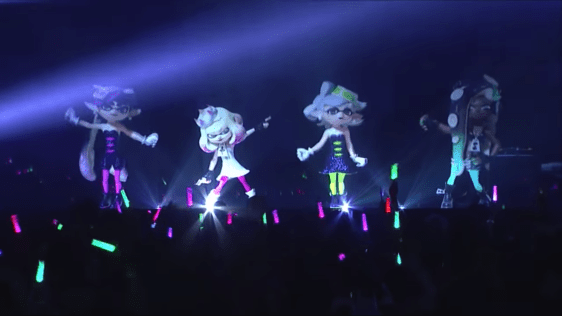
Nintendo Live 2019 in Kyoto featured two nights of Splatoon concerts with holograms of the Squid Sisters and Off the Hook performing onstage. It’s not the first time both pairs have been together, but watching this event made me really appreciate the care put into expressing the individual differences between the characters in accordance with their musical styles.

Off the Hook and Squid Sisters (or Tentacles and Sea o’ Colors in Japanese) are very different groups. Pearl as MC and Marina as DJ have very distinct roles in Off the Hook such that their movements are heavily contrasted with each other. Pearl is fiery and aggressive while Marina is laid-back and soulful, and everything about them screams hip hop, which traditionally has liked to draw a sharp distinction between its musicians. There’s really no confusing the Pearl and Marina, and their performances put a bright spotlight on their individuality.

Squid Sisters, however, are more akin to a Japanese idol group, and so their performances are more synchronized and feel more choreographed. At the same time, every so often, you’d see a small difference in movement—an extra bit of flourish from Callie or a more composed and precise gesture from Marie. It’s especially noticeable at times when both are cheering the audience on, and Callie is bouncing up and down as Marie’s feet stay firmly planted, such as in the video above. The differences between the two are relatively subtle as a result, and idol fans eat this sort of thing up.

Adding these small quirks to Callie and Marie is all the more impressive because a lot of fictional idol media don’t really bother to do the same. When watching an episode of Love Live! or Aikatsu!, there’s often pretty much no difference in performance if two or more characters are doing the same routine in the same song. We’re sometimes told that there’s a difference, but it’s not really shown.

From idols to hip hop and beyond, the musical acts of Splatoon are given presence and personality. This is taken into consideration even in the live concerts. It makes me wonder where a Splatoon 3 will go genre-wise, and I anticipate what Nintendo has in store.

Day 2 Full Concert

Pump Up the Jam: How Heavy Are the Dumbbells You Lift?

Sports anime have been a pillar of Japanese animation since its earliest days, but very rarely, if ever, have any shows focused specifically on exercise. In comes How Heavy Are the Dumbbells You Lift?, a series that emphasizes actively pursuing fitness, whether it be at the gym, at home, or on the beach.

Dumbbell follows Sakura Hibiki, a high school girl who wants to lose weight and attract guys. Surprisingly, on a visit to a local gym, she runs into her rich classmate, who turns out to be an absolute fitness enthusiast. Together, with the deceptively handsome gym trainer Machio, they go through different exercises and approaches for achieving one’s fitness goals—and learning about the role weightlifting can play.

The series has a clear focus on the girls, and there’s no denying that sex appeal is a  fundamental part of Dumbbell. However, there’s an important distinction to make, and the best way is to compare it with another anime that puts focus on exercise: Issho ni Training: Training with Hinako. That short has the viewer watch a lightly dressed girl named Hinako, who goes through her exercise routine as the voyeuristic camera ogles her from multiple angles. But while Training with Hinako uses exercise as an excuse for fanservice, Dumbbell instead uses fanservice to promote exercise. To that end, it actually gives tips on weightlifting and other areas. In fact, the opening theme specifically points out what muscles are worked out by common and popular lifts.

Also, while the body diversity in the series is somewhat limited—the girls don’t have literally the same exact body, but they all fall along conventional ideas of attractiveness—each of them have their own reasons for going to the gym. The main character, Sakura Hibiki, wants to lose weight and look good, i.e. the most expected reason. Soryuin Akemi is obsessed with muscles (both on herself and others) to a fetishistic extent. Uehara Ayaka is the daughter of a retired boxer-turned-coach, and so exercise is as natural to her as breathing. Gina Boyd is a Russian who competes in sambo and arm wrestling, so strength training is just her way of staying fighting fit. Tachibana Satomi, their teacher, is a secret cosplayer who wants to look good for photos and fight the aging process. At the very least, the series promotes the idea that weight loss is not the sole reason to work out.

As one last aside, I once wrote that I’d be interested in a competitive bodybuilding manga because of how the posedown has a heavy psychological element. There is actually a competitive bodybuilding episode of Dumbbell, though it doesn’t quite go as far as I have hoped. Still, it’s forward progress.

How Heavy Are the Dumbbells You Lift? is not going to upend people’s understanding of weight and diet culture, but it also makes a sincere effort to teach people to exercise in ways that fit their specific situations. It’s as if the show is saying, not everyone can do everything, but as long as you’re moving and sweating, it’ll work out.

The Far Side Booth at New York Comic Con 2019

It’s extremely rare that a convention’s exhibitor’s hall, or any particular part of it, would be the highlight of my con experience. But at New York Comic Con 2019, few things brought me as much excitement as seeing a booth for Gary Larson’s The Far Side.

As far as one-panel newspaper comics go, nothing could match up to The Far Side. Its unorthodox, absurd, and at times dark humor was an incredible influence on me in ways that can’t be underestimated. Perhaps the only reason why it was a “childhood” favorite instead of a perennial one, is that it ended in 1997, in what feels like a bygone era. Before things like high-speed internet and cellphones (let alone smartphones) became commonplace, before print newspapers started folding in droves, The Far Side had already sung its swansong. Seeing it prominent in the year 2019 made me feel like my young and older selves collided—a reminder of how I came to love comics and the things I’ve discovered and accomplished because of that passion.

The actual booth for The Far Side at NYCC 2019 was clever. At the top were various recurring character archetypes from the comic’s run—cows, beehive hairdo ladies, etc.—all stretching out their cheeks and sticking out their tongues. On a wall were four displays, each cycling through different Far Side greatest hits. One of those comics, in which a child at “Midvale School for the Gifted” is trying to push open a door with a giant sign above that says “PULL,” was faithfully replicated at a life-size scale so attendees could reproduce the panel.

This display came on the heels of an announcement that The Far Side is coming back in some form, but what exactly that means is still unknown. Gary Larson famously didn’t like putting his work on the internet, so it might just be him finally catching up to the world and having some kind of singular online resource. If it’s actually new The Far Side comics, well that’ll just make my year.

It Was Me, Jin! It Was Me All Along!: Hashikko Ensemble, Chapter 20

Why fight when you can sing? It’s Hashikko Ensemble Chapter 20!

Summary

Tsuyama (of the Mimi-sensei-loving quartet) and Orihara fight under the former’s mistaken belief that the latter sexually assaulted Mimi-sensei. Evenly matched, the situation is eventually defused when Mimi-sensei herself explains that nothing happened and Hasegawa lied about Orihara squeezing Mimi-sensei’s breasts. Tsuyama and his friends still discover it’s Shion who’s the true “culprit,” but at least a couple of them don’t seem to mind at all.

Jin uses the audience gathered from the fight to his advantage, and suddenly announces a 4 vs. 4 singing competition between the Chorus Appreciation Society and Tsuyama’s group.

We learn in a flashback that Tsuyama is actually a pretty good singer, but they’re not exactly ready for this contest. The music teacher Takano-sensei offers to help them. Also, unbeknownst to his friends, the gorilla-like Ogawa (nickname “Ogre”), goes to the Chorus Appreciation Society for help in learning how to sing better. The reason: he doesn’t want to hold the others back. Jin begins teaching him about how to deal with being out of tune.

Back in the present, Tsuyama’s group are about to sing “Cherry” by the Japanese pop group Spitz (Mimi-sensei’s favorite band) against the Chorus Appreciation Society’s “Viderunt Omnes,” when suddenly, Ogawa hands his microphone over to Akira, in what looks to be a shocking betrayal!

Not the Best Handling of Rape as a Subject

I want to preface this minor criticism by saying that I don’t think Kio Shimoku is trivializing or supporting rape in any way, and what I sense from the story is that this little fiasco is more about a false rumor run rampant. Hasegawa, for her part, didn’t even say the word okashita (variously “rape,” “violated,” etc.)–it was Tsuyama who interpreted it that way.

However, given the increasing awareness we as people have about women not being believed when it comes to sexual assault, having a girl like Hasegawa start this rumor is not the best look for the series. For me, it’s not a deal breaker, and I still love the heck out of Hashikko Ensemble, but it’s potentially playing with fire.

Anyone Can Improve Their Singing

Jin makes a helpful point this chapter about how getting better at singing in tune depends on how tone deaf someone is. A person who can recognize that they’re not singing well can, over time, learn to adjust. Someone who is tone deaf, on the other hand, will need another person to tell them when they’re off, but this can still be a path to improvement.

It gives hope to folks like me who are musically challenged.

Friendship Between Misfits

While I originally thought that Tsuyama and his friends might become antagonists of sorts, that doesn’t seem to be the case. Instead, what I see is a group of people who are kind of weird and arguably pretty creepy, but who have one another’s backs. I find it touching that Ogawa thinks so highly of Tsuyama (who encouraged him to work out so that no one could belittle him) that he would go to the enemy for help in learning how to sing. In a way, it’s like these guys are the cast of Genshiken, only all of them are like 10-15% Kuchiki. The clear path is for at least some of these guys to eventually join the Chorus Appreciation Society, but I wouldn’t be surprised at a few twists and turns.

Also, the fact that two of them are into yuri but two of them don’t seem to care that much makes for a small but interesting distinction among their group.

Songs

As Mimi-sensei talks about her fondness for Spitz, the following songs get mentioned:

“Cherry”

“Robinson”

“Sora o Toberu hazu” (“You’ve Gotta Be Able to Fly”)

“Viderunt Omnes” is also brought up again. Orihara basically refused to sing anything else.

Final Thoughts

Despite all the weirdness with Hasegawa, her running commentary for the Orihara-Tsuyama fight is a highlight of this chapter. The way she compares Orihara’s enormous strength to Tsuyama’s speed and technique fills me with glee.

I highly doubt that Akira is doing any sort of real heel turn, but I’m looking forward to how it pans out. I assume that friendship will win over all, and Shion will gain some strange new guardians.

The Real Pressures of Being Asian-American: American Born Chinese

Gene Luen Yang is a comics creator I hold in high esteem thanks to his work on The Shadow Hero and the Avatar: The Last Airbender comics. I know him as a writer who strives to make Asian voices heard, and who depicts the Asian experience as something natural and relatable, as opposed to foreign and exotic. Recently, I read American Born Chinese, Yang and colorist Lark Pien’s 2007 award-winning comic, it resonated with me on a very deep and fundamental level. It’s to the extent that I have to wonder if the story it tells—and the tools it uses—are not intrinsically understood by those for whom race is neither an active or even passive issue.

American Born Chinese tells three seemingly disconnected narratives. One is about the Monkey King, loosely based on the classic novel Journey to the West, and his attempts to prove himself the equal of the gods. Another follows Jin Wang, a Chinese boy born in San Francisco’s Chinatown whose family moves to a predominantly white neighborhood. Jin has to balance his desire to be more like the other “normal” (read: Caucasian) kids against his friendship with a Chinese immigrant classmate named Wei-Chen Sun—particularly when it comes to his crush, a white girl named Amelia. The last is about a boy named Danny who is exasperated by his cousin Chin-Kee, a bizarre figure who seems to embody every awful Chinese stereotype. The three stories eventually come together in an interesting way, highlighting a common theme between all three: the pressure, both internal and external, to change yourself to match what the world says is worth something.

What I find interesting—and extremely personal—is that while the end of the book hammers home the idea that you should love who you are, its specific lens made me feel in my marrow each signal and hint at the conflict Asian-Americans have in terms of cultural identity. The name of the book itself speaks to a common distinction made among Chinese-Americans, those who were born in the US and embrace or at least assume its values (American Born Chinese, or ABCs) and those who have immigrated from China or Chinese-speaking places (Fresh off the Boat, or FOBs).

Growing up, if you were an ABC, you never wanted to do anything that could be read as FOBbish—which was made all the more complicated if you were first generation and your parents immigrated. Wearing clothes that were too Chinese meant you were a FOB. Speaking with an accent, or even in an imperfect way, meant you were a FOB. Kids didn’t know or care that maybe you just mumbled—it all sounded like “ching chong” to them. The American culture and even some Chinese adults to a certain degree communicated the idea that whiteness or a facsimile of whiteness was something to aspire to. Combined with the Chinese spirit of hard work, it was meant to be a recipe for a kind of success. At the same time, the terms ABC and FOB were primarily used among Chinese and Asian kids, almost like we were trying to self-police our collective behavior.

Jin’s initial reluctance to getting to know Wei-Chen reflects this fear of being seen as “too Chinese.” Wei-Chen tries to talk to Jin in Chinese, only for the latter to reply that he should speak English in America. As an immigrant with an accent and different cultural norms, Wei-Chen is basically everything Jin’s trying to run away from. When Wei-Chen then starts achieving things that Jin cannot or believes he’s not American (i.e. white) enough to do, and when Jin encounters racism from those he considered close, it flips his world upside down.

The Monkey King’s increasingly desires to be accepted by the gods. He learns mystic arts and all the things gods are supposed to be able to do, but they still only see him as a monkey. At the same time, he tries to correct his monkey-like behavior—for instance, by wearing shoes. The parallels between Jin and the Monkey King jumped out at me immediately, though I wonder if that’s the case for all readers.

Chin-Kee’s role initially seems to be highlighting racist imagery of Asians. There’s even a kind of laugh track at the bottom of every panel he’s in, as if you’re watching a sitcom with a wacky cousin. But as the story unfolds, his purpose becomes clearer: he embodies the fear that many Asian-Americans have about their image of American-ness showing cracks. If only they could just keep that side of themselves hidden, the world wouldn’t question whether they belong.

There’s an early scene in the comic where Jin is eating dumplings, and a couple of white kids make fun of him for it, even going as far as to say they’re made of dog meat. Chin-Kee is basically the personification of the shame Jin feels in that instant. Dumplings would be innocuous in China or other countries, but they become a barrier to acceptance in his mind.

While it never quite got that bad for me in my own life, I recall questioning why my family would sometimes eat steamed buns for breakfast, when American TV told me it should always involve muffins or something. My parents tried their best to provide a life that was both Asian and American, but on more than one occasion, I would ask, “Why do we have to eat rice so often?” It was only after I came back from my first year of college that I realized what a blessing daily rice and a home-cooked meal from my parents’ culture could be.

In 2019, Asian acceptance is at a high. Between cultural shifts that call to attention subtler forms of racism to successful films and TV shows starring Asians without the need for kung fu, things have changed. But there’s still an Asian-American experience whose trials and triumphs build day by day, and whose specifics may not be communicable to those unfamiliar with such a process. While it may never be entirely possible to bridge that gap, I hope we continue to build.

Trick and/or Treat: Halloween in the Aikatsu! Franchise

Note: This post topic was requested by Johnny Trovato through Patreon. If you’d like to see a particular topic on Ogiue Maniax, consider becoming a sponsor.

One of the interesting things about the 2014 Aikatsu! Episode “Halloween Night Party”  is how it showed that the holiday was relatively new in Japan. Characters repeatedly translate the English “trick or treat” into a Japanese explanatory sentence as if to hammer home the concept. The first few seasons of Aikatsu! didn’t even have Halloween episodes. But it’s been five years since then, and while it hasn’t been a straight line, the concept of “Halloween” is integrated into Aikatsu! pretty thoroughly. At the same time, the degree to which they embrace Halloween varies significantly, as if it’s unclear from year to year how much they should push for Halloween.

2015’s “YOU! GO! KYOTO!” perhaps barely qualifies as a Halloween episode. Instead, the focus is on a trip in Kansai, where the main trio gets together with Hattori Yuu, a friend of Akari’s who’s made a name for herself as a “tour guide idol” of sorts. The girls help her out with a Halloween special, and they do a themed performance as a follow-up. The lack of “trick or treat” is noticeable.

2016’s “Halloween Magic” returns to the Halloween episode format from 2014, albeit with an entirely different cast of characters in Aikatsu Stars! Not only do they bring back explaining what “trick or treat” means, but they even include a special competition just like in “Halloween Night Party.” This episode stands out to me more than any of the others simply because of Rola’s taiyaki outfit, seen above. Taking a relatively serious character and having her go around in the most ridiculous getup without even batting an eye speaks to her character having a certain charming roundedness. I have to wonder if maybe the concept of Halloween needs to be introduced again for newer, younger viewers coming in. Also, while “Halloween Night Party” made a reference to Michael Jackson’s “Thriller,” “Halloween Magic” has one of the characters moonwalk while doing MJ-style “Whoo!”s, as if to say that the King of Pop is as much a part of Halloween as pumpkins and candy.

2017’s “Halloween Surprise” from Aikatsu Stars! places extra emphasis on the “trick” in “trick or treat,” albeit without actually using the words. The second half of this particular series involves a rivalry with another idol school, so the idea of competing takes on a new dimension in this Halloween episode compared to previous ones. Here, participants lose when their heart rate goes over a certain level, so the two sides have to try and scare or surprise one another. It’s kind of a twist on the original formula, and it does a decent job of acting as the stage for a bit of character growth on the character Koharu’s part. There’s a greater emphasis on using Halloween as an opportunity for pushing storylines compared to previous years. Also, for some reason, they reuse the costumes from the previous year. Could it be out of convenience (they already have the character designs laid out), or perhaps the costumes were just that popular?

2018’s “Aine’s Halloween Panic” from Aikatsu Friends! Incorporates Halloween into the show pretty thoroughly without drawing a ton of attention to it. Aine, the most recent heroine, has split off from her Aikatsu partner Mio so that they can train separately and come back stronger than ever. For this purpose, she plays the part in a TV special of a girl who discovers her senpai is a witch. The magical focus is the clear tie to Halloween, but once again there’s no “trick or treat.” In fact, there’s only one trick, as Mirai (seen above) tries to scare a couple characters during the episode. They treat Halloween as the most natural thing—is it a sign that it’s approaching Christmas in terms of cultural integration in Japan?

Looking at all these episodes, a couple things stick out to me.

First, it really is a shame that Yurika, the vampire-inspired idol from the first series, didn’t get any Halloween episodes when she was a more common character due to the relative lack of exposure for the holiday.

Second, the notion of “trick or treat” as a package deal seems to ebb and flow, but its constituent parts, i.e. pranks and candy, remain. One thing worth pointing out is that the tradition of going door to door to trick or treat never took hold in Japan, so maybe it’s no surprise that it would end up as something less codified. That being said, I’m aware that even in the US, trick or treat (especially in big cities) is more organized these days for safety purposes.

So what remains is the aesthetics of Halloween, costumes and all, with a cultural twist. That includes a taiyaki costume, and there’s even one girl in Aikatsu Friends! who dresses as a jiangshi (Chinese hopping ghost popular in Japan). Also, I guess Michael Jackson is part of that aesthetic as well.

Given that the pattern for Aikatsu! Halloween episodes exists, but that each year puts its own spin on the idea, I’m curious to see what direction this year’s takes. Because 2018’s Aikatsu Friends episode took a less upfront approach, could this one be more in the classic style? And with the new giant crossover series Aikatsu On Parade! on its way in 2020, Halloween Idol Activities might very well combine the styles of all previous shows.