OGIUE MANIAX

Anime & Manga Blog | 50% Anime Analysis, 50% Ogi

America the Moeful: Genshiken Volume 21

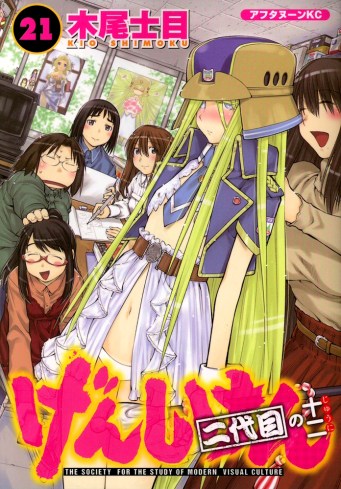
genshiken21-cover

Chapter 127 may have been the end of Genshiken’s serialization, but that doesn’t mean it’s all over yet! As fine patrons of the Society for Modern Visual Culture know, the volume releases always come with extras. So, I’m going to give my thoughts on some highlights.

First and foremost, it is absolutely necessary to talk about the cover, which features Sue in a somewhat bizarre cosplay of Ritsuko from Kujibiki Unbalance. It certainly doesn’t look like any prior incarnation of Ritsuko from Genshiken, and that’s because…it isn’t.
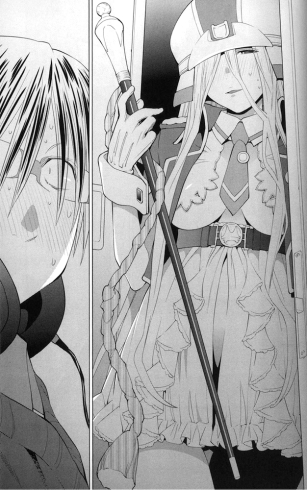
spottedflower-sexycosplay

The cosplay actually comes from the thinly veiled alternate universe Kio Shimoku manga Spotted Flower. For those unfamiliar with it. The premise basically asks, what if a person very similar to Madarame married someone just like Kasukabe? In it, the unnamed wife, pregnant and sexually frustrated, winds up seducing get husband in that very same outfit.

In other words, Sue (who has become Madarame’s girlfriend) is cosplaying a cosplay worn by a parallel universe Madarame’s wife as a way to get some nerd boott, who is in turn a reference to Kasukabe and her Ritsuko cosplay from Genshiken, which is the defining moment when Madarame fell in love with her.

Talk about peak meta. And we haven’t even opened the book!

Inside, you have the standard comic strips between chapters. I won’t go through all of them, but I do want to draw attention to my favorites. genshiken21-ninjaslayer2First is one where Yoshitake mythbusts every idea that Sue has about ninjas. In reaction, Sue makes a Ninja Slayer reference: “Kill all ninjas! Yeeart! Guwah!”
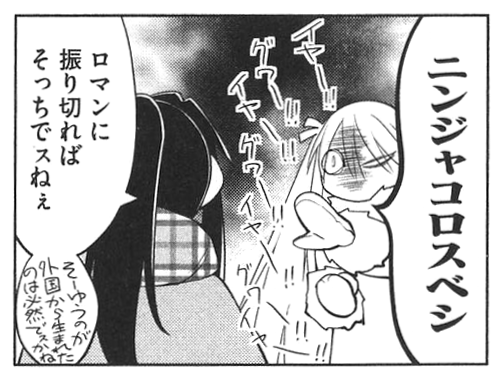
Here we have Sue, an American otaku, referencing a book series that was supposedly created by Americans who love Japanese culture, which was then translated into Japanese, buy is actually a satirical look by Japanese creators at the American obsession with ninjas. Did I say we hit peak meta before? I might have been mistaken.
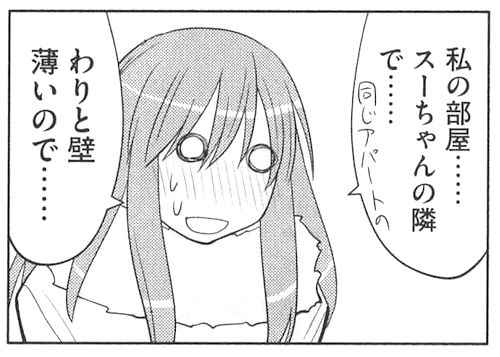
genshiken21-hatowarning

The second is after Madarame and Sue start dating. Hato gives some helpful advice, just in case: “Sue lives next to me, and the walls are thin, so keep that in mind.”

This leads to the final post-chapter content, which caps off Genshiken Nidaime. In the last series, it revolved around a discussion of whether Kasukabe is moe. This time, it has to do with how pathetic Madarame and Kuchiki are in different ways.

At his graduation after-party, Kuchiki brags that he has taken Madarame’s first kiss. Ohno exclaims that surely Sue’s more than made up for that deficit, but this is far from the truth. Not a kiss (let alone anything else) has happened, and the members of Genshiken contemplate just how much of a wimp Madarame is. Kuchiki gets upset over the fact that he never got a girlfriend in college, and has the gall to ask Ohno once again if he can touch her boob, just once. Ohno, unfortunately, is very drunk (as tends to be the case with her at parties), and she actually agrees, going so far as to comply when he asks if she can remove her bra partway underneath her sweater. However, Kuchiki makes his attempt, Yajima gut checks Kuchiki. Sadly for Yajima, all this does is awaken a new fetish in Kuchiki. Everyone is happy that he’s graduating and going away.

I kind of wish that the last moments of Genshiken didn’t have Kuchiki at the center, but it isn’t all bad. In particular, I like the notion that Madarame still hasn’t quite gotten over his awkwardness with girls. In fact, the very idea of him having a girlfriend has probably short-circuited his brain. And if anything, it makes me very aware of just how dramatically Sasahara and Ogiue’s relationship escalated once it hit the threshold. The two of them literally starting having sex with each other once they got on the same page, which is probably not the image we ever had of otaku.

The last things I want to talk about are the extras I received with Volume 21.

genshiken21-koumekeito

I ordered from the Japanese comic store Comic Zin, and with it came a 4-page bonus illustration featuring artists associated with the Genshiken universe. It has Koume Keito (artist of the Kujibiki Unbalance manga), Yagumo Kengou (artist of the Kujibiki Unbalance light novel), as well as Kio himself. It also features a message from Tamaru Hiroshi, creator of Rabuyan, a manga about a Madarame-esque loser.

First editions of Volume 21 also get a version of the “Thank You Messages” compilation that came with the final chapter in Monthly Afternoon. It also features brand new color art for its cover, featuring most of the now-gigantic cast of Genshiken. I love the drawing of Ogiue on here; she honestly looks so cool.

So that’s that. I’ll see you (hopefully) in January, as I start my look back on the first Genshiken. But before that, I still have another post to make, about Kasukabe Saki. Keep an eye out!
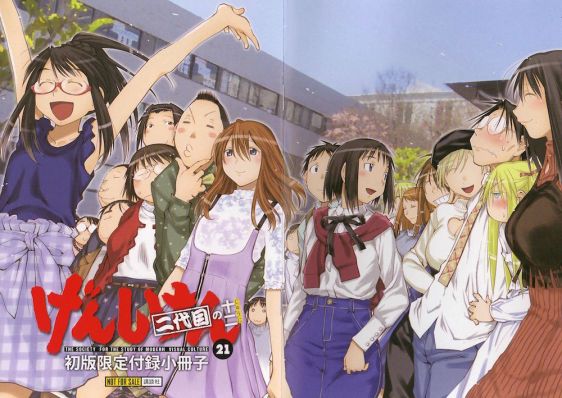
genshiken21-thankyoubook

If you liked this post, consider becoming a sponsor of Ogiue Maniax through Patreon. You can get rewards for higher pledges, including a chance to request topics for the blog.

Save

Save

New York Comic Con 2016 Essay #3: The Artist Alley vs. My Expectations

For this year’s New York Comic Con (which is now months ago, whoops!), I’m doing something a bit different with my coverage. Instead of doing a standard con report, with overviews and opinions on panels, artist alley, etc., I’m going to be writing a series of essays based on things I saw at NYCC 2016. Think of it like extended thought exercises and musings inspired by the con.

While manga is closest to my heart, I love comics in general. Even if individual titles aren’t my cup of tea at times, and even if I find myself going back to Japanese comics more often than not (for reasons both rational and irrational), I never want to stop giving different types of comics a chance. This is one of the reasons I’m generally eager to visit the Artist’s Alley at New York Comic Con. Though it’s been years since I looked forward to Wednesdays (the day when new comics in America come out), I still opened myself up to the artists of NYCC 2016 with a simple desire: I wanted to be wowed, to be drawn to them and convinced to read more.

Perhaps I set too unfair a standard for myself and for the artists there.

I want to emphasize that I think the New York Comic Con Artist’s Alley is full of incredible talent. These are hard-working artists, each of whom have their own stories when it comes to how they came to comics. Also, given that NYCC is built on American comics culture, a lot of it would be the things you’d expect: superheroes, graphic novels, and certain approaches to cartooning and anatomy that have grown out of the American tradition. I think all of these things are great and have their own unique strengths worth exploring, but when it came time to find something that, pardon the cliché, spoke to me, I just wasn’t able to.

I feel that the decision-making process I went through as I looked from booth to booth was vague, even to myself. It’s not that I had any specific criteria. For example, I enjoy seeing comics about cool girls doing cool things, but I’d find that the particular arrangements that existed in the Artist’s Alley fell into recurring categories that made them all blend together to a certain extent. If they weren’t female superheroes, they were girls who wanted to show how much they defy gender expectations. These are both very good things, but it’s as if, in the rush to seize these ideas and the momentum they carry (whether for profit, social consciousness, desire to create interesting stories, or something else entirely), they ended up collectively dulling the product in my eyes.

I believe that a lot of the problem lies with me. When you distance yourself from something as I have, you tend to look at it in broader strokes. The opposite is often true if you get too deep into something. For example, when it comes to anime I’m a long-time Gundam fan. I’ve seen nearly every series, and I appreciate the subtle nuances and varying approaches that they bring, for better or worse. To someone outside of Gundam fandom, it just all looks like robots fighting wars and characters giving speeches. Thus, when I looked at Artist’s Alley as this well of potential to bring me back into the fold, I think I was expecting it to have much more of a gravitational pull than it had any right to. After all, if you’re at an Artist’s Alley at New York Comic Con, it’s natural to assume that you should already be into the stuff. It’s not the responsibility of the artists there to “convince me” to give American comics more of a chance, only to convince me to check out their work.

I still plan on taking a similar approach to Artist’s Alley next year with some adjustments. Instead of hoping for something to call out to me and speak directly to my soul, I’ll drift towards anything that catches my fancy. I shouldn’t expect a revolution, but I should at the very least leave the door open for minor reforms.

Idol Activities are Serious Business: Aikatsu Stars!

aikatsustars-op

In contrasting the different eras of the popular idol anime series Aikatsu!, I once used a JoJo’s Bizarre Adventure analogy. If the original heroine Ichigo is equivalent to Jotaro, then her successor Akari is the Josuke of Aikatsu! If this comparison holds water at all, then the latest series, Aikatsu Stars!, must be the Steel Ball Run of the franchise, and therefore its main character, Nijino Yume, must be its Johnny Joestar. In other words, it’s a new world, a new setting, and all ties to past series have been more or less severed.

It’s unclear to me whether this “reset” was necessary, but then again it’s how the Precure franchise has rolled for the past 14 years. Whatever the case may be, to the discerning eye Aikatsu Stars! reveals itself to be a different beast. While it shares plenty of similarities to the Aikatsu! of years past, there are enough changes to make it feel like a new and almost separate entity.

Aikatsu Stars! follows Nijino Yume as she enters the prestigious idol school, Four Stars Academy, in order to chase after her idols, the mega-popular group known as S4. What she lacks in experience she makes up for in enthusiasm, as well as a strange potential that seems to only manifest itself when she’s directly onstage.

aikatsustars-hmph

The summary above mirrors both Ichigo and Akari’s own stories, but where it begins to diverge is that Aikatsu Stars! feels like a more serious story with higher stakes. This isn’t to say that the show is dark or cynical; they’re not poisoning each other and putting thumbtacks in each others’ lockers. However, whereas Ichigo is confronted in the early episodes by her classmate Ran’s fairly cutthroat attitude and quickly overturns it, I sense a much greater emphasis on rivalry in Aikatsu Stars! Adding to this feeling is the impact of S4 themselves. As the premier female idols, they give off the impression of being nigh-untouchable, their minds occupying a world almost beyond the reach of regular mortals. Not even #1 idol Tachibana Mizuki in the original Aikatsu! quite has that aura.

The most noticeable change with Aikatsu Stars!, however, is the new character design aesthetic. The girls and guys of Aikatsu Stars! have smaller frames and rounder features, giving them a look that feels to me be to more “gender-neutral.” What I mean is, the original Aikatsu! had designs that I see as closer to shoujo manga. Their large eyes weren’t just expressive, they were almost like miniature planets. With Yume and the rest of the Aiaktsu Stars! cast, the designs more resemble a balance between girls’ anime and bishoujo anime for guys. It’s effectively The iDOLM@STER meets Peach-Pit, the artist duo responsible for works ranging from Shugo Chara (shoujo) to Rozen Maiden (seinen featuring cute doll girls).

aikatsustars-s4

While the characters are all different and look different, there’s one semi-subtle link to the franchise’s lineage, which is that the girls of SF4 match the main four in original Aikatsu in terms of hair color. Blond, blue, red, and brown are all present, and although their personalities don’t really line up at all, it can’t possibly be a coincidence.

There are a couple of other differences which I think make Aikatsu Stars! rather interesting. The first is the greater prominence of male idols. Yume meets a boy who turns out to be a member of M4, the top group from the academy’s male division. The previous Aikatsu! as far as I know only barely bothered in male characters. Is this the influence of successful male idol spin-offs, such as Pretty Rhythm: King of Prism?

aikatsustars-sensei

The second is that the series implies a greater and more diverse range of possible idols. Sure, Aikatsu! has things like an American idol, and one who likes to dress as a vampire. But Aikatsu Stars! has a teacher who has a rock background, and the first ending theme is an S4 dubstep song. What other possibilities exist? I want to find out.

Aikatsu Stars! feels more tightly focused and more dramatic, but I do wonder if this comes at the cost of the more lighthearted fun of the original series. That being said, there’s nothing so far that tells me it’s going to plummet or lose its footing. I look forward to seeing Aikatsu Stars! build on itself, and even if the episodic hijinks don’t feel as strong, it looks on-track to being a more polished work overall.

This post was sponsored by Johnny Trovato. If you’re interested in submitting topics for the blog, or just like my writing and want to support Ogiue Maniax, check out my Patreon.

Save

‘Tis the Seasoning: Ogiue Maniax Status Update for December 2016

Is it December already?! It actually feels like I just got done writing the update for November, and now we’re at the end of the year. Much love to all of my sponsors on Patreon for being with me for the entire year!

General:

Johnny Trovato

Ko Ransom

Alex

Diogo Prado

Viga

Yoshitake Rika fans:

Elliot Page

Hato Kenjirou fans:

Elizabeth

Yajima Mirei fans:

Machi-Kurada

November was the 9th anniversary of Ogiue Maniax, so I wrote my thoughts on how the blog’s been going and where I think it’ll head next. I’ve since reflected a bit further on what I said there. While I primarily look at Ogiue Maniax as a place to share thoughts and ideas, I think I’ve been a little sparse in terms of denser, heavier content as of late. I’m looking to write better and with greater insight as I move forward, but also balancing it out with shorter, lighter posts, much like a three-course meal.

It was a long time coming, but I finally posted my feelings on the dismissal of Precure as insignificant because it’s not Sailor Moon. As a fan of both I feel like this is a recurring issue, and I hope that magical girl enthusiasts and just anime watchers in general can come to appreciate Precure better.

I also began my pseudo-series of posts about characters I love, with Inukami Kyouko from the volleyball manga Shoujo Fight. As Ogiue Maniax was built on a foundation of character appreciation, I felt that it was kind of a nice return to my roots, so to speak.

This month’s Patreon-sponsored post sees me tackle the third season of Aikatsu!, which passes the baton from heroine Hoshimiya Ichigo to young upstart Oozora Akari. I mostly talk about the idea of switching protagonists and how the series handles it.

Finally, I want to give attention to something I wrote the day before the US presidential election. Even after all the chaos that has ensued, I want people to read it and perhaps take it to heart. I think it is all too easy to want to silence others if one believes others to simply be hateful and ignorant, but that merely creates greater animosity in my opinion. It’s ostensibly an anime-related post because I talk about Legend of the Galactic Heroes!

Look forward to the rest of December’s posts! I’ve got a new Anime Secret Santa review on the way, my annual “best characters of the year” post, and more!

Why Keijo!!!!!!!! Impresses Me

keijo

Keijo!!!!!!!! is an anime about girls in swimsuits fighting using only their breasts and butts. By all rights, it should be one of those T&A anime that no one should take seriously. However, what separates Keijo!!!!!!!! from many other fanservice anime, and why I’ve surprisingly come to enjoy it (well beyond the sex appeal) is that it actually explores its own fictional sport of butt fighting.

When it comes to a lot of “sexy fighting girls” anime, the combat elements usually act as mere pretense. As they kick and punch and hurricanrana their opponents, clothes go flying, buttocks are exposed, and the result is fights that act primarily as a vehicle for titillation. In many cases, the fights themselves only serve the purpose of showcasing the girls’ flexibility. Keijo!!!!!!!!! in contrast takes almost the opposite approach, by having butt fighting as its foundation and trying in earnest to make actual exciting fights out of it.

Even before the actual battles are taken into account, there a number of notable factors that contribute to Keijo!!!!!!!! treating its premise as more than a flimsy throw-away. First, while the subject of feminism in Keijo!!!!!!!! is up for debate, one thing is clear: the body type diversity in the series is well beyond what you normally find in something like Ikkitousen. From this comes an idea stated in the series: girls of all shapes and sizes can succeed in the sport of Keijo. Second, different characters come from different athletic backgrounds. The heroine Nozomi is a former gymnast, while her friend and rival, Sayaka was a judoka. This is then reflected in their fighting styles. Third, the girls have to train to win, and make use of their own unique strengths and weaknesses.

When the fighting occurs, the fanservice almost (but certainly not entirely) takes a backseat to the action. While slower moments in the series are more than willing to revel in the girls’ physical features, at times the actual competition is so swift and the animators so dedicated to showing off the overall setting and choreography that there’s less time given to even ogle the girls. In many cases, similar series are more than willing to just leave a camera in an awkward position for extended periods of time, but Keijo!!!!!!!! will, at least half the time, prioritize the excitement of the sport itself. 

I have not read the manga, where still images of course can linger into eternity, so I don’t know how the balance of action and fanservice is treated there.

Combined with characters that have unique and interesting motivations—as well as the ability to garner genuine interest in how Keijo works as a competitive field—the result, I imagine, is that many people who watched it purely for sexual thrill or for the sake of irony have come to genuinely enjoy it. In this respect, it reminds me of Food Wars!: Shokugeki no Soma, where a love of food and a deft hand when it comes to portraying naked bodies go hand in hand.

It would be ridiculous to pretend that Keijo!!!!!!!! isn’t a fanservice anime. Anyone who does would either have to be in serious denial or woefully ignorant. However, much like one of my favorite series, Shinkon Gattai Godannar!!, the whole thing—the thrill of the story, the passion of the characters, and, yes, the attractiveness of the girls—all comes together to form an actually engaging experience.

Save

Save

The Wacky (Not Wacky) World of Macross Delta: Ogiue Maniax on the Veef Show Podcast

macrossdelta

I recently made another appearance on the Veef Show to talk about Macross Delta. There, we discuss the ups and downs of the show, and I learn about fan reception to the series, as well as the illicit dealings of the owners of Robotech. Join us!

Save

Giver of Thanks: Ogiue Maniax Status Update for November 2016

November is anniversary month for Ogiue Maniax, but I’ll be saving that for its own dedicated post (if I remember, that is. Someone please remind me!).

A big thanks to this month’s Patreon sponsors. You might not understand how much I appreciate your help, but I’ll explain at the end:

General:

Johnny Trovato

Ko Ransom

Alex

Diogo Prado

Yoshitake Rika fans:

Elliot Page

Hato Kenjirou fans:

Elizabeth

Yajima Mirei fans:

Machi-Kurada

Before going into an overview of my favorite posts of the month, I want to talk a bit about my appreciation to my readers for being curious as to what I have to say. As I go through life, I meet more and more anime and manga fans of different tastes and philosophies, but often I feel it can be difficult to engage in conversations about the nitty-gritty of anime and manga as ways to explore thought, society, emotion, and more. Talk about anime and manga floats at the surface, or, if it delves deeper, is often connected to value judgments or inside looks at the mechanics of industries. I know my audience isn’t especially large, but I am grateful that the topics I’m interested in at least pique your curiosity.

That being said, I know I’m really bad at responding to comments on a frequent basis, and I intend to work harder at fostering actual conversation on Ogiue Maniax. Also, because I’ve been more review-heavy as of late, I’m wondering if this is steering away from the strengths of the blog.

As for this month’s post highlights…

First, at long last, is a final review of one of my favorite manga in recent memory: Mogusa-san. If you love food manga, this is right up your alley.

Second, out of the many films I watched over October, Miss Hokusai has to be the one I enjoyed the most. ALso, check out Kizumonogatari Part II and Shin Godzilla.

Third, I took a different approach to covering New York Comic Con this year, and have been writing response essays to things that caught my attention. If you like giant robot toys, check out my thoughts on Soul of Chogokin Voltron and Megazord.

Lastly, I wrote a bit about Star Ocean EX, and just how 2003 it is.

I’m not sure what I’ll have in store for November, but I’m thinking of devoting a significant chunk to talking about some of my favorite recent characters.

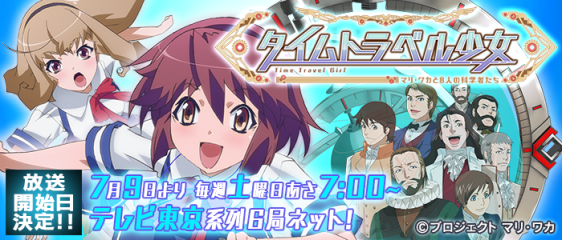
Where in Time is Thomas Edison?: Time Travel Girl Anime Review

timetravelgirl

As a kid growing up in the 1990s, there were a number of educational shows that tried their best to be cool. Some perennial favorites, like Sesame Street and Mr. Rogers, played to the beat of their own drums. Others failed miserably and came across as more cringe-worthy than anything else. But there were a handful that managed to just be “cool enough” that, while you wouldn’t brag to your friends that you were watching these shows, they still felt like they had merit and weren’t overly didactic in their “edumucatin’.” That’s exactly the territory where the 2016 anime Time Travel Girl: Mari-Waka and the Eight Scientists resides.

Apparently based on a 1983 Japanese children’s educational book called Magnets & Electricity, Time Travel Girl follows a girl named Mari as she inadvertently discovers a way to travel through time, always finding herself meeting a great scientist or inventor tied to the history of electromagnetism. As shown in the opening, the eight in question are: William Gilbert, Benjamin Franklin, Alessandro Volta, Michael Faraday, Samuel Morse, Alexander Graham Bell, Heinrich Hertz, and Thomas Edison.

In terms of look, Time Travel Girl does not seem like it comes from this era of anime, no pun intended. From the characters’ hair and eyes, to their archetypes, to even the opening itself, it looks like a show that stepped out of 2003. Placed next to older series like World of Narue or Someday’s Dreamers, it wouldn’t appear out of place at all. I think that also lends to the feeling of Time Travel Girl being a “cool” educational cartoon, because it’s like the aesthetics are a bit out-of-touch with current Japanese animation. That being said, the actual show is fairly fun and informative, and it does resolve instead of remaining open-ended. This is despite the fact that its formula makes that sort of repetition oh-so-easy.

What probably impresses me most about the series is the way it pushes the message that science and discovery are about questioning what we take for granted. By not letting assumptions (be they personal, religious, etc.) control us, it opens up pathways not only for we as individuals to learn, but also in the process creates opportunities for those in the future. A less pertinent message, but important in its own right, is that the show implicitly presents its own theory for why Thomas Edison was an asshole (seriously, look it up). There’s even a bit about slavery in the Benjamin Franklin episode.

If there’s any American cartoon series I would liken Time Travel Girl to, it would have to be Where on Earth is Carmen Sandiego? No, not the one with Rockapella, and not (despite the thematic similarities) the followup quiz show Where in Time is Carmen Sandiego? I’m talking about the one with the grandiose opening, the two kids, and the giant floating virtual head for a chief. Both it and Time Travel Girl have just enough pizazz to be entertaining, but neither are especially gripping examples of animation.

Based on my dated comparison, it’s very clear that Time Travel Girl is certainly not meant for me. However, I could actually see it being dubbed into English and broadcast on TV, as it is unabashedly an educational cartoon. I think it would do all right in that capacity, though I don’t know if we’re still at a point where the characters’ Asian origins would be removed.

If you liked this post, consider becoming a sponsor of Ogiue Maniax through Patreon. You can get rewards for higher pledges, including a chance to request topics for the blog.

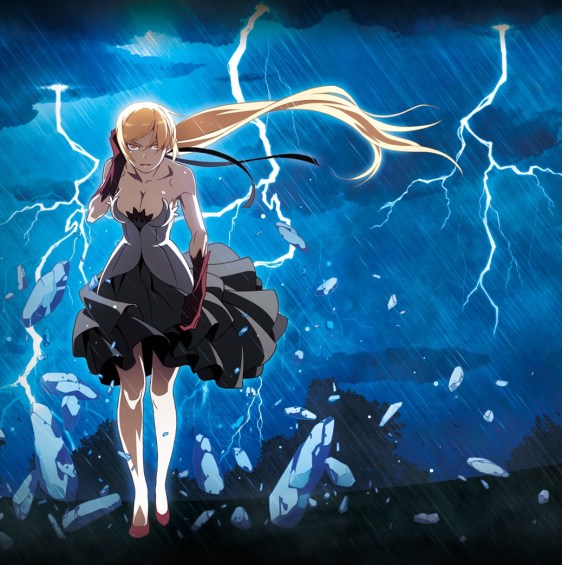
Game of Undeath – Kizumonogatari Part II: Nekketsu

kizumonogatari2

One of the many purposes a prequel can fulfill is to show how the characters we’re already familiar with came to be who they are. This is the story of light novel author Nisio Isin’s Kizumonogatari, which recounts how Araragi Koyomi, protagonist of the Monogatari series, would become embroiled in the world of the supernatural, and how his friendship with his beautiful classmate Hanekawa Tsubasa would form. In its adaptation to film, Kizumonogatari has been split into a trilogy, with the first being an introduction to the cast, and now the second covering Araragi’s realization of his newfound vampire power. Suffice it to say, this film is not meant for people to watch it without having seen Part I.

While the first film was quite violent, as we see images such as a limbless Shinobu bleeding all over the ground, Araragi writhing in agony as the sun sets him aflame, Kizumonogatari Part II: Nekketsu is much more violent in terms of the ubiquity of action scenes. Presented much like a series of video game bosses or Bruce Lee’s Game of Death progression, Araragi (with his new vampire abilities) must fight three increasingly strong opponents who have taken the limbs of his master, Shinobu. During these fights, we begin to see the origins of Araragi’s favored game plan: sacrifice his own body because its regenerative power allows him to take a lot of abuse. In Bakemonogatari, he’s much less of a vampire than he is here, so this is the strategy at its most powerful, even if Araragi’s lack of experience means he isn’t using it as well as he could. One of the other interesting aspects of Araragi’s battles is that he initially assumes himself to be the underdog, which is very much in line with this personality.

In terms of the action scenes but also many of the “slower” parts of Kizumonogatari Part II, this film is unmistakably SHAFT-esque. Ever since director Shinbo Akiyuki brought his signature visual style of sudden cuts, fragmented imagery, and head tilts to the world of Monogatari, it’s created a certain expectation for how these anime should look. With a clearly larger budget than what they get for their TV series, the fight scenes get elaborate and intense beyond what one might even expect simply reading the light novel, and even the endlessly large rooms where battles take place in the TV series feel somehow less infinite than the sets of Part II. Unlike Part I, which I found to be a good deal more amenable to those unfamiliar with or jarred by the Monogatari style, this middle part of the trilogy pretty much goes in full force. Due to how much both Nisio Isin and Shinbo love to indulge in metatextual elements, it often feels like a match made in anime, but at times I wonder if there’s a breakdown somewhere between the two creators’ approaches.

One aspect of the film that still leaves me puzzled is the way that Araragi and Hanekawa would eventually end up the way they are. While Araragi is clearly always attracted to Hanekawa and vice versa in later parts of the series, in Kizumonogatari their mutual interest is almost animal at times. By the time of Bakemonogatari, it’s still there, but somehow also a lot more cordial. Not only that, the two of them also just feel fairly different personality-wise and somewhat disconnected with the images of them I’m more familiar with. This is probably intentional, in order to show their growth. Also, while the disconnect seems jarring, Part II lays some of the foundations for what we see from Araragi and Hanekawa later on in terms of secrets and revelations.

Kizumonogatari Part II: Nekketsu suffers a fair amount from being the second part of the trilogy because the context can feel lacking and the end of the film leaves things a bit unsatisfying so that it can lead directly to the third film. However, it still ends up being a very thrilling and visceral experience in terms of both action and sexual tension. In a way, this film is mainly a transitional state, the point where everything begins to really change, but the outcome of which is still a mystery.

If you liked this post, consider becoming a sponsor of Ogiue Maniax through Patreon. You can get rewards for higher pledges, including a chance to request topics for the blog.

New York Comic Con 2016 Essay #2: Lucha Underground and Scripted vs. Unscripted Promos

I don’t talk about wrestling all that often on this anime and manga blog. Pro wrestling hasn’t been a staple part of my pop culture experience in over a decade. That being, said I do maintain a curiosity towards the state of its industry and its viewers. Who are the popular heroes (faces) and villains (heels)? What wrestling promotions are currently out there? What do the fans think? It’s this desire to keep a finger on the pulse of wrestling that prompted me to attend the Lucha Underground panel at New York Comic Con 2016, despite the fact that I had seen less than 30 minutes’ worth of material.

Lucha Underground is a current American television program that focuses on the high-flying acrobatics style of Mexican wrestling called lucha libre. The panel featured both writers and performers for Lucha Underground, most notably Rey Mysterio, Jr., the man who has become the icon of lucha libre itself in the United States. The panelists discussed what it’s like to work on the show and what Lucha Underground does differently compared to other promotions. Of these various comments, what stood out to me most was the fact that Lucha Underground is produced more like a traditional television series. Storylines are plotted out, many characters are created well in advance (with wrestlers having auditioned to fulfill those roles), and a lot of post-production is utilized to create a more cinematic experience. In other words, Lucha Underground is neither “live” in the traditional sense nor “live to tape.”

The reason I find this notable is that if you ask many current wrestling fans (and I imagine even fans of Lucha Underground) what’s wrong with WWE today, it’s that the show is too scripted. Individual wrestlers have their promos written for them, and only a select few are allowed to go off the cuff. This is a very different world from where wrestling was in eras past, where things like “Austin 3:16” and Macho Man’s “cream of the crop” were their own creations. It makes sense, given that wrestlers are in general not the greatest actors, but that they can be very good at crafting their own characters based on their own personalities, or taking a gimmick given to them and going the distance with it. The fact that Lucha Underground goes even further in the direction of being scripted (not just in outcomes, but also in long-term story planning) seems to fly in the face of this criticism.

However, I wonder if the issue is that promotions like WWE are caught in the middle, such that it lacks both the improvisational feel of old and isn’t refined enough in its narrative elements to really make sure its scripted elements are as tightly plotted as possible. This might just be a symptom of still being a live show on top of being the biggest wrestling show on air today. There’s a desire to avoid taking too many risks at the same time they understand that new blood and new opportunities are necessary, and if something awry happens they can’t just make it so that it never happened (even if wrestling storylines are always incredibly fluid). At the Lucha Underground panel, they mentioned how not having the show be live allows them to do multiple takes, and try crazy and untested ideas because anything that isn’t effective can go on the cutting room floor.

Given that this is how Lucha Underground is made, I find that this format ends up veering closer to sports anime, such as the current wrestling series Tiger Mask W. They can emphasize emotion and power in ways that don’t have to adhere to the semblance of realism (kayfabe) that still persists in other places even though everyone knows wrestling is “fake” now. By using creative camera angles, by making sure the mystic or occult elements of their universe don’t require you to suspend disbelief any more than you would a late-night drama, it perhaps allows Lucha Undeground to create an experience where its luchadores are truly “characters.” And by being characters, they can feel even more real.

If you liked this post, consider becoming a sponsor of Ogiue Maniax through Patreon. You can get rewards for higher pledges, including a chance to request topics for the blog.