Original the Comic: Kansai Comitia 48 (Original Doujinshi Event)

kansaicomitia48-doujinshi

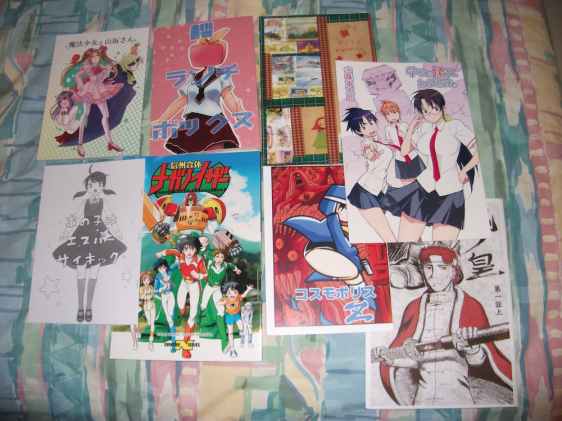
Whenever the typical English-speaking anime or manga sees the word doujinshi, a particular image comes to mind. Typically, doujinshi are associated with fan-parodies of titles both popular and niche, the realm of what-ifs that run the gamut from the silly to the sexy. However, many doujinshi are original works, and Comitia is the largest group of “original-only” doujin events in Japan. I attended Kansai Comitia 48 Osaka recently on May 15, 2016, and it was a fun learning experience. Not only could I feel the creators’ passions, but I also have come to view the importance of doujin events in a different light.

Original Doujinshi

kansaicomitia48-sakuralunchbox

While I am certainly a fan of doujinshi based on existing properties, in many ways original doujinshi are more impressive because they cannot rely on drawing in the fan bases of those works. When I think about it, my first exposure to the idea of doujinshi, the anime adaptation of Comic Party, mainly focused on original works. In that TV series, the main character learns an important lesson: making doujinshi is about what you want to do, not simply what sells. Across dozens of creators, that is exactly the spirit I saw at Kansai Comitia 48.

The event site was laid out roughly according to genre, and when you look at the categories listed it becomes easy to see the variety of interests on display. There was the “Fantasy” section, which was by far the largest, but there were also things like Criticism, Travel, Shounen, Shoujo, Seinen, SF/Mecha, Animals, BL, and so on. The first doujinshi I picked up was a record of the author’s trip to Russia, while my favorite had to be a cute romance about a girl with a bentou box for a head. The handkerchief normally used to wrap a bentou box became the ribbon that accentuated her girlish charm. One table was selling guides to girls’ school uniforms throughout Japan, and the circle that was responsible for it consisted of a mix of both men and women.

What About the 18+ Stuff?

kansaicomitia48-futarigurashi

While doujinshi often brings to my pornographic works, the Adult section at Kansai Comitia 48 was rather small. This is not that unusual, because most doujinshi made are in fact not sexual. However, even there the space for doujinshi as a place to explore one’s passions is visible, and one might even argue that it’s where such sentiments are most evident. Many of the 18+ circles were focused on otoko no ko, or boys who look like girls, and one was even solely about handsome bad guys kissing young girls. There was one artist who drew heterosexual josei-style smut, which can be rather uncommon given the sheer amount of BL that exists.

I picked up one adult title at the event, but not necessarily for the reason you might expect. The artist who drew it was actually Kakimoto Kenjirou, a published manga artist in the 1990s whose series, Futarigurashi, ran in Young Jump. It appeared that he was out of the manga game for quite a while, but here he was at Kansai Comitia drawing what he wanted, and the doujinshi I bought was actually a sequel to Futarigurashi. Here was a space where even someone with manga industry experience could continue the stories they wanted to tell, and essentially make “amateur” sequels to their own “professional” works.

A Haven of Lost Drawing Styles

One aspect of Kakimoto’s doujinshi is that, while it didn’t look quite the same as it did in the 90s, he still retained a very 90s style of manga drawing. What’s more, he wasn’t alone. Throughout Kansai Comitia 48, I saw doujinshi with characters that looked like they came from bygone eras of manga and Japanese pop culture. One artist created a giant robot themed after Nagano Prefecture, Naganoizer, and was clearly inspired by 80s anime artists such as Mikimoto Haruhiko (Macross, Gunbuster, Kabaneri of the Iron Fortress). Another artist’s style was closer to 70s shoujo legends such as Hagio Moto and Takemiya Keiko.

In the actual professional manga industry, failing to change one’s styles with the times comes at a risk. While popular creators such as Miuchi Suzue (Glass Mask) or the aforementioned Hagio and Takemiya still draw in the same style as they did in the 1970s, many have clearly made shifts over time that correspond with trends in manga as a whole. For better or worse, events like Comitia are where those older styles can still exist, away from the pressures of having to pick up on what’s popular. While some are able to sell doujinshi at a profit, that is the exception. Most doujin artists make doujinshi purely as passion projects.

Comparing with Artist Alleys in America

kansaicomitia48-cosmopolicez

I’ve been to quite a few Artist Alleys in American anime conventions, and while you can get a good variety of styles, for the most part I tend to see many similarities in how artists approach works there. Perhaps it has to do with the fact that anime fandom has a rather high turnover rate where many grow out of it as they get older. This is not to say that American anime con artists lack variety, or that they all draw in an “anime” style, but the result is you don’t really get those 80s/90s-style holdouts.

A better comparison would be with the artist alleys at places like New York Comic Con, because you’ll often see artists who are inspired by past generations maintain those styles. For example, you’ll often see artists who love Jack Kirby and aim to maintain his style. They will pepper their drawings with Kirby dots, dynamic poses, and other signature characteristics of the King’s drawings. Similarly, at Kansai Comitia 48, you had artists who still believed in those older styles. Whether it’s because they refuse to adapt or can’t, the result is a window into a different world that is not so much experimental as Indie comics in the US tend to be, but are basically different shades of mainstream from older generations.

If you liked this post, consider becoming a sponsor of Ogiue Maniax through Patreon. You can get rewards for higher pledges, including a chance to request topics for the blog.

Mascot Analysis: Japanese Moving Company Aggregate “Hikkoshi More”

NOTE: I want to be upfront about what follows in this post. I was recently contacted by a promotional company, asking if I could mention a couple of their websites on this blog for pay. I agreed to do so, knowing that this is part of the SEO game.

While I normally wouldn’t accept an offer to just promote something, what caught my attention was that I was requested to make posts specifically because of their purposeful usage of manga and anime characters in marketing. I’m always fascinated by this topic, especially when it comes to Japan where cute fictional cartoon spokespeople are much more ubiquitous across all age groups. Because the types of mascots used can say a lot about a company and who they’re targeting, I decided it would be worth writing about.

I also want to emphasize that I have not used the service below, Hikkoshi More, so I can neither endorse it or advise people away from it.

I hope this makes everything clear.

In the English-speaking world we have sites like Orbitz and Hotels.com that aggregate various offers and prices and present them in one place, allowing users to choose from hundreds of offers. Hikkoshi More serves a similar function in Japan, except it’s for moving rather than traveling. Hikkoshi More is meant to help users to find the right moving company that suits their needs and finances.

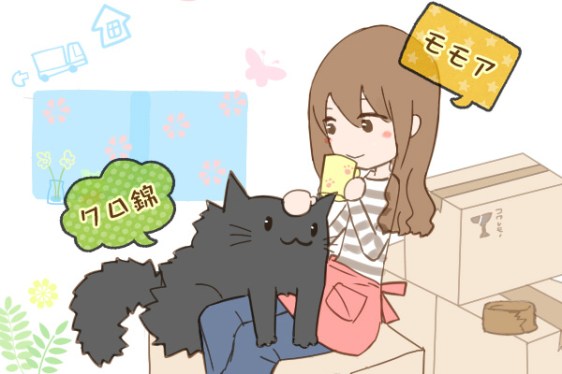
I came to understand the purpose of Hikkoshi More because of the comic on their website, which explains what they’re all about. Sadly, it does not involve shipping the shipping companies, and is instead a parody of the Legend of Momotarou using the site’s mascots, Momoa (the girl) and Kuronishiki (the black cat).

img_peach_kuroneko06

In this story, “Kuronekotarou” is born from a peach and takes it upon himself to defeat the oni of Onigashima Island, but is beaten to the punch by the real Momotarou. The oni are forced off their island, and need to find a new home. Kuronekotarou introduces them (and eventually other character parodies from the Legend of Momotarou) to Hikkoshi More, and they all find homes.

The comic is actually pretty effective for giving an overview of what they’re about, and in my opinion was easier to get through than their actual website.

img_peach_take12

My personal favorite part of this manga is how Momotarou is kind of an asshole. In this panel, it mentions that he not only beat them up, he also took their money and credit cards. The fact that he carries a giant Nippon Ichi flag on his back (not shown above) adds to his ridiculousness. Also, because Momotarou is instantly recognizable to any Japanese person, it becomes an easy target for parody, similar to something like Snow White or Johnny Appleseed for an American.

cat_kuronishiki_move_img_00

When looking at Momoa and Kuronishiki, it’s clear they’re mascots meant for regular adults. They have neither the high moe factor that would draw in more hardcore otaku, nor are they as generically cute as something like Hello Kitty. They’re drawn very simply, and Momoa’s design positions her as anywhere between 18 and 40, giving a sense of youth and vibrancy to the company without making her too young and thus unsuited for representing a site dedicated to a very adult concern of moving. Not that kids don’t care (they arguably care more than anyone), but they’re not responsible for the details of it.

I think people are more used to seeing the Dejikos and Hello Kitties of Japan than what Momoa and Kuronishiki are, which is simply cute and attuned to a more specific, yet not hardcore, demographic. The result is that Momoa and Kuronishiki are charming yet safe, and are perhaps a little more immune to the Erin Esurance syndrome. In that particular case, it was clear that Esurance wanted to use its mascot’s sex appeal to its advantage, only for the whole thing to explode in their face. Momoa might be closer to Flo from Progressive Insurance, if anything, except through that Japanese lens of kawaii.

[Apartment 507] Japanese Manga App Review: MangaOne

shakunetsukabaddi2

The best thing about digital manga is that it’s such a space saver, and it allows you to get manga straight from Japan at a reasonable cost with little hassle. I’ve started up an article series on Apartment 507 where I review various Japanese-language manga apps, and my first is a look at Shogakukan’s MangaOne.

I personally like the app, but that might be because it actually features a sports manga about Kabaddi!

Attack of the Imoutos – BlazBlue: Alter Memory

blazblue-altermemory

Fighting game anime do not have the best reputation. While we’re not at the absolute depths of the 90s and such wonderful stinkers as Tekken and Battle Arena Toshinden, most of the time the individual stories you experience by playing each character one at a time in fighting games are all mashed together into a paste. The result is that characters do not even have enough screen time to properly showcase their already flimsy narratives, and what carries a fighting game anime to any kind of success is enough flair for the characters’ personalities to shine through in their limited actions.

BlazBlue: Alter Memory is not the worst anime in this respect. Based on the popular BlazBlue fighting game series, the fighters themselves are designed to be as bombastic as possible, and while the story is convoluted to no end it seems very intentional. The narrative and presentation of BlazBlue: Alter Memory revels in its anime aesthetic to the point that it ironically suffers from not being as beautiful in the animation department as its source material because they can’t be as meticulous compared with the intricate sprite animations used in the games. I have to admit that I’ve barely played the games, but from what I can read the anime successfully captures the fact that the story involves alternate timelines, powers that are ridiculously vague in their function, and a seemingly endless stream of little sisters.

blazblue-imoutos

Ragna the Bloodedge is our white-haired, Sugita Tomokazu-voiced protagonist with a beefy sword. His little sister Saya was killed in the past, and he swears revenge against the man who did it. However, he keeps coming across girls that appear similar or even identical to Saya. There’s military police officer Noel Vermillion, who is arguably the series’ secondary heroine. There are robots that come possibly from the future (or something?) who have her face. Even one of the main villains turns out to have connections to Ragna’s little sister. I had a passing idea of the narrative of BlazBlue before watching, that time travel was involved, and that it is basically the Guilty Gear series with the anime dial cranked up to 13, but I didn’t realize that the story is basically Super Kyon (from Suzumiya Haruhi) and his deluge of imoutos.

When people use the term “anime fighter,” they’re referring to games like BlazBlue, and while it’s often associated with certain game mechanics such as air dashing and elaborate combos, the aesthetic is also important. BlazBlue, and by extension Alter Memory, takes all of the popular little trends in hardcore anime of the past seven years or so and throws them together to make something gloriously confusing. You have Catgirls and actual cats. There’s a 12-year-old looking vampire girl who’s a fan favorite. Yandere are seemingly everywhere. Angst and ninjas and flourishes of power are presented in such obtuse yet highly cinematic ways that Bleach creator Kubo Tite would blush. The sheer importance of little sisters in BlazBlue is not surprising, then, given just how increasingly prominent they have been in anime, manga, and light novels.

I think if there’s any major flaw of BlazBlue: Alter Memory, it’s from the fact that it’s an anime in the first place. This doesn’t seem like the kind of story you’re meant to experience by just watching. Rather, I think it’s supposed to kind of wash over you as you back in the aesthetic environment of the world and its dynamic characters. Maybe I should play the games more.

You can watch BlazBlue: Alter Memory on Hulu.

This post was sponsored by Johnny Trovato. If you’re interested in submitting topics for the blog, or just like my writing and want to sponsor Ogiue Maniax, check out my Patreon.

Finishing the Sailor Moon Manga

sailormercury-coverSailor Moon was one of the seminal shows of my anime fandom. I recall the joy of waking up every weekday morning to see what would happen next just as much as the embarrassment of being a Sailor Moon fan (I was a dumb kid for sure). However, as formative as that series was in certain respects, one thing I had only heard about but never directly experienced was the Sailor Moon manga. Now, 20 years later, thanks to Kodansha Comics’ re-translation of not only Pretty Guardian Sailor Moon but also its predecessor Codename Sailor V, all of that’s changed.

I don’t think Sailor Moon needs much of an introduction at this point, but just to cover my bases: A young girl named Tsukino Usagi discovers that she has magic powers that lets her transform into a costumed fighter named Sailor Moon. Along with her allies whom she gathers over time, the Sailor Guardians, she fights against numerous forces threatening the Earth. What makes Sailor Moon so memorable is its ever-continuing story of twists and turns, the powerful image of strong female characters fighting without needing to be rescued by a man (though occasionally a man will show up to give some moral support), and just the way it sparks imagination in audiences young and old.

The manga is no exception, though if there’s anything that stands out immediately about the Sailor Moon manga, it’s the relatively brevity compared to its animated counterpart. Instead of a 200-episode TV series, we have instead a 12-volume manga (15 if you count Sailor V and some additional side stories). While this typically implies a great deal of filler or extra stories to pad out entire seasons, and this is indeed true of Sailor Moon, it’s rarely to the degree seen here. Kenshiro in Fist of the North Star takes 26 episodes to reach his first major adversary, Shin, but only one volume of manga to do the same. The Sailor Guardians fight Jadeite in the anime for 13 episodes; he lasts only 3 chapters in the manga. Sailor Moon cuts through villains and entire story lines like a hot knife through butter, and covers most of the major arcs that the anime does in a fraction of the time.

This is a significant change of pace compared to the anime, which is based around a kind of episodic peek into the world of Sailor Moon. Each week, there would be a monster to fight and a problem to solve, and while the overall story would gradually move along, it’s sort of like visiting some friends. The feel of the show is slower, and I don’t mean that necessarily in a bad way. With the manga, however, everything moves forward at such a fast clip that I feel as if the dynamism of the characters themselves, as heroic figures, as beings with style and physicality, progress the narrative through their bodies and the actions they take with them. There’s a kind of connectivity from panel to panel that’s achieved through the statuesque shoujo designs of the characters and their fights that can’t be found to quite such a degree in the anime, even when taking into account the elaborate transformation sequences.

By the time Sailor Moon finishes, I get the sense that Usagi herself has changed tremendously. However, I’m not entirely sure if her maturation is entirely convincing. There are moments when Sailor Moon seems to have learned important lessons about doing what’s right/right for her, and then there are others where the manga tells you that she’s grown, or she suddenly shows a greater sense of compassion and responsibility, but it seems to have come from out of nowhere. In a way, having the story move as quickly as the manga does can make some events feel a little too rushed, and Usagi’s character development might just be one of those aspects. On the other hand, some of the weirder aspects of Sailor Moon (Chibi-Usa’s entire story) come and go just as quickly.

As a final note, I’d like to just give an aside about my favorite character, Sailor Mercury. It’s funny to think about what drew me (and a lot of other boys growing up on Sailor Moon) to the character. To put it simply, I was a nerd, and she was a nerd too, one who prized knowledge and study and interest in books and science. These days, that’s the norm for a lot of characters, and specific attention is being given to encouraging more girls to get into math, science, and the highest of higher education. Nerd girls are so expected of the world that they’ve entered the realm of stereotype. That’s how much things have changed since I first saw Sailor Moon, but the admirable qualities of its characters, whether in manga or anime, are what help make it timeless.

If you liked this post, consider becoming a sponsor of Ogiue Maniax through Patreon. You can get rewards for higher pledges, including a chance to request topics for the blog.
Her Perspective: Kimi xxxru Koto Nakare, Chapter 2

kiminakare2-nobuko   I recently appeared on the Veef Show podcast, where I talked briefly about chapter reviewing Kimi xxxru Koto Nakare. However, I realized, upon trying to say the name of the series, that I didn’t know how I’m supposed to pronounce “xxxru.” It’s not like XXXHolic or Hunter x Hunter where the x is silent, because it’s supposed to be a variable verb. “You shall not ______.” In any case, for future reference, I’ll probably refer to it as its official shortened name, Kimi Nakare, when speaking from now on.

Summary

kiminakare2-kabedon

Chapter 2 of Kimi xxxru Koto Nakare picks up right where Chapter 1 left off. Nobuko is a young celebrity comedian, known more for her ability to get a laugh than her homely looks. Hayato, a childhood friend and classmate, is a popular idol who’s in love with Nobuko. Upon hearing Hayato’s confession, Nobuko tells him that it can’t happen and runs away, clearly flustered. As Nobuko goes home early we’re introduced to Nobuko’s mother, who’s a famous actress known for her beauty.

On a variety show where both she and Hayato appear, Hayato talks about how Nobuko is cute, but because Nobuko is not considered beautiful the host reacts incredulously. Nobuko takes advantage of this and takes on the role of the “ugly pursuer,” who comically keeps chasing after Hayato, which becomes a popular gag over multiple shows. Nobuko claims that it’s because Hayato has to remember the fact that he’s an idol (and idols can’t date), but it’s clearly a way for her to ignore her feelings. Eventually, though, Hayato finally gets to be alone with her, and asks Nobuko about how she feels, and her face says it all.

Nobuko’s View of Herself

One of the most pleasant surprises of this chapter happens right at the beginning, with the story being primarily told from Nobuko’s side. The first chapter concentrated on Hayato, and I had to wonder if this trend would continue, but it’s clear now that they’re basically sharing top billing in this manga.

kiminakare2-nobukomom

Nobuko’s mother, and the fact that Nobuko herself has not inherited her looks, appears to be one of the main reasons that Nobuko lacks such confidence in her appearance. While her mother adores her and is shown dressing a young Nobuko up in a flashback, Nobuko is being judged not only by the fact that she looks more like her father but through comparison with her mom. Alone, Nobuko remarks that “Something must be wrong with Hayato’s eyes,” which is basically a self-deprecating statement.

In this respect, I can’t help but feel for her. Having grown up in the world of entertainment where looks can be paramount, Nobuko is made hyper aware of how she does not fit traditional images of beauty. What should have been an unrequited love due to the contrast between her appearance and handsome Hayato’s is made reality by Hayato and it scares her. The sense I get from Nobuko is that she feels that this isn’t supposed to be happening, that it’s a fantasy that she wasn’t meant to be a part of.

Comedy as a Tool

The fact that Nobuko purposely takes on the role of the unattractive admirer, a kind of Steve Urkel to Hayato’s Laura Winslow, showcases not only Nobuko’s talent for comedy, but also how Nobuko is using humor to lighten the load that her heart has inflicted upon her. At home, Nobuko says to herself, “If I can’t pull away to deal with the situation, then I’ll push,” meaning that by trivializing the idea of a relationship between the two of them, by turning it into fodder for comedy, she can cope with it. This gives great insight into how Nobuko thinks, and how flexible and adaptive she can be.The way that Hayato once again cuts through Nobuko’s defenses, then, is why I think the last scene of this chapter is so good. Nobuko, who’s dressed like a monkey to continue her on-screen obsession with Hayato, ends up alone with him in her dressing room. Hayato uses the classic “kabe don” of shoujo manga fame, and Nobuko’s facade cracks, as shown previously. The fact that all of this happens while Nobuko’s still wearing that monkey suit makes the scene somehow more poignant. The monkey suit is supposed to make the idea of a romance between them nonsense, but Hayto isn’t having any of that.

Serious and Silly Artwork

kiminakare2-gagromance

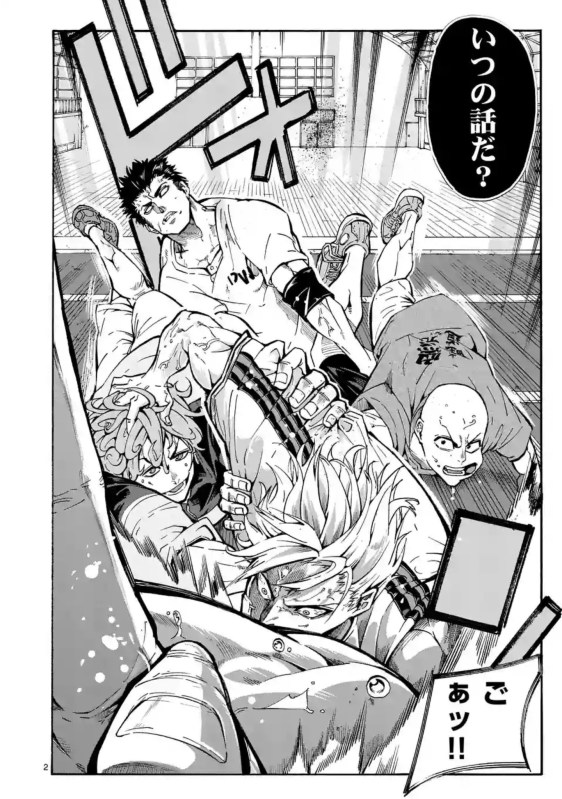
I love how so many of the moments in this manga can be both serious and silly at the same time. Okamichachi’s style captures this seeming contradiction very well, because she has a shoujo (and I think BL?)-influenced style that still leaves plenty of room for exaggerated expressions and a willingness to not have her characters look perfect. While this is less the case for Hayato, who’s supposed to be naturally handsome, seeing him with a relatively serious expression as Nobuko makes kissy faces only enhances the sense that the two are entering this weird space where their feelings for each other are enhanced yet also diminished by being on-screen. Hayato’s reactions show that the situations portrayed in front of the camera, even if they are weird, still land in the realm of what he really wants, and he can’t help but blush himself as a result.

Last Thoughts

Right now, the cast is fairly small, and there aren’t any romances happening between the few side characters that exist. I have to wonder if this will change, as that’s pretty much the fate of all romance manga.

If you liked this post, consider becoming a sponsor of Ogiue Maniax through Patreon. You can get rewards for higher pledges, including a chance to request topics for the blog.
The Many Levels of Fanservice in Food Wars!: Shokugeki no Soma

food-wars!-vol-4-9781421572574_hr

Mito Ikumi, Food Wars! Character

Within the first few minutes of the Food Wars!:  Shokugeki no Soma anime, viewers are made well aware of the extent of its fanservice. If the flavor of peanut butter squid being visually likened to being violated by a large squid wasn’t enough, as the episode progresses characters basically have reactions that are downright orgasmic. It’s the kind of reaction that can really turn people away, but I also am aware of how the seeming need to fully animate a manga can lead to a rather different (and more gratuitous) experience, even when faithfulness to the source material is considered important. This is what I believe happened with another series, Mysterious Girlfriend X, and so when I got the chance to read the manga for Food Wars, I went in curious about two things: the depiction of competition in the Yakitate!! Japan “food battle” sense, and how the fanservice compares to the anime.

Food Wars! portrays both the act of master chefs locked in fierce cooking combat and the sexually charged tasting reactions with equal care and attention to detail. The manga is certainly not a cleaner alternative to the anime, but there are a couple of points I noticed about it. First, the manga’s imagery is a noticeably different experience due to the lack of need to fully animate all of the more gratuitous scenes. Second, Food Wars! actually takes a kind of multi-level approach to its fanservice.

godannar-dvd

Shinkon Gattai Godannar!!

I think it’s fair to judge a series by the most extreme examples of fanservice found in it, and so this isn’t really a defense of Food Wars! as sticking it to the prudes or anything. However, when it comes to anime and manga, they tend to maintain to a fairly consistent level of the kind of fanservice they want to use. Love Hina and Chobits go for mildly risque bath scenes, Aim for the Top! goes for the subdued-by-today’s-standards jiggle and “creative” camera angles, and Godannar!! and Ikkitousen are all about in-your-face shots and revealing clothing (or lack thereof). Food Wars!, in contrast to all of those, encompasses virtually the entire spectrum.

At the far end, you have the scenes described above: images that, in and out of context, look like something you’d find in a naughty magazine. However, there are also plenty of food reaction moments that are more about showing off the girls’ (and in some cases even guys’) bodies in the buff, without that added layer of sexual innuendo. There are images of girls spilling out of their outfits, but there are also relatively more conservative examples. So, while you have a character like Mito Ikumi (pictured at the beginning of this post), who wears bikinis and is based around a rather blatant “meat” theme, you also have characters like Tadakoro Megumi and Mizuhara Fuyumi, who are less voluptuous but are still involved in their own fanservice scenes relative to their designs. In those instances, the manga will decide to show for one panel the way that Megumi’s pants hug against her hips, or that Fuyumi has subtle but noticeable curves.

tadokoromegumi-pants

Tadokoro Megumi

In terms of how men are portrayed (their clothes burst off as they salivate over a five-star meal just as much as the girls do), but I’d actually like an opinion from any readers interested in men as to whether Food Wars! hits any of their buttons in the right way. I get the feeling Takumi Aldini is popular, but I haven’t looked into it extensively.

Given all this talk of gratuitous imagery, I find it all the more interesting that the more I read Food Wars!, the less I think of it as a fanservice series, even though it can be so elaborate and perverted in its character depictions. It certainly is still that sort of manga and anime, but the cooking really takes center stage, and in certain ways the ever-present fanservice is actually subordinate to the food. There’s just something about the intensity and the amount of attention that goes into presenting the culinary masterpieces of the manga’s characters that shines the spotlight on their cooking above all else.

If you liked this post, consider becoming a sponsor of Ogiue Maniax through Patreon. You can get rewards for higher pledges, including a chance to request topics for the blog.

Future History is Awesome: Legend of the Galactic Heroes Novel Volume 1

legend-galactic-heroes-1-e

Depending on your definition of good science fiction, Legend of the Galactic Heroes is one of the finest SF stories ever. Leaning more towards space opera, LoGH combines political intrigue with a genuine look at how people and societies can change (or even regress) as they expand out into the universe. I mentioned the anime on Ogiue Maniax many years ago but never really got into great detail about the series, but now that it’s being released in English in both anime and original novel form I thought that it’s about as good a time as any to talk about what makes LoGH such a strong series by reviewing the first volume of the novel.

Legend of the Galactic Heroes is the story of a corrupt democracy versus a stagnant empire in a far-flung future where humankind has ventured deep into space. Two figures, the unassuming Yang Wen-Li on the side of the Free Planets Alliance and the righteous Reinhard von Lohengramm on the Galactic Empire, act as both heroes and rogues within their respective systems, and their actions change the fates of their societies in unforeseen ways.

As I have seen the entirety of the Legend of the Galactic Heroes anime most of the story is not new to me. It’s been quite a few year so I may have forgotten some details, but the major notes are still pretty fresh in my memory because of how much impact this series has. The prologue of the first volume is actually a short history of how the Galactic Empire and Free Planets Alliance came to be, and how they each try to erase the presence of the other for political reasons. Something as simple as the fact that the Free Planets Alliance (which came after the Galactic Empire was formed from a Hitler-esque powergrab in its predecessor the Galactic Republic) reverted to an older calendar system instead of the Empire’s standard shows just how complex political philosophies and their manifestations in everyday life can be. A similar example exists in the real world: Taiwan’s official name is still to this day the Republic of China because it denies the idea that the People’s Republic of China is the legitimate government of China (and the PRC does the same to Taiwan). Even in the first volume, it encourages thought about how governments and even people’s everyday actions can maintain hegemony.

For some, such as myself, it’s a fascinating read that provides the perfect context for what happens in the main narrative as Yang goes about questioning the blind fervor by which people toss around the term democracy, and Reinhard similarly tries to chip away at the ossified core of incompetency in the Empire. Their personalities, but also many of the characters around them, are so well-portrayed and so effectively invite readers to pursue connections and thematic similarities among the gigantic cast of LoGH that it makes the book a pretty easy read overall. The character of Paul von Oberstein is especially notable for creating more questions than answers, and to this day you’ll have debates over what his true motives are.

Reading the first volume of the novel, one thing that stood out to me that had actually never occurred as I was watching the anime were the parallels between Reinhard and Rudolph I, the original founder of the Galactic Empire many centuries ago. Both believe that their government is suffering from stagnation and corruption, and that the best way to deal with these issues is to seize power from within. While Reinhard believes that people should be judged by their merits and Rudolph I was a staunch proponent of eugenics, the conviction by which they have sought change are strikingly similar.

Similarly, though this isn’t nearly as strong a connection, Yang is portrayed as being a brilliant but lazy man who despite all of his talents and keen insight wishes to live a quiet life. The current Galactic Emperor is initially shown to be a somewhat lost and even incompetent man, but he seems to display sudden flashes of intelligence that imply he might know more than what people expect. However, just like Yang, he prefers a more idle life.

The translation for Legend of the Galactic Heroes is overall very solid. I have not read the original Japanese, so I can’t make so direct a comparison, but the language flows well, never gets too dense or overwhelming even in the most dry of sections, and characters’ personalities are conveyed in a matter of moments. If I have any criticism of the translation, it’s less of a language issue and more of a copy editing complaint. At various times throughout the story, the spelling of Reinhard’s best friend Siegfried Kircheis changes, from Siegfried to Sigfried and then back into Siegfried. It doesn’t impact the quality of the story by any means, but that’s the kind of mistake that shouldn’t be happening.

I don’t think I can recommend LoGH enough, but then again I know pretty much the whole story. That being said, while both the overarching movements of the narrative, as well as the small details that connect with each other, build into something much greater, the first volume does a tremendously good job of setting it all up.

To Japan! Ogiue Maniax Status Update for May 2016

This month I will be flying to Japan to do some sightseeing and meet with some old friends! I actually haven’t been to Japan in 11 years, so I’m curious as to how it’s changed. It’s also an opportunity to see how my Japanese has improved (or degraded) in the time since I’ve been gone!

I have posts planned for the weeks that I’m gone, so you’ll still be able to enjoy my posts in the meantime.

As for this month’s special Patreon sponsors:

General:

Johnny Trovato

Ko Ransom

Alex

Diogo Prado

Sasahara Keiko fans:

Kristopher Hostead

Yoshitake Rika fans:

Elliot Page

Hato Kenjirou fans:

Elizabeth

Yajima Mirei fans:

Machi-Kurada

Following up on last month’s poll about reviewing the new manga series Kimi xxxru Koto Nakare (or Kimi nakare for short), I decided to go with the good ol’ fashioned blog format. It’s where my strengths lie, and while I’m open to challenging myself by making YouTube videos and such, I’m just the kind of person who best expresses himself in writing. You can read the first chapter review here, but if you can either read Japanese or at least want to follow along visually the manga is actually free.

That being said, I’ve considered making videos just to help me practice and get better at speaking, which is more of a holistic quality of life change than anything else. I made a couple a while back but I just haven’t kept up. Though, I did just recently appear on the Veef Show podcast to talk about Gundam: Iron-Blooded Orphans.

This month’s Genshiken review is the first after the conclusion of the Madarame Harem story, and it’s basically a prelude to a new school year. I loved this chapter because of all of the fantastic Ogiue presence in there, but I might be a tad biased.

Other articles that I think readers should check out are my look at the volleyball manga Shoujo Fight and its stylistic similarities to what is sometimes call “OEL manga,” as well as a sponsored post discussing the Popularity of Plushies among anime fans. Actually, Shoujo Fight reminds me that I never finished The V Sign, which is a classic volleyball title, and I really should get back to it.

I’ve also begun participating in a site called senpai.co as a reviewer. While Ogiue Maniax is my main focus, and Apartment 507 is my opportunity to try and reach a different audience, senpai.co is a convenient place to give some quick thoughts about recent anime that has a greater sense of permanence than Twitter.

Last topics for this month:

  1. I’ve been considering changing my blog design to something that doesn’t look quite so outdated. What do you think?
  2. I want to revive Gattai Girls. Is there any series people really want to see discussed?


Ogiue Maniax Talking Gundam: Iron-Blooded Orphans on the Veef Show Podcast

fumitan

I stopped by the Veef Show to discuss the latest Mobile Suit Gundam series, Iron-Blooded Orphans. Have a listen, as we have fairly different perspectives on the show, and I’d love to know what you think of the series as well.

For reference, the post I mentioned about McGillis can be found here, and the series I mention at the end of the podcast that I have begun chapter reviewing is here.

So in conclusion, Fumitan Admoss is the best.