Quesstions: A Renewed Look at Gundam: Char’s Counterattack

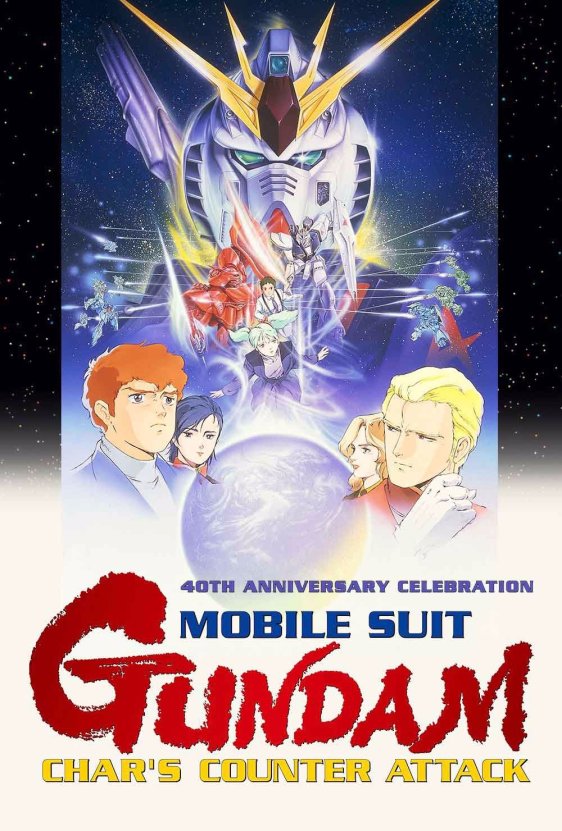
Mobile Suit Gundam: Char’s Counterattack is a defining anime for me. It cemented Gundam in my head as this incredible thing, and its aesthetics (especially its main mobile suits) remain among my favorite ever. That’s why, even though I’d seen the movie plenty of times in my youth and I own a physical copy, I still decided to attend the recent Fathom Events screening. It also didn’t hurt that there was an exclusive new interview with director Tomino Yoshiyuki.

There was one big mishap at my screening, which was that the theater played the wrong audio for about the first ten minutes or so. They eventually fixed it, but were not allowed to restart the movie because it was a Fathom Event. Thankfully, they gave us a free voucher for a future showing.

That mess-up aside, watching the film at my current age made for a significantly different experience compared to when I was a teen in the early 2000s. It wasn’t just that I was older, but that the current circumstances of the world make clear the failure of the story’s adults all around.

Char’s Counterattack is the finale to the ongoing rivalry between the original Mobile Suit Gundam protagonist, Amuro Ray, and his greatest rival, Char Aznable. Both older and in different positions after two different wars—the second of which they fought side by side—it’s a bookend to their ongoing personal, political, and philosophical differences.

One notorious character in the film is Quess Paraya, a young and talented Newtype (essentially a psychic) who willingly gets wrapped up in the conflict. She’s infamous in the fandom as a character nearly everyone hates because she gets in other characters’ ways and acts like a know-it-all despite her age. However, when I watched this time, I could only pity her.

It’s true that Quess can be infuriatingly impetuous and overconfident, but I realize now that her side plot is less about her screwing things up due to arrogance and more about the adults who fail her at every turn. She’s the classic case of a teenager with very real talent and insight but who doesn’t realize how her lack of experience and first-hand understanding of the world limits her. Quess thinks she’s figured it all out but she hasn’t, and when she interacts with Amuro, Char, and even her dad, they all brush her off in different ways or enable her in the worst ways possible. She’s someone who could be guided and mentored, but no one has the time or desire. Even those closer to her in age, who are romantically interested, lack the maturity to be good partners.

There’s a point at which Amuro and Char are fist-fighting while arguing, and Char says that humankind is ruining the Earth and something must be done about it, which prompts Quess to immediately join his side despite ostensibly being with the Earth Federation due to her dad. The way Quess thinks she’s on the same wavelength as Char, even though she knows so little about him, brings to mind a teen on YouTube watching an extreme political video and thinking, “Yeah, I get it!” without realizing how much they’re being manipulated.

But it’s not just Quess who suffers from being a half-broken machine—this is a recurring theme throughout the entire cast. Amuro is trying to be a mature adult who’s both a good soldier but also independent-minded, but can’t shake the ghosts of the past. Char is trying to be a real leader and successor to his dad’s legacy but also can’t come to terms with how things played out with Amuro all those years ago. Gyunei, a soldier under Char, is so close to figuring everything out, but actually thinks that scoring the figurative winning point in the big game will turn everyone to his side. They’re all in shambles, and the film takes away some of their mystique even as it showcases them in gorgeously animated space combat.

In the Tomino interview afterwards, the director described Char in Char’s Counterattack as someone whose star quickly rise in his youth as a pilot, but who finds himself inadequate as a leader partially because he still desires to settle things personally. It positions Char as not the enigmatic rival, and instead a man frustrated by his own limitations but refusing to directly them. It might be no wonder why my teenage self didn’t quite get it.
[Anime NYC 2019] Tomino’s Movie Magic: Gundam Reconguista in G Part I: Go! Core Fighter

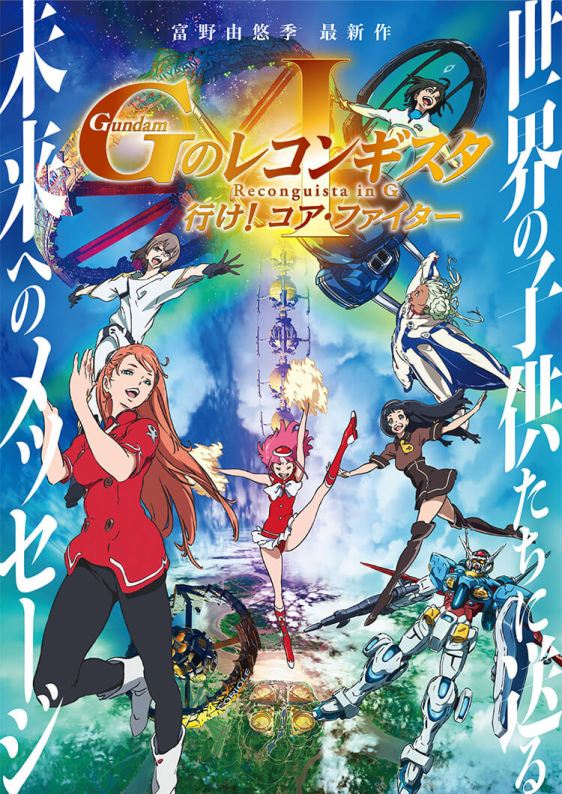
At Anime NYC 2019, I attended the screening of Gundam Reconguista in G Part I: Go! Core Fighter, the first of five planned compilation films based on 2014’s Gundam: Reconguista in G TV series. It was one of the events I was looking forward to most at the convention, and not only because legendary Gundam director Tomino Yoshiyuki was there.

I am a staunch defender of G-Reco because I believe that in spite of its flaws, it has a strong anti-war message which surpasses even the original Gundam‘s in certain respects. Its setting, in an era after the original Gundam timeline, shows what war is like when the cataclysmic devastation of the past is all but forgotten, for better or worse. But I acknowledge that G-Reco did not exactly take the world by storm, as it could be a confusing series, and Tomino’s  “throw you in the deep end” style of no-context dialogue did it no favors.

Thus, I came into the screening with the hope—albeit a tentative one—that these new movies could clean up the rough edges of the series enough to get its ideas and themes across effectively to a wider audience. After all, for every Mobile Suit Gundam trilogy, which is in many ways superior to its source material, there’s a Mobile Suit Z Gundam: A New Translation, which feels sloppily put together. However, I immediately noticed that the film is much clearer and easier to follow, allaying my fears.

There are two simple but major choices that make this first G-Reco film less convoluted. First is the decision to condense the series into films in the first place. Second is the heavier use of internal monologue to make character motivations more obvious.

Many of the scenes and plot points relevant to one another in the TV series could be episodes apart, and by the time something came up again, it was easy to forget what information had been communicated already. But in the movie version, everything is more tightly packed together such that ideas and threads are fresher in the memory. It’s easier to see how various aspects of the world-building fit together, and what potential they hold as the story unfolds.

In regards to characters’ inner minds, the TV series suffered from what seemed like constantly inconsistent actions from characters. They’d switch sides, kill those close to them seemingly without much regret, and just be generally difficult to follow or comprehend. The hero, Bellri Zenam, was especially obtuse. Now, however, there are multiple new scenes of characters expressing either through thought (and sometimes even voice) just how they’re feeling and how it’s affecting their decisions. While the film is still characteristically Tomino and can be full of puzzling dialogue, having it be undergirded by these inner monologues helps to prevent the characters from coming off as sociopaths.

The biggest surprise to me is how much better I understood the character of Noredo Nug, Bellri’s friend and possible love interest. Noredo believes in Bellri’s goodness even more than the man himself does, and she’s willing to defend him in this regard even when he won’t do it himself.

Before the screening began, Tomino said that everyone who came for a Gundam movie will be disappointed because this isn’t Gundam. It seems like a tongue in cheek comment, but I think he really meant it in a way. The message he’s trying to convey through G-Reco is trying to target a new audience that isn’t entrenched in the existing Gundam cultural juggernaut—most likely, that’s what stuff like Gundam UC is for.

Because I’ve seen the TV series, it was impossible for me to go in with fresh eyes Still, I strongly feel that this first G-Reco film is a much more refined work, and while it can still be a challenge to follow at times, it is a major step up. I also just recently rewatched Gundam F-91, and that movie just falls apart a third of the way through, whereas Go! Core Fighter was enjoyable and thought-provoking throughout. Provided nothing goes horribly awry with the sequels, I believe that the Mobile Suit Gundam Reconguista in G films will be the definitive version.


Anime NYC 2019 Hype Post, aka The Craziest, Most Incredible Guests

Anime NYC 2019 is only two days away, and I want to use this opportunity to talk about how amazing the guests are this year. I promise that this is not a paid or sponsored endorsement in any way—these are my genuine feelings, and my feeling is that the guest list this year is just virtually perfect.

First and foremost, you have the legendary director of Mobile Suit Gundam, Ideon, and Zambot 3, Tomino Yoshiyuki. I saw him 10 years ago at New York Anime Festival 2009, and I am eager to see his return. He’ll be showing the first Gundam: Reconguista in G film, and as a staunch defender of that series, I’ve gotta go see it.

Then there’s Kimura Takahiro, animator and character designer on Gaogaigar, Godannar, Betterman, Brigadoon, and Code Geass. He is one of my favorite character designers ever, and I’m so, so stoked for him to be in New York.

Speaking of Code Geass, the voice actor Yukana will be making her New York City debut. In addition to playing C.C. in Code Geass (aka the best character in that series), she’s also Teletha Testarossa in Full Metal Panic!, Li Meiling in Cardcaptor Sakura, and Cure White in Futari wa Pretty Cure!

But Yukana is not the only Cure who will be there, as Ise Mariya (Cure Lemonade from Yes! Pretty Cure 5) is coming to promote The Promised Neverland, where she plays Ray. The director of The Promised Neverland, Kanbe Mamoru, will also be at Anime NYC 2019. He’s also the director for one of my favorite anime ever, Cosmic Baton Girl Comet-san.

Megalo Box is an amazing anime and reinterpretation of Ashita no Joe, Moriyama Yo, and both the director and producer, Fujiyoshi Minako, will be attending.

And the Lantis Matsuri concert Friday night will feature both JAM Project and Guilty Kiss from Love Live! Sunshine!! Having now attended concerts for both groups, I’m pumped to see them again (and again and again in the future, hopefully). Nothing is as fantastic as JAM Project performing “SKILL,” and a part of me is sincerely hoping all the groups involved will join in for a rousing “WHOHhhHHoooHHHooOoooH.”

So see you all at Anime NYC, and I hope these guests get the star treatment they deserve.


Why Are There So Few Recent Titles in Super Robot Wars T?

When a series gets into a Super Robot Wars game, for the first time, it’s a momentous occasion, especially when the game in question is one of the “mainline” iterations. The mecha (or even spaceships these days!) can be from old and obscure works, cult favorites, and even the new hotness. When playing through the recent Super Robot Wars T, however, I noticed that there’s a significant dearth of recent series, and I’m using that term loosely—out of every anime included, only two are from the past 13 years.

Even that number doesn’t tell the whole story. One of the anime referred to above is 2018’s Mazinger Z: Infinity, a film sequel to the original Mazinger Z anime franchise. While technically “modern,” it’s meant to be a nostalgia work. That leaves only Expelled from Paradise, a 2014 film. The next one after that is Gun x Sword from 2005. It’s not inherently a bad thing, and there are a number of welcome surprises in SRWT like Magic Knight Rayearth, Cowboy Bebop, and Captain Harlock. In a Famitsu interview, the director, Terada Takanobu, mentioned that one of their decisions for including new titles was a desire to have something for every age group. So in the sense of newcomers alone, it’s a pretty even split. However, the heavy lean towards the old is still noticeable, and I think a number of factors go into this.

First, as the years go by, what is considered an “old” title vs. a “new” one widens. Second, mecha anime just isn’t the bustling industry it once was, at least not in the same way. Third, I think that, as much as they tried to pull in fans of all ages, their core demographic seems to be working adults somewhere around 25-39, given both the themes of the game and the title selection itself.

For many younger anime fans, a span of five years might very well cover their entire fandom, let alone the now five decades that have elapsed since the original Mazinger Z anime debuted. For Super Robot Wars, this goes double, as it often takes quite a few years for a hot new mecha title to get the spotlight. Back in the early 2000s, Gaogaigar (1997) and Shin Getter Robo Armageddon (1998) were considered fairly young upstarts when they appeared. Now, in Super Robot Wars T, they’re grizzled old veterans. Outside of Super Robot Wars specifically, it’s always fascinating to see a title like Cowboy Bebop (1997 debut but aired on Adult Swim in 2001) go from being the hot new thing in the US to being a virtually canonized masterpiece that’s sometimes more discussed than viewed.

The relative oldness of the entries in SRWT is in part a consequence of how giant robots are simply not the industry juggernaut that they once were. Long gone are the endless number of children’s mecha shows, and the robot anime that do remain know that their audience will often skew older. Super Robot Wars, given its nature as a crossover celebration of what is increasingly a niche genre, is sort of tailor-made for nostalgia, compounding the sense that its appeal does not lie in attracting newer, younger anime fans, but those with a lot of experience watching and loving mecha anime. There are newer titles to pull in, but will they have the same draw as these assumed childhood/youth favorites?

In that sense, it’s interesting to note just where the nostalgia hits hardest for SRWT. Many of the titles are squarely in the 1990s without being made as sequels or reimaginings—Cowboy Bebop, Magic Knight Rayearth, Nadesico, G Gundam, Gaogaigar, and Might Gaine—while plenty of other titles are late 80s or early 2000s. Director Terada mentioned that international fandom was a consideration for which titles to include, and while not the case with every country, I think that the 90s is an especially strong time for fan nostalgia now—or at least the 90s anime they may have seen years later because anime distribution wasn’t nearly as speedy back in the days of VHS tapes and Real Media Player.

It’s also telling that the gimmick of the main heroes is that they’re salarymen, i.e. full-time working adults around ages 25 to 39, instead of teenagers. In some sense, it works as a gimmick, but when past original characters have been decidedly less mundane in their basic premises, the idea of “loyal company employee” stands out. There’s something to be said about how the notion of the salaryman as the default position for adults in Japan has been shattered for many years now, but I won’t go much into it except to say that while a heroine who just really likes a steady paycheck might have seemed like the most milquetoast thing once upon a time, in our current global economy, that idea almost borders on escapist fantasy.

Or maybe the team just really wanted to do a story with Jupiter as a focal point. Between Shin Getter Robo Armageddon, Nadesico, Crossbone Gundam, Aim for the Top!, Gaogaigar, and Cowboy Bebop, the fifth planet from the sun gets major play.

There’s one last possible reason the series is lacking anime titles from recent years: they’re saving them for a direct sequel. While there’s no news yet of a true follow-up to Super Robot Wars T (as opposed to just another game with a completely different cast and universe), there are enough loose threads in this game that a continuation would not be surprising.

Super Robot Wars T and Gaogaigar’s Unspoken Plot Change?

I’ve been playing the heck out of Super Robot Wars T (available via import in English for the Nintendo Switch and PlayStation 4), and as always, I’m into the loving fanfictional goodness that the franchise always entails. When you have all of these different giant robot heroes in the same universe, the interactions are an endless source of amusement and head-nodding affirmation.

Of the many crossover moments little and big, however, there is what I believe to be an unspoken story element that significantly alters the course of one particular series: King of Braves Gaogaigar. This might be mere fan speculation on my part, but I think it also makes total sense.

In the original 1997 Gaogaigar TV series, the main character Shishioh Guy uses an attack called Hell and Heaven to finish off monsters. A little into the series, however, he discovers that using the attack too much does severe damage to his cyborg body, and that overusing it could lead to death. In response to this, his team (known as GGG) creates a new, alternative finisher called the Goldion Hammer, which becomes his default decisive blow through most of the series. It’s only in desperate times when the Goldion Hammer isn’t available that Guy will resort back to Hell and Heaven.

But in Super Robot Wars T, when you meet Guy, the Goldion Hammer is nowhere in sight, despite the story being well past the point in the anime where he was supposed to get the Goldion Hammer. And yet, Guy shows no signs of excessive use of Hell and Heaven. On one level, this is likely a gameplay pacing decision, to keep Gaogaigar from having its strongest attack early on, but I think there’s also an in-story explanation: he simply didn’t have to use it as much in the SRWT universe.

Whereas Gaogaigar and GGG alone fought against EI-01 and the Zonders in the anime, in the game, they occasionally received help from Watta and Tryder G7 (from Muteki Robo Tryder G7), as well as Maito and Mightgaine (from The Brave Express Mightgaine). In other words, in SRWT, Guy had enough assistance in his many battles that, by the time we meet him in-game, he isn’t anywhere near as overburdened as he is in the anime.

It’s considerations like the above which make Super Robot Wars T (and Super Robot Wars in general) such a treat. I’m looking forward to seeing whatever other crazy moments are in store.

The Real Captain Planet: Brave Fighter of Legend Da Garn

The 1990s Brave franchise—most famously known for its swan song, King of Braves Gaogaigar—is a series of children’s anime centered on boy heroes and their heavily merchandisable giant robots. While the overall quality varies, each show indicates a push and pull between being half-hour toy commercials, displaying impressive mecha animation, telling stories that kids enjoy, and imparting important lessons for young viewers. Over the years, I’ve been told multiple times that one of the turning points is 1992’s Brave Fighter of Legend Da Garn: the third entry and first to attempt a more mature and long-form story. Having finally watched it, I can see a more serious yet also a scattershot approach that belies the competing forces dictating the direction of Da Garn.

Takashiro Seiji is a normal ten year old boy whose mother is a news anchor and whose father is a member of Earth’s Global Defense Force. When a mysterious robot attacks the city, he comes across a power lying within the Earth itself that manifests itself as a giant robot guardian known as Da Garn. As the masked commander, Seiji leads Da Garn, and eventually other robot allies who emerge, against ever greater threats—especially the enemy’s ongoing attempt to rob the Earth of its “planet energy.” There’s an ongoing environmentalism and world peace theme underlying everything, exemplified by a line from the opening theme: “This planet is our cherished ship.”

Due to this show’s opening, I once had a very mistaken impression of Seiji. The way he’s drawn and animated in it, there are times when he looks like an adult. It’s almost as if they either hadn’t decided his age, or figured that making him look 6 feet tall and muscular would make for a more exciting intro regardless of how odd it looks. Whatever the case, my expectations had to be modified, though Seiji’s quality voice acting from Matsumoto Rica (best known as Satoshi from Pokemon) helps keep him an endearing if somewhat typical protagonist.

The robots, in typical Brave fashion, are all about combining. Da Garn combines with a plane and a train to become Da Garn X. Later robots combine together and then get additional partners to combine together. However, they’re also kind of a thematic hodgepodge. Da Garn himself is a police car. He gets plane allies and motor vehicle allies. Then they start introducing robots based on animals, even making it seem like one is going take over as the star of the show, as if someone said, “The surveys say kids like lions!!”

There are so many mecha, and they’re given so few opportunities to show their personalities, that only a handful ever get highlighted, leaving many to be less memorable. In contrast, it’s hard to forget any of the robots in Brave Police J-Decker or Gaogaigar. Even compared to a series like Girls und Panzer (which also groups a gigantic cast into “squads” with collective personalities), Da Garn can feel sparse in terms of characterization. The main exception to this glut is an antagonistic robot named Seven Changer, who (of course) has seven different forms, and whose cool arrogance is delivered effectively by Koyasu Takehito (Dio in JoJo’s Bizarre Adventure).

Speaking of villains, I’m not sure if I’d call them particularly strong, but they are definitely memorable, and they’re explored in great detail. Many of their identifies are initially a mystery, and they’re woven into the simultaneous small-town/global atmosphere in interesting ways. As the series progresses, their stories are increasingly a part of the narrative, and it allows Da Garn to touch upon ideas that would make less sense with Seiji or any of his friends. In fact, I’d argue that the anime doesn’t really find its footing until it starts to do more with its villains.

Brave Fighter of Legend Da Garn ends up being the kind of work that is best viewed as taking a step beyond its trappings and its immediate predecessors while still somewhat beholden to them. It’s polished in some areas like visual presentation and general momentum of its narrative, but it sometimes succumbs to the weight of all the different expectations placed upon it. But while it may be outdone by later Brave series, it’s still a joy to experience, quirks and all.

Aikatsu Friends! Knows How to Celebrate Christmas

Christmas is a different holiday in Japan compared to the United States. Even putting aside the religious vs. secular aspects, December 25th is traditionally seen in Japan as more of a romantic occasion featuring cake and fried chicken, and various anime and manga throughout the years have reflected this. That’s why I was surprised to see that the Christmas episode of Aikatsu Friends!—aptly titled “Merry Friends Christmas”—feels so at-home with a more American conception of the holiday.

The episode begins with drawing lots for a big idol tournament. Once the matches have all been decided, each duo goes out to practice and to shore up their weaknesses. The portrayal of “idol activities” is always a highlight of the Aikatsu! franchise, and watching the two goth girls weight-lift using an oversized die and a black crystal ball to shore up their weak stamina reminds me of why I enjoy these shows. What’s more, I like that it doesn’t dedicate the entire episode to Christmas, as it minimizes the sense that this is a one-off break from the main story. The celebration is woven into the overall momentum of Aikatsu Friends!

Heroine Aine decides to invite her partner Mio and their rival teams to have a fun Christmas party, and there’s just something familiarly heartwarming about the gathering. The exchanging of presents, the overall sense that the competition doesn’t overshadow their friendships, and the festive mood would fit right in with US Christmas TV specials—but with all of the morals about kindness and giving merely implied instead of said outright. It’s the sort of execution that makes me wish Aikatsu! could get a real foothold outside of Japan, even though I realize that its success is tied in heavily with the arcade games.

As with every Aikatsu! Christmas, they end with a rendition with of “We Wish You a Merry Christmas” with a characteristic rap section that talks about turning a holy night into a party night. At this point, and I have to wonder what the reason is behind keeping the song from year to year. It’s not a bad thing, but I would have expected them to switch it up from series to series—maybe some “Jingle Bells” or “Deck the Halls.” Maybe it’s just what the fans expect, and hearing the latest generation of Aikatsu! stars give their own take on the song is itself a tradition.

Overall, it’s an excellent Christmas episode from Aikatsu Friends, and an excellent way to set the mood for the holidays. It also makes me wonder if the image of Christmas has changed in Japan! That investigation will have to be for another time.

This post was sponsored by Johnny Trovato. If you’re interested in submitting topics for the blog, or just like my writing and want to support Ogiue Maniax, check out my Patreon.


Gaogaigar vs. Betterman Manga Chapter 1: Go Read It!

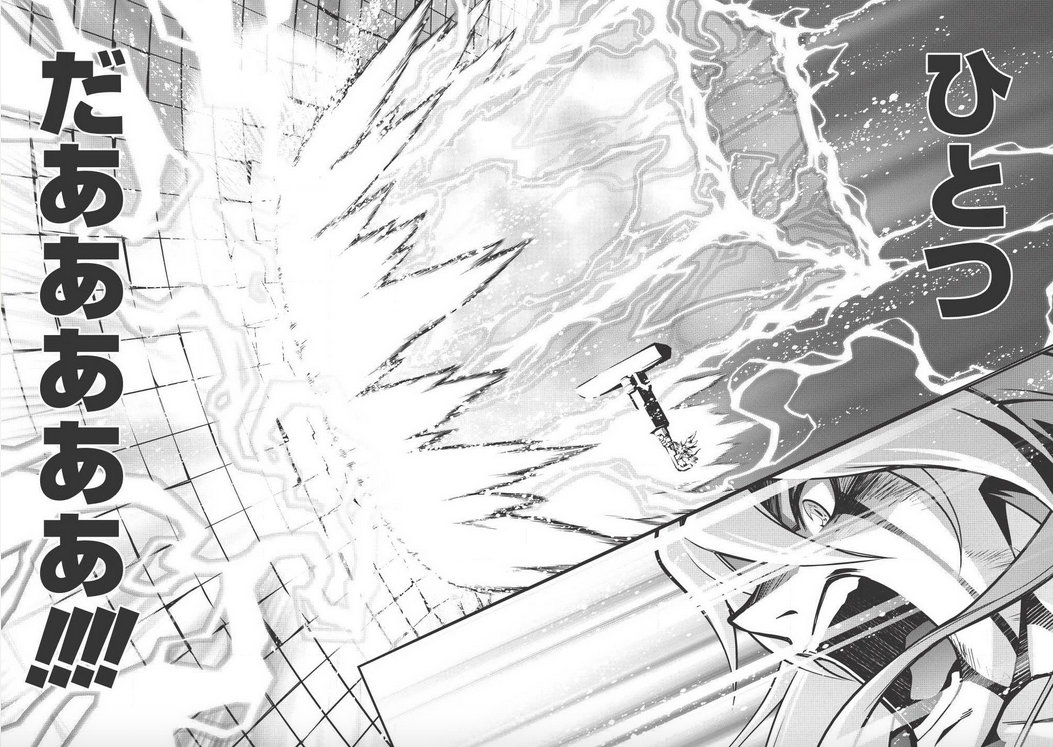
Us Gaogaigar fans had long waited for a new sequel, a call that was answered this past year through the Hakai-Oh: Gaogaigar vs. Betterman novel series. In more recent news, Sunrise announced a manga adaptation, and the first chapter has been available online for the past month or so.

Having read through the first novel, this manga seems to be adapting the contents pretty faithfully. This might go without saying, but the key advantage of the manga version is that it’s more visual—a welcome thing given that Gaogaigar as a whole thrives on visual spectacle.  It’s also a lot easier to follow if your Japanese language proficiency isn’t especially strong.

I’m not sure what the schedule is for this manga, but I’m hoping that having it so easily accessible means that Gaogaigar fans will be able to rally around it, and really give it the attention it deserves.

The Big O and Loving Robots

Warning: Spoilers for The Big O.

Artificial intelligence is one of those staples of science fiction, a bridge between the mechanical and the biological. For if an AI can achieve true sentience, it entails a whole host of questions about the meaning of life. In anime, one recurring topic is how artificial intelligence intersects with love—whether AIs are capable of love, and whether it is morally right to love an AI.

While something like Chobits is more (in)famous in its approach to the subject of love and AI, my favorite example is actually the mecha anime The Big O. While not the central narrative, protagonist Roger Smith’s relationship with his robot assistant R. Dorothy Wayneright is an ongoing plot thread that grounds an otherwise stylishly obtuse series.

Throughout The Big O, Roger is often verbally dismissive of Dorothy, bringing up her android qualities as evidence of what makes her unable to compare to humans. However, this is portrayed as a kind of denial defense mechanism, as he gradually finds himself attracted to and more in love with Dorothy. The impression is that Roger believes he’s not supposed to love her, and that perhaps he’s only drawn by her created and manufactured traits. Yet Dorothy, despite exhibiting very “robotic” mannerisms, seems to have an all too human side of her. And while her characteristic monotone is a source of comedy, it also seems to be a defense mechanism of her own—a constant reminder for herself and Roger that there are supposedly limits to how close they can be.

In one episode, Roger and Dorothy are Christmas shopping, and Roger steps into an elevator. He beckons Dorothy to get in as well, and she initially hesitates. When she finally does join Roger, the elevator comes to an emergency stop. Dorothy, weighing many times more than any human, put it over the weight limit. A moment of awkwardness ensues between the two, at least visibly on Roger’s side. Whether or not Dorothy is bothered by it is difficult to discern due to her apparent nature. Still, Roger and Dorothy seem to share a special connection. Nothing says more about their relationship than the iconic shot of Dorothy inside the Big O, her hand over Roger’s as he readies for a fight against three enemy Megadeuses at the end of Season 1.

Underlying all of this is the notion that love comes part and parcel with sentience. If Dorothy is nothing more then an android whose artificial intelligence is nothing more than a highly advanced computer, then that love feels “wrong” for Roger. But if it speaks toward a complexity beyond prediction, then Dorothy is an equal to Roger and therefore just as capable of love and being loved. In that situation, she must possess agency, and cannot be an object merely to be used. She must be her own being to the point that she can love or not love, and then make decisions of her own as to whether or not to follow along. In other words, it is morally right to love an AI if they can truly reciprocate, if human and robot stand on even footing.

This post was sponsored by Johnny Trovato. If you’re interested in submitting topics for the blog, or just like my writing and want to support Ogiue Maniax, check out my Patreon.

Aikatsu Stars! Christmas 2017 Thoughts

I was asked to talk about the Aikatsu Stars! 2017 Christmas episode, so here I am!

Christmas isn’t the utter juggernaut of a holiday in Japan as it is in the United States, but it’s still celebrated in its own way: as a time for romance and appreciation. It’s not uncommon to see anime and manga feature Christmas stories, notably the many shoujo series where dates happen on and around December 25th. In some cases, series can be long enough Christmas episodes themselves become annual traditions, and this is the case with Aikatsu! Apparently, they even sing “We Wish You a Merry Christmas” every year:

As a Christmas-focused story, episode 87 of Aikatsu Stars! stands out to me for a few reasons. Generally, with these seasons-long children’s anime, the Christmas episodes are pretty self-contained. Maybe it’ll be about meeting Santa, or just having fun with friends. With Aikatsu Stars!, there’s a surprising amount of overall narrative progression. It’s not like they’re throwing revelations left and right, but the fact that M4 (the series’ premier male idol group) is branching off into their own solo careers is kind of a big deal. That there was some romantic development between perennial cat(-like) girl Saotome Ako and M4 member Kiri Kanata is also notable.

I only watch Aikatsu Stars! on and off, so I didn’t realize that Kizaki Rei is from New York City. As someone who just stopped by Rockefeller Center to see the giant tree right before Christmas, and as someone who kind of takes its presence for granted, I found the show’s presentation of it as this stand-out example of “Christmas around the world!” charming. If there’s one thing AIkatsu! has done right that many other series haven’t, it’s having more non-Japanese characters.

Aikatsu Stars! (and Aikatsu! in general) is that it really is in its own world when it comes to idol anime, or magical girl(ish) anime. Other series will be fun and wacky, or they might be a bit serious, but there’s rarely the almost Saved by the Bell-esque feel you find in Aikatsu! Even when the anime are literally about idols using their singing to defeat galactic empires, it lacks that particular brand of mild absurdity that permeates AIkatsu!. This is why Aikatsu Stars! is the sort of anime that could either go episodic forever or rapidly develop into an elaborate story at any moment, and both are equally welcome. Perhaps the Christmas episodes are indicative of that balance of story advancement and self-contained amusement.

This post was sponsored by Johnny Trovato. If you’re interested in submitting topics for the blog, or just like my writing and want to support Ogiue Maniax, check out my Patreon.