Gundam: Reconguista in G – Ambition, Eccentricity, and Perspective

g-reco-op

Mobile Suit Gundam: Iron-Blooded Orphans and Gundam Thunderbolt seem to be the Gundam anime a lot of people are looking for. Whether it’s the story of child soldiers of the former or the hard SF feel of the latter, they both capture in different ways the idea of Gundam as that realistic war story with a science fiction twist. While I’ve been enjoying both of these quite a bit, I wanted to step back and look at the previous Gundam anime, 2014’s Gundam: Reconguista in G, because I think it was a legitimately strong series whose merits went underplayed and under-appreciated.

Gundam: Reconguista in G has a reputation for being confusing, convoluted, and nonsensical. Even the writer and director himself, the original Gundam creator Tomino Yoshiyuki, considered G-Reco a disappointment. I disagree. While the series is rife with Tomino-isms that make the narrative and its characters’ decisions hard to follow, one thing rings out loud and clear: G-Reco is the story of people who, for better or worse, have no true connection to war.

G-Reco takes place many years after the end of the original Gundam timeline. In this new era, the Regild Century, voyage into space is restricted, and energy resources are rationed out to prevent the world from falling into the same catastrophes which scarred previous generations. Over the course of the story, characters frivolously and repeatedly switch sides, the ones most eager to fight have the least conception of war’s effects on humanity, and ultimately even as soldiers die left and right, the consequences of their warfare, if you can call them as such, are vague and ambiguous. On the surface, it doesn’t appear to be a story worth following, but I believe that it all emphasizes a central point, which is that the more humankind is distanced from war, the less they understand its repercussions.

Tomino was born during World War II, so it should come as no surprise that the original Mobile Suit Gundam had a strong anti-war message. While the children of that generation weren’t born in an era of conflict, the adults knew full well what post-war reconstruction was like, and many anime and manga creators have strongly believed in the dedication to pacifism stated in Japan’s constitution. However, G-Reco debuted in a different era, in this current time when forces in the Japanese government have clamored and have now even successfully reduced the influence of the Japan’s official stance on pacifism. Similar to Gatchaman Crowds Insight, G-Reco argues that, while there are merits to a world where large-scale global conflict is a distant memory, namely because it means people don’t have to suffer to the same degree, it ironically pushes war and violence even further into the realm of appealing fantasy. It becomes about heroes and villains, about glory and pride, rather than death and destruction.

At the same time, the characters in G-Reco are largely positive and optimistic, and while its ending is rushed and its final scene is undoubtedly the most confusing part of the anime, it also speaks towards a great deal of faith in the youth of today. They make plenty of mistakes, and they’re in some ways just as guilty of treating war as play, but they’re also not beholden to the manipulations of adults and the older generation. In this respect I get a vibe from G-Reco not unlike that of Evangelion 3.33, though the unique tendencies of their respective directors make for different overall presentations.

I think it’s fitting that the last battle in G-Reco concludes with no clear winners and no real fallout, but also has some notably unceremonious deaths. It pushes the idea that war is both meaningless yet full of things that cannot be undone, and it is up to the current generation of humanity to take advantage of our distance from war by keeping it there, while remembering that such distance comes with its own perils.

—

If you liked this post, consider becoming a sponsor of Ogiue Maniax through Patreon. You can get rewards for higher pledges, including a chance to request topics for the blog.

Best Anime Characters of 2015

BEST MALE CHARACTER

Sunakawa Makoto (My Love Story!!)

In the narrative of My Love Story!!, Sunakawa is naturally handsome, intelligent, and charismatic to the point that girls from ages 8 to 80 seem to fall in love with him at first sight. However, what makes him truly stand out aren’t his looks or his smarts, but his genuine bond with his best friend, the seemingly brutish Gouda Takeo. Sunakawa’s opposite in practically every way, but the two share one important thing in common: big hearts. Sunakawa sees not only the goodness in Takeo but the petty shallowness of those who judge people only by their looks, which affects him just as much as Takeo himself.

Takeo is also a worthy pick, but it’s the way Sunakawa looks out for Takeo that makes him the Best of 2015. Whether you want to be Sunakawa or have him watch your back, there’s no better best friend in all of anime (except maybe Tomoyo).

BEST FEMALE CHARACTER

Koizumi Hanayo (Love Live! The School Idol Movie)

Last year, Koizumi Hanayo was in the final running for Best of 2014, but ultimately the immensely powerful personality of Kill la Kill‘s Kiryuuin Satsuki won out. Now, with Love Live! The School Idol Movie being the swansong for the original Love Live! girls, I thought it best to call Hanayo Best Female Character of 2015 because there might never be a chance to do it again.

If there’s one word I would use to describe Hanayo, it would be “passion.” It’s her nearly unrivaled love of school idols, along with some support from her friends, that allows Hanayo to take the step from fan to idol in the first place. The fiery look in Hanayo’s eyes and her characteristic “quiet scream” when something big is happening is unmistakable. When Hanayo helps Rin overcome her negative self-image, it’s from a place of genuine care and compassion. And when Hanayo goes on a rant about how rice is the central component of a proper meal and that this is one of America’s most critical flaws, why, it’s only appropriate. Hail to the Rice Goddess.

Final Thoughts

When it comes to determining my favorite characters in anime, I don’t think I’m alone in saying that they often possess either admirable qualities I would like to emulate, or traits that I can directly relate to. Sunakawa’s perceptiveness and compassion are things that my oblivious self would love to have. Hanayo’s devotion to food is a match for my own constant desire to find the latest, greatest things to eat, and her instant switch from shy to fervent fan also reminds me a lot of myself. Of course, these are not their only criteria, and ultimately it is their impact on their friends and loved ones that is in a way much more significant, but there’s something about both Sunakawa and Hanayo that makes them both like quiet fist pumps in anime form.

Yesssss.

—

If you liked this post, consider becoming a sponsor of Ogiue Maniax through Patreon. You can get rewards for higher pledges, including a chance to request topics for the blog.

Drifting Along: Ogiue Maniax Status Update for December 2015

Whenever I think of Christmas and anime, my mind immediately goes to Initial D: Third Stage. Does that count as a Christmas anime? I’m going to say yes, and try to make it official.

Here are this month’s Patreon supporters. As always, I’m happy that they have my back.

General:

Ko Ransom

Alex

Anonymous

Yoshitake Rika fans:

Elliot Page

Hato Kenjirou fans:

Elizabeth

Yajima Mirei fans:

Machi-Kurada

We even have a new Yajima fan aboard! Seeing as how the character’s been developing in Genshiken as of late, I wonder if more will join.

It’s a pretty subtle change, but one thing I’ve been trying to do over the past month is put out content three times a week. I used to do at least two posts a week, with a Fujoshi File every other week, but I felt that it wasn’t quite enough.

Speaking of the Fujoshi Files, at the moment they’re on a brief hiatus as I use that time to indulge in my love of Super Smash Bros. After the recent announcement that Cloud Strife is going to be a playable character (!), I’ve gone back to an old love of mine and have been designing movesets for what-if Smash characters. So far I’ve done Pitfall Harry from Pitfall and Zoma from Dragon Quest III, and there will be at least a couple more on the way.

I have more reviews this month, though as always they toe the line between review and analysis. Of course, there’s the requisite Genshiken chapter, and if you’re a Sue fan this is the one for you. I also wrote something about the use of kanji and words in Aquarion Logos, and then there’s my review of the new Digimon anime. If you haven’t heard about that last one, it’s actually a sequel to the original, with all of your favorite characters in high school. If you like giant robots, I also appeared on the Cockpit podcast to talk about Gaogaigar. I even made a new 1 Minute Review to celebrate the release of Girls und Panzer der Film!

As with every month, if you’re interested in requesting topics for me, it’s a reward for those who pledge $30+ on my Patreon. I of course don’t mind coming up with my own topics (and in many ways it’s actually kind of easier),  but I do miss being “forced” to look at something I might not have otherwise. In the meantime I’ve replaced the Ogiue Maniax Skype group reward at $2.00 with a new feature: I will include a link to whatever you want (within reason) in a special section in my sidebar. Remember, if you’re pledging already, you already have access to this, so send those requests my way!

The last thing I’d like to talk about is the whole social media thing. In the past, I’ve tried to make it so that each site I used had a different specialty. My tumblr, for example, was mainly for video clips. However, I realized that many people only look at their favorite social media platforms and rarely venture outside of them. That’s why I’ve been getting a bit more redundant with posts across different sites, to reach more people. My question is, are you someone who sticks to just one, or someone who sees different value in Twitter, tumblr, Facebook, etc.? I’d like to have a better idea of how to interact with my readers, so that I can foster interesting or even delightfully frivolous discussion.


Hammer Connect!: Ogiue Maniax Discussing Gaogaigar on the Cockpit

As a long overdue follow-up to our discussion on Brave Police J-Decker, I was invited along with the Reverse Thieves‘ Kate to talk about King of Braves Gaogaigar on Space Opera Satellite’s “Cockpit” series. Many have called it the best show in the Brave franchise, and it’s been 10 years since I first finished Gaogaigar, when that sentiment was at its strongest.

For your reference: Silverion Hammer

The real question is, why are there so few King J-Der toys?

A Mission for Myself: New York Comic Con

General Thoughts

As New York Comic Con has come to rival San Diego Comic Con and become its east coast counterpart, the scope and demand of NYCC are constant points of consideration for any potential attendee. While the convention pretty much improves every year and little can be faulted for how it’s run, the guests they bring, and just the amount of stuff there is to do (aside from perhaps the inevitable over-emphasis on professional and industry panels), I find that there’s a certain evaluative process I notice my friends and me going through every year, which all boils down to the simple question: should I attend next year?

First and foremost, as an anime and manga fan I have to say that NYCC delivered, and in ways I hadn’t expected to affect me so deeply. This year, they most notably brought Naruto creator Kishimoto Masashi and Uzumaki Naruto voice actress Takeuchi Junko and premiered Boruto: Naruto the Movie for the first time outside of Japan (see my review here). Aside from some hiccups in terms of the Hammerstein Ballroom venue—the overly strict no food policy went so far as to ban bottled water, and the concert-oriented seating obscured the screen for significant portions of the viewers—it was the most memorable part of the convention for me, and it brought me back to 13 years ago when I was at the height of my own Naruto fandom.

On top of that, the announcement of a Tiger & Bunny film helmed by Ron Howard was the biggest surprise by far of NYCC, and the opportunity to get a personal drawing from Attack on Titan animator Asano Kyouji was a rare treat. While I was unable to get Asano to draw Holon from Real Drive like I hoped (to be fair that show is 10 years old), this image of Sasha from Attack on Titan is the coolest thing I brought home from New York Comic Con:

However, my experience with NYCC made me realize just how disconnected I am from a lot of current fandoms. This isn’t to say that I disliked New York Comic Con, or what it does. I’ve always enjoyed the mix that New York Comic Con brought, between the opportunity to meet professional artists, the focus on entertainment media that has extended out from the superhero movie boom, and just the general celebration of nerd culture. However, partly because I was out of the country for four years, and partly because of my own general taste for things, I haven’t been as deep into certain popular works in recent years as I might have been in the past.

What really brought this point home to me was how much I enjoyed the Justice League Reunion panel. Seeing Carl Lumbly talk about bringing his cultural heritage to the role of the Martian Manhunter as an immigrant with a traumatic past, finding out that Justice League Unlimited was a clever and creative compromise with a soulless marketing engine that wished to use the cartoon purely as an action figure commercial, and hearing Kevin Conroy sing “Am I Blue?” flooded me with so many fond memories of what made that series great. It made me recall the character of A.M.A.Z.O. and how incredibly deep and interesting his story was, and the “Ask the Justice League” portion was downright hilarious, especially Martian Manhunter’s greatest enemy being “a villain made of flaming Oreos.” It made me want to find this feeling again within more non-Japanese works.

This is certainly not a criticism of the current state of animation; many fantastic works have been and are still being created. Rather, it has made me aware of just how much a connection to the “nerd mainstream,” as it were, fuels New York Comic Con. NYCC is a for-profit convention backed by the entertainment industry, and it will aim for the works that hit the widest audience, or at least the widest audience within a niche. This is what fuels the decision for a Firefly panel, or indeed inviting a manga megastar like Kishimoto. Rather it fuels my desire to expand my interests further than where they are currently, to get a better sense of the zeitgeist of current American (and non-American!) fandoms.

Exhibitor Hall, Artist Alley, and Panels

Again, when it comes to the actual con, there was much to enjoy. In the Exhibitor Hall, I got the chance
to try Street Fighter V, say, “Domo” to Ninja Slayer, and get that cool Sasha drawing from Asano.

The Artist Alley, as always, was a great place to meet artists, find out about new works, and see the trends that fuel the creators. Superheroes are a no-brainer, anime is less prominent but if it is it’ll be something that captured the imaginations of American fans, such as Dragon Ball Z or Sailor Moon. Stylistically, I made just one purchase at Artist Alley this year, issue 1 of a comic called Henchgirl by Kristen Gudsnuk, the premise of which is exactly what it sounds like. The Artist Alley filled with everything from amateurs to industry veterans, with talent abound. However, I tasked myself with a challenge, which was to find something that spoke to me, that didn’t rely on name recognition, and that wasn’t too tempered by my own preferences for specific types of characters or heroes. Gudsnuk’s drawings resonated with me the most because of the humor and soft, cartoony style. If you’re curious, you can read the comic online for free.

The other highlight of the Artist Alley might have been seeing a small kid, probably no older than 6 or 7, hand a copy of Days of Future Past to Chris Claremont.

As for panels, it’s no secret that a for-profit con like NYCC will have a different flavor from a fan-oriented endeavor such as Otakon. I generally enjoy the latter kind more when it comes to programming, but NYCC has a pretty consistent track record of quality, possibly because it’s such a big deal now and encourages industry hosts to bring their A-Game, as seen with the Justice League Reunion.

The Kishimoto panel was a rare opportunity to get into the mind of one of manga’s most successful creators. While the questions were curated, the host did a great job of opening up Kishimoto, and I’m sure that him no longer having to keep deadlines or worry about how his answers might influence sales of Naruto allowed him to give responses that were a bit more candid than what is usually seen from Japanese guests. Probably the best thing I found out from the panel was the friendly rivalry shared by him and One Piece‘s Oda as Shounen Jump‘s two frontrunners, as well as the titles that influenced him most. That said, I hope the audience that was mostly silent after hearing Kishimoto mention Tezuka Osamu’s Phoenix get the chance to find out more.

“Push Boundaries Forward: Gender, Diversity and Representation in Comic Books,” featuring Marjorie Liu, Darryl Ayo, David Brothers, Amber Garza, Jeremy Whitley, Joey Stern, and Shannon Waters was one of many panels over the weekend that focused on addressing the changing dynamics of comics creators and readers. Both the audience questions and panelist answers showed a strong desire to move forward, to learn, and to understand that greater diversity in comics is a multifaceted challenge that never ends, and is ultimately beneficial to comics as a whole.

The Felicia Day panel was pure Q&A, and that’s exactly what the audience wanted out of it. Incredibly charismatic in that awkward way that appeals to geeks most, Felicia Day genuinely engaged her audience with an attitude that was both deeply caring and kind of flippant, bringing a realness to her answers. The best moment was when she complained that you couldn’t have sex with her character in Dragon Age 2, which her manager had ordered the studio against.

The Sunrise panel showed once again that they’re one of the direct-from-Japan studios to really get what it means to throw a panel. In addition to the surprising news about Tiger & Bunny, their announcements were varied and spoke to different portions of their audience. By the way, if you heard a couple of loud guys cheering for Giant Gorg, that was me and Patz from the Space Opera Satellite Podcast. We were serious, too. Giant Gorg is a rare series directed by the character designer of the original Gundam, and had been in licensing hell for years.

GORG!!!

Yo-kai Watch is also a thing.

Finally, I decided to attend a screening of a Love Live! concert, partly to satisfy my curiosity about this particular aspect of Love Live!‘s media mix, and to see the fan reaction. What I got out of it is exactly something I mentioned in my review of The School Idol Movie: the series is extremely malleable by fans, going from a warm, inspiring story full of interesting characters to a mountain of instant memes at the drop of a hat. As people shouted at the character Ayase Eli, “DON’T LET YOUR DREAMS BE DREAMS,” I wondered if that could somehow be parlayed into the slogan of Love Live!: “Make our dreams alive!”

Cosplay

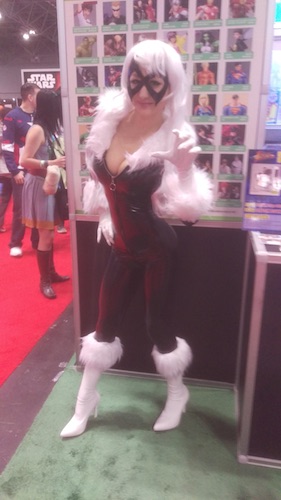
As with most con reports at Ogiue Maniax, I’d like to leave off with some cosplay. Truth be told, I wasn’t digging a lot what I saw, but Sunday really turned it around.

Correcting Past Failures Through the Super Robot Wars Games

The Super Robot Wars series, which crosses over various mecha anime across history in the form of turn-based strategy video games, is known for trying to make giant robots look their best. One way in which this is accomplished is through the attack animations, which have become increasingly detailed, dynamic, and beautiful as graphics have improved, such that even the less popular and even less good-looking series of yesteryear appear to have a new lease on life.

However, on a few occasions there will be an attack, even an ultimate attack, that will within the context of the source material be followed by failure or tragedy, and I find it pretty funny to see when the makers of the Super Robot Wars games try to compensate for this in some way. Below are a few examples.

(Spoilers for some series below).

The first comes from King of Braves Gaogaigar Final.

The mighty King J-Der, rival and ally to Gaogaigar, launches its strongest attack, the J-Phoenix. In the OVAs, this attack is unsuccessful in taking down the enemy, but of course you can’t have that happen in the video game. I personally interpret that pause at the end of the attack animation in Super Robot Wars Alpha 3 to be a vestige of that past failure.

The second example comes from Shin Mazinger Shougeki!! Z-Hen (also known as Mazinger Edition Z: The Impact!).

In the final battle, archetypal hero Kabuto Kouji sends a shower of Rocket Punches at Dr. Hell, ending it off with a final blow with a “Big Bang Punch.” However, in the actual anime, while the attack succeeds, the consequences are revealed immediately after to be arguably worse than if Kouji had not defeated Dr. Hell. It turns out that Dr. Hell, while evil, was also trying to prevent an even more evil force from succeeding. While this is acknowledged in the Super Robot Wars Z games through its story, as the games move along you can just keep using the attack mission after mission. The fact that the background doesn’t just suddenly turn red to signal further horrific developments almost feels as if something is missing.

The third comes from Neon Genesis Evangelion.

When the Angel Zeruel appears, it’s the toughest enemy that Ikari Shinji and the other Evangelion pilots have ever faced. At one point Asuka, desperate to prove herself, launches a non-stop artillery volley at the Angel, only for it to prove utterly ineffective. In the anime, this is one of the stepping stones to Asuka’s total breakdown at the end of the series, but in the video from Super Robot Wars MX below shows it being used to defeat opponents with few problems.

As I mentioned, most of the attacks in Super Robot Wars don’t really have this issue, and generally it’s all about celebrating their successes and having fun with characters from multiple series working together. Though, if most of the attacks in Super Robot Wars were to come from failures in the original anime, that might say something about where mecha anime as a genre has gone.

—

If you liked this post, consider becoming a sponsor of Ogiue Maniax through Patreon. You can get rewards for higher pledges, including a chance to request topics for the blog.

Ogiue Maniax Talks Otakon on the Space Opera Satellite Podcast

goldran-hiddencell

I was recently on PatzPrime’s Space Opera Satellite podcast to recap and review the highlights of Otakon from the mecha fan’s perspective. Joining us were also Tom Aznable, Hazukari, and Ashe Blitzen.

Have a listen

Park Romi Can’t Lose: Otakon 2015

I found Otakon 2015 to be something of an unusual beast, in the sense that a normally fierce dragon might seem uncharacteristically docile. At first I thought that this might be due to my unusual circumstances. While in years past I was able to attend Otakon all three days, this year I had to skip out on Friday. However, rather than it affecting my perspective in an adverse way, I realized it actually made a truth all the more clear: attendance was significantly down compared to previous years, from an average of 33,000 over the past five to about 28,000 for 2015. This is why, when I began my Otakon attendance on Saturday, what would normally be the most heavily populated day of the con was…surprisingly easy to navigate.

Given the continuous growth of Otakon prior, this might all come as a surprise. However, after discussing it with some friends and fellow fans, we came up with a few possible reasons. First, the music guests this year were not A-List, and this would mean that the attendees who normally came to Otakon for the concerts might have skipped out. Second, and probably more importantly, Baltimore was in the news not so long ago, and as many anime con attendees are fairly young. It would not be surprising to see parents fearing for their children’s lives, even if they allowed them to attend Otakon in years past.

Thus, less traffic, less tension, though for those who did make it, a relatively more relaxing experience… unless you were going for the Romi Park autograph line. In that case, it was probably a no holds barred slugfest with the winner getting the right to hear Ms. Park recite a line by Edward Elric, Shirogane Naoto, or any of her other famous roles. To the victors, it would of course have been worth it.

Park Romi’s Wild Ride

I was originally not planning on attending the Saturday press conference for Park Romi. At the last second I changed my mind, and it turned out to be the best voice actor press conference I’ve ever seen. Normally, seiyuu tend to give very safe answers. All of their characters are their favorites, they can’t give too many production details or insider secrets, and overall it’s just an opportunity for them to promote themselves in a benign, marketable way. With Romi, her personality gave the impression that she would never be able to play that safe route, even if she tried.

She talked about blacking out while auditioning for Air Master after uttering the most fierce battle cry. She pointed out how she loves Syrup from Yes! Pretty Cure 5 Go Go and the fact that he’s a walking contradiction (a penguin that flies, that’s innocent yet also cynical). She mentioned going to the karaoke box to wear her voice out in order to portray the pain and trauma that drives Edward Elric in every situation (she described him as her most difficult role ever). She even talked about what it was like to grow up Korean in Japan. Throughout the Q&A, what impressed me the most is that we gradually got a well-rendered image of Romi as a person and a voice actor. As someone who’s always felt a little bit on the outside, perhaps due to her upbringing and ethnic background, she’s been able to connect to characters who do feel a little off, or feel like they go against the grain. She mentioned always playing villains as if they’re the heroes in their own mind, and it pretty much all clicked into place.

One thing that many people will probably be talking about for years to come is that “Edward Elric” is a HUGE Adventure Time fan, a show where she voices the main character Finn for the Japanese dub. Normally one might think of this as a promotional ploy, but her passion for it was oozing. I heard at the previous panel on Friday that she mentioned her favorite show she’s worked on is Adventure Time. When asked what show she’d like to do more work on, the answer was Adventure Time. Which characters does she like the most? Finn, and Lemongrab. In her own words, “I like violence.”

I was able to ask her one question, which had to do with her work on the anime Ojamajo Doremi:

Ogiue Maniax: You play the role Majo Ran on Ojamajo Doremi. What was it like working on the show and with Director Satou Jun’ichi?

Romi: It was a fresh-feeling place there. Lots of cute girls!

Satou was a man who was very deep. He put a lot of thought and passion into everything he did. He was like a big brother type. But he did care a lot about details. Details, details, even more details. So you can guess that the recordings took many, many hours. (In English) Many, many hours.

However, the absolute highlight of her press conference was when Alain from the Reverse Thieves asked what it was like to work with director Tomino Yoshiyuki on the series Turn A Gundam. Tomino, who appeared at New York Anime Festival back in 2008, is famous as being a rather eccentric personality, and it’s always interesting to hear stories about him. Romi Park added to the legend of Tomino by describing to us her experience working with him on not just Turn A Gundam but also a previous show, Brainpowered.

During the recording for episode 1, Park recalls delivering the main character Loran’s famous line, “Everyone, come back here!” as he shouts to the moon, imploring his people to return to Earth. After first delivering the line, Tomino BURSTS through the door of the recording studio and begins to shout at her, to put more emphasis into it. “HERE! HEEEEERE!” he shouted, as he had his arms stretched out to the side. In episode 2, when Loran hits his privates accidentally, and Park delivered an unconvincing impression of it (having no direct experience), Tomino came bursting through the door again, exclaiming to her that this particular kind of pain is extremely intense but fades quickly. What was most telling about this was the fact that the Japanese MAPPA staff that was on the sidelines (Romi was here as promotion for the anime GARO) could be seen snickering, unable to fully control their laughter.

A few hours later, I also had a chance to interview Gundam X director Takamatsu Shinji, who had also worked with Tomino before, to add to the bizarre portrait of the creator of Mobile Suit Gundam. You can read that interview here.

Panels

Otakon is famous for its strong programming track, full of passionate fans who do extensive research in preparation for their panels, as well as industry panels aware of the fact that Otakon attendees tend to be savvier. For me, it’s one of the absolute highlights of going to Otakon every year, though this year I was only able to attend a few. And yet, from what I heard, I wasn’t alone.

It turns out most of the panels this year were either mostly full or at max capacity, which is rather unusual because generally only the biggest guests and the well-known, charismatic panelists get that much attention. To give a clearer image, usually the Studio MAPPA panel is sparsely populated. 10, maybe 20 people tops who know what a wonderful guest Maruyama Masao (founder and former head of Studio MADHouse, current MAPPA founder and president) is, and how insightful his responses are, but this year I heard that the MAPPA panel was impossible to get into. Now, keep in mind that this is also the year where attendance was down (early reports say the attendance was over 28,000 whereas Otakon these past few years has seen attendance records of over 30,000), a situation that brings up quite a few questions about the demographics breakdown for Otakon attendees, as well as their behavior.

Could it be that the Otakon attendees who normally would have made that extra 2,000+ wouldn’t be the ones attending panels? Perhaps the less famous music acts also meant people looked for something else to do and filled the panel rooms instead. Maybe the overall audience has been getting older and more appreciative of panels. In the specific case of MAPPA this year, it might be the case that people have begun to appreciate them more after they released two high-quality action/fantasy shows (GARO the Animation and Rage of Bahamut: Genesis), and I’ve heard that the success of SHIROBAKO and its reference to MAPPA founder Maruyama Masao (“Marukawa Masato”) was a significant factor as well.

In terms of fan panels, I attended both of the Reverse Thieves’ panels this year. I consider them good friends, but it’s not simply because I know them that I decided to sit in. They do good work and always capture the audience’s attention. Most importantly, they encourage people to check out anime they had no idea about, and expanding people’s knowledge about anime and manga is something i’m always for. Between the new “I Hate Sports: A Sports Anime Panel,” and their staple “New Anime for Older Fans,” the fact that these panels filled rooms with both people and their delightful reactions shows that fans aren’t stubborn when it comes to looking for shows beyond what’s familiar to them; they just need the right guides to get through the darkness and the seemingly infinite possibilities that come with the new slew of titles every year.

I also attended Mike Toole’s “Bootleg South Korean Anime” panel, though sadly could not attend its spiritual companion ran by another individual, “DPRKartoon: Anime from North Korea” (see above comment about panels filling up more quickly this year). Mike is known for being an excellent presenter, and he showed his chops not only in this panel but also his moderation for the Discotek Industry panel immediately afterwards, though I felt like the South Korean Anime panel wasn’t as tightly tuned as I’ve come to expect from a Mike Toole panel. Nevertheless, it exposed me to the unique history of Golden Bat in Korean animation, a superhero from the pre-manga kamishibai era of Japan, whose later anime was allowed to air in Korea in spite of bans on Japanese media because Korean staff had worked on the show. When a later iteration of Golden Bat appeared in Korea, he resembled a certain much more famous Bat-themed superhero, except that this “Bat-like Man” (though Golden Bat originally looked more like Ghost Rider with a cape) flew, laughed like a maniac, and show lasers from his fingers.

Otakon was the inaugural industry panel for Discotek Media, and I had to attend to know just what kind of minds were responsible for licensing Mazinger Z AND Shin Mazinger. It turns out, the aforementioned Mike Toole works for them, though he cites the owner of Discotek being a fan of good ol’-fashioned violent cartoons as a major contributing factor. The panel reminded me that I need to own Horus: Prince of the Sun, and even though I’m not a huge Gaiking fan or anything, the announcement of its licensing drew me towards it, rekindling my old desire to watch “all of the robot anime.” What was perhaps most impressive about the panel was finding out that they got an artist to faithfully recreate the bad-looking American Street Fighter cartoon art for their DVD box set. Given how badly that often turns out (have you seen the old boxes for the 80s Teenage Mutant Ninja Turtles cartoon?!), I am truly impressed that it looks so great and terrible at the same time.

One set of panels I did not attend due to advice given to me was the panels run by Pony Canyon for their new shows. Bringing directors known for their extensive and storied catalogues, it turns out that questions were restricted to only being about the shows they were there to promote. As someone who loves exploring the history of anime and picking creators’ brains, that was an instant turn-off. I hope that Pony Canyon learns their lesson for next time.

One More Panel: Mine

Last year, due to time constraints and fear of not finishing my thesis, I decided to skip out on preparing panels for Otakon. This year I submitted a couple, and fortunately the one I really wanted to do made it through. That was “Great Ugly Manga,” inspired by my love of 81 Diver, and the fact that the concept of “bad-good” is still relatively foreign to a manga-reading audience (though less so a comics-reading audience in general). I worked with super ultra manga expert Ed Chavez (who also has an appreciation for the awesomely ugly), and together we worked to try and convey the idea that sometimes “bad” artwork enhances the impact of a manga, whether intentionally or not. The panel ran a bit quickly, finishing early, which makes me wish we packed it with more stuff, but that’s a lesson learned for next time. I do really want to do the panel again.

Artist Alley/Dealer’s Room

I came to Otakon this year a little more prepared to spend money on trinkets and goodies, but ended up getting less than I expected, which is probably best for my wallet. Of the purchases I made, the one that sticks out most is an excellent little double-sided charm from Suzuran, which now adorns my recently-purchased smartphone. In terms of official merchandise, most of my purchases actually came from the Pony Canyon booth. I did not go for their extremely expensive bluray sets, especially because $75 per disc sounds absurd to my ears, but I like the shows that they’re involved with a lot, and wanted to support them in a way they might potentially understand. I came away with a t-shirt and poster of Sound! Euphonium, as well as a CD from Rolling Girls, both anime that I highly recommend. As an aside, I also ended up with a free Love Live! School Idol Movie poster for some reason I still don’t quite understand. Will I frame it and carry it with me to the New York premiere of the Love Live! movie? Only time will tell.

The Real Hero of Otakon 2015: Crab Cakes

So anime is cool and all, and Otakon is the largest anime convention on the east coast, but Baltimore is supposed to be known for their crabcakes, and it’s supposed to be a part of the Baltimore experience to eat some awesome ones. Unfortunately, in the past the ones I had were more decent than incredible, but this all changed when a truck decided to carry some of the best crab cakes ever, and parked itself in front of the hotel I was staying at. To describe how good Flash Crabcakes are is to mention that I regret more than ever the fact that Otakon is leaving Baltimore in a couple of years. I also learned that things named Flash tend to be amazing, whether it’s the superhero, the Starcraft player, or indeed the super lump crabcake. The program that spawned Animutations gets a pass for its accomplishments, even if it’s become a bit senile and deranged.

Countdown to the Beginning of the End

Despite the fact that this Otakon didn’t seem quite as outright exciting as previous ones, I came away from it having two of the best interviews/press conferences I’d ever conducted. It was truly a pleasure to pick the brain of two industry veterans, and my only real regret was not being able to attend any Maruyama Masao panels due to scheduling conflicts.

I also left this year’s Otakon aware of the fact that only one year remains in Baltimore. While I think the move to a larger convention center in Washington, DC is probably the right move, I do feel some concern for the city of Baltimore itself. After all, Otakon is a huge money maker for them, and even if attendance was down, there’s a difference between losing 5,000 tourists and losing 33,000, all of whom want to eat in the area. Will there be another convention that tries to fill the vacuum left by Otakon? The battle for MD/VA begins.

Best Duo

Best Couple

Bester Couple, Oooooh Yeahhhhhh

Otakon 2015 Interview: Takamatsu Shinji

This is an interview with director Takamatsu Shinji from Otakon 2015. Takamatsu as worked on many anime including Gundam X, the Brave (Yuusha) series

First question. Most Gundam series had romance but didn’t have it as a strong focus. Gundam X is a series that put the romance at the very forefront, and it was in some ways the main focus. Why was this decision made for this series?

It’ll be a long story!

I wanted to make something that was Gundam but not Gundam. One rule of Gundam X was to get out of Gundam and to be meta about Gundam, to do things that were not like “Gundam.”

Before that, about a decade prior, you worked on Z Gundam and Gundam ZZ. What was your director Tomino Yoshiyuki, and how would compare his style to yours?

Well, I did grow up watching Gundam myself, and by the time I started to work at Sunrise Mr. Tomino was in the position of being a great director, so it was a scary prospect working with Tomino.

During Z Gundam I was production management, so I reported directly to him, and I was scolded by him every single day. There were days when I was scared about everything.

Romi Park is also at this event, and she gave a similar description of Tomino that is not inaccurate compared to yours.

However, Ms. Park worked with Mr. Tomino much later than I did, and if you look at Mr. Tomino at the time of Z Gundam, he really was off the wall.

You’re also very well known for your work on the Brave series, and you worked on many of them. What was the main reason you returned to the Brave series for so many years?

The first director of the Brave series, Yatabe [Katsuyoshi], brought me onto production for the show, and I worked on a little bit of Gundam in between. So, there was a hiatus for me, but otherwise I started from beginning to end for the entire series. And I got my debut as a director from the Brave series, so I am very much fond of the Brave series.

Might Gaine was my debut as a director, so I am particularly fond of it.

In that case, I have an interesting question to follow up with.

The Brave series is known for being very toy and merchandise-heavy but also having good storytelling, as well as in some cases the staff resisting the merchandising aspects of the Brave series. Two famous examples I know are a hidden cel in Goldran which sarcastically talks about it’s supposed to be a robot that’s easy to make into toys, and how Might Gaine’s ending is a criticism of the toy industry.

What were your and the staff’s feelings at the time, and how did the toy companies such as Takara react?

That’s a very deep and vexing question!

So when I was getting started with Might Gaine, I was told that there’s just supposed to be good and bad, and all I had to do was to have toys that featured good guys and bad guys who would just battle. The staff really felt we need to show some kind of resistance, and that that wouldn’t just be the end of the show. And by staff, I mean myself.

You did not work extensively on Gaogaigar, but I have to ask this question. Do you have any details you can share as to why Project Z never got off the ground?

That I don’t know about!

That’s okay! Moving on, another similar series you worked on was Chousoku Henkei Gyrozetter, which was based on an arcade game. How would you compare working on Gyrozetter vs. working on the Brave series?

Gyrozetter was based on a video game, so while the look and feel of the show may be similar to a giant robot show, production of the show was otherwise completely different.

Unlike previous shows, the robots came from video games, so it wasn’t really needed as a tangible object, and I thought we could have done more with that.

I did grow up watching toy merchandise-based shows and I did think about what if the robot were a toy, but that wasn’t reflected in the show. That would be my regret. I talked about the resistance to merchandising intent of the toy companies for your earlier question but I actually love toys.

Last question. In regards to Cute High Earth Defense Club Love!, people have talked a lot over the years about the idea of a magical boy series. Whenever anyone brings up magical girls, someone asks, what about magical girls? What was the motivation behind finally putting that into reality?

The producer pitched it to me, and I thought, wouldn’t it be fun to work on something no one’s ever done before? And it turned out to be fun. (laughs)

Thank you!

Thank you.

Gundam Build Fighters TRY Fighting References

Gundam Build Fighters Try has made a number of references to fighting styles from other anime, manga, and games, especially towards the end of the series.

In Episode 19, the character Ichinose Junya pulls off a couple of attacks from various fighting styles. This includes a demonstration of boxing, which might look familiar:

This is actually Makunouchi Ippo’s finishing combination from Hajime no Ippo: the Liver Blow, the Gazelle Punch, and the Dempsey Roll.

Next, Junya demonstrates attacks from Ba Ji Quan:

This specific sequence leading into the shoulder tackle is one of Akira’s signature attack strings from the fighting game series Virtua Fighter:

In Episode 20, Kamiki Sekai, one of the central characters of Gundam Build Fighters Try, sends a burst of energy rippling forward by slamming his fist into the ground:

This is a reference to Terry Bogard’s special move, “Power Wave,” which he’s used since the original Fatal Fury and all other games he’s appeared in.

This last one I’m not 100% certain on, but in Episode 23 Junya appears again and confronts Sekai:

I believe it is supposed to be an homage to Fist of the North Star, specifically Souther’s Nanto Hou’ou Ken style:

That’s all I’ve spotted for now. If there are more, then I’ll probably make another post.

—

If you liked this post, consider becoming a sponsor of Ogiue Maniax through Patreon. You can get rewards for higher pledges, including a chance to request topics for the blog.