Between Mister Rogers and Transformers is Precure

I had the opportunity to watch the Mister Rogers documentary Won’t You Be My Neighbor?, and one of the topics it discusses is the origins of Mister Rogers’ Neighborhood as a kind of counter-programming to the fast-paced “bombardment” that was (and continues to be) a staple of children’s television. Mister Rogers was meant to slow things down, and give kids a quieter and more contemplative half hour for them to learn and grow. Fred Rogers’ decades-long show took on an important challenge, but there’s the seed of doubt about its efficacy on people like myself, who remember their young childhood TV experience more along the lines of action-packed cartoons like Transformers or GI Joe. How do you reconcile the allure of such shows with the noble cause of trying to help kids learn to be better people? 

Especially in the 1980s and 1990s, there was a trend of including public service messages in those merchandise-shilling action shows—”Knowing is half the battle!” as GI Joe would say—but they would often come across as unbelievably hokey or even disingenuous. Going from watching GI Joe’s forces blow up an enemy Cobra base, to seeing kids learn how to install a smoke detector—it never felt right.

I began to think about if there were any children’s series out there that integrates a nice balance between satisfying action and good advice to children, and one answer popped into my head immediately: Precure. More than a few magical girl shows carry a strong sense of positivity and wonder—in fact, I once referred to 2001’s Princess Comet as being distinctly Mister Rogers-esque—but they often don’t hit that pleasure zone that comes with watching heroes vanquish villains the way Precure does. After all, its origins are built on “a magical girl show from the director of Dragon Ball Z, and while its staff has changed numerous times, it still more or less maintains that legacy. But when you also look at the various heroines throughout Precure, they serve as confident and inspiring role models for young viewers in ways that almost betray the heavy consumerism that it also engenders.

Consider Cure Yell in Hugtto! Precure, who’s all about giving support to those both looking for their dreams and those pursuing them. Or how Cure Flora in Go! Princess Precure overcomes a major problem by realizing that the power to change and improve comes from within. Or how Cure Heart in Doki Doki Precure! reaches for the stars in everything she attempts. These heroines are only the tip of the iceberg, as many individual episodes also try to speak to the concerns and worries of children, and how to deal with the complicated and confusing emotions they experience growing up.

I think this is why I am, and likely always will be, a fan of Precure. Its creators know the power of being a GI Joe, but it also knows the value of being a Mister Rogers’ Neighborhood. Striking that middle ground can come at a price—a muddled message, perhaps—but attempting that alchemy is valuable in a world where ideals and cynicism alike clash with each other on a daily basis.

Shields or No Shields? Platform Fighters and the Question of Defense

As a long-time fan of Super Smash Bros., I’ve been curious about the recent expansion of the “platform fighter” subgenre, especially in indie gaming. Over the past six years or so, more and more titles have been developed that follow the basic Smash formula. I’ve mostly watched tournament matches to try and get a sense of what each game is about, but more recently I’ve been able to try some out. Playing them made me aware of an odd trend: a lot of these games do not have shielding or anything akin to blocking as a sustained stationary defensive option.

The five indie platform fighters I’ve paid attention to are Rivals of Aether, Brawlout, Brawlhalla, Slap City, and Icons Combat Arena (which is being succeeded by Vortex Rising). Of these titles, only the last two have Smash shielding. The first three have, at most, workarounds. Rivals of Aether has parrying, Brawlout has a spot dodge and a Guilty Gear-esque burst system, and Brawlhalla has a spot dodge.

There’s nothing necessarily wrong with removing shields from a game, but the decision stands out because of how fundamental blocking is to fighting games as a whole. It’s one thing to have weak shields like in Smash Bros. Melee or Smash Bros. Ultimate, but it’s another to eschew the mechanic wholesale—doing so removes the classic rock-paper-scissors balance of blocks > attacks > throws > blocks. Indeed, while Brawlout technically has grabs, they don’t really function all that differently from striking attacks. The fact that the posterboy for Brawlout, Paco, is a wrestler becomes largely a matter of aesthetics.

The big question is simply, why remove the most basic defensive technique there is? After all, while there are clear similarities between these Smash-inspired games, they’re also not necessarily going for the same exact gameplay. Moreover, as different as the actual Smash titles are, they all have shields. 

The answer, it seems, is to try and capture that ineffable quality called “hype” while keeping players from being overwhelmed by complexity.

In the case of Rivals of Aether, its creator describes the lack of shield as a product of both practical limitation and creative decision-making:

Grabs and Shields were removed from Rivals to decrease defensive options and to reduce animation scope by removing throws.

The aggressive focus on Rival’s engine reflects my style as a player. I gravitate toward rushdown and so does RoA’s middleground.

The RoA fans themselves seem to love this, arguing that it emphasizes aggressive gameplay, making things more thrilling overall. Meanwhile, the official Brawlout website has this to say:

Rather than slow-paced defensive battles, Brawlout goes all-out with the lightning-fast aerobatics which platform fighters are famous for.

By focusing on aggressive mechanics, new players will be able to easily nail impressive combos while not feeling overwhelmed by friends who’ve had a bit more practice.

Brawlhalla doesn’t have any specific mission statements, but its free-to-play nature and its overall mechanics also hew in this direction.

Generally speaking, strong defenses frustrate those eager to be rewarded for offense, and that goes double for less experienced players and viewers. Even titles with crazy combos and pressure like Dragonball FighterZ have people getting salty about players who “spam block.” But there’s also the specific context of when many of these platform fighters began development: during the rise and fall of Smash 4. A frequent criticism of the Wii U entry was that shields were too strong, and discouraged the kind of high-pace aggression Melee is known for. Ultimate itself responded to this feedback by weakening shields in certain ways. The shield-less indie games essentially took it one step further. 

It’s also notable that these games, as much as they want to emphasize an almost Melee-esque speed, also try to make competitive-level play more accessible than Melee—a desire to, as the old saying goes, be easy to learn and difficult to master. Brawlout, RoA, and Brawlhalla all try to streamline Smash and especially Melee mechanics to remove some of the execution barrier, whether that’s removing the need for “smash attacks” (Brawlhalla) or simplifying wavedashing (RoA).

However, it’s impossible to fully solve the “problem” of strong defense, blocking mechanic or no. Turtlers always seem to find a way, especially when their opponents want to attack without much forethought. Even Brawlhalla, with its flimsy spot dodge, has seen players frustrated by defensive styles. For example, one asked how to fight passive/defensive players, while another understood how to beat spot dodge (bait it out and punish), but hated playing passively.  

There’s another aspect to consider. Smash Bros. shield is a signature aspect of the franchise, and for a long time, it was unique among fighting games. A barrier that successfully guards against nearly everything at first, it shrinks over time, leaving the user more exposed and more prone to getting stunned into a dizzy state (shield breaking) . It’s one way to introduce weaknesses into blocking, which traditional fighting games usually go about through the concept of high/low mix-ups. But perhaps, because the Smash shield is so iconic, the games that do incorporate it seem even more like “clones.” An alternative form of blocking that’s simple and reasonably effective could be the answer to set future platform fighters further apart. In this respect, some games have been trying their own renditions of shielding. Vortex Rising is implementing one-way shields that are inherently vulnerable to cross-up attacks (i.e. attacks that can land behind your opponent where they aren’t protected), while a newcomer to the platform fighter genre, Slayers for Hire, is going for something more akin to a Street Fighter IV-style “focus attack” (for Smash players, that would be Ryu and Ken’s down special).

The shield-less platform fighters have thus far sought to discourage stationary defense and encourage more active movement, and the players who have gravitated towards these games have found them to be enjoyable. But I have to wonder if aggression can truly be considered as such if there isn’t enough to oppose it. In other words, is rushdown truly rushdown if there isn’t an equally strong defense it needs to crack? Whatever the answer may be, having games that remove blocking entirely may bring about interesting results.

Their Problem is Our Problem: The Promised Neverland, “Coronavirus,” and the Systems that Force Inequality

WARNING: THE PROMISED NEVERLAND MANGA SPOILERS

In Chapter 172 of The Promised Neverland, there’s a collage that’s rather conspicuous, given the actual pandemic hitting the world at this moment. As the heroine Emma is confronting an enemy leader about how differences in positions are the root of conflict, one of the images has a wall with the word “coronavirus” graffitied on it. 

Up to this point, it’s been established that the main characters live in an alternate dimension from the regular human world, but there haven’t been direct calls to the reality in which we, the readers, live. I think this “coronavirus” page is a direct message from the creators of The Promised Neverland, Shirai Kaiu and Demizu Ponsuka, and what that message says is: “The ideas conveyed in this manga are not meant to be taken as mere vague abstractions about generally making the world a better place, but as very real criticisms of society.”

When The Promised Neverland first began, it was an interesting manga about a cat-and-mouse game and a battle of wits in a dystopian setting. Originally, the focus was on escaping an orphanage designed to turn children into food. Then, it was about surviving against the demons on the outside. Over time, however, the series has revealed a greater world where the real evil of the series is not scary human-eating monsters but how the corrosive desire to hold onto power at the expense of the greater good. 

In order to survive, some children strive to become mothers—essentially overseers of the human farms, but also chattel themselves due to being the literal suppliers of the chain through giving birth. Mothers are told that the best among them can become a “grandmother,” supervising all the mothers, making them compete desperately too. It’s even revealed that the demons themselves have an oppressive class hierarchy. Eating human meat is what has allowed them to gain a high level of intelligence, but a steady diet is necessary because otherwise they’ll revert back to beasts. The rulers of their world get access to the best meat, and can thus maintain their already massive advantage. Moreover, there turns out to have been a way to permanently prevent the demons from losing their intellect, but the ruling class purposely and violently obscured that information to keep the masses dependent on those in charge. In other words, everything about society in The Promised Neverland is premised around pitting the lower classes against one another to distract from the intentional systemic issues imposed by those in power.

How does that apply to our own world? “The top 1% hold 99% of the wealth” is about how massive inequality concentrates all the power in a select few who inevitably enrich themselves at the expense of others. In regards to keeping the lower classes at one another’s throats, US president Lyndon B. Johnson famously said, “If you can convince the lowest white man he’s better than the best colored man, he won’t notice you’re picking his pocket. Hell, give him somebody to look down on, and he’ll empty his pockets for you.” Writer and lecturer Douglas Rushkoff even wrote an article in 2018 about how some of the ultra-rich are preparing for the apocalypse by figuring out how to save themselves while still wondering if it would be necessary to lock down their guards’ food supplies to force loyalty.  And now, with the COVID-19 pandemic, we’re seeing how the very same types are retreating further into their massive safety nets, leaving those with less to struggle. It’s crystal clear to me that there’s a similar sentiment at work fueling the overt criticism of the disparity in power and resources in The Promised Neverland

The fact that Weekly Shounen Jump comes out with brand new chapters of manga on a regular and consistent basis can be a blessing and a curse, but one advantage of the accelerated pace of a weekly manga magazine is how quickly it can potentially seize upon the relevant events of the day. What that “coronavirus” graffiti communicates is simple: the crises your heroes are facing in The Promised Neverland are not that far from the problems that plague the very reality in which you live. Emma, as the heart of this series, staunchly opposes false dichotomies that lead to zero-sum situations where one group can only “win” by sacrificing another. Perhaps The Promised Neverland wants us all to be allies in this struggle, and to be aware of the real problems that gave way to our current global crisis: racism, social inequality, intentionally massive disparities in wealth and resources, and an economic environment where those in power are encouraged to let the whole world burn if it means keeping their positions.

Love Live! April Fool’s “CYaZALEA☆Kiss”: References and In-Jokes

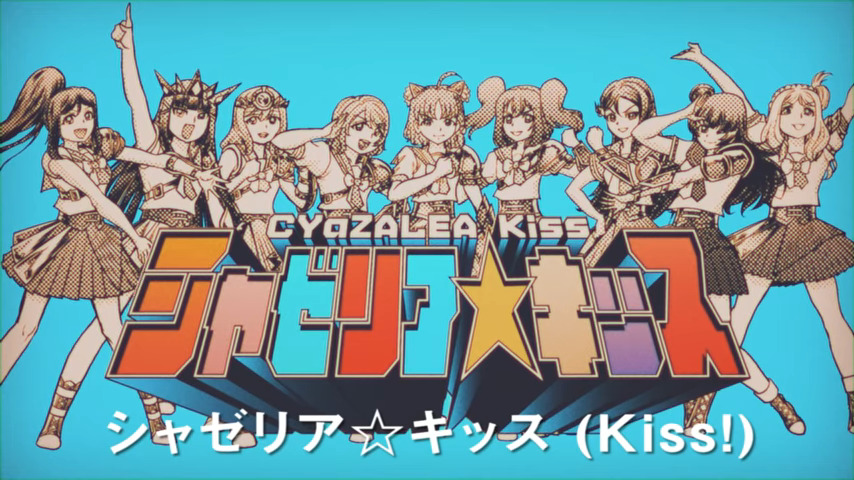
This year’s April Fool’s brought out one of the best things ever from Love Live!: the “announcement” of a new 80s-style action anime called CYaZALEA☆Kiss

But the Love Live! fandom and the 80s anime fandom generally don’t overlap, so I’m here to explain some of the jokes/references on both sides.

The name itself: “CYaZALEA☆Kiss”

The characters featured in this video are collectively known as Aqours (pronounced “aqua”), and are the heroines of the Love Live! Sunshine!! iteration of the franchise. These nine girls, in turn, are composed of three idol sub-units with their own distinct styles called CYaRon!, AZALEA, and Guilty Kiss. In the “plot” to this video, the three sub-units must join forces, but rather than calling them “Aqours,” their separate group names have just been mashed together.

It’s sort of like if you called the Teenage Mutant Ninja Turtles “Leodonphalangelo.”

The narration is a spoof on Fist of the North Star

The introduction of a post-apocalyptic backdrop set in the year 20XX is a reference to the opening narration of Fist of the North Star, a violent 80s shounen series about a world-saving martial arts hero who can make bad guys explode with his fists. In the anime, the narrator explains how in the year 199X, the Earth was ravaged by nuclear war, setting the stage for the series. 

On top of that callback, the over-the-top voiceover featured in CYaZALEA☆Kiss is none other than Chiba Shigeru, the actual narrator from Fist of the North Star! Famously, he’s known for getting more and more ridiculous and impassioned over the course of that series, and he brings that very style to this April Fool’s gag:

The general feel of the opening is an homage to Saint Seiya

From the team aspect, to the outfits the girls wear, to even the swooping logo (featuring 80s cel-animation shakiness), the whole CYaZALEA☆Kiss endeavor is largely based around the 80s shounen manga and anime Saint Seiya. Following a group of heroes who gain special armor and cosmic powers based on the constellations, Saint Seiya is famous for pioneering the “armored pretty boys” genre, and was responsible for bringing many female readers to Shounen Jump.

The general art style is also very reminiscent of the aesthetics of Saint Seiya author, Kurumada Masami.

Sentai colors run amok

At the beginning of the opening video, all the girls in CYaZALEA☆Kiss announce their designated colors, similar to what’s often seen in Super Sentai and other tokusatsu works. But whereas those shows typically have six, maybe seven members at most, there are nine in this case. Not only does this cause a jumbled mess of talking-over, but the actual colors named can get very specific.

Chika: Mikan 

Riko: Sakura pink

Kanan: Emerald green

Dia: Red

You: Light blue

Yoshiko: White

Hanamaru: Yellow

Mari: Violet red

Ruby: Pink

These are the actual signature colors of their respective characters in Love Live! Sunshine!! too. If you buy a glow wand (or “light blade,” as they’re officially called), it’ll come with all nine of these colors.

Though perhaps not intentional, it also harkens back to the sentai parody anime Shinesman, which featured a team of red, gray, sepia, salmon pink, and moss green.

The character designer and artist for CYaZALEA☆Kiss is a famous 80s manga artist

While the overall look of this parody is based on Saint Seiya, the actual artist himself is not Kurumada but rather Shimamoto Kazuhiko, creator of Blazing Transfer Student and Aoi Honoo, aka Blue Blazes

Blazing Transfer Student is a ridiculous school fighting manga. Blue Blazes is an exaggerated semi-autobiographical work about Shimamoto’s time in art college, when his classmates included modern anime/manga luminaries such as Anno Hideaki of Evangelion fame. The former received a 1991 OVA by Gainax (the original Evangelion studio), while the latter was adapted into a TV drama in Japan in 2014.

What did you think of CYaZALEA☆Kiss? Did you appreciate it as an 80s anime/manga fan, as a Love Live! fan, or perhaps as both?

Voices of a Social Distant Star: Ogiue Maniax Status Update for April 2020

Well, what a month it’s been. Back in March, the threat of COVID-19 was real, but I did not expect things to escalate so quickly. The number of sick and dead ever increases. We’re seeing the Tokyo Olympics get postponed to 2021 and Comic Market 98 get canceled. New York City and the United States have become epicenters of the virus. I’m among the many currently sheltering in place and doing my social distance thing, and I’m fortunate to be in a position where my life isn’t thrown into total disarray as a result.

Part of that has to do with the ongoing support of my Patreon supporters, especially the following.

General:

Johnny Trovato

Ko Ransom

Diogo Prado

Alex

Sue Hopkins fans:

Serxeid

Hato Kenjirou fans:

Elizabeth

Yajima Mirei fans:

Machi-Kurada

Not only is it a bit of extra cash, but having this blog and the responsibility of making sure the Patreon is worthwhile helps me maintain a schedule and keeps my mind active. Sometimes I need to remind myself that there’s always something to talk about on an anime blog, even if we’re seemingly entering a new period in the story of humankind.

That being said, if anyone can’t afford to keep up their Patreon subscription for Ogiue Maniax, don’t feel bad about putting it on pause for however long it’s necessary.

What remains to be seen is how many COVID-19-related puns can I make for these monthly updated posts.

Blog highlights from March:

Friends with Consequences: Spotted Flower, Volume 4

It’s been a few years since the last volume of Spotted Flower, and it ramps up the insanity of this Genshiken what-if like nobody’s business.

Brief Thoughts on Anime, Manga, and COVID-19

It’s the talk of the town…! I’m curious as to how the current pandemic might shape the storytelling and themes we find in anime and manga going forward.

Space Cases: Star Twinkle Precure

The recently finished Precure series is not just yabai, it’s kirayabaa~.

Hashikko Ensemble

Chapter 26 has me legitimately wondering if Jin might be on the spectrum.

Patreon-Sponsored

Aikatsu as Absurd Idol Anime Turning Point?

Idol anime can get quite zany these days. Is Aikatsu! the reason?

Apartment 507

I wrote a review of the Nintendo Switch version of Touhou Gensou Mahjong.

Closing

Stay safe, and remember that we’re all in this together.

Oh, and uh, look behind you.

April Fool’s ha ha ha…

Brief Thoughts on Anime, Manga, and COVID-19

It’s rare that anything can have such a visibly profound global impact, but that’s what we’re seeing with COVID-19. I find it funny that I tried last year to predict what the 2020s would hold in store, and it hasn’t even been six months before everything has gone sideways. For many people around the world, it has disrupted various aspects of life, and even the anime and manga industries have already felt its effects. Notably, A Certain Scientific Railgun T was delayed for a little while specifically because of the novel coronavirus, and its situation portends to a general trend going forward.

But COVID-19 likely won’t just change the production logistics of anime and manga—there’s also storytelling, themes, visual expression, and just about all the things we might take for granted or perceive as the norm. While we’re probably see works that either try to explore disease and pandemics (either directly or metaphorically), even more escapist entertainment is going to have the specter of the coronavirus hanging over. What does a harem manga even feel like in an era of social distancing? What about seeing characters just give one another hugs? To what extent well even the fantasies of fiction feel odd? In recent days, I’ll look at old videos from a month ago—including but not limited to anime and manga—and their tacit assumptions about the world already feel…dated.

Another big factor is how globally common the problem of COVID-19 has become. Something like 9/11 affected the US differently compared to other countries (though the US’s actions continue to have widespread effects). 3.11 hit Japan in life-changing ways, but that’s not as much the case in other areas. COVID-19 feels different in that its basic consequences are similar the world over. The disease spreads very easily, and it doesn’t discriminate. Old people are most at risk but no one is necessarily “safe.” Restaurants, theaters, and other social gathering sites cannot function as normal. Staying home as much as you can in order to help out is the name of the game. This universality means any media or entertainment made in response to COVID-19 will be understood virtually anywhere. 

Incidentally, Season 2 of the Cells at Work anime was just announced for January 2021. How ironic it would be if that series got delayed due to these circumstances…

The way COVID-19 has changed and will continue to affect everyday life is difficult to fully grasp, and I hope humankind can come out of this safe and sound and ready to tackle whatever problems still face us. In the meantime, it’ll be interesting to see how our art and entertainment reflect this new world.

Recent Thoughts on Love Live's Nijigasaki High School Idol Club

In the past, the third Love Live! multimedia project, “Nijigasaki High School Idol Club” (previously known as “Perfect DREAM Project”), had somewhat eluded me in terms of its appeal. Certainly, when it comes to Love Live! In general, I’m usually something of a late adopter—it’s usually the anime adaptations that bring me in, as opposed to the games, magazines, or even the songs. I’m also not so big a fan that I’ll follow every crumb of information, or try to pick favorites before I’ve had a chance to learn about the characters.

Two things have changed since then: the Love Live! School Idol Festival All Stars mobile game (hereafter LLSIFAS) came out, and I attended a delayed viewing of the “Love Live! Fest” concert featuring the girls from all three generations. Together, they’ve given me a better insight into how this third Love Live! Is supposed to work, and its concept of “more individualized school idols” has me curious.

As soon as the nine Nijigasaki girls came out on stage at “Love Live! Fest,” it was clear that the thinking behind them diverged from what went into their predecessors. Rather than appearing as a nine-member unit with matching outfits, each of the singers/voice actors dressed like their characters, who themselves all have very different concert wardrobes. So instead of, say, having all of μ’s in white for “Snow Halation,” it was a hodgepodge ranging from a Swedish dress to a fancy nightgown to a kind of Vocaloid-esque ensemble. Their styles were incongruous, and intentionally so. As explained by one of the members, the theme of the Nijigasaki High School Idol Club is to emphasize each girl’s uniqueness above all else. It’s quite a departure from previous Love Live! projects, which were all about nine girls working as one. 

Each of the Nijigasaki girls also has their own solo number (in addition to a couple of group songs), which is something that the members of μ’s and Aqours didn’t get until later. I think it actually helps convey what each of their personalities is like, as opposed to trying to figure out which girl is which when they’re all singing at the same time. Asaka Karin is supposed to have a more mature sex appeal, and it comes across in spades when she’s the only vocalist. Speaking of Karin, learning about her character was an experience. First, she came out and called herself the “sexy” one. Then, she called her fans “slaves.” Last, it showed her signature symbol: a high heel (hmm). It dawned on me that Karin (as well as the other eight girls) are likely all going for very different audiences from one another.

LLSIFAS somewhat departs from its mobile game predecessor by having more of an ongoing narrative in the story mode. In Chapter 1, you learn that the Nijigasaki High School Idol Club is in a sorry state and on the verge of being shut down. Your goal is to bring back the old members and recruit some new ones, and you basically learn about each of the characters along the way. I think this has been effective in helping me get a better sense of what each of them is all about, with the heavy amount of interaction and the clearer direction doing a good job of showing how the characters are when there’s an obstacle to overcome. Still, I wonder why the forces that control Love Live! as a whole decided to move in this direction for their third endeavor.

I’m not ready to fully embrace Nijigasaki because I find that a bit of resistance is for the best when approaching idol franchises, even the continuation of one I’m already a fan of. The original Love Live! won me over even as I was very skeptical of it, and it took some time for me to enjoy Love Live! Sunshine!!, but it happened eventually. I don’t need to pick a favorite Nijigasaki girl, I don’t need to enjoy every song, and I don’t need to go all-in from the start. That said, I’m looking forward to how the more focused format of an anime will tell their story, and how this idea of individuality will play out. And with a fourth Love Live! project on the way, the Nijigasaki idols will become “senpai” themselves.

Aikatsu as Absurd Idol Anime Turning Point?

Every so often, I think about a specific kind of comic absurdity I see in many idol anime. It’s one thing for characters to be having pillow fights, but it’s another for the heroines to be digging miles-long tunnels, shooting lasers, and scaling treacherous cliff sides with the greatest of ease. Of the franchises that fall under this umbrella, I’ve started to wonder if Aikatsu! is actually a significant contributing factor, bridging the silliness of actual idol media appearances with the impossibility of cartoons. I’m much more of an anime fan than I am an idol fan, so my knowledge and experience in regards to the latter is limited, so take what I say with a grain of salt.

I often see clips of idols on variety shows, as well as in their own video specials and the like. There’s a certain lightheartedness portrayed in these instances that creates the opportunity of laughs and gasps. It’s the kind of humor you see more in Love Live! or The iDOLM@STER, which initially tried to be a little more “down to Earth” with their characters and presentation, though are willing to stretch the boundaries of believability. The difference between those examples and what we see out of Aikatsu, Purichan, and Show by Rock! (not exactly idols per se, but a similar vibe) is that these three franchises venture into a very different reality where even everyday interactions are colored by the strangeness of their worlds.

Take for example the go-to mantra of Aikatsu!: “Ai-katsu!” Characters chant it while exercising, practicing, and engaging in pretty much any situation. Sure, it’s just short for “idol activity (aidoru katsudou),” but the way the phrase is treated as this perfectly routine thing everyone understands sets the stage for series after series where the humor is about challenging expectations of what’s normal. Whether it’s the aforementioned climbing, chopping down trees like Paul Bunyan, or visiting an idol school that’s also literally a gigantic cruise ship, the girls of Aikatsu! do what their flesh and blood counterparts cannot—not always because it’s harder for the latter, but sometimes because the laws of real-world physics do not permit them to do the same thing.

So why do I point at Aikatsu! as a possible origin point? It’s because the closest series to it when Aikatsu! first began was Pretty Rhythm, and that franchise was the predecessor for Purichan. Over the course of that transition from Pretty Rhythm to Purichan, the humor changed to something more akin to Aikatsu’s. A little more distantly relevant is the Precure franchise, but even the magical superpowers on display there aren’t quite the same as the at-times Looney Tunes-esque slapstick and accepted norms of Aikatsu!-esque series.

I’m not a deep fan of any of the series mentioned (with the possible exception of Love Live!), so there’s a lot more to potentially deve into. If there’s anything I’m missing or clearly mistaken about, don’t hesitate to let me know.

PS: Today is an idol shared birthday between Hoshimiya Ichigo from Aikatsu! and Sonoda Umi from Love Live! You know what they say: “Beware the idols of March.”

This post is sponsored by Ogiue Maniax patron Johnny Trovato. You can request topics through the Patreon or by tipping $30 via ko-fi.

Simon’s Rival?: Ogiue Maniax Status Update for March 2020

At the end of last year, I hoped that 2020 would turn out better. I’m starting to doubt whether that’ll happen. But before I get too somber, I’d like to thank the following Patreon supporters.

General:

Johnny Trovato

Ko Ransom

Diogo Prado

Alex

Sue Hopkins fans:

Serxeid

Hato Kenjirou fans:

Elizabeth

Yajima Mirei fans:

Machi-Kurada

The big news of the day is COVID-19, the new and highly contagious coronavirus. Even within the specific realm of Japanese culture (let alone the rest of the world), it’s causing schools to be closed, anime and music events to be canceled, and even the Tokyo Olympics might not be safe. Asia is in a panic, cases of the infection are cropping up all over the world, and here in the US, an utterly incompetent executive branch is more concerned with the stock market than people’s well-being.

I don’t intend to panic nor cause others to panic, but I hope that everyone, no matter who they are, take care of themselves. Don’t try to power through sick days. Get the help you need. Get a flu shot to reduce the chances of your flu-like symptoms actually being the flu.

Now, back to your regular scheduled Ogiue Maniax update.

Blog highlights from February:

Mewtwo vs. Mewtwo: Notable Voices in “The Wonderland”

Two of the voice actors who have played Mewtwo show up in the same movie! Also, The Wonderland is great, and you should check it out.

Talkin’ About Shaft: Oogami-san, Dada More Desu

The end of a cute and racy manga about a girl with an incredibly dirty imagination.

The Source of Life: “Ride Your Wave” Film Review

Yuasa Masaaki’s new film is great, and its message powerful.

Hashikko Ensemble

Chapter 25 reveals more about Jin’s family, and the fears and doubts he has about himself.

Patreon-Sponsored

Play the Anime in Your Living Room: Discovering Anime Board Games and Card Games

A request to write about anime-themed games turned into a discovery of some quite creative traditional games.

Apartment 507

I wrote a little bit about Jimbocho, the book town of Tokyo.

Closing

Economic impact is inevitable, but I’m curious as to whether COVID-19 will have any creative impact in terms of the anime and manga that will be made. How appropriate it is that the current season of Precure, Healin’ Good Precure, has a medicine and environmental theme.

Jyushin Thunder Liger: The Impossible Gimmick

January 6, 2020 marked the end of an era as beloved Japanese wrestler Jyushin Thunder Liger retired. His achievements are many, from innovating the Shooting Star Press (now seen in wrestling matches all over the world) to being perhaps the greatest junior heavyweight ever. One thing that stands out to me in his long career is how insane it is that he managed to embrace his ridiculous gimmick, his outward identity as a wrestler, and elevate it to the point of world-wide recognition.

Jyushin Thunder Liger’s name and look is taken from a manga and anime by Nagai Go, creator of Mazinger Z, Devilman, and Cutie Honey. This by itself isn’t unusual. After all, the wrestling manga character Tiger Mask became a real-life wrestler as well. But Jyushin Liger the fictional work isn’t about wrestling or even athletics—it’s about a boy who can summon and fuse with a “bio-armor” to fight evil. The anime isn’t even considered a memorable classic, and yet, Jyushin Thunder Liger somehow made it not just work, but took it over. Now, when you say the words “Jyushin Liger,” you’re probably more likely to get someone who knows the wrestler than the source material. His entrance theme is just the theme song to the Jyushin Liger anime (and makes zero sense in the context of pro wrestling), but rather than being considered hokey, it brings out raucous cheers.

Imagine if a 90s American wrestler was saddled with a Street Sharks gimmick—not even a big property like Teenage Mutant Ninja Turtles—and still wrestled as a Street Shark thirty years later until his retirement brought literal tears to people’s faces. Picture this guy coming out to “They fight, they bite, chewin’ up evil with all their might!” to a standing ovation. That’s basically what Jyushin Thunder Liger accomplished. The closest real equivalent I can think of is the Undertaker, who has played some form of undead wrestling zombe lord (and briefly a American motorcycle rider in the early 2000s) for the majority of his career. Or maybe if RoboCop’s cameo in WCW saw him transition into a regular wrestler who consistently put on great matches.

So here’s to Jyushin Thunder Liger and his global legend. Now let’s see if any new wrestlers come out as Bang Dream! characters.