The Tears of Sound! Euphonium

Anime is no stranger to characters crying. Whether it’s Kenshiro in Fist of the North Star or the entire cast of Alien Nine, tears are fairly ubiquitous. Over the past 10 years, however, there’s been one studio that’s stood at the top of the salt mine, and that’s Kyoto Animation. When they animate characters bawling, the tears are so physical, so three-dimensional that they practically become characters unto themselves.

Kyoani’s new show, Sound! Euphonium is no exception to this trend. Particularly in the penultimate Episode 12, the main character Oumae Kumiko has a scene where she just cries her eyes out. However, while on a technical level this is what we’ve come to expect, within the contest of the narrative itself the tears in Euphonium they take on a new meaning compared to their old works.

[Spoiler warning]

What makes Kumiko’s tears different and indeed special within the greater works of Kyoto Animation is what they represent. In prior shows, tears generally came from some kind of deep trauma or suffering, as if the characters were so overwhelmed by their particular circumstances or the horrible truths of their existences that crying often meant a kind of cathartic, primal action. Reason gives way to sheer passion, so to speak, and the result is a very Key game-esque scenario, not surprising given how many Key games they’ve adapted.

Screen Shot 2015-06-27 at 11.01.04 PM

However, in Sound! Euphonium, Kumiko’s tears are specifically tied to her reason and logic. They’re not caused by her simply being overwhelmed by emotion, but are also tied to the fact that she knows exactly what’s causing them. At that point believing that, despite all of the time and effort she poured into improving, that she would be denied the opportunity to play as part of the ensemble in one of the most important points for a Euphonium in their competitive recital, Kumiko’s tears are frustration towards inadequacy. In doing so, those same Kyoani blobs of liquid gushing out the character’s eyes transform from this generally moe trait to actually conveying the sheer weight of failure, or at least the self-perception of failure.

In a way, in older series from Kyoto Animation, the tears were about being not in control of one’s own life. In Sound! Euphonium, there’s still that sense of lack of control, but it’s paired with a character’s earnest attempt to master her own destiny, and to fall short in the process. Sorrow through action, rather than inaction, is what defines that moment in a series that already places more active motivation in its characters than many other similar series.

[Waku Waku +NYC] Please Take a Look: The Legend of Satoru Iwata

I wrote a post on the Waku Waku +NYC blog in honor of Satoru Iwata, president of Nintendo, who passed away last Saturday at the age of 55. Here’s a sample below:

Yesterday, Nintendo announced to the world that its president, Satoru Iwata, had passed away at the age of 55 due to a bile duct growth. The weight of his death was immediately evident, as fans and industry veterans gave their condolences, but also their respect for a great man in the industry who made a difference in more ways than one.

The Fujoshi Files 141: Best Friend

Name: N/A
Alias: Best Friend (親友)
Relationship Status: Polyamorous Dating/Complicated
Origin: Receptacle

Information:
A girl who regularly discusses her very active sex life with her female friend, she is also secretly in love with her as well. In spite of the fact that her good friend is already in a relationship with a man, this girl begins to date her own friend as well.

Fujoshi Level:
A self-proclaimed fujoshi and shotacon, she believes that there is little difference between otaku and fujoshi in the end because it all comes down to attraction to 2-D.

THE SECRET ORIGIN OF GENSHIKEN? Hi Score Girl

Hi Score Girl is the story of a beautiful romance where a young gamer who meets a girl who’s even better at Street Fighter II than he is. Though antagonistic at first, they begin to develop a friendship, and eventually something more. If you ever get the chance to read it, I recommend checking it out, as does my good friend Dave of Kawaiikochans fame. It’s a shame that the anime adaptation (and a lot of other things) got cut down at the knees due to SNK arguing copyright shenanigans.

BuC61YbCIAAb67k
I noticed a few things about the girl in the story. First, she has long, thick black hair. Second, when she plays Street Fighter II, she picks mainly big, bald, and/or burly characters: Zangief, Dhalsim, E. Honda. In fact, when she plays Final Fight, she selects Haggar. Third, her name is Ohno.

Hmmmmm.

I don’t know if it’s just a coincidence or what, but I’m looking forward to the possibility that one Ohno might cosplay as the other. Also, now that I think about it, the Ohno in Hi Score Girl is more like a cross between Ohno and Sue, given her violent and eccentric temperament.

[Waku Waku +NYC] Before the Death of Superman, There Was Ultraman

A couple of days ago Google had a Doodle celebrating the birthday of the creator of Ultraman, Tsuburaya Eiji. I wrote a post over at the Waku Waku +NYC Blog talking about the influence and impact of Ultraman. It talks about the Australian Ultraman, Evangelion, and more.

Hundred Hand Slap: Ogiue Maniax Status Update for July 2015

Over the past month, Ogiue Maniax finally hit the $100 mark on Patreon. I think that’s a pretty great milestone, and I’m thankful to everyone who’s helped out. I would consider this one of the more important events as of late, except that I actually also recently received my PhD and that kind of trumps everything else. Looking back, my academic achievement is a direct extension of a route that began with Ogiue Maniax all those years ago, and having my writing be appreciated on multiple levels fills me with a sense of wonderful pride (that’s also fleeting because I’m kind of self-doubting).

This month’s special Patreon sponsors are:

Ko Ransom

Alex

Johnny Trovato

Anonymous

Both Patreon-sponsored posts this month had interesting topics, I think. Touhou, Kantai Collection, and the Idea of the Controlled Fandom Experience is a post that came out of a request to talk about Touhou in general, but because Touhou is in such a different place compared to where it really began to make a mark in the English-speaking fandom, and because there’s so much competition in the mental space of otaku, I had to make it about Kantai Collection as well. For the other one, Miyamoto Ariana, “Japanese-ness,” and Black Cosplay, I’m not someone who normally thinks about beauty competitions or even cosplay, but the achievement by Miyamoto I think inevitably ties to a lot of ideas about identity and identity politics that even extends to the cosplay community.

This past month I also went and replaced my old Patreon milestone, the internet meme post, with a new challenge. At $150 I will now write a genuinely negative review of Genshiken, focusing mainly on its flaws (and not fake mascots ever). As my favorite manga ever, and because I tend to be positive overall with the blog, I see this as a challenge for myself. If you’re interested in seeing me squirm, this is your chance.

I still want to think about the whole Skype conversation reward, but it’s more a time concern than anything else at this point. I also am not sure how valuable talking to me actually is. Maybe once I get myself a silky smooth baritone voice, I can bump it up something fierce.


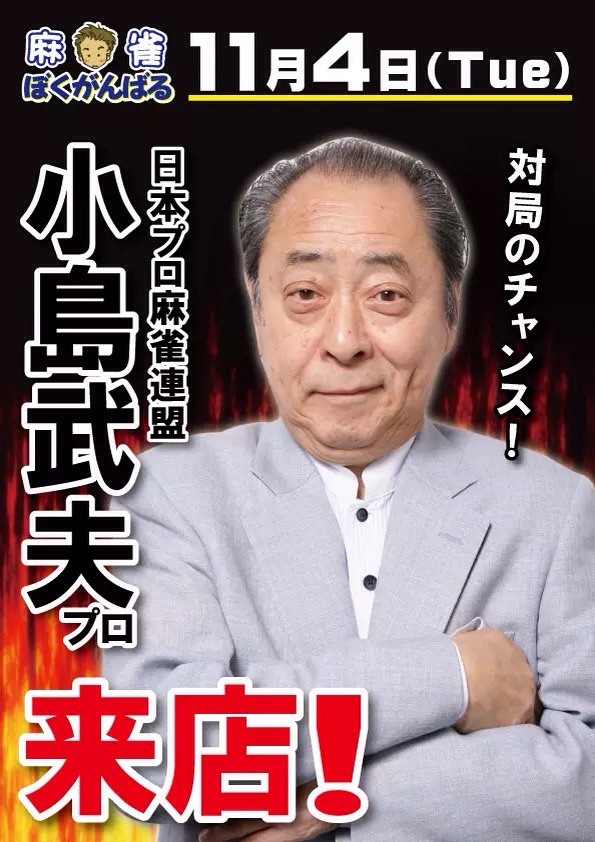
“Mr. Mahjong” Kojima Takeo Appears in Akamatsu Ken’s UQ Holder!


In a recent chapter of UQ Holder!, the main character Konoe Touta gets a lesson in how to mask one of his greatest weaknesses. To make a point, his teacher mentions a certain famous mahjong player who suffered from narcolepsy. That player is actually Kojima Takeo, the most well-known mahjong expert in Japan.


Nicknamed “Mr. Mahjong,” Kojima has been active for decades and even still plays today. Last year, he attended the World Riichi Championship in France along with his fellow players from the Japan Professional Mahjong League.

You can see him in action in this video:

And here he is showing you how to cheat at mahjong:

Cutie Panther is a Creepy Song

Cutie Panther is one of my favorite Love Live! songs. It’s intense, has a catchy beat and melody, and stands out from most of the other stuff that comes out of that franchise. When you actually listen to the lyrics though, it ends up sounding like something a stalker (or maybe a yandere character?) would be thinking.

Below are some of the choice lines. Translation is taken from this School Idol Festival wiki.

(Who are you with?
No way, you’re not allowed to be with anyone besides me)

I love you! You should be falling in love with me
I love you! That’s the right thing to do

Icy words, a gentle gaze… The prize at stake is you!

The rules of love are so hot
They exist to be broken

I miss you! It’s not wrong if it’s out of love
I miss you! That’s what intense love is like

Again, I don’t think this ruins the song, as it’s still my #2, but it sure does make them sound like stalkers! Also, there’s a history of catchy yet creepy-sounding songs, including a lot of old denpa songs (is that still a thing?) from visual novels. The most famous stalker song is probably “Every Breath You Take” by The Police:

If you’re curious, my ranking for Love Live songs is 1) After School Navigators 2) Cutie Panther 3) Shocking Party


I’m Bad, I’m Cool, You Know It’s True: Genshiken II, Chapter 113

The previous chapter of Genshiken ended with most of the characters pairing off in unexpected ways (none of them romantic), setting up the anticipation that there would be some intriguing interactions that go outside of the normal range that Genshiken has been using as of late. In this regard, Chapter 113 is far from being a disappointment.

After Yoshitake finally reins in her history otaku nature and ceases to be a tour guide through the shrines of Nikkou, all of the groups do their own special thing. For this reason, for this month’s review I think it’s worth talking about each notable pair on their own.

Madarame and Yoshitake

In a lot of harem manga, the characters that act as if they’re stringing the main character along through feigned expressions of affection often fall into the category of the harem as well. Because they show the possibility, they’re part of the fantasy too, even if they’re supposed to be tongue in cheek. Not so with Yoshitake. She drags Madarame away not only to spark the fire among the characters who actually are interested in Madarame, but also slyly manipulates Madarame as well by making it seem as if she’s also into him. Perhaps I’m reading too much into it, but the reaction on Madarame’s face seems less like surprise and more like, “Oh no, not again,” which when you think about it is a far cry from where he was originally in Genshiken.

Yajima and Kuchiki

Kuchiki wants what Madarame has but he’ll never get it because it’s hard to imagine too many girls who would like Kuchiki’s personality (then again he did have a girlfriend once upon a time). At the same time, their mildly venomous conversation has a lot of grains of truth being sifted. Kuchiki mentions the appeal of the girl-boy, which is that you have the physical attraction of a female without the seeming mystery of trying to figure out how they think and feel. This actually isn’t far off from what I’ve read about the appeal of certain, shall we say, “alternative” forms of adult entertainment in anime and manga, and it even reflects something I’ve seen before in an old Ann Landers/Dear Abby, which had to do with a wife questioning if her husband was gay. Long story short, that aspect of being able to directly understand the feelings of another, whether that’s more spiritual or more physical, is something that’s understandable when you think about it. As for Kuchiki almost figuring out Yajima’s feelings for Hato, that probably has less to do with Kuchiki being perceptive and more that Yajima is often an open book (see her first meeting with Yoshitake’s “brother”).

Hato and Keiko

It’s been established that the two don’t really get along, and this chapter I think really shows the foundation of why that’s the case. Essentially, both Hato and Keiko believe that the other is somehow manipulating Madarame. Hato believes Keiko is just stringing him along, while Keiko sees Hato’s personality as an ideal construct, pleasing but artificial. Together, they both open up to each other in an antagonistic manner, giving details as to what transpired in each of their respective close encounters with Madarame. Now they both know the approximate truth, and while it can’t be said that Madarame is a two-timer, I do think Hato and Keiko have bonded in a rather bizarre yet understandable manner. That said, I think their lowered opinion of him comes from somewhat different places; with Hato it’s because of how easily Madarame was enticed, and Keiko because it connects to the whole thing about Madarame being happy about Hato’s chocolates.

And then…

I think there’s something to be said about the way that the characters of Genshiken try to exert their wills in this chapter. Yoshitake temporarily dons the role of a fawning admirer to mess with Madarame, Keiko intentionally withholds the fact that Kugayama was at her club too to make Hato think that Madarame came of his own accord, and Hato throws the events of the previous night in Keiko’s face. Nowhere is this clearer than with the fact that Angela’s time has arrived, and she’s come prepared for bear, so to speak. As soon as she finds out she’s pairing with Madarame, out come her noble familiars, barely constrained and ready to serve their master.

I’m not sure if it’s clear from my previous posts, but I love the idea of Madarame and Angela, if only because to me it’s the most hilarious. This chapter begins to prove why that’s the case, even if she probably has the slimmest chance out of the four. Will next month be the most fanservicey chapter of Genshiken ever?

Speaking of Angela and Madarame, or rather the renewed kujibiki drawingI do find it interesting that Yoshitake’s plan to see the temple Youmeimon, the culmination of her trip to Nikkou, is derailed by construction much in the same way that her original plan to mix the group up into new and exciting pairings also backfired in terms of its original intent. It makes me wonder if this second lottery is going to also be reflected in Yoshitake somehow encountering an even more amazing sight.

Last thing of note: as seen in the first image in this post, this chapter clearly used photo references for its color pages that lend a greater amount of realism to the backgrounds, to the extent that it feels like the chapter is actually promoting tourism for Nikkou. I don’t think that’s actually the case, but Genshiken rarely goes for that look.

The Fujoshi Files 140: Big Sister

Name: N/A
Alias: Big Sister (姉)
Relationship Status: Polyamorous Dating/Complicated
Origin: Receptacle

Information:
The older sister of a certain video game-obsessed high school boy with a mildly sadistic girlfriend, this girl spends much of her time in idle conversations with her female best friend about their sex lives and relationship issues with their respective boyfriends. However, this older sister eventually enters a relationship with not only her boyfriend but also her best friend as well.

Fujoshi Level:
Other than that she is less extreme compared to her best friend, nothing specific is known about the kind of fujoshi she is.