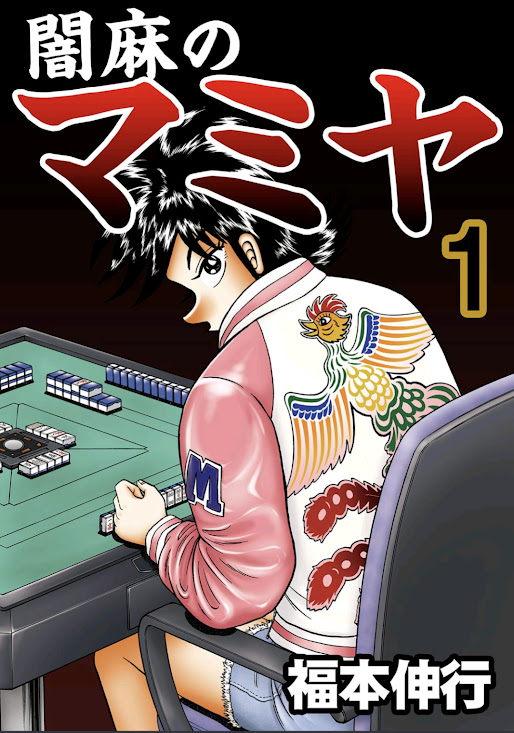
Two years ago, I found out about Akagi author Fukumoto Nobuyuki’s newest mahjong manga: Yamima no Mamiya, also known as Yami-Mahjong Fighter: Mamiya. Set 20 years after Akagi Shigeru’s death in the series Ten: Tenhoudoori no Kaidanji, the latest series aims to change things up in the well-worn mahjong manga genre by introducing in its title both a new way to play (“yamima” or “darkness mahjong”) and an uncommon protagonist for Fukumoto: a 17-year-old girl named Mamiya.
Due to the initial lack of digital releases of Yamima no Mamiya, I put off checking it out, but since early 2021, the series has started to appear in Japanese ebook shops. Now having read Volumes 1 and 2, my main takeaways from the manga are 1) It has that reliably strange Fukumoto style, and 2) Fukumoto doesn’t exactly know how to write female characters.
The Latest Gimmick: Darkness Mahjong
Yamima no Mamiya’s titular “darkness mahjong” is sort of the polar opposite of the Washizu mahjong first featured in the pages of Akagi. But whereas the latter involves playing with clear tiles that can reveal parts of your hand that would normally be concealed from view, darkness mahjong allows players to hide discarded tiles from view. However, should a player who hid tiles still manage to lose, they’ll lose much more than if they had played normally—and getting your “dark tile” claimed for a win results in an even steeper penalty. Mamiya is an expert in this style of play, and she shows sharp gambling instincts.
Mamiya and the Male Gaze
Character-wise, Mamiya’s androgynous appearance and youthful attitude give me the impression that she’s designed to come across as a product of a new era unlike what we’ve seen in the Akagi universe. However, she doesn’t feel like a character to whom the presumed Kindai Mahjong-reading audience of older men are meant to relate. Whereas Akagi Shigeru appeals by a badass power fantasy and Itou Kaiji has the charm of being a perpetual underdog, Mamiya is treated with a certain kind of distance that I presume is by virtue of her gender, like she’s a female side character in a salaryman manga who abruptly got the starring role.
Because of this, Mamiya’s presentation feels like a very conscious and intentional use of male gaze, though any sort of gratuitous sexual objectification is heavily limited by Fukumoto’s artwork. While Mamiya offers her body in a gamble with her first major opponent, a 70-year-old entertainment mogul named Onigashira Kanji, he bawks at the age gap—which then results in a running joke where Mamiya accuses Onigashira of being a perverted old man despite him trying his best not to make it happen. It’s humor by an old dude, for old dudes.
Another Genius who Descended from the Darkness?
Given that Mamiya is presented in the manga as “Akagi’s legacy,” the big question that has yet to be revealed is if that’s simply due to her mahjong skills or if there’s some familial connection. Could she be his daughter? She does occasionally have a very Akagi-esque smirk. Perhaps she learned the game from her uncle Shigeru, and now she’s heir to his name. At the very least, she pals around with a now-gray-haired ramen shop-owning Osamu, who remains delightfully mediocre in every way possible—and like the past, he’s mainly there to be a Krillin to Mamiya’s Goku.
I’ll Keep Reading for Now
I don’t think it’s impossible for Mamiya to grow more interesting and robust over time, but Fukumoto’s heroes aren’t exactly about character development, so I’m not holding my breath. The series has also yet to finish its first big match, and without that final masterstroke moment where Mamiya’s presumed genius is on full display, it’s hard to make a solid judgment about the series. I’m going to keep following Yamima no Mamiya, hopeful that it’ll deliver.
Some time ago, I wrote a kind of light and frivolous observation: What if the home renovation shows were given a kind of isekai twist? Because both genres are built on reliable tropes and wish fulfillment, it could work. What I later came to realize is that there are already anime out there that capture some of that same spirit as a Fixer Upper or Home Town, and they’re “most P.A. Works shows.”
While P.A. Works anime like Sakura Quest and the recent The Aquatope on White Sand aren’t focused on sprucing up individual houses, they do often tackle or at least address an increasingly prevalent problem that home renovation shows are also built around: decreasing populations in small towns as people move to bigger cities to find opportunities and birth rates decline. This is a recurring issue in both Japan and the United States in particular, and has led to the decline of rural areas as they can’t hope to compete with more urban ones. Much like how Home Town remodels homes to try to breathe life into Laurel, Mississippi, so too does P.A. Works create events from scratch like Hanasaku Iroha’s once-fictional Bonbori Festival as a way to try to start traditions—because they have to begin somewhere, right? Sakura Quest meanwhile is explicitly about this topic, and the characters actively strategize on how to bring people back to a half-way abandoned town.
The cause is just, and it would be great if these approaches could make a difference, but there are underlying issues that TV shows, fictional or otherwise, can only do so much to fully fix. For the US, one major problem is the poor health infrastructure (and infrastructure in general) that forces even those who might not want to leave non-urban areas to try to chase employment down in the hopes of, if not getting health insurance through work, at least making enough money to afford it. In Japan, a lack of economic opportunities and a sexist society that still looks at career-oriented women with suspicion means that the rural regions of Japan are filled with empty and abandoned houses as a brain drain occurs.
I wonder if the two sides could learn from each other. Perhaps P.A. Works can do an anime all about renovating homes in a town, while maybe HGTV or whatever can try to make a program that pulls the camera back a bit and looks at infrastructure issues beyond single homes per episode. If there’s some way to make both work, I’d love to see the result.
I love pretty much everything about Kageki Shojo!! It’s not the first anime about aspiring actors, and it’s certainly not the first to be inspired by the Takarazuka Revue, but it combines elements of both in a way that makes every episode an emotional journey.
Watanabe Sarasa is a teenage girl who has just been accepted into the Kouka School of Musical and Theatrical Arts, which trains students to become future members of the all-female troupe known as the Kouka Revue. It’s no easy feat getting in, let alone making it through the program, but Sarasa has a couple of unique traits that cause her to stand out: her towering height compared to the other students, and her background connected to the traditionally all-male kabuki theater, which brings a different flair to her performances.
Kageki Shojo!! Inevitably reminds me a lot of the classic Glass Mask, especially with how much Sarara’s ability to embrace her roles and mimic others is reminiscent of Kitajima Maya. However, while I hardly remember any of the characters in Glass Mask outside of the major ones, virtually every side character in Kageki Shojo!! makes a powerful impression. Each girl brings their own perspective and baggage to the Kouka School, such that even the notion of “pursuing success” can differ immensely in terms of how each character defines it, and what they perceive their own strengths to be.
The students’ backstories (and current stories for that matter) can also get quite dark at times, with topics like sexism, neglect, predation, and bulimia being explored. Impressively, the series balances both its heavier and lighter elements without trivializing the former or making the latter feel inappropriate.
The anime ends at 13 episodes, but there’s clearly more manga that can be adapted. I can’t wait for a second season, should it ever come o
ANIME NYC HAS REPORTED A CONFIRMED CASE OF THE COVID-19 OMICRON VARIANT. IF YOU ATTENDED ANIME NYC, GO GET A COVID-19 TEST.
One year ago, New York City was still reeling from the COVID-19 pandemic. Vaccines had not yet begun to roll out, and many of the annual traditions we expected had to be put on hold—possibly even indefinitely. Though not seen in the same rarefied light as Thanksgiving, Christmas, or New Year’s, Anime NYC had become an annual outing for my friends and me. I was sad, though understanding, that 2020 had to be canceled.
Anime NYC is right in my backyard, tends to have some interesting Japanese industry guests, and the fact that it has thrived in one of the toughest convention cities (see the defunct Big Apple Anime Fest and New York Anime Festival, among others) meant I’ve felt a strong desire to support the event—lest it go away and be substituted by unscrupulous scams and the like. When Left Field Media announced that Anime NYC 2021 was on, I was filled with both excitement and trepidation.
Lines, Crowds, and COVID Mitigation
Vaccination rates are generally high in NYC, and we have a general mandate for indoor venues. However, the situation was different even compared to Otakon three months ago, thanks to the rise of the Delta variant, the colder weather, and concern over waning efficacy of vaccines. In the end, I decided to attend, thinking that there might be a drop in attendance that would give plenty of breathing room. After all, New York Comic Con 2021 in October saw lower numbers, right?
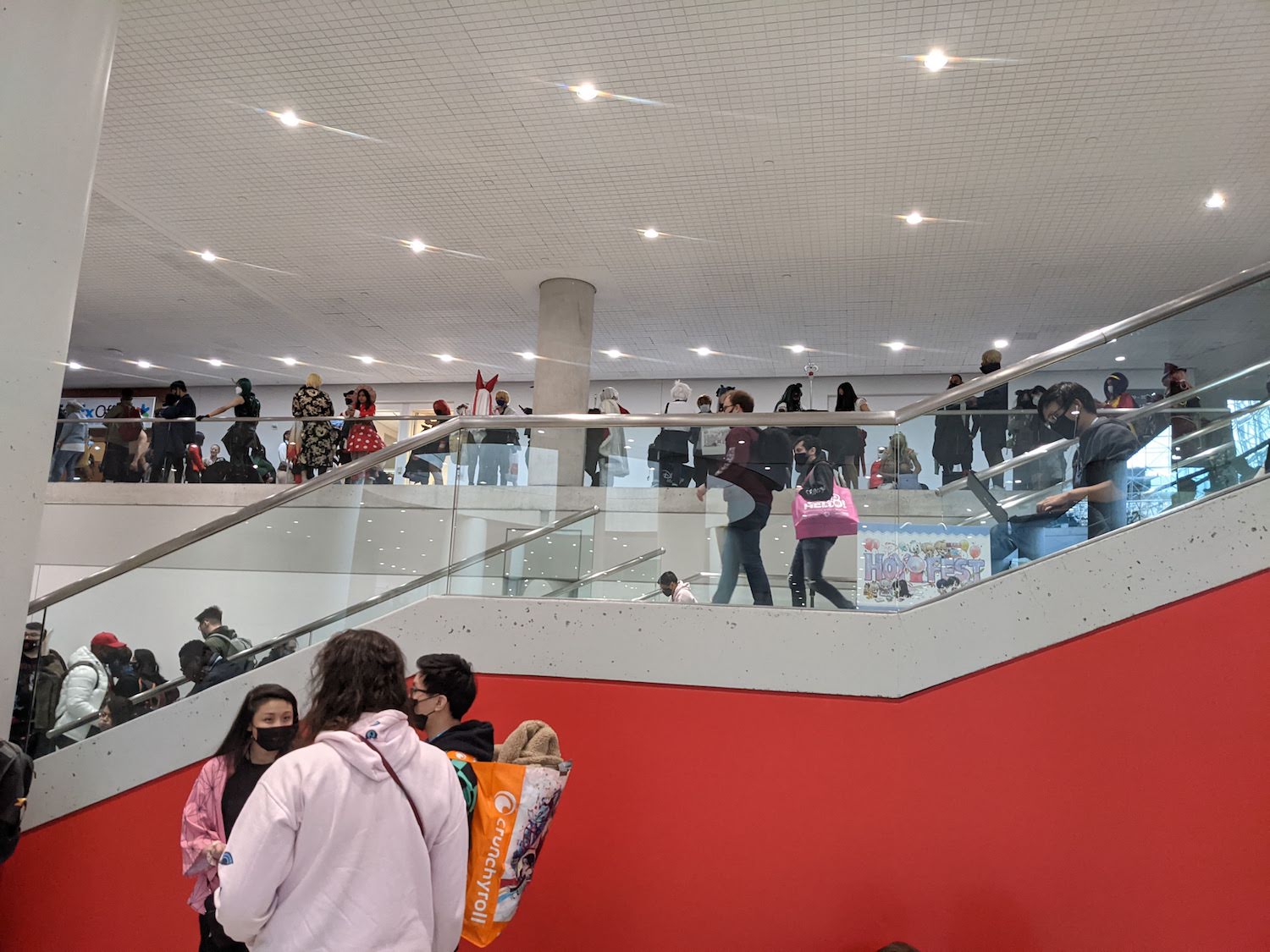
Not so. Anime NYC 2021 was packed with fans extremely ready to revel in the convention experience. In fact, attendance was up compared to 2019—from 46,000 to 53,000. By comparison, New York Comic Con saw a drop from 260,000 to 150,000.
I find that this contrast highlights the difference between having a larger but relative more casual and mainstream audience versus a hardcore base ready to go wild. The former will see better results in the good times, but the latter will ride with you even when it gets bad. I suspect this has less to do with loyalty towards Anime NYC itself and more to do with passion for anime and manga in general, but the results are the same.
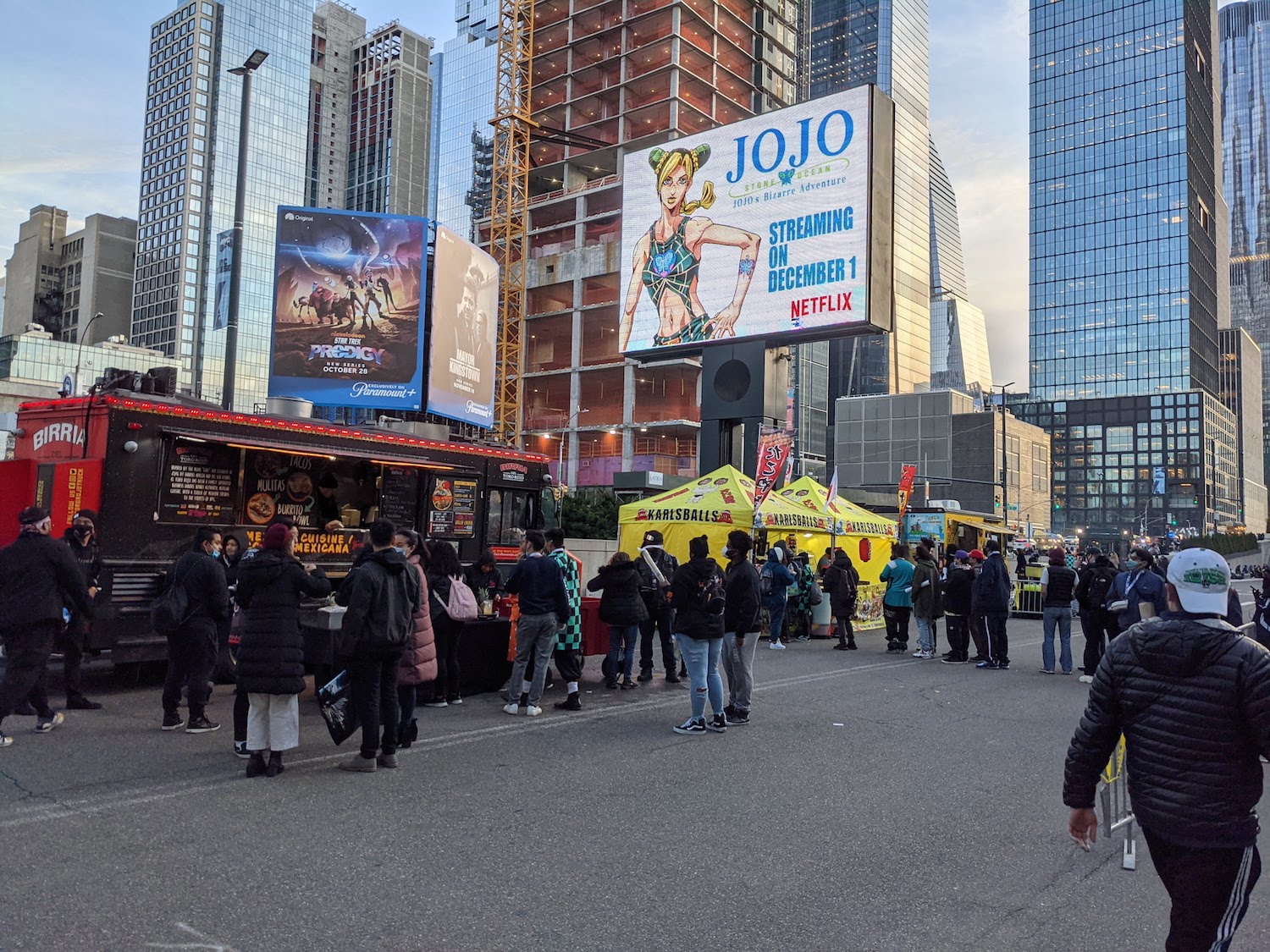
Anime NYC 2021 was from Friday, November 19 to Sunday, November 21. It was clear that the showrunners knew how big the lines were going to get, as they began sending out alerts encouraging as many people to grab their vaccination wristband and badge on Thursday before the con. However many heeded their advice, by the time Friday rolled around, it was clearly not enough. The con opened at 1pm, but people were lining up since 9am, packed together outside in fairly cold weather, all while being unsure of whether they were on the right line. In previous years, this would have been a nuisance. With COVID-19 around, I could only hope that people kept their masks on and were smart about it.
As a press attendee, I had the benefit of being able to avoid the brunt of these problems. However, what should have been a five-minute process of “getting in” turned into almost half an hour as I was told three different things by three different people as to how to get my wristband and get into the Jacob Javits to get my press badge. So while I was fortunate to not have gotten the worst of the lines, the small taste I had made me aware of how much worse it probably was for the attendees on Friday. Saturday and Sunday seemed more organized, but I don’t know how much it alleviated any issues.
In addition to better communication and maybe even the ability to line up indoors, I have to wonder how much of the problem is that the Thursday badge pick-up hours only go to 6pm. Anime NYC is very much a commuter con, and I imagine many people are working or going to school from 10am to 6pm. Even in pandemic times, New York is still often the city that never sleeps.
Omicron Variant
Of course, the elephant in the room in hindsight is the news that one attendee had a case of the new Omicron variant of COVID-19. Any sort of precautions were inevitably taken without knowledge of its existence, but excuses also don’t treat infections. Thankfully, none of the people I know personally who attended Anime NYC (including myself) have tested positive, but between reports that the Omicron variant spreads more easily and that the person who was found to have it may have spread it to half of a group of 35 friends, it’s clear that there needs to be an extra layer of vigilance.
Take mask compliance, for example. I found it to be mostly there, but it felt like people got more and more lax. All the classic errors of masking were there (not covering the nose, taking it down to talk, not wearing it all). While this is partly on those attendees who flouted proper mask usage, I would like to have seen better enforcement by the con itself. Even the simple act of providing free masks at the con could go a long way.
Dealer’s Hall
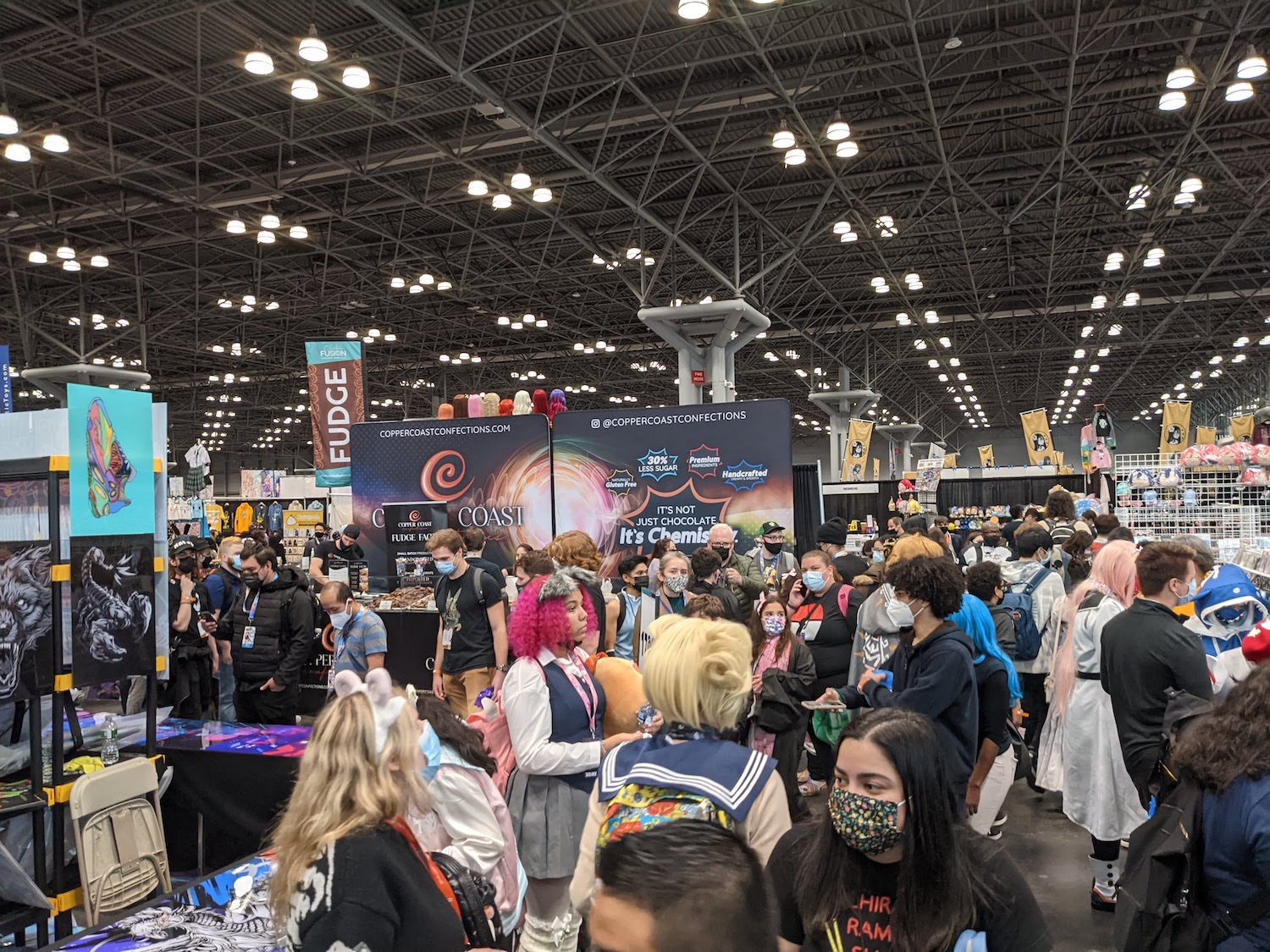
The Dealer’s Hall felt like any other at a professionally run big con, but I did notice one thing in particular: People seemed very, very eager to buy stuff. It was as if two years’ worth of pent-up desires to purchase came crashing to the surface. So not only was it packed each day, but attendees were behaving like the money they had was burning holes in their wallets. Because of my wariness over COVID-19, I went in and out, trying to avoid staying in there for too long.
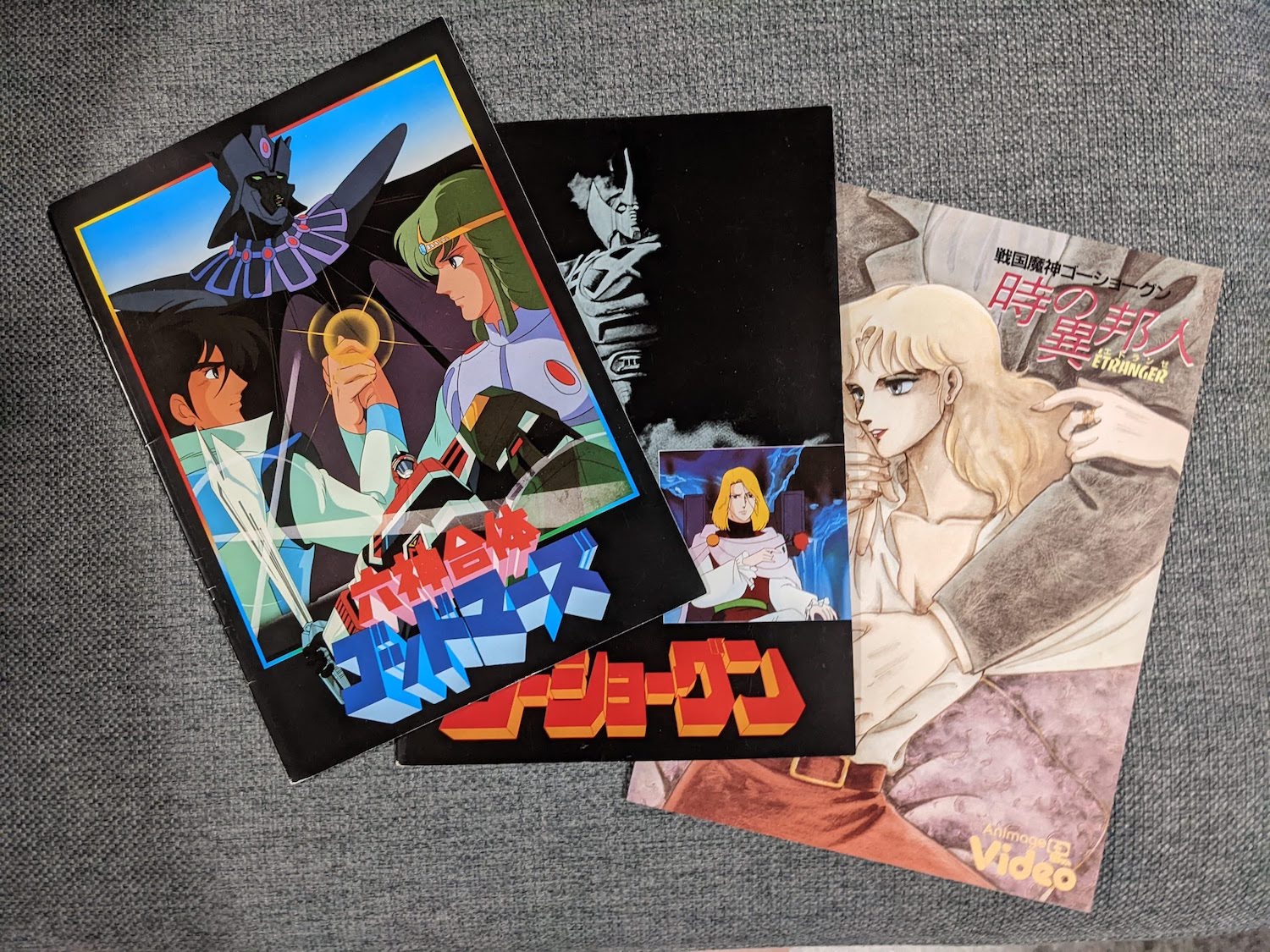
That said, I did purchase a few things with the intent of making them part of my convention memories, so I understand that sentiment. I got an official May hoodie from Guilty Gear Strive, nabbed some new manga, and found a booth that actually sold old Japanese movie brochures. I picked up one for God Mars and a couple for Goshogun.
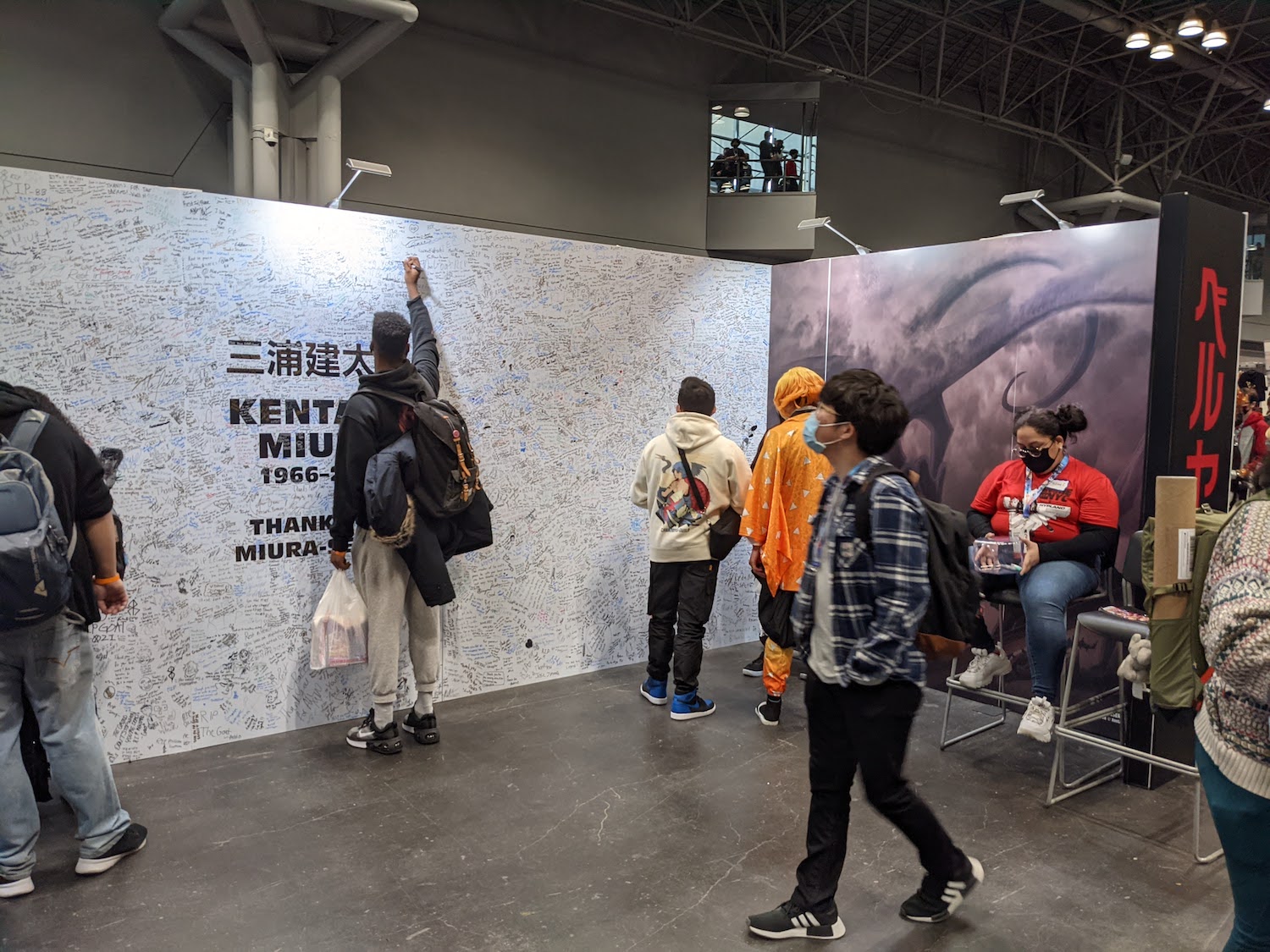
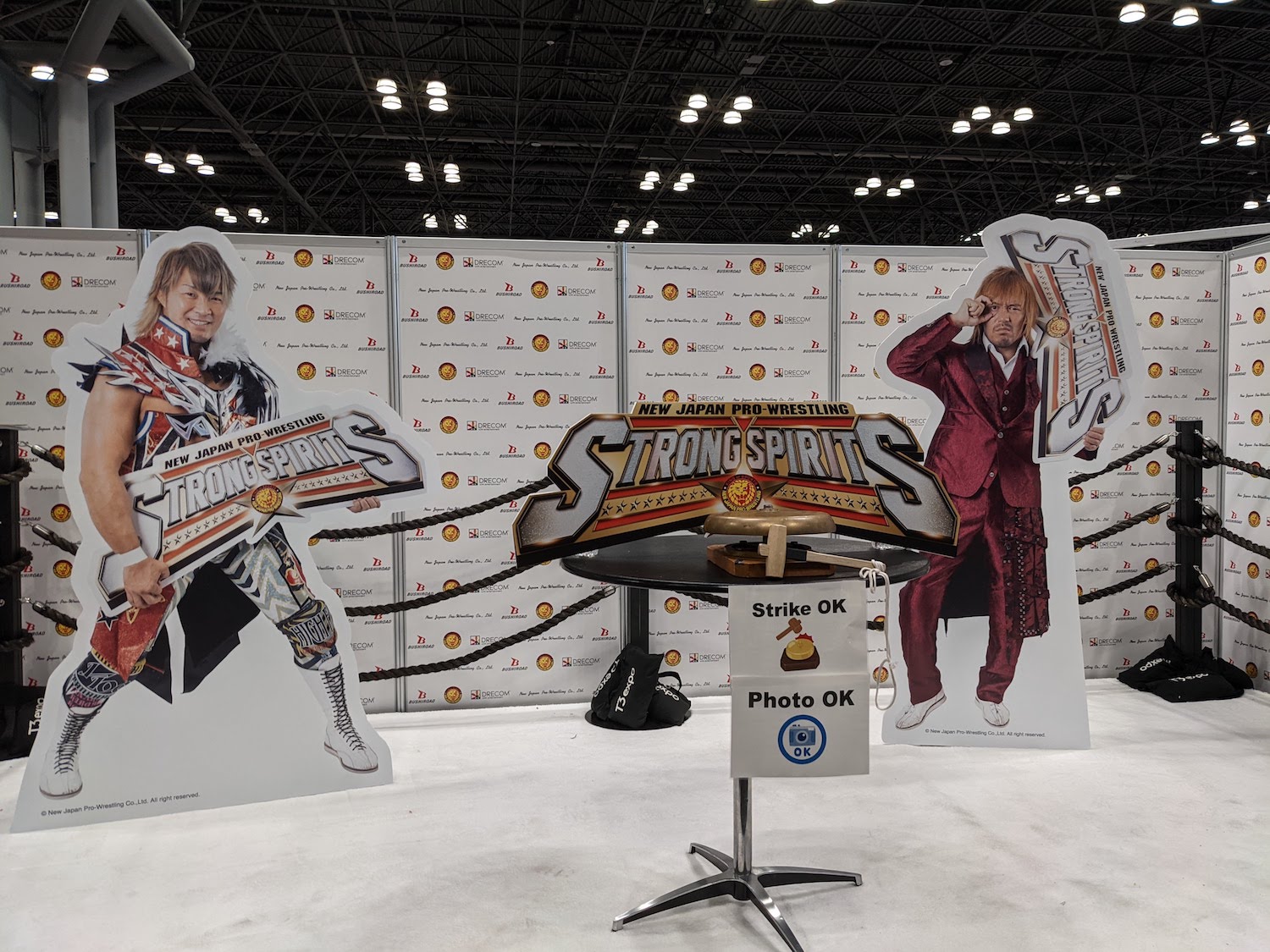
Other highlights of the Hall included the HololiveEN booth where you could take photos with cut-outs of all the EN girls (including from the inaugural generation), a tribute wall to the late Miura Kentaro, author of Berserk, along with a New Japan Pro-Wrestling booth where you could hit the actual NJPW ring bell.
Panels
One of my favorite things about anime cons are the panels. While Anime NYC isn’t anywhere close to the amount of content you’d get from something like Otakon (and it’s clearly not the con’s priority), there was at least a panel track when you wanted to sit and listen.
Due to other engagements, I was unable to attend the Aramaki Shinji panel. I was told it was informative and even went over some of his work on American cartoons (M.A.S.K., Pole Position), though it seemed like Aramaki had less time than he thought.
Hololive Council
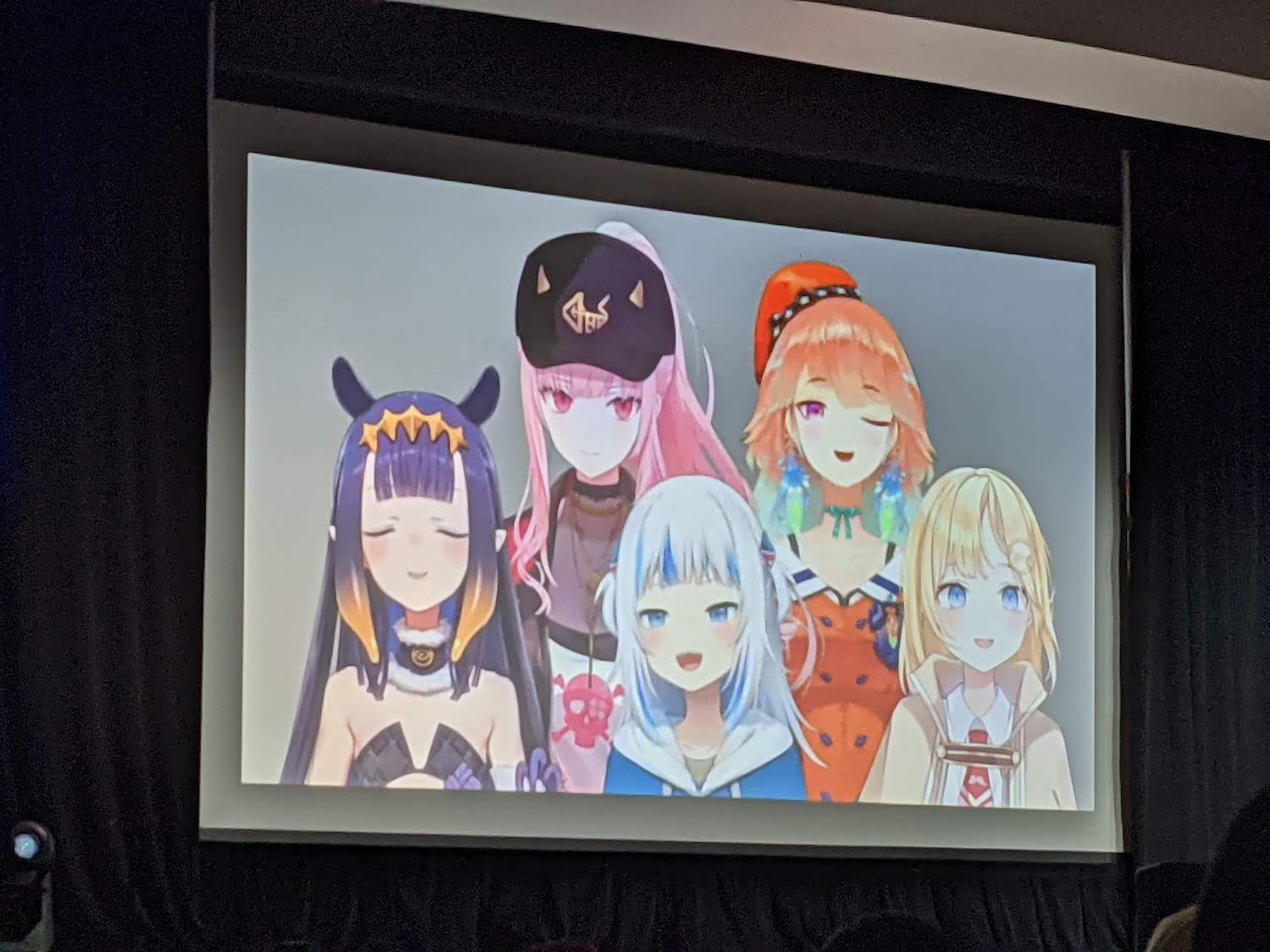
I’ve been getting more and more into Virtual Youtubers over the past couple years, and so I was looking forward to HololiveEN Council’s con debut at Anime NYC.
One of the running jokes among the fandom is that Hololive English group streams tend to be pretty “scuffed,” and this was certainly no exception. The panel started roughly half an hour late, and there were technical issues throughout, such as audio delays. Still, it was good to see the Council get their moment in the sun at a convention, and they were entertaining nevertheless. While the panel was focused on HoloCouncil, HoloMyth (the first generation of HololiveEN) made a cameo with some messages for their kouhai.
One big difference compared to other Hololive conventional panels I’d seen online was that there was less interactivity with the live audience. Namely, much of the interactions were scripted and questions were taken from Twitter rather than a live audience, which was a tad disappointing but also understandable given the size of the crowd and the inevitable technical difficulties. Overall, it felt like a very managed experience, possibly because it was sponsored in part by the Consulate General of Japan in New York. Also, while the interactivity wasn’t as high, the fans in the audience tried to bridge that gap. It was easy to notice who got the most enthusiastic fans—Ouro Kronii’s “Kronies” certainly wear their preferences on their sleeves.
Afterwards, I got some Hololive merch thanks to a friend: A Ceres Fauna button!
New Japan Pro-Wrestling Strong Spirits
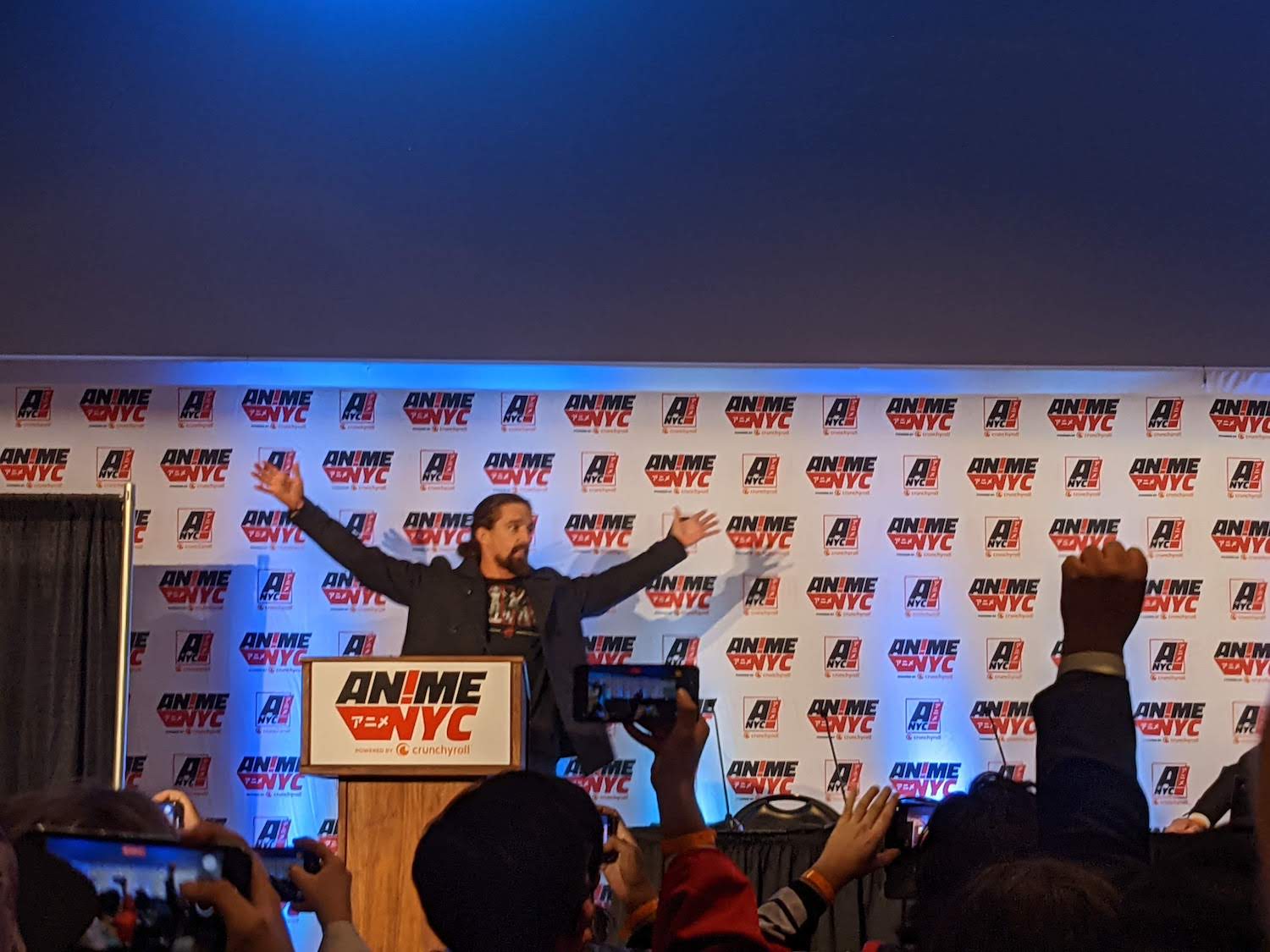
While there weren’t many guests who flew in from Japan this year, one surprising appearance came from New Japan Pro-Wrestling’s “Switchblade” Jay White, leader of Bullet Club. He was there to promote NJPW’s new mobile game: New Japan Pro-Wrestling Strong Spirits.
Jay mentioned that this was his first-ever convention appearance, and he was pretty much a natural at entertaining the crowd. My favorite thing was his insistence that he was the sole reason NJPW sold out Madison Square Garden a couple years ago, and every time he said it, a large and obnoxious image of this fact would flash on screen.
Although I had a good time , part of me regrets going to this panel because I should have expected an audience of wrestling fans to be loud and care little about the risks of COVID-spreading associated with yelling. One person in particular was loud, maskless, and insisted on shouting constantly. I also had the sense that the fans love bringing attention upon themselves.
As for the game itself, “bizarre” is how I would describe it. Unlike so many other wrestling games, it uses all existing video footage for moves, as well as green-screened video of the wrestlers during turn-based move selection. The developer of the game (from Bushiroad) even said they had to clear rights for the footage in 150 countries. There was also an example of training to improve your wrestler’s stats, and the key point here is that it also has live footage of your chosen NJPW wrestler, this time getting sweaty in the gym. This, I believe, is where the real appeal of the game might be. It will also predictably have a gacha component, but the developer claims it won’t be pay-to-win.
GKIDS
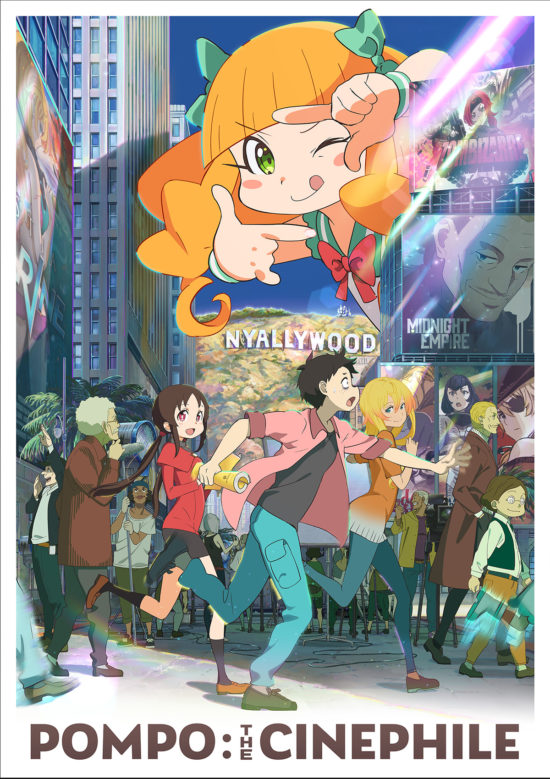
I’ve long known GKIDS for their involvement with the New York International Children’s Film Festival, but they’ve also been putting out some excellent titles on home video lately. GKIDS was there because many of their films were having American or east-coast premieres at Anime NYC. While I was unable to see most of them, I was glad to find out that they’re pretty much all getting limited theatrical releases, notably Hosoda Mamoru’s Belle in January and Pompo the Cinephile in Spring 2022. I was able to see Pompo at the con, and you can read my review here.
At the panel, I found out how successful Promare has been, which is quite a bit. It’s the reason the film keeps getting re-screenings in theaters while others do not.
Cosplay
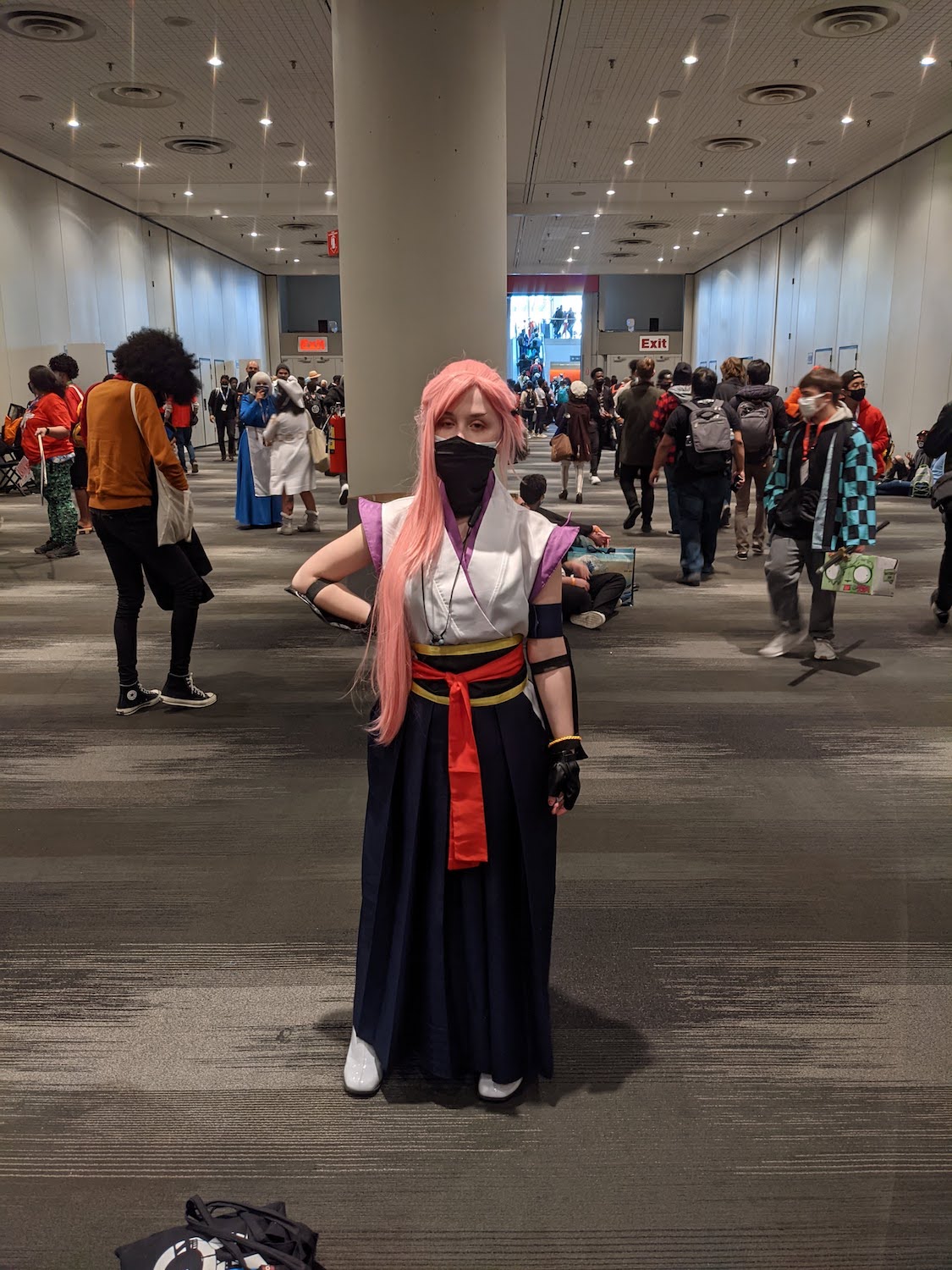
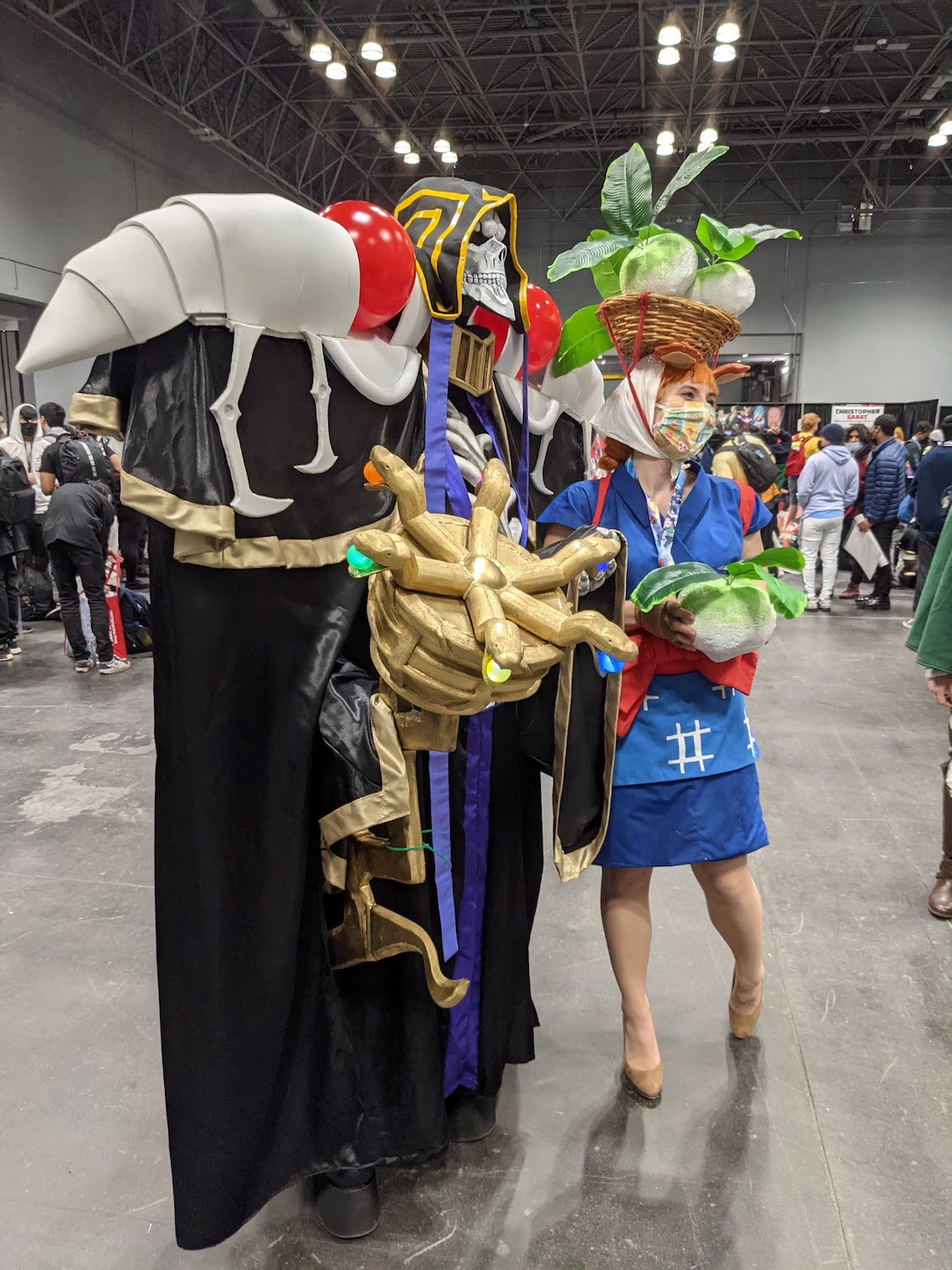
I didn’t take many cosplay photos this year, but I wanted to at least share a couple.
Final Thoughts
In spite of an inevitable lack of Japanese guests and trepidation over the pandemic, Anime NYC came back at a time when people were champing at the bit to do something in person again. I had a decent time at the con, but seeing the crowds made me realize a truth about this new era: More success means more precautions are necessary if we don’t want worse-case scenarios happening. I hope that whatever fallout occurs due to the Omicron variant, it becomes an outlier rather than a standard of conventions.
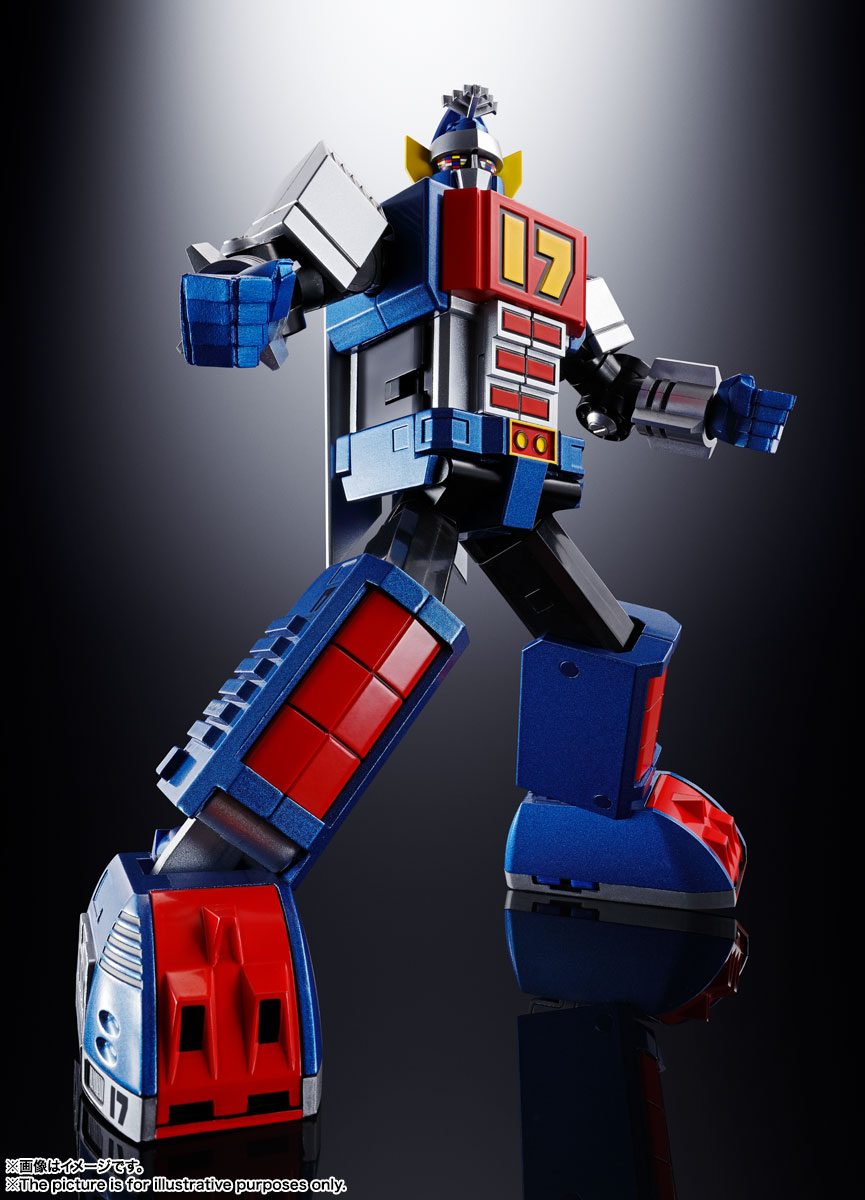
The latest Soul of Chogokin figure was announced last month, and it’s Daitetsujin 17 (pronounced “One-Seven”) from the 1970s tokusatsu series by the same name. It was created by the very father of tokusatsu, Ishinomori Shotaro, and features the classic “little kid remote-controlling” giant robot motif that began with Tetsujin 28. Prior to its release, I never watched any Daitetsujin 17, but I decided to check out the first episode, and what I noticed is that the promo images for the SoC version really capture how the toy is designed with a kind of live-action clunkiness seen in the original program itself.
There’s no doubt that this is highly intentional, as the Soul of Chogokin line is famous for trying to get as close to “show-accurate” as possible. Japanese toy reviewer wotafa stated in his look at the POSE+ METAL Gaogaigar that one of the big things differentiating it from the earlier SoC release was that the latter is more faithful to the anime, while the former looks like “Gaogaigar came back from studying abroad in America.” But in contrast to the myriad anime-derived Soul of Chogokin figures, adapting tokusatsu giant robots like Daitetsujin 17 seems to present another sort of challenge.
Whereas the anime robots have to reconcile the contradictions between the (mostly) two-dimensional drawings with the three-dimensional realities of the toys themselves, a different conflict is in play. Tokusatsu shows typically have their mecha appear in two different ways: as a model for transforming and such, and as a costume for a suit actor to fight in. A figure whose goal is to bring the source material to life has to balance these two dominating visuals, and from what I can tell, Daitetsujin 17 looks like it succeeds on that front.
But Daitetsujin 17 is not the only live-action robot to get the SoC treatment, and so I started looking at past instances to see if that characteristic tokusatsu-ness is still present. What I found is that, while not as strongly flavored as Daitetsujin 17, that feel is still present to varying degrees.
The recently released Daileon from Juspion comes from a different era than Daitetsujin 17, but the premium it places on poseability goes to show just how important it is to capture that “guy-in-a-suit” element of the show. Comparing the 3DCG trailer they released to the live-action footage, you can see how much emphasis was put on making sure Daileon could strike all its signature poses, as if to say the very acting of posing defines the feel of Juspion as a whole:
A more popular SoC figure, at least among English-speaking countries, is the Megazord (or Daizyujin) from Mighty Morphin’ Power Rangers. This one looks more like it emphasizes a cool, stocky appearance that’s a bit removed from how the Megazord usually looks in motion.
However, when compared to a similar figure released around the same time—Voltron (aka Golion)—the contrast in proportions between the two really drive home how the Megazord was made with different considerations in mind. It’s notable that the SoC Voltron has lankier proportions than its original toy from the 1980s to be more in line with its iconic pose from the anime’s opening.
This trend continues all the way back, whether it’s Leopardon from Toei’s Spider-Man, Battle Fever Robo from Battle Fever J, or King Joe from Ultra Seven.
The Daitetsujin 17 figure seems to most greatly embody the concept of tokusatsu-faithfulness, and I think that speaks to how far the Soul of Chogokin line has come. Every year, it seems to get more and more impressive, and I have to wonder what they’ll tackle next. Although the Daitetsujin 17 and many of the tokusatsu-based figures aren’t my priority, I find I can appreciate the lengths they’ll go to making the biggest nostalgia bombs possible.
THIS IS A REVIEW FOR A SCREENING AT ANIME NYC 2021, WHICH HAS A REPORTED CASE OF OMICRON-VARIANT COVID-19. IF YOU ATTENDED THIS CON, GO GET TESTED.
When it comes to making movies, editing is often seen as one of the least glamorous elements. The image of filmmaking pop culture conveys to us often eschews that process. The anime film Pompo the Cinephile chooses instead to celebrate the nitty gritty of film editing and the painful decision of what to leave on the proverbial cutting room floor, all while being a vibrant and creative work itself.
Pompo is the nickname of Joelle D. Pomponette, a prodigy film producer in “Nyallywood” who has been responsible for one box office hit after the next. Her assistant, the perpetually haggard Gene Fini, is a lover of movies who can’t understand why Pompo seems to work only on schlocky blockbusters—or why she hired an untalented wreck of a human being like him. But Pompo sees that Gene has what it takes to work behind the camera, and when she picks him to be the newbie director and editor of her new project, Gene falls deeper into the world of filmmaking than he thought was possible.
A movie about making movies can feel like an exercise in pretentious navel-gazing, but Pompo the Cinephile manages to strike a tricky balance between “the artist and their oeuvre” and “films are for the enjoyment of others” that gives merit to the indie arthouse piece, the Academy—excuse me, Nyacademy Award winner—and the popcorn flick. Much of Pompo the Cinephile is about exploring the emotions one experiences when involved in different parts of a production, and while there is a good amount of anime-style melodrama and bombast, those feelings read as genuine. The characters feel like both people unto themselves and the conduits to deliver a simultaneous celebration and criticism of filmmaking, but without seeming overly preachy. For example, Pompo is very insistent that films should never exceed 90 minutes, but her argument is shown to come from a very personal place while also being quite reasonable. The viewers are left to decide whether to disagree, but the movie itself doesn’t shy away from making assertive statements.
Pompo the Cinephile doesn’t try to flip filmmaking inside out or challenge it to be more experimental. Rather than challenge the status quo of what works and doesn’t, from tropes like the manic pixie dream girl to the notion of killing your darlings as a tenet of artistic creation, the film doesn’t seek a revolution. It shows but doesn’t discuss the difficulties of overwork. Rather, it portrays characters finding imaginative ways to work within the system, even including a strangely engaging side story about investment banking (another conceptual quaalude) and the film industry.
Even if the kind of filmmaking Pompo the Cinephile showcases isn’t one’s cup of tea, I find it encourages active discussion of how we as people see and regard the act of creating movies. At times, it can feel both insightful and shallow—which is exactly the kind of film Pompo herself excels in. Perhaps most importantly, it’s exactly 90 minutes.
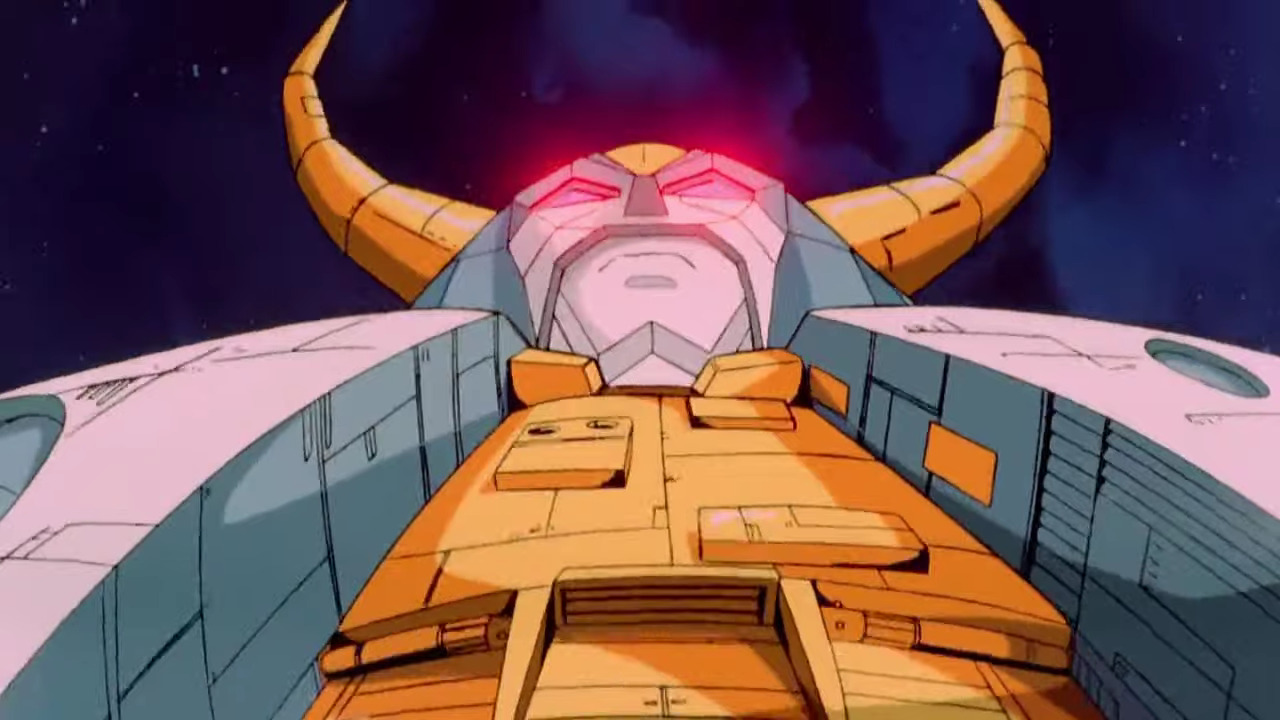
The end-of-the-year holidays are rolling around, and I feel like I’m in a strange place mentally and emotionally. I think it’s tied to the assumption that this year’s Christmas would be a far cry from the feelings of hesitation and dread that came with COVID-19 and hot off of the 2020 US elections, and how history might potentially be repeating itself. Virtually everyone I know is vaccinated, including many kids, but reports of the new Omicron variant make me wonder if I need to temper my expectations. And inevitably, it just makes me think of a certain planet-sized Transformer.
(Speaking of which, I got the new blu-ray recently. I don’t know for sure when I’ll re-watch the movie, but it never fails to disappoint.)
On a lighter note, I haven’t been looking at as much anime and manga lately, but there’s a very good reason for that: Super Robot Wars 30. It’s supposed to be over 100 hours, and I haven’t even scratched the surface. I am enjoying the hell out of getting to use Gaogaigo and the J-Decker squad, though.
I also attended Anime NYC 2021, but due to my blog schedule, my coverage of it will be in December. Look forward to a review of Pompo the Cinephile!
I wish for safe and soul-comforting holidays for everyone, and I’d like to thank my patrons for the month:
An anniversary post turned into a reflection on the site Something Awful in light of its founder’s death.
Hashikko Ensemble
Chapter 46 is more serious than silly, and it provides a window into Jin’s inner turmoil.
Kio Shimoku’s Twitter involves sharing his thoughts on erotic manga artists.
Apartment 507
Six giant robot anime came out in Fall 2021. Here are my basic impressions of all of them.
Closing
The world is ever unpredictable, and I hope we do what we can as people to watch out and care for one another. Get vaccinated if you can, look out for your fellow humans, and understand that no one is free until we’re all free.
Kio promoting Hashikko Ensemble Chapter 46. He doesn’t like how Kurotaki Maki is cut off here, so he retweeted his old drawing of her as a bunny girl. Kio also remarks how he’s noticed that all the girls are pretty stacked (with one exception).
Kio saw the anime film Sing a Bit of Harmony. As the creator of a manga about singing, he noticed the realism with which the main character of the film, Aya, breathes while performing.
Kio drunk-reviewing the latest chapter of Five Star Stories. He doesn’t remember lines or story details, but it made an impression on him—particularly the character Auxo’s expressions.
There are official water-based Gundam model kit paints now, and Kio comments that he’s had cases of the paint going all over the place using water-based acrylics. It was still fun, though. He’s painted a Juaggu and a Z’Gok that way.
Kio finally managed to store a ton of manga in boxes. At least some of the boxes are from 20 years ago, and there are about 25 boxes with 30 books each.
Kio drinks the Japanese energy drink Lipovitan D Super to start working on a new manga manuscript. He also decided to take an outdoor bath because it’s not that cold outside, and finds it’s actually good for work.
Kio has much respect for ero manga artists because of how much they have to master: poses, anatomy, camera angles, etc. Apparently, one thing people say is “If you want to get good at drawing, do porn.” But Kio also respects those porn artists who aren’t trying to make a career and just want to draw horny things. He actually drew some in middle school, but he stopped because he was afraid of his family finding out.
Jin is on one heck of an emotional arc in Hashikko Ensemble, Chapter 46.
Summary
The girls of the Chorus Appreciation Society (plus Yukina and Yumerun) start on their Valentine’s Day mini-concert—Kozue’s idea for bringing Jin out of his musical funk. But within himself, all he can seem to hear are their flaws. Still, while they’re lacking either skill, group coordination, or both, they seem to have the very music in them that he’s lost.
Right before they can start their encore, however, Shion brings out her Valentine’s chocolate for Kousei and makes another confession. Kousei deflects by asking Jin if she has any hope of getting into a music college and having a career (the chances are rough. Kousei further comments that Shion’s not that good with the technical work needed for their high school either—as if to imply that Shion wouldn’t be prepared for the hardship of dating him.
At that point, Yukina cuts in and remarks that Kousei is underestimating Shion, and promises to help Shion with her schoolwork. Yukina actually only has a month until she graduates, which prompts the two girls to leave the concert and get started practicing. Losing its alto in Yukina and its accompaniment in Shion, the concert comes to an impromptu end, to Kozue’s chagrin.
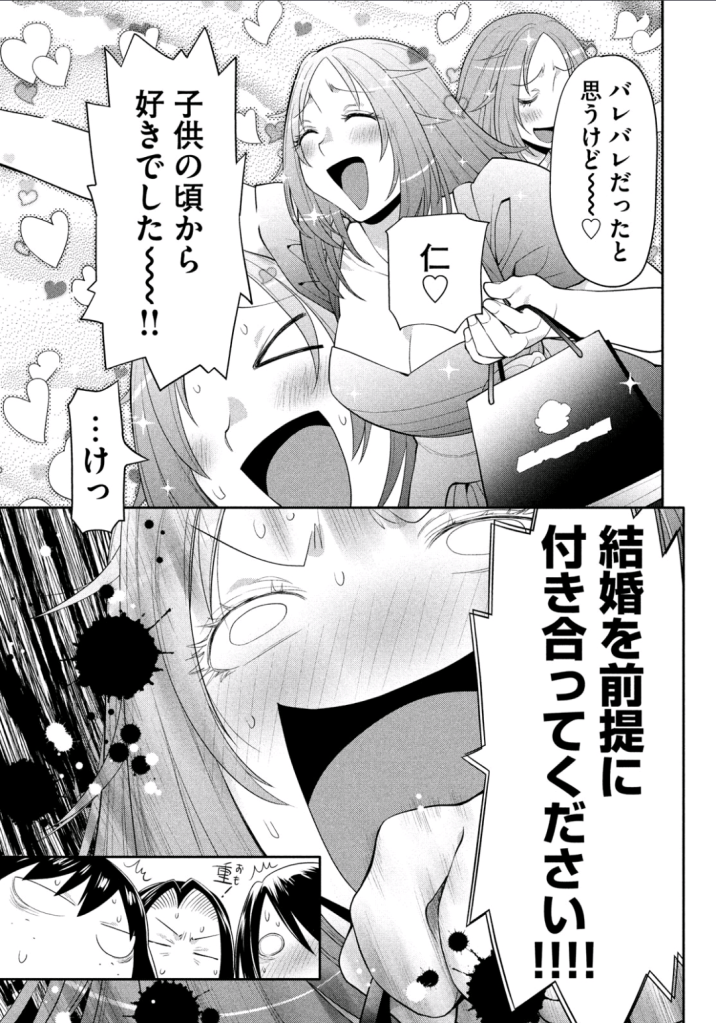
Yumerun tries to brighten the mood by delivering an intense confession of her own to Jin (“Please go out with me with the intent of marriage!”). While she says her feelings for him were likely always obvious, Jin (ever oblivious) mentions that he never even noticed. When Jin asks what kind of feeling “love” even is, Yumerun replies that it’s to treasure someone—while also thinking inside that it’s about wanting to have someone all to yourself—Jin curtly replies, “I don’t think I’m worth that much,” and leaves. Akira immediately gets up to chase, but Kozue stops him, saying that he shouldn’t be the one, and goes off after Jin herself.
The Details of Drama
The above summary is a lot wordier than I would typically prefer, but I felt that the contours of this chapter are important this month—especially because of how serious Hashikko Ensemble is getting. The drama has ramped up in many ways even if there’s still a dose of levity, with the Jin-Yumerun interaction emphasizing that contrast. In some ways, it reminds me of the Karuizawa story in Genshiken (where Ogiue finally pours her turbulent heart out to Sasahara), but the difference is that Ogiue started out full of pain, and Jin’s recent turn is more drastic compared to how we first meet him back in Chapter 1.
Jin and Love
Jin is the main focus throughout here, and I love what they’re doing with his character. The conflict that’s broiling inside him feels so real. Jin’s impressions of the girls’ performance come after Akira’s, and their differences in this moment really drive home how out-of-sorts Jin feels. Akira’s perspective comes from a less experienced place: He can tell how strong Yumerun is, that Kanon sings like it’s karaoke, and how Kozue is uncharacteristically not that great at it. Jin’s analysis, on the other hands, is very cynical and clinical, which feels so unlike what we expect of him. It’s like he’s turned a harsher ear on others as a consequence of becoming harsher on himself.
Then, when he’s asking Yumerun what it means to “love,” I get the impression that he’s not just talking about people. I suspect that he’s doubting whether he truly ever understood what it means to love music. Perhaps he feels that he’s been confusing his highly dedicated study and time poured into singing with genuine passion. When he says he isn’t worth that much, I think it might be because he seems himself as something of a fraud.
Master Yukina
Kousei continues to resist his interest in Shion, but one fun development out of this is Yukina and Shion’s friendship! I’m a fan of how Yukina and Shion quickly lose track of what they were talking about in the first place—It’s like watching a real and genuine friendship grow. Shion starts to call Yukina Shisou (“Master”), and I hope we get more of this in the future.
Jin, Kozue, Yumerun
Given the tiny bit of blushing, I can’t help but wonder if Kozue feels something for Jin beyond his surprisingly muscular body. The fact that she has a thing for that childhood friend of hers already means she’s potentially into multiple guys—a nice change of pace from so many other manga. The story seems to be going towards forging a bond between Jin and Kozue, and I think maybe it’s precisely because Kozue can’t sing all that well that she’s the right person to talk to Jin. Akira might very well drive Jin further down the hole, while Kozue’s lack of skill means that “having the music inside yourself” isn’t necessarily tied to one’s ability.
The fact that Jin was entirely unaware of Yumerun’s love for him is completely unsurprising, and I still wonder if he might be somewhere on the spectrum. Yumerun’s near-yandere romantic emotions are equally unsurprising. If there is some kind of love triangle at work here, I don’t know which I would cheer for. All possibilities are excellent, even the less orthodox ones.
Songs
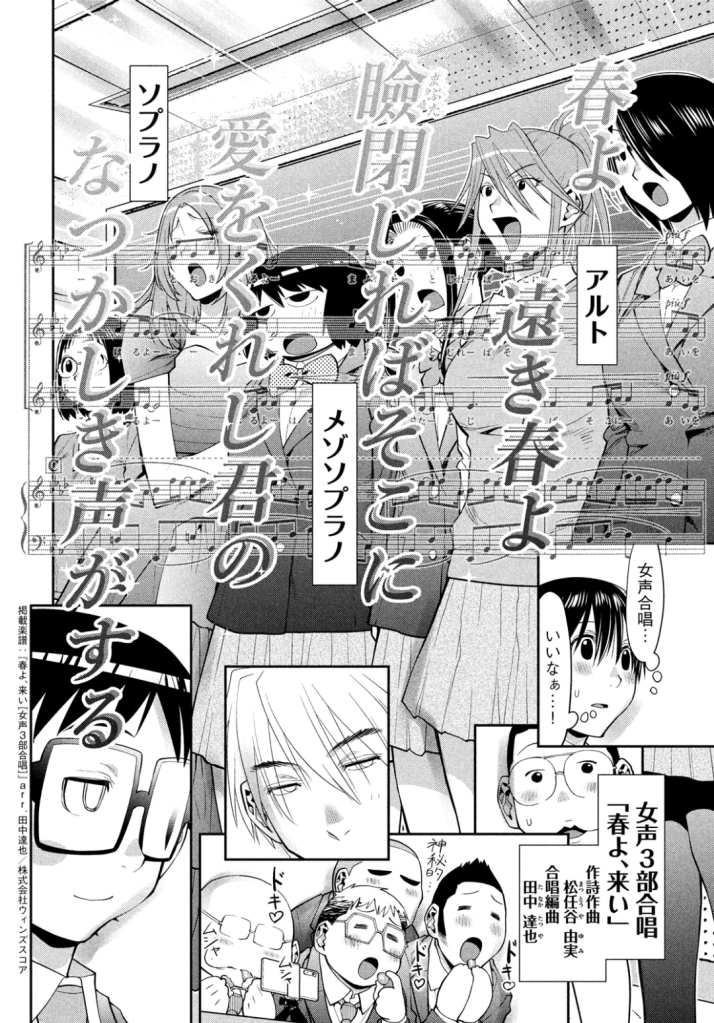
“Haru yo, Koi” (“Come, Spring”) by Matsutouya Yumi.
“Mugi no Uta” (“Song of Wheat”) by Nakajima Miyuki. The lyrics of this song in particular feel like they’re talking to Jin and his current problems. “Even if the wheat loses its wings, songs have their wings.”
Final Thoughts
Akira refers to Yumerun as “Yumeru” in this chapter, and I can’t entirely tell if that’s actually her name or if Akira is just misremembering it. If it’s the latter, it’s a reminder that they barely met each other.
I don’t necessarily feel obligated to write about every crossover character in the Shinkalion franchise, but when she’s a rendition of one of my favorite heroines from one of my most beloved anime, I just have to say something.
Shinkansen Henkei Robo Shinkalion Z has continued the propensity for surprising cameos by introducing a new character based on the mysterious Maetel from Galaxy Express 999. Given that she comes from a manga that prominently features a space vehicle shaped like an old steam locomotive, Maetel is arguably a more sensible guest character than Shinji from Evangelion or Hatsune Miku. However, the fact that she turns out to be a Shinkalion pilot feels like an even bigger (but still welcome) twist.
Maetel, in this case, is not the charming and motherly figure who gives an orphan boy a train pass to go on a never-ending journey to the stars. Rather, she’s an 11-year-old from Hokkaido who has trouble talking in person but likes listening to ham radio and 70s enka. In the story of Shinkalion Z, she learns about Shinkalions through a broadcast by a confused and forlorn antagonist from the first series, and discovers the existence of the Shinkansen Ultra Evolution Institute that commands the Shinkalions. Key to this is someone who’s clearly the commander of the Institute from the first series, thinly disguised. Having made a handful of appearances since Episode 20, she reveals her own Shinkalion in Episode 28: The Shinkalion Z H5 Hayabusa.
It’s pretty much impossible for Shinkalion Z to have kept any of Maetel’s original backstory, so I understand why they went a very different route. Her Shinkalion is also the spiritual successor of Hatsune Miku’s, the latter of whom has a connection to Hokkaido through the annual Snow Miku festival—but I’m not sure if there’s any such relationship this time Somewhat like Miku (who uses a different kanji for Hatsu-ne in this anime), her name is slightly off in Shinkalion Z: Her full name, Tsukino Maetel (“Maetel of the Moon”), is a sideways reference to Hoshino Tetsurou (“Tetsurou of the Stars”), the main character of Galaxy Express 999.
While the aesthetic of Shinkalion is quite different from Galaxy Express 999, I hope they can incorporate the latter somehow. The gimmick of Shinkalion Z is that the bullet-train robots can combine with other trains for upgrades—could the H5 Hayabusa get some steam-locomotive arms?
Shinkalion Z episodes are typically only available for free on YouTube for a week or two, so that’s why I’m posting this now. In a rare moment, Episodes 21 through 27 are available until the 30th of November, so if you want to see more of Tsukino Maetel, now’s your chance.


















 OGIUE MANIAX