Back Arrow Never Asks for Too Much

In today’s media landscape, it can feel like everything is about having an obsessive audience. Mobile games incentivize you to try to get every ultra rare and keep following a neverending story. Superhero movies, like their comic counterparts, want you to watch every single sequel and spin-off leading to the next mega film. Manga and anime want you to look into every character’s backstory and all the convoluted history that connects them together. These aren’t necessarily bad things, but they can be exhausting.

Under these circumstances, the anime Back Arrow is like a breath of fresh air because it doesn’t expect your total time and attention. Every episode, I would be entertained and intrigued; I might even have speculated what would happen next. But in a time when my mental space is being bombarded by world-changing events on the regular on top of all the aforementioned fan-forward storytelling, I like having an anime that’s just trying to be a sandwich instead of a 10-course meal.

The premise: Lingalind is a world of constant strife, with countries big and small vying for supremacy. Surrounded by a divine Wall that cannot be crossed, mysterious drop pods called rakuho fall from the sky and provide mysterious armbands known as Bind Warpers. These devices allow people to manifest their convictions and form giant robots called Briheights, and are the primary weapon of war. One day, a group from the tiny village of Edger finds a rather unusual rakuho containing a man with no memory—other than the seemingly insane notion that he comes from beyond the Wall. This man, who comes to take the name Back Arrow, is not only able to manifest a Briheight without having any conviction of his own, but is also able to defeat other Briheights without killing them, which was thought to be impossible. 

Back Arrow is like a cross between Gun x Sword, Star Driver, and Code Geass (even sharing the same director in this last case), only a whole lot less subtle. And given what those three series are like, this means watching Back Arrow is like getting hit over the head by two ham fists. The two major world powers are the Republic of Rekka, a hyper-exaggerated Dynastic China with Three Kingdoms elements, and the Supremacy of Lutoh, essentially pre-Revolution France with a seedy underbelly. Back Arrow and the residents of Edger Village all look like poorly dressed cowboys. But somehow, the anime ends up being really entertaining with endearing characters, lots of twists and turns, and some pretty solid action scenes—all without being bogged down or burdened with an excess of unrealistic ambition.

That’s not to say Back Arrow phones it in. The series’ narrative developments aren’t that surprising, but it’s never boring. In many ways, Back Arrow reminds me of really good pro wrestling. It’s ridiculous if you step back, but it’s easy to suspend disbelief thanks to the charisma of its presentation. Moreover, predictability isn’t a four-letter word, and in fact can be the foundation of some of the best stories because they have satisfying payoffs. 
Superhero Fans Are from Mars, Venus, Krypton, and Everywhere Else

It’s the 4th of July, so here I am to discuss my ever-changing relationship with American superhero comics fandom.

I’ve been an avid comics reader since childhood, and having interacted with many fellow fans over the years, there’s one truth I’m often reminded of: there’s no one type of fan. It’s not just that Fan A might like Spider-Man and Fan B might be into Jimmy Corrigan, either. How people approach the very act of experiencing comics can be so fundamentally different that calling them both “comics fans” ends up being a gross simplification, and failing to understand that can stifle one’s own understanding of the power of comics.

I recall a conversation with someone who’s a big fan of the Batman franchise. The topic of spoilers came up, and they basically replied, “Oh, I don’t care about that”—not so much because knowing in advance what happens didn’t bother them, but because the actual story isn’t the biggest priority for them and their fandom experience. Rather, it’s the characters themselves (Bruce Wayne, Dick Grayson, Tim Drake, etc.) and the values and traits they embody in and of themselves. It’s what allows these characters to be placed into alternate-universe fanfics. It’s also what allows them to be protected, in the eyes of such fans, from bad writers and plotlines. If Batman is written to be a racist, they can remember the perfect version of him instead. Japanese manga scholar Ito Go calls this kyara: the capacity for a character to be removed from their context and still exude a sense of identity, and superheroes certainly are iconic.

I’ve noticed more and more fans like this, and I believe their passion is real and wonderful. At the same time, this is not the type of fan I grew up with, and their interactions with both one another and with their comics are not the kind I cut my teeth on. Instead, I’ve generally been more accustomed to textual analyses, plot speculation, and the classic “who would win in a fight?” I caught up with an old friend at New York Comic Con 2019 two years ago, and their explanation of the ambitious nature of Marvel’s House of X and Powers of X stood in stark relief from the Batman fan’s way.

In his book Comics and Narration, French comics scholar Thierry Groensteen writes about a generation gap he feels with younger comics fans:

“For readers of my age…comics has always meant being exposed to a certain type of fiction, divided into genres and series, and being hooked on adventure stories. It went without saying for us that comics…was a “narrative type within the narrative genre.” Of course, we have to acknowledge that comics…arouses among certain groups of younger readers different expectations…. [O]ne needs only to consider the phenomenon of “cosplay”…to realize that these young people who dress up as their favorite hero have little interest in the story—what they are seeking…is the hero or heroine with whom they identify. The emphasis is on the characters themselves, their costumes, their attributes, possibly the values that they incarnate, but not at all the context in which they appear or the adventures that they have had. The phenomenon of identification is difficult for readers of my generation to understand…[W]hat mattered to us was how they gained hero status through their actions and how they swept us up in the excitement of their adventures.”

Unlike Groensteen, I feel I can relate to both his perspective and the “cosplayers” he finds inherently difficult to connect with. Still, I myself have noticed that when I talk with people from different groups about comics, the gears in my head turn in ways to accommodate the type of fan I’m talking to. Understanding their priorities also means understanding the kinds of questions that will bear fruitful responses. I don’t mean that I am constantly making intensely conscious decisions as to what to say or ask, but that talking with the Batman fan and the HoXPoX fan almost requires a different frame of mind.

While we all have our own ways and preferences, I think failing (or refusing) to acknowledge these differences creates tension among comics fans. People can even like the same comic but have very different ways of deriving their enjoyment. Trying to reconcile them (in the sense of trying to judge then with the same parameters) may be a fool’s errand. Recognizing that perspectives can be incongruous but appreciating them all the same lends strength to comics fandom as a whole, and all its possibilities.

Ju-shin Ly-ger: Ogiue Maniax Status Update for July 2021

Summer 2021 anime is just beginning, and there are plenty of shows I’m looking forward to. Chief among them is Getter Robo Arc, bringing the classic giant robot franchise into the 2020s. I definitely plan on reviewing it once it’s done, but I’m curious to see how it does with a modern-day anime audience.

Speaking of robots, Bandai just announced the GX-100 Soul of Chogokin: Gaiking and Daikumaryu. Coming in at 82,500 yen and measuring about 750mm, it is going to be an impressive hunk of diecast metal. I’m not a super big fan of Gaiking, but I’m looking forward to all the toy reviews.

Also, check out this GX-100 celebration stream featuring Sasaki Isao, singer of Yamato, Gaiking, Getter Robo, and many other classic themes.

Before getting into the posts from the past month, I’d like to thank the following Patreon sponsors:

General:

Ko Ransom

Diogo Prado

Alex

Dsy

Sue Hopkins fans:

Serxeid

Hato Kenjirou fans:

Elizabeth

Yajima Mirei fans:

Machi-Kurada

Blog highlights from June:

20th Century Boys: Pandemics, Conspiracies, and Cults of Personality

How the Urasawa Naoki manga is eerily more relevant than ever before.

BNA: Brand New Animal, Assimilationism, and the Myth of the Model Minority

This series from 2020 continues the trend of socially conscious furry anime.

Little Lady, Big Meals: Kozuma no Kobito no Kenshin Recipe

One of my favorite manga authors, the creator of Mogusa-san, has a new series!

Hashikko Ensemble

Chapter 41 brings the Culture Festival tournament arc to a powerful finish, as well as some surprising insight into the Kimura family.

Kio Shimoku’s Twitter account through June featured a lot of insight into his older work.

Apartment 507

Pui Pui Molcar!

Closing

I mentioned last month that I am fully vaccinated, and it’s given me a new sense of security and freedom I didn’t have before. However, now we have a new COVID-19 variant, the Delta variant, wreaking devastation around the world. It’s also getting a foothold in the US, and I find myself nervous that I’m getting a little too complacent and worrying about trying to neitheo over- or undercompensate for the current situation. Having to balance the psychological happiness that comes from doing things again with some sense of normality with awareness that we are in no way close to getting out of this pandemic reminds me of all the conscious decisions I’ve had to make these past 18 months, and the toll it can take.

That being said, I plan on being at Otakon next month. I’ll be fully masked, and playing it as carefully as I can short of canceling. I hope it’s the right choice.

Kio Shimoku Twitter Highlights June 2021

These are tweets from manga author Kio Shimoku from June 2021 that I found notable and informative. They include a number of early sketches from Genshiken, and his dreams of having a vacation home just for building model kits.

Genshiken and Related Drawings

Though he can’t quite remember, Kio presumes this is Ogiue practice from Genshiken. He thinks he made her too loli in these drawings.

Original Sue design from Genshiken. Kio thinks she comes across differently here.

Early Madarame. Kio thinks he captured the spirit of the character well. Character descriptions on the drawing include: close-cropped hair, thin, lolicon, high-energy, glasses, and likes fighting games. Originally, he was supposed to be the best at fighting games among the group, and his preferred main was Nakoruru from Samurai Shodown. The notes also describe him as being essentially the leader of the club despite being a second-year, and also that he likes to tease others.

(What I find interesting is that the fighting game skills went to Kohsaka, and that the character gained a lot more vulnerabilities in the actual manga. Those flaws are part of why people like Madarame, and here we see sort of what could have been.)

Ogiue autograph boards, the purpose for which Kio doesn’t remember.

By the way, if anyone has the actual final versions of these, I would like to make a deal.

Sketches of anime directors Ikehata Takahashi and Mizushima Tsutomu. Both worked on Genshiken anime.

A rough manuscript of a manga Kio was planning before Genshiken. It would have been an action series featuring magical sage powers (senjutsu).

The wife’s ex from Spotted Flower, crossdressing as part of a prank on the editor character.

Giant Robots and Model Kits

A custom design for a Zeong. Kio feels like he still doesn’t have what it takes to make this work.

A 20-year-old photo Kio took of a model kit he built. The robot is the L.E.D. Mirage from Five Star Stories, and the photo was taken with a non-digital camera. Airbrushing was probably involved.

Kio saw Mobile Suit Gundam: Hathaway’s Flash. Even though the Universal Century timeline has been around for a long time, the film is full of imagery he’s never seen before: what first class looks like for civilian space travel, a military mess hall that’s like a food court, the terror of having to move around the legs of mobile suits in combat. He was glued to his seat while watching..

A 1/144 model kit of the Waff from Gundam: The Origin. It’s the only airbrushed Gundam model Kio has, and he likes how it’s small but still looks chubby. 

Kio’s first tank model kit: the Panzer IV Ausf.D from Girls und Panzer. Kio mentions not really knowing how to do weathering, and that he used the darkest paint from the Waff on this kit as well. He also likes how sharp the details are.

The first thing that Kio thinks of when he sees the term “plastic model training camp” is Plamo Kyoushirou, the proto–Gundam Build Fighters manga. He recalls wanting to be like the characters taking the kit boxes out and saying, “I’m gonna make the Dougram!” and “I’ve got the Real-Type Zaku!” 

After he became an adult, he started collecting them to his heart’s content. It’s why he wants an extra vacation home, so he can have room for all the kits—though actually, he has so many he can’t add any more. But model kits keep on evolving, and he wants to keep up.

Kio continues to describe his dream of a lodging just for model kits that would have all the equipment and features needed to build kits, and stacks of manga to read. Then, he and the others there would go out at night for drinks.

After someone mentions that the possibility is closer than he might think, the conversation mentions a Wonder Festival dealer named “Backyennew.” Kio responds that he knows this garage kit maker.

Responses to Other Works

Kio recalls this crossover drawing between different Shounen Sunday characters. After trying to remember what happens on the next page, a follower answers that it was a kind of fourth-wall breaking moment where they mention that the other manga authors said to do this.

Kio watched the anime film Pompo: The Cinéphile, and thinks it’s a really interesting movie. He talks about how important the editing process is, and recalls that back when he worked on Gonensei [The Fifth-Year], he tried to cram every idea in. For that reason, the progress the character Gene makes as a first-time director is impressive.

By the time of Genshiken, Kio knew how to edit down better, though he actually just took the cut material and turned them into extras in the collected volumes.

The director of Pompo, Hirao Takayuki, is happy that Kio “of Genshiken fame” tweeted about the film. Hirao says he read Gonensei, and that the pain from that manga is still with him today. Kio gives him a big thank-you, mentions how young and inexperienced he was at the time of Gonensei, and compliments Hirao for the highly technical edits. Kio also says the movie being shorter is a good thing, and that he still want so get the second half of the limited-edition extra booklets.

…And here he is with both extras.

Kio says that even though he only read a little bit, Uncle from Another World is a manga that made him think that he’d like to see it as an anime.

In order to get all the limited-edition goods, Kio went to see Shin Evangelion four times. The fourth time around, he felt he could just sit back and enjoy the movie.

Hashikko Ensemble

Kio points out that this song, “Ame” (Rain) from “Mizu no Inochi” (The Life of Water) is mentioned in Volume 3 of Hashikko Ensemble.

Kio went to see this mini concert by the Oedo Coraliars. He was blown away by the harmonizing.

Until next time!

Finishing Strong: Hashikko Ensemble, Chapter 41

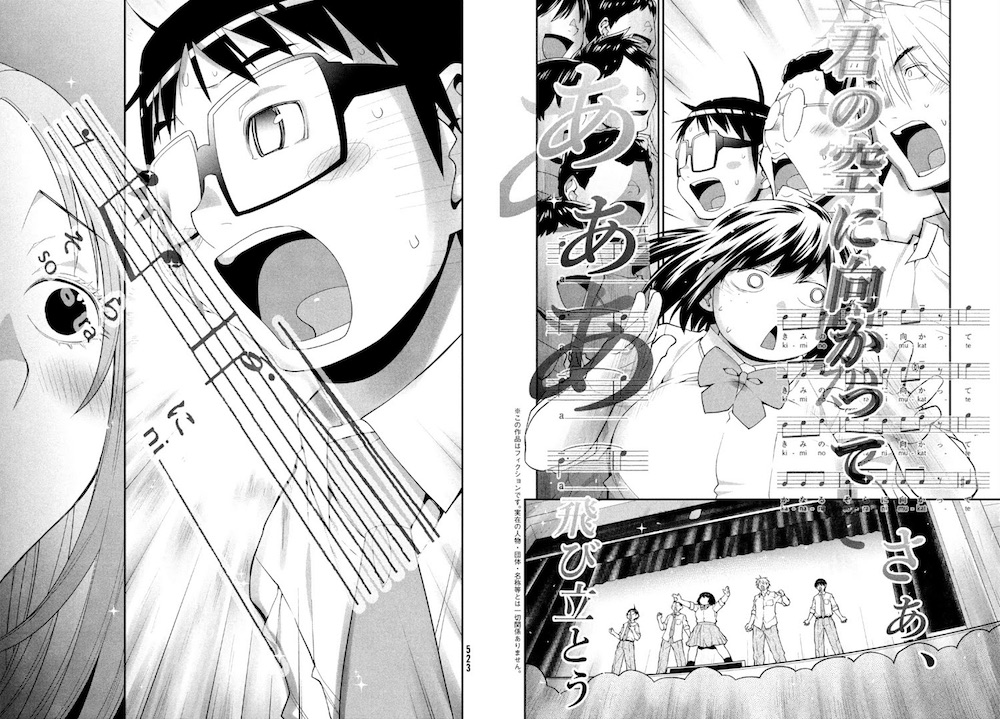
Akira singing as the audience (including his mom) stares on while impressed

The end of the current arc paves the way for the next!

Summary

As the Chorus Appreciation Society’s finals’ performance continues, the boys pour everything they have into their singing, Kozue has actually begun conducting the audience more than the singers on stage. With a strong finish, the Chorus Appreciation Society is declared the winner of the Culture Festival’s singing competition.

Soon after, Jin and the other members confront his mom, Reika. After a brief pause, Reika goes up to the group…only to focus on Akira, rather than her son. She remarks that Akira has talent, and that he should contact her because she knows a good music teacher for him. Jin is stunned into silence.

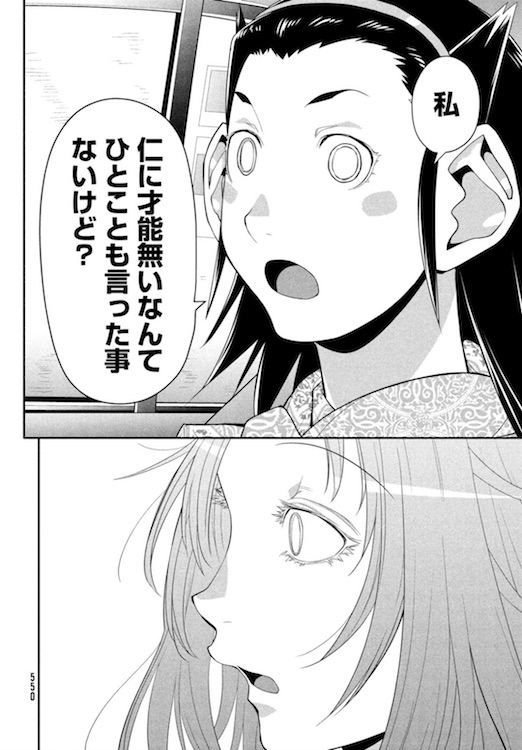
Later, as Reika and Yumerun are leaving by car, Yumerun comments that she thinks Jin has actually improved a lot. She asks why Reika thinks Jin has no talent, to which Reika responds that she never said any such thing. Rather, what she has meant to say is, why would someone with his talent join a chorus or choir, where people go to hide their lack of ability? When asked why she’s never said this outright, Reika answers that calling your own kid talented is embarrassing.

“Relative” Talent

Reika: “But I’ve never once said Jin has no talent.”

The way Jin’s mom really feels about him is something of a revelation, and like the characters themselves, I completely misinterpreted the situation. But I had also previously wondered about whether Jin truly is “untalented” or if he’s just holding himself to a ridiculously high benchmark in Reika, and I believe we have our answer here. Simply because Jin has to study and learn what comes intuitively to his mom, he perceives himself as needing to make up for some deficiency. 

On some level, Jin might be what you call a Larry Hemsworth—an exceptional individual who assumes they’re unexceptional because he constantly compares himself to others close to him who arguably shine even more. But also like Larry, who believes his being a pediatric surgeon pales in comparison to his three brothers’ acting skills, the question of who’s more talented between Jin and Reika is subjective. Jin’s ability to break music down, analyze it scientifically, and put it into practice is amazing in its own right, but he seems to be unable to see it from that perspective.

It remains to be seen whether Reika’s glowing words about Akira create a rift between him and Jin, but I doubt that it’s going to result in any sort of high drama. Perhaps like his mom, though, Jin might be surprisingly indirect in specific situations—as in her conversation with Yumerun in the car.

Yumerun and Jin

The audience getting into the song, and Yumerun seemingly being captivated by Jin’s singing

The chapter has a moment where Yumerun is looking at Jin perform, and she seems to be quite taken by him. They’re childhood friends, and she seems to have some sort of unusual fondness for the guy, but given that everyone is blushing all the time in Hashikko Ensemble, it can be kind of hard to tell what’s romance and what’s not. However, given their history, I feel like something may develop…or at least turn into some Boa Hancock and Monkey D. Luffy situation like in One Piece: a comedically one-sided love where the lack of reciprocation is more due to empty-headedness than incompatibility.

To the Next Story

The image of Akira wowing the audience with his powerful bass feels like a turning point of some kind. His classmates already knew he had a deep voice, and he’s sung in public on multiple occasions at this point, but I predict that he’s gonna gain a whole new reputation after this.

The likely thing is that we’re going to see enough new members join them for the Chorus Appreciation Society to gain proper Chorus Club status, and I expect there to be familiar and unfamiliar faces alike. In my view, Mai is the most likely one, but I think there are probably going to be some real curveballs in there. Might there be any unnamed audience members from this even who will end up as recurring characters?

Songs

“The Wings of Mind” continues and concludes from the previous chapter.

Final Thoughts

Great artwork in this chapter. I continue to enjoy the fact that the portrayals of singing feel intense but don’t go deep into the realm of exaggeration. Not that I mind it in general, but I think it works well for the relatively subdued quality of Hashikko Ensemble.

Also, I don’t think I recall this event being called the “Hashi High Acapella King/Anything-Goes Decisive-Battle Tournament,” but maybe I just glossed over it. In any case, I give props to Kio Shimoku’s first-ever tournament arc. 

Little Lady, Big Meals: Kozuma no Kobito no Kenshin Recipe

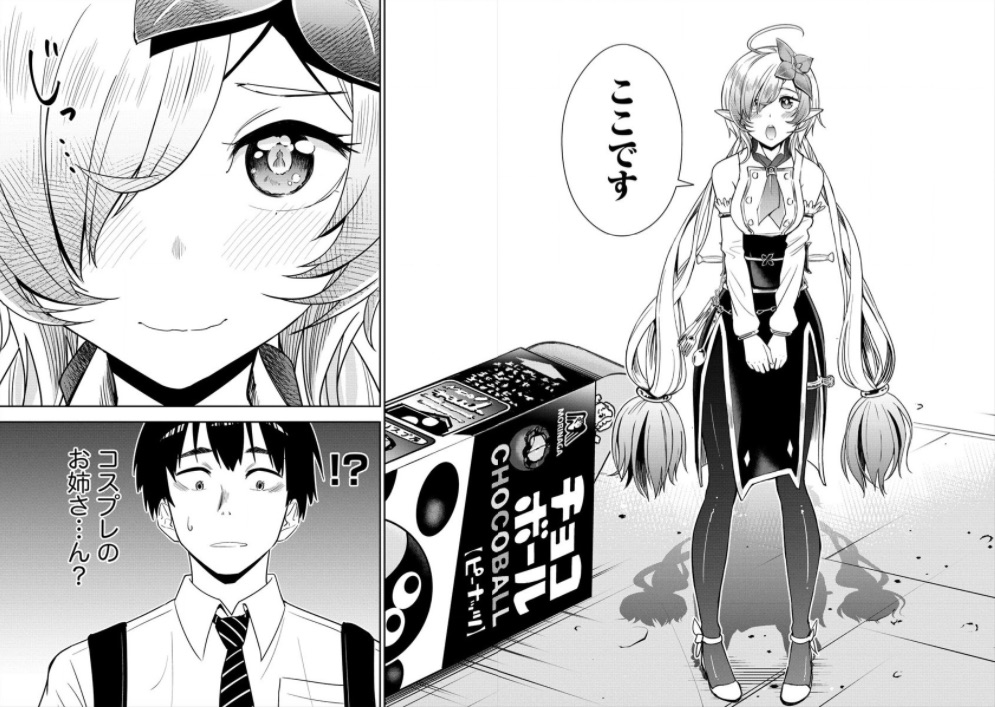
The author of Mogusa-san, one of my favorite manga in recent memory, has a new series out. Kozuma no Kobito no Kenshin Recipe by Ootake Toshitomo tells the story of a down-on-his-luck salaryman named Oomori Shizuru and a 15-cm tall pixie named Mint, who shows up with the intent of becoming Shizuru’s wife and cooking him delicious meals. The series, whose title translates roughly to My Pixie Wife’s Recipes of Devotion, combines two things Ootake has focused on in his relatively short manga career: exquisitely drawn food and oddball romances.

One big change from Ootake’s other manga—Mogusa-san, Mogusa-san Fights Against Appetite, and Teasobi—is that Kenshin Recipe isn’t published under Shueisha’s Young Jump label. Instead, it’s serialized in the web-only Comic Gamma Plus, which is under Takeshobo: a publisher arguably most famous for its mahjong magazines and manga. Essentially, the Takeshobo audience tends to skew older, and this is evident just from Shizuru being 27 years old instead of a high school or college student. However, Kenshin Recipe’s focus on cuteness means it’s not nearly as horny as many of its Comic Gamma Plus peers.

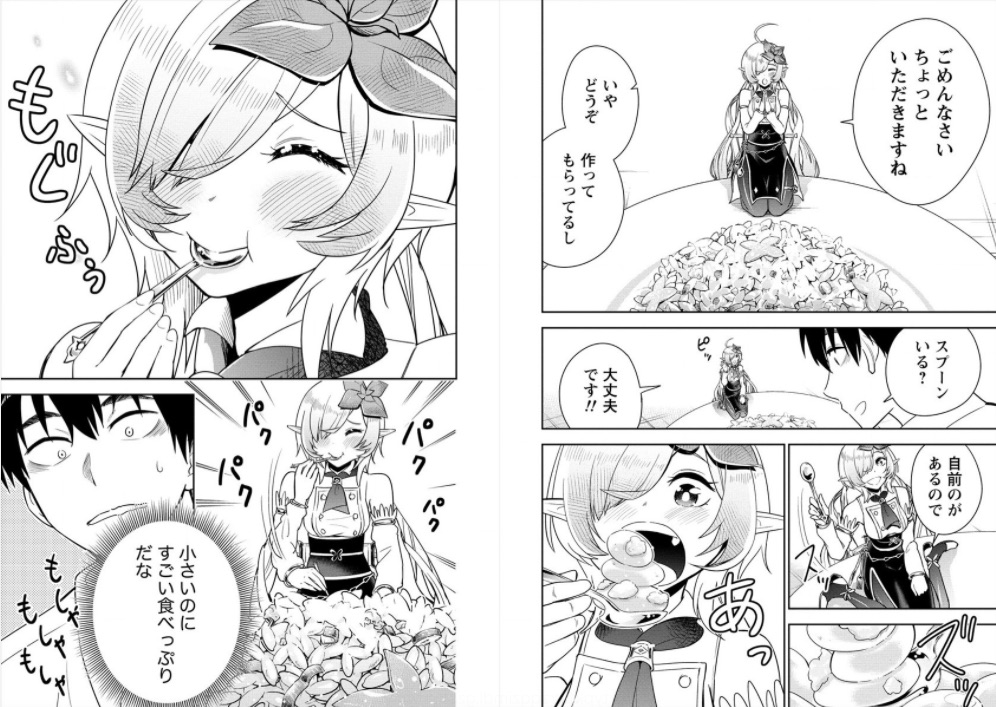
The highlight of the series thus far has to be the cooking scenes. Mint is around six inches tall, yet she has to use Shizuru’s human-sized cookware. Kenshin Recipe shows the way she gets around this: by casting a disinfectant spell on herself and doing everything from headbutting eggs to utilizing fire-resistant clothing to climb inside a frying pan. Ootake knows how to draw food and make it look good, and this provides a perspective on dish preparation that’s both fun and different.

Mint is the linchpin of the series, and while she’s no Minori Mogusa, she has her own unique charms. Putting aside those who are really into fairies and/or wives making home-cooked meals, one thing that stood out to me was Mint’s reasons for wanting to marry Shizuru in the first place. Having long observed him from afar as he left work every day, his sad figure at dusk made her want to protect him. It’s simple and silly, and even has a bit of wish fulfillment thrown in, but I rather enjoy the bit of agency given to the pixie.

There are plenty more opportunities for absurdity, and I’m eager to read more of Kozuma no Kobito no Kenshin Recipe. Based on Ootake’s past works, though, the truly entertaining parts are going to come when he introduces an expanded cast. It’s his strength with ensembles that brings his work from good to great.

BNA: Brand New Animal, Assimilationism, and the Myth of the Model Minority

There are anime where, if you really sit down and try to read deep underneath the surface for messages, you’ll find some surprisingly political messages. Then there’s BNA: Brand New Animal, which says to hell with subtlety—we are going to talk about racial politics, and we’re going to juuuust barely disguise it with furry characters. BNA is a story featuring stark looks at the act of othering, the specter of assimilationism, and the way society and government create negative stereotypes of minorities to then use those fabrications to push racist policy.

BNA takes place in a world where humans share the world with part-animal beastmen. Kagemori Michiru is a human girl who one day finds herself as a tanuki, and must deal with anti-beastman prejudice. She travels to Anima City, a city built and run by beastmen, in order to find answers. There, she meets a wolf beastman named Ogami Shirou who considers it his mission to protect his fellow beastmen. Michiru soon finds herself further embroiled in the complicated politics of both Anima City itself and its relationship with the human world. 

One of the major points of conflict in the series is how humans perceive beastmen. Some are well-meaning but prone to exoticizing, others believe beastmen are inherently inferior. Even Michiru, once human and now beastman in appearance, has a perspective that is both insightful and limited due to her unique situation. She knows what it’s like to face prejudice but does not have the lived experience of those who are born that way. 

Also important is that the very purpose of Anima City is to provide a safe haven for beastmen, but its astounding success and prosperity are seen as a nuisance by powerful forces—including those that ostensibly support Anima City. Though I do not know if this is a direct reference, the city has parallels to Greenwood in Tulsa, Oklahoma—aka “Black Wall Street.” A predominantly black space where residents thrived commercially and financially, Greenwood was burned to the ground in a racist massacre in 1921 due to the absolute fear and resentment from white people towards the notion of black success. 

As BNA moves towards its climax, events similar to Tulsa begin to emerge, particularly by outside attempts to frame beastmen as being inherently one step away from violence and chaos. Michiru and Shirou, as well as their allies, must fight against the racist idea that the beastmen must be “saved from themselves,” presenting an argument against what Ibram X. Kendi (author of How to Be an Anti-Racist) calls “assimilationism”: the flawed belief that a race can improve itself by behaving more like a “superior” race. The climax of the series even includes something about constructed notions of racial purity, and how flimsy they are when scrutinized to any real degree. 

Due to some muddling of metaphors, BNA’s approach isn’t perfect. A racist viewing this series could potentially use it to reinforce their own beliefs because of the human/beastman distinction, and allegory often gets lost on those who ignore it, even when it’s this on-the-nose. However, the series ultimately rests on the notion that those who are disingenuous about equity and equality will constantly move the goalposts in order to maintain their oppression, rendering the notion of achieving success as a model minority is inherently limited.

While there’s the possibility that I’m reading too into a show about a tanuki girl and wolf guy, Studio Trigger’s previous works show an awareness of politics in the US and elsewhere. Promare features a thinly veiled reference to ICE (Immigrations and Custom Enforcement) known as Freeze Force. A very special episode of Inferno Cop has a fat and obnoxious parody of Donald Trump. Because of the content of the anime itself and this history, I think BNA can only really be interpreted through the lens of racism, both in its effects on society and its perpetuation by the powerful.

Kazuya Mishima in Smash Ultimate: I Sensed This Coming

I’ve been going a little hog wild with the Smash Bros. DLC posts lately, devoting entries to Goro, Kerrigan, and Nightmare just in the past couple weeks. But one thing I’ve felt for a while is that Smash was lacking a representative for 3D fighting games. It’s why I tried to come up with a moveset for Akira Yuki from Virtua Fighter before he was revealed as an Assist Trophy in Ultimate. Now, we have our answer: Kazuya Mishima from Tekken.

While I never made any formal blog posts about it, I did entertain the notion in my Min Min analysis. I also made a couple of tweets last year arguing in favor of Kazuya:

Over time, what I’ve wanted to see out of Smash more than even my dream character picks (NiGHTS is the only one remaining, really) is to have it reflect a greater breadth of gaming: genres like the beat ‘em up and the RTS, and even influential consoles like the Atari 2600 and the Commodore 64. This includes 3D fighters. While 2D and 3D fighting games look similar from a distance, they’re actually two very different gameplay experiences. I’m glad for the inclusion of Ryu and Ken from Street Fighter and Terry Bogard from Fatal Fury, but I found it odd that one side of the fighting game genre was so lopsided in Smash

I know very little about Tekken other than having a general sense of how the game plays at a casual level, as well as familiarity with most of the characters through pop culture osmosis. From what I’ve seen of people’s initial reactions, Kazuya in Smash comes across as somehow having been transplanted straight from his source games into this new environment. We don’t have any detailed gameplay explanations to reference (the Kazuya showcase will air on the 28th of June), but if it was challenging enough to convert Tekken characters into 2D for Street Fighter x Tekken, I wonder how Sakurai and his team have made Kazuya work. It feels harder to translate Tekken moves to Smash compared to Street Fighter or Fatal Fury/King of Fighters.

Speaking of adapting fighting game characters to Smash, I realized a huge distinction between them and most of the roster: A lot of characters come from singleplayer games where the goal is for them to be relatively simple to use, and Smash movesets are designed relative to that. Not so with Kazuya and pals. In fact, Kazuya and the other Mishimas are generally considered among the hardest characters to master in Tekken. I think it’s why they can be so polarizing when in this crossover context.

Incidentally, the Kazuya trailer begins with Kazuya tossing Ganondorf off a cliff. Kazuya has a move called the Demon God Fist, or Majinken. Ganondorf’s neutral special, Warlock Punch, is actually also called Majinken in Japanese, albeit with a slight kanji difference. In other words, it was a battle of Demon Fists, and Kazuya won.

Welcome to Kazuya, and remember: the most important thing to come out of this is that the Banjo & Kazuya Mishima gag is real now.

20th Century Boys: Pandemics, Conspiracies, and Cults of Personality

I never read 20th Century Boys until this year, but in some ways, I’m glad I waited this long.

Warning: SPOILERS

20th Century Boys in 2021

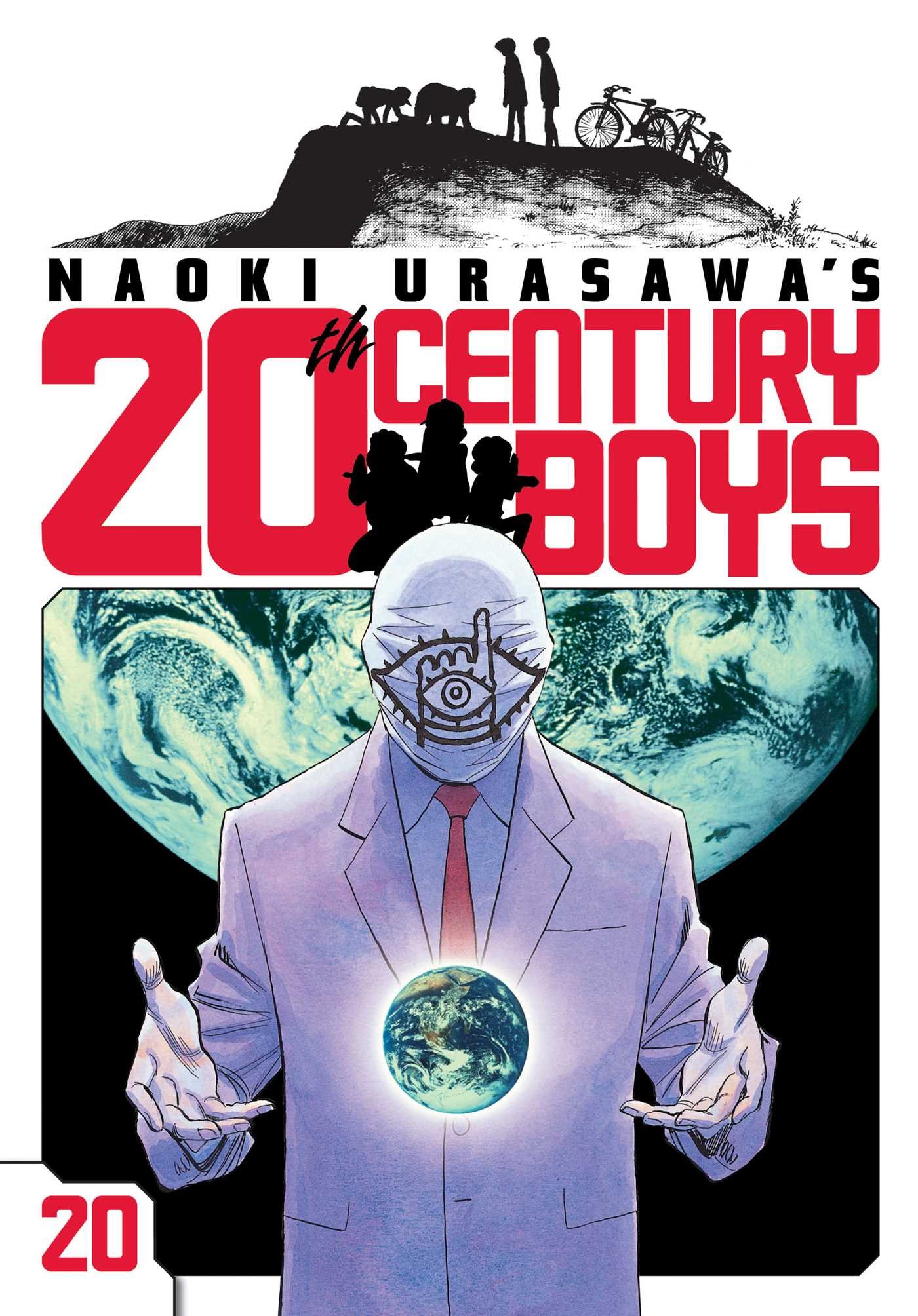
A manga by the award-winning author Urasawa Naoki, 20th Century Boys (published from 1999 to 2006) is a decades-spanning mystery about a man named Endo Kenji and his childhood friends, whose innocent elementary school antics are resurfacing in bizarre and dangerous ways. A Book of Prophecy they wrote around 1970 with far-fetched doomsday predictions about plagues that seem to be coming true, and at the heart of this conspiracy is an enigmatic and politically powerful cult leader known as the Friend. But while the Friend’s identity is unknown to all, there’s a hint that Kenji should know who he is: the Friend’s symbol is exactly the same as one Kenji and his friends came up with when they were kids.

Although conspiracies, cults of personality, and apocalyptic disease are not that unusual in fiction, these elements resonate particularly strongly in 2021. Between QAnon, authoritarians such as Bolsonaro and Trump, and then COVID-19, there are a lot of parallels between what happens in 20th Century Boys and what has transpired in reality. There’s a certain poetic element to a series revolving around The Book of Prophecy seeming to tell the future in itself, but whatever farseeing power it might have possessed are less interesting to reflect on than its portrayals of human behavior. What struck at my core from reading 20th Century Boys was not merely the presence of all these current dangers, but the all-too-real psychological reactions we’ve seen actually take place in the world.

QAnon vs. the Friendship and Democracy Party

One vital difference between QAnon and The Book of Prophecy is that the former has not been substantiated in any way, whereas the latter’s predictions are actively made true through the machinations of the Friendship and Democracy Party led by the Friend. Regardless of actual success rate, however, the two bear some fundamental similarities. In one scene in 20th Century Boys, the character Manjome Inshu recalls how he came to know and support the Friend. Manjome, who has a history of being a snake-oil salesman, is one of the people responsible for giving the Friend his messiah-like aura to his followers. At one point, they use a rope and pulley to make the Friend seem like he’s levitating—a flimsy trick that could have been undone by a bit of swaying. However, not only does the audience buy it hook, line, and sinker; even one of the assistants who literally helped hoist the Friend up by rope starts to believe the man can fly. Manjome, thinking to himself, comes to a realization: the people are just looking for something to believe in. Like QAnon, the Friend’s following is not about logic, rationality, or even trying to understand the world through one’s emotions. It’s working backwards from a conclusion because of a particular desire to see the world a certain way, and to feel like one has a part in its transformation. 

Donald Trump vs. the Friend

When it comes to the Friend’s authoritarian nature and god complex, the commonalities between him and Trump stood out to me from the very beginning. However, when the Friend’s identity is finally revealed, their resemblance only gets stronger. The Friend, as suspected, was part of Kenji’s childhood circle, but one who viewed Kenji with utter disdain. The Friend—a boy obsessed with anime, manga, and other children’s entertainment of the time—accrued knowledge, things, and experiences as a way to impress his classmates. Yet, it was Kenji who seemed to capture the attention of the other kids. The Friend was so hellbent on one-upping Kenji that, when a planned trip to the 1970 World Expo in Osaka fell through, he decided to just lie and fabricate journal entries for school as if he had actually attended the event. The wounds of failure remain so open and painful to the Friend that even in the mythos provided to his followers, it’s canon that the Friend Definitely 100% Attended the Osaka Expo and It Was Amazing.

Other clues point to a man with the mind and maturity of a little boy as the mastermind. Many of the hints about who he really is require knowledge of his childhood hobbies because they inevitably reflect what the Friend values. In this sense, 20th Century Boys is somewhat like Ready Player One, which also plays on the idea of pop culture trivia being key to everything, though in the case of 20th Century Boys there’s no Gary Stu power-fantasy protagonist. Also, prior to the big identity reveal, one character manages to get a close look at the Friend and is able to sketch his appearance from memory. When drawing the Friend, the character remarks that even though the Friend is clearly not a child, his face looks as if the man has never aged emotionally—a description that also seems to get ascribed to Trump.

In Too Much and Never Enough: How My Family Created the World’s Dangerous Man, the author Mary L. Trump (a psychologist who’s also the niece of the former US president) explains that Trump is unable to let go of grievances. Every slight he’s ever felt sticks with him forever—as shown by an anecdote of how Donald’s older sister recalling a story of him getting a bowl of mashed potatoes dumped onto his head for being a bully still seems to hurt the man well into adulthood. He has spent a lifetime constantly trying to get others to believe that he’s the richest, the smartest, the handsomest, and the best person in the world, and even becoming the leader of the strongest nation on Earth wasn’t enough to placate that selfish desire. With the Friend, his being overshadowed by Kenji became a deep psychological scar, and he uses that motivation to reach a similar place. If you erased my memory of the publication history of 20th Century Boys and told me that the Friend is a reference to Trump, I would believe you. But that’s not the case, and what we’re left with, in retrospect, is a very accurate portrayal of how someone with the most vile qualities could win the hearts and minds of others and remain just as terrible. 

COVID-19 vs. Bloody New Year’s Eve and Beyond

The spread of deadly disease is a recurring horror in 20th Century Boys, though in the manga’s case, it is a biological weapon utilized by the Friend to achieve his goals. I’m not going to get into much detail here, but I think the example I give is going to make it clear why 20th Century Boys ends up being a curiously ominous work when it comes to human psychology. In one scene, a scientist character is trying to make a colleague of hers—one who is responsible for developing new viruses for the Friend—understand at heart just how many people died from the virus they spread on “Bloody New Year’s Eve,” the name for the traumatic events of December 31, 2000. So what are these overwhelming casualties brought on by the virus? What is this horrifying statistic that defies human understanding? 

150,000. 

That number was meant to shock and horrify when it was written. But COVID-19 has killed nearly 600,000 people in the United States, and it has taken the lives of nearly 4 million people worldwide. “150,000 deaths” was a pie-in-the-sky notion dreamed up by a manga author, and we in the real world now see that as the “early days,” when the infection rate hadn’t gotten so out of hand. 

The trauma of the coronavirus is going to stick with us for a long time. 

A Compelling Warning

There’s much more to 20th Century Boys than simply being prophetic, and it’s a superb manga in terms of art and storytelling. Nevertheless, the way its narrative relates to these difficult times makes it all the more powerful. What should have been a suspenseful piece of fiction with an examination of humanity now feels closer to a documentary with a foreboding warning of how easily the human mind can be warped by a diet of bad information. I hope we’re able to heed its messages.

Nightmare (Soulcalibur) for Super Smash Bros.

A Truly Flagship Video Game Villain

Villain characters have been a great addition to the Super Smash Bros. franchise, starting with Bowser in Melee and more recently with the inclusion of Ridley, King K. Rool, and Sephiroth in Ultimate. In anticipation of E3 and the official Nintendo Direct scheduled for June 15, I’ve been making blog posts about possible antagonist characters I think would fit well. But as cool as Goro and Kerrigan would be, what occurred to me is that neither is necessarily the unquestioned face of the video games they represent. Mortal Kombat is Scorpion and Sub-Zero. Kerrigan can make a better case, but she’s not necessarily the first character people think of.

However, there is a particular case I think could fit my self-imposed criteria of being a bad guy while also being a game franchise’s most iconic mascot character: Nightmare from Soulcalibur. Not only does he wield Soul Edge, the demonic weapon that is the primary catalyst for the game’s story, he’s also literally in the logo of the Soulcalibur development team, Project Soul.

Another Swordsman, But…

One potential strike against Nightmare is Ultimate is a game that sometimes gets criticized for featuring too many swords. But Nightmare has so much going for him aesthetically, as well as in terms of possible gameplay mechanics and features that he could successfully fill a space that’s only partially covered by the likes of Ike and maybe Ganondorf: a true superheavy swordsman.

Nightmare’s Soul Edge is like a combination of Ike’s Ragnell and Cloud’s Buster Sword, only bigger. It’s this massive hunk of evil energy in the form of a two-handed blade, and it looks menacing in a way that even Sephiroth’s Masamune can’t quite compare. The menacing march of a character clad in armor who’s not as slow as one might expect could also add a quality of intimidation ideal for heavies. You know his dash attack would be that hilarious dropkick.

Potential Gameplay

Moveset-wise, it’s harder to establish what’s a “special move” vs. a “normal move” compared to 2D fighting game characters, but I think Nightmare could bring a lot of Soulcalibur mechanics to Smash. While the Soul Charge boost could be nice, Nightmare in Soulcalibur VI has a unique mechanic called “Terror Charge.” A mode that enhances his attacks in different ways, Terror Change can be activated either independently like a powerup on command, or it can be triggered by having the opponent hit Nightmare during specific armored moves. 

The two things Terror Charge might most closely resemble are 1) Incineroar’s Revenge (a counter that absorbs a plow to power up the next attack) and 2) Lucario in Project M, who could power up its aura during combos. Rather than being a comeback mechanic or even a snowball mechanic, Terror Charge would be a strategic tool that is fully controlled by the player and can apply to a variety of situations. Other folks more intimately familiar with how Nightmare plays can give a more in-depth moveset idea:

Who Else?

Nightmare isn’t the only villain who’s also the key figure in a game series—fellow Namco character Heihachi Mishima from Tekken could also make the case. Are there any other truly flagship villains out there?