Thoughts on Open-World RPGs and the D&D Lineage

Open-world RPGs have never really been my thing, though it’s less about genre preference and more about circumstances. I was never much of a PC gamer when RPGs like Baldur’s Gate were around, and by the time similar games (such as The Elder Scrolls series) emerged on more powerful console hardware, I didn’t have any of those systems. But from a distance, I find the branching paths of Western RPGs and Japanese RPGs to be such a wonderful story of diverging Dungeons & Dragons lineages—namely how the former has taken more from the customization and self-insertion aspects of tabletop roleplaying in contrast to the latter and how the latter has went on to emphasize the narrative and storytelling components by way of old Western computer RPGs such as Wizardry.

It might be my ignorance and unfamiliarity at work, but I see expansive open-world RPGs as putting less emphasis on defining strong characters through which a story unfolds. More often than not, my impression is that they are about putting the player in the driver’s seat and trying to convey a virtual environment where they can do “whatever they want” within the boundaries of a game’s programming. Even if they have set things to do and accomplish, these games are meant to feel like your story.

That being said, plenty of JRPGs have user insert characters, including Dragon Quest and Pokemon have audience insert protagonists, and the latter even allows for heavier aesthetic customization now. However, I do feel that there is a more defined sense of a default look and feel to these generic JRPG player characters, and the result is that they also end up feeling like someone you’re observing from a distance—like you’re in a dream seeing yourself from a third-person perspective.  For me, personally, I’ve traditionally preferred that direction.

Of course, I’m making certain assumptions and generalizations when I define Western RPGs as more expansive and open-world, as even those words can change meaning and significance depending on what players are used to and how they perceive the importance of those qualities. For example, it’s interesting to me that the prevailing online opinion on Pokemon Black & White has changed so drastically in the ten years since its debut. 

Back when it first launched, the games were criticized as being too easy and hand-holdy—you always knew exactly where to go next. This was a far cry from the original Pokemon Red & Blue generation-1 games, which gave far fewer explanations and kind of left a lot of things ambiguous. But now, Black & White are touted as being one of the gold standards of Pokemon, and its descendants inferior for their perceived lack of strong and focused storytelling. Red & Blue, in turn, are seen as cumbersome relics that don’t do enough to guide players. It comes down to a generational divide, but even within the specific realm of Pokemon—hardly what you’d call a premiere example of open-world gameplay—this debate about the two Dungeons & Dragons lineages takes place.

I feel that the success of expansive open-world RPGs on an individual level comes down to whether or not the inevitably less defined bits of narrative that are a consequence of heavy personal customization and gameplay systems that encourage defining “your” story as opposed to following someone else’s. Both it and the JRPG style are capable of capturing people’s imaginations, but it’s what we want to do with our captive imaginations that highlights our differences.

This post is sponsored by Ogiue Maniax patron Johnny Trovato. You can request topics through the Patreon or by tipping $30 via ko-fi.

Beyond “Friendship, Hard Work, and Victory”: The Promised Neverland

The Promised Neverland recently concluded in Weekly Shounen Jump, and it caps off a four-year run as perhaps my favorite dedicated shounen manga of the last twenty years. It both elevates and challenges the foundational Jump motto of “Friendship, Hard Work, and Victory” by pushing far past simple power fantasies and the thrill of adventure. It dives deep into the territory of political thought as it tells an intriguing story about kids trying to both survive and make a difference in their world.

This is not the first time I’ve praised The Promised Neverland. I’ve previously written about the significance of its main heroine, Emma, and the fact that the series criticizes the entrenched systems of injustice that stay in power by pitting people against one another. Now that the series has crossed the finish line, I feel that my positive opinions of the manga have been more than justified. The Promised Neverland is a series that dares to say something about the world, utilizing its world and its characters to challenge readers to imagine a better world.

The Promised Neverland places a female protagonist front and center, gives her the agency to make changes, and emphasizes the idea that we don’t have to perceive the world as some zero-sum game of absolute winners and losers—a world where the first thing we ask is how we can save as many people as we can, and not how many people we need to sacrifice to achieve a goal. Here and now in the year 2020—between COVID-19, Black Lives Matter, democratic protests in Hong Kong, and countless other human rights and safety issues—these are messages we need. 

An opinion I keep seeing online is that The Promised Neverland was at its best in the first arc, when it was about orphans trying to outsmart their sinister and powerful mother figure in order to escape. And certainly, there was a kind of thrill to the “high stakes battle of wits” that defines the  early manga. However, I am so glad that The Promised Neverland evolved past that point. It would have been all too easy for this manga to simply be about the nerve-racking excitement, but it became a genuine piece of thought-provoking science fiction—the kind that encourages readers to imagine a different world, one that looks at concepts of utopia and dystopia, and asks how one could turn into the other and vice versa. 

There is another Shounen Jump series that I feel hits with a similar weight, though it’s a far different series in a lot of ways: Barefoot Gen, the story of two siblings who live through the bombing of Hiroshima and the pain of post–World War II Japan. No, The Promised Neverland is not couched in the trauma of directly experiencing a nuclear explosion, and its pain is abstracted through its fantastical setting, but it still looks deep into who we are as a collective people called humanity, and challenges us all to be better. 

Animal Crossing: New Horizons as Rorschach Test

Animal Crossing: New Horizons arrived just in time to explode in popularity. With so many people staying home due to COVID-19 and in need of some respite, the series’s laid-back atmosphere might just be what the doctor ordered. I know because more than a few of my friends and loved ones have been playing it, some long-time veterans of the franchise and others absolute newbies. After a while, seeing the people I know derive such enjoyment out of it, I had to see firsthand what the fuss was all about.

I wouldn’t quite call Animal Crossing: New Horizons a personality test, but I find that it does reflect something of what’s going on in each of us. There are goals you can progress towards, and there are achievements that can net you bonuses, but the game is largely without any demands. You could do everything or you could just do the bare minimum. You gradually shape your space according to however you feel, with some harmless elements of luck and the mellow atmosphere preventing it from being something like a SimCity. Seeing my island slowly come together and comparing it with others’, I can see how we express ourselves through the game’s quirks.

Animal Crossing is clearly not for everyone, and I can think of two categories of players who might regret getting the game. The first is anyone who needs there to be a distinction between winners and losers. While there are areas in which you can potentially compete—fishing events, the size of your collection, how much money you have, etc;—they’re largely arbitrary and there’s no judge keeping score. You really have to go out of your way to make it about competition, because there’s nothing that inherently says one person’s stuff is better than another’s.

The second category is anyone who would feel anxiety over accomplishing all the million little tasks and activities the game offers. It’s possible that, rather than being a calming, almost meditative experience, Animal Crossing: New Horizons becomes a source of stress. If you feel bad about ignoring things you could be doing, and you feel like you avoided guilt rather than achieved satisfaction by accomplishing them, then playing this might be a bad idea.

As for me, I’m trying to make my island into an incongruous mix of relaxing good times and abstract horrors. Either way, my villagers look like they’re having a good time.

Beastars and the Fight Against Behavioral Absolutism

Exploring the tension of anthropomorphic animal society from the perspective of high school students, Itagaki Paru’s Beastars can at times feel like it’s encouraging a very dangerous view of the world. In a world where carnivores and herbivores co-exist peacefully and eating your fellow animal is illegal, the constant pressure faced by the timid wolf protagonist, Legoshi, for not embracing his violent, meat-eating ancestral nature seems to bleed into sexist alpha/beta nonsense territory. Yet, by the end of a first anime season filled with tumultuous and shocking developments, the message I took away was something far different and more nuanced than a simple animalistic nature vs. civilization dichotomy.

Warning: Beastars spoilers ahead

Legoshi is portrayed as shunning the spotlight. Although he’s in the drama club, Legoshi works as a meek behind-the-scenes stagehand, leaving the attention to others such as the club’s star actor, Louis the red deer. But what Louis notices is that Legoshi is clearly stronger and potentially more intimidating than he lets on. As a gray wolf, he possesses might that no herbivore can hope to match, and it incenses Louis that Legoshi can be such a pushover. When Louis gets hurt and a shuffling of roles causes Legoshi to appear in a play, a tiger clubmate named Bill tries to bring out Legoshi’s dormant ferocity.

However, Legoshi is afraid of his own carnivorous side. Not only was his good friend, Tem the alpaca, eaten by a carnivore, but Legoshi himself comes dangerously close to succumbing to his lupine instincts and devouring a female dwarf bunny named Haru—a girl he later develops strong feelings for. Legoshi does not want to be that kind of animal, which is why he looks up to Louis, who accomplishes things through grace and diplomacy. Even so, there’s no denying that Legoshi would be incredibly powerful if only he let himself be. 

Part of what holds Legoshi back is a society that discourages carnivores from exerting dominance through force. Meals for them are made with high protein content, e.g. eggs, as a way to sate hunger, but the appeal of real flesh can be overwhelmingly difficult to endure. Throughout the series, Legoshi struggles to fight that desire for meat, which then blends in odd ways with his love/lust for Haru, further complicating things in his heart.

Towards the end of the series, Haru gets kidnapped by an organized crime group—a cadre of lions called the Shishigumi—with the intent to eat her. Having discovered previously that Louis is seeing Haru (though what Legoshi doesn’t know is that Haru is extremely promiscuous as a way for her to have some control over her life), Legoshi tries to bring Louis along. However, Louis declines, having already learned about the kidnapping and being told that he must stay quiet if he is to accomplish his goal of rising to the top of society and being able to effect widespread change. Legoshi storms the Shishigumi base without the red deer, and by fully tapping into his violent side, is able to rescue Haru. 

At first, the lesson seems to be that Legoshi finally set aside his false persona of timidity for what was truly inside, but what happens afterwards communicates what I found to be the most important takeaway from Beastars: when it comes to instinct vs. reason, there is no universal answer.

Having saved Haru, Legoshi and her end up at a love hotel prepared to take their relationship to a physical level. Legoshi confesses that he was the one who tried to eat her, and Haru says she always suspected it was him but was still drawn towards Legoshi. However, just as they are on the verge of consummating their relationship, Legoshi’s mouth moves uncontrollably as if he’s going to eat her, and Haru’s body moves, as if on its own, to be eaten by him. Built into their genetics is a relationship of predator and prey, and sex between them isn’t “supposed” to happen. Even so, they’re genuinely in love with each other and they want to make it work, which means denying what their DNA is screaming at them to do. If Legoshi wants his heart’s desire, reason must prevail over instinct.

The underlying message I take away from Beastars is that the question of whether to follow or rebel against one’s animalistic nature is not an all-or-nothing proposition. There are times when it can be of great benefit, but other times when it can be a mistake or lead to disastrous outcomes. Moreover, whether or not doing so is a right choice will vary from individual to individual. Legoshi is not Louis. Legoshi is not Haru. They can naturally accomplish things he cannot and vice versa, but they’re also all capable of going out of their inherent comfort zones to do even more. It is the moderation of both reason and instinct relative to each other that allows us to flourish.

A Villain’s Redemption: Pokemon Masters Finally Hits an Interesting Story

Pokémon Masters continues to be a curious mobile game. It never had the ultra-mainstream appeal of its cousin Pokémon Go, and its focus on established human characters over the marketable critters themselves basically implies that the game’s target audience are already loyal Pokémon fans. Up until recently, that fanservice didn’t go much beyond seeing your favorite gym leaders and heroes interact with one another more extensively, but the Ho-oh event from last month takes it a step further by redeeming one of Pokémon’s antagonists.

The story involves Ethan and Silver, protagonist and rival of Pokemon Gold, Silver, and Crystal, looking for the legendary Pokemon Ho-oh. At this point, Ethan and Silver are no longer enemies but loosely working together. Ho-oh is said to appear to humans who are pure of heart, which Silver believes disqualifies him from becoming its partner. After all, his history is one of doing terrible things to his Pokemon, being cruel and nasty to other people, and being the son of Team Rocket boss Giovanni. However, Lance appears and explains that he has seen genuine change in Silver—a transformation clearly reflected in SIlver’s bond with his Sneasel. Ultimately, Silver proves himself worthy by choosing to save his allies instead of trying to catch Ho-oh, and the legendary Pokemon rewards him by joining his side.

There’s something about mobile games in general where I can’t really get into their narratives because of how they’re locked behind tedious gameplay requirements. Pokémon Masters is no exception in terms of feeling a bit like a chore, but I think the payoff was rewarding because of how nice Silver’s story ends up being. The original Gold, Silver, and Crystal games (as well as the Heart Gold and Soul Silver remakes) do show that Silver has started to turn a new leaf, but the result was left somewhat ambiguous. What Pokemon Masters does, though its canonicity is unclear, is to give Silver a satisfying conclusion to his journey from villain to well-meaning rival. It’s the first time that Pokémon Masters has presented a story with actual stakes, and it works to really humanize Silver. This has resulted in what I consider the peak of the mobile game currently, and one of the highlights of Pokémon as a whole.

Learning About the Butterflies and the Bees: Saotome-senshu, Hikatakusu

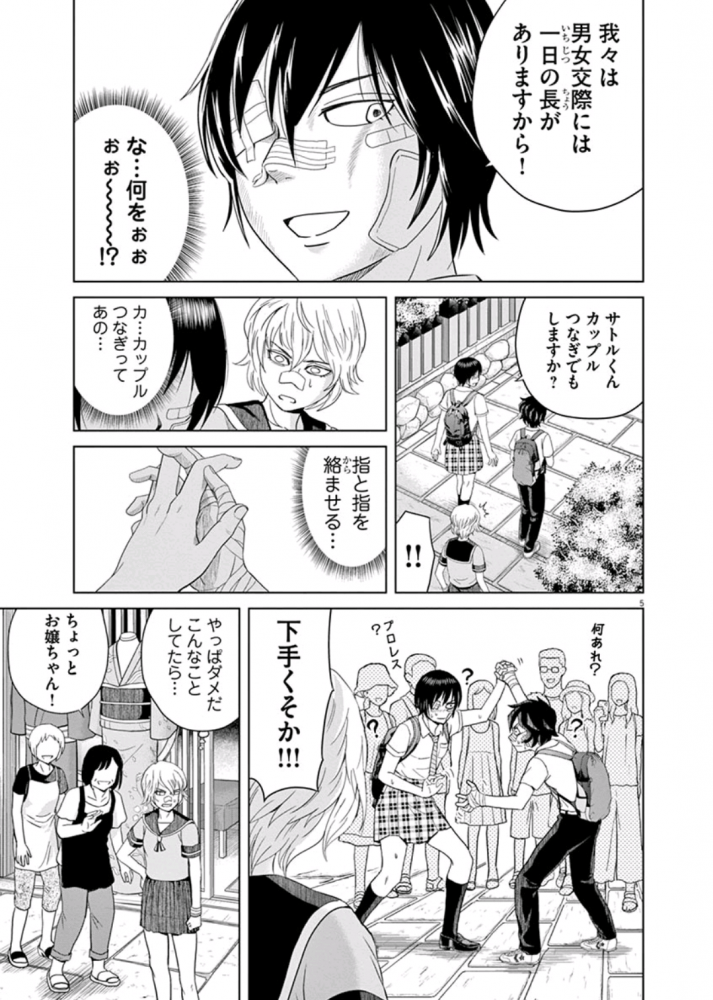
The first thing one notices when looking at the cover of a volume of Saotome-senshu, Hitakakusu (Saotome Covers Up) is the main heroine and her abs. Who is this muscular girl? How did she get that impressive six-pack? What’s her deal? The answer: she’s the heroine of a beautiful manga that’s a little romance, a little sports, and a whole lot of stupid in the best possible way. More than that, its central boyfriend-girlfriend relationship is portrayed so wonderfully and positively that I would present it as a shining example of a love that feels healthy and genuine.

Saotome Yae is her high school boxing club’s ace, blessed with strength, agility, and a preternaturally good knack for fighting. But the first chapter opens up with a low point, as the boy she likes, Tsukishima Satoru, rejects her confession. The reason: he’s also in the boxing club, and he doesn’t want to jeopardize her next crucial match. However, the romantic feelings are clearly mutual, and by the end of the chapter, Tsukishima has become Saotome’s coach—a setup that not only hides their going out against school rules, but also allows Tsukishima’s endless passion for boxing to benefit Saotome as well.

Saotome and Tsukishima are the definition of adorkable. They will try to hold hands, but their unfamiliarity with doing boyfriend-girlfriend things makes it look closer to a test of strength. At another point, Tsukishima declares that they’ll succeed through the power of love, only to realize that he’s talking to Saotome’s little brother, who proceeds to forever call him “Power-of-Love Man.” This is one of those series where everyone is kind of an idiot on some level, and it results in a wonderfully silly and sweet series that isn’t afraid to go for a heartfelt scene one moment and immediately transition to a gut-busting gag the next. The humor is somehow both subdued and absurd, and I can’t really think of many similar works. It somewhat approaches the stylings of Shibata Yokusaru’s 81 Diver, but isn’t quite as extreme and over-the-top.

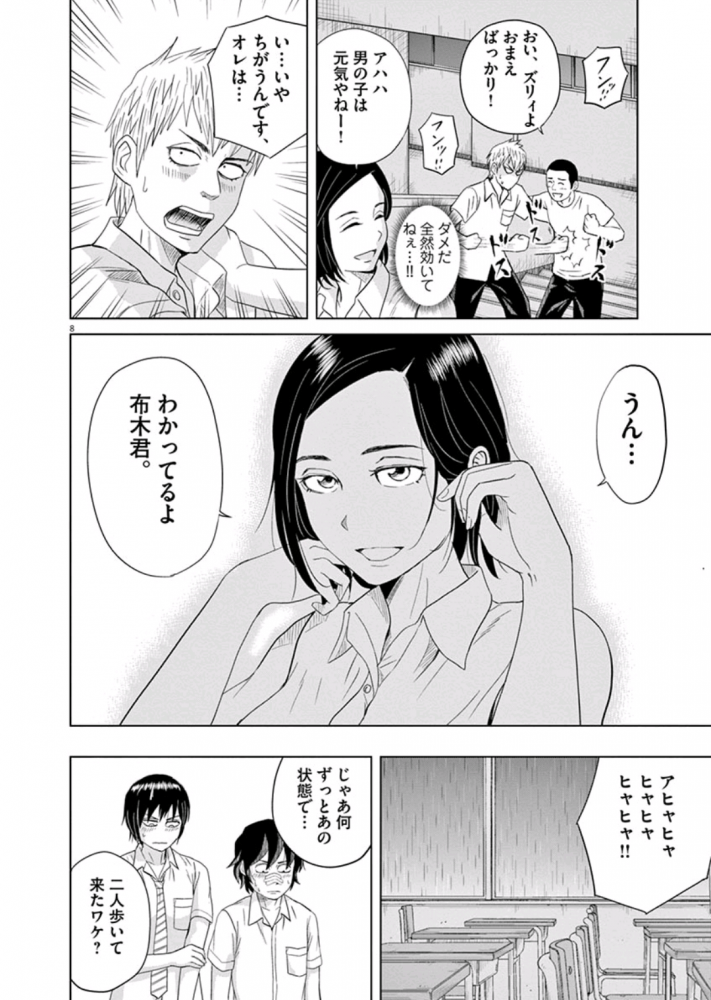
Virtually every character, from the main couple to the wide array of side characters, are hilarious and memorable—even Saotome’s random clubmates. Above is a scene where one of their clubmates tries to get some alone time with Wakano, a college-aged boxer and childhood friend of Tsukishima’s, by incapacitating his own friend with a punch to the stomach. …Except, they’re all boxers and can take a hit, so his friend just stands there laughing merrily. This whole thing ends with Wakano showing how to really deliver a body blow, leaving the clubmate doubled over but also a little happy.

Of the supporting cast, my favorites are Satsukawa Mizuki, a rival of Saotome’s who transitioned from karate to boxing with the most terrible sense of direction, and Konno Mito, the boxing manager who basically teases anyone and everyone. In those rare instances where the two are together, it’s even better.

But what I think really anchors this series and will make it endure is the depiction of Saotome and Tsukishima’s excellent relationship. On the surface, the two look like a somewhat mismatched couple that seems to thrive on reversing gender roles. Saotome is big and tough, and knows how to achieve victory after victory. Tsukishima is small and weaker, and has yet to win a single match in his boxing career. However, you can see that the two think the world of each other, and both inspire each other to greater heights. Saotome does not see Tsukishima as a “loser” who’s capable of less, but rather as a guy full of love for boxing, and who is making progress on his own terms through his own power. Tsukishima, for his part, is 100% supportive—not jealous—of Saotome’s greater success. He’s a challenge to toxic masculinity and the fear of emasculation: he’s shorter and less skilled in his own chosen sport than his own girlfriend, but absolutely no one thinks less of him, especially himself.

One unfortunate thing about Saotome-senshu, Hitakakusu is its timing. Saotome’s boxing path is about aiming for the  2020 Tokyo Olympics, and the series even ends with a flashforward to them. Before, it would have been possible to imagine the characters actually being there for the real deal, but COVID-19 has turned the 2020 Olympics into the 2021 Olympics, forever dating the series as a pre-coronavirus title. However, while that dates the manga, this doesn’t really detract from its overall excellence, and I hope as many people as possible end up reading it.

The Panda from Beastars Is Basically Black Jack

The manga and anime Beastars by Itagaki Paru features an eclectic menagerie of personalities, but one that caught my attention is the panda character Gohin. The reason: the character is likely an elaborate reference to the classic Tezuka Osamu manga character Black Jack.

Gohin, like Black Jack, works as an unlicensed doctor, being called upon by those who cannot (for whatever reason) request more legitimate professional help. Both have a moral code, but it lies outside the normal boundaries of society. Even Gohin being a panda has hints of the Tezuka character: Black Jack’s skin on his face has two shades—the darker skin comes from a skin graft he received from his half-African best friend. 

What seals the deal on Gohin being the Beastars Black Jack is that he’s voiced by Ohtsuka Akio, who has been the voice of Black Jack in numerous anime adaptations since the 1990s.

Basically, I can’t wait to see Gohin operate on himself while fighting off some dingos—albeit ones who walk on two legs and talk.

Break the Unbreakable, Fight the Power: Ogiue Maniax Status Update for June 2020

This blog is a reflection of myself, and my thoughts and feelings on anime and manga both for their own sakes and within the greater context of the world we share. So much has happened within this past week, let alone this past month, that I’m feeling overwhelmed. Between COVID-19 and the protests that have emerged in the United States, Japan, and Hong Kong in response to institutional injustice, I hope that everyone can stay safe as we fight for fundamental changes to transform the world into a place where power and authority are not used as tools of oppression.

Thank you to my Patreon sponsors this month. I appreciate your support, not just those listed below, but everyone who thinks Ogiue Maniax is worth something even in these times.

General:

Johnny Trovato

Ko Ransom

Diogo Prado

Alex

Sue Hopkins fans:

Serxeid

Hato Kenjirou fans:

Elizabeth

Yajima Mirei fans:

Machi-Kurada

Blog highlights from May:

The House in Fata Morgana and Full House: The Inherent Limits of “Pure” Translations

Translation accuracy and localization have been recurring fandom topics lately. I thought I’d give my perspective on it.

The White Fear of Mediocrity

A thought about Steely Dan in JoJo’s Bizarre Adventure turns into an exploration of whiteness in America and its ties to the suburbs that dot the country.

Wishing for Hope, Reaching to Help

The recent deaths and suicides of so many have me wishing that everyone stays safe mentally, physically, and emotionally.

Hashikko Ensemble

Chapter 28 puts some focus on the castle-loving Shinji.

Patreon-Sponsored

My Favorite (?) Anime Computer Games

It is what it says, sort of?

Apartment 507

Thinking about nostalgic sequels and their use of time.

Closing

Whether you choose to stay indoors or go out there to fight for justice, please stay safe. I will try to provide things worth reading, whether you want to engage more with the world around us or to stay within the realm of art. Just remember that the border between the two sides are porous and prone to mingling.

Boy, Become Mythology: Hashikko Ensemble, Chapter 28

It’s Shinji’s turn to live his passion in Chapter 28 of Hashikko Ensemble.

Summary

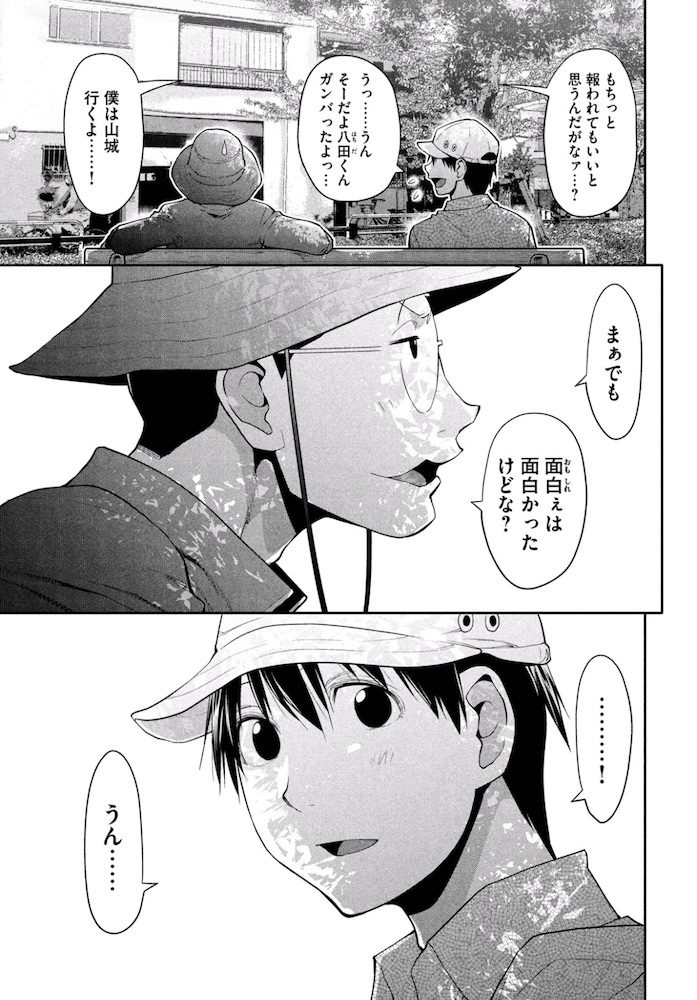
Now that M-Con is over and the rest of summer break is left, Shinji decides to do what he’s been wanting to this whole time: visit a castle! After all, his original plan in high school was to make a Mountain Castle Club, before he got roped into singing. He wanted to bring the other members along, but only Akira and Hasegawa ended up joining him. Also, it’s technically a valley castle and not a mountain one, but that’s better for amateurs like the latter two anyway, according to Shinji.

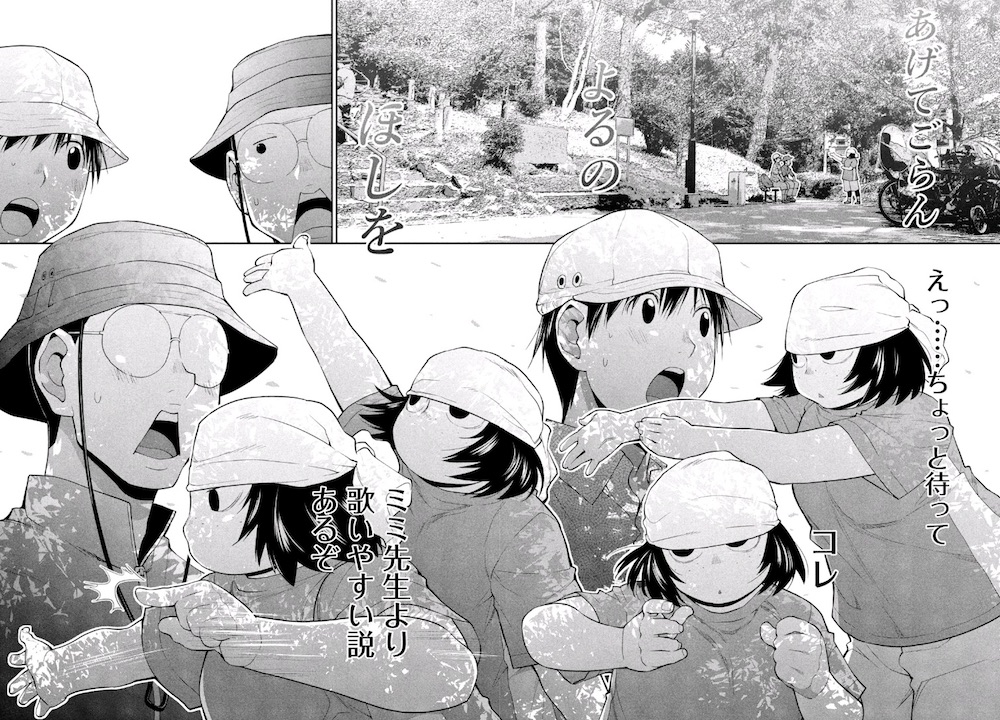
As the three take a break, Akira expresses his desire to sing more, while Shinji admits that even he got into it more than expected. Hasegawa surprises the both of them when she suddenly starts conducting, and the two guys start singing. She reveals that she’s been practicing in secret while watching Mimi-sensei, and the two immediately realize that she’s actually better at it than their club adviser.

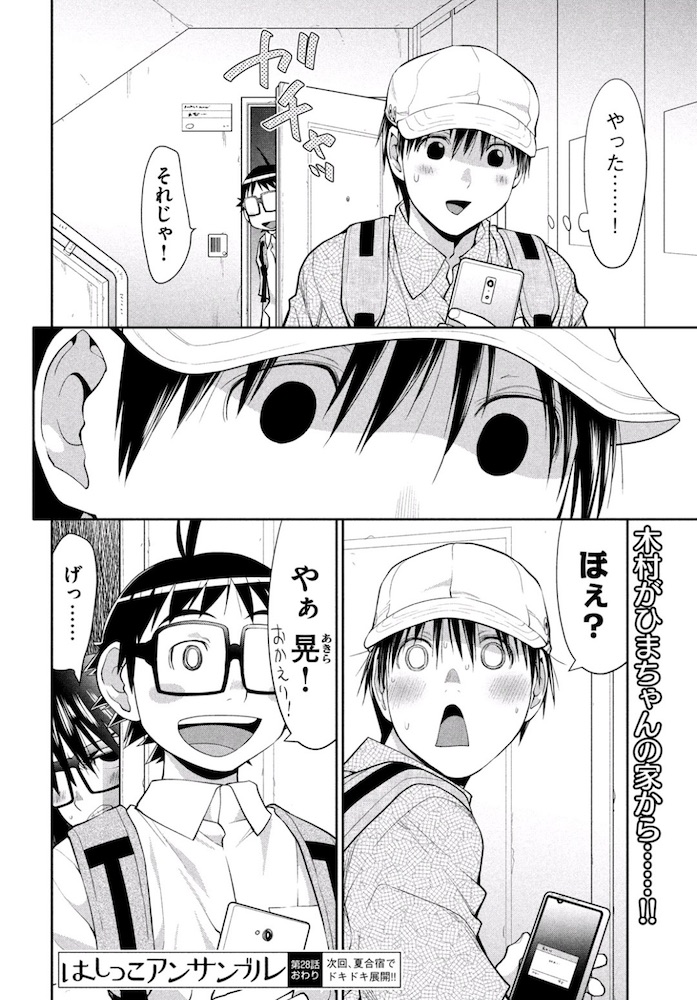
The singing draws the attention of an old man walking around, who explains that he’s a member of the Suns—the chorus they had visited when they were trying to figure out Orihara’s “hearing issues.” The old man, whose name is Yoshinaga, is himself a castle enthusiast, which thrills Shinji. During their conversation, he mentions having a vacation home in a nice outdoor area they could use for a training camp. After some calls, most of the club is into the idea, including Jin, who responds to Akira last. However, just as Akira is leaving his place, he sees Jin exiting Himari’s apartment while greeting Akira with a smile!

Oh Castle, My Castle

I had been wondering if Shinji’s love of castles would forever remain on the back burner in Hashikko Ensemble, so I’m happy that he finally gets to enjoy his true passion. Unfortunately, we don’t actually get to see the castle they visited, which is a reminder that this is indeed a manga primarily about music. I hope he eventually gets a true mountain castle.

I wonder if we’ll end up seeing more of Yoshinaga, if only because this would give a real mentor to Shinji—someone who can foster his love of castles and his burgeoning interest in singing. It could be something unique to Shinji among all the characters, and it might be the key to leveling him up really quickly for the next time the Chorus Appreciation Society performs.

Jin x Himari…?

In all likelihood, Jin stepping out of Himari’s family apartment (along with Himari’s angry grunt at being discovered) is going to just be some innocent misunderstanding on Akira’s part. Still, if i were to entertain the notion that something happened between the two during summer vacation, I have to admit that I think they’d be a cute couple. There’s something about the contrast between Jin’s overwhelming cheer and Himari’s curmudgeonly attitude that would appeal to me if they were an item, and one can only imagine how awkward everything about their relationship would be.

But putting that aside, the real purpose of that last-second shock is to highlight that Akira has romance on the brain to a certain extent. He’s been thinking about Shion a whole lot, even feeling continued jealousy toward Shunsuke after finding out that Shion’s been visiting Shunsuke’s home to practice piano now that her hand has healed. Now that Hasegawa is aware of the truth, her teasing is getting stronger, though it’s interesting that Hasegawa isn’t being protective of Shion. Instead, she seems to be encouraging it.

The innocence of the romances in Hashikko Ensemble is such a contrast to Spotted Flower, I must say.

Conductor Hasegawa

I figured at least a few of the characters not directly involved in the music would eventually join the club in a more involved capacity, but certainly didn’t expect Hasegawa to start working towards a role as conductor. I have to wonder how the others might eventually reach this point, and if this is the real reason behind Jin being at Himari’s home.

Then there’s Kurotaki Mai, the girl with the deep voice. I still think she’ll come in for a more prominent role eventually.

Songs

As Hasegawa conducts, Akira and Shinji sing “Miagete Goran Yoru no Hoshi o” by Kyu Sakamoto—the same featured song as the last handful of chapters.

Final Thoughts

Given that M-Con is in the past now, I can only assume they’ll be practicing some new songs to add to their repertoire. I wonder where they’ll go next. I personally don’t have any must-see songs, but something far off from “Miagete Goran Yoru no Hoshi o” could be a nice change of pace.

Artistry in Manga and Anime, and What’s Lost in “Translation”

Every so often, I come across someone on Twitter who talks about how they love anime but don’t really mess with manga. To them, manga is inherently inferior to anime, or at the very east, doesn’t give them the full multimedia package that anime offers—animation, music, voices, etc. Of course, people are free to enjoy what they want however they want it, but a part of me can’t help but feel a little frustrated that manga, as a mode of creative expression, is not reaching them. They can appreciate the artistry of anime but not the artistry of manga. 

“Artistry” is a very loose term and it can mean a million different things. Moreover, you’ll likely find people arguing that certain styles are better than others, and that certain creators are more imaginative and skilled than others. When I use the word “artistry” here, I’m thinking from a very broad sense, where it means how something is portrayed as opposed to what is being portrayed. Two titles could wind up portraying the same thing—a blond guy throwing a punch, for example—but the execution could create two very different experiences. 

Years ago, I wrote a couple of blog articles: one on decompression in comics, and another on its opposite, compression. One of the big takeaways is how the page as a whole is typically used in manga, where the panels and visual elements are geared towards a very smooth and continuous experience that allows the eyes to quickly move from one panel to the next. There are many different avenues of manga artistry, but this is the one that sticks out to me most because it’s a form of creative direction where time and space seem to transition seamlessly. But even given the history of comics in Japan, this is something that had to develop over time, and there’s no one right way to make the pages “flow.” It’s not as fundamentally intuitive as treating a comic like a picture book playing out one panel at a time, and I have to wonder if maybe that extra step needed to engage with manga is a step too far. Without it, perhaps manga really does seem like a lesser version of anime. That engagement has to be learned on some level.

In a sense, the difference between anime and manga is a less pronounced version of the separation between film and books. Anime and film engage more senses, and they progress without the viewer needing to actively move them along. Manga and books are focused mostly on the visual (on a basic level), and the story does not continue unless the reader actively chooses to move it forward. While anime and manga are closely tied in the sense that they often draw from the same stylistic trends and adaptations from one to the other are incredibly common, this difference in how one engages the medium seems to be too large a disparity for some. If I could help it, I would want to take someone who only reads manga and help them appreciate anime, as well as vice versa. If that were possible, then I would do what I could to help people appreciate the artistry of these creative endeavors.

This post is sponsored by Ogiue Maniax patron Johnny Trovato. You can request topics through the Patreon or by tipping $30 via ko-fi.