Banjo-Kazooie, Dragon Quest, and the Precariousness of Nostalgia

The dual Smash Bros. Ultimate character reveals of the Hero(es) from Dragon Quest and Banjo and Kazooie have gamers abuzz with excitement. While I didn’t quite get the DQ villain I wanted, I’m no exception when it comes to riding the hype train. However, seeing some of the negative reaction among English speakers online over the Hero’s entry into Smash makes me realize something: a lot of fans care less about video game history as a whole and more about their own video game history.

This is not unexpected, nor is it inherently bad. The games we grow up on and love are going to get a stronger reaction than things we only have a more academic understanding of. Nostalgia is a powerful thing, and when people engage in hype, they’re not necessarily engaging their intellectual side. Even the Japanese fans who are freaking out over Dragon Quest are doing so because of emotional attachment. DQ crosses generations and is an indelible part of Japanese pop culture on a scale that few things can compare to. If Banjo-Kazooie fever is a combination of 1990s gaming nostalgia and the return of a prodigal icon, then Dragon Quest in Smash is just plain nostalgia for a perennial favorite, transcending gaming and any specific time period. It popularized the RPG as a genre in Japan, and its simple gameplay made it accessible to audiences young and old in ways few games ever have.

Where I take umbrage with some of the reactions I’ve seen from some vocal Smash fans is a combination of entitled behavior and the seeming inability to engage that intelligent side of their brains that can allow them to appreciate things that aren’t necessarily connected directly to them. Just because there’s no deep, emotional bond doesn’t mean it’s not worthy of attention or fanfare. Smash Bros. is in many ways a celebration of video game history, so to see fans willfully reject that history is sad to see.

Dragon Quest has the potential to expand the reach of Smash Bros. far beyond what anyone has seen. Few characters can reach literal sixty-year-old Japanese businessmen the way DQ can. World-famous manga artists like Kishimoto Masashi (Naruto) have written about their experiences with the RPG. Toriyama Akira (Dragon Ball) has been responsible for the art since the franchise’s inception!

Banjo-Kazooie and Dragon Quest are both important new titles for Smash Bros., and I hope as many people as possible appreciate that.

PS: The Japanese trailer for Hero actually has him saying the names of his spells, so a silent protagonist he is not. I wonder if this might change the impression people have of the character if this difference sticks.

The New Ojamajo Doremi Comedy Shorts Hit Exactly Right

To celebrate the 20th anniversary of Ojamajo Doremi, Toei Animation has been putting out little flash shorts called Ojamajo Doremi Owarai Gekijou (Comedy Theater). Drawn super-deformed (but also as high school students as per the light novel sequels), the art is simple but in the current style of character designer Umakoshi Yoshihiko—vibrant and full of energy.

While seeing the light novels animated would be great and all, what I love about these little gag shorts is how the voice actors sound like they haven’t lost a step. All five of the core Ojamajo are here—Doremi, Hazuki, Aiko, Onpu, and Momoko—and they play their parts perfectly. If anything, Aiko sounds even more Osakan than ever. Hearing them again, there’s just something so special about Ojamajo Doremi that the magic even comes out in something this innocuous.

There are currently six episodes out, albeit untranslated. Still, I think even those who don’t know Japanese can get a sense of the fun in them.

This 20th anniversary celebration is also just the right time to get lots of choice Doremi merchandise. I know I’m eyeing that Nendoroid Aiko.


Why Are There So Few Recent Titles in Super Robot Wars T?

When a series gets into a Super Robot Wars game, for the first time, it’s a momentous occasion, especially when the game in question is one of the “mainline” iterations. The mecha (or even spaceships these days!) can be from old and obscure works, cult favorites, and even the new hotness. When playing through the recent Super Robot Wars T, however, I noticed that there’s a significant dearth of recent series, and I’m using that term loosely—out of every anime included, only two are from the past 13 years.

Even that number doesn’t tell the whole story. One of the anime referred to above is 2018’s Mazinger Z: Infinity, a film sequel to the original Mazinger Z anime franchise. While technically “modern,” it’s meant to be a nostalgia work. That leaves only Expelled from Paradise, a 2014 film. The next one after that is Gun x Sword from 2005. It’s not inherently a bad thing, and there are a number of welcome surprises in SRWT like Magic Knight Rayearth, Cowboy Bebop, and Captain Harlock. In a Famitsu interview, the director, Terada Takanobu, mentioned that one of their decisions for including new titles was a desire to have something for every age group. So in the sense of newcomers alone, it’s a pretty even split. However, the heavy lean towards the old is still noticeable, and I think a number of factors go into this.

First, as the years go by, what is considered an “old” title vs. a “new” one widens. Second, mecha anime just isn’t the bustling industry it once was, at least not in the same way. Third, I think that, as much as they tried to pull in fans of all ages, their core demographic seems to be working adults somewhere around 25-39, given both the themes of the game and the title selection itself.

For many younger anime fans, a span of five years might very well cover their entire fandom, let alone the now five decades that have elapsed since the original Mazinger Z anime debuted. For Super Robot Wars, this goes double, as it often takes quite a few years for a hot new mecha title to get the spotlight. Back in the early 2000s, Gaogaigar (1997) and Shin Getter Robo Armageddon (1998) were considered fairly young upstarts when they appeared. Now, in Super Robot Wars T, they’re grizzled old veterans. Outside of Super Robot Wars specifically, it’s always fascinating to see a title like Cowboy Bebop (1997 debut but aired on Adult Swim in 2001) go from being the hot new thing in the US to being a virtually canonized masterpiece that’s sometimes more discussed than viewed.

The relative oldness of the entries in SRWT is in part a consequence of how giant robots are simply not the industry juggernaut that they once were. Long gone are the endless number of children’s mecha shows, and the robot anime that do remain know that their audience will often skew older. Super Robot Wars, given its nature as a crossover celebration of what is increasingly a niche genre, is sort of tailor-made for nostalgia, compounding the sense that its appeal does not lie in attracting newer, younger anime fans, but those with a lot of experience watching and loving mecha anime. There are newer titles to pull in, but will they have the same draw as these assumed childhood/youth favorites?

In that sense, it’s interesting to note just where the nostalgia hits hardest for SRWT. Many of the titles are squarely in the 1990s without being made as sequels or reimaginings—Cowboy Bebop, Magic Knight Rayearth, Nadesico, G Gundam, Gaogaigar, and Might Gaine—while plenty of other titles are late 80s or early 2000s. Director Terada mentioned that international fandom was a consideration for which titles to include, and while not the case with every country, I think that the 90s is an especially strong time for fan nostalgia now—or at least the 90s anime they may have seen years later because anime distribution wasn’t nearly as speedy back in the days of VHS tapes and Real Media Player.

It’s also telling that the gimmick of the main heroes is that they’re salarymen, i.e. full-time working adults around ages 25 to 39, instead of teenagers. In some sense, it works as a gimmick, but when past original characters have been decidedly less mundane in their basic premises, the idea of “loyal company employee” stands out. There’s something to be said about how the notion of the salaryman as the default position for adults in Japan has been shattered for many years now, but I won’t go much into it except to say that while a heroine who just really likes a steady paycheck might have seemed like the most milquetoast thing once upon a time, in our current global economy, that idea almost borders on escapist fantasy.

Or maybe the team just really wanted to do a story with Jupiter as a focal point. Between Shin Getter Robo Armageddon, Nadesico, Crossbone Gundam, Aim for the Top!, Gaogaigar, and Cowboy Bebop, the fifth planet from the sun gets major play.

There’s one last possible reason the series is lacking anime titles from recent years: they’re saving them for a direct sequel. While there’s no news yet of a true follow-up to Super Robot Wars T (as opposed to just another game with a completely different cast and universe), there are enough loose threads in this game that a continuation would not be surprising.

Crossovers on the Brain: Ogiue Maniax Status Update for June 2019

E3 is next week, and I’ve been trying to finish Super Robot Wars T so I can devote my full attention to whatever Smash Bros. Ultimate shenanigans Nintendo has waiting for us. I wonder if I can get really into a third ridiculous crossover franchise and go straight over the edge.

Before, I get into Ogiue Maniax highlights from the past month, I’d like to thank my supporters on Patreon and ko-fi.

General:

Johnny Trovato

Ko Ransom

Diogo Prado

Alex

Sue Hopkins fans:

Serxeid

Hato Kenjirou fans:

Elizabeth

Yajima Mirei fans:

Machi-Kurada


My favorite posts from May:

Spoilers Matter

My counter-argument against the idea that obsession with spoiler warnings hurts more than helps

“Very East-Coast Avengers.” War of the Realms: New Agents of Atlas

A look at Marvel Comics’s new All-Asian team, and what it could mean.

Growing Step by Step: Run with the Wind

My review of a really great anime that gives some really important life lessons that I hope people take to heart.

Hashikko Ensemble

Chapter 16 continues the Chorus Appreciation Society’s excursion to another school.

Patreon-Sponsored

The Healing of Heisei Anime

A retrospective of sorts on anime of the Heisei period, which ended recently with former Emperor Akihito’s abdication.

Closing

You know what’s an expansive crossing over of many major players? That’s right, the Mueller Report.

Sure is worth reading, if I do say so myself.

First and Second Impressions: Hashikko Ensemble, Chapter 16

More time at Nishigafuchi leads to some interesting personal connections in Chapter 16 of Hashikko Ensemble.

Summary

The Hashimoto Chorus Appreciation Society continues their joint-practice session at the prestigious Nishigafuchi High School, and they’re making quite an impression.

Mimi-sensei is getting conducting advice. Shinji learns the personalities of all the Nishigafuchi part leaders (soprano, alto, tenor, bass) from a first-year tenor named Andou who wishes he could sing bass. Jin is enthusiastically giving the other students voice lessons and even tips for pronouncing German. Kousei is scaring everyone away, especially because he refuses to sing anything he doesn’t want, but also surprises everyone when he jumps at the chance to sing some Brahms. Akira talks to Sadamoto, the guy from his old school who recognized him, but it seems that despite Akira’s worries, Sadamoto holds no animosity towards him.

However, Sadamoto makes a rather cryptic statement in reference to their past singing together: “We still won even though you didn’t sing, so that turned out well. But sometimes I think, even if we all sang and couldn’t win, that would’ve been good too.”

German Elocution

Jin’s brief lesson on German is that while things like umlauts and diphthongs matter, ultimately good German pronunciation comes down to position of the tongue and shape of the mouth. I figure that applies to a lot of languages, but it’s interesting to note what Jin would concentrate on first, as well as what he assumes is already common knowledge. The response from the other students is basically “We don’t follow.”

What Happened to Akira’s Voice

We know that Akira’s voice got hit by a lightning bolt of puberty back in middle school, but based on his exchange with Sadamoto, I have some conjecture. To me, it seems like in whatever competition they were a part of, Akira decided to lip sync because his voice had changed so much as to 1) be embarrassing 2) shift him out of whatever range he was supposed to sing. It’s even possible he went from soprano or alto to bass, based on what Himari has said about Akira’s childhood voice.

As for Sadamoto’s words, not only does it seem like he holds no grudge against Akira, but it even looks like he has some regret over Akira feeling the need to pretend to sing. I’m curious as to how this will develop.

The Nishigafuchi Elite Four

Andou basically fanboys over the Nishigafuchi club leaders, and it’s cute to see. He lays out their personalities as follows.

Shindou Yui: Soprano leader, has a gentle smile but a sadistic personality

Hisamura Nozomi: Alto leader, appears harsh but is actually kind and gentle

Honma Tadashi: Bass leader, started off as a regular member but rose to the top through practice and effort

Kouno: The sub-leader of the tenors, who isn’t important (according to Andou) because of…

Saiga: Tenor leader, a fop who’s prone to giving up easily

We were briefly introduced to most of them last chapter, with Saiga being the big exception. Was saving his appearance for this chapter just to make his eccentric personality stand out that much more, or is he going to be a more prominent character compared to the others? Either way, I like that these characters are getting established, though I do think the quick summaries provided by Andou are very different from how Hashikko Ensemble has been introducing its characters thus far. Up to now, they’ve mostly been more “show” than “tell.”

I also find it quite interesting that they’re being treated like idols or manga-style “popular students,” but they actually look quite normal—even Saiga. Compared to making them suddenly larger than life, it keeps the series grounded and humble, even though it can get fairly absurd.

While it’s mostly Andou talking about this, I did feel that the chapter spent more time on Shinji than normal, and his role as the straight-man among a cavalcade of eccentrics is getting more firmly established. I also wonder how Andou, who thinks Akira is a kindred spirit, is actually the naturally strong bass singer that Andou wishes he was.

Songs

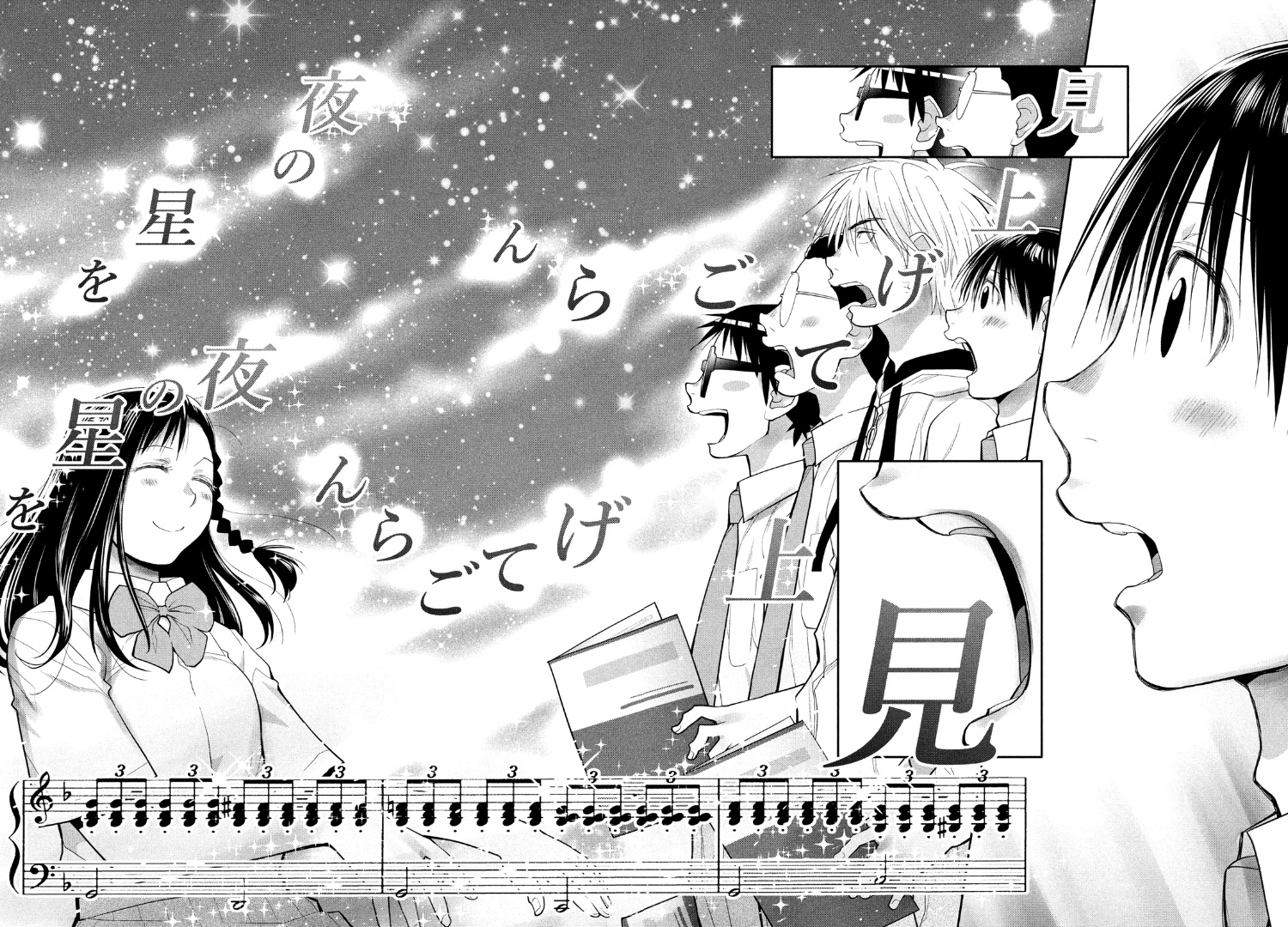
The song Nishigafuchi is performing at the beginning of the chapter is “Hitotsu no Asa” (A Single Morning), composed by Hirayoshi Takekuni with lyrics by Kataoka Teru.

The song that Orimura really wants to sing is Johannes Brahms’s “O Heiland, reiß die Himmel auf, Op. 74, No. 2.”

Lastly, the song Shion is playing on piano is “Chopin Nocturne – No 5 in F Sharp Major Op. 15-2.”

Final Thoughts

This has nothing to do with the ongoing story, but I wish fanart of this series existed. I know the characters don’t have the most iconic appearances, but I think they’re worthy of some love

The Healing of Heisei Anime

EvangelionIt’s difficult to succinctly describe or summarize anime and manga in the Heisei era. After all, that’s a lot of time to cover, from 1989 to 2019. But when I think about the works that have come out over the past thirty years, one word keeps coming to mind: therapy.

The Heisei era is defined by many things, but one of the biggest is the bursting of the 80s bubble economy, leading Japan into a recession it’s never fully recovered from. It has affected everyone young and old, flipping norms and assumptions on their heads as the idea of a stable future weakened and crumbled. I find that many of the trends in Heisei anime reflect this uncertainty. Heisei covers the birth of healing anime. It marks the emergence of concepts in Japan like NEETs, hikikomori, and fear of declining birth rates, which then make their way into anime. Deep introspection and escape from reality alike were in full force, asking viewers whether they needed to manually get away or to find solutions.

In that struggle between therapy as problem-solving and therapy as respite, in my opinion there’s no show as emblematic as Neon Genesis Evangelion. While it takes from works past, what Evangelion does so well, and part of why its legacy has endured for so long, is that it pushes the psychological fears and doubts of its characters to the forefront, enveloping viewers in their inner worlds. Their struggle to understand themselves and navigate youth, violence, love, and lust is still powerful today. However, another significant part of Evangelion‘s legacy is the commodification of its characters, their wispy yet mature bodies the subjects of figures, posters, ad campaigns, and more. Their idealized forms themselves provide a form of fantasy that consequently flattens and simplifies their presences.

And yet, that doesn’t necessarily mean the two sides of Evangelion never mingled, and their dual influence is reflected in 21st century anime culture in major ways. Whether it’s Rei as the progenitor of the “emotionless” blue-haired girl trope or Shinji and Kaworu as an evergreen fujoshi pairing (despite, or perhaps because it only lasts one episode), the clash of consumption, creation, reflection, and escape all continue to swirl around today. It’s fitting that the Rebuild of Evangelion movies, which show the characters trying much harder to communicate with one another and overcome the cycle of doubt and despair, is set to conclude in the Reiwa era after a ten-year delay.

The anime of the past three decades hasn’t been all doom and gloom, nor has it solely been a psychological bomb shelter shielding its viewers from the world. Heisei birthed the Yuusha/Brave franchise, with its positive messages (albeit with the occasional sprinkling in of anti-toy-company cynicism). It covered Sailor Moon and Ojamajo Doremi and Precure in terms of magical girl works that give viewers a sense of hope and optimism. Perhaps the function of these shows, however, is that they also provided positive messages to young kids in a society that didn’t necessarily provide it through other means.

While anime as therapy was born out of Japan’s own recent history, I think the global success of anime in the Heisei era shows that there were people all around the world who needed it as well, myself included. As is probably the case for many reading this, my entire otaku history has been in the Heisei era, and in retrospect I have to be amazed at how much it’s shaped my life even from the perspective of “therapy.” I learned to embrace unconventional views of masculinity and femininity through Cardcaptor Sakura. I found peace and comfort (but also artistic inspiration) from Hidamari Sketch. I discovered what means to live with confidence by reading Genshiken. I made introspection a part of my life thanks to Evangelion. This won’t necessarily change just because there’s a new emperor on the throne of Japan, but I hope I can look back again in thirty years with a similar fondness.

This post was made possible thanks to Johnny Trovato. If you’d like to request a topic or support Ogiue Maniax in general, check out the Patreon.

“Very East-Coast Avengers.” War of the Realms: New Agents of Atlas

Every year, New York Comic Con is a torrent of color and energy squeezed into a space that will barely fit everyone inside. But I’ve gotten fairly accustomed to it after so long, and at this point it’s basically an annual ritual. But eight months removed from the last NYCC in 2018, I still think about the Asian-Americans in Comics panel held there. Discussing everything from the success of Crazy Rich Asians to the challenges of portraying Asians in media in a landscape eager to work off of old, exotic stereotypes, it made me more invested in a fight I’ve had a stake in all along, even as this blog has concentrated primarily on anime and manga.

So when I read that Marvel was debuting a comic with an all-Asian team, I decided to break my years-long hiatus from traditional superhero comics and purchase the first issue of War of the Realms: New Agents of Atlas. But without even seeing a single image or piece of dialogue, I instantly sensed who the writer for this brand-new series was, or perhaps hadto be: Greg Pak, a long-time champion of introducing Asian characters to comics who was also one of the biggest names on that NYCC panel. Joining him on art is Gang Hyuk Lim, and on color Federico Blee.

The first issue opens up with a very familiar problem in Asia: a territorial dispute. Wave, a Filipino superhero, is chasing after a disturbance only to run afoul of a Mainland Chinese superhero named Aero, who tells her that she shouldn’t be outside the Philippine Sea. The comic instantly frames the level of detail the series aims to have by not only touching upon the ongoing disagreements over borders between Asian countries but also implies that the Filipino and Chinese heroes have different levels of connection to their respective governments.

From there, the series introduces the main Agents of Atlas team, which consists of Asian characters from all around the world, with some established Marvel characters and some all-new. Here, while also showing individual character motivations, the comic also highlights something important: they may all be Asian and raised Asian, but they’ve all been brought up in different ways with different values and assumptions based on the countries of their respective people and where they call home. For many Asian-Americans, there’s often a bit of cultural dissonance when going back to Asia because of the Western values they’ve grown up with. In other words, the first issue specifically emphasizes that just because they’re all “Asian” doesn’t mean they can be painted by the same brush.

The comic goes on to show various other heroes, including a number of Korean ones, as if to imply that superheroes have really taken off there. Amid attack by an outside enemy (from another REALM!), confusion ensues, and a lack of communication and a whole lot of jumping to conclusions leads to heroes fighting one another rather than their common foe.

What impresses me about this first issue is how much it respects both the similarities and differences of Asian cultures around the world while also pointing at the sensitive topics endemic to Asia and its diaspora. It’s the classic and universal idea of “we have to put aside our differences and work together to overcome this obstacle” but through the lens of Asian characters. There’s no exoticizing of any of the heroes, not even the older ones who came about in a time of exoticization.

While I know Greg Pak values and pushes for Asian characters, I have to wonder if part of the reason why Marvel as a business has gone ahead with New Agents of Atlas and its all-Asian team (and non-affiliated Asian heroes) is due to the success of the Marvel movies in China especially. The afterword suggests this, such as when it mentions how stories featuring Aero and Swordmaster can be found on NetEase, a Chinese comics site. As China exerts influence on entertainment and media, companies increasingly try to cater to the country and it’s government’s values. At the same time, however, if appealing to a Chinese audience potentially means more portrayals of Asian characters are respectful, is it a net positive? I don’t really have an answer myself at the moment.

So War of the Realms: New Agents of Atlas is off to a good start more or less. Here’s to hoping it keeps its momentum.

Super Robot Wars T and Gaogaigar’s Unspoken Plot Change?

I’ve been playing the heck out of Super Robot Wars T (available via import in English for the Nintendo Switch and PlayStation 4), and as always, I’m into the loving fanfictional goodness that the franchise always entails. When you have all of these different giant robot heroes in the same universe, the interactions are an endless source of amusement and head-nodding affirmation.

Of the many crossover moments little and big, however, there is what I believe to be an unspoken story element that significantly alters the course of one particular series: King of Braves Gaogaigar. This might be mere fan speculation on my part, but I think it also makes total sense.

In the original 1997 Gaogaigar TV series, the main character Shishioh Guy uses an attack called Hell and Heaven to finish off monsters. A little into the series, however, he discovers that using the attack too much does severe damage to his cyborg body, and that overusing it could lead to death. In response to this, his team (known as GGG) creates a new, alternative finisher called the Goldion Hammer, which becomes his default decisive blow through most of the series. It’s only in desperate times when the Goldion Hammer isn’t available that Guy will resort back to Hell and Heaven.

But in Super Robot Wars T, when you meet Guy, the Goldion Hammer is nowhere in sight, despite the story being well past the point in the anime where he was supposed to get the Goldion Hammer. And yet, Guy shows no signs of excessive use of Hell and Heaven. On one level, this is likely a gameplay pacing decision, to keep Gaogaigar from having its strongest attack early on, but I think there’s also an in-story explanation: he simply didn’t have to use it as much in the SRWT universe.

Whereas Gaogaigar and GGG alone fought against EI-01 and the Zonders in the anime, in the game, they occasionally received help from Watta and Tryder G7 (from Muteki Robo Tryder G7), as well as Maito and Mightgaine (from The Brave Express Mightgaine). In other words, in SRWT, Guy had enough assistance in his many battles that, by the time we meet him in-game, he isn’t anywhere near as overburdened as he is in the anime.

It’s considerations like the above which make Super Robot Wars T (and Super Robot Wars in general) such a treat. I’m looking forward to seeing whatever other crazy moments are in store.

Spoilers Matter

Between Avengers: Endgame, Game of Thrones Season 8, and the upcoming Star Wars Episode IX: The Rise of Skywalker—all concluding parts for their respective stories—pop culture has been in prime “spoiler warning” territory. If you’re plugged into any sort of social media, and you don’t have the opportunity to watch things as they’re released, it can be a struggle to avoid any and all information. This also means it’s incredibly easy for a few trolls to ruin other people’s days, but what I’m even more concerned about is a recurring notion I’ve been seeing, about how people’s anger and frustration over being spoiled is some kind of sign that these works are less about art and storytelling and more about shock value and surprise. They might even say something like, “Truly good works are good even when spoiled.”

Perhaps they’re right. Perhaps they’re not. Either way, it still doesn’t mean that a desire to go in relatively “blind” is somehow valueless. In fact, I find it to be quite rude and even a little elitist to value a work over people’s own desires to such an extent that negatively impacting their experience is somehow “okay” because it shows how “limited” both the people and their “shocking” entertainment can be. While it’s true that some things stand the test of time better than others, and that a piece of media that can be enjoyed over repeat viewings is strong in many ways, you still only get one chance to see something for the first time regardless. Just because something is even better the second or third time around doesn’t mean that the initial exposure should be diminished.

Granted, even without spoilers, “going in blind” means different things to different people. Some might have ideas as to what they think will happen, and will be bracing for the moment that their pet theories are confirmed or denied. Others might be looking at character interactions and trying to see if their chosen characters have any romantic developments. Personally, I purposely try to avoid pushing my expectations onto a work as much as possible. But whatever one’s approach, and even if a work holds up after spoilers, being aware of what happens changes the way a work is experienced. You go from trying to navigate the work on your own terms to being aware in the back (or front) of your mind that an Important Thing is going to happen. That’s not necessarily bad, but if you view a work once without spoilers and then a second time with spoilers, it means you get to have both experiences.

Note that there are a few caveats. The choice of spoilers vs. no spoilers is anything but binary, and that something as simple as a movie trailer can be “too much” for some and “not count as spoilers” for others. There’s also a difference between “being okay with spoilers” and, say, people who want advance warning on anything that might trigger them and cause deep psychological pain. And for instances where a work might come from a very unfamiliar time and culture, and not knowing the proper context can mean not catching many of the meanings and signals that are assumed to be “obvious” or “common sense” to anyone from that original time or place. Foreknowledge can be significant, but having it isn’t inherently better than not having it. First impressions can potentially be based in ignorance, but that ignorance can be corrected afterwards. You can’t take back a spoiler.

If all a film, TV show, book, or whatever has is shock value, so be it. If it has more to offer, all the better. That still doesn’t make those who wish to be surprised or who wish to focus on the unexpected somehow symptoms of an ailing entertainment industry, or make their experiences trivial. They can always come back, and if the problem is that people don’t want to revisit after the first go-around, that’s not an issue with anti-spoiler culture—that’s an issue with time and its usage. But ultimately, if people only have enough time to see something once, they should be able to do it on their terms, and not ones set by some externally imposed values rooted in notions of how “true quality” is defined.

Kotobukiya Wants to Know Your Favorite Yuusha/Brave Robots

Good news for fans of 1990s giant robot fans: plastic model and figure maker Kotobukiya is looking into making plastic models from the Yuusha/Brave series, and they’re holding a survey to get customers’ opinions.

The survey is in Japanese, but for those who can’t read the language but still want to participate, I’ve translated the prompts, which you can see below.

  1. Please select your gender. (Choices are male, female, and no answer)
  2. Please select your year of birth.
  3. Among the options below, please select your favorite work in the Brave series. (Options are in order of release date)
  4. Please select the Brave series products you hope to see. (Pick 3)
  5. Please write any opinions you have pertaining to Brave series plastic model kits
  6. Please tell us your favorite plastic model purchase from the last six months.
  7. Please tell us why the answer in #6 is your favorite.
  8. Please choose any of your favorite plastic model lines from Kotobukiya. (Frame Arms series, Frame Arms Girls series, Hexa Gear series, M.S.G. Weapon Unit series, M.S.G. Heavy Weapon Unit series, M.S.G. Gigantic Arms series, M.S.G. Mecha Supply series, M.S.G. miscellaneous, Other)

So happy survey-filling-out (?)! I for one will be voting for Shadowmaru (J-Decker), King J-Der (Gaogaigar), and Gaogaigo (Gaogaigar vs. Betterman novels). Survey ends May 31.