The Significance of the Classic Anime Devilman in Devilman Crybaby

Devilman Crybaby made quite a splash when it was released earlier this year on Netflix, introducing Nagai Go’s classic series to a new generation of anime and manga fans. While there are stylistic differences stemming from both difference in era and the aesthetic of director Yuasa Masaaki, Devilman Crybaby is largely the same as the original 1972 Devilman manga at its core, showing that the series’s story of a human who uses demonic powers to fight other demons and its themes of human strength and ugliness are still culturally relevant.

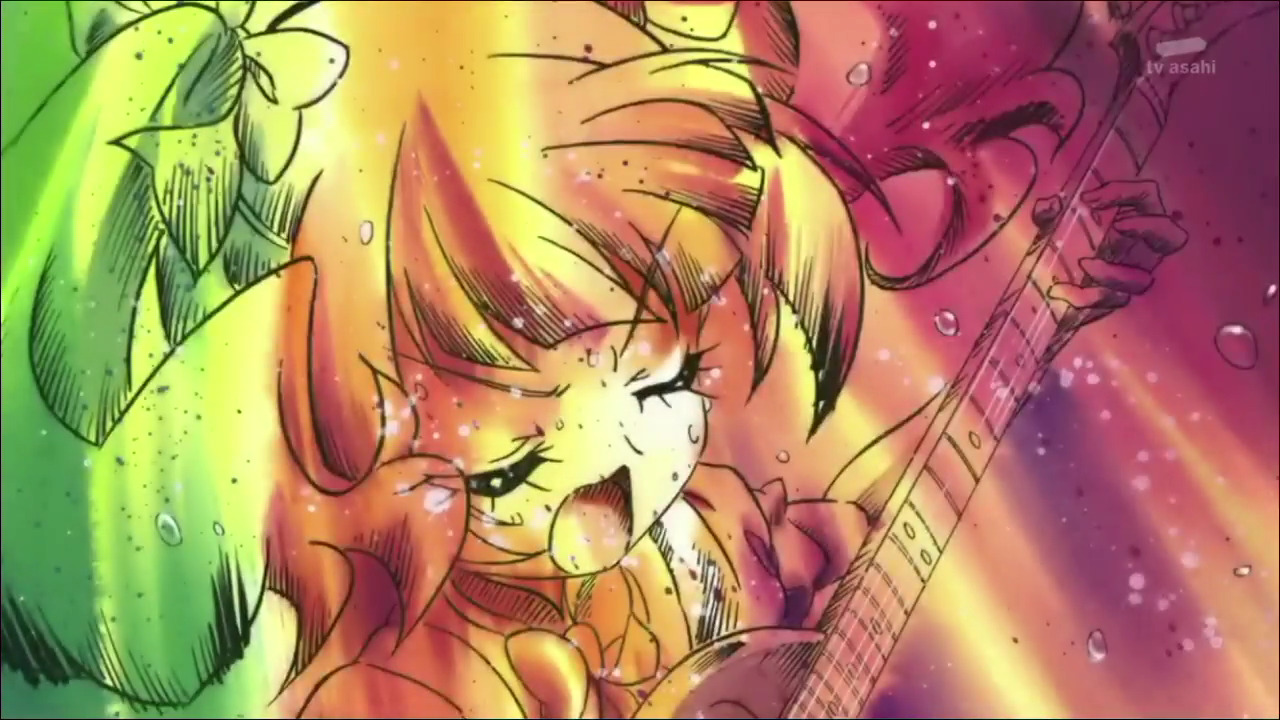
While Devilman Crybaby is hardly the first adaptation, spin-off, or sequel, it does do one thing that most other Devilman works try to shy away from: it incorporates elements of the kid-friendly 1972 Devilman anime TV series. In that cartoon, Devilman is closer to a superhero than a brutal demon in appearance and demeanor. Even his theme song calls him a “hero of justice” while listing all of his special ability (Devil Wing, Devil Eye, Devil Beam, etc.).

It’s so different from every other iteration of Devilman, and Devilman Crybaby repeatedly uses it in such specific scenarios, that I believe TV anime Devilman has special significance in Crybaby beyond providing an addictive remix of the classic theme song, which can be found below.

Whenever that song, “Devilman no Uta” is used, there’s an element of innocence or human compassion attached. It’s often paired with an actual image of the TV anime Devilman himself, who shows up on television screens or on YouTube videos and the like. It’s especially prevalent in Ryo’s flashbacks, where a young and orphaned Ryo can be seen staring at the green, heroic Devilman on TV. Ryo appears to be drawn towards it.

There’s a third symbol too: Devilman’s actual design in Crybaby. Devilman adaptations tend to draw more from the manga than that old anime series, and this extends to the aesthetics of Devilman himself. In almost every version, Devilman feels more like a beast than a man, and Crybaby’s is generally no exception. However, there are times in Devilman Crybaby when Devilman himself feels more reminiscent of the “hero of justice.”

Devilman the character can be thought of as having two original strains—the Nagai manga original and the classic TV version—with different iterations veering towards one or the other. If a work wants to hint at a more hyper-violent Devilman, they portray him along the lines of the manga. If, however, it wants a cleaner and friendlier Devilman, then the TV version is the way to go. Crybaby Devilman strikes a very interesting middle ground. While he has the fur, the facial features, and the overall demonic appearance, he takes aesthetic elements from the TV version. Namely, he has those distinct stripes on his shoulders, and he’s often portrayed with a blue/greenish tint to his skin. It’s unclear if his skin is actually supposed to be green, or if the creative lighting of the series just makes it look that way, but there’s a clear commonality between Crybaby Devilman and TV Devilman, at least in part. What’s also noticeable is that the green skin seems to be most noticeable in scenes where Akira is trying to defend the innocent, like when he protects a group of innocent people from being stoned to death out of fear that those poor souls “might” be demons.

In other words, the incorporation of elements of the TV anime Devilman into Devilman Crybaby isn’t merely for referential purposes, or a clever wink and nod—It’s actually important to the themes and symbolism of the series. While Crybaby largely follows the plot of the original manga and not the TV anime, the presence of the superheroic Devilman is ongoing, and it hints at Akira’s inherent goodness. He struggles with himself and the devil inside, but Akira ultimately wants to fight for what’s right and just, whether his foes are human or demon. The old anime Devilman is who he aspires to be, even if he ultimately cannot live up to that ideal.

Life on Repeat: Hashikko Ensemble, Chapter 9

Orihara’s hard to understand, but it might not be for the reasons anyone assumed.

Summary

It’s the Sports Festival at Hashimoto Technical High School, but the biggest spectacle isn’t any event—it’s Orihara on a rampage. Another classmate has played a prank on him by messing with his music player, so Orihara responds by going berserk and tossing him around like a ragdoll. Jin and the others suspect that the only thing that can calm him down is his music and his noise-canceling earphones, but (as revealed in a flashback), they’ve been having trouble fixing the earphones, even with Himari’s help. However, Himari reveals that she’s spent extra time to repair them. In a mad dash, the Chorus Club and the Rugby Club work together to successfully subdue Orihara.

As Orihara listens to his music player and falls unconscious, he remembers the parental abuse he and his little brother suffered as children. He remembers hearing screaming, but can’t remember if it was his or his brother’s voice. But as the police came to take away his mom and her boyfriend, he remembers thinking it was his brother’s. In fact, Orihara can still hear his brother’s voice today.

They Laughed, They Cried

This chapter kind of reminds me of the infamous soccer episode of the anime Eureka Seven, which contained, in the same episode, both athletic filler hijinks and a plot-crucial coup d’etat. The situation in Hashikko Ensemble isn’t quite the same, as what happens at the Sports Festival contributes directly to the main story, but the contrast is potent. The general wackiness of this chapter makes the dramatic reveal of Orihara’s situation much more impactful.

As comedic as Hashikko Ensemble can be, I really don’t think this reveal is an absolute tonal shift for the manga. There’s a recurring theme of among the characters of trying to deal with the emotional and physical setbacks of their pasts, and it even creeps through in Jin’s vague descriptions about his relationship with his dad. Orihara’s story seems to be the most serious by far, and I have faith that it’ll be executed well. I mean, this is the guy who wrote Ogiue from Genshiken‘s story, after all.

Orihara’s Abuse

The exact circumstances of Orihara and his little brother’s abuse is kept vague. The manga mentions that his little brother was unable to move, and the arrival of the cops clearly implies that this was not the result of illness or accidental injury. It’s unclear if the abuse was primarily physical, emotional, sexual, or any combination, and I don’t have any hypotheses at this moment. More information will likely be revealed to us over time, but the degree to which Kio holds back will be interesting to see. Whatever the case might be, the chapter is a crucial piece of the puzzle that is Orihara. He’s not just a loner, and he’s not just temperamental—his past is complicated, and having him open up to others (let alone join a club) is going to be about understanding his issues.

Himari’s Personality

Himari works hard to restore Orihara’s earphones, but I don’t get the sense that she’s doing this out of either sympathy for the guy, or out of a desire to uphold her end of the deal with Akira and Jin. She seems to me like someone who either values the technical skills needed or who has a sense of pride in her own abilities—like it’s a challenge she wants to overcome. Nothing says this more than her pantomiming the hand motions necessary to make the complicated earphone repairs. In that respect, she might make a good team with Jin, whose audio expertise potentially supplements her own strengths. His explanation of the complexities of noise-canceling earphones (like how you need to get through the urethane coating that’s meant to prevent short-circuits before you can even begin to fix them) is a perfect example in this regard.

Songs

What Orihara’s been listening to this whole time is Gabriel Fauré’s “Requiem Op.48: In Paradisum.” It’s used in Catholic church funerals, which probably means that Orihara’s little brother didn’t make it.

Final Thoughts

There’s a brief mention at the beginning that Hashimoto Technical High School switch to holding their Sports Festivals on weekdays because in the old days, delinquents from rival schools would come over to pick fights on the weekends. While the culture has changed since then, they keep the scheduling. Just having this little hint at the yesteryear of the high school (as well as the fact that the one older female teacher still remembers those days) gives this funny sense of history to the school setting of Hashikko Ensemble.

Also, Hasegawa is excellent as always. I can’t help but laugh every time I see her now.

A Look Back at an Aikatsu! Halloween

In the spirit of the month, I was asked by Patreon sponsor Johnny Trovato to look at one of the Halloween episodes of Aikatsu! I chose episode 106 of the original series, which takes place after Akari has become the new main character. It’s a fun episode characteristic of all that is good and enjoyable in Aikatsu!, though a few elements stood out in particular.

Whenever the characters say, “Trick or treat!” they immediately follow by explaining in Japanese what exactly that means: “If you don’t give me candy, I’m going to play a trick on you!” It’s a redundancy that not only has to make up for the language barrier—a little kid might not know the English words—but also speaks to the fact that Halloween as a concept is still relatively new in Japan. If you look online, you’ll find articles talking about how it didn’t get any traction until the 21st century, and now it’s featured in multiple anime.

I wouldn’t read too deeply Aikatsu!‘s interpretation of Halloween—I reckon it’s as much tinged with the Idol Activities spirit as anything else. If the episode didn’t feature some wacky game that highlights all of the characters lovable quirks, then I would’ve been shocked. That’s where Aikatsu! consistently shines, though. You just know that if they’re doing a Halloween episode, vampire-style Idol Toudou Yurika is going to have a moment. They even make the expected (and desired) joke that Yurika wearing a cape and fangs while exclaiming that she’ll suck your blood isn’t that different from how she normally behaves.

“The day Yurika visited your Halloween party was the most important day of your life. But to me, it was Tuesday.”

I watched this episode semi-isolated from the rest of the series, so I don’t know exactly what has transpired beforehand. However, it reinforces something I’ve felt about Aikatsu! in general, which is that the first season’s characters seem to have the most clear-cut personalities, which makes it easier to do these silly one-off episodes. I still don’t always quite get what Akari and her friends are supposed to be like. They seem a tad more subdued, which can work better over the long term but maybe isn’t as attention-grabbing at first sight. https://www.youtube.com/watch?v=sOnqjkJTMaA#t=9m5s

It would be remiss of me to end this post without mentioning the teacher, Johnny Bepp, and his unnamed homage to Michael Jackson. With a vaguely “Thriller”-esque piece playing in the background, Johnny-sensei encourages the students to do the famous zombie dance (or whatever it’s called), which exhausts every student around—except Akari. I would think that a dance sequence from one of the finest performers ever would be absolutely grueling for even the girls at an idol academy, though in hindsight I guess this is actually a bit of characterization for Akari as a girl with immense stamina. In this case, I don’t know if it’s the “obvious” gag per se, but the payoff is again reliably satisfying. Kudos, Aikatsu!

Given that this episode is quite a few years old at this point, I am curious to see how the Aikatsu! Halloween episodes have evolved as the holiday itself has become more popular in Japan. Maybe that’ll be something for next year!


Gaogaigar vs. Betterman Manga Chapter 1: Go Read It!

Us Gaogaigar fans had long waited for a new sequel, a call that was answered this past year through the Hakai-Oh: Gaogaigar vs. Betterman novel series. In more recent news, Sunrise announced a manga adaptation, and the first chapter has been available online for the past month or so.

Having read through the first novel, this manga seems to be adapting the contents pretty faithfully. This might go without saying, but the key advantage of the manga version is that it’s more visual—a welcome thing given that Gaogaigar as a whole thrives on visual spectacle.  It’s also a lot easier to follow if your Japanese language proficiency isn’t especially strong.

I’m not sure what the schedule is for this manga, but I’m hoping that having it so easily accessible means that Gaogaigar fans will be able to rally around it, and really give it the attention it deserves.

The Fujoshi Files 182: Koyanagi Hanako

Name: Koyanagi, Hanako (小柳花子)
Alias: N/A
Relationship Status: Dating
Origin: Wotaku ni Koi wa Muzukashii!

Information:
Koyanagi Hanako is a 27-year-old OL (office lady) who cosplays in her free time. In and out of the office, Hanako is generally cool and collected, though she often butts heads with her co-worker and boyfriend, Kabakura Tarou. An avid cosplayer (especially of male characters) and a fan of Takarazuka, she’s also friends with her fellow fujoshi, Momose Narumi, and her boyfriend, Nifuji Hirotaka.

Fujoshi Level:
Koyanagi will often read BL right in front of her boyfriend, partly to tease him, partly because she aggressively doesn’t care.

Harsh Lessons in Teamwork: Eyeshield 21‘s Kongo Agon

One of my favorite characters to think about is Kongo Agon from the football manga Eyeshield 21. He’s not a favorite in the sense that I would put him on a top 10 or even top 100 best characters list, but what he does provide is an entertaining and exciting role as an antagonist whose presence allows a more complicated story about what it means to be a successful teammate.

In Eyeshield 21, Kongo Agon is the undisputed best high school American-football player in Japan. His reaction time is unmatched. While others might be stronger or faster, no one has the optimized combination of both like him. Anything you can do, he can probably do better. Agon isn’t even one of those characters who is strong individually but is especially bad at teamwork. He knows how to work within a group, at least to a certain extent. The fact that he’s so superior to everyone else, however, lands him into a classic trap for someone of such extraordinary talent: he finds less worth in those who can’t keep up with him.

When mentioning what his ideal team would be, Agon describes a hypothetical team that’s 21 of himself + one teammate who has a few unique skills. And in a way, he’s right. An All-Star All-Agon team would probably beat every other team around. However, that team fundamentally cannot exist (Eyeshield 21 is not a science fiction series), and this is where Agon begins to falter. He may be perfect, but no one else is, and his inability to truly accept that is what opens up the cracks in his armor and leads him on the road to defeat.

One of the most famous athletes in history, Michael Jordan, ran into a similar problem. Jordan in his rookie days was a once-in-a-generation talent, but felt he couldn’t trust his teammates. What turned it around was his coach, Phil Jackson, who pushed Jordan to assume the role of a true leader, and to motivate his teammates into believing that Jordan trusted them. No small part of this was Scottie Pippen, who could mediate between Jordan and the rest of the bulls and lead by example in the process.

A lot of what made Jordan able to overcome his over-reliance on himself are the very things that Agon ends up failing to learn for a long time. Agon, despite being the best player around, is not an effective leader for a team; he’s closer to a tyrant than a captain. Moreover, the man who could be his Pippen, his brother Kongo Unsui, is shown little if any respect by Agon. Because he views everyone else as so beneath him in talent, he can’t even fathom the relatively minuscule accomplishments of opposing teams as matter at all—only for such an “insignificant” change to hand him a devastating, skin-of-his-teeth loss. Agon is decent at teamwork, but if only he respected his teammates and his opponents more, he could have been invincible.

Perhaps the biggest character development moment for Agon in Eyeshield 21 is the day that he finally bothers to train. Much like Frieza in Dragon Ball: Resurrection F, Agon is begrudgingly pushed to the point that he has to actually try, only Agon’s storyline predates Frieza’s in this particular sense. That realization by Agon, that he has to work at maintaining his dominance, is the ultimate blow to his being. He’s forever transformed, unable to ever go back to thinking that he, by simple virtue of being himself, is enough to defeat everyone.

New York Comic Con 2018 and Thoughts on the Asian-American Experience

New York Comic Con is the only non-explicitly Japan-focused convention I typically attend. In that respect, it gives me an opportunity to explore in greater detail the aspects of comics and media fandom that I normally prioritize less. This year, while I did my fair share of anime and manga-related activities—namely see Son Goku’s esteemed voice actress Nozawa Masako—my main takeaway from NYCC 2018 was that the shifting cultural landscape beneath the United States at this moment is of the utmost importance in comics and entertainment.

I went to many events during the convention, but the main stand-out was Super Asian America. A Q&A and discussion about Asian-Americans in comics, animation, and related media, the panel featured a bevy of guests: comics writer Marjorie Liu (Monstress), actor Ryan Potter (Hiro in Big Hero 6), comics writer Greg Pak (creator of Amadeus Cho), Kickstarter publishing’s Camilla Zhang, comics creator Nidhi Chanani, and host Mike Le. Much of the discussion was about the surprisingly good year that Asian-Americans have experienced in the entertainment industry between the successes of Crazy Rich Asians, To All The Boys I’ve Ever Loved, and Searching. The main takeaway was that this is a good step, but that convincing the Hollywood machine that falling back on its old racist and conservative mindset for “safety” reasons is going to take a lot more. Moreover, the United States as it currently stands is a troubling place for non-white ethnic groups, and this fight extends to more than just movies and TV shows.

I’ve long struggled with an unfortunate truth: many Asians, especially from older generations, are extremely racist. Readers might be wondering what this has to do with New York Comic Con, but my view of my fellow Asian-Americans is not always charitable. It always saddens me to see a kind of “we Asians need to get ahead” mindset that seems to come at the expense of others, the kind of attitude that encourages ingratiating ourselves to white people and avoiding association with other ethnic groups. So for years, I’ve seen those struggles for better representation in Hollywood and such, and felt myself being a bit skeptical. “How many of these people are really thinking about equality and opportunities for all?” Now I realize I’ve been conflating more than a few things that should be considered separate yet loosely related.

It is true that many Asians living in the US have been racist, and have tried to emulate “white success” to some degree. It’s also true that the Asian communities often focus on themselves to almost a deleterious degree, ignoring the reality of the politics surrounding us. However, the fight for better representation of Asians and Asian-Americans on screens and pages big and small is itself a fight against the racism that lingers within our communities among fellow Asians. There are generations of stereotypes that Asians have to fight against, like being weak and ineffectual compared to rugged European folk (unless we’re doing martial arts), and the sooner we remove the seeming need to graft the problematic elements of white privilege onto our own identities, the sooner we can make all Asian-Americans feel like they don’t have to conform to others’ ideas of who we can be.

Can-do Candy: Dagashi Kashi Full Manga Review

Two years after I declared Shidare Hotaru the best female anime character of 2016, I’ve finally read all 11 volumes of her manga, Dagashi Kashi. Now, it’s time for a full review of this eccentric and wonderful series about Japanese snack nostalgia and the thirstiness of youth

Shikada Kokonotsu is a small-town high school boy who dreams of drawing manga professionally, but his dad wants him to take over the family business—a shop that sells dagashi, a category of Japanese snacks that are made to be cheap so that kids can afford them with their small allowances. One day, the vivacious heiress to the Shidare snack company, Shidare Hotaru, arrives at their store with a mission: to recruit Kononotsu’s dad to her family’s company. However, in order to do that, Kokonotsu needs to take over their shop. Thus, Hotaru takes it upon herself to convince Kokonotsu to embrace the dagashi passion in his blood by making daily visits and challenging Kokonotsu in various snack-related ways.

I love reading reactions to Dagashi Kashi because of how it seems to frustrate many anime and manga fans. At first, it seems to be a fanservice-heavy rom-com/harem work with a veneer of Japanese snack nostalgia, only to quickly reveal itself as the opposite. Sure, Dagashi Kashi is filled with attractive and powerfully charismatic girls, but it’s their passionate and humorous interactions over the snacks themselves (as well as the history lessons provided) that are the true backbone to this series. This might not be what others want out of Dagashi Kashi, but it’s exactly what won me over.

One can hardly call Dagashi Kashi an ultra-complex manga, but it’s endlessly entertaining, and its characters memorable and fully realized. Hotaru is the lynchpin of the series, a whirling dervish of intensity, passion, and mild misfortune, but every character carries their weight in making it a delightful comedy. For example, Endou Saya, a childhood friend who harbors a secret crush on Kokonotsu, is a perfect “normie” character—someone who only has a casual connection to dagashi but rounds out the main cast as a result. Every time a new character is introduced, they also quickly endear themselves. The key example is an employment-challenged character named Owari Hajime, who shows up when Hotaru vanishes for a brief period. While the hole Hotaru creates in her absence can’t be filled by anyonese (a plot point in the series), Hajime differentiates herself by being this adult who’s both more mature than the kids around her yet ill-equipped for the real world.

The humor comes across to me as a kind of manzai battle royal. While manzai comedy classically involves one boke (buffoon) and one tsukkomi (straight man), the classifications are modular within the context of Dagashi Kashi. Most of the time, Kokonotsu is the one who’s reacting to characters’ shenanigans, be it Hotaru, his best friend Tou, or even his dad. But sometimes, Kokonotsu lets himself be carried away by Hotaru’s dagashi antics, and it’s up to Saya or even Hajime to call him out on it. However, Kokonotsu’s casual reactions can be completely disarming to her, which puts her out of the driver’s seat, so to speak. The humor is sort of like a cross between Lucky Star and Sayonara Zetsubou-sensei, and if that doesn’t quite make sense, it’s because Dagashi Kashi is kind of its own thing in the end.

Another interesting aspect of the series is that it’s a very different experience reading it compared to a Japanese audience. For many who grew up in Japan, dagashi are just a part of life, and part of the appeal of Dagashi Kashi is that it’s a trip down memory lane. For foreigners like me, however, it’s more about discovering a little-explored aspect of Japanese culture. In that regard, I love learning all this dagashi trivia, and there’s plenty to go around. In fact, the series can be so information-dense that it’s sometimes hard to believe that Dagashi Kashi chapters are generally only eight pages.

It’s hard to decide which chapters are my personal favorites, but a few stand out upon reflection. First, there are a couple that are meant to celebrate the announcement of the anime (seasons 1 and 2), and they’re intentionally drawn to be dynamic and action-packed, as if to challenge the animators to do something about it. Second, there’s a chapter that features Snickers, of all things. It lets a non-Japanese reader like me sort of get the nostalgic experience that’s expected from Dagashi Kashi. (As an aside, Hotaru actually presents Snickers as an ideal emergency survival food due to its high sugar, fat, and calorie content.) Third, there’s one about red bean ice cream bars. Hotaru, for some reason, essentially asks which would win in a fight: a red bean bar in the summer or a red bean bar in the winter? The question is as nonsensical in the story as it is in this paragraph, and that’s what makes it great.

With a series like Dagashi Kashi, it can be difficult to see how the series ends or whether it’s satisfying. I will say that I enjoy the conclusion, but it more or less resolves in an open-ended fashion. While it’s not entirely ambiguous, be it in romance or the pursuit of dreams, it feel as if the message of Dagashi Kashi is that these characters are still young and have their entire lives ahead of them. In other words, even as the manga finishes, the characters are capable of doing so much more. It’s a nice message to end on, and an appropriate way to send Hotaru, Kokonotsu, and the rest of the crew off.


Good Harems vs. Bad Harems: Morality in Polyamorous Manga

The term “harem” gets thrown around often in anime and manga, but series considered to be part of the harem genre rarely feature actual polyamorous or polygamous relationships. Instead, the purpose of many of these series is pure, carnal power fantasy. However, I’ve noticed that a few series make a distinction being “good harems” and “bad harems.”

Case 1: Tales of Wedding Rings

For the most part, Tales of Wedding Rings is a fairly orthodox harem fantasy series about a boy who gets transported to another world and must wed powerful princesses across the land to defeat an evil entity revived. The girls are all beautiful in different ways, and unlike those works which tend towards having the hero choose a true partner, the implication is that none of the heroines mind a polygamous relationship. It’s no strings attached. Or is it?

More recent chapters have revealed an interesting wrinkle. The hero, Satou, is the new “Ring King,” and for most of the series, his predecessor has been spoken of as a legend savior. But one of his former wives reveals a dark secret: as he continued in his role as the first Ring King, his thirst for for power grew in more than one sense. Knowing that his might relied on his physical and emotional bonds with his wives, he began to abuse and even rape them. The wives endured all they could, but ultimately they worked together to take revenge and kill the Ring King.

Suddenly, a manga about an ideal male power fantasy, the harem of hot and powerful babes, carries a lesson that there’s a difference between genuine love and the desire for control and power that leads to abusive relationships. It’s not enough to have all the women, but to treat them with respect as well. Otherwise, the fate that the first Ring King brought upon himself through his violent behavior might very well befall Satou as well.

Case 2: Mobile Suit Gundam: Iron-Blooded Orphans

The Gundam franchise traditionally doesn’t stray too far from heteronormative relationships, at best teasing about the prospect of other types of attraction and love through its characters. Mobile Suit Gundam: Iron-Blooded Orphans is a major exception to this rule. Its romances feature homosexuality, major age gaps, and yes, actual harems.

The character Naze Turbine commands a ship piloted by his many wives. But while he might appear to be a dubious personality at first, his real goal in marrying so many women is to take them out of dangerous, dead-end situations. He makes them his wives so as to afford them the protection of his yakuza-esque organization, Teiwaz, and he provides training and education for them so they have the skills to survive in their own. He doesn’t even require his wives to actually sleep with him, so some are spouses in name only. Of course, he won’t refuse a physical relationship either, and has fathered many offspring as a result.

Like first Ring King in Tales of Wedding Rings, there is a character who represents the “bad harem” in Iron-Blooded Orphans: Jasley Donomikols. Another member of Teiwaz, he constantly tries to bribe Naze’s wives to his side with gifts of money and power with no success, failing to realize that what they value most in Naze is not riches but love and caring. Eventually, Jasley is murdered out of revenge by Naze’s wives.

Naze’s approach to love ends up influencing even the main love triangle of Iron-Blooded Orphans. At one point, Amida (Naze’s #1) says to a young Atra Mixta that a true man has enough love to go around, a lesson Atra takes to heart.

So What’s the Difference?

In both Tales of Wedding Rings and Iron-Blooded Orphans, a clear distinction is made between a healthy harem and an unhealthy one. The former is based on caring and generosity, while the latter is founded in greed, selfish desire, and the treatment of women like objects. Both the first Ring King and Jasley make this mistake, and end up paying the price for it.

This notion of the “selfless harem” is fairly idealistic and at odds with how harems are generally envisioned. Normally, they are wish fulfillment fantasy for boys and men filled with lust and eyes for many, or for those who don’t want to choose. Institutionalized polygamy (like the kind found among Fundamentalist Mormons) can become a dangerous source of power imbalances in communities, harming both men and women. The irony is that according to the series which champion selfless harems, they can only be truly obtained when one does not greedily desire for them, like some kind of Zen or Taoist riddle.

Darling in the NYCCs: Ogiue Maniax Status Update for October 2018

New York Comic Con is this week. I’m hoping to see Nozawa Masako (the legendary voice of Goku) at the Dragon Ball Super: Broly film showing. I wish she had a signing—she plays Tetsurou in my favorite anime ever, Galaxy Express 999—but alas.

Thank you as always to my supporters on Patreon and Ko-fi, especially the following!

General:

Johnny Trovato

Ko Ransom

Diogo Prado

Sue Hopkins fans:

Serxeid

Hato Kenjirou fans:

Elizabeth

Yajima Mirei fans:

Machi-Kurada

My favorite posts from September:

On Loli Vampires, Fiction, and Morality

A complicated topic I’d been wanting to write about for a while: the complexities of morality when it comes to large age gaps in fiction.

Akira Yuki (Virtua Fighter) for Super Smash Bros.

My interpretation of how Akira would work in Smash!

Please Tell Me! Galko-chan and Portrayals of the Nerd/Bombshell Romance

How does the uniquely insightful, uniquely horny Galko-chan handle one of the classic romance tropes?

Hashikko Ensemble

Chapter 8 puts the spotlight on Koizumi Himari, a childhood friend who’s more than meets the eye.

Patreon-Sponsored

Aikatsu Friends! Choreography Has Won Me Over

The dancing has improved in Aikatsu! and notably so.

Closing

This month is actually my first ever wedding anniversary! It’s crazy to think that I’ll have been married for one whole year. Here’s to love.