Tree Skills vs. Skill Trees: Hashikko Ensemble, Chapter 11

The path to a full Chorus Club is revealed, and the super-intense Kurata Shion gets center stage in this month’s chapter of Hashikko Ensemble.

Summary

Orihara is now a part of the Chorus Club, and Jin needs just one more member and a faculty advisor to get formal “Appreciation Society” status. If he can, he wants someone who plays piano.

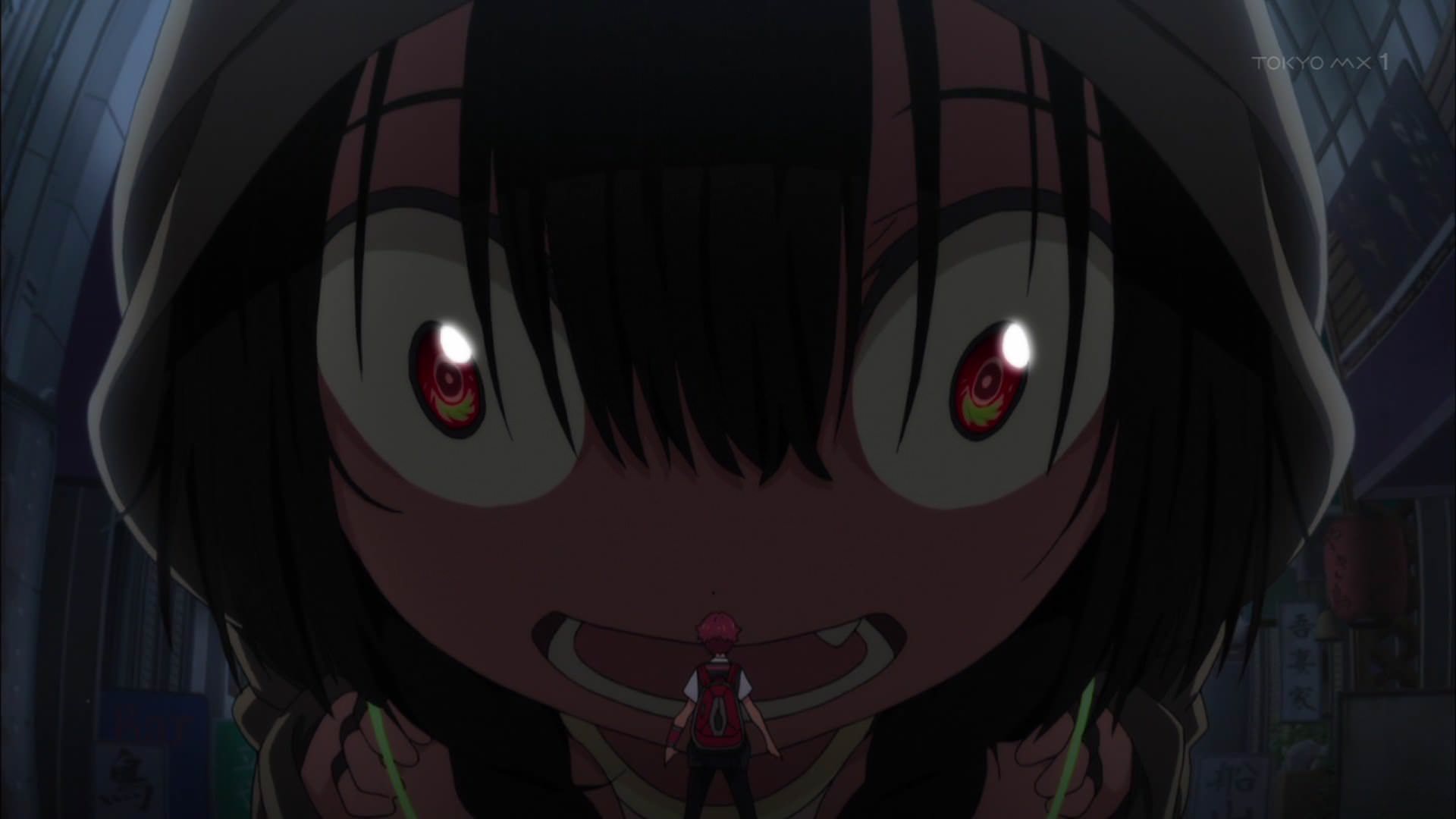
Meanwhile, Kurata is getting advice from Oumi-sensei (the gray-haired one), who suggests that she join the woodworking club to improve her skills and to relax a little. However, the over-serious Kurata (who’s also revealed to be quite the spaz) refuses, seeing it as frivolous fun that gets in the way of Hashimoto Technical’s purpose as a vocational school. Both shy towards her fellow female classmates and frustrated at her lack of talent, she runs away, only to accidentally bump into Akira and the Chorus Club. Curiously, instead of making a typical startled noise, she lets out an F♯2 note.

In judo class (apparently a staple of Hashimoto Technical), Kurata is participating along with Hasegawa and her friend. Hasegawa, it turns out, is actually the daughter of a prominent judo family, and tosses around both one of the school’s judo club members and Orihara effortlessly (while also simultaneously ogling the latter). Kurata and Hasegawa’s friend are practicing against each other, but when a sudden pain in Kurata’s hand causes her to fall over, she reveals that her tendonitis is flaring up—as a result of her piano-playing!

Kurata’s Situation

Kurata doesn’t know how to crack eggs, and can’t seem to even run on a school racetrack without going off-course. If there’s any character she reminds me of, it’s Mio from Nichijou, who can’t seem to follow rules of any kind when it comes to sports or competition. I also love the way they reveal her music background, with her unusually melodic yelp.

I might be sounding like a broken record, but Kurata’s the latest in a long line of interesting characters in Hashikko Ensemble. First, there’s the fact that her antagonism towards the Chorus Club is kept mostly to herself—in fact, Jin and Akira don’t even really recognize her. Second, is that her dislike of the Chorus Club had seemed personal on some level, but the hints we get as to why this is the case make her and her story all the more intriguing.

It’s clear that Kurata has a musical background of some kind and that it’s limited by her tendonitis. Was a potential piano career derailed by health issues, leading her to lose faith in putting her future in something as fragile as musical performance? Is it perhaps pressure from parents? How much does she actually believe what she’s saying when she declares her preference for the pragmatic, and how much is she forcing herself to think this way? I’m really looking forward to finding out more.

As for what she’ll do as a potential Chorus Club member, one would think piano, but the fact that she has trouble playing might mean she’ll be another singer instead.

Hasegawa’s Unusual Friendship

Hasegawa and the other girl who’s always with her (whose name might not even have been mentioned yet) are so different from each other that you wouldn’t necessarily expect them to be close, but they say outright that it’s just a natural product of there being so few girls at the school. From what I can tell, while it likely began out of convenience, it transformed into a genuine friendship at some point. Now, they’re trying to get closer to Kurata too, but she’s as nervous and unsocial as they come.

I really enjoy how it doesn’t take much to portray Hasegawa and her friend as fleshed-out characters with an authentic-feeling history. This feeling of realism is one of Kio Shimoku’s greatest strengths.

As for Hasegawa’s judo background, I got a good chuckle out of how she actively eggs on the judo club. Also, i wonder if her love of beefy dudes is because of her family or not.

Songs

No music this chapter, aside from some basic voice lessons.

Final Thoughts

In a flashback, Kurata asks why the Japanese shorthand for “smartphone” is sumaho and not sumafo, as if it doesn’t make sense. I AGREE. IT’S ALWAYS BOTHERED ME.

Gattai Girls 10: “Mobile Police Patlabor” OVA 1 and Izumi Noa [Anime Secret Santa]

Introduction: For the second year in a row, I’m combining my Reverse Thieves’ Anime Secret Santa entry with my Gattai Girls review series—posts dedicated to looking at giant robot anime featuring prominent female characters due to their relative rarity within that genre.

Here, “prominent” is primarily defined by two traits. First, the female character has to be either a main character (as opposed to a sidekick or support character), or she has to be in a role which distinguishes her. Second, the female character has to actually pilot a giant robot, preferably the main giant robot of the series she’s in.

The year is 1988, and the long-standing image of giant robots in anime fluctuates between either fantastic heroes and gritty, expansive science fiction. In this environment, one multimedia franchise decides to ask a simple yet potential-laden question: how does a society police its citizens in a world where mecha are commonplace?

In the near future of Patlabor, humanoid robots are commonly used in various industries, the police have also decided to incorporate mecha known as Patrol Labors into their forces. Patlabor follows Special Vehicles Unit 2, a ragtag bunch of eccentrics who solve Labor-related crimes. While there are multiple iterations of Patlabor, including anime, TV series, OVAs, and films (all of which apparently have branching continuities), this review will be focused on the first OVA series, titled simply Mobile Police Patlabor, but also known as Patlabor: The Early Days.

At first, Patlabor presents itself as a fairly low-stakes works, with its eclectic cast of officers and mechanics trying to deal as much with each other as the crimes they’re supposed to prevent. However, it gradually reveals concerns that are deeper and broader than first expected—provided you peel back the curtain a little bit. Over the course of the seven episodes of the first OVA series, those “Labor crimes” (not sure if pun intended) often speak to underlying social issues in Japan such as the struggle between pacifism and militarism that has affected the nation since World War II.

Such themes are the wheelhouse of the OVA’s director, Oshii Mamoru, and he gets even more philosophical about the intersection between technology and society in his Patlabor films. Here in the first OVA, though, Oshii doesn’t go nearly as hard on his pet topics, and the result is a comparatively much more straightforward story. The OVA is much more willing to be a police drama with some underlying political messages, and thus more approachable for those who might feel the films to be too overbearing.

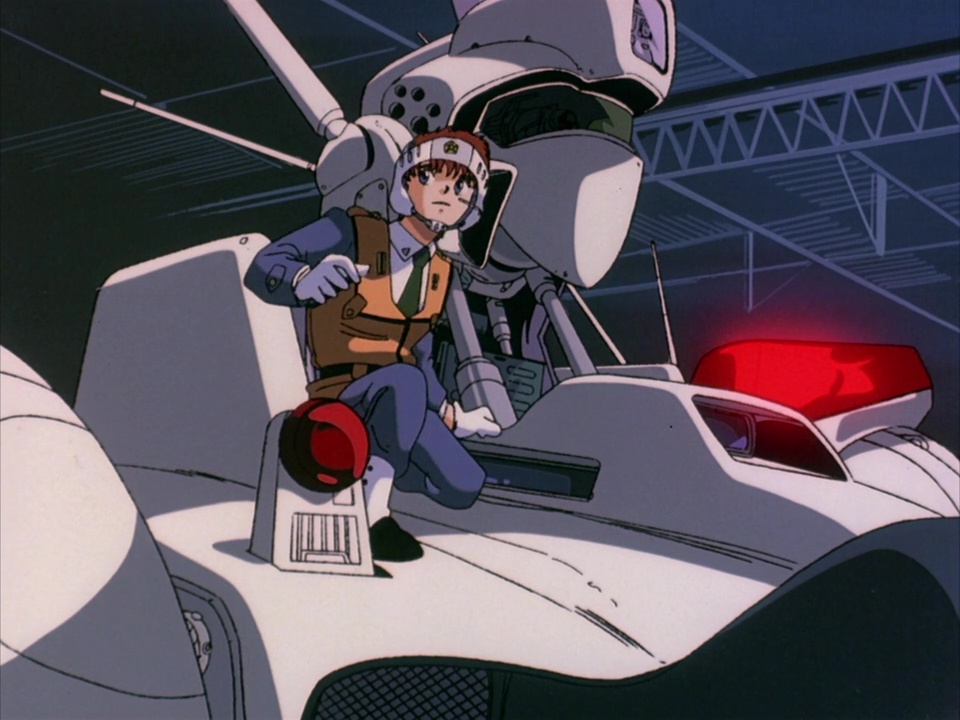
But it’s also impossible to shake the idea that Patlabor cares relatively little about what it presents on the surface, especially when it comes to the treatment of the ostensible protagonist, Izumi Noa. If one were to guess what Patlabor is about from just the opening alone, one would assume that Noa is the star of the show, as she relaxes with, takes care of, and fights in her beloved Patlabor, Alphonse. In fact, she’s the only character who appears in it at all! Yet, somehow, the clear poster child for Patlabor as a whole only ever has a semi-major part at best in any of the episodes.

It’s not as if Noa is portrayed as useless or incompetent or in need of big, strong man to rescue her, but her general character—tomboyish robot lover with a knack for piloting—seems to have the least connection to the series’s underlying focus on the intersection between politics and technology. In contrast, Shinohara Azuma is the son of the president of a Labor-manufacturing company, while Goto is the deceptively intelligent and wily chief whose past has him confront the militaristic elements of Japan. Even the other prominent female characters, Kanuka Clancy and Nagumo Shinobu, seem to get more screen time than Noa because they’re tied much more deeply with the police system. Ironically, the woman who was to be the heroine by virtue of her neutral and apolitical passion for mecha ends up feeling more like a side character.

Overall, Mobile Police Patlabor seems to embody much of the OVA spirit that permeated anime in the 80s and 90s by providing an opportunity for projects to go in unique and interesting directions. The result is a fascinating series, but also one that seems in conflict with itself at times.

Aikatsu Friends! Knows How to Celebrate Christmas

Christmas is a different holiday in Japan compared to the United States. Even putting aside the religious vs. secular aspects, December 25th is traditionally seen in Japan as more of a romantic occasion featuring cake and fried chicken, and various anime and manga throughout the years have reflected this. That’s why I was surprised to see that the Christmas episode of Aikatsu Friends!—aptly titled “Merry Friends Christmas”—feels so at-home with a more American conception of the holiday.

The episode begins with drawing lots for a big idol tournament. Once the matches have all been decided, each duo goes out to practice and to shore up their weaknesses. The portrayal of “idol activities” is always a highlight of the Aikatsu! franchise, and watching the two goth girls weight-lift using an oversized die and a black crystal ball to shore up their weak stamina reminds me of why I enjoy these shows. What’s more, I like that it doesn’t dedicate the entire episode to Christmas, as it minimizes the sense that this is a one-off break from the main story. The celebration is woven into the overall momentum of Aikatsu Friends!

Heroine Aine decides to invite her partner Mio and their rival teams to have a fun Christmas party, and there’s just something familiarly heartwarming about the gathering. The exchanging of presents, the overall sense that the competition doesn’t overshadow their friendships, and the festive mood would fit right in with US Christmas TV specials—but with all of the morals about kindness and giving merely implied instead of said outright. It’s the sort of execution that makes me wish Aikatsu! could get a real foothold outside of Japan, even though I realize that its success is tied in heavily with the arcade games.

As with every Aikatsu! Christmas, they end with a rendition with of “We Wish You a Merry Christmas” with a characteristic rap section that talks about turning a holy night into a party night. At this point, and I have to wonder what the reason is behind keeping the song from year to year. It’s not a bad thing, but I would have expected them to switch it up from series to series—maybe some “Jingle Bells” or “Deck the Halls.” Maybe it’s just what the fans expect, and hearing the latest generation of Aikatsu! stars give their own take on the song is itself a tradition.

Overall, it’s an excellent Christmas episode from Aikatsu Friends, and an excellent way to set the mood for the holidays. It also makes me wonder if the image of Christmas has changed in Japan! That investigation will have to be for another time.

This post was sponsored by Johnny Trovato. If you’re interested in submitting topics for the blog, or just like my writing and want to support Ogiue Maniax, check out my Patreon.


The Dynamics of Hugtto! Precure’s Gay Couple

Following a landmark canon lesbian couple in Kira Kira Precure a la Mode, this year’s Hugtto! Precure (a series that is largely progressive in its views) has established its first clearly gay relationship in franchise history. I want to explore the pairing in terms of how it’s portrayed and its significance because there’s a lot to unpack here.

The couple is two side characters, Aisaki Masato and Wakamiya Henri. Masato is the eldest son of a rich and powerful family who, when we first meet him, is all about maintaining the family image. Henri is a half-French, half-Japanese figure skater who enjoys wearing women’s clothing because he makes it look good. They’re opposites in many ways, and at first, rather antagonistic towards each other. “Aren’t you embarrassed to dress like that?” Masato once snidely asks Henri.

Masato is an interesting character, though he doesn’t initially appear that way. When the show first introduces him, Masato’s main actions are to shame and discourage his little sister Emiru from playing electric guitar—her greatest passion. He nags her about how it’s a low-class hobby unbefitting a proper daughter of the Aisaki family. But after Masato is captivated by one of Henri’s performances and the two guys start being seen around each other much more, Henri is shown to be much more supportive of Emiru. Something changes in him.

For better or worse, Hugtto! Precure never says outright that it’s portraying a homosexual relationship. However, for anyone who’s paying attention, the hints are numerous. In one episode, Henri is skating in a competition, and during his performance blows a kiss at a crowd of mostly girls which “just happens” to have Masato at the center. All the girls swoon while Masato barely reacts, but it’s clear what’s going on here.

Given that relative subtlety (one might call it “plausible deniability”), I would venture to say that Masato is initially closeted gay. The reason he’s so hard on Emiru, and why he’s so adamant about her giving up guitar, is likely because he’s projecting his own insecurities onto her. He has to be the proper son who lives up to the Aisaki name. He has to dress the correct way, act the correct way, be the correct way.

Henri, with his fair looks and unflappable personality, explodes all of that. And so, even though their relationship progression is never shown outright, Masato is a little kinder every time we meet him. “Close friends” indeed.

In the end, the fact that Precure can’t just outright say what it has is somewhat disappointing, but the story it’s telling about two guys in love is actually a lot more robust and encouraging than that it may initially seem. The hope is that eventually, Precure will be able to say what it’s really feeling.

The Identity Crisis of Twitter

To a great many, social media is just a part of life now. Whether it’s Instagram, Facebook, Snapchat, or Twitter, these websites and apps are practically glued to us due to the ever-increasing ubiquity of smartphones. But each form of social media in certain ways replicates the online communication tools of old, and I find that with Twitter in particular, its strengths and weaknesses come from being essentially a highly modular chatroom. The problem is that, while the scope of this “chatroom” can be large or small, individual users only have so much control once it gets beyond a certain size, which leads to Twitter and its users running into an identity crisis of sorts.

It’s true that if you want an absolutely private experience on Twitter, you can more or less make it happen. Set your account to private, only follow a handful of people, and maybe even communicate primarily through direct messages. You can actually just make it about you and your friends. However, there are a few aspects that limit the Twitter experience once you move past that point and want to utilize the site as most others do, which is to operate in this massive space where you can instantly search for what people are saying about any given topic.

Traditionally, chatrooms were less people-focused and more concept-focused. Even in the earliest days of AOL, you scrolled through a potential list of chats, picked one that matched your interests or desires, and then joined. Even if it was just to ask A/S/L to everyone, there was a sense that you were stepping into a shared, localized space. Web 1.0 had this feeling in general. With Twitter, you are essentially your own chatroom moderator, and it’s up to you to constantly manage who you want to listen to and who you want to interact with. This kind of customization certainly has its merits, as it lets you really control your experience on Twitter to a certain degree, but having to potentially police your own twitter feed constantly is practically a recipe for decision fatigue. A user doesn’t have to care that much, but that can lead to the next problem: if you choose to take a relatively hands-off approach, that means you can’t control the people who are peering inside.

A common story of many a Twitter faux pas is that a user (often a fairly prominent one) treats their very public and well-known account like it’s still a small, localized experience when things have in fact changed. This person might be using in-jokes that appear crass or downright offensive to outsiders, but is considered to be innocuous teasing by their more immediate circle. They might even get called out by their followers for those words and asked to apologize, and those followers might even have a point. Even so, it can feel like there’s a disconnect between what this particular user thinks is their Twitter experience (shooting the breeze with friends) and what the users at large think is the Twitter experience (a public forum where any and every statement hangs in the air for all to see).

Consider two scenarios of a person in real life who says something racist, not expecting it to be an issue, only to be reprimanded by someone listening. In scenario #1, it’s a private setting where a friend is warning this person that what they’re saying is messed up, and they need to watch how they think and use words. In scenario #2, it’s an open space where everybody’s listening and a stranger shouts down the speaker for being so damn racist. Both cases involve someone rightly pointing out racist speech and that it needs correcting, but there’s a fundamentally different experience between someone who says something around those with whom they’re familiar and while surrounded mostly by strangers. The issue with Twitter is that it can seem like the former on the surface, only for a user to discover that it’s been a public square all along. The perception of extremely public vs. relatively private space explodes and collapses in a way that doesn’t happen when you actively search for servers and chatrooms on IRC or the more modern Discord.

I believe that this folding of public and private on Twitter is also what makes harassment on the platform especially insidious. It’s no secret that certain groups (especially the alt-right) have learned to almost weaponize Twitter’s idiosyncratic behavior. They can make a statement, “innocently” @ another user, and sit back and let their followers dog-pile that user. They can search out people who are discussing a topic, and attack total strangers in their replies. Users might want to interact through Twitter as if they’re just talking to their friends and acquainances, but the search function makes it possible to seek out holders of different opinions and try to verbally abuse them. It’s all too easy to find someone you disagree with on Twitter, and to see them as the enemy.

Chatrooms aren’t and weren’t ever peaches and rainbows. They come with their own hosts of problems, from power-abusing moderators to the active nurturing of toxic spaces by users if they should so choose. I used to be part of a chatroom or two where there were some people with gigantic chips on their shoulders—folks who seemed a little too trigger-happy with their hostilities. I remember a time where I talked about my surprise that a couple of anime voice actors were married to each other, only to get shouted at about how I must be one of those shallow folks obsessed with following the frivolous minutiae of celebrities (but of course said in a much less polite way). I thought the guy was being an asshole, but I also went into that chat knowing that this was a possibility, and that I was ready to fight back and call him out on being unnecessarily angry. Not everyone is willing or should be willing to have to fend off trolls and angry mobs, but Twitter’s public/private collapse makes that fight all the more inevitable for anyone discussing a controversial topic.

I’ve been on Twitter for over ten years now, but I’ve come to realize that I’ve reduced my utilization of its chatroom-esque qualities a long time ago. I still do communicate with friends and mutuals to an extent, but a lot of it is me shouting into the wind and seeing what sticks. Much like this blog here, I use it as a place to experiment with an express thoughts and ideas. Analyzing this shift in Twitter behavior, I think it’s largely because a certain degree of distance is necessary. Those who jump onto Twitter with bleeding hearts inevitably attract sharks. But while there were always sharks, even among the islands of Web 1.0 and 2.0, the social media age means being surrounded by potential predators on all sides.

Ahh Real Babies: Hosoda Mamoru’s Mirai

Director Hosoda Mamoru is nearly synonymous with family themes in anime films, but his newest work, Mirai (in Japanese: Mirai no Mirai) takes it to a whole new level. Whereas his past films such as Summer Wars, Wolf Children, and The Boy and the Beast explore the value and meaning of family, Mirai is more focused on the authentic feel of raising (and being) real flesh and blood children, and the challenges that come with having a family.

The story of Mirai centers around Kun, a bullet train-loving toddler who’s meeting his newborn little sister, Mirai, for the first time. As is typical of only children who suddenly have a sibling in their lives, he quickly grows jealous over all the attention given to the new baby. However, his tantrums lead him to discover that his backyard is the gateway to something magical, and that it lets Kun discover places and times he never could have otherwise. Through these voyages, which bring him to see his family members past and present in a new light, Kun is witness to the many small steps that lead him to being who he is.

At least, that’s the way the film presents Kun’s adventures. Mirai has almost a Calvin and Hobbes feel in that they never explain outright whether it’s all his imagination or if there really is time travel, and I think that ambiguity is a strength. While Mirai leans more toward the notion that Kun is actually accessing his family’s history given the amount of details he picks up, it doesn’t discount the possibility that Kun, like so many young children, is paying more attention than anyone realizes.

What makes the film truly memorable is the way it so realistically portrays the behavior and learning process of small children in Kun and Mirai. Speaking from my own experiences, I have plenty of friends and family at this point who have raised kids of their own, and many of the obstacles the parents face in dealing with Kun and Mirai actually perfectly mirror the experiences I’ve seen in those close to me. In particular, there’s a scene where Kun refuses to change out of his favorite pants—a stubbornness I’ve seen firsthand. It can feel almost too real, as if Mirai is trying to tell parents that it understands what they’re going through. Moreover, Kun’s mother and father also have to deal with delegating responsibility in their “working mother + work-from-home father” situation that’s quite unusual in Japanese society, which leads to even more examination of the “roles” of family in the modern age. To little surprise, in an interview shown at the screening, Director Hosoda discusses how having children of his own influenced the making of this film.

But it’s not just the parents that the film successfully empathizes with; the portrayal of the experience of being a young child is just as vivid and authentic. There’s one scene in particular toward the end of the film that successfully captures a child’s fear of being in a strange and unfamiliar place. While I’ve not been a baby in a long, long time, Kun’s reaction to his surroundings reminds me of the nightmares I had as a kid, as well as the times where I got lost in a mall or similarly large and eerie spaces.

Mirai feels more like a series of small episodes tied together into a single movie, but perhaps that’s the way childhood is. There’s no grand scheme or single obstacle to be overcome. It’s a learning process for the entire family.

SSSS.Gridman and the Question of Genre

At a Studio Trigger panel at Anime NYC 2018, an interesting exchange occurred. During the Q&A session, the topic of Trigger’s preferred genres came up, and producer Wakabayashi Hiromi asked the audience what genre they thought the studio’s latest anime, SSSS.Gridman was about. They received various answers, but a common one was “action,” to which they responded, “Action? Really?” What this says is that, on some level, many viewers see SSSS.Gridman very differently compared to its creators.

The point here isn’t to figure out what genre SSSS.Gridman (Twin Peaks-esque paranormal mystery?). Rather, it’s to dwell on that incongruity between so many of those con attendees and Trigger itself. There are certain caveats to account for—like how this was only a handful of fans in the grand scheme of things or the way the series holds its cards close to its chest—but something has to be creating that difference in judgement.

Perhaps those viewers simply have a broader, more lenient idea of what denotes an “action series,” especially compared to creators who inevitably go in with their own values beforehand. If you asked Tomino Yoshiyuki what genre Mobile Suit Gundam is, he might not necessarily say “mecha” or “science fiction” or, indeed, “action.” Moreover, while fans might take the tokusatsu feel of the show (which it captures down to the rubber suit-like movements of the monsters) as more evidence of its “action” qualities, Studio Trigger could be seeing it as an aesthetic quality in service to a greater structure.

Adding thrilling violence to a story could just inevitably change how fans perceive it. The spectacle, on some level, can be overpowering. While I can’t say with full confidence that SSSS.Gridman is a Twin Peaks, there is an anime that takes a lot of inspiration from David Lynch and Mark Frost’s influential TV series: JoJo’s Bizarre Adventure Part 4: Diamond is Unbreakable. While that series revolves around its small-town mysteries as well, the legacy of JoJo as a shounen fight series is still present in its DNA. For some fans, that battle tendency might dominate their view of Part 4.

Whatever the case may be, it’s clear that in the eyes of the creators, there’s more to SSSS.Gridman than just action. At this point, as the show moves towards its conclusion, that might very well be “obvious,” but I do wonder how many fans it pulled in under the vague pretense of strong fight scenes.

Smashing-Good Holidays: Ogiue Maniax Status Update for December 2018

Ogiue Maniax just celebrated its 11th anniversary, and it feels like quite the milestone. However, as much as that has been on my mind, my head space is currently occupied 80% by Smash Bros. Ultimate. 4 days to go!!!

I’m always grateful for my supporters on Patreon and ko-fi. Many thanks to the following!

General:

Johnny Trovato

Ko Ransom

Diogo Prado

Sue Hopkins fans:

Serxeid

Hato Kenjirou fans:

Elizabeth

Yajima Mirei fans:

Machi-Kurada

Here are also my favorite posts from November:

Geek Reference Culture vs. Rap Reference Culture: A Personal and Meandering Comparison

An exploration of how heavy reference usage differs between geek entertainment and rap.

How Hugtto! Precure Tackles Childbirth and C-Section Controversy in Japan

The current Precure series likes to go places.

“Hi-New York”: Anime NYC 2018

My overview of Anime NYC 2018.

Hashikko Ensemble

Chapter 10 feels like the end of one story and the beginning of another.

Patreon-Sponsored

An Amateur Look at the Atelier Games

How mellow can an RPG series get?

Closing

I promise that not every post I make for the next 6 months will just be about Smash Bros. That said, I get the feeling there will be plenty to go around.

The Pressure to Morally Justify One’s Fandom Tastes

When I first began to formulate this blog post in my head, the core of what I wanted to write about was something I observed in online fandom: the policing of preference and desire, and the seeming need to couch fandom debates in moral rhetoric. My desire was to focus on the absurd degree by which fans try to justify their tastes by presenting some greater benefit or boon to humankind.

However, I’m not the only one who’s been ruminating on the subject. A recent article about essentially weaponized anti-fandom had explored the subject in depth, the author tracing their observation of this disturbing trend through the pains of trying to transplant the islands of LiveJournal to the complex web of Tumblr. Anti-fandom goes from being passion with a negative bent to a cold and calculated scalpel designed to influence and threaten fans, critics, and creators alike. The article has forced me to approach this post a little differently than I had intended. To that end, I still want to think out loud about that concept of forced justification, but more as the other side of the coin compared to what is described by that author.

Critical analysis of preferences in storytelling and art, be they one’s own or the preferences of others, is an important part of the relationship between creative endeavors and their effects on people and society. It’s not wrong that a series like Tintin, which early on featured racist caricatures, would fall under rightful scrutiny, and that those decisions open up important conversations, or that superhero comics are having to confront the sexism and racism that has been entrenched in its veins on both content and creator levels. However, there has been a trend of fans who try very hard to prove that their particular fandoms are fundamentally superior (or indeed that others are inferior), as if fandom reflects wholly one’s dedication to the moral fiber of society. Perhaps it’s all an act, as the article implies, a feigning of outrage to achieve a selfish goal, but I believe there are also fans who feel that they cannot like something unless it gels 100% with how they view themselves on that moral level.

This is a potentially harmful philosophy to abide by, not just for those who are potentially attacked by this sort of fan, but directly dangerous to the fan themselves. When a  “problematic fave” enters the conversation, the situation descends to  whether or not liking something in fantasy reflects some moral or personal shortcoming. From there, it’s a short step to accusing each other of not believing in the greater good strongly enough.

When we still don’t have real answers as to how people’s relationship with fiction affects everyone (whether broadly or on an individual basis), it comes across as a desperate desire to not be on the wrong side of the barrel. Either that, or they risk ending up like the character Nishikinomiya Anna from the anime/light novel Shimoneta. Anna, who was raised from childhood to be the perfect representative of moral fastidiousness, turns out to be dangerous and depraved in certain ways. However, because she was brought up to believe that she is pure and just, she rationalizes her behavior as being inherently moral because she is inherently moral herself.

My concern is that in an environment where there is (rightful) social pressure to be more open and to not hold beliefs that demean other people, it can become all too easy to believe that every word you say carries deep significance to such an extent that people feel they cannot be frivolous. If one feels that their words must reflect their fundamental being, then it also becomes dangerous to think that every piece of entertainment you consume has to be morally justified, as if it fits into a greater picture of a consistent and righteous self. It makes me think that these fans feel disdain for the fact that humans are often contradictory, and rather than understand and accept that, they see admonishing their peers for their inconsistency as the better choice.

For Hymn: Hashikko Ensemble, Chapter 10

In this chapter, the secrets of Orihara—his hearing and his traumatic past—are revealed in full.

Summary

Waking up inside the nurse’s office, Orihara explains that he suffers from a chronic high-pitched ringing in his ears. Jin figures out that Orihara suffers from a slight degree of hearing loss due to overexposure, specifically in the 3khz range—the same frequency as a baby crying or a woman screaming. Jin, however, believes Orihara’s brain is likely still picking up sounds at 3khz even if his ears aren’t, which is why Orihara can somehow “hear” things that he “can’t hear.”

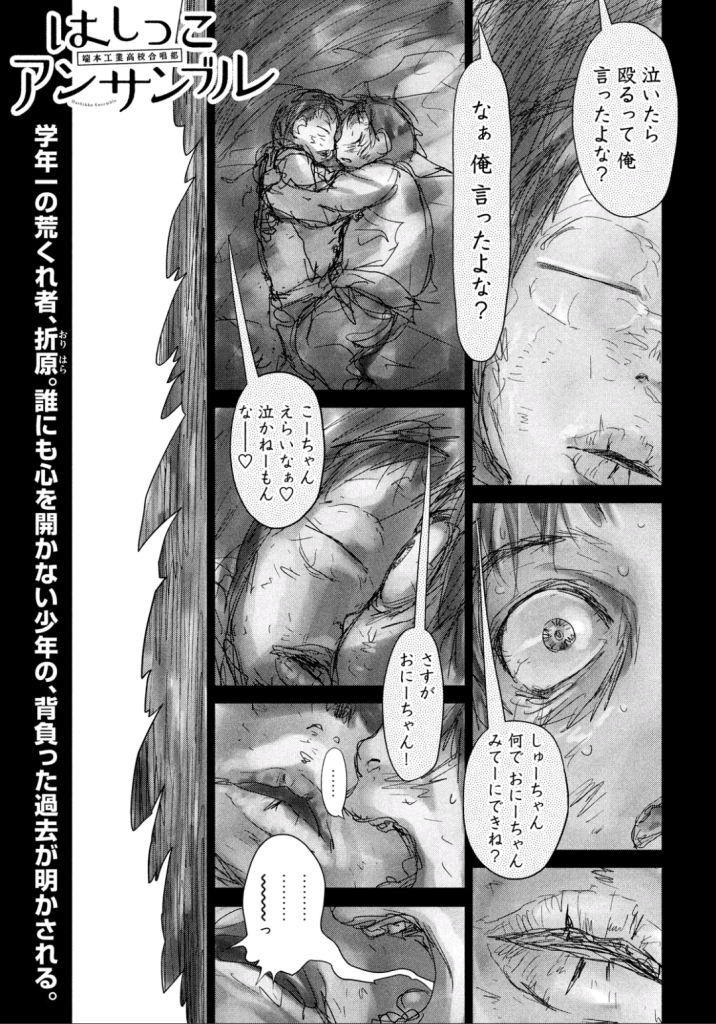
During this talk, Orihara reveals two things about his past to the others. First, his little brother died. Second, the one time he was able to get rid of the ringing in his ears was in third grade, at a recital by a choir of old men, and a specific religious foreign song—hence, why he keeps listening to similar music. For this reason, Jin uses his connections to bring Orihara back to that choir from his childhood and have him repeat the same song. Hearing it again, Orihara is moved, but while Jin’s scientific explanation seems right, Akira has a simpler one: Orihara was healed by this music. Envisioning (?) a young voice from heaven speaking directly to him, Orihara smiles.

Later, at school, Jin comes barging in to get Shinji and Orihara (given name Kousei) for chorus club practice. Orihara is now an official member of the Chorus Club. The days pass, and coming up now is the MHK Concours—aka M-Con—an amateur chorus competition!

Music: When Science and Magic Collide

Orihara’s story, in my eyes, adds an interesting wrinkle to the ongoing theme of music as something that straddles the line between the known and the mysterious. Jin’s explanations make sense, yet I can’t help but wonder if Orihara’s deceased little brother might actually be trying to communicate with him. The manga itself never really says one way or the other, but regardless of the actual (meta-) physics, it’s notable that Orihara feels the song in his head and in his heart. There’s an important lesson here about how even as we might “understand” music on a theoretical level, there’s still an almost magical or spiritual quality to song that captivates the soul. As dominant as Jin is in this manga, his perspective isn’t the only one.

That being said, I doubt the manga is trying to push any sort of religious angle. It seems more an acknowledgement of the significance of the church in Western music.

Bouncing Back from Tragedy

Orihara’s story is the heaviest I’ve seen a Kio manga get, and that’s including Ogiue trying to commit suicide as a kid. Child abuse, and the degree to which Orihara’s anger is a product of his trauma, are incredibly tragic. Although not said outright, it’s extremely likely that the guy suffers from PTSD. The story basically implies that Orihara can’t hear the 30khz frequency because he was constantly being subjected to the anguished screams of his mom and his brother. And somehow, the series manages to swing around into silliness not long after.

It’s really not easy for a narrative to get so serious and then switch back into lighthearted humor, but I think Hashikko Ensemble does it well by actually making the awkwardness in that transition more prominent. In particular, when Orihara mentions his deceased brother, Jin seems to obliviously bring the topic back to music and science. But is Jin as ditzy as he acts? His ambiguously strained relationship with his dad, or indeed something else, might hint at this being a willful act of feigned ignorance.

Songs

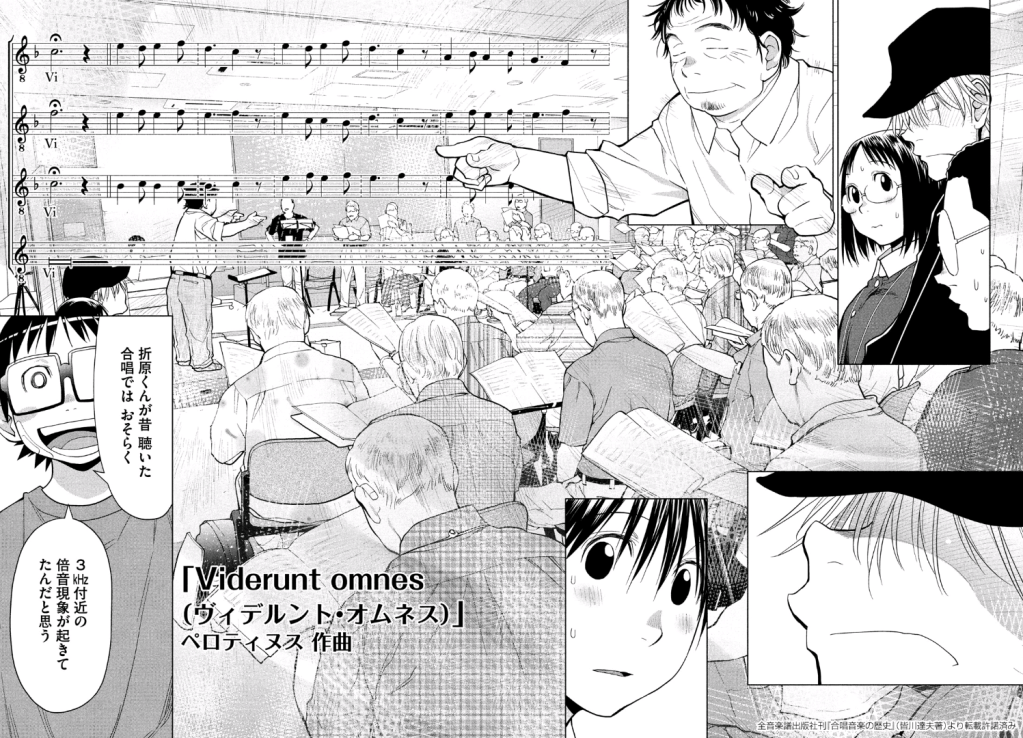
The featured song this chapter is “Viderunt Omnes,” a Gregorian chant composed in the 11th century by Protein. Gregorian chants were traditionally used in Roman-Catholic churches.

Final Thoughts

Next chapter promises to focus on Kurata, whose intensity and dislike of the frivolous has me intrigued about her. However, given how quickly the manga jumped from “Orihara’s on board” to “Competition!”, I’m worried that Hashikko Ensemble is suffering from a lack of popularity and his rushing things forward. I genuinely think this is a very strong manga from Kio Shimoku, so I hope it has a long life ahead of it.