Dick Dastardly’s Gun Kata: Appare-Ranman!

The anime studio P.A. Works generally follows a consistent formula: establish an interesting setting such as an old-fashioned hotel (Hanasaku Iroha), an animation studio (SHIROBAKO), or a small town in decline (Sakura Quest), and then place front and center a cast of primarily cute girls with lots of emotion, humor, and drama. That’s why the recent Appare-Ranman!—a show starring a primarily male cast about a transcontinental race across the United States in the late 19th century—caught my eye. It’s in many ways the total opposite of the studio’s standard output. While the title is not entirely what I initially hoped for based on the premise, Appare-Ranman! turns out to be both an inspired and inspiring anime.

Appare-Ranman! stars Sorano Appare, an eccentric Japanese guy whose love of engineering and invention puts him at odds with his traditional merchant family. A series of strange events (largely of his own making) takes him and a samurai named Isshiki Kosame to the US, where Appare decides to compete in the Trans-Atlantic Wild Race. Competitors range from heroes to nobles to criminals, but unlike the rest who are using gasoline-powered cars, Appare aims to take the win with his own steam-powered creation.

Racing shows are usually about, well, racing. Whether it’s the classic Speed Racer/Mach GoGoGo, the insanely energetic Redline, the technical Initial D, or even Hanna-Barbera’s slapstick Wacky Races, one expects emphasis on three things: what the vehicles can do, who will come out on top, and how each of the competitors go about trying to win. Appare-Ranman! does highlight all those aspects to a degree, but half the time it feels like those things take a backseat to both more personal character stories and more conventional action outside of their vehicles.

This shifting of priorities is by no means a sign that Appare-Ranman! is a bad anime, and it benefits a lot from exploring its characters through their relationships with violence, adversity, and ambition. Jing Xialang is a female Chinese racer who’s had to overcome sexism and racism to find a place in the racing world. Appare himself is a great protagonist whose creative genius and flouting of cultural standards is shown to have both its strengths and limitations, and while it’s not outright stated, I get the impression that he’s non-neurotypical. In certain ways, this series reminds me of the fantastic Mobile Fighter G Gundam. That being said, the comparison to G Gundam goes beyond the multicultural cast and competitive setting. Appare-Ranman! ramps up the martial-arts-action gunfights to such a degree that, as the series reaches its climax, you begin to wonder where the heck that transcontinental race went.

Appare-Ranman! kind of swerves a bit, but it’s ultimately an entertaining anime that starts off strong and finishes well, even if it goes to some odd places. The main character’s car being steam-powered also makes the story feel like some kind of reverse-steampunk because of its portrayal as being on the way out historically. Now, what I find funny is that the focus away from racing at times actually brings to mind what I mentioned at the very start of this review: the fact that P.A. Works anime tend to use their settings as background for the real story they want to emphasize, and in a sense, Appare-Ranman! fits that bill perfectly. Only, istead of romantic drama, it’s wild shootouts.

Talk About a Scary Month: Ogiue Maniax Status Update for October 2020

The new anime season is starting up with plenty of potentially great shows, and we’re one month away from one of the most important general elections in the history of the United States. It would be an understatement to say I’m feeling some whiplash.

Before I get into the two sides, though, I want to thank this month’s Patreon sponsors.

General:

Johnny Trovato

Ko Ransom

Diogo Prado

Alex

Dsy

Sue Hopkins fans:

Serxeid

Hato Kenjirou fans:

Elizabeth

Yajima Mirei fans:

Machi-Kurada

First, the fun part:

For the new anime season, there are strong sequels galore—the two I’m hyped for are Haikyu!! To the Top part 2 and Golden Kamuy season 3. In terms of new titles, I’m curious about Dragon Quest: The Adventure of Dai (I’ve heard good things about the manga over the years), Hypnosis Mic (because everything fans have told me about it is bonkers), and Taiso Samurai (gymnastics + MAPPA).

I’m also looking forward to experiencing Love Live!: Nijigasaki High School Idol Club as a full-on anime instead of as the story in a mobile game. I’m curious to see how the different art style they’re using will affect the feel of the show. The Fall usually is traditionally great for anime, and while real-world events have thrown many anime off course, things are looking strong for now.

And then the not-so-fun part:

We are less than one month away from seeing if the United States is capable of rejecting a president who wishes he was a dictator, the corrupt politicians and businessmen who continue to enable his reckless destruction of the US, and whose combined greed and incompetence have the blood of over 200,000 people on their hands. And now, we find a president who not only denies reality when it gets in the way of him being beholden to debtors for what may be over a billion dollars, but is also currently hospitalized due to COVID-19: the very pandemic that he has tried to deny over and over again in order to prop up the economy at the expense of human lives.

I know I have readers outside the US, and you don’t have a direct say in the outcome of this election, but you’re probably concerned. I’m thinking of this as the most important election of my life, but that’s only because I hope and pray that it doesn’t get worse from here.

Now, back to good ol’ anime blogging.

Blog highlights from September:

Gattai Girls 11: “Granbelm” and Kohinata Mangetsu

Gattai Girls—wherein I review giant robot anime starring female pilots—is back!

Wyld Stallyns’ Greatest Triumph: Bill & Ted Face the Music

My review of the long-awaited sequel to one of my favorite movie franchises of all time.

Try Angles: My Teen Romantic Comedy SNAFU Climax!

The anime adaptation of one of the best modern light novels comes to a close.

Hashikko Ensemble

Chapter 32 starts a new trimester and a new story arc for the singers of Hashimoto Technical High School, and it’s one of my favorite chapters yet.

Patreon-Sponsored

Hololive EN and Multilingual Fluency Among Virtual Youtubers

Some thoughts on crossing the language and (sub)cultural barriers through the new English-language VTuber group

Apartment 507

The Matter of Family in Demon Slayer: Kimetsu no Yaiba

When it comes down to the appeal of this popular series, I really think it’s about familial love.

Closing

Take care of yourselves.

Try Angles: My Teen Romantic Comedy SNAFU Climax!

My Teen Romantic Comedy SNAFU (aka My Youth Romantic Comedy Is Wrong, as I Expected) is the modern light novel anime that reminded me to never judge a book by its cover. While on the surface it looked to be another series about a cynical protagonist who ends up surrounded by attractive girls, it quickly became clear that what the series is selling is less a fantasy and more observations of reality—namely the ups and downs of growing mentally and emotionally in the messiest yet sincerest ways. Now, the final anime season has arrived, and what we’re left with is a satisfying conclusion that stays true to the series’s identity.

My Teen Romantic Comedy SNAFU Climax! once again revolves around loner Hikigaya Hachiman, bubbly Yuigahama Yui, and no-nonsense Yukinoshita Yukino as they run the Service Club: a group dedicated to problem-solving for any student who asks. All three are very different in personality, which makes their views on how to fix a given issue very different, but they complement one another well. This season, their main obstacles are pulling off an American-style prom, dealing with Yukino’s impossibly perfect mother who maps out her daughters’ lives to the letter, and the three main characters (at long last) resolving their feelings. 

All three storylines come down to battles of words and wills, and it’s this angle that highlights just how important language is to SNAFU. This series loves its wordplay—it’s why all the character names sound like superhero alter egos—but it doesn’t end there. SNAFU absolutely revels in both utter verbal ambiguity and extremely precise word choice that the Japanese language is so frustratingly good at. 

Take a couple of the keywords that showed up in the second season and present themselves here in full force: tasukeru and honmono. Tasukeru can mean “to help” or “to save,” and the ambiguity between the two gives a certain weight to Yukino’s words when she says it. But it’s also precisely because the characters can be so roundabout that they find a certain kinship. Honmono, introduced by Service Club faculty advisor Hiratsuka-sensei, can be translated as “genuine article,” “real deal,” “something real,” and so on. What exactly that means can change with context (is it more physical or more abstract?), and it’s not even clear whether Hachiman himself quite understands—other than it might just be worthwhile even while the fear of losing what you already have (even if it’s built on lies) is ever-present. Each character is both hurt and helped by how they utilize language, and it’s their strong friendship that brings them both smiles and tears.

The title of this series was originally about how the kinds of teenage romances celebrated in media are a lie, and that Hachiman’s life is anything but picturesque. By the end, but the meaning has morphed into the idea that it might not have been what the cool and popular kids get, but it’s something just as special. In a way, it’s perfect that SNAFU Climax! puts such emphasis on a prom, that classic symbol of Hollywood and American rom coms. The fact that the battle over the prom is more important than the event itself is especially fitting.

I’m happy to see this series to the end, but it also makes me aware of how different my own life and perspective has become since I watched the first season seven years ago. Back then, the sinews of high school and college social interaction still felt somewhat  fresh in my mind, and I could see pieces of myself and friends I knew in Hachiman. Now, my interaction with SNAFU has transformed from relatable experience to nostalgia. It’s as if I started as Hachiman the student and became Hiratsuka-sensei.

Over the Top: Hashikko Ensemble, Chapter 32

A new story arc begins in Hashikko Ensemble, Chapter 32!

Summary

Summer is over, and the students at Hashimoto Tech are back to school. While things seem mostly the same, there are some differences. For the Chorus Appreciation Society, they can now use the music room to practice. Tsuyama’s crew, the Mimi-sensei-obsessed guys who had previously competed against the Chorus Society, now all have girlfriends. And for some reason, there seems to just be a lot more singing at school overall. It turns out that the latter two things are related: Tsuyama and co.’s performance in front of the school is the reason they got girls, and now all the boys think a capella is the key to popularity.

Back with the main characters, Jin is naturally beyond excited about more singers at school, Mimi-sensei is having a bit of a crisis over losing her place as conductor to Hasegawa Kozue, and Shinji wonders why the girls aren’t coming to them. Right then, a tough-looking girl shows up next to Kousei, and when he tries to shoo her away (assuming that she doesn’t care about music), she puts his hand in a death grip and overpowers him. Kozue identifies her as Kawamura Yukina, a third-year construction major and the school’s reigning arm wrestling champion—a title she won by beating both guys and girls.

The chapter ends with students remarking about how many damn a capella clubs are springing up. It all looks to be headed in one direction: a singing tournament!

Excitement

I love this chapter.

I thought I knew where this manga was going, with Jin trying to prove his mom wrong and Akira fretting over Shion. However, the way the school has changed feels like a subtle yet still seismic shift, as if they’re entering a new environment where the rules are different. What’s more, this all stems from their singing! This series is delightfully hard to predict at the best times.

It’s typical of an action or sports series to up the stakes or expand its scope, and this feels similar yet noticeably different in terms of fallout. Genshiken didn’t really do story arcs in the traditional sense, and I find Hashikko Ensemble to be somewhere in the middle in a good way.

Mama Mimi

I do feel for Mimi-sensei, but what I’ll probably remember more about her in this chapter is her hilarious interaction with Shion. No longer conductor, she tries to let Shion be comforted by her, but Shion responds by asking, “Are pecs boobs?”

Later, Mimi wonders if this like a child being weaned from their mother’s breast.

The ridiculousness of Shion’s question followed by the wordplay from Mimi is top-notch.

Yukina is a Badass

Yukina is technically not a new character, but might as well be. It’s not 100% certain if Yukina is a delinquent, but she certainly has that energy. 

I really want her to join the group.

While she’s not the only physically strong girl around (Hasegawa is a skilled judo player), Yukina adds a certain level of cool. Not only would she be the oldest among the students, but her connection to Kousei—whatever it may be—seems intriguing. At the very least, we haven’t seen anyone treat him so lightly 

Is there an element of romance between the two? The characters are certainly entertaining the possibility. Akira thinks Shion might have a crush on Kousei, so he immediately tries to see how Shion reacts to Yukina, but it’s not entirely clear. I can practically feel Akira’s incredible self-consciousness, though I still think he’s somehow mistaken.

Songs

In this chapter, they practice “March 9” by Remioromen, which is Shinji’s pick for the Festival.

They also sing the official school song, though there’s no audio resource for that.

Final Thoughts

When Shinji asks why they’re not getting any girls, Kanon responds that 1) the Society already has girls and 2) a capella is cooler. It makes me think about how I’ve been translating gasshou as “chorus,” but “glee” could work just as well. And one particular TV show aside, it’s true that glee clubs are not exactly considered exciting. I do wonder if I should have been translating it as glee all along, but I can live with my choice.

Where in the World is the Next Smash Bros. Character?

I woke up one morning with an amazing idea: What if Carmen Sandiego became a Smash Bros. character?

Sure, there are a lot of things working against her. The Carmen Sandiego franchise is traditionally more about teaching kids geography than anything else, and there’s not much “gameplay” to speak of. There’s already a thief as a guest character in the form of Joker from Persona 5. She’s not even all that recognizable in this day and age, though people who grew up in the 1990s might know her through the various shows based on her that populated public and network television in the US. 

However, she would directly represent a genre of gaming that is only barely touched upon by other characters: edutainment. Sure, it’s not as exciting as RPG, FPS, or fighting games, but Carmen herself has enough style to give her a striking impression.

Also, I think I have a great moveset for her, and I really want to share it. 

As a virtually unparalleled thief and criminal mastermind, Carmen Sandiego would be a nimble and slippery character, light yet speedy in most respects. She would probably be similar to Joker in that respect, but unlike her fellow sticky-fingered compatriot, she would place less emphasis on building towards a powerful, combo-oriented office.

Carmen Sandiego is not just good at stealing—she makes off with the most absurd and improbable items possible. Among them are “the Trans-Siberian Railroad,” and “all the goulash,” and “the steps to the tango.” In other words, she can steal things of enormous scale, infinite quantity, and even concepts! That’s why her neutral-special move would be a command grab called Master Theft, and it would allow her to rob an opponent of their own neutral-special. 

Essentially, it would be akin to Kirby’s Inhale mixed with a bit of Villager Pocket, except it would actually deny the target the use of their move! However, she wouldn’t be able to use the attack herself. Instead, she would store it in a briefcase that she uses for some of her attacks, and having a stolen special move would increase the damage and knockback, turning it into a potent KO move.

This special move would clearly be more potent against some characters. While Ganondorf losing Warlock Punch wouldn’t be the biggest deal, Shulk should be scared to not have Monado Arts.

From there, Carmen’s special moves would be as follows.

Jetpack would be her up-special, and would make for nimble recoveries, but limited offensive potential. 

Side-special would be Phantom Step, and would have her create an illusory clone that can stay still or move forward. The closest thing in Smash would be Greninja’s Shadow Sneak, but this is closer to the Adept’s Shade technique in Starcraft II.

And down-special would be V.I.L.E. Henchman, which would summon a random subordinate of Carmen’s, each with different properties. It would resemble Duck Hunt’s Wild Gunmen attack to a certain extent, but the effects would be much more varied than “different guys shooting.” 

Her Final Smash would be V.I.L.E. Assault, and would entail a full-on attack by all the Henchmen and Carmen at the same time As for which henchmen would be picked, I really am not sure. The game-show ones like Robocrook would be most recognizable, but that might stray too far off from Smash Bros. as a celebration of games.

That being said, it would still have to include the Rockapella theme. 

There are other edutainment games that could serve the role of representative, such as Oregon Trail or Math Blaster. But I think Carmen Sandiego has the cultural penetration and character charisma to make her a great addition to Smash Bros. I know the chances are slim, but it would be such a fantastic surprise for a future Nintendo Direct.

PS: I never get tired of this:

Hololive EN and Multilingual Fluency Among Virtual Youtubers

Virtual Youtubers continue to be a tour de force, reaching beyond Japan to worldwide recognition. Given this success, as well as the crossover appeal of certain English-fluent VTubers (such as Fujima Sakura, Pikamee, and Kiryu Coco), it was only a matter of time before one of the big VTubers agencies would try to make an active effort to court an English-speaking audience. Thus is born Hololive EN, and with it five new streamers.

The tricky thing with something like Hololive English is striking the right balance in terms of audience desire and accessibility. Speaking in the target demographic’s native tongue does wonders for directly engaging with viewers, and offers an experience closer to what the Japanese viewers typically enjoy. Rather than Inugami Korone’s amusing struggles with English, little gets lost in translation. However, it’s also possible that part of the appeal is the existence of a culture gap—that there’s an element of exoticism found in both the language barrier and the moe idol aesthetic. Veering too far in one direction might alienate certain fans.

The route that Hololive English appears to have taken is to feature VTubers with decent degrees of spoken Japanese fluency—enough to interact with the Japanese fans as well. Their true identities remain unknown (as is standard), so it’s unclear if they’re natively multilingual or if they achieved it through study, but the result either way is that there isn’t a complete disconnect with the Japanese origins of Hololive. The style of English seems to differ from one to the next, whether it’s the cutesy affectations of Gawr Gura or the more natural-sounding speech of Mori Calliope. I think this probably a good way to hedge their bets in terms of figuring out what will garner the most fans, though I don’t know how intentional that is.

While all of them are able to speak Japanese fairly well, written fluency varies significantly between the Hololive English members (unless it’s somehow all an act). Case in point, Takanashi Kiara’s language skills are very strong to the extent that she self-translates, Ninomae Ina’nis appears to have a solid handle, and Amelia Watson can struggle with the basics. Kiara’s advantage is obvious, but I think the ones who are less fluent actually have a certain appeal themselves. Not only do they resonate with those of us who grew up speaking our parents’ languages but never became properly literate, but they’re also relatable to those currently learning Japanese or who want to learn Japanese—no doubt a common occurrence among Virtual Youtuber fans. 

For now, I don’t really have a favorite, but I wish all of them the best of luck. If they find success, I wonder if other Vtuber groups will push harder to have an active international presence.

This post is sponsored by Ogiue Maniax patron Johnny Trovato. You can request topics through the Patreon or by tipping $30 via ko-fi.

I Love Villains with Secret Weaknesses

One of the big mysteries of One Piece is just how Blackbeard is able to use multiple Devil Fruit powers when that should theoretically kill any being. I don’t have any strong theories as to what the truth is, but I do know one thing: when we do discover the secret, I think it’ll be one of the most satisfying moments in the entire series.

I love that trope, I really do. Whether it’s Sauron realizing that the One Ring is steps away from Mount Doom, and is filled with terror, or Voldemort coming to the horrifying realization that his Hocruxes are being eliminated, one of my favorite moments in fiction is when a villain realizes that their special hidden achilles heel, and thus they themselves  have been exposed.

If I were to say why I’m so fond of this idea, I’d say that it comes partially from how it resembles “boss fight” sensibility. Of course, this sort of storytelling element predates video games by a significant margin, but it is arguably most straightforward in the context of games. Only the worst weapon can harm Dr. Wily. Lavos Core attempts to fool enemies by hiding its true self in a seemingly unimportant floating “pod.” This idea can even extend to something like Gradius, where the final boss is a weaponless and disembodied brain. Here, the idea is that your final adversary is defenseless precisely to imply that you were never “supposed” to reach it—the soft, squishy point behind layers and layers of minions and firepower was meant to be unassailable.

But that puzzle aspect is only one component, and what really makes it satisfying is that the moment of unwanted revelation about their weakness being exposed is predicated on a contradiction. Villains like Voldemort and Sauron want to be invincible, but by pursuing that goal, they inadvertently create the cracks in their own armor. Voldemort fears death above all else, so he tries to achieve immortality by placing pieces of his soul into other objects and hiding them away, which in turn makes those very items a source of obsession for Voldemort. Sauron is already immortal, but his desire to control and dominate everything results in his transferring most of his power into the One Ring. Even when he first loses the One Ring in combat, the fact that it’s near-impervious gives Sauron a certain reassurance. He will eventually reunite with the ring because nothing is strong enough to get into Mordor if it’s not on Sauron’s terms. They use both smoke and mirrors and sheer martial strength to try and hide these flaws, so to see their best-laid plans begin to crumble gives me joy.

It’s precisely because Blackbeard goes to such great lengths to hide the workings of his multiple-Devil-Fruit usage that makes me confident that the reveal (and the ultimate use of it against Blackbeard) will be one of the best plot threads to come out of One Piece. His obsession with power, and the weak-minded truth of his being provide a perfect formula for this trope to play out in the best way possible.

Wyld Stallyns’ Greatest Triumph: Bill & Ted Face the Music

Bill & Ted’s Excellent Adventure and its sequel BIll & Ted’s Bogus Journey are two of my favorite films ever due to their absurd premises to their even more ridiculous climaxes. Bill S. Preston, Esquire and Ted “Theodore” Logan epitomize what people today call “himbos”—dim yet sincere dudes, and the two are great watches even today. Now, 30 years later we have a new movie in Bill & Ted Face the Music, and it’s a great sequel that captures the spirit of its predecessors. But as much as I enjoyed the film, I’ve also come to realize that it has an underlying story about how great Bill and Ted are as parents.

Because this is going to be discussing the ending to Bill & Ted Face the Music, be warned that there will be HEAVY SPOILERS involved.

The basic plot of the film is that metalheads Bill and Ted, aka Wyld Stallyns, have not been able to live up to their potential. They’re supposedly destined to write the song that ushers in a centuries-long age of peace and harmony, but they’ve spent the last 25 years failing to accomplish what should be their moment of greatness. Bill and Ted aro longer young, perhaps best shown by the fact that their daughters, Billie Logan and Thea “Theadora” Preston, have gone from babies at the end of Bogus Journey to 24-year-olds in Face the Music. After many time travel shenanigans (par for the course with Bill and Ted), Bill and Ted realize that they’re not the ones who are meant to write the ultimate song, but their daughters. What results is a song that is not only heard across time and space but also literally played by every person ever simultaneously.

There is a clear passing of the torch aspect to Billie and Thea being the true “destined ones,” in case any future films are to happen. However, I  see Billie and Thea as more than just replacements, and that’s because of something heavily implied throughout Face the Music: the daughters are able to succeed in creating the ultimate song because they were raised by Bill and Ted to love and appreciate music. It’s thanks to their dads’ support that they’re able to build on and surpass what the original duo achieved.

At the beginning of the movie, Bill and Ted perform their latest attempt at the song that will unite all, and it’s an extremely bizarre and experimental piece. Their audience, Ted’s brother’s wedding party, is not having it. But when the two talk to their daughters, they express how impressed they were by Wyld Stallyns’ use of the theremin and Tuvan throat singing—far, far cries from their rock and metal origins. What’s not said outright in these scenes is that Bill and Ted, in their attempt to write the ultimate song, have greatly expanded their musical horizons over the year. This pursuit of all forms of music, in turn, has rubbed off on Billie and Thea. The daughters are also portrayed as much more intelligent than their fathers, and might very well be musical geniuses.

Thus, when Billie and Thea go on their own time travel adventure to recruit the greatest band in history, they pick famous figures from across many musical genres: Jimi Hendrix, Louis Armstrong, Ling Lun, Mozart, and a cavewoman named Grom. And while a young Bill and Ted wondered who “Beeth Oven” was, Billie and Thea know exactly who Mozart (and everyone else) is. Another notable difference is that, whereas rock and metal have traditionally been dominated by white performers, most of these artists are non-white, showing greater respect for music from other cultures. When Face the Music gets to its climax and Wyld Stallyns make way for Billie and Thea’s production and DJing skills to thrive (and save the space-time continuum), Bill and Ted are doing more than just stepping aside for their daughters—they’re allowing their greatest triumphs to fulfill their own destiny.

The support shown by Bill and Ted towards their kids stands out all the more when remembering the upbringing they themselves had, especially Ted. Rather than fostering Ted’s dreams of becoming a rock star, Mr. Logan is a police captain who cares more about instilling discipline and making his son “do something” with his life. The threat of a future at the military academy hangs over Ted in both Excellent Adventure and Bogus Journey. It’s not until Face the Music that Mr. Logan finally accepts all that Ted has gone through (time travel, going to heaven and hell). In contrast, Ted has likely been behind Billie from Day 1. 

Although Isaac Newton has never appeared in the Bill & Ted films, his famous quote about standing on the shoulders of giants is highly relevant here. Bill and Ted are the unlikeliest of heroes, but the ground they cover thanks to their adventures allow their daughters to take things to the next level. Sure, BIllie and Thea are much more astute and sharp by comparison, but father and daughter alike appreciate the other on a deep and fundamentally important level. It’s that love and respect, the fact that their relationships embody the dual mottos of “be excellent to each other” and “party on, dudes” that ultimately allows them to save the universe. 

Creator Chemistry in A Whisker Away

The Japanese anime film A Whisker Away caught my attention early on due to its writer-director combination of Okada Mari and Sato Jun’ichi. Okada has worked on some of my favorite anime, including A Woman Called Mine Fujiko and Aquarion EVOL. Sato has helmed numerous masterpieces, especially in the magical girl realm—Sailor Moon, Princess Tutu, Kaleidostar, Ojamajo Doremi, Hugtto! Precure, among others However, this is not the first time they’ve worked together, and their last collaboration, M3: The Dark Metal, was mixed at best. Their strengths as creators are total opposites in a certain sense, which can make for a brilliant chemical reaction or an explosive mess. In the case of A Whisker Away, the combination succeeds.

A Whisker Away follows a girl named Sasaki Miyo, whose crush on her boy classmate Hinode Kento only seems to irritate him. What Kento doesn’t know, however, is that the stray cat he loves so much, Tarou, is actually Miyo in disguise through the power of feline magic. Key to the film are the desire to understand and to be understood.

When I say that Okada and Sato have opposite strengths, what I mean is that the two specialize in very different expressions of emotion. The writer’s works are all characterized by melodramatic floods of powerful emotions (especially at the climax), while the director’s greatest strength is conveying small and intimate emotions whether the setting is humble or grandiose. It is a challenge for both types of emotional expression to exist in the same space without smothering each other, and as I discussed years ago on the Veef Show podcast, this is one of the problems with M3: The Dark Metal

I think what makes the newer work click in contrast to their previous title is that both Okada-style and Sato-style emotional expression are able to coexist. The film has moments for both styles to shine, especially given the numerous scenes of quiet introspection and frustration juxtaposed with loud and bombastic outbursts from the heart. It also doesn’t hurt that cute but trying teenage romance is the wheelhouse of both creators.

Given this long trend of two whole films, I am eager to see what comes from the next Okada-Sato joint effort. Now that I know this team can pull it off, I have high hopes that the third time around will be spectacular. In the meantime, A Whisker Away is worth a watch.

Gattai Girls 11: “Granbelm” and Kohinata Mangetsu

Introduction: “Gattai Girls” is a series of posts dedicated to looking at giant robot anime featuring prominent female characters due to their relative rarity within that genre.

Here, “prominent” is primarily defined by two traits. First, the female character has to be either a main character (as opposed to a sidekick or support character), or she has to be in a role which distinguishes her. Second, the female character has to actually pilot a giant robot, preferrably the main giant robot of the series she’s in.

For example, Aim for the Top! would qualify because of Noriko (main character, pilots the most important mecha of her show), while Vision of Escaflowne would not, because Hitomi does not engage in any combat despite being a main character, nor would Full Metal Panic! because the most prominent robot pilot, Melissa Mao, is not prominent enough.

— 

Granbelm is a series that feels both modern and retro at the same time. The cute all-female cast is standard for current anime. Its premise, which pits these girls against each other in a Highlander-esque scenario to inherit the Earth’s magic, screams “early 2010s anime.” The story is straight-up early 2000s sekai-kei, a genre where the relationship between two characters determines the fate of the world. The mecha designs come straight out of a tradition of cutely proportioned robots from the late 1980s to early 1990s. Yet, while Granbelm isn’t shy about making its influences known, it’s also not ruled by them.

Female mecha protagonists are uncommon, which is why the lack of men in the series stands out all the more. That being said, this is not all that unusual, as there was an industry realization at some point in the industry that the total or near-total absence of male figures in anime could be a selling point to male and female audiences alike. In this sense, Granbelm follows in the footsteps of franchises like Love Live! and Puella Magi Madoka Magica, with the general mood of the show being more towards the darkness of the latter.

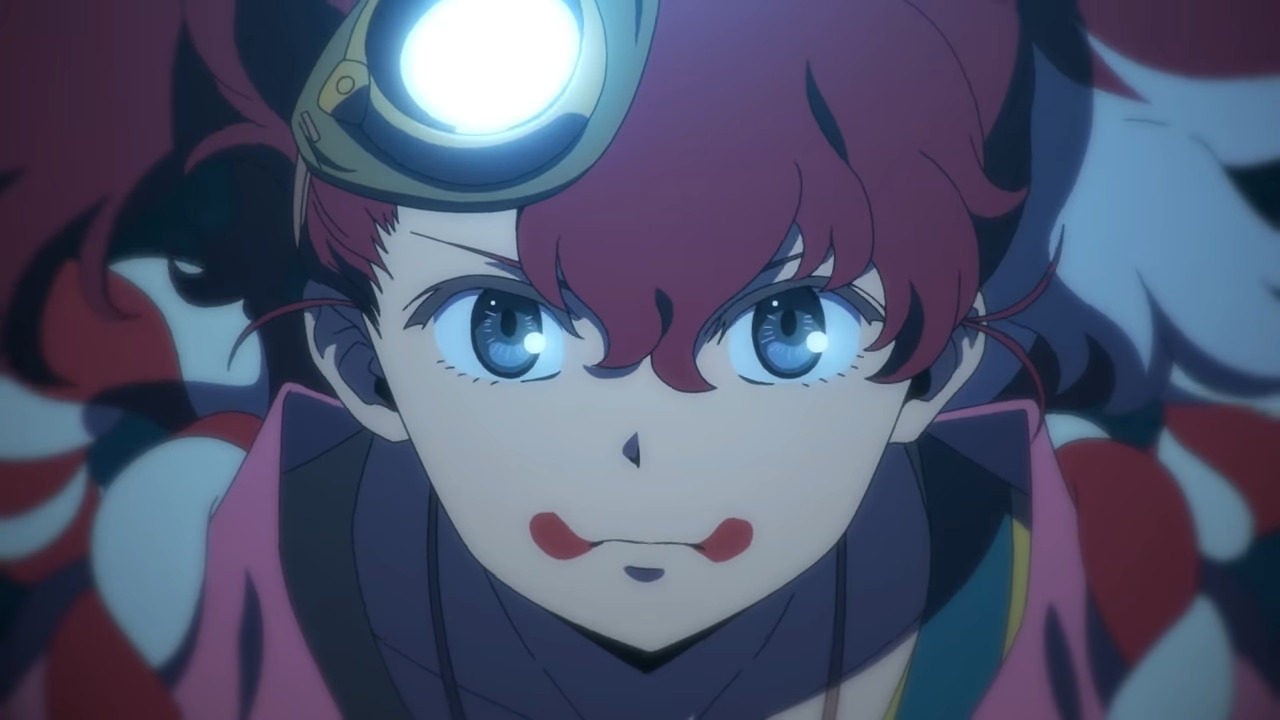
While having a predominantly female cast and thus passing the Bechdel test practically by default is by no means a mark of inherent feminism, these characters are varied in their personalities, motivations, strengths, and flaws in ways that emphasize their sheer presence on the screen. Whether it’s Anna (above) and her obsession with living up to her family reputation or Shingetsu and her guilt over her own power, the characters are convincing in their convictions. All the more impressive is the portrayal of the heroine, Kohinata Mangetsu (below). Although she comes across initially as a very generic protagonist, the series takes her naivete and exuberance and juxtaposes them against the others so as to highlight essential truths about her character in a manner most reminiscent of Selector Infected Wixoss

Moreover, it’s Mangetsu’s relationship with Shingetsu—their names meaning “full moon” and “new moon,” respectively—that is central to Granbelm. The way it plays out, similar yet profoundly different to Madoka and Homura’s in Madoka Magica, could only work with such strongly defined characters.

Given the general angle of Granbelm, the mecha might initially seem like an afterthought, but the series’s staff have worked hard to make them a vital part of the show in ways I appreciate a lot. Not only does the series wear its influences on its sleeve, with visual references to Gundam and even Space Runaway Ideon, but the way that characters argue with each other over heated personal and philosophical issues is right out of the playbook of Tomino Yoshiyuki, director of the original Mobile Suit Gundam and Ideon. Each robot—or “ARMANOX” in the anime’s parlance—reflects in form and function the personalities and fighting styles of each contestant. Whether it’s stealth, agility, or even emotional manipulation, you can sense through how they fight just what kinds of individuals they are. Mangetsu’s unit, White Lily, is fueled by her enthusiasm at the notion that she can be special in ways that elude her self-perception of mediocrity, and it comes across in the limit-shattering power and energy White Lily can generate.

Aesthetically, the ARMANOX draw from a very specific genre of giant robots: the chibi-fied robot tradition that began with SD Gundam and came into prominence in the 1980s to early 1990s anime thanks to titles like Mashin Hero Wataru, Mado King Granzort, and NG Knight & Lamune 40. Currently, the only modern anime that shares this look is the current 20th anniversary sequel to Wataru, which actively draws upon that visual nostalgia and carries a more straightforward good vs. evil story common to its original’s peers. The use of these mecha, with their squat and rounded appearances not only makes the visuals of Granbelm memorable against the backdrop of current anime, but also helps contribute to the cute yet foreboding feel of the anime as a whole. 

Granbelm takes cues from many anime trends over many decades, but it ends up synthesizing them all in an emotionally satisfying and thought-provoking manner. Vital to this success is the series’s portrayal of both its female characters and the giant robots they use to fight as reflections of each other and of the world they occupy.