OGIUE MANIAX

Anime & Manga Blog | 50% Anime Analysis, 50% Ogi

Aikatsu! and the Challenges of Protagonist Succession

aikatsuakari

Years of watching sequels has made one thing clear to me: it can be remarkably difficult to properly pass the torch from one protagonist to the next. For every Love Live! Sunshine!! that presents a cast with its own individuality, there’s a Saved by the Bell: The New Class, which, like so many in the graveyard of failed follow-ups, tries too hard to imitate the formula of the predecessor. In this respect, Aikatsu! takes on one hell of a challenge, not only taking the focus off of original heroine Hoshimiya Ichigo and re-centering it on newer star Oozora Akari, but actually keeping Ichigo and the rest of the old guard around.

The risk that comes with keeping the older characters around is that they might very well make the newer characters feel less worthwhile. In a post comparing the manga Genshiken to the series Kyuukyoku Choujin R, Japanese blogger tamagomago talks about how, while both series are about generations of college students, in the latter’s case the older characters stuck around to the extent that they overshadowed the younger ones. In Gundam SEED Destiny, protagonist Shinn Asuka ended up taking a backseat to the original Gundam SEED hero, Kira Yamato, to the extent that the opening changed to reflect this. Perhaps this is why the 800 lb. girls’ show gorilla known as Precure switches to a completely disconnected world with every new series more often than not.

To my pleasant surprise, I find that Aikatsu! does a fine job of re-focusing itself to highlight Akari as its new protagonist, with Ichigo passing into the role of support character in a manner that diminishes neither character.

It is necessary that I point out the following: for the sake of this post, I did not watch through the second year-long stretch of Aikatsu!, and thus cannot comment on how the actual transition from Ichigo to Akari went. All I know is that Akari was introduced partway through, and that, sort of like in the world of pro wrestling, she was gradually elevated to take center stage. By the time the third season starts up, Akari seems just different enough from Ichigo that it somewhat resembles the relationship and character contrast between Jotaro, the hero of JoJo’s Bizarre Adventure Part 3 and his Part 4 successor, Josuke. Like Jotaro, Ichigo even as an inexperienced individual feels like a powerhouse of sorts, a rock-climbing, tree-chopping force of nature. Akari, in turn, is more unsteady but brimming with life, akin to Josuke. She’s very much her own character, which is also the case for all of the newer cast.

Ichigo’s substantial role change into supportive mentor also has me thinking about the aura that emanates from characters who were ex-protagonists. Often, when a work no longer revolves around them, these former main characters gain a kind of stature or legendary status that elevates them above even the most prime moments of their time in the spotlight. Think of how the arrival of Cure Black and Cure White is generally considered a high-impact moment in the Precure crossover films, or how the arrival the original Red Ranger in the Power Rangers special Forever Red has the others standing in awe. Think of Goldberg at Survivor Series 2016. Ichigo is more or less the same character.

From my prior experience, Aikatsu! had been a consistently strong and entertaining series, so it’s not too much of a surprise that later parts of the anime manage are similarly high in quality. Akari’s a worthy successor thus far, and I’m curious as to how she and her friends will transform and perhaps someday become mentors themselves.

This post was sponsored by Johnny Trovato. If you’re interested in submitting topics for the blog, or just like my writing and want to support Ogiue Maniax, check out my Patreon.

Save

Save

Save

Save

Save

Amae Koromo and Her Weird Japanese Speech Patterns

Amae Koromo, demon of the high school mahjong world, is the first major opponent in the manga Saki. Able to oppress her opponents using the power of the moon, her physical appearance is deceptive: though she’s a year older than Saki herself, she resembles a small child, which causes her grief to no end. Those of you who’ve seen the anime and read the manga, however, might not be fully aware of just how much Koromo’s strange mix of naivete and maturity also comes across in her speech.

When Koromo speaks, the two main elements to notice are that 1) she often mispronounces words and names like a child would, but that this is contrasted with 2) she uses a heavy, heavy amount of classical Japanese idioms and obscure, old-fashioned vocabulary. So just as often as Koromo will call Nodoka “Nonoka,” and act like a spoiled brat, she’ll throw in phrases like 黄壌 (koujou, afterlife) and 神算鬼謀 (shinsan kibou, ingenious scheme). Her Japanese is so dense and difficult at times that Japanese people themselves have trouble. If you do a search for many of her lines, you’ll find even Japanese speakers asking, “What in the world is she saying?”

The result is that Koromo comes across as a girl who is very well-read and intelligent, but also sheltered and unaware of what the commoners enjoy. This, as readers of Saki know, is exactly what she’s like.

This site collects Koromo’s idioms up to Volume 8 of the manga, while this one has some other examples of her strange vocabulary. And as always, may the Haitei Raoyue be with you.

Why Keijo!!!!!!!! Impresses Me

keijo

Keijo!!!!!!!! is an anime about girls in swimsuits fighting using only their breasts and butts. By all rights, it should be one of those T&A anime that no one should take seriously. However, what separates Keijo!!!!!!!! from many other fanservice anime, and why I’ve surprisingly come to enjoy it (well beyond the sex appeal) is that it actually explores its own fictional sport of butt fighting.

When it comes to a lot of “sexy fighting girls” anime, the combat elements usually act as mere pretense. As they kick and punch and hurricanrana their opponents, clothes go flying, buttocks are exposed, and the result is fights that act primarily as a vehicle for titillation. In many cases, the fights themselves only serve the purpose of showcasing the girls’ flexibility. Keijo!!!!!!!!! in contrast takes almost the opposite approach, by having butt fighting as its foundation and trying in earnest to make actual exciting fights out of it.

Even before the actual battles are taken into account, there a number of notable factors that contribute to Keijo!!!!!!!! treating its premise as more than a flimsy throw-away. First, while the subject of feminism in Keijo!!!!!!!! is up for debate, one thing is clear: the body type diversity in the series is well beyond what you normally find in something like Ikkitousen. From this comes an idea stated in the series: girls of all shapes and sizes can succeed in the sport of Keijo. Second, different characters come from different athletic backgrounds. The heroine Nozomi is a former gymnast, while her friend and rival, Sayaka was a judoka. This is then reflected in their fighting styles. Third, the girls have to train to win, and make use of their own unique strengths and weaknesses.

When the fighting occurs, the fanservice almost (but certainly not entirely) takes a backseat to the action. While slower moments in the series are more than willing to revel in the girls’ physical features, at times the actual competition is so swift and the animators so dedicated to showing off the overall setting and choreography that there’s less time given to even ogle the girls. In many cases, similar series are more than willing to just leave a camera in an awkward position for extended periods of time, but Keijo!!!!!!!! will, at least half the time, prioritize the excitement of the sport itself. 

I have not read the manga, where still images of course can linger into eternity, so I don’t know how the balance of action and fanservice is treated there.

Combined with characters that have unique and interesting motivations—as well as the ability to garner genuine interest in how Keijo works as a competitive field—the result, I imagine, is that many people who watched it purely for sexual thrill or for the sake of irony have come to genuinely enjoy it. In this respect, it reminds me of Food Wars!: Shokugeki no Soma, where a love of food and a deft hand when it comes to portraying naked bodies go hand in hand.

It would be ridiculous to pretend that Keijo!!!!!!!! isn’t a fanservice anime. Anyone who does would either have to be in serious denial or woefully ignorant. However, much like one of my favorite series, Shinkon Gattai Godannar!!, the whole thing—the thrill of the story, the passion of the characters, and, yes, the attractiveness of the girls—all comes together to form an actually engaging experience.

Save

Save

I Heart Volleyball Captain Inugami Kyouko

inukamikyouko

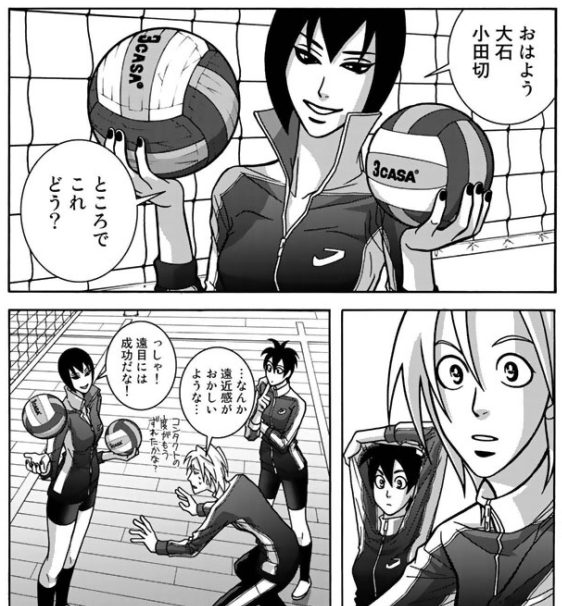
I recently found another favorite manga character: Inugami Kyouko from the volleyball manga Shoujo Fight by Nihonbashi Yoko. As captain of the Kokuyodani Girls’ Volleyball Team, she’s a trusted leader whose insight and sense of caring for her teammates are as impressive as her talent for the game itself. However, she’s also a huge troll always eager to set up a practical joke, and having those qualities all wrapped up into a single awesome package is what wins me over as a fan and admirer.

Looks-wise, Inugami has deeply piercing eyes, a limber physique, and almost always sports a grin that belies her fondness for ribbing others. It’s that smile which draws my attention most of the time. This is because it’s either setting up a moment where she’ll do something out of the kindness of her heart for one of her teammates, or is the precursor to one of her pranks. The fact that it’s hard to tell which is which is part of the thrill of her character.

Inugami’s jokes come in two forms. The first is a verbal quip, where she’ll nonchalantly comment about something that embarrasses one of her teammates. For example, when their new coach puts the entire team on a fast, one of the other girls comments that it shouldn’t be necessary because all of them are in good shape and can hardly be called overweight. Inugami then suddenly appears behind them to try and correct them: one of her fellow third-years has trouble keeping off the weight. For her trouble, she gets smacked upside her head. This isn’t to say that I think fat jokes are funny, but rather that Inugami’s delivery is where the humor lies.

inukamikyouko-basketvolley

The second joke type is a prop gag. Inugami’s hobby is constructing items and scenarios that will aid her trickster attitude. She’ll paint a basketball to look like a volleyball and then try to deceive the first-year students into playing with it. She’ll make an entire fake souvenir gift box of volleyball mascot manjuu. She constructs round tables in the vein of King Arthur’s. Once, she even tried to get the girls to play a game in a pool just because it’d be funny. In most cases, she again usually gets socked for her efforts.

miyako-rollingarms

mai_yuuko_buddha_pose_ep4

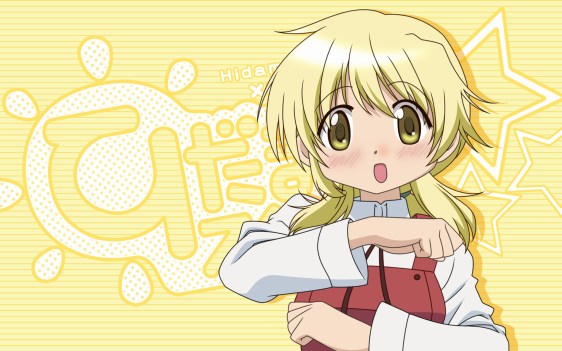
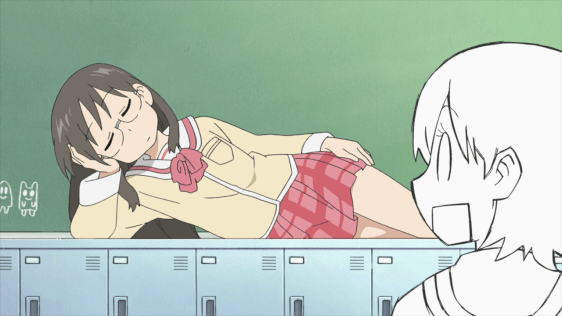
If there are any characters I might compare Inugami Kyouko to, it would actually be a mix of Miyako from Hidamari Sketch, who similarly makes weird objects that no one else would think up, and Mai from Nichijou, who is the most supreme troll in existence. The fact that she ends up being the “boke” to other characters’ “tsukkomi” roles is what I think keeps her charming. She isn’t really getting away with her trollish behavior, so she never feels cruel. If anything, Inugami it speaks to a kind of strange innocence in her character, that she’s always interested in having fun.

Save

Precure is Not a Lesser Sailor Moon

curemoonlight

A few months ago at Otakon, I was talking with Alain from the Reverse Thieves, who had attended a panel about magical girls and feminism. He had described how the presenter went through the various series she’d be discussing, but made specific mention that she’d be omitting Precure from the discussion, citing the fact that she wasn’t particularly impressed. Although I did not attend the panel myself, I found that to be unfortunate, not because of the dismissal of Precure by the presenter in isolation, but because this stance on the long-running magical girl franchise is not that uncommon. Among many fans, presenters, and even scholars, Precure is assumed to be bland and generic and not worth discussion.

In my opinion, that kind of thinking is a mistake. Precure is not only the biggest and most popular magical girl property of the past ten years, eclipsing even Sailor Moon in certain ways (sales, longevity on TV, etc.) and therefore worth observing for its cultural footprint, but it is also a fount of positive imagery for girls. While there are certain elements that can remain issues, such as the increasing ubiquity of pink as the only possible color for the main heroine and the fact that a lot of the magical girl outfits have high heels, Precure utilizes strong female characters by default, rather than making a big deal out of their existence. What’s more, because the series refreshes itself every year or two, its variety results in different approaches to characterization of female characters and themes pertaining to feminism. You have weak girls who become strong over time (as well as a nuanced exploration of what it means to grow), heroines who are more ideals of human potential, and even characters who try to reclaim the term “princess” to mean something more than “demure.” Even the very first series is significant due to its portrayal of girls having aggressive, hand to hand fights (in a show for young girls, no less), and the fact that its two main characters are more about their life goals than pining at the boys around them.

I have my suspicions as to why Precure has ended up with this reputation, and a lot of it has to do with Sailor Moon. It was the first of its kind, the sentai-inspired battling magical girl genre of which Precure is a part. In terms of cultural influence around the world, Sailor Moon has crossed the barrier from niche interest for anime fans only to seminal work, and is frequently cited as a pivotal show in the development of many young artists. Just the fact that it portrays these mature-looking girls who fight and win is on a basic level empowering and inspiring, and so any similar series gets compared not only to Sailor Moon but also its presence as a kind of nostalgic defining moment where any weaknesses it possesses as a series are forgiven. It’s also very important to point out that, especially in the US, Precure is just plain hard to come by. As a result, for English speakers it has much less potential of becoming part of the fabric of one’s upbringing, with the possible exception of Smile Precure!, which has been loosely adapted to become Glitter Force on Netflix.

I get the feeling that, when the Sailor Moon generation typically sees Precure, a common process occurs. First, they see that Precure is similar, and that its story (depending on which version they watch) is often more lighthearted initially. Second, they see that the character designs are younger-looking, and so it seems less mature as well. Third, they might do a bit of research and become aware that the franchise is also popular with adult men, lending a sort of “creepy pervert” vibe to their impressions. Finally, they fill in the blanks, and without watching much more, jump to the conclusion that the franchise can’t possibly do things so differently from Sailor Moon that it’d be worth looking into more, or that it’s only for sad otaku (unaware that Sailor Moon was the show for doujinshi in its heyday). Moreover, because Precure doesn’t have the more immediately apparent dark appeal of a Revolutionary Girl Utena or a Madoka Magica, it’s further assumed to be generic kiddie fare. That’s not to say that the series isn’t for children, but that the type of maturity it carries is more in how it approaches the task of trying to show strong images for a female audience. As discussed above, I believe Precure does this to great success, and to see it brushed aside saddens and angers me.

I like Sailor Moon, and I don’t mean to paint fans of that series with the same brush. However, because it is a defining magical girl show for a lot of people, it gets written about as if it is the be-all, end-all of its particular brand of mahou shoujo. The reputation of Sailor Moon surpasses what is actually in the series in a certain way, and it casts an unfair shadow on Precure when Precure does many things that I would argue are improvements or directions that Sailor Moon never goes. This is especially the case with its feminist qualities. My hope is that, when people think about progressive portrayals in anime and the magical girl genre, they not only remember that Precure exists, but are aware of all that it offers.


If you liked this post, consider becoming a sponsor of Ogiue Maniax through Patreon. You can get rewards for higher pledges, including a chance to request topics for the blog.

Save

The Wacky (Not Wacky) World of Macross Delta: Ogiue Maniax on the Veef Show Podcast

macrossdelta

I recently made another appearance on the Veef Show to talk about Macross Delta. There, we discuss the ups and downs of the show, and I learn about fan reception to the series, as well as the illicit dealings of the owners of Robotech. Join us!

Save

Democracy and Freedom of the Speech Go Hand-in-Hand

In an environment where a celebrity-turned-politican can rouse up support through anger and vitriol, I think it is only natural to be wary of how people use speech. It becomes viewed as a tool of fear, a force to fight against, and this can lead people down the dangerous path of trying to fight fire with fire. From that sentiment springs the dichotomies of right and wrong, as well as the idea that the ends justify the means: if you’re so clearly and obviously right, anything you say or do should be for a just cause, even if that means silencing the opposition, right? But such thinking is on the precipice of censorship, and a sense of righteousness can blind people to that.

Whenever I think of the core functions of democracy, I think back to Yang Wen-li in the Japanese novel/anime series Legend of the Galactic Heroes. When comparing  democracies and dictatorships as forms of government, Yang emphasizes that while a good, strong, and just dictator can create more sweeping changes and reforms at a quicker rate, a terrible dictator is beyond dangerous. They can seize and maintain power forever, suppress the people, and can only be removed with a great deal of effort. In contrast, it may be harder to get things done in a democracy, but the constant renewal of leadership means that, even if we get some bad politicans, they can only last so long. Democracy has greater potential for change, even if that change comes only in fits and starts.

I think freedom of speech serves a similar role in society, and that in order to have democracy you need to have an environment where people are free to speak their minds. The risk that comes with this is that people may not always say things we’re comfortable with or agree with. This does not mean that we cannot criticize ideas, or how they’re delivered, or that something like hate speech should just be allowed to flourish. However, this also does not mean that the solution is to shut them up or to try and “overpower” them. I do believe that, on some level, part of the reason racism keeps rearing its ugly head is that people are shamed into silence, and they harbor these feelings so that they take the first opportunity for them to voice their feelings in a way that feels empowering. If people speak at each other, it cuts off avenues for dialogue. It’s perhaps no surprise that American politics seem to often be games of one-upsmanship and stifling the opposition, as opposed to trying to find compromise and promote candid conversation.

As an anime and manga blogger, I know this isn’t the sort of topic readers would immediately expect, but I think it is relevant to how fans as people interact with the various worlds they engage in, be they discussions of fiction, participation in their local communities, or engagement in political forums. I hope that we remember that democracy and freedom of speech are not static tools, and they are best utilized as dynamic, ever-changing entities.

Yowamushi Pedal: Brains, Heart, and Body

yowamushipedal-firstyears

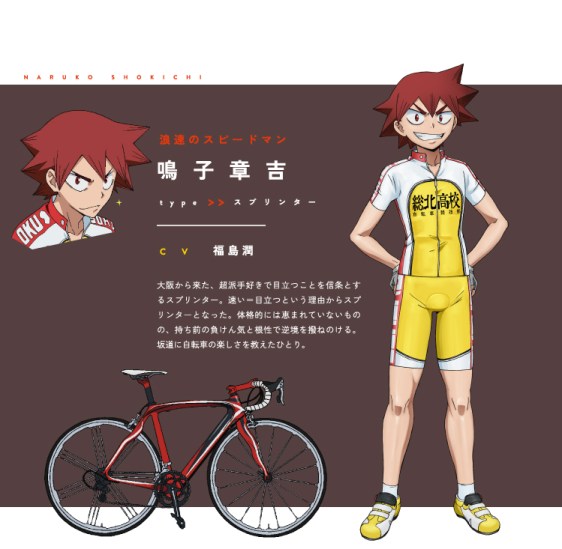
As a sports manga and anime with an enormous cast, Yowamushi Pedal is home to a variety of characters designed to contrast with each other in terms of personality and approach to competitive bicycle racing. This certainly applies to the first-years when the series begins, as all-rounder Imaizumi Shunsuke, speedy Naruko Shoukichi, and high-cadence protagonist Onoda Sakamichi are all differ from one another significantly. In looking more closely at these three characters, however, I find that they resemble professional fighting game player Laugh’s theory of the Three Fighting Game Player Archetypes. My aim here is to elaborate why I believe this to be the case, and which archetypes apply to these three.

As described by the video above from Core-A gaming, the three categories of players are brains, heart, and body. While this distinction is not exclusive to fighting games or even gaming or competition in general, I find that Yowamushi Pedal with its theme of cycling has a lot of parallels with fighting games. Although fighting games are typically 1-on-1 matches and bicycle racing is shown to be a team sport on the biggest stages, the emphasis on how a human being competes through the use and fine-tuning of their equipment is a point of commonality. At one point, a character in Yowamushi Pedal even talks about how, unlike other sports, you don’t need to be the biggest or the strongest because what matters is how you work with your bike. Replace that with “joystick” or “controller,” and the similarities start to become clearer.

In the training camp arc of Yowamushi Pedal, where the characters compete to see who will represent Sohoku High School in the Inter-High National Tournament, club captain Kinjou purposely messes with the first-years’ bicycles in order to challenge them to work on their major weaknesses. In doing so, he reveals the archetypes that Imaizumi, Naruko, and Onoda embody.

imaizumi-shunsuke-full-1565241

Imaizumi is a “brains” type, or someone who relies on superior knowledge and study to win. When Kinjou removes his ability to shift gears, it initially throwsImaizumi for a complete loop. Just as a brains-based fighting game player knows frame data like the back of their hand, Imaizumi had up to that point relied on his optimal knowledge of gear shifting to tackle any level of slope while cycling. Although he eventually overcomes this flaw during the training camp, his sheer joy when he’s finally able to reunite with his cherished gear shifters shows just how much the “heady” part of bicycle racing factors into Imaizumi’s approach to the sport.

naruko-shoukichi-full-1565240

Naruko, then, is a “heart” type, who prefers to “feel” things out. In fighting game terms, this is someone who is confident they can outmaneuver you in unorthodox situations and “mind game” you. His advice to Onoda to surprise Imaizumi with a technique in a previous race, as well as his own “Sprint Climb” maneuver, are indicative of a similar quality. At the training camp, Kinjou removes his lower handle bars, thus limiting Naruko’s ability to adapt and be as creative as he’d like. Unable to do things “in the moment” as a result, Naruko is forced to work around it.

onoda-sakamichi-full-1565236

That leaves Onoda as the “body” type. While this might not make sense given how Onoda is the “heart” of the team, that’s a different kind of conception of heart as a spiritual center. Instead, the reason why Onoda is a “body” cyclist is because of the fact that his high cadence is the linchpin of his riding style. Just as a “body” type in fighting games always has things like technical precision and perfectly executed high-damage combos to fall back on, Onoda’s ingrained ability to raise and lower his cadence like the pedals are an extension of his body lets him overcome situations where he might be “strategically” beaten. And just like the other two, when his ability to freely pedal as quickly or as slowly as he’d like is interfered with, he starts off feeling utterly helpless.

Imaizumi the brains, Naruko the heart, and Onoda the body. Together, they create a complete being, which is perhaps why they work so well together. What about the other characters, then? I’ll leave you to figure them out.

If you liked this post, consider becoming a sponsor of Ogiue Maniax through Patreon. You can get rewards for higher pledges, including a chance to request topics for the blog.

Giver of Thanks: Ogiue Maniax Status Update for November 2016

November is anniversary month for Ogiue Maniax, but I’ll be saving that for its own dedicated post (if I remember, that is. Someone please remind me!).

A big thanks to this month’s Patreon sponsors. You might not understand how much I appreciate your help, but I’ll explain at the end:

General:

Johnny Trovato

Ko Ransom

Alex

Diogo Prado

Yoshitake Rika fans:

Elliot Page

Hato Kenjirou fans:

Elizabeth

Yajima Mirei fans:

Machi-Kurada

Before going into an overview of my favorite posts of the month, I want to talk a bit about my appreciation to my readers for being curious as to what I have to say. As I go through life, I meet more and more anime and manga fans of different tastes and philosophies, but often I feel it can be difficult to engage in conversations about the nitty-gritty of anime and manga as ways to explore thought, society, emotion, and more. Talk about anime and manga floats at the surface, or, if it delves deeper, is often connected to value judgments or inside looks at the mechanics of industries. I know my audience isn’t especially large, but I am grateful that the topics I’m interested in at least pique your curiosity.

That being said, I know I’m really bad at responding to comments on a frequent basis, and I intend to work harder at fostering actual conversation on Ogiue Maniax. Also, because I’ve been more review-heavy as of late, I’m wondering if this is steering away from the strengths of the blog.

As for this month’s post highlights…

First, at long last, is a final review of one of my favorite manga in recent memory: Mogusa-san. If you love food manga, this is right up your alley.

Second, out of the many films I watched over October, Miss Hokusai has to be the one I enjoyed the most. ALso, check out Kizumonogatari Part II and Shin Godzilla.

Third, I took a different approach to covering New York Comic Con this year, and have been writing response essays to things that caught my attention. If you like giant robot toys, check out my thoughts on Soul of Chogokin Voltron and Megazord.

Lastly, I wrote a bit about Star Ocean EX, and just how 2003 it is.

I’m not sure what I’ll have in store for November, but I’m thinking of devoting a significant chunk to talking about some of my favorite recent characters.

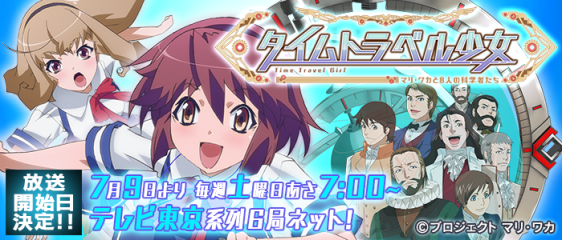
Where in Time is Thomas Edison?: Time Travel Girl Anime Review

timetravelgirl

As a kid growing up in the 1990s, there were a number of educational shows that tried their best to be cool. Some perennial favorites, like Sesame Street and Mr. Rogers, played to the beat of their own drums. Others failed miserably and came across as more cringe-worthy than anything else. But there were a handful that managed to just be “cool enough” that, while you wouldn’t brag to your friends that you were watching these shows, they still felt like they had merit and weren’t overly didactic in their “edumucatin’.” That’s exactly the territory where the 2016 anime Time Travel Girl: Mari-Waka and the Eight Scientists resides.

Apparently based on a 1983 Japanese children’s educational book called Magnets & Electricity, Time Travel Girl follows a girl named Mari as she inadvertently discovers a way to travel through time, always finding herself meeting a great scientist or inventor tied to the history of electromagnetism. As shown in the opening, the eight in question are: William Gilbert, Benjamin Franklin, Alessandro Volta, Michael Faraday, Samuel Morse, Alexander Graham Bell, Heinrich Hertz, and Thomas Edison.

In terms of look, Time Travel Girl does not seem like it comes from this era of anime, no pun intended. From the characters’ hair and eyes, to their archetypes, to even the opening itself, it looks like a show that stepped out of 2003. Placed next to older series like World of Narue or Someday’s Dreamers, it wouldn’t appear out of place at all. I think that also lends to the feeling of Time Travel Girl being a “cool” educational cartoon, because it’s like the aesthetics are a bit out-of-touch with current Japanese animation. That being said, the actual show is fairly fun and informative, and it does resolve instead of remaining open-ended. This is despite the fact that its formula makes that sort of repetition oh-so-easy.

What probably impresses me most about the series is the way it pushes the message that science and discovery are about questioning what we take for granted. By not letting assumptions (be they personal, religious, etc.) control us, it opens up pathways not only for we as individuals to learn, but also in the process creates opportunities for those in the future. A less pertinent message, but important in its own right, is that the show implicitly presents its own theory for why Thomas Edison was an asshole (seriously, look it up). There’s even a bit about slavery in the Benjamin Franklin episode.

If there’s any American cartoon series I would liken Time Travel Girl to, it would have to be Where on Earth is Carmen Sandiego? No, not the one with Rockapella, and not (despite the thematic similarities) the followup quiz show Where in Time is Carmen Sandiego? I’m talking about the one with the grandiose opening, the two kids, and the giant floating virtual head for a chief. Both it and Time Travel Girl have just enough pizazz to be entertaining, but neither are especially gripping examples of animation.

Based on my dated comparison, it’s very clear that Time Travel Girl is certainly not meant for me. However, I could actually see it being dubbed into English and broadcast on TV, as it is unabashedly an educational cartoon. I think it would do all right in that capacity, though I don’t know if we’re still at a point where the characters’ Asian origins would be removed.

If you liked this post, consider becoming a sponsor of Ogiue Maniax through Patreon. You can get rewards for higher pledges, including a chance to request topics for the blog.