Last year at this time, it felt like the world might not ever be the same again. This past month, I became fully vaccinated.
While I’m still exercising caution in a lot of different ways (including wearing a mask in public), the extra safety a COVID-19 vaccine has provided has helped tremendously to alleviate some of the psychological pressure I’ve been feeling since 2020. For the first time in a long while, I feel like I can grasp some sense of the normal again. I’m still undecided if I want to attend the recently confirmed Otakon 2021, though.
I just hope that we actually learn from the mistakes we’ve made on a social and political level, and that we must create a better “normal” than the one that resulted in a global catastrophe powered by greed and willful ignorance. I’m fortunate to be in a place where I could obtain a vaccination after a year and a half of keeping safe, as not everyone has been able to do that. The real failures—whether they’ve been in the US, Japan, Brazil, Sweden, China, India, or elsewhere—are the consequences of poor leadership above all else.
I can’t make anyone get the vaccine, and availability varies from place to place, but I hope everyone does what they can to at least protect themselves and those they care for.
Thank you to June’s Patreon sponsors, with special gratitude to the following.
I just learned that Zettai Karen Children is ending soon after 17 years. It’s amazing to see a series that ran for seemingly forever actually reach the finish line. Authors and artists, take care of yourselves!
“Whether it was his art, his storytelling, or his characters, he poured his overwhelming passion into everything. I’m trying to find the right words, but I don’t have them…My deepest and heartfelt condolences for Miura-sensei in his passing.”
Kio watched a recording of The Professional: Anno Hideaki where Anno says, “I’m okay with dying for my creations.” This made Kio’s head spin. (Having come so soon after Miura’s death, it seems to have hit Kio extra hard.)
Otaku moments with Hasegawa, previously posted on the @hashikko_music account. She worries about having accidentally outed herself as an otaku, but when asked if she’s a fujoshi, Hasegawa responds, “That isn’t the setting this time.” Also, when Shion expresses interest in Miyazaki anime, Hasegawa considers going into the deep end: Horus: Prince of the Sun, Panda Go Panda, Heidi, 3,000 Leagues in Search of Mother, Anne of Green Gables.
Kio explains that the “broken Gouf leg joint” incident from Genshiken wasn’t exactly based on reality, but he had a similar experience as a kid. In a later tweet, though, he realizes that the reason it happened to him is because model kits in those days didn’t use polycaps on ball joints, which made for a less maneuverable limb.
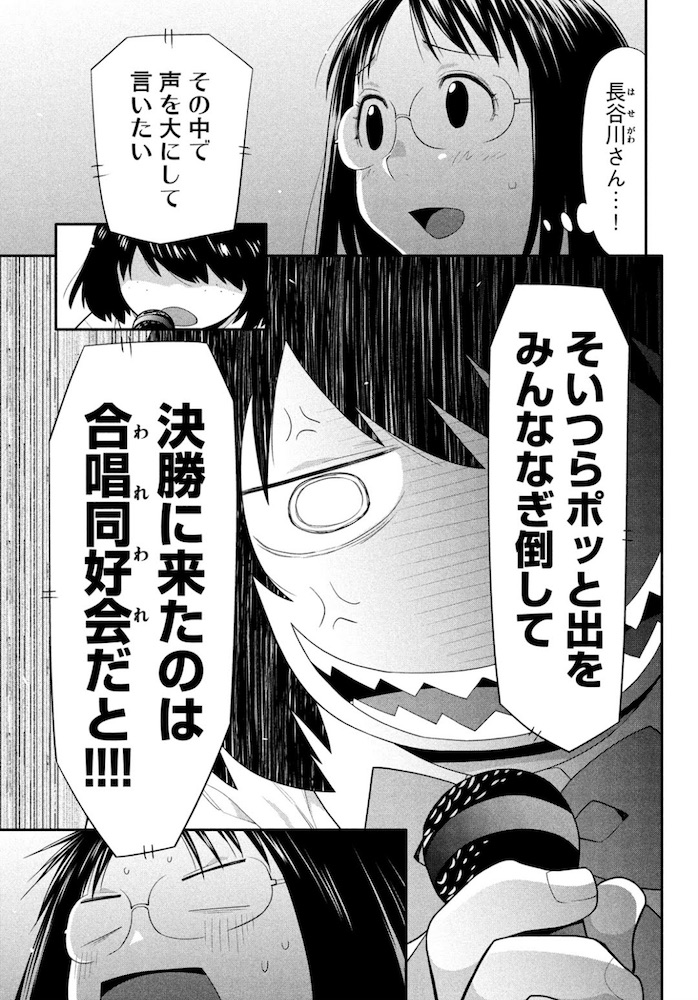
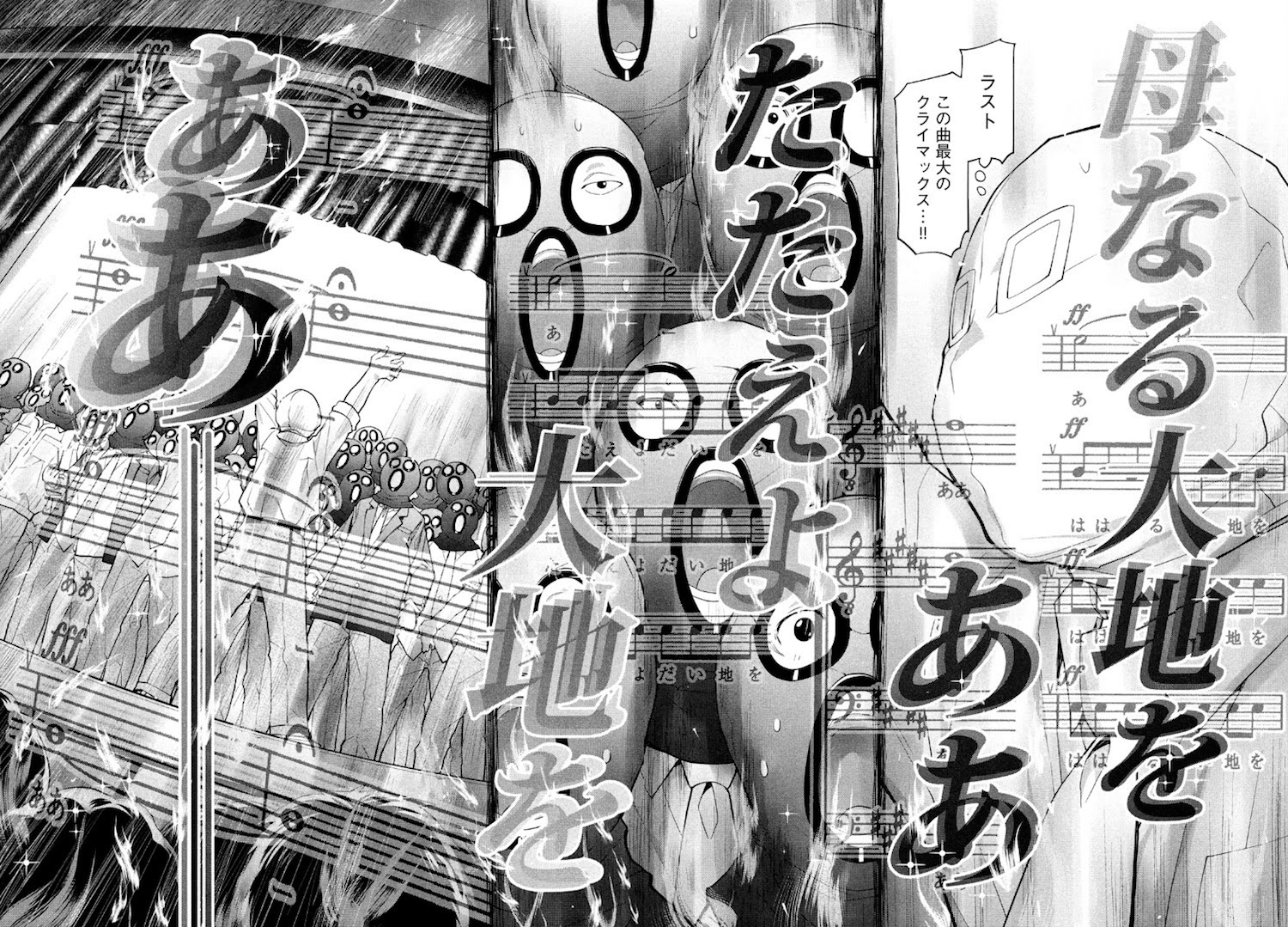
It’s time for the Chorus Appreciation Society to sing in their last song of the School Culture Festival, and Jin is nervous about being onstage in front of his mom. Fortunately, Kozue delivers a confident speech about their happiness spreading music through the school, which calms Jin down—though she then turns it into a taunting preemptive declaration of victory.
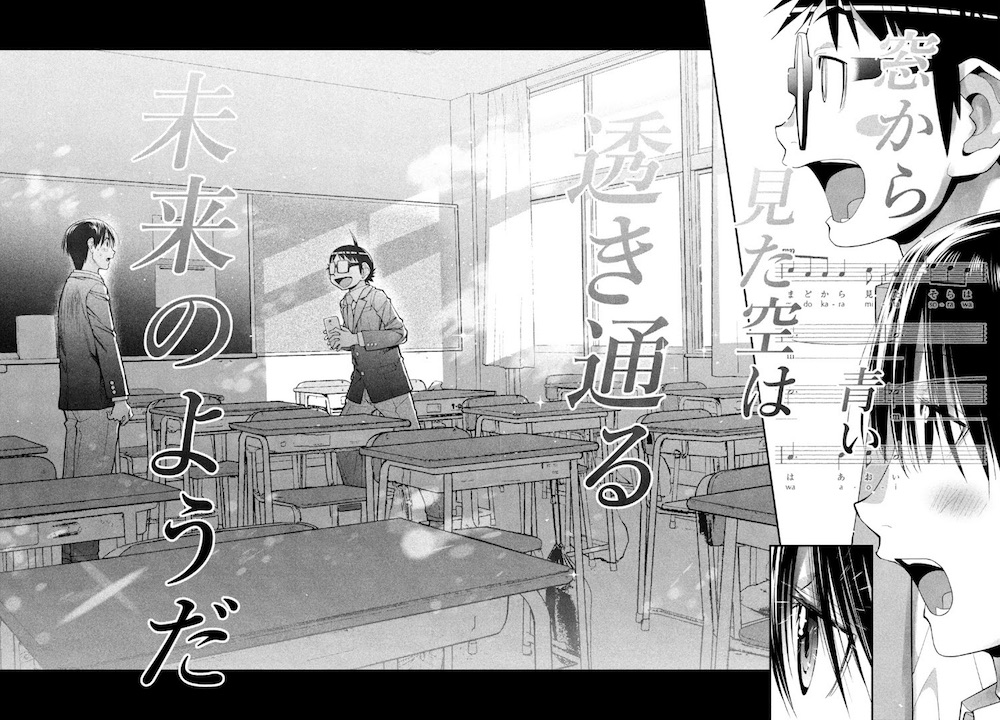
Their performance of “The Wings of Mind” begins, and the four guys harmonize perfectly, the beauty of the song causing emotions to well up in nearly everyone listening. The LED display Himari programmed displays the lyrics, and before everyone realizes it, the entire audience is doing the same as she is: singing along and being drawn into the performance. However, the chapter ends with Reika with an ambiguous expression that seems to read as her not being terribly impressed.
Song, Singular
This month, there’s only one song, and it’s the centerpiece of the entire chapter. The power of “The Wings of Mind” seems to be its ability to resonate on a very personal level with everyone listening to it. The song brings about a range of emotions: hope and disappointment, nostalgia and discovery, past and future. The two flashbacks indicate this strongly: Akira remembers meeting Jin in the classroom and being introduced to the world of music, while the senior members of the Rugby Club recall looking at the younger teammates as they themselves have to move on to the next phase of life.
This potentially ties into a previous conversation Akira had with Jin about individual interpretations of a song’s meaning. It’s something Jin has trouble with, and to see “The Wings of Heart” hitting people in different places highlights the notion that we bring a part of ourselves into the songs we hear. “Art is how you interpret it,” or something like that.
Perhaps this is why the audience gets swept on in singing. As explained in the chapter, it’s not just that the lyrics are visible, but that it’s as if everyone is being compelled to follow along by the song. Everyone, that is, except Reika.
1v1 Me, Son
The bit of nervousness (or self-consciousness) Jin feels before the performance is not just understandable—it speaks to the core of Jin’s internal conflict. His mom thinks he’s not trying to prove that talent doesn’t matter so much as he’s hiding his own lack of, and Jin is afraid that she’s right. In this respect, I think the whole “sing-along” plan he thought up might actually backfire, as I suspect Reika sees it all as a gimmick: more camouflage for Jin’s comparatively mediocre vocals.
Reika and Jin’s contrasting priorities reminds me of arguments made about competitive games. Players of 1v1 games will point to the fact that in a 1v1 scenario, you own all your wins and losses, whereas team games soften the blow of failure by giving players the excuse of blaming their teammates. At the same time, there are impressive things achieved through the group cooperation of team games that 1v1 games can’t touch. All of it is true at the same time, making it so that neither side is inherently correct.
The Hasegawa Kozue Show
Kozue carries such power in this manga, being a kind of motivational force that can redirect the inertia of the other members, not unlike Saki from Genshiken. The confidence in her speech, the way she sets Jin back on course, she’s proving more and more how invaluable her friendship can be.
Even if he never said so outright, it’s clear at this point that Kozue is one of Kio’s favorite characters. One thing I like about her character and the emphasis given to her is that she’s nowhere near a traditional “bishoujo” by manga standards, and I like that it bucks expectations and stereotypes. Even her romance (of sorts) with poor Sora from the Rugby Club feels refreshing and new.
She gets thanked by Kousei and blushes a bit, but I don’t yet see it as anything special. It feels more like Kozue is unaccustomed to such direct gratitude, especially from a guy like Kousei.
Final Thoughts
This sort of feels like the series could end soon, but I really hope it doesn’t. I want to see the club officially form, and for some new faces to give opportunities for more interesting storytelling and drama.
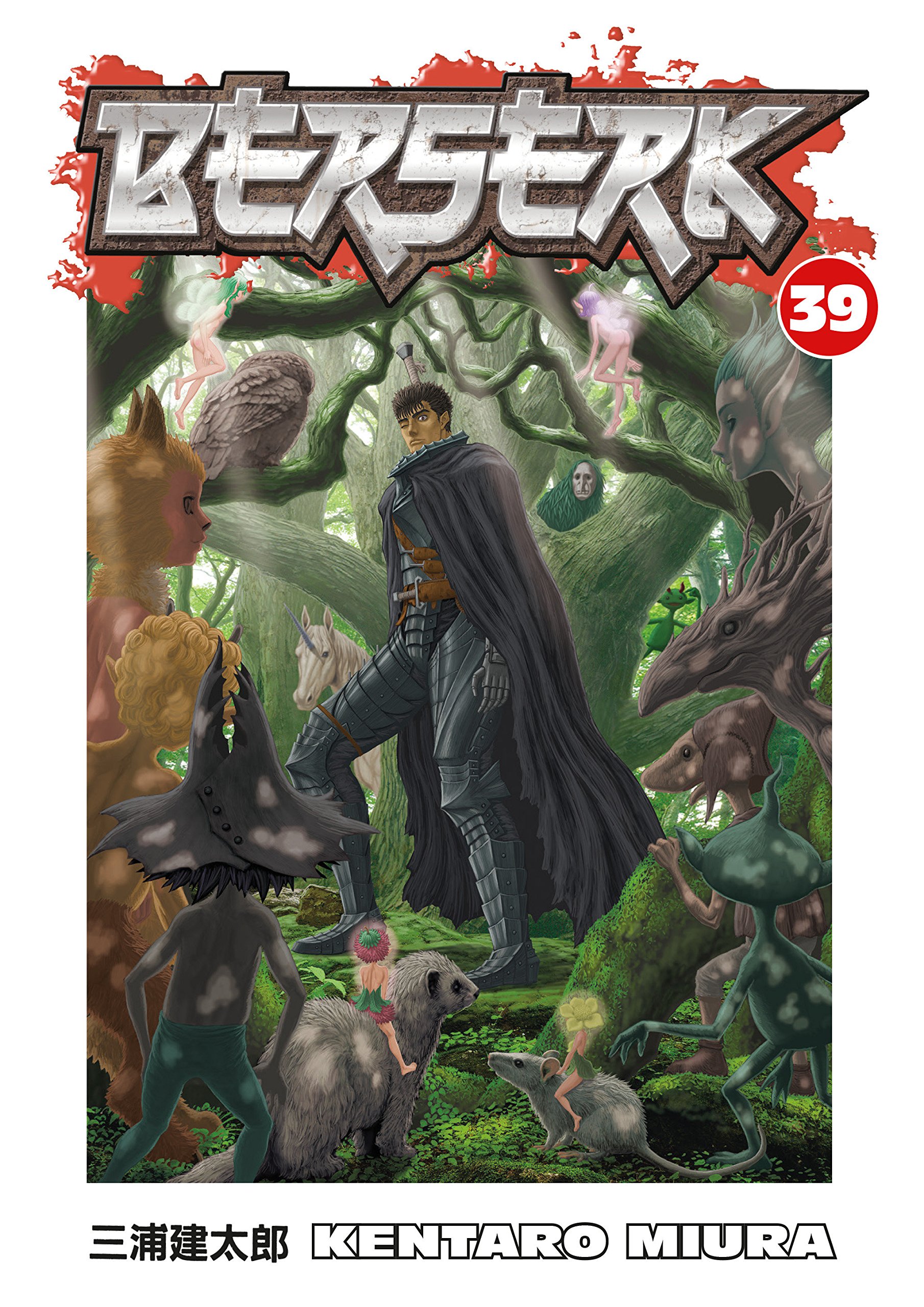
This past week, the world learned of the passing of Miura Kentaro, the creator of Berserk, on May 6th. Miura was 54. This leaves one of the most powerful and influential manga in history most likely unfinished, but more importantly, it’s the sudden and tragic end to a career of an artist whose ambition in storytelling always felt beyond human.
To be clear with where I stand, I’m not a Berserk mega fan. I didn’t spend my developing years in the thrall of its gorgeously detailed artwork like some manga readers, so my connection to the series isn’t especially personal. However, even without that intimate closeness to Berserk, it’s impossible to not feel the amount of dedication that Miura put into his magnum opus. He began the series in 1989 and worked on it for over 30 years. I don’t think it’s an exaggeration to claim the man poured his soul into Berserk—Morikawa George, creator of Hajime no Ippo and an artist to whom Miura was an assistant early in their careers, said as much:
The months passed by, and I started serializing Hajime no Ippo, and it wasn’t long after that Berserk started. Miura shared some stories of difficulty with me, but I was confident that his manga would be a hit. Kentarou-kun had poured his strength and confidence into this long-awaited serialization, after all. The world would soon be as astonished as I was when I first saw his drawings. He had a completely refined artistic skill and drew with all his soul, and I had nothing but the deepest respect for every new chapter of Berserk.
It’s one thing to have a long and sprawling story but a less detailed art style, or an intricate style but a fairly simple story. It’s another to try to go full blast in both respects. To want to tell a tale so ambitious in scope and so lovingly rendered on every page, and to make it so cohesively impactful is nothing short of astounding. Just thinking about his designs of the God Hand, malevolent deities central to the story in Berserk, leaves me amazed. In fact, it’s a wonder that Miura was able to keep it up for as long as he did, even if chapters became much more infrequent later in his life.
There’s a question of whether stress played a role in Miura’s death, given that aortic dissections can be caused by high blood pressure, and that the manga industry is known for putting people through the ringer and encouraging workaholic habits. Tezuka Osamu himself passed away unable to finish his most ambitious work (Phoenix) after a self-imposed grueling career that became a model of sorts for other creators. However, one thing that makes it hard to tell how much responsibility the manga industry carries is that Miura was an absolute perfectionist, and not the kind of creator who would compromise quality for expediency. In an interview from 2019, he mentions switching over to working digitally, only for him to end up going through his drawings pixel by pixel—a trap common enough for it to be mentioned in a chapter of Genshiken, but also something that takes on a whole new meaning now that Miura is gone.
If there was a way he could’ve told the story he wanted to tell, the way he wanted to tell it, all the way through while still being able to live to old age, I wish we could have found it. That said, it’s clear to me that the whatever disappointment remains over a potentially unfinished work, Miura’s artistry and vision of Guts’s journey in Berserk has left a mark on fans the world over.
Spotted Flower is Kio Shimoku’s refracted-universe version of his hit manga Genshiken, but as the series goes on, more and more major differences crop up. Recently, I realized that one major change might be that a few characters are, in essence, fused together from different Genshiken characters.
Since her first appearances in Spotted Flower, there has been a certain character who looks and behaves much like Sue Hopkins from Genshiken. Outside of age—Spotted Flower characters are all far into adulthood as opposed to being roughly college age—the major difference between Sue and Not-Sue is that the latter has much wider hips and larger breasts. From the neck down, she’s much closer to Angela Burton, the other Genshiken American character.
I originally chalked up Not-Sue’s physical qualities to just being another way to slightly bend the details of Genshiken to make it “different enough,” but a recent side chapter of Spotted Flower, 35.5, makes me think that the merging of characters might be a recurring aspect of the series.
In it, Not-Sasahara racks his brain over trying to interpret Not-Sue’s signals, and the possibility of a threesome. As he’s trying to shake off the mental image of Ogino-sensei (aka Not-Ogiue) and Not-Sue together nude, he has an expression that is very uncharacteristic of Sasahara but makes him look just like Kuchiki, the annoying guy from Genshiken who has issues with boundaries. The resemblance to Kuchiki is further enhanced by the character’s hairstyle. This leads me to believe that Not-Sasahara might actually be better described as a kind of “Kuchihara,” though mostly dominated by the Sasahara side in terms of personality.
Endou, the “original character” who’s actually closer to Yoshitake than anyone else is probably not a fusion, but she feels like she belongs in a similar territory. In her case, it’s almost like she’s a mix of Yoshitake and a Genshiken character who never made it off the drawing board.
Not every character in Spotted Flower is a mash-up, as plenty map onto their Genshiken characters pretty comfortably. However, I’m keeping my eye out for any potential combos from now on.
The anime adaptation of Don’t Toy with Me, Miss Nagatoro has put the “teasing character” back in the spotlight, and what I find interesting is how strongly this archetype draws fans in. I see the teasing character as a sort of middle ground between different preferences (and fetishes), and this positions it to hit a variety of targets simultaneously.
In a sense, the “teasing character” can be viewed as the grandchild of tsundere and the direct offspring of the yandere. The tsundere is all about the prickly personality, often portrayed as a character who tries to deny their own feelings or reluctantly develop them. They might attack the love interest, but they’re typically built as reactive or passive characters in the realm of romance. The yandere, however, is the twisted mirror image of the tsundere: an obsessive and dangerous love whose thrills border on horror. The teasing character, then, is a sort of a compromise between the two by being more aggressive than the tsundere but lacking the morbid violence and emotional intensity of the yandere. They actively pressure their possible love interest, throwing them off their game and rendering them helpless. Any romantic feelings are covered in layers of snark and smugness, but unlike the tsundere, the power resides primarily in the teaser.
If tsundere is too tepid and yandere is too scalding, then the teasing character might be just right. Even then, it should be noted that there are differing degrees of teasing characters. Nagatoro’s bullying isn’t quite the same as the heroines of Teasing Master Takagi-san or Uzaki-chan Wants to Hang Out, who are more prankster and brat, respectively.
I also find that the “Goldilocks”-esque nature of the teasing character extends beyond the tsundere-yandere spectrum and into other territories. So much like how the teasing character is like “tsundere but more aggressive” and “yandere but without the obsessive physical/psychological violence,” you can describe the archetype in similar ways relative to other fetishes. It’s NTR (a form of cuckolding, for the unfamiliar) but without the betrayal aspect—the powerlessness of the audience character is there, only not in as soul-crushing a manner. It’s S&M but primarily emotional and without cold contempt, meaning that all the pain and pleasure isn’t in the realm of physical pain—and it’s not the Blend S-style distanced masochism. A lot of relationships in storytelling are about power dynamics, and the teasing character is right in the thick of it.
I’m actually not that into the teasing character type (or everything I’ve mentioned beyond possibly tsundere), so my observations are limited by my lack of personal connection. If there’s more insight to be had, I’m interested in hearing from the true fans.
Witch Hat Atelier is a manga with gorgeous art, compelling plot and characters, and an endlessly fascinating world. What I’m especially impressed by, however, is the way it manages to achieve a near-perfect balance of complexity and simplicity in its storytelling. It goes beyond the boundaries of manga and deep into the general world of fantasy fiction.
A Robust Yet Accessible Tale
I love the variety brought by manga in general, but it can often be difficult to recommend titles to a wider audience because of a focus on an incredibly niche subject, an issue of how approachable problematic tropes might be, or just the sense that you have to be “into” manga to read certain titles. More emotional stories might get criticized for lacking a robustness of environment, while those with careful attention paid to world building might be seen as too heady for their own good. Where Witch Hat Atelier differs from so many titles is that it manages to be both emotional and intellectual, and makes it difficult to distinguish where one begins and the other ends.
The Story
Witch Hat Atelier takes place in a world where magic exists but is almost entirely out of reach for most people, instead being the sole domain of those inherently gifted with it. Coco, the young daughter of a dressmaker, wishes she could become a witch, but when she tries to mimic a Wizard named Qifrey by drawing runes, she accidentally turns her mother to stone. Qifrey takes Coco under his tutelage so that she can learn how to undo the curse on her mother (a forbidden spell), and it’s from Qifrey that she learns the truth: Magic is usable by anyone, but the devastation it has caused in ages past has resulted in its gatekeeping by the Wizards, who seek to keep history from repeating itself. All it takes is the right ink and the ability to draw magic circles, but with that knowledge comes great responsibility.
The Political Nature of Witch Hat Atelier
Right from the premise, you have many different elements coming together into a tale that stimulates on multiple levels. Coco is a young heroine whose goals tap into a love of the mysterious but also a sense of guilt, and the supporting characters all have their own hopes and dreams that are as myriad as their unique personalities. The true nature of magic is that it’s built on a logical system, but having it executed through drawing brings a wondrously creative and artistic side as well. Most fascinating of all, the fact that magic is essentially a form of structured knowledge evokes both the political and the philosophical—namely whether closely guarding the truth of magic is ultimately for good or for ill.
Overall
What Witch Hat Atelier manages to achieve is a story with depth and breadth. There’s an endless path of discovery beyond the characters due to magic’s history within the world, but Coco, Qifrey, and every other soul within the story are like universes unto themselves. Their stories are straightforward yet intricate, and each chapter is more rewarding than the last. It’s no wonder that this manga is so beloved. Between this and Shirahama’s other title, Eniale & Dewiela, I hope we can see more of her manga work in English.
There’s a lot going on in the world that seems out of strangest dreams and nightmares, but within the specific realm of anime fandom, the big news has been that licensing rights for the Macross franchise have, at long last, been resolved. It’s like seeing pigs fly, then transform into Gerwalk mode. For all fans who have wanted to support Macross more directly but haven’t had the means to do so, this is our chance to let the creators and everyone else know what an impact Macross has had on our lives. I haven’t written any blog posts about the topic, but I don’t have that much to say except “Listen to my song!”
There’s not much out of it yet, but in the meantime, the official YouTube channel has uploaded the full Macross Flash Back 2012 (a sort of music video compilation) for a limited time. “Tenshi no Enogu” best song, by the way.
Oh, and despite the title of this month’s update, I’m Team Misa all the way.
Moving on to May’s Patreon sponsors, I’d like to say thank everyone, especially everyone here:
Another month of Kio Shimoku tweets is here! The guy has finally learned how to thread tweets, which makes things easier for me. A lot of the month was promoting his books, as well as other titles in Rakuen: Le Paradis, where Spotted Flower runs.
Crossover Images Featuring Genshiken, Hashikko Ensemble, and Spotted Flower
“Stand like you’re being held by a string from the sky!” [a way to teach proper posture for singing]
“It’s normal for me to be hunched over, you know. *mutter*”
A duo who will never see eye to eye.
Image 2:
“So what was like in high school?”
“Well, it was pretty ordinary. I was in an otaku club…and I had long hair…”
“Ahh, Hashi Tech has one of those too. It’s called the Society for the Study of Modern Visual Culture.”
“……Huh?”
I find this amusing because I sort of think of Jin and Madarame as similar characters, but they’re actually quite different. Jin is almost like if you mixed Madarame and Kohsaka.
Also, it turns out that teenage Madarame, Tanaka, and Kugayama doppelgangers (in an actual Genshiken club) actually did make a cameo in Hashikko Ensemble!
Old drawings from the @hashikko_music Twitter. In the first, Hasegawa is commenting that Sue has a nasty expression. In the second, Himari is about to make the same comment about Ogino-sensei, but is struck by their similarities.
Kio recalls a moment from 10 years ago, where a stray cat was curiously poking at the tortoise as the latter slowly tried to scuttle away. He remarks that, amazingly, this is the same tortoise who now actively rams the window asking to be let in.
Thanking Taniguchi Jun’ichirou for his animation work on Genshiken. This includes Nidaime and the original series, where Taniguchi and Mizushima Tsutomu (who would later go on to direct Nidaime) worked on the infamous “nose hair” episode.
Jin’s mom continues to be a tour de force in Hashikko Ensemble, Chapter 39.
Summary
It’s now the finals of the Culture Festival’s music competition, and the Chorus Appreciation Society is up against the mysterious masked Basso Masters. However, not everything is as it seems. The leader of the Basso Masters isn’t anyone special or known—just a friendly third-year named Satou who was inspired by Jin to follow his interest in music. And even though Jin’s mom, Reika, gave Jin a deal to let him go to music college if they win, Jin himself doesn’t really care about that. In fact, he likes applying his match and science skills in electrical engineering, and simply wants to show Reika the merits of singing as a group.
The Basso Masters go first, but just as they begin their performance, Reika interrupts them to rearrange the singers’ positions to group them according to roles (Bass I, Bass II, Tenor I, Tenor II). She also provides some advice on how to sing from the entire body instead of just from the throat. The difference is so immediately noticeable and significant that even the members of the Chorus Appreciation Society can’t help but applaud by the end.
As Jin, Akira, and the others get ready for their turn, a student from electrical engineering brings to Jin an LED display meant to show the lyrics to their next song, “Kokoro no Tsubasa.” Here, we learn that Himari has been hard at work getting this done, going so far as to learn how to program. Akira, seeing how many people Jin has touched and changed with his passion for music (Akira himself included), encourages Jin to consider music college after all.
The Power of Reika
Once again, Reika steals the show, as she presents an interesting obstacle for Jin. I think the really challenging thing about her from Jin’s perspective is that her talent, as well as her ability to recognize talent, are undeniable. While Reika believes group singing is less important than solo performances, it’s not as if she dismisses it outright. In fact, it’s thanks to her immense understanding of chorus dynamics that the Basso Masters are able to put on an amazing performance. She also specifically tells Satou, the Basso Leader, that he’s actually pretty good at conducting, so it’s not as if she has an ego about it. Reika is simply incredibly unfiltered—another similarity she has with her son, even if they manifest differently. At one point, Reika puts on a spare pair of glasses, and the students at school instantly recognize her as Jin’s mom. The way the Kimura family carry themselves is unmistakable.
Reika’s advice for how to sing better explains a lot as well. Essentially, she says that the common folk breathe from the throat, the experienced breathe from the spine, and the true masters breathe from the heels. So, when you sing, your feelings should erupt forth like magma—through the butt, then the spine, then the throat, then the forehead, then the top of your head. Not only is it a vivid visual metaphor (especially for a song called “Hymn of the Earth”) but it explains why Reika believes that an exposed forehead makes for better singing.
Himari Working Behind the Scenes
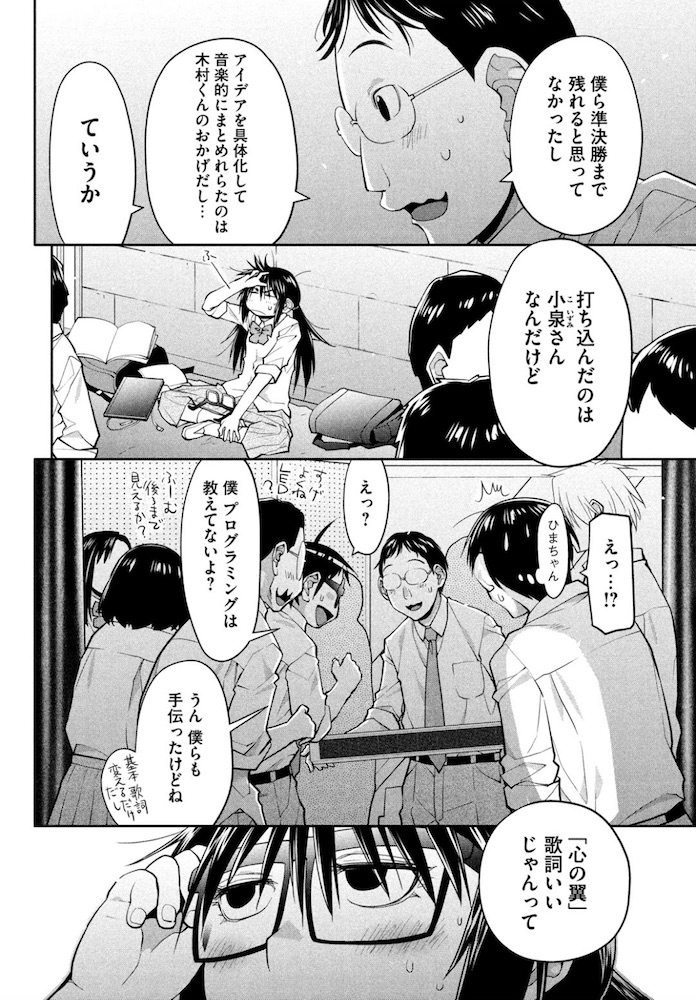
I had been wondering about Himari’s lack of presence in recent chapters, and I’m glad that it wasn’t just her being outshone by other characters. The fact that she hasn’t been in the spotlight is also quite fitting for her personality, and in hindsight I think it was the smart move overall. She’s trying to help in her own way, and she doesn’t make a big fuss out of it because she doesn’t want the attention. This likely goes all the way back to Jin leaving Himari’s apartment (and the inevitable misinterpretation of events that occurred): she was probably helping Jin with this LED display. Moreover, Akira points out that Himari has always been fond of picture books and poetry and such, so the lyrics of “Kokoro no Tsubasa” must have resonated with her.
Himari isn’t a writer, as far as we know, but could her appreciation of the written world lead to her eventually joining the Chorus Appreciation Society? Either direction would work, and would indicate where her character has headed.
Songs
Basso Masters: “Daichi Kinshou” (Hymn of the Earth) from the cantata “Tsuchi no Uta” (Song of the Land)
“Kokoro no Tsubasa” (“The Wings of Mind”) composed by Kitagawa Noboru
Final Thoughts
I’m worried that something disastrous is going to happen to Akira and Jin! Something tells me the conflict with Reika isn’t over by a mile.





 OGIUE MANIAX