Love Over Hate: Ogiue Maniax Status Update for November 2020

It’s no secret that politics and the health of the United States has been on my mind these past few months, and now we’re a mere two days away from Election Day. I hope that this is the most important election of my life, because I don’t want to imagine another presidency worse than this past four-year ordeal. For those who have already voted, either by mail or through early in-person voting, I hope you remained safe. While I am deeply horrified at the idea of Trump getting another term, I respect the exercise of democracy as long as all who are rightfully eligible are afforded the same opportunity.

Please bear with me as I express my strong beliefs about this election.

Long-time readers may know that while I could touch on a lot of related topics in years previous, my specific political beliefs were rarely ever front and center on Ogiue Maniax. However, the 2016 election changed something in me, as I came to feel that my distanced academic outlook did not do enough. While I still believe in robust dialogue aimed at finding common ground, I’m much more aware of the fact that right-wing extremism is a dangerous part of the current landscape, whether that’s attempting to recruit kids through video games, voter suppression, or outright violence. I changed my policy of allowing any and all relevant comments to a blog post because there’s a difference between disagreement and merely wearing a facade of civil discourse as a means to push ridiculous ideas. I recently deleted a comment that started with the notion that “wokeness” is ruining anime because it’s an extension of a general right-wing corrosion of Youtube as a whole.

As for Trump himself, I’m going to say straight-up that he needs to be stopped if the United States is to survive, literally. We cannot take even more negligence and death rates when it comes to COVID-19. We cannot take a man who purposely sabotages the US Postal Service in the age of a pandemic and in an election year. We cannot take a man who will sell out the US to the highest bidder, a man who abandons allies to the slaughter and allows bounties on American soldiers. We cannot take a man who thinks climate change is fake yet also believes windmills cause cancer. The Paris Climate Accord is crucial to the well-being of not just the US but the entire planet, and if the country does not rescind our withdrawal, we are headed straight for catastrophe upon catastrophe. Most importantly, we cannot take more damage from the Republican Party, which has enabled this would-be dictator to escape responsibility just because they use him as a battering ram to get more federal judges into the system, including three Supreme Court justices.

To all readers in the US, if you see voter intimidation at your polling place, contact the Election Protection Hotline.

And now, back to Ogiue Maniax proper.

Thank you to this month’s Patreon sponsors.

General:

Johnny Trovato

Ko Ransom

Diogo Prado

Alex

Dsy

Sue Hopkins fans:

Serxeid

Hato Kenjirou fans:

Elizabeth

Yajima Mirei fans:

Machi-Kurada

Blog highlights from October:

Smash Bros. and the Concept of Restrictive Consequences

A thorough look at how the notion of constant freedom plays heavily into competitive Smash Bros., and how it contrasts with the ability to be “very wrong” in other fighting games.

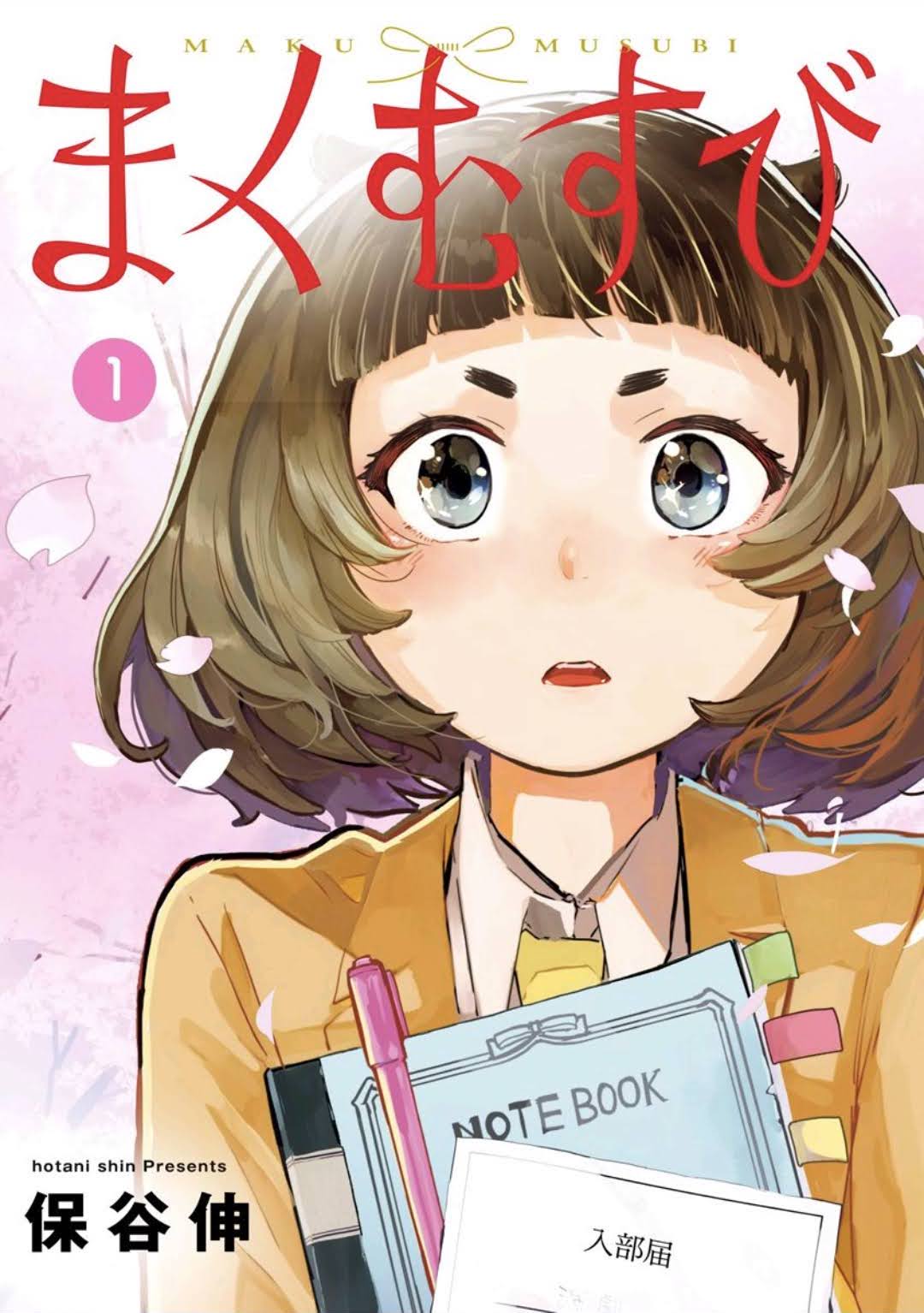
Manga Made for Theater: Maku Musubi

A recent manga series focused on a school drama club that has a nice theme of finding a new creative direction after the loss of a dream.

Dick Dastardly’s Gun Kata: Appare-Ranman!

Last season’s transcontinental racing anime is not quite what I expected.

Hashikko Ensemble

Chapter 33 starts a battle of the bands at the high school culture festival! Lots of great side characters return for this one.

Patreon-Sponsored

Anime Faces: VTuber vs. Horror Games

Thinking about how the limitations of virtual youtubers actually enhances the horror-game-streaming experience for viewers.

Apartment 507

Love Live! Nijigasaki’s Yu Takasaki is the Perfect Audience Character

The new anime pulls off transforming the mobile game’s player character into a fleshed out individual.

Closing

Vote if you can, stay safe no matter what, and I’ll see you on the other side.

16 Bands Enter: Hashikko Ensemble, Chapter 33

Fierce (?) competitors lie in wait in Chapter 34 of Hashikko Ensemble!

Summary

The school’s cultural festival has suddenly turned into a battle of the bands, and the Chorus Appreciation Society is in a 16-band bracket to see who comes out on top. Among the groups participating are a number of familiar faces: Kurotaki Mai (the deep-voiced girl who once saved Akira), Tsuyama’s crew, Mimi-sensei and a group of teachers (with Takano-sensei on piano), and even the Rugby Club that tried to recruit Kousei. 

During this, Shion is visibly bothered by Yukina’s presence and closeness with Kousei, all but confirming her having romantic feelings for him. But when Kozue asks why Yukina’s into Kousei, her answer absolutely flabbergasts Shion: “Cuz he’s cute.” 

Mai’s band wins, and the teachers forfeit their match because all they really wanted to do was put on a single performance. The Rugby Club is going directly against the Chorus Appreciation Society in the first round, and to everyone’s surprise, one of the players, Sora, asks Kozue to go out with him if the Rugby Club wins. She agrees but only as a form of rejection—she actively encourages the audience to reject their opponents and Sora’s convenient love story in the making. However, the Rugby Club turns out to be better singers than she anticipated, meaning it might not be such an easy win after all.

A School Tournament?!

It’s not surprising to see tournaments happen in Hashikko Ensemble. After all, if they’re going to eventually be in bigger events, the Chorus Appreciation Society is going to have to see some long competitions. However, this is quite different from the more refined environment and structure of the M-Con, the inter-school event they had previously they participated in as an exhibition.

I really like this direction, particularly that the series has suddenly become more about music in an interesting way by having music fever take over the school and generate all this excitement and energy. Also, while it’s indeed looking to be a tournament arc after all, “winning” seems less important than having all the characters reach their personal goals. Looming overhead is the powerful shadow of Jin’s mom (despite the fact that she hasn’t even shown up yet), and in a sense, she’s the real boss fight.

Love Bonanza

The increasing presence of romance in Hashikko Ensemble is all but undeniable. It’s not even that Shion’s interest in Kousei is clear as day now, but also the strange love polygon that now exists between her, Akira, Kousei, Yukina, and maybe even Mai. What’s more, there’s also the lovey dovey couple team (Yukio feat. Mayomyon) metaphorically tossing hearts into the air, and a public confession to Kozue from the kid who tried to warn his classmates about her judo skills?!  And the latter’s going to be the most pressing plot point leading into Chapter 34?!

It’s not nearly as messy a relationship web as good ol’ Spotted Flower, but it sure is getting increasingly complicated.

Knowing this manga, I could see Kio swerving the readers by having the Chorus Appreciation Society lose in Round 1, and having Kozue reluctantly start dating Sora. There’s maybe one path of hope for the rugby player, which is that a person can earn Kozue’s respect through skill and power. In this chapter, she basically gushes over Yukina’s high proficiency in a huge array of industrial skills (including gas and arc welding, crane operating, etc.), so if the poor guy can show similar prowess (in singing or otherwise), maybe he can impress her. That said, it’s probably more realistic to see Kozue be into Yukina.

Divergent Feelings

I was thrilled to see Mai show up again in this chapter—doubly so to see her singing. All signs have pointed to her becoming a more important character as the series went on, and while it’s still uncertain that she’s going to join the Chorus Appreciation Society, I’m still rooting for it. There’s also the matter of her previous interactions with Akira, and while he has Shion on the brain currently, I could see a future where these two get together instead. 

I think Hashikko Ensemble has been emphasizing how different potential relationships can potentially end up being in terms of interpersonal dynamics. Chapter 33 highlights this by the ways that Shion and Yukina each view Kousei; the former sees him as brave, cool, and strong, while the latter looks at him like a cute underclassman. When picturing those two possible couples, they’re just so fundamentally different. But this is also the case imagining Akira with Shion versus Akira with Mai, which has a similar dynamic of two very different individuals on the one hand, and two very similar people on the other. 

Songs

This time, I’ve included each of the groups participating in the tournament this chapter, followed by what song they perform.

Nighttime Festival Club 2.1: “Itoshii no Ellie” (“Beloved Ellie”) by Southern All Stars

Noi Majo (Kurotaki Mai’s quartet): “Hakujitsu” (“White Day”) by King Gnu

Yukio feat. Mayomyon: “Shibuya at 5 o’clock” by Suzuki Masuyuki and Kikuchi Momoko (You might recognize Suzuki as the singer of the opening to Kaguya-sama: Love Is War)

Teachers’ Angel (Mimi-sensei + other faculty): “Boku no Koto” (“About Me”) by Mrs. Green Apple

Rugby Club A Capella Group: “Zenzenzense” (“Past Past Past Life”) by RADWIMPS (as heard in Your Name)

Final Thoughts

Back in the pre-pandemic times, I used to go karaoke somewhat often. One of the most common songs among one of the groups was actually “Zenzenzense.” This chapter makes me want to learn all these other songs and bring them out someday. May there be a future where we can karaoke to our hearts’ content.

Manga Made for Theater: Maku Musubi

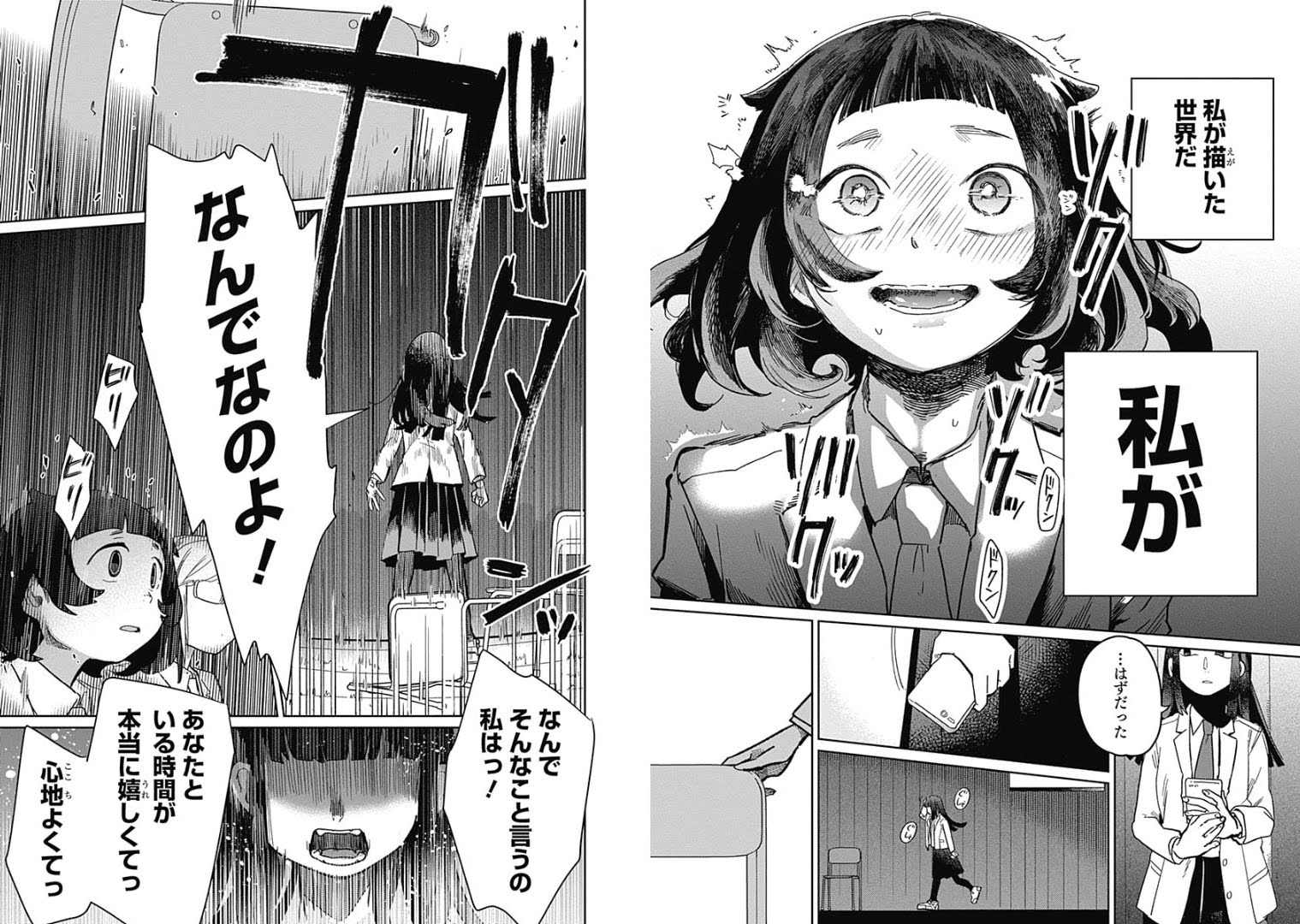
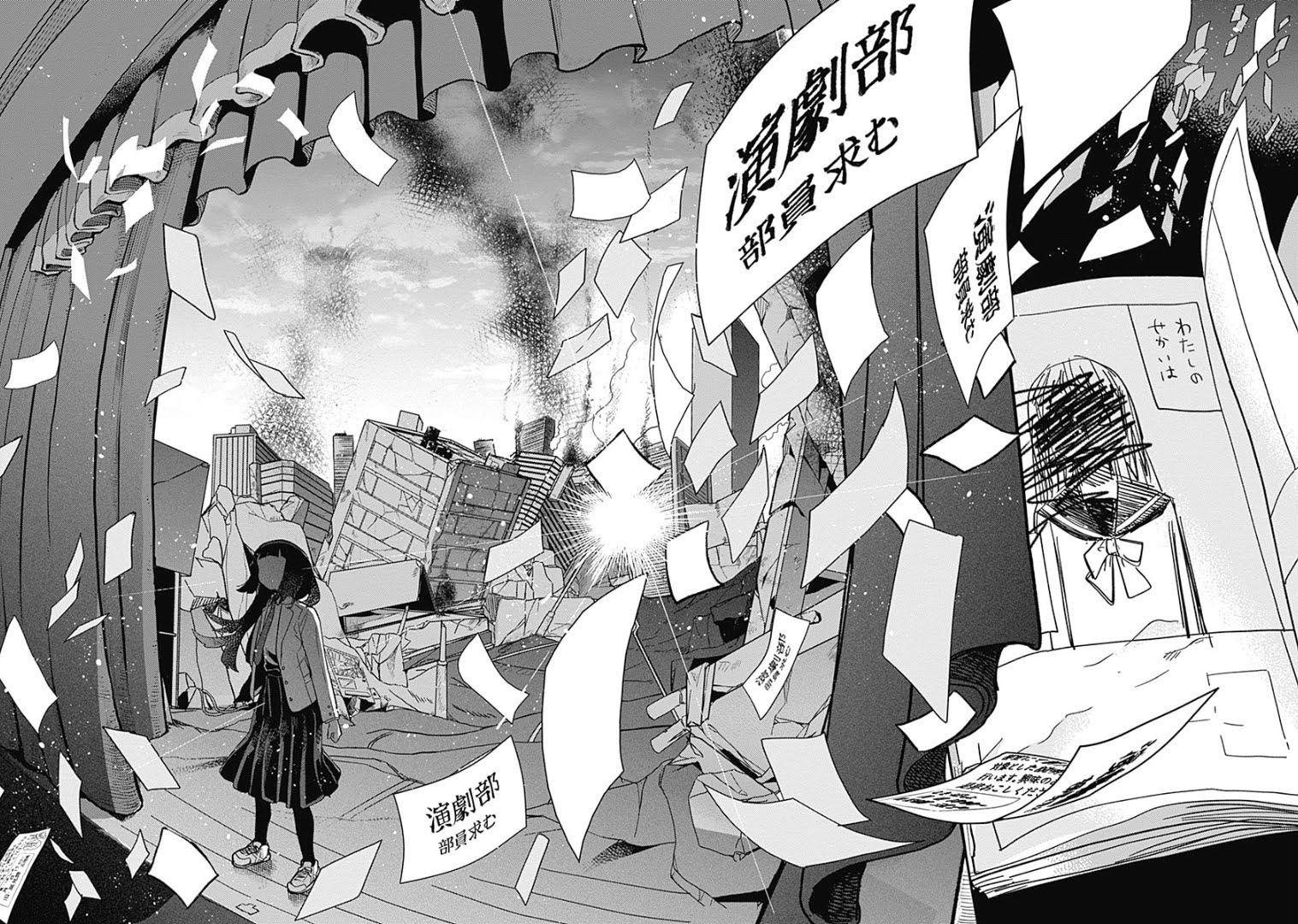
Whether it’s Glass Mask or Beastars, there’s something exciting about seeing theatrical performances in manga. Perhaps it’s because we’re viewing a medium that thrives on ingenuity in presentation and strongly projected emotions through the lens of another that emphasizes dynamic page composition and intense closeness. A recent genre work, Maku Musubi by Hotani Shin, stands out because of how it delves deeper into the process of creating a play, told from the perspective of a girl discovering her potential as a scriptwriter.

The plot: When she was little, Tsuchikure Sakura loved to draw manga. But now, as she starts high school, Sakura sees her childhood art as a hurtful and embarrassing part of her past. When one of her old drafts inadvertently ends up in the hands of the school’s drama club, Sakura gets drawn into their world. While her drawings don’t make for the best manga, they might just be the perfect material for theater.

It’s always a little heart-wrenching to see someone’s dreams get shattered, and Maku Musubi goes in depth on just how much drawing manga meant to Sakura. It was her way of letting her imagination flourish, unbeholden to the judgment of others, but it’s also due to past criticism that she feels unable to keep making comics. This is not uncommon in stories both fictional and real about creators, but I find the angle about Sakura’s pivot towards theater to be filled with storytelling potential. 

Many works would keep her on a path towards pursuing a career in manga with a “never give up” theme. Maku Musubi instead presents the interesting notion that its heroine isn’t necessarily untalented as an artist, but rather just hasn’t found the avenue of expression that best fits her. Although a story about teenagers, I think it has the power to resonate especially with adult readers, who might look at their own lost childhood aspirations with a bit of regret, but who could find inspiration in channeling those dreams in a different but still fulfilling direction.

This manga also has a great cast of supporting characters, especially the members of the drama club. A mix of experienced but eccentric upperclassmen and newcomers looking for change in their own lives, it greatly reminds me of the club aspects of Sound! Euphonium and even Kannagi to some extent. The introduction of a nationwide competition between school drama clubs also brings it away from a slow-paced slice-of-life feel and towards challenging its characters to change and grow. 

Maku Musubi was actually on my radar for a while, and I’m actually kind of mad that I didn’t get around to it sooner. As of Volume 1, Hotani’s work really appeals to my taste and aesthetics, especially with its cute yet striking depictions of both inner and outer human emotions. Consider me a fan, and I can’t wait to see these characters on a bigger stage.

Talk About a Scary Month: Ogiue Maniax Status Update for October 2020

The new anime season is starting up with plenty of potentially great shows, and we’re one month away from one of the most important general elections in the history of the United States. It would be an understatement to say I’m feeling some whiplash.

Before I get into the two sides, though, I want to thank this month’s Patreon sponsors.

General:

Johnny Trovato

Ko Ransom

Diogo Prado

Alex

Dsy

Sue Hopkins fans:

Serxeid

Hato Kenjirou fans:

Elizabeth

Yajima Mirei fans:

Machi-Kurada

First, the fun part:

For the new anime season, there are strong sequels galore—the two I’m hyped for are Haikyu!! To the Top part 2 and Golden Kamuy season 3. In terms of new titles, I’m curious about Dragon Quest: The Adventure of Dai (I’ve heard good things about the manga over the years), Hypnosis Mic (because everything fans have told me about it is bonkers), and Taiso Samurai (gymnastics + MAPPA).

I’m also looking forward to experiencing Love Live!: Nijigasaki High School Idol Club as a full-on anime instead of as the story in a mobile game. I’m curious to see how the different art style they’re using will affect the feel of the show. The Fall usually is traditionally great for anime, and while real-world events have thrown many anime off course, things are looking strong for now.

And then the not-so-fun part:

We are less than one month away from seeing if the United States is capable of rejecting a president who wishes he was a dictator, the corrupt politicians and businessmen who continue to enable his reckless destruction of the US, and whose combined greed and incompetence have the blood of over 200,000 people on their hands. And now, we find a president who not only denies reality when it gets in the way of him being beholden to debtors for what may be over a billion dollars, but is also currently hospitalized due to COVID-19: the very pandemic that he has tried to deny over and over again in order to prop up the economy at the expense of human lives.

I know I have readers outside the US, and you don’t have a direct say in the outcome of this election, but you’re probably concerned. I’m thinking of this as the most important election of my life, but that’s only because I hope and pray that it doesn’t get worse from here.

Now, back to good ol’ anime blogging.

Blog highlights from September:

Gattai Girls 11: “Granbelm” and Kohinata Mangetsu

Gattai Girls—wherein I review giant robot anime starring female pilots—is back!

Wyld Stallyns’ Greatest Triumph: Bill & Ted Face the Music

My review of the long-awaited sequel to one of my favorite movie franchises of all time.

Try Angles: My Teen Romantic Comedy SNAFU Climax!

The anime adaptation of one of the best modern light novels comes to a close.

Hashikko Ensemble

Chapter 32 starts a new trimester and a new story arc for the singers of Hashimoto Technical High School, and it’s one of my favorite chapters yet.

Patreon-Sponsored

Hololive EN and Multilingual Fluency Among Virtual Youtubers

Some thoughts on crossing the language and (sub)cultural barriers through the new English-language VTuber group

Apartment 507

The Matter of Family in Demon Slayer: Kimetsu no Yaiba

When it comes down to the appeal of this popular series, I really think it’s about familial love.

Closing

Take care of yourselves.

Over the Top: Hashikko Ensemble, Chapter 32

A new story arc begins in Hashikko Ensemble, Chapter 32!

Summary

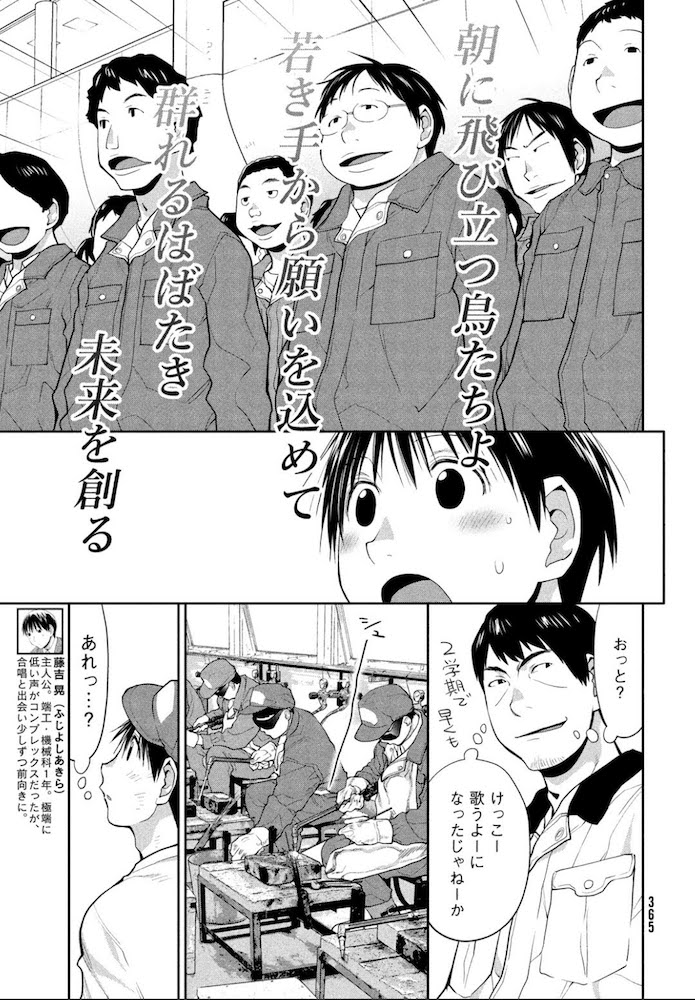
Summer is over, and the students at Hashimoto Tech are back to school. While things seem mostly the same, there are some differences. For the Chorus Appreciation Society, they can now use the music room to practice. Tsuyama’s crew, the Mimi-sensei-obsessed guys who had previously competed against the Chorus Society, now all have girlfriends. And for some reason, there seems to just be a lot more singing at school overall. It turns out that the latter two things are related: Tsuyama and co.’s performance in front of the school is the reason they got girls, and now all the boys think a capella is the key to popularity.

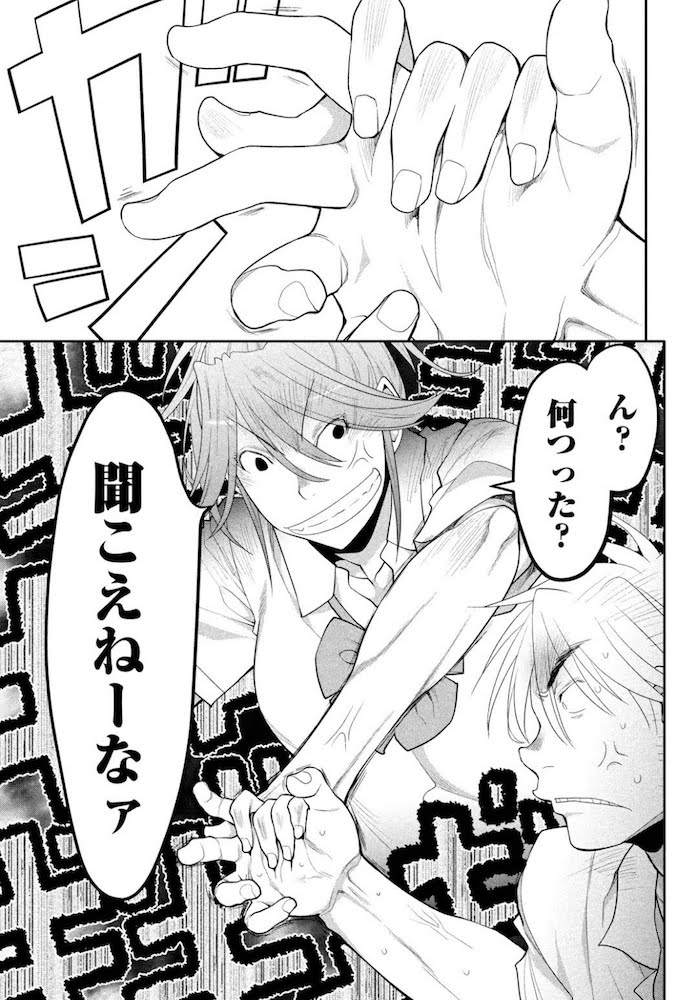
Back with the main characters, Jin is naturally beyond excited about more singers at school, Mimi-sensei is having a bit of a crisis over losing her place as conductor to Hasegawa Kozue, and Shinji wonders why the girls aren’t coming to them. Right then, a tough-looking girl shows up next to Kousei, and when he tries to shoo her away (assuming that she doesn’t care about music), she puts his hand in a death grip and overpowers him. Kozue identifies her as Kawamura Yukina, a third-year construction major and the school’s reigning arm wrestling champion—a title she won by beating both guys and girls.

The chapter ends with students remarking about how many damn a capella clubs are springing up. It all looks to be headed in one direction: a singing tournament!

Excitement

I love this chapter.

I thought I knew where this manga was going, with Jin trying to prove his mom wrong and Akira fretting over Shion. However, the way the school has changed feels like a subtle yet still seismic shift, as if they’re entering a new environment where the rules are different. What’s more, this all stems from their singing! This series is delightfully hard to predict at the best times.

It’s typical of an action or sports series to up the stakes or expand its scope, and this feels similar yet noticeably different in terms of fallout. Genshiken didn’t really do story arcs in the traditional sense, and I find Hashikko Ensemble to be somewhere in the middle in a good way.

Mama Mimi

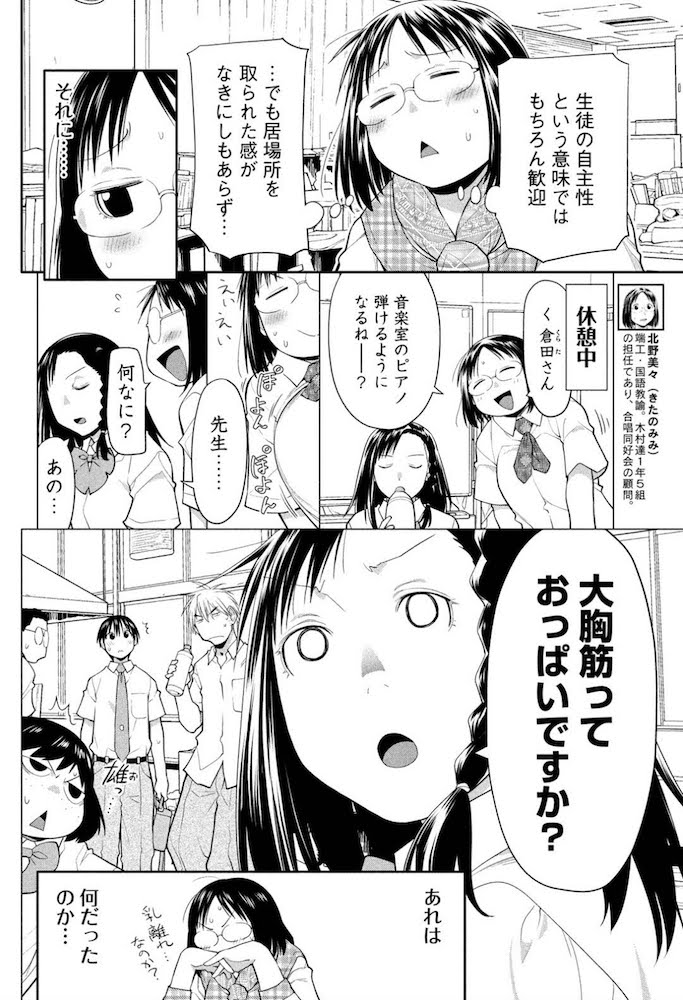
I do feel for Mimi-sensei, but what I’ll probably remember more about her in this chapter is her hilarious interaction with Shion. No longer conductor, she tries to let Shion be comforted by her, but Shion responds by asking, “Are pecs boobs?”

Later, Mimi wonders if this like a child being weaned from their mother’s breast.

The ridiculousness of Shion’s question followed by the wordplay from Mimi is top-notch.

Yukina is a Badass

Yukina is technically not a new character, but might as well be. It’s not 100% certain if Yukina is a delinquent, but she certainly has that energy. 

I really want her to join the group.

While she’s not the only physically strong girl around (Hasegawa is a skilled judo player), Yukina adds a certain level of cool. Not only would she be the oldest among the students, but her connection to Kousei—whatever it may be—seems intriguing. At the very least, we haven’t seen anyone treat him so lightly 

Is there an element of romance between the two? The characters are certainly entertaining the possibility. Akira thinks Shion might have a crush on Kousei, so he immediately tries to see how Shion reacts to Yukina, but it’s not entirely clear. I can practically feel Akira’s incredible self-consciousness, though I still think he’s somehow mistaken.

Songs

In this chapter, they practice “March 9” by Remioromen, which is Shinji’s pick for the Festival.

They also sing the official school song, though there’s no audio resource for that.

Final Thoughts

When Shinji asks why they’re not getting any girls, Kanon responds that 1) the Society already has girls and 2) a capella is cooler. It makes me think about how I’ve been translating gasshou as “chorus,” but “glee” could work just as well. And one particular TV show aside, it’s true that glee clubs are not exactly considered exciting. I do wonder if I should have been translating it as glee all along, but I can live with my choice.

I Love Villains with Secret Weaknesses

One of the big mysteries of One Piece is just how Blackbeard is able to use multiple Devil Fruit powers when that should theoretically kill any being. I don’t have any strong theories as to what the truth is, but I do know one thing: when we do discover the secret, I think it’ll be one of the most satisfying moments in the entire series.

I love that trope, I really do. Whether it’s Sauron realizing that the One Ring is steps away from Mount Doom, and is filled with terror, or Voldemort coming to the horrifying realization that his Hocruxes are being eliminated, one of my favorite moments in fiction is when a villain realizes that their special hidden achilles heel, and thus they themselves  have been exposed.

If I were to say why I’m so fond of this idea, I’d say that it comes partially from how it resembles “boss fight” sensibility. Of course, this sort of storytelling element predates video games by a significant margin, but it is arguably most straightforward in the context of games. Only the worst weapon can harm Dr. Wily. Lavos Core attempts to fool enemies by hiding its true self in a seemingly unimportant floating “pod.” This idea can even extend to something like Gradius, where the final boss is a weaponless and disembodied brain. Here, the idea is that your final adversary is defenseless precisely to imply that you were never “supposed” to reach it—the soft, squishy point behind layers and layers of minions and firepower was meant to be unassailable.

But that puzzle aspect is only one component, and what really makes it satisfying is that the moment of unwanted revelation about their weakness being exposed is predicated on a contradiction. Villains like Voldemort and Sauron want to be invincible, but by pursuing that goal, they inadvertently create the cracks in their own armor. Voldemort fears death above all else, so he tries to achieve immortality by placing pieces of his soul into other objects and hiding them away, which in turn makes those very items a source of obsession for Voldemort. Sauron is already immortal, but his desire to control and dominate everything results in his transferring most of his power into the One Ring. Even when he first loses the One Ring in combat, the fact that it’s near-impervious gives Sauron a certain reassurance. He will eventually reunite with the ring because nothing is strong enough to get into Mordor if it’s not on Sauron’s terms. They use both smoke and mirrors and sheer martial strength to try and hide these flaws, so to see their best-laid plans begin to crumble gives me joy.

It’s precisely because Blackbeard goes to such great lengths to hide the workings of his multiple-Devil-Fruit usage that makes me confident that the reveal (and the ultimate use of it against Blackbeard) will be one of the best plot threads to come out of One Piece. His obsession with power, and the weak-minded truth of his being provide a perfect formula for this trope to play out in the best way possible.

Nine Feels Like Seven: Ogiue Maniax Status Update for September 2020

I seriously am having trouble believing that we’re almost to the Fall season. Nothing says to me the effect that COVID-19 time dilation has had on my mind that the month of August feels like it went by in a flash.

In terms of anime news, what sticks out most to me is that the last big anime con of the year, Anime NYC, has finally declared its cancellation for 2020 due to the ongoing pandemic. While New York City has managed to go from the highest infection rate in the nation to the lowest, an event with 30,000+ people is inevitably going to be the worst kind of Petri dish. They made the right choice.

However, even before anime and anime cons, the ever-approaching US election is occupying my thoughts, fears, and even hopes. If you’ve read this blog at all lately, you know where I stand politically, and I strongly feel that continuing down this same dark path created by systemic racism, income inequality, and Trump’s unbounded corruption is going to lead to a United States that is weaker, sicker, and more concerned with hierarchy than equality at the expense of its people and its economy. If you’re a US citizen and you haven’t registered to vote yet, there’s still time. And while I can’t force anyone to vote one way or another, I do hope we can all recognize the threat of authoritarianism we have seen explode in recent months.

Anyway, back to your regularly scheduled Ogiue Maniax update with this month’s Patreon sponsors.

General:

Johnny Trovato

Ko Ransom

Diogo Prado

Alex

Dsy (NEW PATRON!)

Sue Hopkins fans:

Serxeid

Hato Kenjirou fans:

Elizabeth

Yajima Mirei fans:

Machi-Kurada

Blog highlights from August:

Healin’ Good Precure and the Age of Coronavirus

My thoughts on the potential impact of COVID-19 on the biggest magical girl franchise.

A Farewell to Arms, the Studio Behind Genshiken 2

Genshiken 2 came out when Ogiue Maniax first started, so with Arms declaring bankrupty, I thought it to be a good time to reminisce.

Success and Failure in the Ongoing Attempt to Bring Giant Robots Back to Kids

The site’s most popular post in a while, this is my survey of kid-oriented mecha shows of the past 10 years.

Hashikko Ensemble

Chapter 31 is the most music-heavy chapter yet, but more importantly, it talks about Macross!

Patreon-Sponsored

Saint Snow’s Dazzling White Town Is from Another Time

My review of the debut single of Saint Snow from Love Live! Sunshine!! Spoilers: The songs are amazing.

Apartment 507

Mobile Games Are Temporary, But Their Anime Are Forever

With the announcement of the North American version of Magia Record closing, this article feels even more relevant.

Closing

The United States is not the only country facing the threat and sad reality of authoritarianism. Stopping this hateful and foul ideology is paramount for the safety of the entire world, and I hope we can make our way out of this to a better place.

More Like “Protoculture Festival”: Hashikko Ensemble, Chapter 31

After months of focusing on the same song, the musical possibilities explode.

Summary

Still at their summer training camp (of sorts), the Chorus Appreciation Society decides that they will do four songs for the school culture festival. The only catch is that they’re having trouble narrowing down a final list, even after listening to a wide variety of options.

Ultimately, the group decides that the songs will be chosen by three of the singers plus Hasegawa choose, with Orihara abstaining. To everyone’s surprise, despite his previous objections, Jin actually chooses a song with piano. What’s even more surprising, then, is that Akira doesn’t. While the gentle and harmonious tunes of Akira’s pick resonate with the whole group, Shion is clearly upset and calls Akira a traitor for the second time, despite having forgotten about the first incident.

Songs They Didn’t Choose

Normally, I leave the song list to the end of the review as a bit of extra fun. However, since there’s so many this time and they’re such a central part of this chapter, I thought it best to list them all from the beginning, to split the list up, and to make it the main focus of this review.

Part of the fun is also in looking up what all of these sound like to get a better understanding of why they were or weren’t picked. There’s also the inevitable hurdle of manga being a non-audio media, and I think Kio still hasn’t figured out a way to make the visualization of each song feel different, so it can make the reading experience feel a bit incomplete.

“Daitokai” by Crystal King, aka the Fist of the North Star singers. I actually wish they picked this one!

“Ame” (“Rain”) composed by Tada Takehiko

“Gekkou to Piero” (“Moonlight and Clown”) composed by Shimizu Osamu

“Composition for Men’s Chorus” composed by Mamiya Michio

“Kareki to Taiyou no Uta” (“Song of the Withered Tree and Sun” Ishii Kan

“Kotoba Asobi Uta 2″ (Song Playing with Words 2” and “Kabe Kieta” (“The Wall Disappeared”) composed by Niimi Tokuhide

“Koi no Nai Hi” (“A Day Without Love”), “Itsu kara Ya ni Tatte”, and “Hakobune” (“Ark”), composed by “Kinoshita Makiko” 

“Mizu no Inochi” composed by Takata Saburou

Gabriel Foure’s “Requiem Op. 48” (This wasn’t a choice, just a song Orihara wants to listen to on top-of-the-line audio equipment.)

The Four Culture Festival Songs

What I find interesting about these is how the reasons behind each pick clearly reflect the characters themselves.

“March 9” by Remioromen 

Shinji purposely picks a song that everyone is familiar with, given that the established goal is to attract new members and become a full-fledged club. It has a soft pop rock feel, and I think it speaks to the fact that Shinji has gotten into singing but is still all about exploring castles. Even though I personally didn’t know this song, it just comes across as the most conventional choice.

“Do You Remember Love?” by Iijima Mari (cv. Lynn Minmei)

Last chapter, I predicted that Hasegawa would go for a Ghibli song, but she hit me with the curviest of curve balls, instead opting for the main theme of the film Macross: Do You Remember Love? Incidentally, it’s the only song besides “Daitokai” that I’ve actually heard before. Hasegawa has already shown her otaku side numerous times, but this really clinches her geek status, especially with her infodump about the historical significance of Macross as the first idol anime and the importance of Iijima Mari. I would love to see this animated, just so I could hear a men’s chorus version of this iconic anime song.

“Etupirka” composed by Hirose Ryouhei

While Jin’s song is not a capella like originally intended, it’s still technically difficult and speaks to his desire to show his mom that she’s wrong about him. Even my amateurish ears can tell this song is tough, given its pace. In addition to how “Etupirka” really seems to carry Jin’s will, one of my favorite moments in this chapter is seeing Shion get serious about figuring out how to play it. 

“Kokoro no Tsubasa” (“Wings of the Heart” composed by Kitagawa Noboru

Akira explains that he picked this song because the melody, lyrics, and harmony are all soft and gentle but also supportive. It makes sense, seeing as he also picked “Miagete Goran Yoru no Hoshi o” for the M-Con. It’s certainly a shock that he would not pick a song that includes a piano given how hard he fought for it and his feelings for Shion, but to me, it feels like the song itself was strong enough to him that it actually overrode his prior convictions. There’s a certain strength to Akira, even if it’s not always obvious. Either that, or he did it because he’s still feeling awkward when it comes to Shion.

Fun fact: For this chapter, the team behind Hashikko Ensemble actually got help from the composer Kitagawa Noboru!

Final Thoughts

First, I really want to see this series become an anime now.

Second, check out Shion with the Ogiue hair.

Want to “Support the Creators?” Here Are Actual Ways to Do It

Among online anime and manga fandom, there’s been an ongoing narrative about “supporting creators, not companies.” Often presented as a noble justification for piracy, where the companies that own the rights to either creating or translating the works are greedy exploiters of the artists, authors, and other contributors, the idea is that it’s better to buy merchandise instead. This is, in short, a very faulty understanding of how the anime and manga industries work. 

However, if we’re to take at least some of these sentiments as genuine and merely misguided, there are actually outlets to support anime and manga creators more directly.

One cause worth contributing to is the Animator Dormitory Project, which began in 2014 and aims to provide affordable housing to young animators for the first three years of their careers. Animation is grueling work, and a lot of young animators fall out of the industry after three years because the salaries are abysmal—sometimes less than $300 USD a month.

Related to the Animator Dormitory Project is founder Sugawara Jun’s other idea: the New Anime Making System Project. The basic gist is that it’s hard for animators to unionize both because of historical reasons, and that the animation studios themselves often don’t have enough money to sustain unions even if they wanted to do so. Sugawara’s idea is to have animators work on short music video projects for musicians from all around the world, and pay them more—eventually two to four times what they’d make otherwise, if all goes well. Compared to the Dormitory Project, I believe this one could be even more attractive fans who are skeptical of the production committees and companies who oversee anime production. It holds the potential to transform the industry as a whole for the better.

But maybe someone is really in love with the idea of supporting a creator directly. In that case, it’s not wholly out of the question. Some artists, both professional and amateur, have turned to Patreon-esque sites such as Pixiv fanbox and Fantia, which allow fans to directly donate to the authors either in general or for specific projects. You might just be able to find one of your favorite creators on those sites.

For example, I discovered that manga artist Matsui Katsunori (artist on La Sommelière) is currently trying to restart his Mixed Martial Arts-themed fighting manga, Hana Kaku: The Last Girl Standing. I learned a couple years ago that the manga had ended rather abruptly, so I’m glad to see him try to continue this series. I really love what I’ve read of it, and I think sites like fanbox and Fantia give a platform for passion projects that might not have been deemed as mainstream-viable.

Buying manga and anime legally and signing up for legitimate digital services will still, of course help creators out and contribute to their financial success, even as structural issues in these industries still exist. That said, if anyone feels sincerely passionate about “wanting to support the creators,” in a more direct fashion, I hope you’ll take one of the options listed above, or perhaps even try to find other possibilities.

Idiots: Hashikko Ensemble, Chapter 30

Emotions run hard and Hasegawa gets to the heart of the matter in Hashikko Ensemble, Chapter 30.

Before we get into the review, I have a couple things to share, for those that missed previous blog posts:

The final episode of the anime Wave, Listen to Me! features “Miagete Goran, Yoru no Hoshi o,” the song that the Hashikko characters have been singing and practicing up to this point. I talk about it here.

Also, I took extensive notes from a recent interview with Kio Shimoku by Virtual Youtuber Luis Cammy. It’s long, but I recommend you all check it out! There’s a whole lot of insight into Kio’s life and career, and it’s his first ever audio interview! If you ever wondered where Akira’s ultra-deep voice comes from, it’s a reflection of the author himself.

Summary

Shion is lost somewhere in the woods, but Orihara manages to be the one to bring her back to safety. The image of him carrying Shion on his back haunts Akira to such a degree that he dreams of the two in a loving embrace. This awkwardness persists through breakfast the next morning.

Later, Hasegawa tries to get all four of the Chorus Appreciation Society’s singers to resolve the question of whether to do an a capella performance for the school festival (Jin’s stance) or to involve Shion on piano (Akira’s stance). In order to coax Jin’s true motives out, Hasegawa brings out a live video chat of Yumerun, Jin’s condescending childhood friend). Her casual conveyance of the dismissive words of Jin’s mother causes Jin to reveal the truth: he wants to do something musically impressive to show his mom up, knowing that she’ll be watching. 

However, just as it seems consensus has been reached and a capella is the way to go, Hasegawa turns around and declares everyone to be idiots. She explains that Jin is so caught up in trying to prove his mother wrong, he’s forgotten their actual goal: to attract new potential members in order to graduate from appreciation society to full-fledged club. With everyone now on the same page and their eyes on the prize, Hasegawa is poised to reveal the popular, catchy, possibly anime-related song they’ll be doing next.

It’s Ghibli, Isn’t It?

In Chapter 14, Hasegawa goes ballistic when she discovers that multiple members don’t know Studio Ghibli and its famous music. GIven that their goal is to try and do something that’ll have wide appeal to students at a technical high school who likely don’t know much about music, this seems to be the natural choice. 

The question, then, is what song (or songs) has Hasegawa decided on? I have my own favorites (“Carrying You” from Laputa: Castle in the Sky, “Hikoukigumo” from The Wind Rises, “Always with Me” from Spirited Away), but what’s tricky is that most of the Ghibli songs are performed by women. One hint might be Orihara’s interest in harmonizing, but given my limited musical knowledge, I don’t think I’d know what a “good song for harmonizing” would even be.

Hasegawa is the Saki of Hashikko Ensemble

By cutting through all the reticence, the veiled reasonings, and the personal hang-ups, Hasegawa fulfills a role akin to Kasukabe Saki in Genshiken. She’s direct, keeps her eye on the prize, and seems more insightful when it comes to human relationships compared to the others. Granted, she doesn’t seem to have the social grace of Kasukabe. In that sense, Hasegawa reminds me of something akin to Hikigaya from My Youth Romantic Comedy is Wrong, as I Expected (aka My Teen Romantic Comedy SNAFU)—good at finding solutions but willing to play dirty in the process. I wonder if her contacting Yumerun is just for this, or if she’s actually formed a friendship with the strange girl.

Jin himself comments on Hasegawa’s effectiveness, telling her that he’s glad she’s on board as their conductor. Jin also uses Hasegawa’s first name—Kozue—for the first time, which she herself points out is quite the milestone. Jin calls people by their first name extremely easily (including Orihara!), so it’s interesting in the first place that he had previously avoided doing so with Hasegawa.

Love Triangle Man

Everything seems to be pointing towards both Akira and Orihara liking Shion on a romantic level. A part of me still suspects that Orihara’s and maybe even Shion’s reactions are being misread by Akira, but it could really be that obvious. Whatever the truth may be, the important thing is how self-conscious Akira is about the whole situation, and that it’s likely going to get worse. Akira’s overactive imagination even comes into play a second time (the first was with Shion and Shunsuke). There’s a chance Hasegawa (or maybe Kanon?) will find some way to untangle this mess, but I think it’s going to get crazier and crazier.

I still want to hear from Akira at some point what he likes so much about Shion. I know people shouldn’t necessarily have to articulate their feelings, but I’m genuinely curious.

Songs

No songs this month.

Final Thoughts

I’m looking a few chapters ahead and thinking if any new faces will join the appreciation society after the upcoming school performance. I’ve still got my eye on Kurotaki Mai, the deep-voiced girl who helped Akira, and the possibility of a girls’ vocal group starting up. If Yumerun somehow ends up at Hashimoto Tech, that would be wild.