Space Cases: Star Twinkle Precure

The Precure franchise always goes out of its way to convey a positive, inspiring message. 2018’s Hugtto! Precure is all about telling kids that they can do anything and be anything. 2007’s Yes! Pretty Cure 5 focuses on dreams and aspirations. The recently concluded Star Twinkle Precure, then, centers around curiosity about the cosmos and the creative power of imagination, and I think it does a splendid job of marrying its ideas together into an enjoyable and uplifting series.

When the twelve Star Princesses (greater beings based on the Zodiac who are responsible for maintaining the universe) are attacked by an intergalactic force known as the Notraiders, they turn themselves into Princess Star Color Pens and send themselves across the universe to prevent their power from being taken. Three aliens, a girl named Lala, a blob named Purunsu, and a fluffy fairy named Fuwa, are tasked with retrieving and restoring the princesses. They travel to Earth, where they encounter Hoshina Hikaru, a human girl who loves to draw and loves the stars. Hikaru and Lala soon discover that they can transform into warriors known as Precures to fight the Notraiders. Along the way, they make new friends and allies, among them Cure Soleil (Amamiya Elena) and Cure Selene (Kaguya Madoka), as they continue their fight to save the universe.

Star Twinkle Precure is one of the most consistently strong Precure anime I’ve ever seen, with my biggest criticism just being that it celebrates the quackery that is horoscopes. I know it’s popular, though.

The characters–whether or not they’re heroines or villains, stars of side characters–are generally compelling and develop in interesting ways over the course of the series while still maintaining the cores of their identities. This even includes Hikaru, Cure Star, when often times the main heroine in these team-based magical girl shows often end up feeling somewhat generic. The series is also paced well over its 49-episode run, with more self-contained episodes rarely wearing out their welcome, and more plot-oriented episodes successfully building on one another. The theme of space travel means a strong sense of wonder and discovery both internal and external, and as the series progresses, the concept of “imagination” is explored in interesting ways–especially in terms of the heroines’ more positive use of imagination vs. the villains’ “twisted” imaginations that prey upon fears and doubts. The animation also rarely falters, and the big fights during dramatic moments in the series are nothing to sneeze at.

One of the important messages woven into the anime is inclusivity. Not only is there the basic idea of discovering and appreciating aliens from outer space such as Lala, but Star Twinkle Precure is the first series to have a human, Earth-born Precure who is not fully Japanese. Elena is Half-Mexican, Half-Japanese, with darker skin than the rest of the main cast, and her biracial heritage is highlighted in multiple episodes. A few episodes are even dedicated to her or her family dealing with feeling different from other Japanese kids. The only downside is that the series doesn’t come out and say “racism” or “discrimination,” but the implication is there, and it is powerful. I hope Precure eventually finds the courage to bring controversial topics right to its viewers without being so vague, confident that kids are smart enough to understand.

Of the Precures themselves, I’m fond of Hikaru’s love of the unknown and her catchphrase, “Kirayaba…!” but I think my favorite might be Lala, aka Cure Milky. I think her transformed outfit is really great in the way it conveys the space alien motif (namely, the clear shoulder bubbles), but I also like her backstory, about how she comes from a planet where a lot of thinking and doing is done for its people by computers, and how she wants to overcome that. But really, all of the girls are great here, and there’s no wrong answer. I hardly wrote about Madoka, but her story about carrying the weight of her dad’s expectations of perfection is something a lot of kids could benefit from seeing.

Overall, Star Twinkle Precure is just an incredibly solid series that I think communicates its messages and themes extremely well. I think it’s great for both newcomers to Precure and longtime fans alike.

One last important note: the second ending is basically Precure vaporwave, and it is fantastic.

Friends with Consequences: Spotted Flower, Volume 4

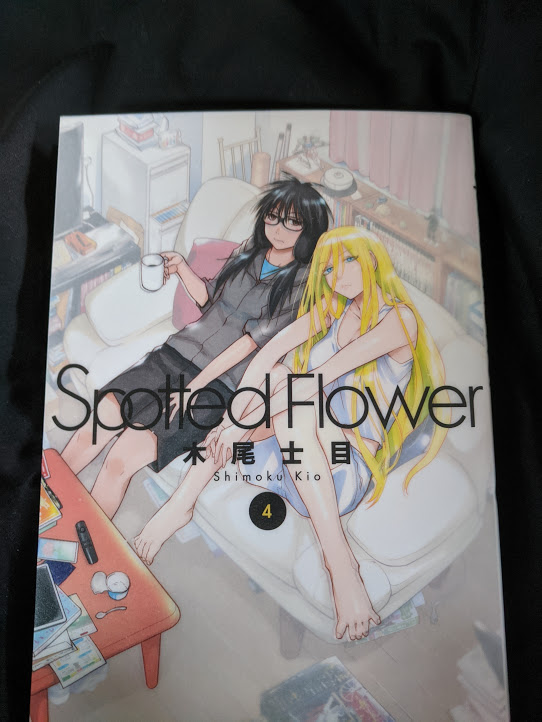
Spotted Flower has always been a difficult series to suss out what the story is trying to say, if anything at all. What once began as a thinly veiled what-if pairing of two Genshiken characters has morphed into a crazy tale of adultery, inadequacy, and a cast of characters where monogamy is rare and polyamory is chaotic and unpredictable. Volume 4 continues this trend, spotlighting all the unusual relationships that have arisen. And while I haven’t consistently reviewed Spotted Flower over the years, this one has a lot of Ogiue—er, Ogino-sensei—so I have an extra reason to write about it.

Last year, I presented a panel at Otakon about Kio Shimoku’s works, and during my research, I came to realize that Genshiken is actually somewhat of an outlier in terms of his catalogue. Most manga Kio makes, including his debut professional manga, involves extremely messy relationships and a whole lot of emotional betrayal—and not in a fetishy way, either. So Spotted Flower is actually a kind of return to the older Kio, and the fact that it hits so hard is because the characters are Genshiken analogues.

Volume 4 has the husband (Not-Madarame) and wife (Not-Kasukabe) returning home with their newborn daughter, Saki. It’s not long after the husband had a one-night stand with Asaka-sensei (Not-Hato), so he’s on-edge the whole time, and literally still feeling it in the ass. The wife doesn’t suspect anything at first, especially because Asaka was very thorough in cleaning up, but the slightest hint of perfume on just one of the husband’s sweaters—as well as some pointed questions later—have her suspecting foul play. The rest of the volume involves the husband and wife reaching out to different friends to express their worries while those friends, in turn, grapple with their own complicated situations. Also, Endou (Asaka’s editor) discovers that Hato has a penis, learns about Asaka sleeping with their beloved senpai, and inadvertently spills the beans to Ogino and Not-Sue.

I think it’s important to lay down just how convoluted the web of relations is in this series. The husband is married to the wife, who just recently had their kid, but the husband slept with Asaka out of a sense of inferiority over the wife’s ex, Not-Kousaka. Asaka is in a relationship with Not-Yajima, who knew well in advance what Asaka was planning and was generally okay with it. Not-Kousaka always really wants to have a threesome, but can’t get any, and it’s probably why he’s no longer with the wife. Ogino is living with Not-Sue and is in a physical relationship with her, but also has a real thing going on with Not-Sasahara, whom she adores. Not-Sue is extremely jealous of Not-Sasahara, and balks at the idea of them in a threesome. Not-Ohno and assumed Not-Tanaka seem to be the only ones exclusive to each other. Whew! What a situation.

One of the biggest gut punches of Volume 4 is when Not-Sasahara explains in clear detail that Madarame’s worries over not matching up to Not-Kousaka are totally unfounded. Specifically, it turns out that the wife’s ex just straight-up left after seeing the baby—which means that he basically gave up, and confirms that the husband fucked up 10,000%. What’s amazing to me is that it’s easy to see where the husband is coming from, but just as easy to acknowledge that he’s garbage.

This also makes me wonder if something like this could’ve happened to the real Madarame and Kasukabe in Genshiken. Fans loved the idea of opposites attracting, but it wouldn’t have been out of the question for Madarame to feel like he could never match up to Kousaka. Madarame and Sue are on similar wavelengths, after all. However, there’s also a lot that’s different about Spotted Flower, and it feels as if this is maybe a symptom of how their world is, instead of the cause. Another notable change is that Endou (who is jokingly implied to be the Yoshitake of this series) never went to the same college as the rest of the cast.

During this volume, Ogino initially tries to suss the truth out of her editor boyfriend, and when he refuses to budge, she lays one hell of a deal out: in exchange for telling her what the husband spoke to him about, she will agree to a threesome with her and her blond girlfriend. The look on his face is one of deep, soul- and libido-igniting conflict, and the fact that he apparently doesn’t give in is testament to this character. Ironically, it probably makes Ogino like him even more. 

It can be difficult to figure out Kio’s intent, but there’s perhaps a clue in the extra story provided in this volume. The wife is talking about how she read Ogino’s new manga, which is more out and out BL. The husband responds, “Isn’t it good that she’s doing what she wants?” The wife follows up and says, “But I think her previous work was better.” Maybe Spotted Flower is just unchecked Kio Shimoku, for better or worse.

Given that Spotted Flower chapters come out at a snail’s pace, it’s wild how far the story has come. It’s really impossible to tell how things will resolve, but the way it portrays the differences between willing unorthodox relationships and those built on deception means things are probably going to get worse before they get better. The fact that a child is involved makes the sting that much more severe.

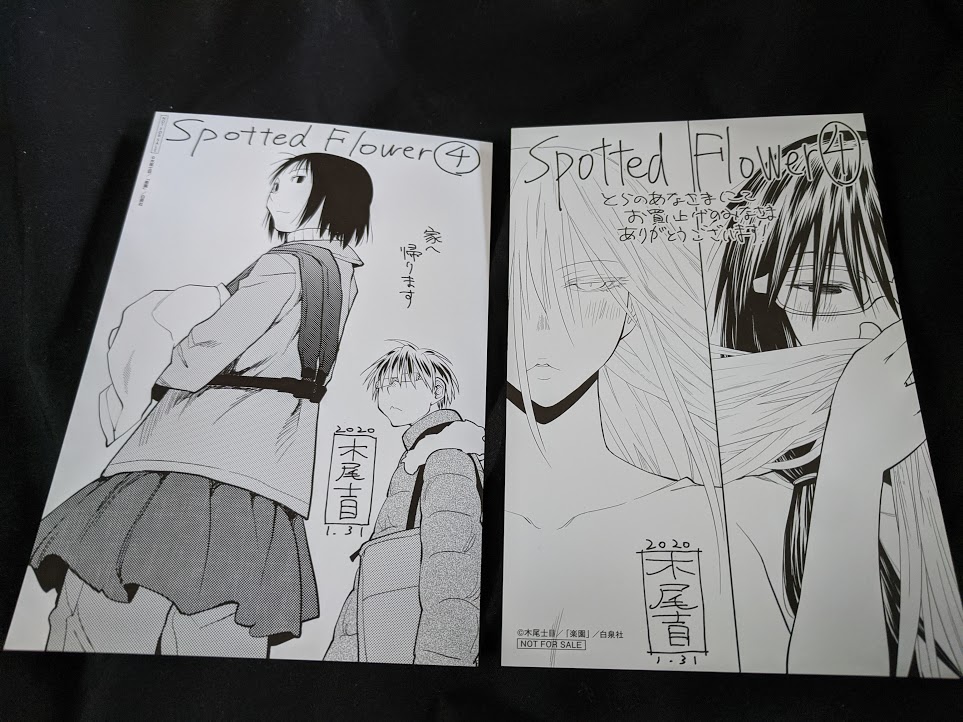
PS: I managed to get both a general purchase bonus, as well as a Toranoana store-exclusive one featuring Ogino and her blonde, Sue-esque roommate. Does it count as Ogiue merchandise when it’s technically not Ogiue?

Welco Metot Henex Tlevel: “Sonic the Hedgehog” Movie Review

I originally was on the fence about seeing the Sonic the Hedgehog movie. But the praise it received from those I trust to have loving but honest opinions about Sega convinced me. So in preparation, I basically went all-in on Sonic. I finally played (and beat) Sonic Mania, which I had put off for a long time. I filled my playlists with songs from Sonic and Sonic-adjacent sources. In a way, it was a homecoming for me, because my very first online community was actually a Sonic and NiGHTS fanfiction site. A part of me will always love the blue hedgehog.

One thing that struck me about the film is how, despite Sonic having a continued presence throughout the decades, Sonic the Hedgehog the movie is essentially a nostalgia film that nevertheless has appeal to kids today. It’s not set in the past (smartphones exist), and the way they portray Sonic as kind of naive and lonely fits better in today’s environment, but the overall buddy flick sensibility feels like it comes straight out of the 1990s, when Sonic was at his peak in terms of recognizability. Even though Jim Carrey isn’t portrayed with the classic girth of Robotnik, he comes across as how the character (described as having an immense IQ but the maturity of a child) could have been translated well to film even in the 90s. In fact, Jim Carrey probably could have played Robotnik back then as well.

Sonic the Hedgehog the movie is a surprisingly solid movie that feels faithful to the core spirit of Sonic as a “cool dude with attitude.” So much could have gone wrong, and the fact that it was inches away from being a total disaster makes it all the more miraculous. Most notably, the original design for Sonic in the movie was met with such widespread panning that they had to redo all the CG. And it matters a lot! That re-design basically was the difference between Sonic being an endearing character and one who induces nightmares.

The artists responsible for fixing Sonic’s look also got their studio shuttered before Christmas in the worst thank-you ever. If all the success this film has achieved doesn’t somehow go back into paying all of these employees who helped save this movie, then my opinion of it will sour immensely. But for now, I think Sonic the Hedgehog is worthy of praise.

It’s fitting that both Sonic the Hedgehog the movie and Sonic Mania are processed blasts of the 90s. Perhaps it took those three decades or so for the nostalgia to come around and make the Sonics everyone wanted into a reality once more.


What a Dream Boat: Hashikko Ensemble, Chapter 25

Another new character brings further insight into Jin’s history in Hashikko Ensemble Chapter 25.

Summary

The Hashimoto Tech Chorus Appreciation Society has arrived at M-Con, nervous about competing. Day One is just for observation, though, and they see Nishigafuchi (the school they visited previously) succeed. They’re also worried about Shuusuke not showing up after he tore down Jin so thoroughly, but luckily, he arrives. However, another figure appears as well: a girl named Shouji Yumerun, a classmate of Jin’s when they were kids, and when she looked very different.

Yumerun mentions becoming a pupil of Jin’s mom, and that this means Jin doesn’t have to worry about being talentless anymore—words meant to comfort, it seems, but which have the opposite effect. Jin begins to think about why it is he’s so unable to be naturally expressive, and how he gathers people who make up for this weakness. The chapter ends with him getting ready to ask Akira a question.

Jin’s Intuition

I’m actually surprised to discover that Jin sees himself as talentless, and that all of his singing ability comes from hard work and study, if only because he has come across as such a natural in previous chapters. In Naruto terms, he’s the Rock Lee everyone thinks is a Sasuke, and it makes him more relatable in some ways.

Another character Jin reminds me of is Mike from Monsters, Inc. Like Mike, Jin has the theory down but can only take it so far due to a lack of natural ability. The fact that Jin has such an eye for talent further reinforces this image while also adding an extra wrinkle to his character. He finds people with the raw potential he himself lacks, almost to an intuitive degree.

Yumerun

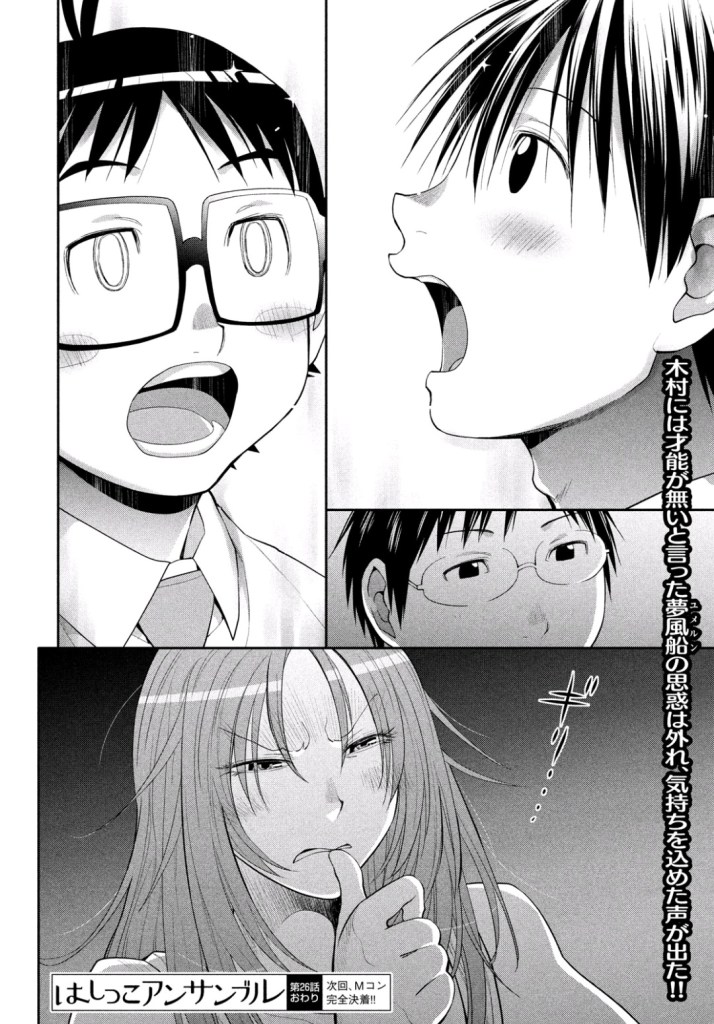
We get another new character in Yumerun, who drops some hints about Jin’s past and his relationship with his mom. Apparently, Jin and Yumerun were classmates, and he helped bring her into music. Now, she’s studying under Jin’s mom, and she thinks this means Jin doesn’t have to worry about being talentless anymore—implying perhaps that Jin felt pressure to succeed his mom, and that maybe Yumerun has a thing for him?

I’m struck by Yumerun’s words, particularly when she says to Jin, “You won’t be told anymore to stop escaping into the chorus just because you lack talent.” What I interpret this to mean is that Jin likes singing in a group because it better hides his deficiencies. Rather than just being a passion, it’s also a defense mechanism.

In the Mind But Not in the Heart

Every chapter review, I record all the music terms that crop up, partially because they’re in Japanese and not necessarily common knowledge even for fluent speakers. But it’s also because I have little to no musical knowledge or ability, so I feel the need to try and understand. The fact that Jin has a somewhat similar struggle makes these sections take on a new meaning of sorts. As someone not musically inclined, it’s hard for me to tell if these flaws of his are really that basic or if it’s the difference between being decent and being elite, though the fact that no one at Nishigafuchi said anything makes me think the latter.

In this instance, Yumerun brings up all the things Jin has trouble with: enunciating s, k, and z sounds; the nuances of syncopation;  and techniques for emotional expression. Apparently, he can understand it on paper, but has trouble doing it himself. Syncopation is “a shifting of the normal accent, usually by stressing the normally unaccented beats.”

Songs

No songs this month, but the fact that the previous storyline is officially known as the “Spitz arc” amuses me.

Final Thoughts

The Chorus as a place where people who lack in certain areas can support one another feels like the story of a team sports manga, as opposed to ones about individual competitors. Hashikko Ensemble might not have the attractive characters or the pizzazz to attract regular sports manga readers, but I wonder if this possible theme of “the sum being greater than the parts” might resonate still.

Insane in the Menbre: 22/7 Anime vs. Youtube Thoughts

When the anime for fictional idol group 22/7 was first announced, I wasn’t quite sure what to expect. My only exposure to them was through the Youtube channel of Fujima Sakura, one of the characters in the franchise. Played by Sally Amaki, a Japanese-American who moved to Japan to become an idol, the resulting videos were surprisingly off the wall. Videos like the one about using “menbre” as cutesy shorthand for “mental breakdown” set the tone for 22/7 in my mind as this quirky idol group that wasn’t afraid of gallows humor. Contributing to this was the fact that Sally Amaki herself would express on Twitter some of the challenges of being an idol and talk about her love of Flamin’ Hot Cheetos to the extent that fans threw bags of them onto the stage at Anime Expo. It was like 22/7 and Fujima Sakura peeled back just a layer or two of the idol illusion—enough to entice but not to ruin.

So I jumped into the first few episodes of the 22/7 anime wondering if any of the above would be reflected. To my surprise, the series has taken a completely different approach: a mostly serious show about conflict and self-doubt. Fujima Sakura is a prominent part of the series, but she’s not the main character. Instead, it’s primarily about Takigawa Miu, who’s portrayed as having a crippling lack of confidence stemming from childhood difficulties. There’s tension from the very beginning in ways that I don’t see from many other idol anime. To some extent, the dramatic nature of the 22/7 anime in contrast to the silliness of the Youtube channel feels like when you go between the Love Live! anime vs. the mobile game or the Drama CDs—only that difference is dialed to 11. 

I appreciate the anime’s take on things, partly because Miu is such a different heroine compared to those found in other idol series. Whether it’s Amami Haruka (The iDOLM@STER) or Kosaka Honoka (Love Live!), they tend to fall under this umbrella of “generally optimistic and cheerful girls who are pretty normal but try their best.” Starting with someone who’s struggling internally from the very beginning (and not just in an “I’m too plain” sort of way) is pretty refreshing. The anime also has other eccentricities that at the very least pique my curiosity, such as the mysterious “wall” that gives the members of 22/7 their orders. It reminds me of a similar entity in AKB0048, only it actually seems even more bizarre in the 22/7 anime because of the relatively mundane setting.

I’m not sure if this is the presentation of 22/7 its creators wanted all along, or if maybe it’s intentionally different in order to achieve a different kind of appeal, but it’s an attempt at doing something compelling. I don’t mind it, though one potential consequence is that Sally Amaki’s Twitter seems a lot cleaner and more professional, which might ironically take away from her and Fujima Sakura’s original appeal. Sometimes a diamond in the rough stands out precisely because of its situation.

Dongs of History: Golden Kamuy

After two seasons of Golden Kamuy, I think I finally have an understanding of how I feel about it. A combination of historical fiction, action/adventure, slapstick comedy, multicultural spotlight, and cooking show, it’s a series that messes with conventional genre boundaries. If Golden Kamuy were a chef, it would be the kind who puts in more lemon juice when you ask for more sugar. Even so, I’ve come to really appreciate that it can be so jarringly disparate, as the work comes across as genuinely passionate and uncompromising.

Golden Kamuy centers on Sugimoto Saichi, a veteran of the Russo-Japanese War, and his pursuit of a hidden Ainu treasure. Having earned the nickname “Immortal Sugimoto” for his military exploits—namely his seeming ability to survive any wound or calamity no matter how severe—he teams up with an Ainu girl named Asirpa. Together, they form a powerful bond that takes the two through layers of conspiracy, eccentric enemies and allies alike, and greater understanding of each others’ cultures and customs.

It can sound like a fairly straightforward and serious work, but its mood can swing wildly from one moment to the next. Golden Kamuy can go from showing Sugimoto’s PTSD, to featuring Asirpa’s hilariously wacky faces as she cooks, to displaying a bloody and merciless battle, to presenting a seemingly endless parade of dick jokes, to focusing on a genuine and heartfelt moment between Sugimoto and Asirpa. Combined with an overwhelmingly large cast of characters who are individually memorable but also hard to keep track of due to sheer size, experiencing Golden Kamuy can sometimes feel like whiplash. But when all engines are running at full steam, there are few series that can compare in terms of excitement, comedy, and emotion. You just kind of never quite know what you’re going to get, except maybe “everything.”

As of Season 2 of Golden Kamuy, the stakes are higher than ever, and the series leaves me with a lasting impression of its bizarre charisma. Season 3 can’t come soon enough.

Distillation of the Busty Failure: Ponkotsu Musume no Nichijou

A couple years ago, I noticed a trend in characters that I called “busty failures”—a translation of the Japanese terms ponkotsu plus kyonyuu. Their primary qualities are, as the term implies, big chests combined with a tendency to be unreliable wrecks. In hindsight, maybe “busty disasters” would’ve been a better choice.

Often times, characters breed unspoken archetypes, which lead to categorization. At some point, these archetypes might become explicitly acknowledged by the very medium they’ve come from. I think the busty failure has reached that point with the recent four-panel gag manga Ponkotsu Musume no Nichijou (“Failure Girl’s Everyday Life”) by Kawakami Masaki.

The series is as expected: an attractive girl (name: Ponkotsu Ato) tries to get through life but mucks things up in the process. It’s fanservicey as all heck (as implied by the cover), and lacks any sort of topical veneer like Dagashi Kashi does with the “cheap snack foods” gimmick. It’s very much a what-you-see-is-what-you-get title.

In other words, Ponkotsu Musume no Nichijou is geared towards a very specific audience, i.e. the kind of person who revels in busty failures. Personally speaking, I think I’d prefer just a little more substance. A series so unabashedly horny isn’t inherently bad, and the character does feel more relatable than other instances of the archetype, but it could aspire to more. Who knows? Maybe it’ll go places over time.


Mewtwo vs. Mewtwo: Notable Voices in “The Wonderland”

The Wonderland (Birthday Wonderland in Japanese) is a film packed with whimsy, imagination, and a tale of a young girl finding the strength to keep going. The movie is directed by Hara Keiichi (Miss Hokusai), and I really recommend it. 

But there’s also something about the film that delights me on a much more personal level: it features not one, but two different voice actors who have played the Pokemon Mewtwo.

In the role of Hippocrates the Alchemist is Ichimura Masachika, who voiced Mewtwo in the anime film Mewtwo Strikes Back, Mewtwo Lives (aka Mewtwo Returns), and Super Smash Bros. Melee. He’s known for much more than anime—being the original Japanese Phantom of the Opera—but it’s his performance as the Genetic Pokemon that is nearest and dearest to me. He brings a similar gravitas to his Hippocrates, though The Wonderland also allows a more comedic side as well. 

The antagonist of The Wonderland, Zan Gu, is played by Fujiwara Keiji—Mewtwo in Smash 4 and Super Smash Bros. Ultimate. He’s known for roles such as Maes Hughes in Fullmetal Alchemist and Holland in Eureka Seven. Zan Gu is actually more similar to Mewtwo, but Fujiwara doesn’t give the two the exact same vocal quality.

As an aside, if you want to hear both of them perform dialogue as Mewtwo, switch your copy of Melee and Ultimate to Japanese.

Having two Mewtwos is a rare distinction for any work, and it’s all the better that they give such stellar performances in a strong movie like The Wonderland. I’m not saying you should go see the film just for the acting, but they definitely make it even better.

Talkin’ About Shaft: Oogami-san, Dada More Desu

Hot on the heels of Teasobi and Change!, another one of my current manga of choice has ended. In this case, it’s the quirky romance manga Oogami-san, Dada More Desu, or in English, Oogami-san is Letting More and More Out.

The story of Oogami-san follows Oogami Meiko, a teenage girl with an overactive and dirty imagination. She writes erotic fiction, constantly fantasizes, and spends significant portions of her day thinking about guy parts, all while keeping this side of her secret. She becomes curious about one of her classmates, Shinichirou Yaginuma, a quiet and distant guy, but she soon discovers that he has a secret: anyone who touches him blurts out whatever they’re thinking deep down. For Oogami, her true feelings come out as “Show me your dick.” That’s the start of their relationship.

It’s a pretty gimmicky romance manga at the start, but the early chapters are really carried by how fun and expressive Oogami is as the main character. Her and Yaginuma both have things they don’t want to share with others, and they sort of become mutual confidants. But as the two grow closer and even make other friends, the series goes into not judging books by their covers, bullying, overprotective parents (who have a genuine reason to be that way), jealousy, and other topics that give Oogami-san more weight—all without abandoning the ridiculousness of its base premise. It’s a ribald comedy with a touch of seriousness, where characters love and learn and one of them likes to talk about penises. A lot.

Oogami-san, Dada More Desu concluded in December, and the 7th and final collected volume came out in Japan on January 23. It’s the kind of bizarre love story that is right up my alley, and I think it’s definitely worth a read.

You Are, All of a Sudden, a Mechanical Man: Hashikko Ensemble, Chapter 24

A new character flips everything upside down in Chapter 24 of Hashikko Ensemble.

Summary

Shion has sprained her wrist, and the Chorus Appreciation Society is forced to do something about it. Given a few options, they ultimately land on getting an alternate pianist to accompany them, though Akira expresses that he doesn’t think anyone could really replace her. Shion pulls a favor with her mom, and gets an old acquaintance/friend to take her place: Mashino Shuusuke, a guy who carries around a sun umbrella and who just has an aura that screams “elite.”

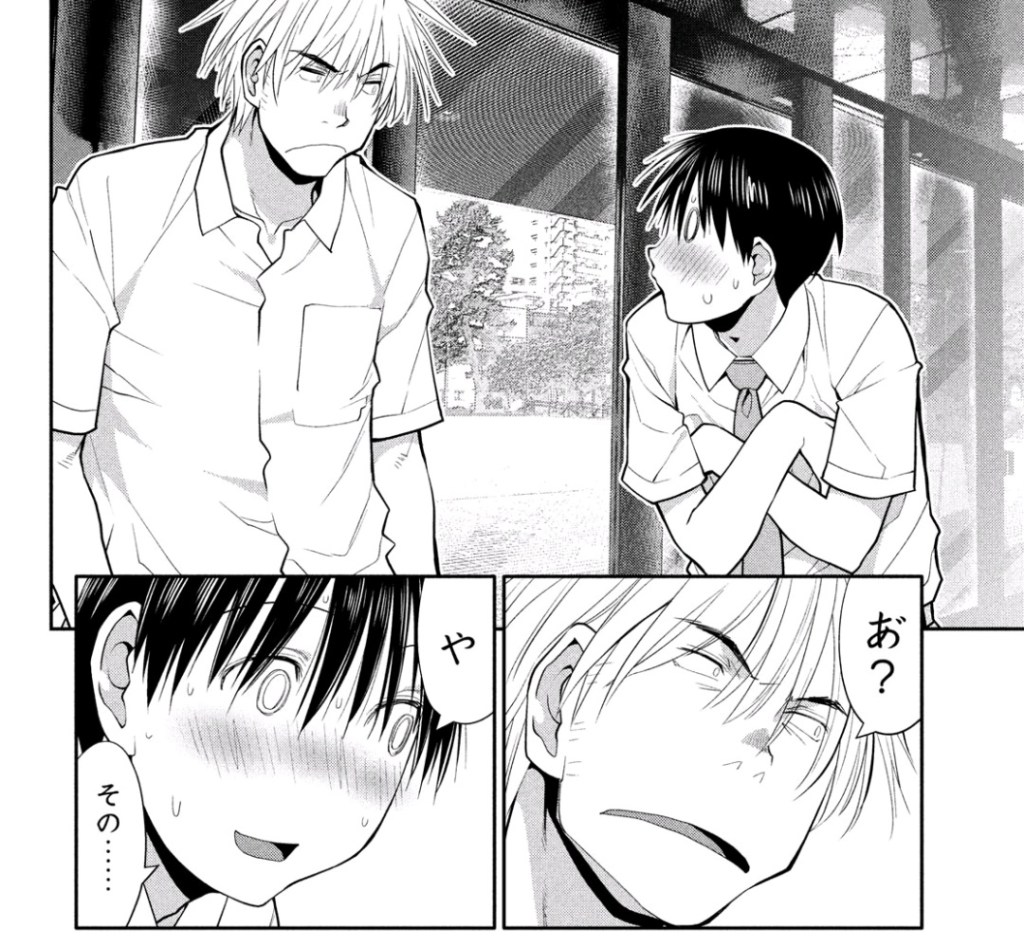
However, after just one song, Shuusuke finds the Hashikko boys to be fundamentally inadequate. He critiques each of their weaknesses one by one—and actually declares Jin to be the most hopeless of all! While the rest of the group is eager to prove Shuusuke wrong, Jin seems uncharacteristically glum.

Their Unique Problems

It’s interesting to see where each character’s singing flaws are, as pointed out by Shuusuke. It’s not easy to convey in comics, so the exposition is welcome. Also, it might be a hint at how the characters might develop over time.

Akira is trying too consciously to sing low, and his enunciation is suffering. He’s pushing his vowels out at the expense of his consonants.

Kousei doesn’t sing with purpose. According to Shuusuke, Kousei comes across as someone who thinks passion and feeling can make up for that, but it can’t.

Shinji is a total beginner, so there’s not much to be done there. Shuusuke says this as if there’s nothing specific he could say to help, which makes Shinji all the angrier

Jin knows how to “sing,” but what comes out of him isn’t “music.” In terms of criticisms, this one hits the hardest.

A Hurdle for Jin

I find the introduction of Shuusuke to be one of my favorite story developments so far because it’s the first time that Jin has been challenged as a character. Up to this point, Jin has always been the fount of knowledge who knows more about sound and music than anyone else. To have that called into question, to have someone say that Jin’s singing is merely technically proficient, is a major change-up. Adding to this is the fact that Shuusuke is clearly a legitimate talent at the piano.

The only times in the past that Jin has looked even remotely that taken aback is when he mentions his mom. We have the sense that there’s something messy underlying his interest in music, and I have to wonder if Shuusuke’s comments are related in any way.

Shuusuke and Shion (and Akira?)

As implied by the chapter’s title page, there’s a history between Shuusuke and Shion dating back to their piano concert days (Shion, as we see, has always been herself). There’s a clear frustration he has over her choosing to go to a technical high school–my best guess is that he saw her as a rival, or at the very least, someone who’s wasting her talents. There might not necessarily be any romantic sparks (or at least not reciprocal ones), but the “childhood friend” history is a reliable, if not as common a trope as it used to be. Given Akira’s bit of blushing early in the chapter when he comments on Shion being irreplaceable, there might be some tension there.

Songs

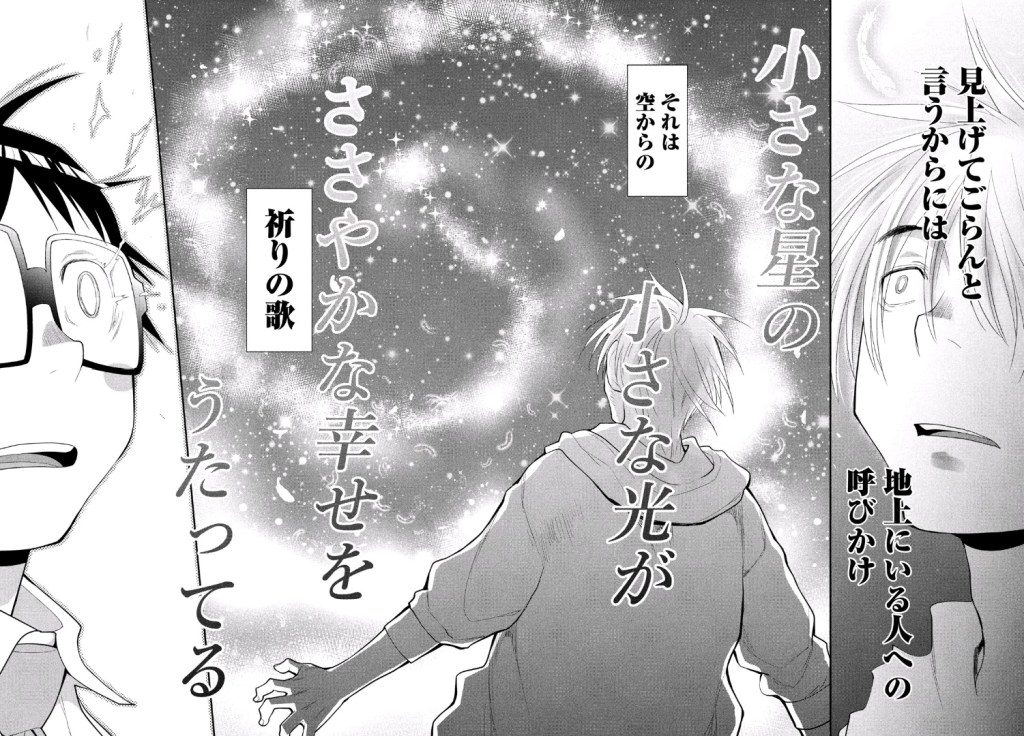
“Miagete Goran Yoru no Hoshi o” (Behold the Nighttime Stars) by Kyu Sakamoto make another appearance here.

Final Thoughts

In frustration, Shion says that it’s actually Shuusuke’s fault that things aren’t going well, and that they’re much better when she plays. It’s hard to tell if she’s just being stubborn or if there is some merit to her words, so I’m looking forward to seeing what the answer is in the end.