
Weekly Shounen Champion has a new series, a harem where all the girls are delinquents. I wrote a review about it, so check it out.

Weekly Shounen Champion has a new series, a harem where all the girls are delinquents. I wrote a review about it, so check it out.

Though I was originally asked to write about Aikatsu! through my Patreon, I quickly found myself hooked on the show. Despite the sheer length of the series, I finished the first 50-episode season in less time than I usually take to watch shows half that size. Thus, I want to give an update to my previous post to talk about some of the later developments that I enjoyed.
Summary
Aikatsu! follows Hoshimiya Ichigo on her quest to become an idol. She enrolls in Starlight Academy (a school specializing in idols) with her best friend and idol fan, Kiriya Aoi, and over the course of the series they climb the ranks and make many friends. While girls’ shows such as these tend to not work in dramatic narratives, the lack of a very concrete goal leaves the series without any continuing driving force other than the sheer personalities of its characters.
However, with respect to those characters Aikatsu! is immensely entertaining. Though none of them are particularly complex, the way they bounce off of each other and the way that even the most gimmicky characters exhibit a great deal of heart and vibrancy in their personalities helps the show along immensely. When the show is being episodic, it’s still entertaining. When it allows its characters to grow, Aikatsu! is home to a number of memorable moments.
Great New Characters 
There are three major changes since my previous post that make the show better overall. The first is the growing of the cast into something rather enormous, and yet Aikatsu! is able to keep it from being unwieldy. Of the later additions, I think Ichinose Kaede and Kitaouji Sakura are fantastic. Kaede is a scene stealer with her constant Engrish (she comes from America after all), ability to make sushi appear out of thin air, and just the way she represents the idea that, at least in the Aikatsu! universe, being an idol in the US is rough business that requires you to be on your A game at all times. For Sakura, I love how her running gag, the fact that she will just break into Kabuki-style talk when discussing important topics, is weaved into moments and then quickly transitioned out of back into normal conversation.
If there’s one thing that I think was a lost opportunity with Sakura, it has to do with the fact that she originally appears as Ichigo’s fresh-faced freshman (whereby Ichigo is supposed to guide her), but Sakura is already way more talented than Ichigo in a variety of ways. What Ichigo is meant to teach Sakura is the sense of exuberance that Ichigo is known for, and I think they could have directly developed that more.
Improved CG

The second upgrade is the improved 3DCG dance sequences. CG at the start of Aikatsu! was pretty bland, something it shares with rival series such as Pretty Rhythm. But it gets better as the show progresses, and with both more natural-looking movements and better camera work the dance numbers go from tedious to pretty entertaining. The only strike I hold against them is the fact that they’re often meant to be competitions but no differences are really shown in regards to how each character is dancing (they do the same moves at the same time all the time), with the exception of the “Special Appeals,” which are essentially fanciful cut scenes that act as special moves (this is based on a game, after all).
As someone who is neither a dancer nor rhythmically inclined in general maybe I’m not getting it, and I also don’t expect a show for little girls to cater to my adult sense of continuity, but I think this is exactly the sort of thing anime and manga tend to be good at. It’s hard for an ignoramus like me to enjoy ballet, but when it’s ballet + shocked expressions + exposition, even I can enjoy Swan Lake.
Hoshimiya Ringo, an Awesome Mom

The third improvement is the way that they build up Ichigo’s mom. When the series begins, Ringo is shown owning a simple bento shop and having no connections to the idol world. Over the course of the series, it blatantly hints that she’s not what she seems, and while it’s quickly made obvious to the audience that Ringo was a member of the most famous idol group in history, Masquerade (along with Starlight’s headmaster Orihime), seeing Ringo hint at her past in conversations with Ichigo by dispensing advice only when necessary, or exchanging knowing glances with Orihime kept me wanting more. In the end, the payoff for this little plot thread is well worth it.
The show actually hints at this right from the opening, as Ringo is shown pretending that her rice scoop is a microphone and posing for her son Raichi’s camera. What is supposed to be a mom playing at being an idol is actually Ringo very briefly delving back into her past.
Final Thoughts
It’ll probably be a while before I watch the second season, but I can easily see now why Aikatsu! garners such a loyal fanbase. It’s a genuinely entertaining series that never really has any low points, and stays consistent throughout even if it doesn’t have any kind of massive involving story arc. Let’s look back in a year or two and see if I’ve come back to the world of Idol Activities. Alhough, I feel like I’ll miss the first opening and ending themes; they really were the best.

By the way, I spent a bit of time in Japan recently and got to play the actual Aikatsu! arcade game. What stood out to me most about the game is that the awkward idol poses in the anime are just there to directly reflect the game elements. Without the visibility of success and failure in those sequences, however, some of the impact is lost on TV.
I also got a couple of sweet cards for my trouble, and I rocked Kaede as my character. While I was indeed playing a game for 5 year olds, the only other person playing was a salaryman in a suit and tie. Perhaps Idol Activities truly are for everyone.
—
If you liked this post, consider becoming a sponsor of Ogiue Maniax through Patreon. You can get rewards for higher pledges, including a chance to request topics for the blog.

It’s the aftermath of a love scandal in Kimi Nakare Chapter 5. How will Hayato and the rest of his band mates deal with it?
Summary
Jirou, one of Hayato’s fellow members in the idol group WARP, was discovered with a girl. In this chapter, we learn that it isn’t just any girl, but the love of Jirou’s life. Resolving to choose love over his career, Jirou decides to quit WARP and marry his longtime girlfriend.
Hayato in the meantime finds that his school has now become a target for paparazzi, specifically so that they can catch him in the act. Ironically, Nobuko’s “ugly but passionate admirer” gimmick works out in their favor, as she’s able to chase off a gossip mongerer.
However, despite Hayato’s protests and even his own threat of quitting the band to chase love himself, it turns out not to be necessary. WARP is disbanding.
Young vs. Old Idols
The topic that I found most fascinating in this chapter is the distinction between younger and older idols. At one point, Hayato points out that there are idols that have gotten married without any backlash, and their manager responds that only established idols can do that. As a group, you have to reach a point where you basically become a fan’s first love, so even as those fans grow and perhaps get married themselves, the idol will always have a special place in a woman’s heart (and the woman in the idol’s). In other words, a relatively new group like WARP hasn’t built up the cache.
Most of the time, the thought over idols is that love is forbidden because they must forever be locked away as long as they indeed hold the status of “idol.” However, this implies that idols are a kind of evolving phenomenon that can choose to either stay as they are or grow with their audience. At the same time, the path to the “married idol” is fraught with danger, and appears to be only the domain of the true veteran.
It’s still kind of weird that Japan’s most famous idol manager ended up marrying one of his idols, but I digress. I’m also perhaps being unfair; if Celine Dion could find happiness with her manager, why not?
Not Enough Hayato and Nobuko?

While I previously mentioned being curious over the side characters, and Hayato’s scene with Nobuko protecting him from a prying photographer is rather charming, I do feel like I didn’t get enough of the two of them this chapter. I think that speaks a lot to how appealing they are as main characters, but perhaps I’m not giving the rest of the cast a fair shake. Jirou being a sweet guy is a welcome surprise, as is his decision to choose his girlfriend over his job. Not to say that it would be the right decision in every case, but I was convinced that it was what he personally should have done.
It also made me aware that there are two different love conundrums at work in this series: the career-based one, and the psychological one. Even this brief interaction lets the two sides play out beautifully.
Last Thoughts
I wonder if the loss of WARP might spur Hayato to begin a full-fledged career as a comedian, so that he can stand by Nobuko’s side. Wouldn’t that be nice?
—
If you liked this post, consider becoming a sponsor of Ogiue Maniax through Patreon. You can get rewards for higher pledges, including a chance to request topics for the blog.
August is full of fun and surprises. For one thing, I have two panels at Otakon 2016: “Greater Uglier Manga” and “Such Dog, Much Anime, Wow.” The schedule isn’t available yet, but when it is I’ll be making a post.
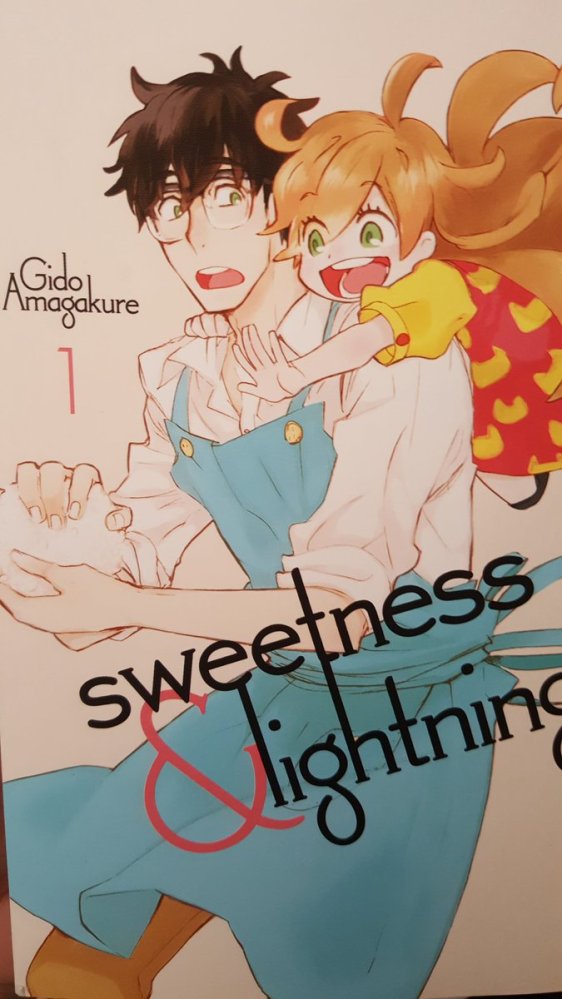
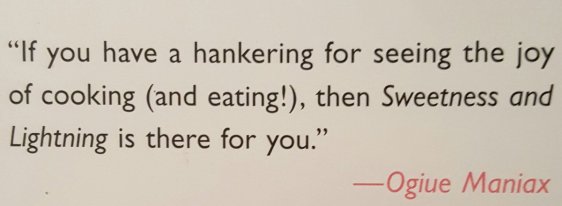
Another bit of news is that Ogiue Maniax has, for the first time ever, been quoted on the back of a manga! The title in question is Sweetness & Lightning:
I consider this quite the milestone, and I’d like to thank my readers, but especially my Patreon sponsors in particular for supporting me:
General:
Johnny Trovato
Ko Ransom
Alex
Diogo Prado
Sasahara Keiko fans:
Kristopher Hostead
Yoshitake Rika fans:
Elliot Page
Hato Kenjirou fans:
Elizabeth
Yajima Mirei fans:
Machi-Kurada
I’d also like to congratulate Johnny for winning my Love Live! contest.
Perhaps the biggest news of all for the blog is that Genshiken is ending! I’ve written my review for the penultimate chapter, and I already have emotions welling up inside of me in anticipation for the final conclusion. You’ll be certain that I’ll have a lot to say at the end.
If nothing crazy happens (like a third Genshiken being announced soon after), I’m considering doing a series of nine posts to review the original series volume by volume. What do you think?
Other notable posts this month include my Patreon-sponsored article on Purity in Anime, my reviews of the Kyoto subway tourism light novel, Kyo Girls Days, and Girls und Panzer der Film, as well as a report on my visit to the university on which Genshiken is based.
It’s kind of a hectic month looking ahead, so I haven’t had time to think of any new projects for the blog. For now, I’m still watching and reading through quite a back catalog, with the intention of clearing up some time to finally review Super Dimensional Cavalry Southern Cross for Gattai Girls. Luckily, it’s now on Amazon, free for Prime users and 99 cents per episode for non-Primes. So, I have no excuses left!
Once again, I’ll be at Otakon, so if anyone wants to come up and say hi at a panel, feel free to do so! I’m actually a tad shy in real life, and it can come across as surliness, but don’t let that scare you.
In my recent visit to Kyoto, I discovered two interesting manifestations of Japan’s interest in anime and manga. The first I first came upon while taking public transit: posters featuring anime-style high school girls who act as mascots for the Kyoto Subway system’s “Ride the Subway” campaign. After being redesigned in 2015 to match a more contemporary anime aesthetic they’ve really caught on, and have even been featured in TV ads:
The second I had already planned to visit, which was the Kyoto International Manga Museum, an archive of countless manga from all decades that is open to the public. Like the girls of the Kyoto subway, the Manga Museum has its own mascot, Karasuma Miyu, to whom I was immediately drawn. I think it’s clear why, given her design:

Now aware of this Ogiue-esque character (though also clearly much more cheerful in comparison), I felt compelled to buy some kind, any kind, of Karasuma Miyu merchandise. This led me to the light novel known as Kyo Girls Days, written by Motoki and illustrated by Kamogawa. Featuring both the Kyoto Subway Girls and Karasuma Miyu, it not only celebrates the subway and the Manga Museum, but also Kyoto tourism in general.

Kyo Girls Days follows best friends Uzumasa Moe, Matsuga Saki, and Ono Misa as they decide what to do for Golden Week. With an initial plan to visit “power spots” all across Kyoto, they end up running into Karasuma Miyu, who works at the manga museum. Not only a manga enthusiast but also a Shinto miko, Miyu imbues the girls with supernatural sight, allowing them to see the various kami and other spirits that populate the old capital that is Kyoto, and transforming their vacation adventure in unforeseen ways.
Light novels can often follow certain trends. They’re frequently designed to be adapted into anime and manga as part of a media mix. They’ll feature young protagonists to whom an otaku audience can relate, with narratives that emphasize wish fulfillment fantasies or twists on well-worn tropes. Others get more creative, and fight against the reputation of light novels as trashy and lacking in substance. However, a promotional light novel, especially one that is an offshoot of a city government effort to encourage more frequent use of its public transportation, is a unique beast all its own. While this means that there’s a certain inevitable sheen of safeness in Kyo Girls Days, the result is actually kind of pleasant given that there’s less concern over whether the narrative is trying to go for cheap titillation, or objective exploitation of the girls beyond their roles as mascots.
If anything, the exploitation takes the form of the girls being a little too upstanding as people. Moe’s primary qualities are her love of helping others and her encyclopedic knowledge of the Kyoto Subway. Saki is sporty and tomboyish, and Misa is the otaku of the group, who even bought a guitar because of K-On! Another important character, Tokyo transplant, photographer, and Moe’s classmate Shirakawa Sumi, is shy and nervous about befriending Moe. None of them have any particular flaws, the closest being that Saki is somewhat impatient, while Misa is kind of lazy and can often be late to gatherings. In fact, there’s actually a scene where Misa arrives late and blames it on the trains, and Moe’s response is basically, “That’s silly, the trains in Kyoto are never late!” as a reminder that, yes, this is promoting public transit.
Nowhere is Kyo Girls Days do-it-all character roster more apparent than in Miyu. She’s a manga fan who has the entire museum memorized. She’s lived abroad, and is not only fluent in both French and English but has extensive knowledge of French and American comics. On top of that, she can communicate with spirits on a regular basis. Miyu is all-powerful and carries within her the view point that manga is indeed international just as it says in the name of the Manga Museum. One other interesting wrinkle to her character being that she’s actually a college student, possibly as a reference nearby Kyoto Seika University’s famous manga program, which supports the Manga Museum.
And yet, I can’t really begrudge Kyo Girls Days. I knew what I was getting into as soon as I picked it up. After all, it’s like going to an aquarium and getting a picture book about the aquarium; no one should be shocked when it talks about how great things are and how everyone should visit. Conscious of that promotional aspect, the story and narrative are actually very fun and engaging. Even though Moe and the rest of the cast’s personalities and characters are a little too perfect, the portrayal of their lifelong friendship feels solid and convincing. Even the introductions of various Kyoto landmarks are interesting because they taught me a lot about the city, and a clever insertion of a quiz towards the end of the manga is a clever wink and nod to see if the reader has been really paying attention.
Another quality I enjoyed about the light novel is that all three of the subway girls speak in Kyoto dialect. It can be hard to follow, but it positions them as true Kyoto natives, and gives their portrayal a more authentic feel.
It’s unlikely that Kyo Girls Days will ever be translated officially, just because its main focus is getting native Japanese people to pay more attention to Kyoto and its subway system. It’s not really something that translates too well to an audience that enjoys light novels (or light novel adaptations) in other countries. At the same time, I wonder if it could be released by a Japanese tourism agency for use in the US and around the world. While it wouldn’t be serving the exact same purpose, it could still motivate people to travel to Japan and check out the Kyoto area.
Pokemon Go is by far the most clear indicator of Pokemon‘s cultural impact in the United States. While there are plenty of other examples, from perpetually high sales numbers to the unprecedented Twitch Plays Pokemon, the way that Pokemon Go literally became an overnight sensation and has people of all ages running around their towns and cities trying to catch Pokemon takes the presence of the franchise to another level.
While I personally am not as obsessed with Pokemon as I was 14 years ago, I still find myself drawn to this new take on an old idea. What I’ve found is that the catching element has made me fall in love with Pokemon all over again, but the way that evolution works still leaves something to be desired.
Over the years, catching Pokemon in the main games has felt fun but also kind of like a chore, especially after playing them for so many years. However, I still remember what it was like to first venture into Viridian Forest in Pokemon Red, the first time I encountered Articuno in the Seafoam Islands, and just that overall sense of wonder when one unexpectedly comes across Pokemon. Even though all of the current species in Pokemon Go come from the classic 151, and so I’m more than familiar with all of them, I find myself getting excited over spotting a Jynx or running into a Squirtle. Even though the ARG elements of Pokemon Go don’t feel like a perfect immersion, they’re good enough.
Where I think the game falters is its current approach to evolving. Instead of leveling up or using stones or trading as one could in the first games, all evolution and strengthening of one’s Pokemon is done through collecting candies and stardust. All candies and stardust, in turn, are obtained by catching more of the same species. This makes it so that, while the catching mechanics are fun, I feel no sense of personal connection to the Pokemon I am catching because I cannot use them in anything other than gym battles. When I get a Pokemon to evolve, they do not feel like comrades with whom I have developed a bond over the course of an adventure, but rather just something I feed sweets without their participation.
Pokemon Go has only just come out, and in spite of its numerous bugs it’s still quite fun to play. This speaks well for the basic appeal of the game, and I think it won’t go away even as it eventually adds newer Pokemon. I just hope that the game will let me feel like the Pokemon I catch matter more than they do, and that I can share my victories, defeats, and growths as a trainer with them.
—
If you liked this post, consider becoming a sponsor of Ogiue Maniax through Patreon. You can get rewards for higher pledges, including a chance to request topics for the blog.

While there are a lot of unique and unusual aspects to Kimi Nakare, this chapter brings something I thought I’d never see: a charming scene of a bishounen masturbating in a non-pornographic title.
Summary
Returning to the end of Chapter 2, we see Hayato confronting Nobuko and asking her about her feelings. Nobuko (still dressed in a monkey suit) says it can’t happen, and Hayato reflects on how cute her blushing face is… while in the bathroom. After finding “relief” and profusely apologizing to Nobuko in his mind, he goes to continue his work.
Told by his manager that his image as both an idol an an innocent guy means dating is out of the picture for him, Hayato goes on-set to do a comedy skit with Nobuko, but finds that their humorous roughhousing is giving him a stiffy. Also, despite his best attempts to hide his attraction to Nobuko, the others quickly figure it out, and one of his fellow WARP members reminds him how important not being in a relationship is for idols.
However, the next morning they discover that one of the other members of WARP was caught leaving a girl’s apartment, and that it’s going to be a PR nightmare. Now, Hayato knows exactly the danger he’s in should he pursue something with Nobuko.
Hayato’s O-Face is Something Special
While Tonari no Young Jump is no stranger to fanservice or even sexually charged situations in its series, I think what makes this all the more unusual is the combination of Hayato’s appearance and the subject of the series itself. Kimi Nakare thus far has been sweet and innocent enough that seeing a panel literally devoted to him orgasming is a pretty big shocker. While plenty of good-looking guys show up in shoujo and josei titles and do far more, the fact that Hayato has on his mind a character who’s traditionally unattractive transforms the moment into something more memorable and perhaps even impossible to forget.
Still Romantic, Though

In a sense, however, the fact that it’s masturbation and not full-on sex actually makes it both more intense and somehow also sweeter. He is actually so in love with Nobuko both physically and mentally that she can turn him on even while wearing a dumb monkey costume. The manga does such a great job of showing how Hayato perceives her, and moments like the aforementioned orgasm and the hard-on he gets while performing just add to the idea that this attraction to Nobuko is not only genuine but derived from a special place that normal folks who’ve never experienced such passion can even relate to. That’s impressive, both in terms of how this sort of thing has been portrayed in a manga format, and for Hayato as a character.
Last Thoughts
Did I spend this entire chapter review talking about a guy in manga masturbating? I sure did! Then again, I once reviewed an entire series where the theme was jacking off.
Kimi Nakare is still a great romance manga.
—
If you liked this post, consider becoming a sponsor of Ogiue Maniax through Patreon. You can get rewards for higher pledges, including a chance to request topics for the blog.

When it comes to stories about witches, it’s quite common (and perhaps even expected) to have magic be prominent. Whether it’s American sitcom classic Bewitched, Archie’s Sabrina the Teenage Witch comic, or an anime and manga like Witch Craft Works, the influence of spells and sorcery is, if not grandiose, at the very least quite large. The anime Flying Witch is a much mellower series in comparison. As a show where just the lightest of touch of the supernatural appears, it makes for a most delightful series.
Adapted by J.C. Staff from the manga by Ishizuka Chihiro, Flying Witch follows the daily life of Kowata Makoto, a teenage witch who moves in with her cousin Kuramoto Kei’s family as part of her coming of age. Residing in Aomori Prefecture in the Tohoku region of Japan, the people there still have a fairly strong connection to nature, and just going back and forth from school is enough to take in the greenery. For the most part, magic doesn’t make much of an impact, but when it shows up it’s just enough to make their world feel a little bit more unusual, and a little bit more wonderful.
Though the show consistently succeeds at its sparse but effective interaction between the human and witch cultures, the most memorable example has to be in the very first episode. Makoto is walking home from school with her new friend, Nao, when she sees an unusual plant. For anyone who’s familiar with stories about witches and wizards this is a red flag. Sure enough when she gives it a hard tug a mandrake pops out and gives its shrill cry.
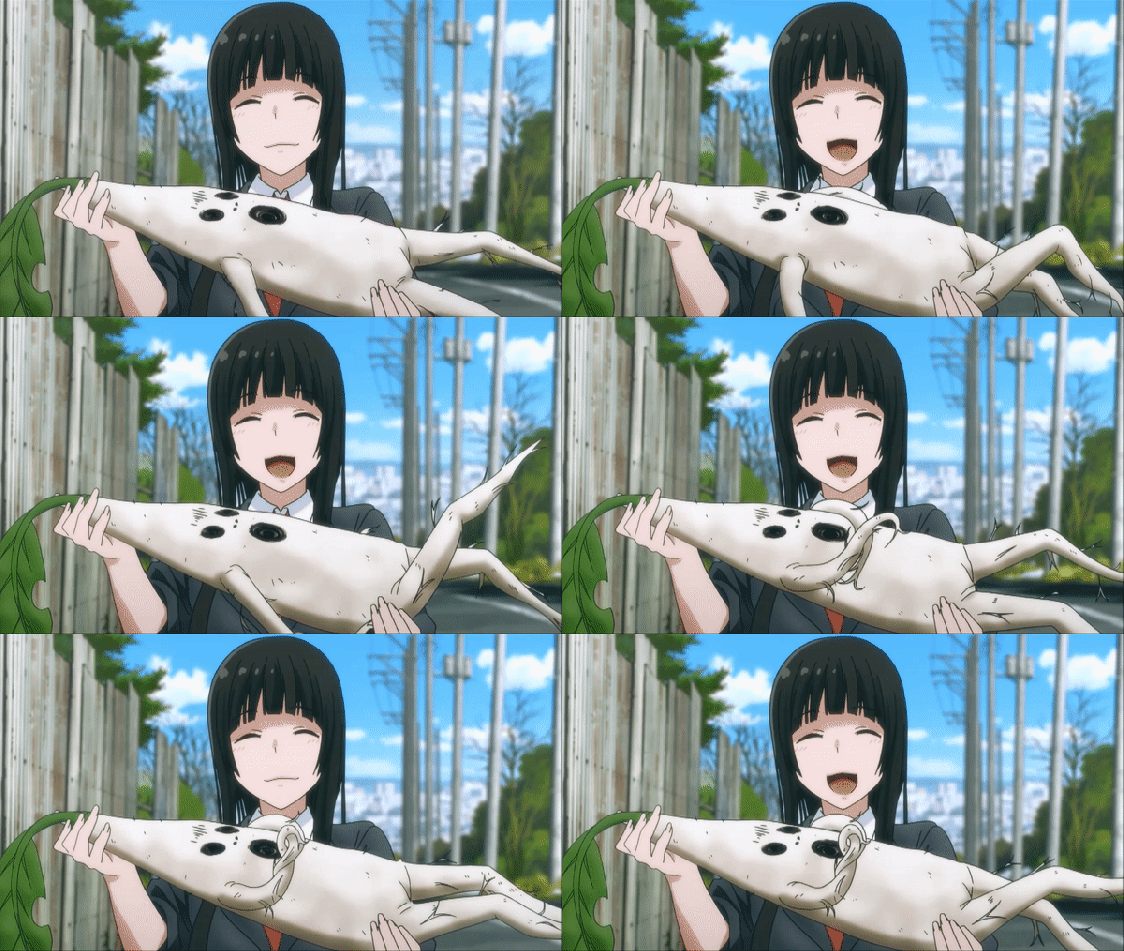
As Makoto cradles the demon plant, she cheerfully explains to an aghast Nao that it’s a good thing that they found a young Mandrake because an adult one can literally send people to the hospital or worse. The anime doesn’t stop being this fairly laid-back series, but the result is that the tiniest bit of magic feels that much more amazing.
What also helps Flying Witch is that all of its characters, guys and girls, are extremely charming. Makoto’s older sister Akane is a more experienced witch whose penchant for mischief contrasts delightfully with her younger sibling. The Kuramoto family is entertaining all around, whether it’s the dad’s thick Tohoku accent being indecipherable for Makoto or Kei trying to get his little sister Chinatsu to try more vegetables.
The fanservice in this show also has a deft touch akin to its use of magic, to the point that it might not even be right to call it fanservice. Just to be clear, generally speaking the female characters in this series are all extremely attractive, but Flying Witch never goes out of its way to show them off. When it focuses on Makoto or anyone else, the anime just lets the audience see how nice they look without lingering or leering.
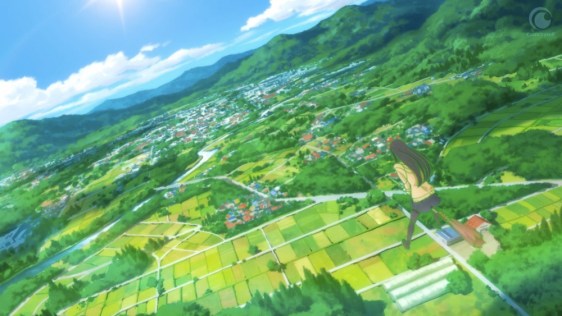
Another notable aspect of Flying Witch is its focus on Aomori, because it at times feels like a promotion for the prefecture. In fact, it makes me wonder if this is one of the reasons it was adapted from manga to anime. The Tohoku region has in recent years been known more for the Fukushima disaster, and a lot of effort has been put into reviving the region in terms of agriculture, tourism, and more. A series like Flying Witch might be just the thing to really get people to visit Aomori and Tohoku again.
Overall, because of how delightfully mellow yet powerful the show’s humor and characters are, Flying Witch has become one of my favorite anime of the year. When I get the opportunity, I’m definitely going to pick it up, possibly in multiple formats. If you want to check it out, you can find the entire anime on Crunchyroll, and Vertical Comics is releasing the manga in 2017.
—
If you liked this post, consider becoming a sponsor of Ogiue Maniax through Patreon. You can get rewards for higher pledges, including a chance to request topics for the blog.
Don’t forget, the Ogiue Maniax Love Live! Contest ends this Saturday!
With that out of the way, let’s get back to our regularly scheduled monthly blog update.
As always, much thanks to my Patreon sponsors:
General:
Johnny Trovato
Ko Ransom
Alex
Diogo Prado
Sasahara Keiko fans:
Kristopher Hostead
Yoshitake Rika fans:
Elliot Page
Hato Kenjirou fans:
Elizabeth
Yajima Mirei fans:
Machi-Kurada
A special thanks to Diogo in particular for giving me an amazing present: Volume 1 of the Brazilian edition of Genshiken!

A new season of anime is on the horizon, and I’m looking forward to checking out as much as I can. I’m most looking forward to Love Live! Sunshine!!, which started airing just this past weekend. Unfortunately, I tend to watch many more shows than I have time to write about, so often some of my favorite series don’t end up getting blog posts dedicated to them. I’m considering doing something about that, but it’s always a small struggle between writing about the anime and manga that no one’s looking at to get them more exposure and talking about the things I like that people already have some familiarity with so that there’s an easier connection to be made.
I think that, due to a lack of time, my posts have started getting a bit shorter again. I believe that there are strengths and weaknesses to larger and shorter entries, but it also means that Ogiue Maniax might feel more like the scratchpad for my thoughts that it originally was in the first place. What do you readers think of this, and is there any kind of preferred ratio for you?
June’s post of the month has to be the review of Genshiken Chapter 125. I know, I know, Genshiken is a highlight every month, but I think this is a real case of the manga zagging when you thought it would zig, and it more than anything else reminds me of how wonderful a series Genshiken is.
I also have more reports from my trip to Japan, including my visit to two different Love Live! events, and a look at Comic Store Wonderland in Osaka, which is home to a ton of amazing autographs from famous manga artists. The Hanayo bag I bought at the doujin event is quite possibly my favorite piece of merchandise from Japan. Taketayo~
Another highlight is my review of the new Cardcaptor Sakura manga. CLAMP is back! I mean, they’ve never left, but I just lost interest after years and years of Tsubasa and XXXHolic. This new CCS really feels like a return to form, and I’ve already got plans to get each issue of Nakayoshi as it comes out in Japan.
Lastly, I wrote a post about Mystic Archives of Dantalian, as requested by Patreon sponsor Johnny Trovato, where I explore the show’s intersection with the idea of chuunibyou.
As always, if you’re interested in having me write about something, you can make a pledge through Patreon. And if you’ve ever wondered why that tier is so high, it’s actually because I really want Ogiue Maniax to still be a space where I share and explore my thoughts, and so having the blog just be about fulfilling requests isn’t what I really want. However, because I’m also always eager to broaden my horizons, I invite the opportunity to make me watch or read or talk about something I might not have thought of otherwise.
I hope you all have a great July. I’ll be spending the month getting panels ready for Otakon in August. If any of you are going, I look forward to possibly seeing you.

Girls und Panzer is quite upfront about what’s in it: you have the cute girls, and you have the tanks. In spite of its seemingly vapid approach, however, the TV anime is actually quite robust, and I rate it very highly. But a television anime is different from a film, and a major question about the film sequel, Girls und Panzer der Film, is whether it can succeed similarly in spite of the new format. In this respect, I find Girls und Panzer der Film to be a very strong work, but one which is not as adept at drawing in skeptical or uninitiated viewers as its TV prequel.
Synopsis
Taking place right after the original TV series, Girls und Panzer der Film follows tactician Nishizumi Miho after she has led the ragtag rookies of Ooarai Academy to become the champions of competitive tank sports. Having defeating her former school in the grand finals, their efforts were supposed to save the school from being shut down, but because of a legal loophole their work isn’t done yet. With the help of old friends and foes alike, Miho and Ooarai Academy continue to fight for their school.
Television vs. Film
When it comes to the TV anime, I don’t believe it is absolutely necessary to be a fan of both cute girls and tanks. The show sports strong narrative and characterization as well as celebration of military hardware (as well as war simulation as competitive sport), such that a lukewarm reception of one aspect could be saved by the other. Because the series was more structured and more adept at its dramatic progression, it ends up being more enjoyable than other shows of its ilk. It’s only when either one or both elements together create wariness in a viewer (dislike of moe designs, fear of the show’s potential role as military propaganda) that the anime doesn’t really work.
Girls und Panzer der Film makes no concessions. The film immediately starts with a tank battle and ends with a tank battle. In contrast to many anime, films, etc. where we see either multiple small battles without any real sense of connection between them, or the focus is on a single duel, the last fight is a continuous 50-minute campaign. It showcases elaborate strategies on both sides, lovingly introduces new tanks to the story, and brings together characters in battle that had previously never joined forces. This film is made for people who love Girls und Panzer, and while it happens to have a solid and enjoyable story overall, newcomers are clearly not its target audience.
Slim but Effective Character Narratives
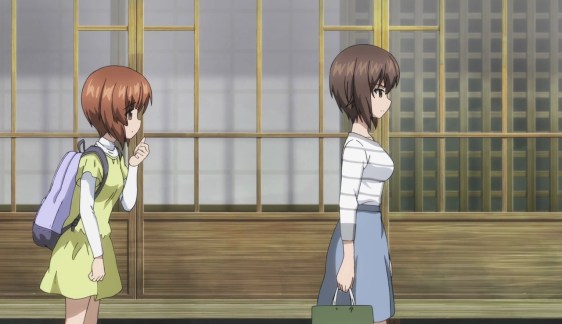
The battles themselves are fantastic. It’s rare in even the most action-packed shows and movies that a single battle will go for nearly an hour, especially one where you have a strong sense of where all the pieces are positioned and how they influence each other. Girls und Panzer der Film accomplishes just that. However, I have to re-emphasize that the concluding battle is so long that you have to enjoy tank combat at least a little bit. Either that, or you have to be so invested in the characters that seeing them develop and grow gives you great joy, even if it’s amidst the explosion of tank shells.
That’s not to say the film meanders needlessly, or that it doesn’t know how to tell a story. Girls und Panzer der Film, despite its enormous cast of fan favorites, keeps its narrative nice and focused. Perhaps nothing is more surprising than the fact that fan favorite Akiyama Yukari does not take over the film, but that’s because it isn’t really about her. While considered a possible weakness of the original TV series, the light characterization of Girls und Panzer (where characters are defined either in groups or from a few simple and easy-to-grasp qualities) works in the movie’s favor because one can easily grasp many of the girls’ motivations in only a few minutes. Seeing Miho reunite on good terms with her sister Maho (the commander of the team she defeated in the championships) was a joy. Even my favorite character, Anzio’s squad captain Anchovy, makes an appearance, and shines in her own special way.
Girls und Militarism
The elephant in the room (though not really because I already mentioned it), is to what extent Girls und Panzer der Film promotes militarism. While it’s easy to write Girls und Panzer off, either as a series that is clearly designed to get Japanese men to enlist in the Japanese Self-Defense Forces or as simple fluff that shouldn’t be overthought, I don’t think it’s so simple.
When it comes to the question of whether Girls und Panzer glorifies war and militarism, the answer is yes and no. I know that sounds like a cop-out, but let me explain. On a surface level, the appeal in this respect is obvious. Get people to fall in love with the girls, associate them with tanks, and you might see some otaku driving them once they hit enlistment age, and while the anime isn’t quite that simple, that initial impression carries a lot of power. That being said, if you watch the series, tank combat is presented as a sport akin to archery or soccer, and it presents a world where tanks are no longer weapons that take millions of lives but rather tools for friendly competition. Is this whitewashing history, or is it presenting a kind of utopian alternative? I think cases can be made for both, which is why it’s more complicated than what is evident at first glance.
So where does Girls und Panzer der Film fit into all of this? I argue that, even as it celebrates tanks and tank combat, the film makes a rather prominent criticism of patriotism. In the movie, a new school is introduced call Chi-Ha-Tan, where the girls try to make up for their lack of skill with sheer fiery gusto. However, they’re also constantly sabotaging themselves because of the members’ desire to preserve their “honor.” When comrades are taken out, they believe that the best solution is to charge the enemy and fall in glorious combat. They despise turning their backs to the enemy, because they need to make up for everything. Unlike Saunders Academy (the American school), who believe in overwhelming force as a strategy, they have no actual strategy, and are instead merely victims of their own zealousness.
In other words, the science of senshadou (way of the tank) reigns, and foolhardy aggression (the kind of thing encouraged in Japanese citizens during World War II) is a mistake.
Conclusion
Girls und Panzer der Film deftly balances its two extreme components through efficient storytelling, compelling action, and overall cleverness. It’s not as newbie-friendly as the TV series, both in the sense that it’s a direct sequel and because the tank combat is much more important, but it also doesn’t let the desire for fanservice (both technological and girly) get too much in the way of a solid narrative. It even adds an interesting new angle on the image of itself as a work that promotes militarism. Girls und Panzer der Film does a lot in two hours, and leaves a lot to contemplate, even if the movie might seem pretty light on thoughtful content otherwise.
—
If you liked this post, consider becoming a sponsor of Ogiue Maniax through Patreon. You can get rewards for higher pledges, including a chance to request topics for the blog.
 OGIUE MANIAX