The Lightness of Light Novels and the Magnified Hate of Light Novel Anime

Today’s anime industry is filled with light novel adaptations, many of which revolve around tropes that are loved by some and hated by others. Common ones include ridiculously long and descriptive titles, an average passive guy who discovers a special power, and the throngs of girls (some of whom may or may not be his little sister) who fall for him as he saves the world. For those who aren’t fans, the term “light novel anime” has come to be filled with a certain level of apprehension. “Oh, it’s a light novel anime, but don’t hold that against it.” However, while the contents of these stories contribute a large part in why they draw ire from some anime fans, what I think is an equally important factor is the implication that a good deal of money is required to adapt a light novel into an anime.

Generally speaking, the “light” in light novel refers to the fact that they’re supposed to be light reads. Sure, they might be full of esoteric jargon (hello Index) and long and complicated word play (Monogatari), but for the most part light novels are meant to be easy to pick up, finish, and put down. It doesn’t cost much to write a light novel, relatively speaking: it’s usually one person writing, and one person doing a handful of illustrations. Overall, while the industry itself isn’t necessarily cheap, the act of writing requires only a pen and paper (or keyboard and computer).

Imagine you’re presented with a book that’s full of the same tired elements, and even reeks of some author’s self-insert revenge fantasy. Its prose seems stiff and workman-like, without any creative flair. You read it, make a face, and then put it away. No harm, no foul, and even though you might later find out it’s popular and don’t personally understand why, this simple “light” book is no skin off your back.

However, then you find out that the book is being made into a Hollywood movie. They’re pouring millions of dollars into it. It feels weird, almost as if it weren’t meant to stand on this grand of a stage.

This, I think, is akin to what happens sometimes when a light novel gets adapted into an anime. Of course, there is much, much less money in the anime industry compare to big budget films, but there’s still a transition from a light novel, a piece of fiction similar in function to old American pulp magazines, to something that requires funds, hiring of talent in great numbers, and just a great deal of combined energy. As Shirobako has shown, anime production is a grueling process, and the idea that the anime industry is putting all of that energy into making some bad light novel look good can seem to detractors like a waste of finite resources.

The industry standard for the “look” of anime involves a certain higher level of polish and presentation. Most shows on a very basic level pass the test of “does this look like it was drawn and created by professionals?” What this means, then, is that whether an anime is based on some award-winning novel or something else entirely, they have similar levels of professionalism. The amateurish qualities of a light novel, which might have been forgivable for more people if they remained in that realm, vanish, and this causes fans to look at these stories from a different perspective.

In other words, if all light novel anime looked like gdgd Fairies or Ai Mai Mii, I don’t think they would get quite as much hate. Actually, that’s something I would love to see.

Sound the Gong: Ogiue Maniax Status Update for August 2017

Otakon is this month! With guests like the director of Eureka Seven, JAM Project, and more, I’m unbelievably hype for this year’s convention. If you happen to spot me at the con, feel free to say hello.

Thanks to all of my Patreon sponsors!

General:

Johnny Trovato

Ko Ransom

Alex

Diogo Prado

Viga

Yoshitake Rika fans:

Elliot Page

Hato Kenjirou fans:

Elizabeth

Yajima Mirei fans:

Machi-Kurada

I want to talk about Twitter for a bit. In the past, I’ve never really had any of my tweets go wild; the most successful one I had for the longest time was this:

That was almost two years ago. But all through July, I’ve been hitting it out of the park in ways I hardly expected. I was never good at the social media game, so seeing my tweets go viral again and again is hard for me to wrap my head around.

Have I figured something out? Only the future knows…

Anyway, here are monthly post highlights:


Gattai Girls 6: The Super Dimension Cavalry Southern Cross and Jeanne Fránçaix


After three long years, it’s finally the 6th entry in Gattai Girls review series! I look at mecha anime starring female robot pilots.

Pre-Evo Thoughts: Video Games vs. Chess Analogies


Gamers love to say that their favorite game is comparable to chess. But couldn’t we think through the analogy more?

Bootleg Products and the Defiance of Value


Bootleg stuff is often either demonized or written off as harmless, but what effects does it have on a fandom’s ability to grow itself?

Patreon-Sponsored

Aikatsu and the Power of Not Running Jokes into the Ground
The Aikatsu !posts continue! This month, I look at how great the humor is in this series. You might think I’m being paid by the creators or something, but it’s just that my biggest patron is a huge Aikatsu! fan!

Return to Genshiken

Return to Genshiken: Volume 4 – Ogiue Descends

Ogiue’s finally here! Starting this volume, I’ll be using the Japanese books along with the English ones for my re-reads.

Closing

Hopefully the next Gattai Girls post won’t take nearly as long. I’m waffling between… Patlabor and BBK/BRNK. What do you think?

Anyway, see you at Otakon!

Save

Save

Save

[AnimeNEXT 2017] Studio Trigger Interview

Last time, I asked the illustrious Studio Trigger about the origins of Turning Girls. This time I only had the chance for one question to Yoshinari Yoh (director of Little Witch Academia), but the answer was quite informative.

When you were a lowly footman in the anime industry, what did you swear you’d do when you got further? Like, “If I ever become director, I will definitely do this.”

Yoshinari Yoh: When I just entered Gainax, it was right when Sailor Moon was airing, and I was reading an article in a magazine. I remember commenting, “I would never want to do something about magical girls.” But then once I entered Gainax, the executives (such as Anno) loved Sailor Moon, so I ended up working on it.

Thank you for the interview!

Return to Genshiken: Volume 4 – Ogiue Descends


It’s finally here—the advent of Our Lady of Surly Shipping, the Angriest of Fujoshi, Ogiue Chika. To call this a major event in the series would be an understatement, but I’m getting ahead of myself.

What is Return to Genshiken?

Genshiken is an influential manga about otaku, as well as my favorite manga ever and the inspiration for this blog, but it’s been many years since I’ve read the series. I intend to re-read Genshiken with the benefit of hindsight and see how much, if at all, my thoughts on the manga have changed.

Note that, unlike my chapter reviews for the second series, Genshiken Nidaime, I’m going to be looking at this volume by volume. Starting with this volume, I’ll be using both English and Japanese versions of Genshiken! Also, I will be spoiling the entirety of Genshiken, both the first series and the sequel, so be warned.

Volume 4 Summary

Due to the fire accidentally started by Kasukabe, the Society for the Study of Modern Visual Culture has been temporarily suspended, with club room privileges revoked and its members assigned mandatory community service. Feeling incredibly guilty over causing all of this trouble, Kasukabe reluctantly volunteers to go to Comic Festival to buy doujinshi for the others and even participate in a cosplay contest. There, she not only punches out a guy trying to get some upskirt shots, but her striking appearance causes the embers in Madarame’s heart to ignite into a flame.

More revelations and events follow. Tanaka and Ohno have started dating. Madarame passes on the mantle of club president to Sasahara, who declares his intent for Genshiken to create a doujinshi to sell at ComiFes. The club even gains two new members: Kuchiki, a familiar face who was rejected from the Anime Society, and Ogiue, a standoffish otaku-hating girl who literally jumped out a second-story window to spite the other Manga Society girls. So Genshiken grows with two problematic additions.

Saki’s Remorse
The way Saki’s guilt slowly eats at her, culminating in that single tear rolling down her cheek, is quite subtle. Her stoic expression as they move from one member’s apartment to the next in lieu of a club room is easy to miss. Even more significant is why she feels so bad about the situation.

It’s not simply a matter of being responsible for the fire, it’s that she sees how lifeless the others have become. It’s as if her actions have robbed them of the very space where they can open up and just enjoy being who they really are. This is where I think Saki truly becomes one of them—even if she’ll never be an otaku, she at the very least can empathize with their energy.

Later in Nidaime, when Madarame finally confesses to Saki, his thoughts go back to this moment: “I always knew that Kasukabe-san cries easily.” It was her first true moment of vulnerability in the series, and may be what planted the seeds of “Kasukabe is moe” in his head.

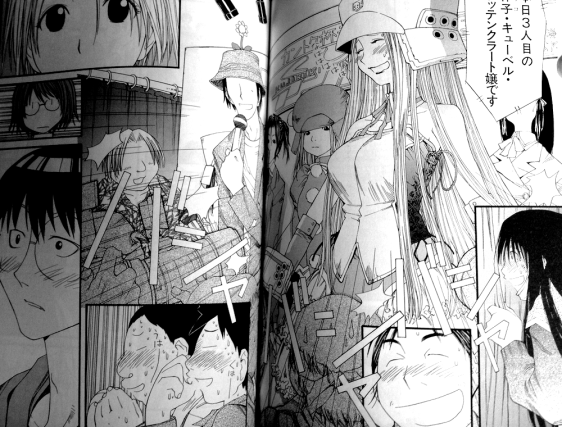
The Ritsuko Kubel Kettengrad cosplay she does in this volume is, in some ways, merely the icing on the cake. But what an icing it is!

The Cosplay Heard ‘Round the World

Saki’s cosplay is the catalyst for many future threads in Genshiken. It’s the moment Madarame confirms his own feelings for her. It’s what prompts him to get those photos of her, which eventually are found by Hato. It’s what leads to Saki pressuring Ogiue to cosplay as Renko from Kujibiki Unbalance.

Speaking of those Saki photos, I’ve always been fascinated by how they’re made to look more…lustrous…than the actual characters themselves, including Saki. It gives those pictures a kind of aura, almost like this is how Madarame sees her. Comparing the photos to the actual depiction of Saki, the difference is that the photos use screentone shading for her outfit, and that she looks comfortable and poised in them (as opposed to nervously sweating like in the image earlier).

There’s actually another moment related to this cosplay that I think marks the beginning of something special, which is a clear sign that Kio Shimoku is paying more and more attention to page composition.

In the above scene, we see from Kasukabe’s point of view as she tries out her Ritsuko cosplay for Ohno. For each panel, Ohno is in a similar position on the page, creating a clear vertical column that unites the page from top to bottom. At the same time, the fact that Ohno’s size varies relative to each panel gives it some variety and keeps it from feeling repetitive. It’s simple yet highly effective, and captures well the concept of “flow” in manga.

Tanaka: Best Friend and Boyfriend

Model kit and cosplay-loving Tanaka ultimately gets fewer dedicated chapters than many of the other characters in Genshiken. It’s sort of a shame, as the brief spotlights he gets here (though shared), point towards an interesting fellow. Not only do we get the sense that he and Ohno have been developing their feelings not-so-under the surface all along, but let’s not forget that he was the first of the “total dork” otaku to get a girl. As the characters themselves mention, it only makes sense. It’s not just that their hobbies overlap, but that their respective passions for their hobbies run equally strong.

The anime Genshiken 2 actually saw it fit to devote an episode to exploring the sexual side of Tanaka and Ohno’s relationship. In the manga, we only get Ohno’s lament that he still hasn’t made a move, and then towards the end of Nidaime we find out that he gets to see Ohno “only” once a week. Talk about progress!

Tanaka’s connection with Ohno is not the only highlight here. When most of the club finds out about them dating, it turns out Kugayama knew already because Tanaka told him. Here, you get the idea that they’re really close friends, arguably closer than any other two characters in a platonic relationship in the entire manga. By being a little more in the background, I get the sense that they’re having these private conversations on the regular, and we the readers are only privy to the crumbs.

Sasahara’s Ambition

The reason behind Madarame giving Sasahara the presidency is the interesting one. Essentially, he says that Sasahara is the one most true to being an otaku. From the perspective of 2017, this brings to mind the notion of “real geeks” vs. “fake geeks,” but it’s worth noting that Sasahara is the most inexperienced otaku out of all potential prospects (and Saki doesn’t count by not having a single otaku bone in her body). Ohno is well-known cosplayer with years of experience, and Kousaka is basically Madarame-level, but the big difference is that both Ohno and Kousaka are able to fully function in the world of non-otaku. Part of it is simply due to looks, but there’s a sense that what lies at the core of Genshiken as a club is personal and social dysfunction. If you’re able to function and thrive that easily among “normal folks,” can you be true to the spirit of the classic otaku?

The assumption that otaku will always be society’s rejects is also very telling in hindsight. After all, the whole Densha Otoko boom was about a year or two away at this point in Japan, and eventually Ohno does become president after Sasahara. The image of otaku begins to transform from those whose passions prevent them from being able to succeed to those whose passions help them succeed. It’s why Yajima in Nidaime is so self-conscious about her role in Genshiken—everyone else is attractive and/or successful, and Yajima is, in her own mind, fat and ugly and untalented.

But perhaps Sasahara is himself emblematic of this change. As soon as he becomes president, he declares his desire to create a doujinshi for Comic Festival, something that the club has basically avoided because none of them have the drive or the active desire to put in the hard work. After all, they did reuse their club presentation materials so much that the paper has started to brown. They’re slowly going from a do-nothing club to a do-something club, and a certain paintbrush-haired fujoshi eventually becomes central to that.

Ogiue Time

I had almost forgotten that, when we first meet Ogiue, we don’t quite know that she’s a closet fujoshi yet. We know she’s an otaku who hates other otaku for whatever reason, but it’s not until the next chapter that we see her get tempted by the Genshiken honeypot pile. She just comes across as an incredibly troublesome character with very brief glimpses of vulnerability, especially when Saki comforts her after Kuchiki puts a hand on Ogiue.

Because Ogiue is introduced alongside Kuchiki’s re-introduction, they’re presented as contrasts. Ogiue, coming from the Manga Society, is reticent, grumpy, and unwilling to open up to others. Kuchiki, coming from the Anime Society, is loud, spastic, and a little too lacking in a filter. Perhaps I’m biased, but I can see why Ogiue got more of the spotlight as the series goes on.

I think there’s a bit lost in Ogiue’s introduction in English versus the original Japanese. “My name is Ogiue, and I hate otaku” is a perfectly good translation, and it’s how I’d translate it as well. It sounds good in English, and it’s how English speakers typically introduce themselves: I’m [name] and I [do/like/am something]. But in Japanese, she says, “Otaku ga kirai na Ogiue desu“—”I am the otaku-hating Ogiue.” The very first thing she blurts out is her dislike of otaku and, as we later learn, her self-loathing. Maybe something like “I hate otaku. Hi, I’m Ogiue” would work better?

It’s also notable that Ogiue’s design is somewhat different at this point. Her side hair antennae are a little more angled, and her face is sharper. The character designs as a whole get a bit rounder over the course of the manga in general, but this specific version of Ogiue really gives off a “dangerous, do not touch” vibe.

Another thing to point out is how, while Ogiue’s eyes change permanently after she starts to date Sasahara, you see glimmers of it in Saki’s interactions with Ogiue right from the beginning. Saki’s quite good at breaking down walls, after all.

Final Random Thoughts

I need to make a correction to something I said back in Volume 2, which is that the original president never shows up again. But he does, right here in Volume 4! He dispenses some advice for Saki, that flits off to wherever wizened old otaku leaders go.

Last thing: One of the club discussions that crops up in this volume is comparing the Kujibiki Unbalance manga to the anime, where the former is inevitably considered better than the latter by its members. The anime is noted as having many more jokes, and overall being a crazier experience. What’s funny to me about this comparison is that it’s clear the Kujibiki Unbalance OVAs we got with the first Genshiken anime are trying to be the anime spoken of in this volume. It’s a bit of meta-humor for Genshiken fans, and it won’t even be the last time this sort of referencing occurs.

Save

Save

Save

Save

Save

Save

Save

Save

Save

Save

Save

Save

Save

Gattai Girls 6: The Super Dimension Cavalry Southern Cross and Jeanne Fránçaix

Introduction: “Gattai Girls” is a series of posts dedicated to looking at giant robot anime featuring prominent female characters due to their relative rarity within that genre.

Here, “prominent” is primarily defined by two traits. First, the female character has to be either a main character (as opposed to a sidekick or support character), or she has to be in a role which distinguishes her. Second, the female character has to actually pilot a giant robot, preferably the main giant robot of the series she’s in.

For example, Aim for the Top! would qualify because of Noriko (main character, pilots the most important mecha of her show), while Vision of Escaflowne would not, because Hitomi does not engage in any combat despite being a main character, nor would Full Metal Panic! because the most prominent robot pilot, Melissa Mao, is not prominent enough.

— 

The Super Dimension Cavalry Southern Cross might be a mere footnote in anime history if not a confluence of factors. In Japan, it gains some notoriety by being the follow-up to Peruse in the Super Dimension franchise. In the United States, it was heavily edited into the second arc in the influential Robotech TV show, its characters transformed into completely different identities so as to bridge continuity with the previous Macross saga. Another feature, arguably more important in this day and age, is that Southern Cross is an action series that prominently features  capable heroines in leading roles and does not diminish their strengths.

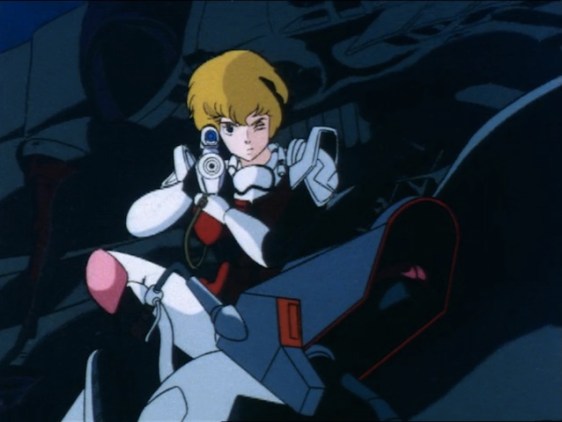
In the future year 2120, humanity has ventured out and colonized space. On the planet Gloire, its denizens enter into a war with a mysterious alien force known as the Zor. Central to this story is a feisty 17-year-old girl named Jeanne Fránçaix, member of the 15th Squad of the Southern Cross’s Alpha Tactics Armored Corps. As Jeanne and her allies fight (and break the rules) on a regular basis, they learn the truth of the Zor, as well as the beauty and ugliness of humankind.

Southern Cross is something of a meandering show, with the largest and most compelling narrative developments coming quite late into the series. Given its early cancellation (indicated by its unusual count of 23 episodes) and its consequential rushed ending, the series is certainly flawed. However, its portrayal of a young and energetic group of soldiers going through life try to enjoy it more than dread it—less Gundam and more Patlabor. No character embodies this environment more than Jeanne herself.

Jeanne Fránçaix, Main Heroine

Jeanne possesses many features that could be deemed stereotypically female—boy-crazy, obsessed with fashion and shopping, and generally ruled by her emotions. Southern Cross also isn’t afraid to give her more than a few shower scenes to flaunt her to the audience. However, it’s important to note that she’ never really portrayed as a “weak” girl. Jeanne a capable soldier who ends up being a clever and shrewd commanding officer. She pays attention to the feelings of her comrades. And when it comes to one the major criteria for Gattai Girls—the requirement that the heroine actually pilot a giant robot and fight with it—Jeanne is practically second to none.

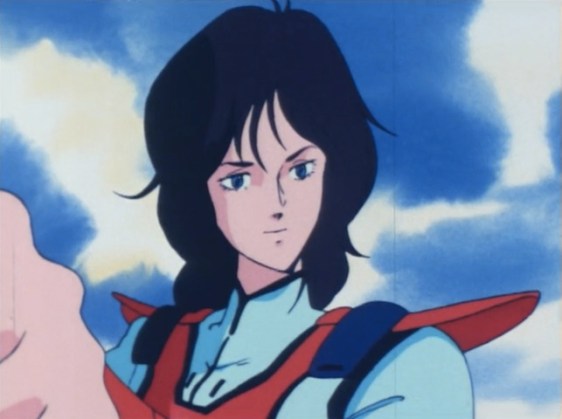
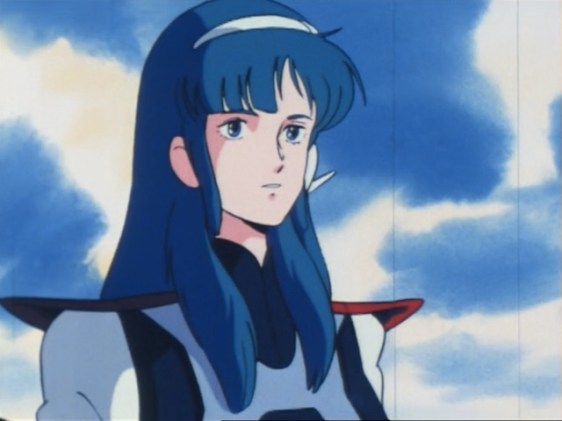
Neither Jeanne nor the other two major female characters, Marie Angel and Lana Isavia, ever end up becoming damsels. When they go into battle, they do so with great skill and as equals to the men with little underestimating of their abilities. Lana is less talented in this respect, but that’s also because her position is less combat-oriented. When the show later introduces another major female character, the Zor girl Musica, the fact that she’s more meek and waif-like is just one possible example of a girl, rather than the sole portrayal.

Marie Angel

Lana Isavia

I’ve read that Dana Sterling, Jeanne’s counterpart in Robotech, has a significantly different personality. I’ve never watched the Robotech Masters portion of that series, so I can’t say how Dana fares as a Gattai Girl, but I imagine the basic core of a talented and tough heroine is still there. It would take some extreme cuts to make Jeanne/Dana anything but admirable.

Jeanne’s personality, and by extension the strengths of Southern Cross, can be best summed up by the following. In the film Valerian and the City of a Thousand Planets, there is a scene towards the end where the female character Laureline urges the hero Valerian to choose love over duty. However, it comes across as a bit incongruous in that context, as we see plenty of Laureline essentially working by the book as she fulfills her assignments as a soldier/agent. If Jeanne were in Laureline’s position while giving the same exact speech, it would make complete sense. Jeanne is driven by her passion, whether she shirks responsibility or embraces it.

We see Jeanne love. We see her lose. We see her lift friends up and take enemies down. For all the faults of Southern Cross, Jeanne transcends them. In many ways, she is far greater than the series from which she comes, but it’s also thanks to that world that we can see how strong she truly is.


Save

[APT507] Dragon Ball Super and the Tournament of Power: Combining Two Unlikely Story Narratives!

I’ve previously made it known that I’m a fan of Dragon Ball Super. Now, I’ve wrote a post about why I think the latest arc, the Tournament of Power, is something quite special. Check it out on Apartment 507!

Icons: Combat Arena and the Social Establishment of Character Archetypes

The desire to create competitive games in the vein of Smash Bros. often comes with the intent to court the existing player base for Smash Bros. Melee—the hyper-fast entry of the popular Nintendo franchise with the most storied tournament history. This is evident in the recently named Icons: Combat Arena. With its EVO 2017 gameplay trailer showing off attack animations and characters a little more than reminiscent of Smash Bros., the comparisons are more than inevitable. One of the consequences of this courtship is that, not only is the intended character roster inspired by high-level Melee play, but there is also a clear assumption from the creators of Icons that how the strongest characters have emerged from within Melee‘s environment have shaped the very foundation of the genre of the platform fighter subgenre.

The name of the studio behind Icons, Wavedash games, is by itself sufficient evidence for the team’s reverence for Smash and Melee. It’s named after the most well-known of the “hidden techniques” of Melee. The developers have even released videos over the past year detailing their design philosophy and inspirations. However, the fact that the Melee top tier is virtually replicated in the Icons roster revealed thus far is the biggest indicator of Melee‘s influence.

Take, for example, the character known as Kidd, an anthropomorphic goat character who’s also an homage to Joseph “Mang0” Marquez. One of the “five gods” of Melee, Mang0’s nicknames include “The Kid” and “The GOAT” (in reference to his numerous achievements). According to the creators themselves, Kidd is purposely patterned after the characters Fox and Falco from Star Fox, two of the top tiers. More than simply taking cues from these two, Icons considers the “space animal” to be a mainstay character archetype for platform fighters, the way that the “shoto” (a balanced character with fireball, anti-air uppercut, and horizontal movement special move) or the “grappler” are in traditional fighting games.

The positioning of the space animal as an archetype is very telling because, while there are shared qualities between Fox and Falco (the latter being a “clone” built directly from the template of the former), what really defines the significance of “spacies” to the platform fighter is their dominance in Melee and the reputation of superiority that precedes them. No character embodies competitive Melee more than Fox—his speed, incredibly good tools, difficult technical requirements, and overall role as “master of all trades” helps to define that high-pace action Melee is famous for. In other words, the reason the space animal is an archetype is because they’re so absurdly strong in that environment, a notion which extends to many of their archetypes listed by Wavedash Games in one their development vlogs:

The eight archetypes are: space animal, swordsman, speedy brawler, floaty, duo, projectile master, alternate weapon, and grappler. Of these, the first four can be found directly in Melee‘s upper echelons. The fifth, the projectile master, is arguably best seen with Solid Snake in Smash Bros. Brawl.

From 1 through 8: Space Animal, Space Animal, Swordsman, Speedy Brawler, Floaty, Floaty, Duo, Speedy Brawler

To be clear, this is not accusing Wavedash Games of lacking creativity. While certain attacks shown so far are quite obviously taking cues from Smash Bros. and especially Melee, there’s also a clear intent to innovate. Ashani the speedy brawler is supposed to be “30% familiar, 70% new.” Even so, Ashani is clearly assembled from the building blocks of Captain Falcon in Melee. This makes sense, given that Captain Falcon is arguably the most beloved Melee character due to his flashy, up-close combos, and the fact that he’s good, but not so overwhelming as to be stigmatized for it. Another Icons character, Zhurong, is a sword wielder clearly modeled after Marth (another Melee top tier).

If not for how competitive Melee turned out, it’s highly likely any of these categories wouldn’t even be thought of as archetypes in the first place.

That might seem like an obvious point. After all, why wouldn’t a genre grow based on the successes of past releases? However, I still think there’s a vital difference between how Icons defines its archetypes and how other games, including other competitive ones, have gone about it.

Look at Street Fighter, for instance. In Super Street Fighter II Turbo, the Spanish ninja known as Vega/Balrog/Claw is one of the best characters while also possessing a unique fighting style. Yet later fighting games inspired by Street Fighter didn’t consider “Claw” to be a foundational character style. They were more likely to go with archetypes that, while based on Street Fighter‘s success, aren’t necessarily based on tier lists—the Zangief-esque grappler, for example, fluctuates up and down the tier lists from one game to the next, and wasn’t especially strong in Street Fighter II. At this point in Icons, there seems to be no indication of a “Mewtwo”-esque character, possibly because Mewtwo is a low tier in Melee.

The archetypes established for Icons: Combat Arena do not come from the success of Smash Bros. and especially Melee as competitively viable games alone. They also derive from the collective Melee community’s perception of what is assumed or expected of a game that is trying to exist within not just the same world, but practically on the same city block. If Melee didn’t have the space animal or the swordsman, its history would’ve been far different, but the lopsidedness of its tier list also means that many of the characters who could’ve been archetypes are perceived as otherwise due to their ineffectiveness. For a competitive scene so firmly built on the top being home to only a handful of characters, it is arguably the best way for Icons to say, “I am familiar territory, don’t be afraid to try me.”

Save

Cersei Lannister vs. “Anime Incest”

There are a great number of anime and manga with incestuous overtones, but contrary to what might seem obvious, I’m not so sure how much of it truly has to do with a desire to have sex with siblings, real or imaginary. There are other qualities to take into consideration, such as what goes into a “little sister” or a “big sister” as a character archetype beyond simply a familial relationship, or the fact that these archetypes exist at all.

To what extent does the anime/manga aesthetic itself, as well as the other tropes that these works tend to carry, make “anime incest” into something even more different from simply its portrayal in fiction, positive or negative?

HBO’s Game of Thrones is a non-Japanese property which features very prominently an incestuous relationship. Jamie Lannister and his sister Cersei are madly in love with each other, and have even bore children as a result. However, I don’t think Cersei is thought of in the same vein as the sisters of My Little Sister Can’t Be This Cute or The Irregular at Magic High School, and therefore does not possess the aspects which make those characters so popular. There’s something to this “positive portrayal of incestuous relationships” in anime and manga that transcends the characters being connected by blood… or not, in the case of the “non-blood-related sibling” trope that technically removes the moral and biological issues to an extent.

CerseiEW

My Big Sister Can’t Be This Vindictive

Put a different way, if the sisters, hot moms, or other family members were not portrayed visually and narratively through anime and manga, would the fans of these characters still be fans of them? If so, would it be for the same reason? My feeling is that the answer would be “no,” because it’s these incestuous character archetypes exist within a greater realm of tropes that anime and manga fans are drawn towards.

Save

Save

Aikatsu! and the Power of Not Running Jokes into the Ground

WARNING: Spoilers
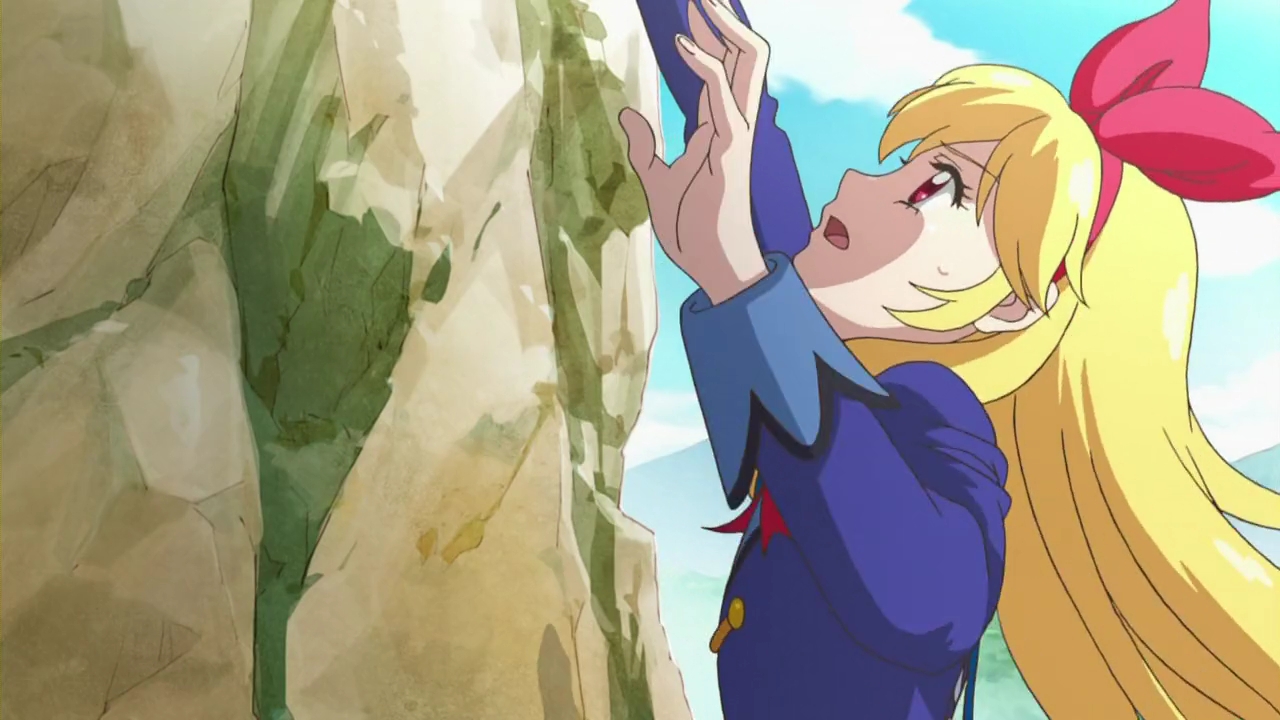
For all of their abundant, game-shilling elements, the Aikatsu! anime have done a remarkably good job of standing on their own. Whether it’s Ichigo or Akari from the first series, or Yume from Aikatsu Stars!, the franchise creates fun, interesting protagonists and then surrounds them with a large cast of equally charismatic and compelling characters. Another important quality of Aikatsu! is that it excels at not letting any of its running jokes overstay their welcome, which is best seen in how it handles its famous “cliff-scaling” gag.

In an early episode of Aikatsu!, Ichigo tries to get in contact with a world-famous fashion designer who lives atop Angely Mountain. Ichigo, willing to do whatever it takes, ends up climbing all the way up, unaware of the fact that she could’ve taken an elevator. After meeting the fashion designer, Ichigo goes on to view her as a guiding voice of sorts, someone to ask for advice. And every time she visits, she takes the hard way.

Ichigo’s “pilgrimage” is not overused. It doesn’t show up every episode, or even every other episode. Every time that mountain shows up, it’s an opportunity to laugh but also to view progress. Eventually, Ichigo climbs it with such ease that it becomes symbolic of her drastic improvement as an idol. I knew that, whenever that cliff showed up, I would smile with glee.

Not every running joke is used as sparingly. Yurika’s vampire gimmick is prevalent. Even here, however, the frequency with which Yurika plays up her faux-occult origins becomes part of the humor. Because Yurika works hard to maintain what pro wrestlers call “kayfabe” (essentially living the role), it becomes one of her endearing qualities. Her constant refrain of “I’ll suck your blood!” is presented as one of the many reasons Yurika’s fans love her.

When it’s revealed late in the first season that Ichigo’s mother is a legendary idol, nothing is more perfect than the further revelation that Hoshimiya Ringo is already well accustomed to visiting Ichigo’s designer. “It’s been a long time since I’ve done this,” she says, ready to climb. The cliff-scaling is not a gag exclusive to Ichigo, but actually permeates the entire idol universe of Aikatsu! 

In one of the later openings, Akari (Ichigo’s successor as heroine) can be seen climbing along with her friends. Thanks to the context established by Ichigo, the scene encapsulates what’s great about Aikatsu!, instead of feeling like a callback to a worn-out image.

This post was sponsored by Johnny Trovato. If you’re interested in submitting topics for the blog, or just like my writing and want to support Ogiue Maniax, check out my Patreon.

Chala Head Chala vs. Rock the Dragon and the “Image” of Dragon Ball Z

In a recent blog article, I wrote about how the character of Vegeta in Dragon Ball Z is portrayed differently in Japanese and English, and how this has resulted in something of a divide among fans. The article was a surprising success, quickly becoming one of my most popular posts in recent memory, and the numerous responses I received (especially on Twitter) prompted me to think more about how Dragon Ball Z (and the Dragon Ball franchise in general) is perceived differently depending on how a person came across it.

Is Dragon Ball a gruff fighting series, or a heartful adventure? How big a role should comedy play before it goes too far? Many factors go into how the series is viewed, including whether or not someone started with adult or kid Goku, but I came to realize another influence: theme songs. On some level, I believe that the core difference between how Dragon Ball can be summed up in the contrast between “Rock the Dragon” and “Chala Head Chala.”

Before I delve more deeply, I do want to say that, while I prefer “Chala Head Chala,” my taste in music is not important here. Nor is the fact that “Chala Head Chala” came first. Tthe anime is based on the manga, which has no actual sound at all, let alone opening and ending themes. “Being the original” is not a sound argument to make. What I will be focusing on is mainly, how do each of those themes make its viewers feel?

“Chala Head Chala” feels fairly light-hearted, with quite a few odd lyrics (“If I discover a dinosaur in ice, I want to balance it on top of a ball” ???), yet there’s also a quiet sense of gravitas thanks to Kageyama Hironobu’s warbling voice. While the theme does suggest action and excitement, it emphasizes more a sense of “adventure” and “discovery,” though perhaps not to the same extent as the Dragon Ball opening, “Makafushigi Adventure.” Most of the visual imagery in the opening is concentrated on movement—flying and running. Motion is the key.

“Rock the Dragon” is all about heavy use of electric guitar riffs. The song puts all of its emphasis on high-octane thrills, and the the lyrics (as repetitive as they are) further push to the forefront the idea that this is not just a series with action, it’s the action series. Instead of the first image being a rotating dragon ball, it’s the dragon itself in all of its majesty and glory. All of the footage aside from that is fighting, fighting, and more fighting.

If I had to greatly simplify, I’d say that “Rock the Dragon” is more about “body and spirit,” and “Chala Head Chala” is more about “heart and soul.” They both introduce the same overall series, about Goku and his allies taking on ever-increasingly powerful threats to the Earth, but one revels in the fighting and the other suggests fighting as a means of expressing character. Because of this difference, I think it cements different core images of Dragon Ball in people’s minds, and this affects how subsequent works (Battle of Gods, Dragon Ball Super) are received as well. Looking ahead, the opening of Dragon Ball Super, “Limit Break x Survivor,” is actually a kind of middle point between “Chala Head Chala” and “Rock the Dragon” with a dash of “Makafushigi Adventure.” Could it be the theme that unites Dragon Ball dub and sub fans once and for all?