OGIUE MANIAX

Anime & Manga Blog | 50% Anime Analysis, 50% Ogi

Understanding “Safe Spaces” as Expressions of Ideals

In observing the interactions and conversations about social justice and related topics, one thing that becomes increasingly apparent is the stark difference in perspective that can come from being a minority vs. a majority. In particular, the criticism of “overreaction” is a fascinating one to explore, because of how it can lead to the idea that “political correctness” is causing more problems than it solves. However, what I find is that the issue isn’t so much that people are oversensitive, or even that the other side is composed of monsters, but that there is a particular approach to life that is implicit in the actions of many who take can be thought of as “overreacting.” I call this “externalization of an internal ideal.”

Before I continue, I want to say this: although I’ve actually been thinking about this subject quite a bit, it’s Duncan “Thorin” Shields’s recent video above arguing how the media is all too eager to create outrage that has prompted me to really commit my thoughts to text. This is because, while I don’t agree with some of the key points of his video, he at least lays it all out such that it promotes debate and discussion. And even if I’m not of a similar belief to him in certain respects, I still highly value his work on eSports and continue to watch his videos regularly.

At one point in Thorin’s video, he mentions the Donald Trump “pussy grabbing” scandal, arguing that the outcry against it was exaggerated to an absurd extent. This is not because Thorin is defending sexual assault, but that the way in which Trump was speaking was in the context of a private conversation between men where the objectification of women is par for the course. The idea laid out in this minor point is that Trump’s words should have been a surprise to no one, so to respond with shock and horror is to willfully ignore reality.

I think Thorin is right in a certain sense, but I also don’t think that this is automatically a problem. Although some might navigate their lives by saying, “This is how the world is, so I’d better figure out how to best work within those restrictions,” others might instead think, “I want to live my life as if the world is at the point I wish it to be.”

Let’s put this in the context of minorities. When it comes to the dictionary definition of a “minority,” it would only make sense that they would feel like the world does not cater to them. If there was a world where the population was 99% majority and 1% minority, then mathematically it would be unlikely for this minority to gain much traction. And yet, that does not mean someone who is a member of a minority should only ever be able to feel like they are excluded from the majority, that they cannot act as if they are the default or standard. If there is a black person, or an Asian person, or a gay person, or a transgender person, and their mindset is to behave as if they are not an outsider, that they are not the “other,” then I think that is a perfectly fine way to live.

This is also why I think the idea of “safe spaces” is often misunderstood. Sometimes you’ll see them characterized as “hug boxes,” or places that prevent people from learning to overcome adversity. If the “real world” is where iron sharpens iron, then safe spaces are supposedly sites of stagnation for individuals and groups. But their ideal function is to be a place where one can feel “normal,” that they are not some deviation that must inevitably be compared to what is most common in society. Why shouldn’t women want a world where they’re not judged first by their looks, even if the first thing we tend to notice about people is how they look? Why shouldn’t a racial minority get to spend some time without being implicitly judged by their skin tone and the cultural stereotypes they carry?

There is a downside to all this. If you live by trying to externalize your ideals, you risk creating a false perception of the world, especially if you ignore the need for reality checks. However, if you take the world “as it is,” then you might end up reinforcing hierarchies if the desire to fight is absent. What I think is especially important in the former’s case, and why I think the notion can seem so foreign to certain people is that it carries a kind of utopian desire. Rather than simply imposing one’s will upon the world and forcing it to obey, it’s a mark of a hope for a better world. Instead of the world telling you how you are, you tell the world how you are. Even if people “shouldn’t” have been outraged at Donald Trump’s words, they want the world to be one where implied sexual assault is admonished. Only by understanding this perspective can discussion really begin.

I am not someone who believes “overreaction” does not exist, or that it is a wholly unfair criticism towards liberals. It is all too easy for even well-meaning people to have knee-jerk reactions, not understand the context of a situation, and then ride their anger without looking back. Nevertheless, I do think that this desire for an ideal world is not simply a pipe dream or a refusal to acknowledge reality. The better way to look at it is as a wish for the world to be a better place starting with one’s own mind and body.

Christmas Feast!

Save

[Anime Secret Santa] Queen Millennia, Ah-Ahhh, Savior of the Universe

queenmillennia-millennia

NOTE: This review is part of the 2016 Reverse Thieves’ Anime Secret Santa Project

While I don’t religiously embrace the works of Matsumoto Leiji, I consider myself a loving fan. The Rintaro-directed Galaxy Express 999 film is far and away my favorite work of Japanese animation ever, and the gravitas-laden feel of Matsumoto’s manga never ceases to draw me in. When approaching the film adaptation of Queen Millennia, however, I came to it with a vague inkling that I should expect something different. Years ago, the film was discussed by the podcast Anime World Order, and the main thing I remembered from that review is the fact that its director, Akehi Masayuki, is not exactly known for subtlety. With films of bombastic super robots and handsome shounen heroes to his name, my expectations could be summed up as “Matsumoto through the lens of wild action and spectacle.”

Queen Millennia certainly lives up to that expectation, but what I find more prominent is just how discombobulated the entire film feels.

The story of Queen Millennia is set in the far-flung year of 1999, and centers around a woman named Yukino Yayoi, who, unbeknownst to her co-workers, is actually the secret alien queen of the Earth. Having overseen the Earth for the past 1000 years as one of many millennial queens dating back to time immemorial, Yayoi (real name Promethium II) is set to abdicate her position for the next successor and return to her home planet of La Metal. However, La Metal has its own plans and now seeks to destroy the Earth. Queen Millennia must now defend her adopted homeland from her own people with the help of a young boy named Hajime.

queenmillennia-meteorites

There is a generally haunting quality to Matsumoto Leiji works that appear even in adaptations, and Queen Millennia is no exception. Scenes of destruction, pans over wide swathes of land and outer space give the impression of an expansive universe with a great deal of history. However, at numerous times during the film, the atmosphere feels as is if it all but takes over the film, sacrificing the coherency of the narrative along the way. There are numerous plot points in the film come too abruptly and then fade away, as if the viewer is only given the Cliff Notes version of events.

We learn almost immediately that Yayoi is Queen Millennia, a role whose purpose is woefully under-explained. When the soldiers of La Metal attack the Earth with their futuristic spaceships, they’re held back by the weapons of Earth, including fairly outmoded ones such as harpoons and catapults. For some reason, despite ruling over the Earth secretly for thousands upon thousands of years, and even bringing up the fact that humankind is violent and prone to war, the La Metallians mention that they did not expect the people of Earth to have spears and rocks. The film picks up towards the end, especially when the spirits of the former Queen Millennias are summoned, and they each have secret space battleships buried in the Earth with their faces emblazoned on the bows, but that sort of energy and bizarre presentation feels like it should have come much earlier.

queenmillennia-matsumoto

queenmillennia-ship

I suspected that Queen Millennia was suffering from being a film adaptation of a longer series, and I was right. There was both a five-volume manga series by Matsumoto, as well as a 42-episode anime. If you go to Wikipedia and read the plot summary, it makes a lot more sense and gives the impression that many important plot points are set up and executed over a long period. The Queen Millennia film, in condensing all of that into two hours, leaves a good deal of story by the wayside.

However, this issue cannot fall squarely on the shoulders of being a “summary movie,” because other even longer Matsumoto works have been successfully adapted to film. The aforementioned Galaxy Express 999 film takes a massively long-running manga and anime and transforms it into a feature-length work, but the compromises made for time help connect the narrative rather than scramble it. They visit far fewer planets, but the ones they do are directly relevant to the events at the climax of the film. Notably, when they reach the last stop, the name of the planet is changed from “La Metal” in the original to something that effectively drives home the major plot twist while also transforming what took minutes in the anime TV series into mere seconds. While I haven’t actually taken a look at the TV series or the manga of Queen Millennia, very little gives me the impression that it has these sorts of considerations built in.

Ultimately, I think the positive qualities of Queen Millennia are its excellent atmosphere, its strong emotions, and its visual spectacle. The issue with it is that these qualities come at the expense of a coherent story, and much of the time devoted to showing fights or the world could have been used to provide a better sense of the stakes at hand and the significance of Queen Millennia herself much earlier in the film. By the time the film starts to pick up, it’s already about two-thirds over, and it leaves a feeling of what could have been.

Last note: What is going on with this guy’s hair helmet? He’s taking the Jotaro hat-hair thing to a whole other level.

queenmillennia-hairmask

Save

Save

The End of Sabagebu!: A Shoujo Manga of Girls, Guns, and Greed

sabagebu-smile

Sabagebu!: Survival Game Club ended this month, and it’s one of my favorite shoujo manga of the past few years. Check out my thoughts on this bizarre series at Apartment 507, and why I think it has a place in manga history.

America the Moeful: Genshiken Volume 21

genshiken21-cover

Chapter 127 may have been the end of Genshiken’s serialization, but that doesn’t mean it’s all over yet! As fine patrons of the Society for Modern Visual Culture know, the volume releases always come with extras. So, I’m going to give my thoughts on some highlights.

First and foremost, it is absolutely necessary to talk about the cover, which features Sue in a somewhat bizarre cosplay of Ritsuko from Kujibiki Unbalance. It certainly doesn’t look like any prior incarnation of Ritsuko from Genshiken, and that’s because…it isn’t.

spottedflower-sexycosplay

The cosplay actually comes from the thinly veiled alternate universe Kio Shimoku manga Spotted Flower. For those unfamiliar with it. The premise basically asks, what if a person very similar to Madarame married someone just like Kasukabe? In it, the unnamed wife, pregnant and sexually frustrated, winds up seducing get husband in that very same outfit.

In other words, Sue (who has become Madarame’s girlfriend) is cosplaying a cosplay worn by a parallel universe Madarame’s wife as a way to get some nerd boott, who is in turn a reference to Kasukabe and her Ritsuko cosplay from Genshiken, which is the defining moment when Madarame fell in love with her.

Talk about peak meta. And we haven’t even opened the book!

Inside, you have the standard comic strips between chapters. I won’t go through all of them, but I do want to draw attention to my favorites. genshiken21-ninjaslayer2First is one where Yoshitake mythbusts every idea that Sue has about ninjas. In reaction, Sue makes a Ninja Slayer reference: “Kill all ninjas! Yeeart! Guwah!”

Here we have Sue, an American otaku, referencing a book series that was supposedly created by Americans who love Japanese culture, which was then translated into Japanese, buy is actually a satirical look by Japanese creators at the American obsession with ninjas. Did I say we hit peak meta before? I might have been mistaken.

genshiken21-hatowarning

The second is after Madarame and Sue start dating. Hato gives some helpful advice, just in case: “Sue lives next to me, and the walls are thin, so keep that in mind.”

This leads to the final post-chapter content, which caps off Genshiken Nidaime. In the last series, it revolved around a discussion of whether Kasukabe is moe. This time, it has to do with how pathetic Madarame and Kuchiki are in different ways.

At his graduation after-party, Kuchiki brags that he has taken Madarame’s first kiss. Ohno exclaims that surely Sue’s more than made up for that deficit, but this is far from the truth. Not a kiss (let alone anything else) has happened, and the members of Genshiken contemplate just how much of a wimp Madarame is. Kuchiki gets upset over the fact that he never got a girlfriend in college, and has the gall to ask Ohno once again if he can touch her boob, just once. Ohno, unfortunately, is very drunk (as tends to be the case with her at parties), and she actually agrees, going so far as to comply when he asks if she can remove her bra partway underneath her sweater. However, Kuchiki makes his attempt, Yajima gut checks Kuchiki. Sadly for Yajima, all this does is awaken a new fetish in Kuchiki. Everyone is happy that he’s graduating and going away.

I kind of wish that the last moments of Genshiken didn’t have Kuchiki at the center, but it isn’t all bad. In particular, I like the notion that Madarame still hasn’t quite gotten over his awkwardness with girls. In fact, the very idea of him having a girlfriend has probably short-circuited his brain. And if anything, it makes me very aware of just how dramatically Sasahara and Ogiue’s relationship escalated once it hit the threshold. The two of them literally starting having sex with each other once they got on the same page, which is probably not the image we ever had of otaku.

The last things I want to talk about are the extras I received with Volume 21.

genshiken21-koumekeito

I ordered from the Japanese comic store Comic Zin, and with it came a 4-page bonus illustration featuring artists associated with the Genshiken universe. It has Koume Keito (artist of the Kujibiki Unbalance manga), Yagumo Kengou (artist of the Kujibiki Unbalance light novel), as well as Kio himself. It also features a message from Tamaru Hiroshi, creator of Rabuyan, a manga about a Madarame-esque loser.

First editions of Volume 21 also get a version of the “Thank You Messages” compilation that came with the final chapter in Monthly Afternoon. It also features brand new color art for its cover, featuring most of the now-gigantic cast of Genshiken. I love the drawing of Ogiue on here; she honestly looks so cool.

So that’s that. I’ll see you (hopefully) in January, as I start my look back on the first Genshiken. But before that, I still have another post to make, about Kasukabe Saki. Keep an eye out!

genshiken21-thankyoubook

If you liked this post, consider becoming a sponsor of Ogiue Maniax through Patreon. You can get rewards for higher pledges, including a chance to request topics for the blog.

Save

Save

New York Comic Con 2016 Essay #3: The Artist Alley vs. My Expectations

For this year’s New York Comic Con (which is now months ago, whoops!), I’m doing something a bit different with my coverage. Instead of doing a standard con report, with overviews and opinions on panels, artist alley, etc., I’m going to be writing a series of essays based on things I saw at NYCC 2016. Think of it like extended thought exercises and musings inspired by the con.

While manga is closest to my heart, I love comics in general. Even if individual titles aren’t my cup of tea at times, and even if I find myself going back to Japanese comics more often than not (for reasons both rational and irrational), I never want to stop giving different types of comics a chance. This is one of the reasons I’m generally eager to visit the Artist’s Alley at New York Comic Con. Though it’s been years since I looked forward to Wednesdays (the day when new comics in America come out), I still opened myself up to the artists of NYCC 2016 with a simple desire: I wanted to be wowed, to be drawn to them and convinced to read more.

Perhaps I set too unfair a standard for myself and for the artists there.

I want to emphasize that I think the New York Comic Con Artist’s Alley is full of incredible talent. These are hard-working artists, each of whom have their own stories when it comes to how they came to comics. Also, given that NYCC is built on American comics culture, a lot of it would be the things you’d expect: superheroes, graphic novels, and certain approaches to cartooning and anatomy that have grown out of the American tradition. I think all of these things are great and have their own unique strengths worth exploring, but when it came time to find something that, pardon the cliché, spoke to me, I just wasn’t able to.

I feel that the decision-making process I went through as I looked from booth to booth was vague, even to myself. It’s not that I had any specific criteria. For example, I enjoy seeing comics about cool girls doing cool things, but I’d find that the particular arrangements that existed in the Artist’s Alley fell into recurring categories that made them all blend together to a certain extent. If they weren’t female superheroes, they were girls who wanted to show how much they defy gender expectations. These are both very good things, but it’s as if, in the rush to seize these ideas and the momentum they carry (whether for profit, social consciousness, desire to create interesting stories, or something else entirely), they ended up collectively dulling the product in my eyes.

I believe that a lot of the problem lies with me. When you distance yourself from something as I have, you tend to look at it in broader strokes. The opposite is often true if you get too deep into something. For example, when it comes to anime I’m a long-time Gundam fan. I’ve seen nearly every series, and I appreciate the subtle nuances and varying approaches that they bring, for better or worse. To someone outside of Gundam fandom, it just all looks like robots fighting wars and characters giving speeches. Thus, when I looked at Artist’s Alley as this well of potential to bring me back into the fold, I think I was expecting it to have much more of a gravitational pull than it had any right to. After all, if you’re at an Artist’s Alley at New York Comic Con, it’s natural to assume that you should already be into the stuff. It’s not the responsibility of the artists there to “convince me” to give American comics more of a chance, only to convince me to check out their work.

I still plan on taking a similar approach to Artist’s Alley next year with some adjustments. Instead of hoping for something to call out to me and speak directly to my soul, I’ll drift towards anything that catches my fancy. I shouldn’t expect a revolution, but I should at the very least leave the door open for minor reforms.

The Fujoshi Files 164: Sugar

Name: N/A
Alias: Sugar (シュガー)
Relationship Status: Single
Origin: Girls Saurus DX

Information:
A member of her high school’s Manga Study Club, she assists the club president Maria in creating BL manga, notably one of student Chiryuu Shingo, who has a reputation for avoiding women. When Maria nearly loses her ability to create yaoi due to a kiss from Chiryuu, Sugar actively removes Chiryuu and decides that they can no longer create manga of him, lest it taint Maria further.

Fujoshi Level:
Sugar at one point punches fellow club member Kitty, because Sugar believes in the “Mike x Keith” pairing instead of the “Keith x Mike” one.

Save

Ichigo x Rukia: The Victim of Soap Opera Tactics?

Warning: Bleach Ending Spoilers

I’ll be upfront: I shipped Ichigo x Rukia.

From the very start of Bleach I loved their dynamic. The continuously growing friendship, the humorous arguments, and both the establishment and reinforcement that their bond was something special made me feel that, if anything was true about Bleach, it was that they would end up loving each other and being closer than anyone could possibly imagine.

While romantic love is not the only kind out there, it’s clear from the ending of Bleach that creator Kubo Tite had a different idea in mind. As seen in the final chapter, Ichigo ends up with childhood friend Orihime, and Rukia ends up with a childhood friend of her own, Renji. While those two relationship paths were certainly developed throughout the series, it still seemed jarring to me because I still found the connection between Ichigo and Rukia to be so much stronger and more profound. Because I wasn’t deeply invested in Bleach by the end, these canon pairings didn’t jar me into any sort of indignant fervor, but they nevertheless left me a bit puzzled.

In a conversation with Kate from the Reverse Thieves anime blog about when fans and creators disagree in terms of romance in particular fictional titles, she pointed towards the soap opera community. As love triangles and changing relationships are hallmarks of soap operas, they inevitably create strong groups of shippers for any and all combinations. However, when there is a particularly fervent fanbase that the creators disagree with greatly, one common tactic is to separate the two characters so that they are not allowed any on-screen time together. The hope (though often a futile one) is that it will quash the support base for that particular pairing and promote the ones that are being shown.

Upon first hearing about this, I laughed at it as an amusing quirk of soap operas, but the more I thought about it the more it started to sound like exactly what happened with Bleach. If you look at early chapters of the manga, Ichigo and Rukia are around each other often, and their interaction is the core of what what makes the series endearing. When Rukia gets taken to Soul Society and Ichigo follows to rescue her, there’s a sense that something has been kindled between them, even if it might not necessarily be romantic feelings. It’s no wonder so many fans (including myself) latched onto this idea.

However, when looking at later developments in Bleach, Ichigo and Rukia are rarely seen together. I might be mistaken, but I think the last time that they spent any significant time together is after Soul Society when Rukia is supposedly gone but shows up at Ichigo’s high school once more, new and improved. While seeing Ichigo’s reaction to Rukia’s return is another “evidence” moment, what’s more important here is that, in just about every arc after this, Ichigo and Rukia are usually fighting separately. More often than not, Ichigo is with Orihime, and Rukia is with Renji. While Rukia had her own arc of being taken away to another world, Orihime gets the same treatment in Hueco Mundo. Even in the final battle against the ultimate villain of the series, Yhwach, these combinations are perpetuated.

Of course, I don’t actually know what went into Kubo’s thinking, but it just plain stands out to me that Ichigo and Rukia have so little page time together after a certain point in Bleach. Although ultimately how a relationship develops in fiction is the product of how creators write the characters, it’s as if Kubo had ended up smothering any additional opportunities for fans to enjoy and revel in the Ichigo/Rukia dynamic which made the series so strong initially. It feels like the only time we see them together again is in that final chapter when the two are already happily married to others and with kids of their own. The other remnant of their bond is when their respective children meet, but that is only a fragment of a new potential beginning between two similar-yet-different characters.

If you liked this post, consider becoming a sponsor of Ogiue Maniax through Patreon. You can get rewards for higher pledges, including a chance to request topics for the blog.

Idol Activities are Serious Business: Aikatsu Stars!

aikatsustars-op

In contrasting the different eras of the popular idol anime series Aikatsu!, I once used a JoJo’s Bizarre Adventure analogy. If the original heroine Ichigo is equivalent to Jotaro, then her successor Akari is the Josuke of Aikatsu! If this comparison holds water at all, then the latest series, Aikatsu Stars!, must be the Steel Ball Run of the franchise, and therefore its main character, Nijino Yume, must be its Johnny Joestar. In other words, it’s a new world, a new setting, and all ties to past series have been more or less severed.

It’s unclear to me whether this “reset” was necessary, but then again it’s how the Precure franchise has rolled for the past 14 years. Whatever the case may be, to the discerning eye Aikatsu Stars! reveals itself to be a different beast. While it shares plenty of similarities to the Aikatsu! of years past, there are enough changes to make it feel like a new and almost separate entity.

Aikatsu Stars! follows Nijino Yume as she enters the prestigious idol school, Four Stars Academy, in order to chase after her idols, the mega-popular group known as S4. What she lacks in experience she makes up for in enthusiasm, as well as a strange potential that seems to only manifest itself when she’s directly onstage.

aikatsustars-hmph

The summary above mirrors both Ichigo and Akari’s own stories, but where it begins to diverge is that Aikatsu Stars! feels like a more serious story with higher stakes. This isn’t to say that the show is dark or cynical; they’re not poisoning each other and putting thumbtacks in each others’ lockers. However, whereas Ichigo is confronted in the early episodes by her classmate Ran’s fairly cutthroat attitude and quickly overturns it, I sense a much greater emphasis on rivalry in Aikatsu Stars! Adding to this feeling is the impact of S4 themselves. As the premier female idols, they give off the impression of being nigh-untouchable, their minds occupying a world almost beyond the reach of regular mortals. Not even #1 idol Tachibana Mizuki in the original Aikatsu! quite has that aura.

The most noticeable change with Aikatsu Stars!, however, is the new character design aesthetic. The girls and guys of Aikatsu Stars! have smaller frames and rounder features, giving them a look that feels to me be to more “gender-neutral.” What I mean is, the original Aikatsu! had designs that I see as closer to shoujo manga. Their large eyes weren’t just expressive, they were almost like miniature planets. With Yume and the rest of the Aiaktsu Stars! cast, the designs more resemble a balance between girls’ anime and bishoujo anime for guys. It’s effectively The iDOLM@STER meets Peach-Pit, the artist duo responsible for works ranging from Shugo Chara (shoujo) to Rozen Maiden (seinen featuring cute doll girls).

aikatsustars-s4

While the characters are all different and look different, there’s one semi-subtle link to the franchise’s lineage, which is that the girls of SF4 match the main four in original Aikatsu in terms of hair color. Blond, blue, red, and brown are all present, and although their personalities don’t really line up at all, it can’t possibly be a coincidence.

There are a couple of other differences which I think make Aikatsu Stars! rather interesting. The first is the greater prominence of male idols. Yume meets a boy who turns out to be a member of M4, the top group from the academy’s male division. The previous Aikatsu! as far as I know only barely bothered in male characters. Is this the influence of successful male idol spin-offs, such as Pretty Rhythm: King of Prism?

aikatsustars-sensei

The second is that the series implies a greater and more diverse range of possible idols. Sure, Aikatsu! has things like an American idol, and one who likes to dress as a vampire. But Aikatsu Stars! has a teacher who has a rock background, and the first ending theme is an S4 dubstep song. What other possibilities exist? I want to find out.

Aikatsu Stars! feels more tightly focused and more dramatic, but I do wonder if this comes at the cost of the more lighthearted fun of the original series. That being said, there’s nothing so far that tells me it’s going to plummet or lose its footing. I look forward to seeing Aikatsu Stars! build on itself, and even if the episodic hijinks don’t feel as strong, it looks on-track to being a more polished work overall.

This post was sponsored by Johnny Trovato. If you’re interested in submitting topics for the blog, or just like my writing and want to support Ogiue Maniax, check out my Patreon.

Save

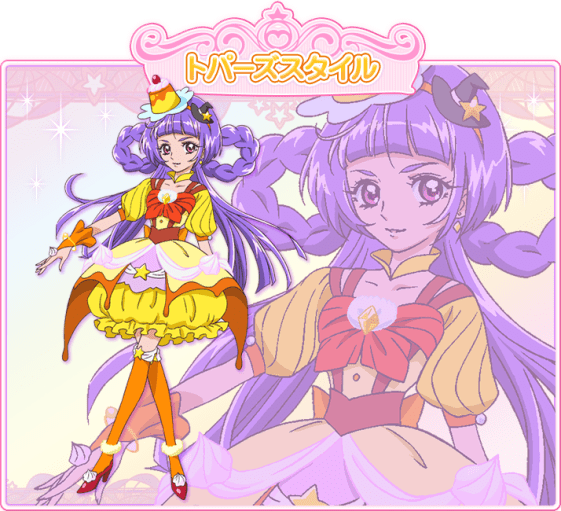
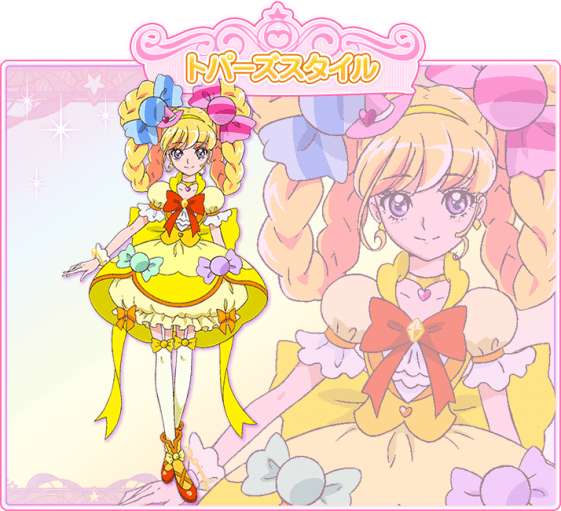
Here Are My Hopes for Kira Kira Precure A La Mode

precurealamode

I’ve written an article over at Apartment 507 talking about the latest Precure. There aren’t any major details yet, but if you want a quick rundown of Precure as a whole, and want to know how I’d like the series to go, head on over.

Save