
I wrote a post about the eccentric heroine of Dagashi Kashi over at Apartment 507. You can find out why Hotaru might be my character of the year, and why her role as a sheltered dagashi heiress is so interesting to me.

I wrote a post about the eccentric heroine of Dagashi Kashi over at Apartment 507. You can find out why Hotaru might be my character of the year, and why her role as a sheltered dagashi heiress is so interesting to me.
Out of all of the new characters introduced in Super Smash Bros. for Nintendo 3DS & Wii U (aka Smash 4), the Mii Fighters are among the most contentious in its competitive scene. Based off of Nintendo’s official user avatars, Mii Fighters can look like anyone, wear unique costumes, be any size (within certain limits), and have access to a full range of special attacks, more than any other characters by default. Ever since they were introduced, there has been an on-going debate as to what extent Miis should have access to their full range of customization (size, visual design, attacks). Recently, EVO 2016 announced its Smash 4 ruleset to include only 1111 guest-sized Miis, locking them into a specific size and a specific set of special moves that many Mii players deem unfair.
However, I’ve noticed a tendency on both sides to try and pass off some often small, minor detail as a deciding point that completely negates the opposing side’s concerns, when in fact many of these points have holes to them.
In my opinion, trying to build some watertight argument about Mii Fighters is ultimately futile because they’re mostly arbitrary. In showing this arbitrariness below, however, my goal is to actually direct the whole discussion towards the subject of the characters’ emotional resonance. The decision to #FreeMiis or not is ultimately about a base of players who want to play the character they want, and the discussion should go towards an emotional compromise.
Keep in mind that I am neither for nor against full Mii Fighters, so I have no hat in this race. Also, I’m coming from the perspective that, as far as we know, Mii Fighters do not have any extremely unfair advantage against the rest of the cast.
1) The “Menu” Argument
Aside from DLC, all characters in Smash 4 can get custom moves just like the Miis. Previous tournaments have tried custom moves for the entir ecast, but the general trend has been away from that direction. This is the reason why many tournaments that allow Miis require a single moveset and default to 1111.
Mii players point out that, even in a Customs Off environment, you can select Miis with non-1111 special moves. Thus, the argument goes that, if the UI deems it correct, then so it should be. The fact that customized Miis are also available in non-Customs online tournaments supports this idea.
The problem with this particular argument is that the Smash Community has never based its decisions on what the menu or standards tell them is correct. For Glory is played with 2 stocks/5 minutes, and Online Tournaments impose a 3-minute time limit on matches with “amount of damage done” being the criteria for a tiebreaker. Actual tournaments on the other hand go either 2 stocks/6 minutes or 3 stocks/8 minutes (that’s a debate I won’t go into), and handle tiebreakers differently.
Along these lines, the menu argument can be turned against the Mii Fighters just as much, because they by default do not appear on the character select screen, and must specifically be created in order to show up. Moreover, when you create a Mii Fighter, their attacks also default to 1111 and you have to specifically choose different ones.
The ability to twist the menu argument in either side’s favor is why I think it’s a point of disagreement that should just be dropped. It’s unproductive and kind of silly to begin with, especially because of how it’s used as “scientific” proof.
As an aside, Super Street Fighter II Turbo had hidden characters called “Old Characters,” alternate versions of the existing cast with different properties that could only be selected by navigating the character select screen in very specific ways to input a code. Ultimately, only one character out of these was controversial, and for the most part they are an accepted part of the game.
2) The “Adapt” Argument
There are three Mii Fighter archetypes: the Brawler, the Swordfighter, and the Gunner. Each of them has access to 81 possible combinations of special moves, though some are clearly superior to others lessening the number somewhat. One point of compromise is forcing Mii Fighter players to use only default size pre-made Miis that come with Smash 4 to avoid having to upload Miis to the system and create delays at large tournaments, but if size differences are allowed the amount of combinations goes into the thousands. There are small differences in frame data, endurance, reach, and power when adjusting size parameters that can make a difference in competitive play, where even shaving one frame off of a move can be the difference between it being useful or useless.
One argument against full custom Miis is that the ability to pick whatever moves you want is an unfair advantage when other characters cannot do the same. Why should a player have to prepare for all of these combinations of Mii Fighters, and why should the Mii player be able to cherry-pick their moves? Instead of that, it is argued that Mii Fighters need to learn to deal with having one moveset.
Full Mii supporters argue that players are already dealing with 55 other characters, and that having a lack of knowledge as to how Mii Fighters work is ultimately the fault of the opposing player. According to this point of view, Mii Fighters changing special moves is not nearly as drastic as someone who goes from Mega Man to Bowser, two characters that are different in nearly every aspect), so it’s arguably easier to adapt to that than a full character change between sets.
On either side of this fence is the implication that the opposition needs to learn how to “adapt.” In an age of balance patches for competitive games in general, where players will frequently complain that they need an official update in order to use their character competitively, it has become increasingly common to admonish newer players for their inability to roll with the punches and take the advancement of their characters into their own hands.
Just like with the “Menu Argument,” both sides can twist a this philosophy to their advantage. Why shouldn’t players adapt to new patches just as much they should adapt to a lack of patches? Similarly, the Limited/1111 Mii side argues that Mii Fighters need to learn to fight effectively with a locked moveset, while the #FreeMiis side argues that those against Full Miis should be able to handle the variations. Adapting has to happen at some point. I feel that if only there could actually be some compromise between both sides, it would go a long way towards settling this issue.
3) The “Mii Gimmick” Argument
This argument is derived from the idea that each character for the most part has some unique feature that defines them and their gameplay. Little Mac has KO Punch, Cloud has Limit, Ryu has Special Inputs, and so on. A lot of these features are not part of the standard Smash character, and so it’s argued that the variable movesets of Mii Fighters fall into the same category. In past games, you could even choose to transform into different characters, so why is that allowed but not full Mii moveset options?
What I find odd about this stance, however, is that it works ever so conveniently in the #FreeMiis contingent’s favor. When it’s pointed out that Palutena is built around a similar principle, it goes all the way back to the “Menu” Argument, that the simple press of the “Customs On/Off” icon is the dividing line that prevents Palutena from reaching her full potential but allows Miis more or less free reign. There are also some players who don’t just want to have custom moves but want to be able to switch their moves in between tournament rounds or even within individual matches, all under the umbrella that it is the “Mii gimmick.”
The idea that the spirit of the Miis is lost when you’re unable to play them exactly as you want them might be to some extent true, but competition isn’t necessarily looking at how the characters align with their players on a personal level. The use of Guest Miis already puts a damper on everyone who wants to be Proto Man or James Bond or any other custom Mii design, so at the end of the day it really is about the moves.
This does not mean that Miis should be restricted to 1111, but the idea that they should be allowed their full range of moves at nearly all times is as arbitrary a line as 1111, or, say, making it so that all characters have to use 1231 regardless of which Mii Fighter they’ve chosen. The question I want to ask here is, do Miis lose all purpose if you can’t customize their moves, and if so, is that a problem?
4) The “Moveset Synergy” Argument
It is objective fact that fully customized Miis have greater potential to succeed competitively than 1111 Miis, by virtue of the fact that, not only are many of the non-1111 moves significantly better, but the ability to pick just the right moveset for the character you’re facing allows you to maximize the effectiveness of your special moves. If you are a Mii Gunner and you are fighting a character without a projectile, you have less of a reason to use your Echo Reflector special move. If you’re a Mii Brawler, who normally is good at racking up damage but has trouble killing, getting access to Helicopter Kick gives the character a potent kill option, thus making them more rounded in general.
I think anyone who looks at Mii Brawler’s 1111 moveset will notice that it’s pretty bad. Why do they have both Soaring Axe Kick and Head-on Assault, when those attacks are pretty redundant? This potentially points to the idea that the Mii Fighters are not designed for 1111 at all, or even if they were the game is ultimately not hurt by them having their best special moves.
The problem with this position is that not all characters have perfect synergy in their movesets either. It is not necessarily an oversight, or something that is supposed to be ripe for the changing. Characters are generally designed to have pros and cons, and while they can’t totally erase many of the physical properties of a Mii Fighter, having special moves synergize better can be used to shore up their weaknesses. However, to go back to the “Adapt” Argument, the idea that it’s not right for Miis to have flawed existences can apply just as much to other characters. Maybe Mii Brawler is supposed to have trouble killing. Maybe Gunner is supposed to have holes in the projectile and range game. Who’s to say they’re not meant to be like Ganondorf, with very clear and extreme upsides and downsides?
Final Thoughts
I think the core of the Mii Fighter problem isn’t that Miis are too good, or they’re too bad, or anything actually having to do with competitive viability or fairness. The issue at stake is that Mii players do not feel much gratification playing 1111 versions of their characters. Without the right moves, they become emotionally empty vessels, perhaps all the more appropriate that they’re supposed to be combat-oriented versions of personal online avatars. That being said, I have to wonder if Mii Fighters could potentially provide “just enough satisfaction.” Mii Fighter users all seemingly want their preferred movesets no matter what, but perhaps it could be enough to have 50% or 75% a the preferred combination. For example, if everyone who cares about Miis were able to vote on a common moveset that had just enough appeal to all of the various Mii contingents, then maybe that sort of compromise is worth looking into.
—
If you liked this post, consider becoming a sponsor of Ogiue Maniax through Patreon. You can get rewards for higher pledges, including a chance to request topics for the blog.

Name: Serinuma, Kae (芹沼花依)
Alias: Ekka (えっか)
Relationship Status: Single
Origin: Kiss Him, Not Me!
Information:
Serinuma Kae is a high school student whose dramatic weight loss as a result of the trauma of her favorite anime character dying gives her an inadvertent makeover. Afterwards, she attracts the attention of a number of boys (and even a girl) at her school. At first unrecognizable to even those close to her, Kae’s devotion to her favorite pairings and series at first overwhelms her potential suitors (especially her extensive merchandise collection), but they all come to accept it sooner or later, especially given the genuine passion she exudes for her yaoi pairings.
Kae’s favorite series are Mirage Saga, which is home to her dearly departed favorite character Shion, and later Katchu Love, an anime about a samurai armor that can transform into a handsome man. She shares her fujoshi hobbies with her best friend Nakano Amane, as well as one of her suitors, Nishina Shima.
Fujoshi Level:
Kae’s fondness for Katchu Love and the pairing of hero Sametora Hyakka and his armor Akane may or may not have caused the angry spirit of the real Sametora to achieve peace and pass on to the afterlife.

Today marks the 20th anniversary of the Pokemon franchise, and I for one am happy to see one of my favorite video game franchises thrive and improve to this day. With each generation of games, Pokemon has expanded its world view by drawing inspiration from cultures around the globe, taken advantage of newer technologies that help to connect players, and have refined themselves to be fun, accessible, and even a bit challenging once the human element comes into play. Although I think the games have evolved for the better, however, there is a certain experience I miss from the earliest days of Pokemon.
To celebrate, Nintendo is releasing the original Pokemon Red, Blue, and Yellow on Virtual Console (Japan gets Green as well). Yet, having it on virtual console means that new (and old) players won’t have that feeling of being able to instantly recognize a fellow Pokemon player.

I started with Pokemon Red myself. I would play everywhere while keeping an eye out for comrades. If I saw a bright red or blue cartridge sticking out the back of a Game Boy (often at this time the Game Boy Pocket), I would go up to them and ask if they wanted to trade or battle. The cartridges were beacons that drew Pokemon Trainers together, and sadly with the way that Nintendo’s portable devices have been designed over the past 15 years or so it’s not really possible anymore.
It’s not all Nintendo’s doing: I got older and I learned more and more about competitive Pokemon. I used to participate regularly on sites such as Smogon and its old school predecessor, Azure Heights. From there, I eventually became too aware of what it took to make a strong team. As time passed I found myself with less of a desire to create my perfect ideal team, leveled up to 100 with lots of synergy and strategy but also full of the Pokemon I like, and I stopped being eager to challenge people. Either that, or Stealth Rock is total BS and I wish it were removed from the game or was not so danged powerful (seriously!).
Maybe that’s the day this all changes. Maybe I can dive back into the intricacies of Pokemon. I mean, I do own a Pokemon XY 3DS so maybe I can use that as a calling card like the days of old. In the meantime, here’s a list of some of my favorite Pokemon blog posts throughout the years:
Shudou Takeshi, Pokemon, and Me
In Honor of Twitch Plays Pokemon Crystal
Random Thoughts on Twitch Plays Pokemon
Pokemon Omega Ruby and My Fabulous Pageantry Adventure
PS: Fun fact, I tried to find my original Pokemon Red…then remembered it got stolen out of my locker during gym class. Ah memories.
—
If you liked this post, consider becoming a sponsor of Ogiue Maniax through Patreon. You can get rewards for higher pledges, including a chance to request topics for the blog.

The trip to Nikkou winds down with a final stay at Yajima’s family home. Yoshitake presses Madarame to make a decision about who to date, but as each potential partner makes their case (or has their case made for them), Madarame is still hesitant to pick. However, when Kuchiki suggests that it be done by lottery if Madarame doesn’t care one way or another, Madarame chooses not to leave it in fate’s hands and declares that he will make his decision…next chapter.
Is it at long last the end of the Madarame harem arc? Will he end up with anyone or perhaps no one at all? Will Genshiken actually have Madarame choose, or will it be a Naruto-esque string of chapter titles each more final than the last?
Personally speaking, the harem aspect itself, the fact that four individuals are attracted to Madarame to varying degrees, is less interesting in terms of who ends up with who, and more in terms of its opportunities for characterization. This includes characters both inside and outside of the harem.
One of Yoshitake’s recurring traits is that she always has the group dynamic in mind. Much of the reason she wants Madarame to just choose already is because she’s worried about the relationships, the friendships, that exist among the members of Genshiken. The longer Madarame takes, the more these threads get frayed, but at the same time she wants the decision to be a real one, not a spur of the moment fancy. That’s why she arranged the whole Nikkou kujibiki dating scheme in the first place.
Angela is an impossibly attractive blonde American who encourages polygamy, having the least to lose due to the distance between the US and Japan. She has an interest in Madarame, but is more about having a good time. Sue, as Ogiue puts it, is Madarame’s ideal character: a blonde loli who’s also fluent in both “Japanese” and “otaku.” However, even after her confession it’s clear she still isn’t entirely sure what she wants their relationship to be. Hato is a “girl-boy” straight out of a visual novel, but interestingly enough is still espousing the potential pitfalls of a homosexual relationship to ground Madarame in reality. They all carry some element of wish fulfillment that borders the realm of perverted imagination with some counter-balance in the fact that they’re all actually human.

In contrast, Keiko’s points out that she’s the most similar to Saki out of all of them, and this hits Madarame like a ton of bricks. While that makes Keiko in a way the most “realistic choice,” her words also carry an element of fantasy to them. She is the closest to fulfilling Madarame’s unrequited love for Saki, the most profoundly grounded woman he has ever met. The fact that Madarame reacts so intensely to Keiko’s words shows that he still holds a torch for Saki, and perhaps even suggests that his indecisiveness towards both accepting and rejecting others is a product of a desire to be wanted but also to want someone like Saki.
It’s surprising that Keiko of all people objects to Angela’s “harem ending” suggestion, stating that she’d rather not be involved at all if that’s how it’s going to end up. She wants to try a monogamous relationship, and she’d rather be single than deal with some fantasy otaku arrangement. Given that Keiko is not above seeing more than one guy at a time, I think it might say something about how Keiko sees Madarame as an opportunity for some stability, and further puts into relief the differences between her and the rest. At the same time, being an approximation of Saki isn’t actually being Saki, so in a sense Keiko becomes the most “ideal” choice of all. Of course, she certainly doesn’t see it that way, and I wonder if she in fact sees herself as what Madarame ultimately needs.
Madarame, as much as he acts like anyone would do because he’s just a dorky, desperate otaku, is suddenly against the idea when it’s suggested that he pick randomly when Kuchiki brings it up. Madarame is neither totally noble nor utterly selfish, and the realization that he cannot just keep the harem in stasis as is common in long anime and manga series ultimately forces him to try and choose on his terms rather than leave it up to luck. I think somewhere in his decision is the belief that having the choice made for him is utterly irresponsible and would lead to more harm than good, while also clarifying that he clearly does not see all of them the exact same way. In the end, actions have consequences, and I look forward to seeing how this plays out.
To end off, this month’s Ogiue moment is more of an Ogiue focus than anything in a long while. As briefly alluded to above, Ogiue gets really invested in presenting Sue as the best possible choice for Madarame, even going so far as to say that this is Madarame’s once in a lifetime chance to be with this girl of his dreams. What’s really notable about her behavior in this instance is that Ogiue has never really come across as being particularly invested in the Madarame/Sue combination even if she does believe it’s the right choice. It feels like there’s something more at stake here. Is it being able to finally get Sue to abandon the “Ogiue is my wife” joke (probably wouldn’t happen)? Does she truly believe that Madarame and Sue are best for each other? Does she want to give Sue some happiness? Whatever the case may be, I quite enjoyed seeing Ogiue’s fire.

—
If you liked this post, consider becoming a sponsor of Ogiue Maniax through Patreon. You can get rewards for higher pledges, including a chance to request topics for the blog.
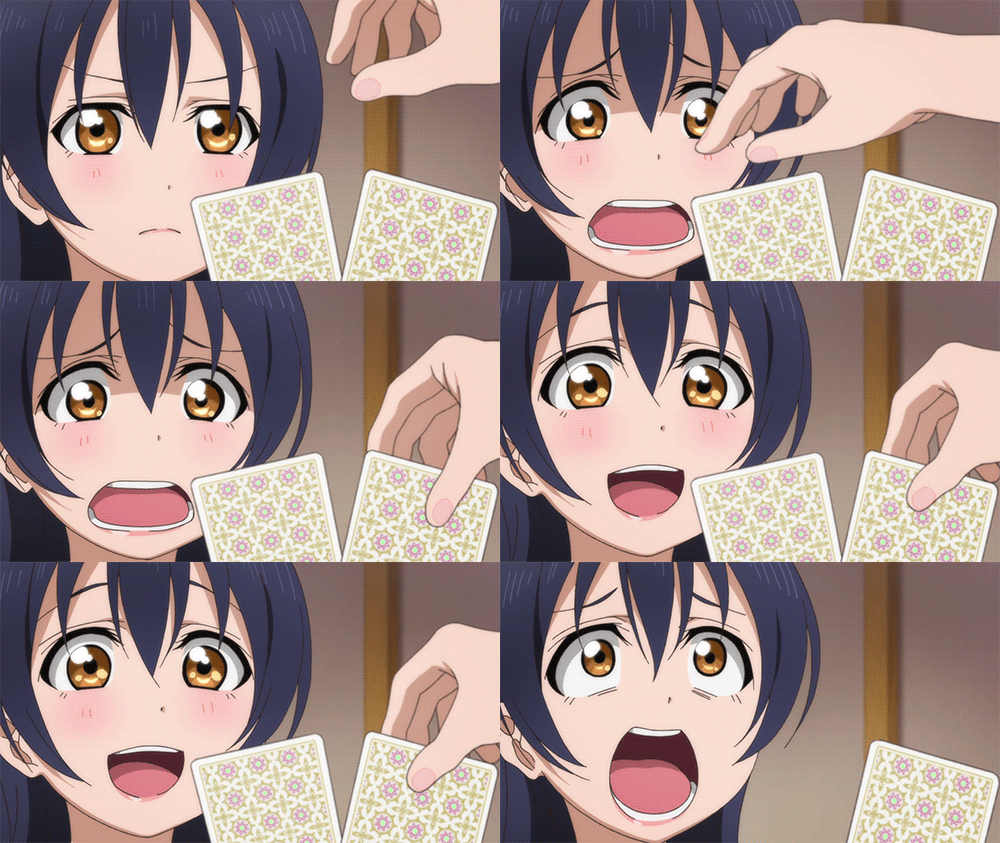
To follow up my post on Yazawa Nico, I’ve written an analysis of Sonoda Umi for Apartment 507.
She really is a wonderful character.
One of the big bugaboos of Japanese to English translation has been the use of untranslated words. Whether it’s senpai (“upperclassman”) nakama (“comrade”), or the utterly fictitious zankantou (“colossal blade”) the question of whether words should be left as is or fully adapted to English rages in arguments between fans, translators, and everything in between. Of course, there are no solid rules, and determining where in this spectrum your translation should fall is very much a case-by-case basis. However, what intrigues me about this debate is that, when you look at the Japanese language and how it’s used in anime, advertisements, and more, there is a very intentional sprinkling of foreign words with the clear idea that they are used for their exoticism.
The show that actually got me to think about it was, of all things, Show By Rock!! Here are the first lines of the opening:
Ren’ai inochi VERY VERY HAPPY!
Yuujou inochi hajikeru JUMPING!
Bouken inochi dokidoki OK?
Seishun ouka COM’ON READY? LET’S GO!
I’m leaving it untranslated just to show the clear use of English vs. Japanese. They didn’t have to use English words but they did. Similarly, let’s look at the popular One Punch Man opening:
ONE PUNCH!
(THREE! TWO! ONE! KILL SHOT)
Sanjou! Hisshou! Shijou saikyou
Nan dattenda? FRUSTRATION Ore wa tomaranai
One concession is that a lot of these words are very simple, like “HAPPY” and “JUMPING.” They’re not terribly complex and don’t carry a great deal of cultural baggage like senpai (though one might argue that ren’ai (romantic love) being originally a concept introduced from Europe to Japan falls into that range). However, I think where the actual big cultural difference comes from is that Japan has been open to receiving a lot of foreign words and maintaining them as emphatically foreign, as opposed to fully integrating them into the language. So while English has its fair share of Japanese loan words, from sushi to karaoke, they don’t maintain as much of their exoticism. It’s just a very different environment for sentences and words themselves.
What’s funny is that English wasn’t always this way, especially when it was not the lingua franca of the world. Prior to World War II, French was the most dominant language in diplomacy, and (correct me if I’m wrong!) throwing in French words with the expectation that only a few would understand it was not uncommon among the educated. Of course, this is different from the use of “HAPPY” and “JUMPING,” but I do think that the English language’s ubiquity leads to the sense in us users that it doesn’t have to bend to the will of others.
Translating to English often assumes that English is important. That sounds like a no-brainer, but what I mean specifically is that English speakers value their own native language so highly that it comes across to some extent as a rejection of foreign influence. France today for example is known for trying to keep foreign words out of its language, preferring to take existing French words and modify/combine them accordingly to eschew the need for new loan words.
I’m not saying translators who do not use senpai or whatever are imperialists anymore than I think that using nakama means someone is fetishizing Asian culture. Moreover, the exotic aspects of English usage in Japan come with their own sets of considerations and concerns. Rather, the seeming need for everything to be transformed into English might say something about how we as English speakers look at ourselves, and that this differs depending on how we individually approach that self-reflection.
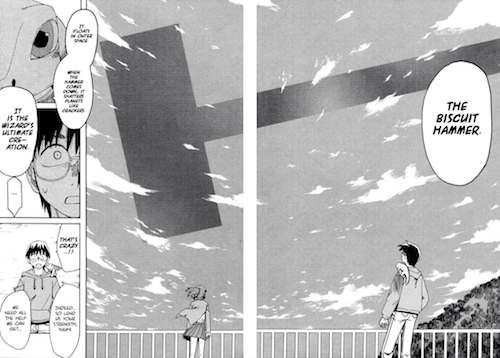 Hoshi no Samidare by Mizukami Satoshi, known in English bizarrely as Lucifer and the Biscuit Hammer (and sometimes The Lucifer and Biscuit Hammer) is an odd manga. Ostensibly a story about a boy who gets mystic powers in order to fight an evil golem-creating wizard, The Lucifer and Biscuit Hammer sports an eccentric cast of characters, an even stranger goal for its main characters, and a convoluted sense of narrative progression that somehow only adds to its appeal.
Amamiya Yuuhi, who has all the appearance of a typical high school kid, wakes up one day to find a talking lizard. The lizard, Neu, informs Yuuhi hat he is a knight who must protect their princess from an evil wizard and save the world from the dreaded Earth-shattering “Biscuit Hammer,” a huge mallet hanging over the planet visible only to those with profound despair. However, the princess, Asahina Samidare, is fiercely powerful, possessing beyond superhuman strength, and has her own agenda. Calling herself a demon lord (the titular “Lucifer”), Samidare seeks to stop the Biscuit Hammer because she in fact wishes to destroy the planet herself, and Yuuhi becomes her loyal servant in her cause. Overall, the series can be viewed as a kind of sekai-kei (world-style) manga, stories where the fate of the world rests on a “you and me” relationship.
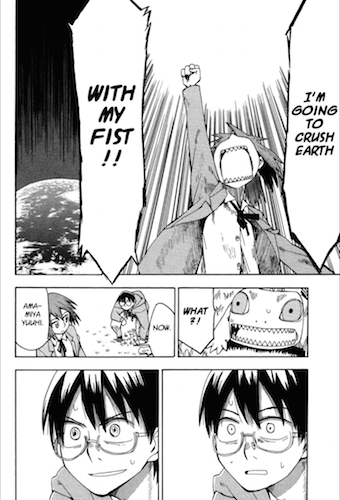
When I say that this manga’s sense of progression can be confusing, what I mean is that often times it seems as if the stakes of their battle seem both all-important and frivolous at the same time. Most of the characters have unusual personalities that position them somewhere between delusional and disillusioned, trapped by their own immaturity, but many of them grow over the course of the series. Their fight to foil the wizard and his Biscuit Hammer involves taking on progressively stronger and stronger golems as if they were video game bosses, but then sometimes a friend or ally will die in battle. The emotional weight of the deaths are expressed as quite significant and serious, and yet the question of whether they’ve made any real progress (or how progress can be defined) is ambiguous. It might sound frustrating, but it gives Lucifer and the Biscuit Hammer an odd charm. If anything, it feels akin to a more optimistic and lighthearted Bokurano. While that series is about as fun and happy as a mass suicide, there’s a similar sense of characters grasping at the darkness.
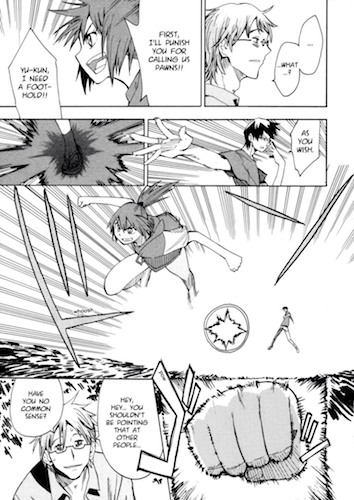
The art in Lucifer and the Biscuit Hammer has an unrefined quality to it, where characters appear a bit flat and the world feels frayed and uneasy. However, I believe that this also helps to give the manga that shaky sense of progression that makes it such an interesting story. The manga also does a good job of playing with and presenting its characters’ powers, especially given the versatility of their core ability. Each character is capable of using a “holding field,” a mass of dense energy that can be used in a variety of ways, including creating stepping stones in the air, being thrown as a spear, and more. It can be a difficult thing to make look interesting, yet the action scenes have weight and impact.
Overall, I find that Lucifer and the Biscuit Hammer is not so much an addictive series that has you hungering for the next chapter, but is rather one that invites you to slowly observe its seemingly by-the-numbers premise of fighting and power ups. From there, it draws you in by portraying each character’s struggle and a unique sense of stasis that seems to permeate its world and its story, making its introspective qualities feel that much more as if they’re coming from a place that ignores time and space.
—
If you liked this post, consider becoming a sponsor of Ogiue Maniax through Patreon. You can get rewards for higher pledges, including a chance to request topics for the blog.
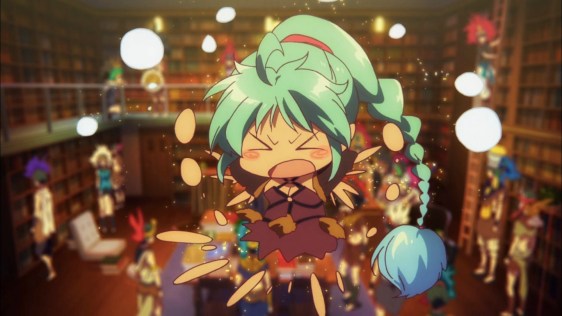
I’ve written a post about Myriad Colors Phantom World over at Apartment 507, and its similarities to anime of the 90s such as Slayers and Saber Marionette J. What do you think? Is Phantom World a “1990s anime in 2016 clothing?”
Thanks to One Punch Man, I’ve been listening more to JAM Project as of late. I love how JAM Project takes anime music so seriously, and their desire to create actual “anime music” about the shows they sing for is admirable. However, the more I listen through their catalog, the more I miss one of their original founders, Mizuki Ichirou.
For fans of anime music, Mizuki Ichirou possibly needs no introduction. The voice behind almost countless theme songs, his work in titles such as Mazinger Z, Babel II, Golion (aka Voltron), and Kamen Rider X earned him the moniker “Emperor of Anime Songs.” In 2000, he became one of the founding members of JAM Project, taking a less active role a few years later.
Other members have come and gone from JAM Project, namely Sakamoto Eizou, the lead vocalist of the heavy metal band Anthem, and Matsumoto Rica, a singer who’s also famous for being the voice of Satoshi (Ash) from Pokemon. They also lent their own unique voices to JAM Project in interesting ways, but something about Mizuki Ichirou’s singing is different.
Unlike the younger members of JAM Project, Mizuki’s vocal style invokes a different era of music, culture, and of course anime. It’s deep, memorable, and reminiscent of a Frank Sinatra-style crooner, only he’s singing about Mazinger Z’s Rocket Punch. When you placed him alongside his fellow JAM Project members, it would add something unique, something classic, to their sound.
Above are two versions of JAM Project’s “Hagane no Messiah,” one without Mizuki and one with. I think hearing them side by side really shows what the “Aniking” added to the band.
 OGIUE MANIAX