Throughout the years on this blog, I’ve speculated who would be a proper mascot for Western PC gaming in Smash Bros. As that series has transitioned from being “Nintendo All Stars” to “Video Game All Stars,” I’ve thought about the kinds of characters who could do a field as wide as “gaming on computers” justice. Maybe it could be the Warcraft orc Thrall, who features prominently in the real-time strategy, MMORPG genres, and MOBA genres. Maybe it could be Turrican, who comes from the Commodore 64 and Amiga era. But what I failed to realize—even after I did an analysis!—is that Steve from Minecraft is that Western PC representative.
Minecraft is currently owned by Microsoft and on nearly every platform available, but as one of only two characters to get his start on computers (the other being Solid Snake and his original MSX debut), Steve 100% counts as a PC gaming mascot. I think the reason it didn’t even occur to me until recently is the sheer degree of Minecraft’s success. It is literally the best selling video game ever, and its presence transcends gaming. Yet, it still has fairly humble origins as a side project for a programmer working at a browser-based game company, to the extent that you might even count Steve as also the first indie gaming rep in Smash Bros. even if it is technically no longer an indie game.
As with every out-of-left-field fighter added to Smash, Steve opens up a world of possibilities in my mind. I want more than ever to just every aspect of video games from its earliest days somehow included. What about edutainment? Ryu, Ken, and Terry cover 2D fighting games, but 3D fighting games are substantially different. Reimu from Touhou could cover doujin games as well as shmups. Mobile and gacha games are such a huge part of the industry now—why not Angry Birds, or Dragalia Lost if they want to keep it in the Nintendo family? Imagine if Great Giana Sisters (which began as a Mario rip-off) made it in. Hell, why not bring in Computer Tennis?
I’m aware that there are only three DLC slots left in Super Smash Bros. Ultimate, and that I’m wishing for the moon. Even so, it feels like we keep getting one ladder rung closer to that impossible dream, and it becomes ever so tempting to keep imagining. I realistically won’t be disappointed to see something less, and I respect all that the developers have accomplished, but nothing will stop me from looking toward the next sequel.
Otakon, the largest American anime convention on the east coast, is in trouble. Due to the ongoing pandemic stifling last year’s event and the nonprofit nature of its parent organization, Otakon is at risk of shutting down for good. In order to fight off this unfortunate possibility, Otakorp is now, for the first time ever, accepting donations online.
I make no effort to hide the fact that Otakon is by far my favorite anime convention. I’ve been an attendee since before I started Ogiue Maniax all the way back in 2007, and I’ve gone as press (and occasionally even a panelist) every year since. Writing con reports and conducting interviews with great Otakon guests have become staples of this blog and my experience as an anime fan. Donating to Otakon has been one of the easiest decisions I ever made.
What I love so much about Otakon is that it never feels as commercialized compared to some of the professionally run anime conventions that are so common these days. I can expect interesting guests from Japan, including those who might not be as well known to the mainstream anime fan, and it’s always a pleasure to pick their brains for industry insight. I also love the fan panel culture that has grown out of Otakon, where every year is full of genuinely enthusiastic presenters, both new and seasoned, who encourage their audience to explore a little further and think a little deeper about anime, manga, and fandom. And it’s also been a great place to connect to many of the fellow fans I’ve met online.
In honor of Otakon and in hopes of it continuing on, I’ve decided to list some of the great interviews I’ve done at the convention over the years. I hope they can at least show you why it’s a cultural touchstone worth saving.
We are on the other side of a terrifying four years, and I am glad to be here with you. Though we don’t know what the future holds, I feel somewhat optimistic.
However, we still have COVID-19 killing thousands of people a day, so I hope for the safety of you and everyone you hold dear. Also, I hope this is obvious, but please do not attend any anime conventions while we’re in the middle of a pandemic. Seriously, don’t. Stay home, and enjoy anime from the comfort of your TV or computer. The new anime season is in full swing, and Valentine’s Day is around the corner, which means plenty of talk about giri and honmei chocolates.
Thank you to the following Patreon sponsors for their support in the month of February:
How does this gymnastics-themed anime handle its “older” protagonist?
Hashikko Ensemble
Chapter 36 is the long-awaited debut of Jin’s mom! Spoilers: She probably got teen pregnant.
Closing
If you’ve got a favorite anime of the season so far, I’m all ears. I’ve been enjoying the return to form that is Show by Rock!! Stars! and the strange and irreverent Back Arrow.
Everyone gets hit by a Minmay Attack in Hashikko Ensemble, Chapter 36.
Summary
The next round is on, and the Chorus Appreciation Society takes the stage once again. Before that, though, Kozue asks Kousei why he doesn’t try to cheer Shion up after his rejection of her, and he replies that they’re just from different worlds: a safe rich girl vs. a delinquent with a lot of baggage.
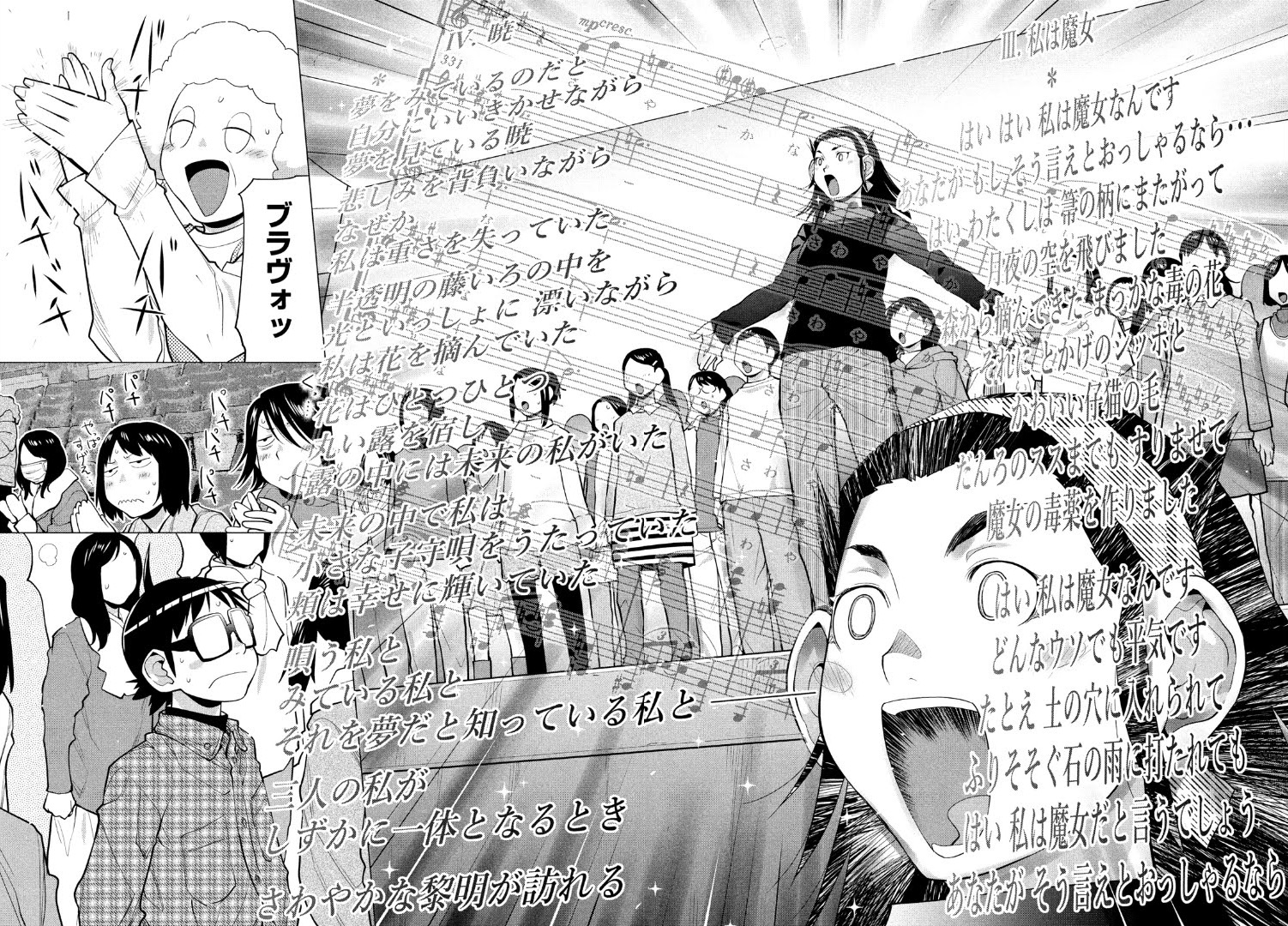
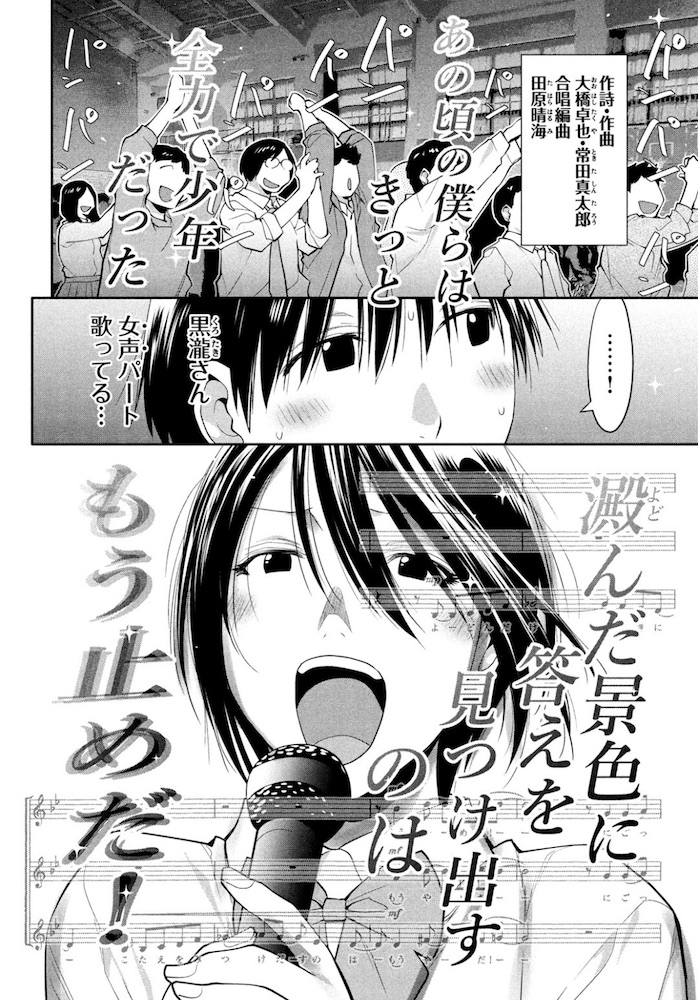
This time, it’s “Do You Remember Love?” from the anime film Macross: Do You Remember Love. Akira and the others deliver a powerful performance that doesn’t just wow the audience, it seems to actually bond the members (and those close to them) together in a way that only music can. As they finish, Kousei seems to have Shion on his mind as he thinks, “Maybe our worlds aren’t so far apart after all.”
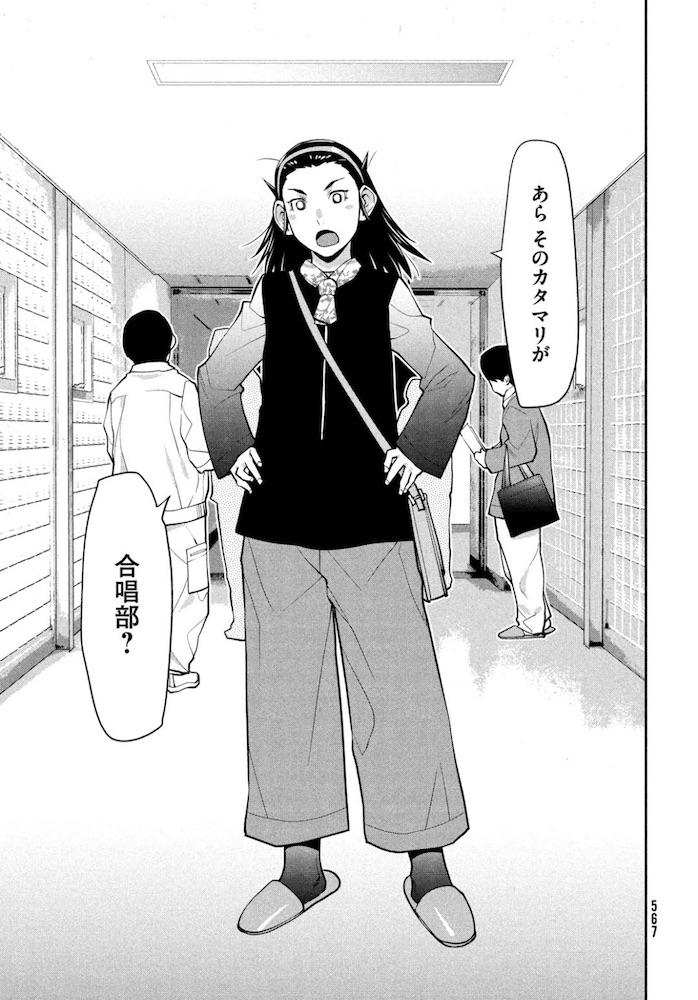
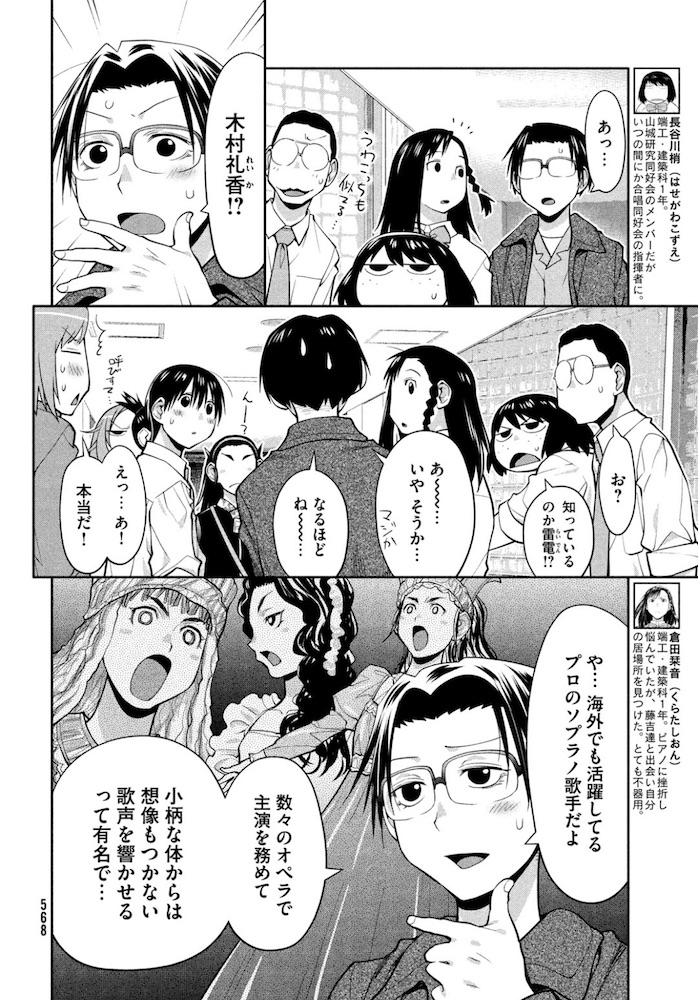
Elsewhere, Yumerun is pacing frantically, when finally the person she’s waiting for arrives: Jin’s mother, Kimura Reika, who turns out to be a highly eccentric 31-year-old soprano. The chapter ends as the two head out to Hashimoto Tech (Reika reluctantly so) in order to see Jin and the others sing.
Darkness and Light
Hashikko Ensemble is a series that’s high on levity, but the glimpses of darkness are astoundingly brutal. As Kousei is talking about his past, the first image shown is what appears to be a first-person perspective of one of his abusers (his mom’s lover, I think) rearing for a punch. This then transitions into Kousei throwing a punch at someone on the street in a fight. There’s a lot of trauma in his life, and the manga conveys a link between the violence inflicted on him and his rough attitude.
That’s also what makes the portrayal of the society’s “Do You Remember Love?” all the more powerful. You can see in Kousei all this internalized fear, anger, and self-loathing, and it seems to just wash away as he sings. During the performance, Yukina (the arm wrestling champ who has a thing for Kousei) suddenly begins to cry during his performance, and she isn’t sure why. The way I see it, what she’s sensing is how strongly Kousei’s feelings are reaching out to Shion, and she’s realizing they’re not for her. Only in song is Kousei able to be honest.
I Love You So
I’m not well-versed in music, let alone the sheer breadth of what’s thus far been presented in Hashikko Ensemble. Many times, what this means is that outside of seeing the lyrics on the pages, I don’t always fully internalize what the songs are conveying in a chapter. This is not the case with “Do You Remember Love?”—it’s a song I know all too well, and it’s a staple of my karaoke sessions. In other words, I can really “feel” this chapter in ways that I haven’t been able to before.
“Do You Remember Love?” is indeed a love song, but it’s also about reaching out to others and connecting. “I hear you calling out to me.” “I’m no longer alone, because you’re here.” Characters make mention of how well Akira and Kousei are harmonizing, as if they’re on the same page emotionally; most likely, it’s because they’re both singing to Shion.
Questions are asked throughout the chorus of the song: “Do you remember when our eyes met?” “Do you remember when we held hands?” And while these lyrics are more romantic, their juxtaposition against Kousei’s traumatic memories makes me think that he’s actually, in a sense, remembering what it’s like to love The contrast between the beauty of the song and the violence of Kousei’s past is very fitting for a song played during the climactic battle of the Macross movie.
Jin’s Mom Is a Surprise
Kimura Reika is very different from what I pictured. When Jin described her in previous chapters, I was expecting an older strict woman—perhaps an unforgiving taskmaster with many years of experience and even a few wrinkles. In contrast, we get this weirdly aggressive and intense ball of energy who’s similar enough to Jin that you can see the familial relation, but also different to the point that you wouldn’t mistake the two. During her introduction, Yumerun asks why in the world Reika isn’t wearing her contacts, and she responds that she forgot them but also thinks it’s too much of a hassle to go back to retrieve them. When asked why she won’t just wear glasses, Reika claims that when she has them on, it makes her feel like her voice won’t fly out properly. That’s the sort of person Jin has to deal with in his home life.
And I have to point out the elephant in the room: Assuming that Reika is Jin’s biological mother, it also means she got teen pregnant! This isn’t the first time that the author, Kio Shimoku, has explored that topic (see his two-volume baby-raising manga Jigopuri), but I’m still surprised to see it pop up here. Just what kind of life has Reika gone through?
Songs
It’s noted that most of the groups only prepared one or two songs for the competition, so there are a number of repeats from previous chapters.
Basso Masters: “Daichi Kinshou” (Hymn of the Earth) from the cantata “Tsuchi no Uta” (Song of the Land)
Team “Promise” (a bunch of otaku): “Yakusoku” (Promise) from The iDOLM@STER
Yukio feat. Mayomyon: “Shibuya at 5 o’clock” by Suzuki Masuyuki and Kikuchi Momoko (You might recognize Suzuki as the singer of the opening to Kaguya-sama: Love Is War)
Noi Majo (Kurotaki Mai’s quartet): “Hakujitsu” (“White Day”) by King Gnu
Chorus Appreciation Society: “Do You Remember Love?”
You can find the above songs, along with previous references, in my Hashikko Ensemble Youtube playlist.
Final Thoughts
I’m really looking forward to seeing more of Jin’s mom. I feel like we’ve only scratched the surface of what she’s really like.
Mai’s group, Noi Majo, has moved on in the competition as well. I wonder if the groups will end up against each other.
Blocker Gundan IV Machine Blaster is a 1976 super robot anime that most people have probably never heard of. It doesn’t have a long and storied legacy, and its international presence is limited to the Philippines and Italy, where it was known as Striker Force and Astrorobot, respectively. But it’s also a part of the grand history of giant robots in Japanese animation, and now one of the studios that produced the show, Nippon Animation, has started a crowdfund project to convert the Machine Blaster film reels into a digital archive through the site readyfor.jp. The goal is 3 million yen, or approximately $29,000 USD, by February 26 Japan Time.
While Machine Blaster is in many ways a footnote of anime history, that’s all the more reason why I want to see it preserved. I think it’s easy to assume that the art and entertainment we as humans create will always be around in some form, but film wears down, or it can get lost and buried. For many years, the sole copy of the Korean giant robot animated movie Robot Taekwon V was a badly damaged reel, and it was only by luck that a near-complete duplicate film reel was discovered. Machine Blaster is no Gundam or Mazinger Z, but I love giant robots and I would hate to see even this obscure series not have a proper archived version beyond its DVD releases.
Also, while Machine Blaster is indeed not Gundam, it actually shares a mecha designer! Ookawara Kunio, the man responsible for the mobile suits of the original TV series (as well as shows like Reideen, Zambot 3, and Daitarn 3), is also behind the robots of Machine Blaster. He even has a written message on the crowdfunding page talking about his time with the series as one of the many 20-somethings there being thrown into a full-on project without much experience.
If you’re like me and want to donate to saving Machine Blaster, I’ve provided a guide below, as the site is entirely in Japanese. Also, I should note that this is not a crowdfund to get a copy of the series; it’s just to help archive it. That being said, there are bonus goods for those who contribute more (though it’s not clear if they’ll send them abroad).
First, you’ll have to make an account on the site. At the top-right corner is a red button for logging in and creating an account. From there, you can either choose to register directly with readyfor.jp by clicking the red button on the right, or via Facebook using the button below it.
The blank spaces above, from top to bottom, are “user name,” “email address,” “password,” and “password again.” Then you’ll get a confirmation email, in which you’ll have to click a link to confirm your registration.
From there, if you go back to the Machine Blaster project, you’ll see another red button to the right of the main image. That’s the donate button, and it’ll take you to a page where you can choose how much you want to put in. Unlike other crowdfunding sites, you can only select along preset amounts, so the minimum is 3,000 yen, which gets you a thank-you message and updates via email. The most expensive one, seen below, is actually preview film reels of random episodes of Machine Blaster for 100,000 yen. The middle range has a bunch of merchandise you can get, like buttons and even a beach blanket. Choose which one you want, and note that you can actually select more than one at the same time. At the bottom, you’ll have the choice to pay via credit card or bank account. For payments outside of Japan, it’s probably better to use a credit card just because bank info in Japan can be very specific and have aspects that other countries don’t.
This is where it gets tricky. After putting in your credit card info, you’ll have to add your address as well. However, the form is not formatted for non-Japanese addresses, so you’ll have to work around it. Thankfully, if you just kind of fill it in as you would a normal address (and ignore the actual meanings of each form space, in case you can read Japanese), then it works out. Another crowdfund on readyfor.jp has provided a helpful screenshot, which I’ve also provided here. Note how the postal code in Japanese is just filled out as 111-1111. The only blank spaces this image isn’t showing are for your name.
From there, you hit the last button at the bottom and confirm your contribution! You can also write a message in the space provided.
Not every giant robot anime is going to be of legendary status, but I want to make sure we can keep and preserve as many as possible for both the fans who grew up with them and those who look back on anime’s history with curiosity. Blocker Corps IV Machine Blaster at least deserves that much.
PS: Like so many 70s giant robot anime, it got its own Italian theme song for the Italian dub. It is glorious, and worth comparing to the Japanese songs and their pleasant cheesiness.
Soul, the latest CG animated film from Disney and Pixar, speaks to me on a very deep and personal level. It’s not just that it’s about an older minority protagonist who chafes at family pressure when it comes to doing what’s safe and expected. Nor is it that the movie is set in New York City, where the familiar sights and sounds make me oddly nostalgic in a time when stepping foot outside can be a stressful decision in itself. What really hits home is one of the core messages of Soul, which is to be aware of how we as people often confuse inspiration, passion, purpose, and fulfillment—and how doing so can hold us back in life in fundamental ways.
The story of Soul follows Joe Gardner, a black middle-aged middle school music teacher who still dreams of being a professional jazz musician (the long overdue first black protagonist in a Pixar film). When a rare opportunity to play with one of the greats comes knocking, an ecstatic Joe gets caught in an accident that causes his soul to leave his body. Desperate to avoid the afterlife and get back to the land of the living (and his gig), he winds up as the mentor to 22, a soul that for thousands of years has failed to find the spark to become a full-fledged living being, and who sees her pre-life to be much more appealing than life on Earth.
Whether it’s Joe’s firm belief that his purpose in life is to play jazz, or the pre-life system that brings history’s greats in as mentors to guide those like 22 to begin life, Soul highlights the way people often think about what it means to live a great life. We celebrate those who follow their passion and transform them into monumental discoveries and achievements. We think having a greater purpose is the key to reaching greater heights. But just as Joe throughout the film is often so obsessed with his life-long aspiration that he fails to see the positive influence he gives (and receives) from those around him, it’s all too easy to feel like a failure when we focus only on destinations and not journeys.
Although I don’t see myself as being in a completely similar position to Joe, Soul made me realize something: for whatever reason, I often feel a lingering sense of guilt over not accomplishing more than I should have, or was supposed to. On a certain level, it can feel ridiculous. I’m at least fairly proud of the things I’ve managed to see and do in my life, achievements that I know took intelligence, dedication, and maybe even a bit of courage. Yet, I still see myself as rarely having ever gone the distance that can leave myself without any regrets. A career switch may have truly turned out for the better on a personal level, but still leaves me feeling that I left some potential unfulfilled. Even in the context of this blog here, I sometimes criticize myself for not having improved my writing as rapidly as I should have been, and for not having the drive to force that change upon myself. This guilt is in some ways internal and in other ways external, but the result is the same.
Thanks to Soul, I realize now that I do indeed get caught up in conflating inspiration with passion, purpose with fulfillment, and so on. I haven’t resolved what exactly this means for me, or what it is that I ultimately will feel once I’ve sorted out these feelings and the degree to which I value them, but it has me on a long road of introspection. Not every film can do that, which makes having watched Soul all the more worthwhile.
The anime The Gymnastics Samurai is set in the year 2003, and nothing makes me feel older than having a fictional story ask “Remember back in the day?” about a time period that still in many ways feels like yesterday. But as the story of a veteran gymnast whose years are starting to catch up to him, it’s all too appropriate. The Gymnastics Samurai is not an altogether unique take on the trope of an old fighter trying to recapture glory, but it does stand out in a couple ways: its avoidance of faint and damning praise for its protagonist, and (for better or worse) the bizarreness of its setting details.
Protagonist Aragaki Jotaro, nicknamed “Samurai,” was once a former silver medalist in gymnastics who started a “Samurai boom” in Japan and around the world. Now, he finds himself a widowed father of one, unable to even approach his past success and considering retirement. However, a chance meeting with Leo, a foreigner dressed like a ninja, changes all that. Jotaro begins to wonder if there’s a chance he can keep doing what he loves, despite the fact that gymnastics is a young man’s game. In addition to the encouragement he gets from family and friends, he’s also egged on by a much younger rival who treats Jotaro as a dinosaur who should leave the spotlight for those with potential to fulfill.
The immediate comparison that came to mind watching The Gymnastics Samurai is 2006’s Rocky Balboa, the 6th movie in the Rocky franchise. In it, the famous Italian Stallion comes out of retirement for a boxing exhibition match against the current champion of the world, but has to re-invent his style once again (a recurring theme throughout the films) to make up for the fact that his body can’t move like it used to. Jotaro is in a similar position as Rocky, with a few key differences. First, Jotaro is nowhere near as old as Rocky in Rocky Balboa (29 vs. early 60s—almost a joke, in a way), and doesn’t have to deal with calcium deposits on his bones. Second, rather than Rocky’s approach of building muscle so that every punch he can land counts for more, Jotaro’s re-invention involves a return to fundamentals, and the muscle he does gain is to compensate for his old injury.
That second point is one of the most notable aspects of the story the anime is telling, because it’s in part a criticism of the notion that “spirit” and “hard work” can make up for anything. As the anime explains, Jotaro tried to work through his injury by just throwing himself further and further into gymnastics, only to end up aggravating his shoulder further. The fire of perseverance is not inherently a bad thing, but Jotaro has to learn how to work smarter instead of hoping to gain results from a mindless grind. Over-the-top training bordering on abuse is a classic (albeit dated) trope of sports anime and manga, so it stands out when a series like The Gymnastics Samurai puts it in stark relief with a more conscientious regimen.
There’s no doubt that it does get harder to keep up one’s physical peak as time passes, but the training Jotaro goes through is also not necessarily about abandoning what used to work for him. Instead, it’s a way to let him do what he was known for by providing a more stable structure. It reminds me of how Umehara Daigo, the most famous fighting game player in the world, trained to improve his reaction time rather than leaving it to his younger opponents because he didn’t want to limit himself by thinking like an old man (Daigo ended up winning a major online tournament). Note that Daigo is also older than Jotaro, being 39.
As for the bizarreness of The Gymnastics Samurai, although the anime is centered around a fairly straightforward sports narrative, there are a lot of little aspects of the show that seem like they come out of left field. Jotaro’s action movie-loving daughter, Rei, has a gigantic tropical bird (named Big Bird) who tells people to smile more. Leo appears to be a ninja-obsessed Japanophile whose use of theatrically archaic Japanese (de gozaru) is more a Japanese person’s idea of how a weeb would speak than any reflection of reality. Especially due to the bird, it reminds me of Tamako Market, which also has an avian creature providing comedy. These details make for a jarring tonal shift at times, which ultimately don’t remove the emotional impact of key moments in The Gymnastic Samurai but can still leave a sense of bewilderment.
The Gymnastics Samurai is one of the latest instances of a story that asks whether an old dog can indeed learn new tricks. While it’s not entirely a criticism of ageism due to its hero still being a reasonably spry 29, the series does give credence to the notion that re-invention and restoration are possible, especially where passion meets wisdom. In a genre of anime and manga dominated by stories about high school athletics—and where graduating at 18 is seen as the first step into mythology—Jotaro gives at least some hope to those who still want to compete.
As someone who has traditionally valued online discussion, I’ve long believed that de-platforming is something of an extreme measure. However, as multiple social media platforms have banned Donald Trump for inciting further violence akin to the attempted coup on the United States capitol, one thing that’s clear to me is how de-platforming is not about robbing someone of their freedom of expression. Rather, when used properly, it’s about protecting those who would wish to engage in honest discourse from those who seek to use the facade of debate and social interaction as a Trojan horse to further causes that seek to oppress and diminish others.
In far too many cases, “change my mind” ends up simply being a smokescreen. It’s become a running joke. Often, those who throw such statements out are not actually open to ideas but are performing images of strength and indignation in the presence of those who are potentially vulnerable to their posturing. The use of bots to spread disinformation and make an outlandishly dangerous opinion have greater support than is actually there only contributes to this weaponizing of public discourse. To leave social media open to such actors is to invite them to continue to bamboozle people through demagoguery.
I do have concerns when it comes to de-platforming. I fear is that if it’s taken as too default an action, then it can become incredibly easy to label anyone with whom you disagree as “arguing in bad faith” without it necessarily being the case. One of my core beliefs is that people grow at different rates. While there are those who never let go of their hatred, anger, and/or ignorance, there are also those who need the right person or people to communicate with them, and to encourage a level of change that doesn’t meet self-resistance or induce a backlash. I worry that people may be so perpetually drained both mentally and emotionally that they push anyone and everyone into the “bad-faith” category to spare themselves both the pain of having to engage a potentially disingenuous person on the other side and the stress of constantly trying to discern whose minds can be changed and who are lost causes.
But while I encourage people to give others the benefit of the doubt initially, once someone has revealed themselves to be a snake, you don’t let them crawl back into your nest. It might seem like a game without stakes, but it has become painfully clear that there are deadly consequences: COVID-19 is ravaging the world and especially the United States at an unprecedented level that can only get worse, and we just had a mob try to take over the US federal government in order to re-install their hate-filled savior figure. How many lives could have been saved if we had not let Trump and those like him keep their online megaphones for so long?
If anything, the skill that I think needs to be developed most robustly for human beings going forward is being able to discern between those who come to the table actually open to an exchange of ideas and those who are simply pretending to be. In the meantime, while freedom of speech is an inherent right of all Americans, there should be consequences for those who seek to abuse it—especially for the leaders who play games with lives.
Today is January 20, 2021, and a new US president is being sworn into office. I hope that the lessons of these past four years are not in vain.
The manga Chainsaw Man by Fujimoto Tatsuki recently concluded “Part 1” of its story, and having heard fans both real and virtual praise the series up and down, I decided to marathon through it. Count me as a convert, as I think it’s one of the best things to come out of Shounen Jump in recent years. The narrative turns are compelling and the characters are charming in their foolishness.
However, there’s a large twist in the series that brings to mind a trope that sparked discussion around superhero comics back in the early 2000s: Women in Refrigerators. Originally coined by Gail Simone (who was still a critic and not a writer of comics at the time), it refers to when characters close to the hero—often a lover or companion—is killed in service of making the villain appear more nefarious. While not automatically bad, its overuse reduces female characters to discardable pawns. Manga, especially male-oriented titles, can have their own instances of fridged women, but Chainsaw Man seems to lean fully into the concept in ways I’ve never seen before.
The protagonist of Chainsaw Man is Denji, a lonely guy who doesn’t think life is worth living, but is given a second chance when a demon he befriends known as the Chainsaw Devil offers him a chance at the normal existence he’s always wanted. Denji’s discovered by a beautiful female government agent named Makima, who recruits Denji to fight demons as Chainsaw Man. In addition to being a target of Denji’s immature affections, Makima provides him with companions, including a female fiend (half-human, half-devil) with blood-based abilities named Power. Over time, the bond between the two of them grows, and they make a great if chaotic team—like two violent Monkey D. Luffys with bad attitudes but good hearts. Eventually, though, Makima reveals that her motives for recruiting Denji were anything but pure. In an act of cruelty designed to cow Denji and leave him in despair, Makima murders Power in front of Denji with little warning, Power even having been carrying a birthday cake for Denji in anticipation of a celebration. Death of named characters in Chainsaw Man is not uncommon, but Power’s death hits especially hard.
It is undoubtedly a moment where a female character is killed so as to create a psychological impact on the male hero, but what Chainsaw Man also reveals this to have been Makima’s plan from day one. As Makima explains, Denji inadvertently entered a contract with the Chainsaw Devil where Denji is meant to receive a normal life in exchange for their fusing together, and the only way to deny him that basic happiness is to manipulate his life. As such, Makima purposely gave Denji friendships so that she could snatch them away and keep him under her thumb. Unlike many superhero instances of Women in Refrigerators, this is not tacked on as a way to raise the stakes, but is core to the overall story and the truth of Chainsaw Man’s world. The trope isn’t just kind of there thoughtlessly—it’s front and center, and fully exposed.
To be accurate, Power isn’t completely gone, as her blood-control powers allow her to exist within Denji, and his motivation transforms into finding a way to bring her back. At the climax of the story, Denji also delivers a fatal blow to Makima using a chainsaw made from Power’s blood. Narratively, it’s explained that Power’s blood can prevent Makima from regenerating—Makima’s actually powered by a devil just like Denji, and has come back from death over 20 times—but there’s also a great symbolism in having Power get her payback in essence. Power is neither fully alive or fully dead, and while reducing her physical existence does potentially play into the idea that her role in the story is subordinate to Denji’s, the manga does such a strong job of portraying their relationship as that of equals (albeit two incredibly idiotic equals). The result is that Power looms large over Chainsaw Man as it enters Part 2, and is still one of the most important characters in the manga. She’s also consistently the most popular character in the series among English and Japanese fans.
Part 1 of the manga actually ends with a woman in a refrigerator. After defeating Makima and keeping her from regenerating, he tries to figure out a way to keep her from coming back from the dead. His solution: chop her up, store her in the fridge, and slowly cook and eat her entire body as a way to deny Makima her wish, which is to be eaten by the devil Chainsaw Man due to certain unique properties that Chainsaw Man possesses. Denji actively engages in cannibalism as himself and not his transformed state to prevent this from happening. He also chooses this gruesome route because he sees it not as an act of malice but a perverse way of wanting to be “together.” I don’t believe that this is the author of Chainsaw Man intentionally calling out the trope, but it’s hard to ignore, and it still winds up with a woman being literally fridged in service of a greater goal.
Chainsaw Man is a manga that can come across as brainlessly violent and gross, but it’s proven itself to be the product of extreme thoughtfulness. Even though its characters are often brash and simple, the story itself is not, and the handling of its own Women in Refrigerators does not feel like it detracts from the series other than making readers angry that Makima dare kill the best character. Power’s influence on the series continues to loom large, and it helps avoid the feeling that being fridged trivializes her character, and keeps Chainsaw Man as a whole from being subsumed by the wastefulness of the trope. In an Obi-Wan Kenobi sort of way, striking Power down makes her more powerful than we can possibly imagine.
It was Spring 2018 when I first encountered the Japanese multimedia franchise known as Hypnosis Mic: Division Rap Battle. I was on vacation in Japan, and on a visit to Ikebukuro, I happened to walk past a Hypnosis Mic collaborative cafe. Not wanting to disturb the customers, I quickly left while wondering what it was I had just seen, though the large images of handsome anime guys with microphones told me that it was something at least idol-adjacent. I eventually learned the gimmick of Hypnosis Mic—rap battles!—as well as its incredibly odd premise (more on that below), which both puzzles and intrigued me. So when the anime was announced (full title: Hypnosis Mic: Division Rap Battle “Rhyme Anima”), I thought it would be my chance to finally see firsthand what this was all about. The result: a show that’s not the most sophisticated work per se, but is consistently fun and ridiculous.
The outline: In the aftermath of World War III, Japan’s government has been taken over by a women-led political group called the Party of Words, who have managed to outlaw all weapons and replaced them with special devices called Hypnosis Microphones. These microphones can affect people physically and mentally, and they’re most powerful when wielded by talented rappers. In this environment, men are only allowed to live in specific areas of Japan called divisions, and in the present time, groups of men from each division are tasked with forming rap crews in order to compete in a tournament known as the Division Rap Battle.
The four main groups of Hypnosis Mic are uster Bros!!! (three brothers from Ikebukuro), Mad Trigger Crew (a combo of yakuza boss, police officer, and military veteran from Yokohama), Fling Posse (a fashion designer, a literary author, and a gambler from Shibuya), and Matenro (a doctor, a host, and a salaryman from Yokohama. Both intra-group and inter-group dynamics between the characters make for prime shipping fodder, especially because the leaders of each have a shared history.
I certainly was confused upon hearing all this first explained to me, as I had a ton of questions about the political implications of the plot. Women are clearly the target audience, so why are women also the primary antagonists of the series? What does it say that women are both responsible for demilitarizing Japan and saving it from itself but also are incredibly authoritarian? What would a feminist activist or a men’s rights activist think if they watched Hypnosis Mic? My best guess is that the setting is mostly a pretense, and that all contradictions are secondary to style and drama.
One thing I have to acknowledge is that because I’ve come to primarily know Hypnosis Mic through the anime, I had a fundamentally different experience from the fans who were there at the start. In its original format of music CDs, fans could purchase and vote for their favorite groups to advance—akin to voting for one’s favorite idol in AKB48 or Love Live! In its anime incarnation, Hypnosis Mic is mostly about cool rappers shooting music laser blasts with and against one another, like a bunch of hip hop Nekki Basaras from Macross 7. They call forth ethereal sound sets through which they deliver their verbal beatdowns, and it’s heavily reminiscent of how characters from Yu-Gi-Oh! might summon the Blue Eyes White Dragon or the Stardust Dragon. I titled this post after a gag from Yu-Gi-Oh! Abridged because it just so perfectly sums up Hypnosis Mic that I couldn’t resist. Also, I think there really is a similar spirit of spectacle between the world’s most famous card game anime and the world’s only anime about superpowered rappers.
As for the raps themselves, I’m not the best judge of quality, even as I’ve been trying to learn. However, I believe there to be a genuine desire from the franchise to make rap exciting and interesting to an audience that is probably not well versed in it, and from what I’ve read, they do use experienced hip hop producers. The lyrics for certain songs can get pretty clever, and while not every voice actor in the series is a bonafide genius on the mic, the quality is generally high, and there are a few standouts. I’m particularly fond of Jyuto’s bars, the cop character from Mad Trigger Crew. Speaking of them, I don’t know if I’d call Mad Trigger Crew my favorite group, but I do like how Rio (the military guy) keeps accidentally grossing his teammates out by feeding them dishes made with bugs and other unorthodox things—someone I can relate to. My actual favorite character is the leader of the Party of Words, Touhouten Otome, but she doesn’t rap in the anime, so you can see where my preferences lie.
Hypnosis Mic is a trip, and the anime is worth checking out just to see with your own two eyes that such a show really exists. I love the idea that the franchise as a whole is potentially introducing rap and hip hop to people who might not have bothered with it otherwise; something akin to Hamilton. Much like how Hetalia inspired fans to learn more about history, it can be a gateway into discovering an entire musical genre. Though hat I really wonder is, how would the real world’s rap greats look in the world of Hypnosis Mic? Would someone like Tupac, Rakim, or Eminem summon rhymes so strong that they shatter the Earth itself?