Dark Waters: Hashikko Ensemble, Chapter 35

Heartache and bracket upsets abound in Hashikko Ensemble, Chapter 35.

Summary

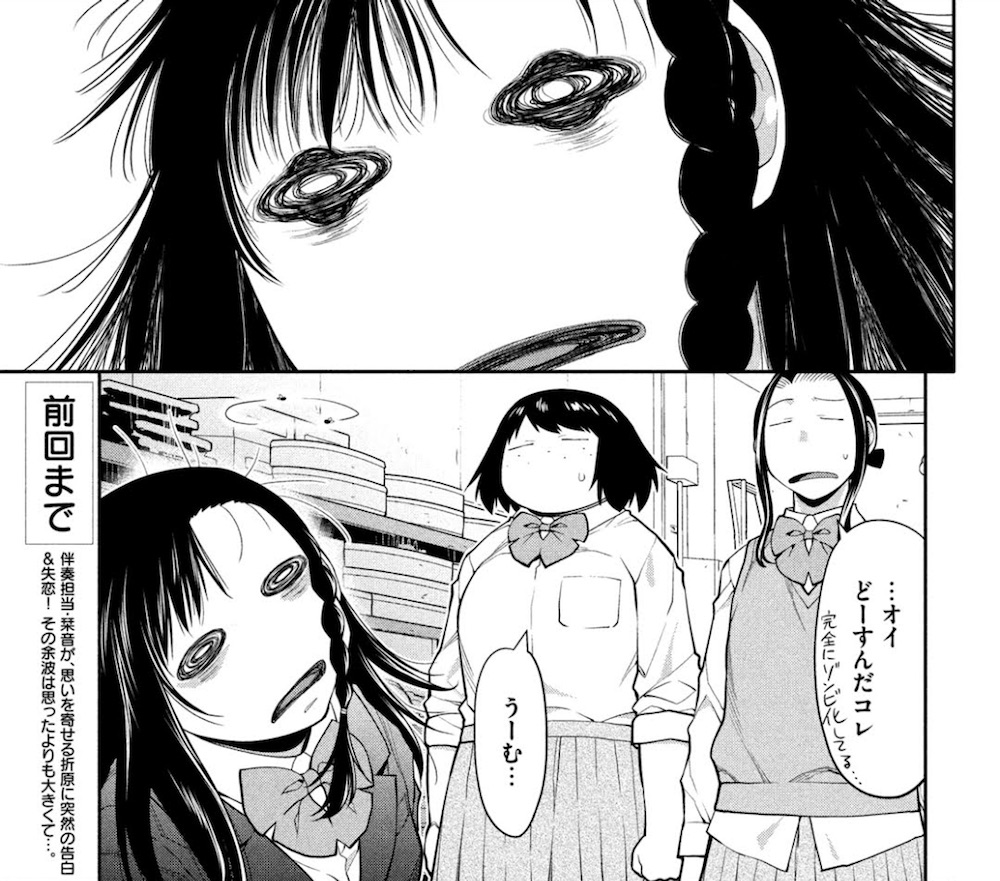
After being rejected by Kousei, Shion is emotionally devastated. Yukina asks why Kousei would word his rejection so harshly, while Jin correctly (and inappropriately) brings up Kousei’s mom as the reason he doesn’t like to deal with girls.  At the same time, seeing Shion confess to Kousei has put Akira into a funk, which impacts his singing as a part of Tsuyama’s group in the school music competition (once again, Akira got roped into participating with them as well). Combined with a lack of practice and a focus on girls over music, the “Tsuyama All Stars” are defeated by a group of otaku singing an iDOLM@STER song. 

Dropping out in Round 1, all of their girlfriends instantly reject them as losers, and Tsuyama is on the verge of kicking Akira’s ass. However, Kurotaki Mai steps in to defend Akira by pointing out that Tsuyama and company’s song choice betrayed them, as they clearly lacked the conviction they showed when singing a Spitz cover at the previous competition against the Chorus Appreciation Society. The Tsuyama crew then realize the “error” of their ways and go back to worshipping Mimi-sensei. But Mai also criticizes Akira, and relays something that Jin taught her: the low notes are the foundation of harmonizing, and as possessors of deep voices, they’re vital to the success of their respective groups’ performances.

But right when everyone expects the Light Music Club to win their round, they’re actually beaten by a mysterious masked group calling themselves “Basso Masters.” Who are they, and why are there 52 of them?!

Oh, Mai
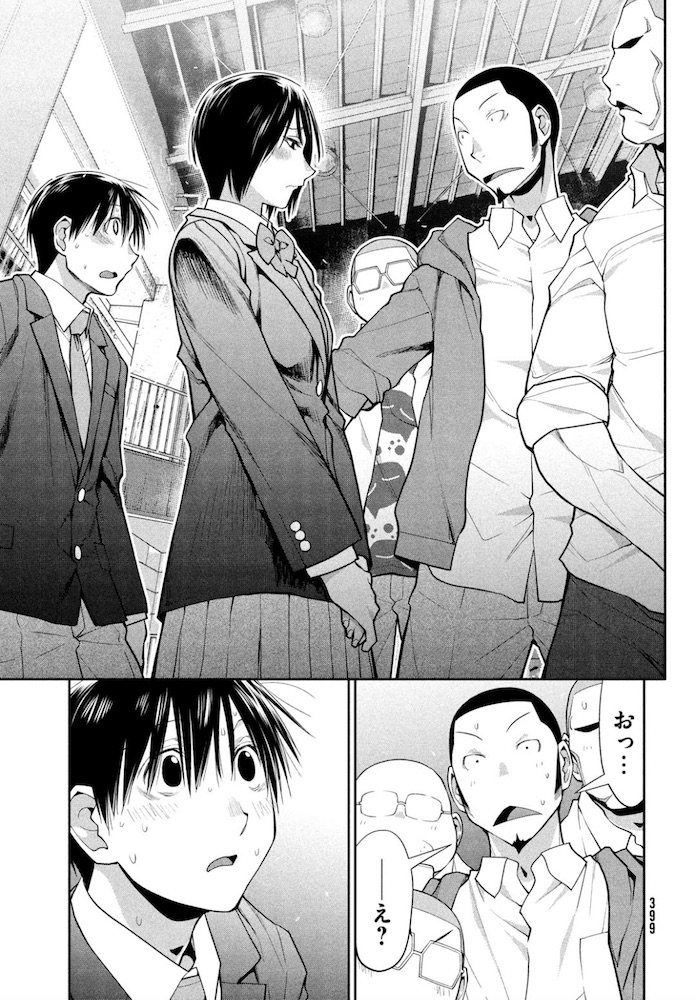
With all the romantic drama coming out over the past few chapters, it’s no surprise that a look into Mai’s inner thoughts would reveal that she has feelings for Akira as well. Sure, all the blushing and gratefulness since her introduction into Hashikko Ensemble was a pretty strong hint, but after giving Akira advice, she thinks to herself, “Liking someone who likes someone else…It happens all the time.” In a different context, it might come across as more ambiguous, but then it’s followed up by Himari seeing everything and reacting with a thought of her own: “…Ugh. Looks like she’s gonna be a real pain.” Himari is clearly seeing something there, though I’m still not sure how Himari herself feels. Being Akira’s childhood friend, is there something more? The love web somehow gets more defined and more convoluted as the story continues.

Meanwhile, Akira’s mom is there in person and seeing this tangled web of emotions in action, thrilled at her darling son experiencing the ups and downs of youth. As with the last chapter, I love how supportive she is, and when I think about something like Genshiken, the sheer parental presence in Hashikko Ensemble sticks out all the more.

Shallow Love
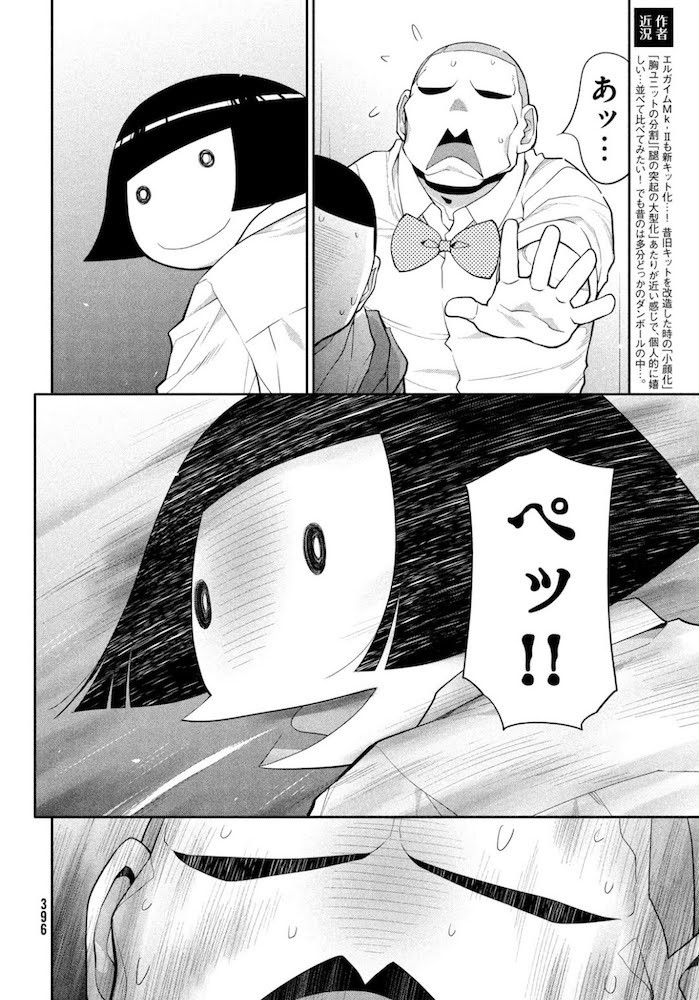
It’s ironic that Tsuyama’s crew, the ones who made it look like music was the key to dating success and the most visible symbol that the school had changed, were mercilessly tossed aside by their girlfriends and are now back to square one. It’s a humorously tragic moment, simple in its brutality, but also speaking to the dangers of romance through prestige. Both the guys and the girls involved likely got into it for shallow reasons, though in what ways they were shallow changed. I could see Tsuyama and the others jumping at the very first opportunity to have some cute girlfriends, while the girls merely liked the cool cache brought to them by dating these guys. When Mai is telling them off, she mentions that their song choice was clearly made in order to please their girlfriends, who know nothing about music and shouldn’t have been such a significant factor. 

It’s implied that their devotion to Mimi-sensei was on a whole other level, and that whatever they were feeling for their girls just wasn’t quite the same. I feel sorry for Mimi-sensei for having to deal with them again, and it’s not exactly a happy ending, but i am amused by how confused she is in the aftermath. 

Jin Is Never Smooth

Some chapters ago, I wrote about how I think he’s supposed to be a non-neurotypical person, which came through in his inability to understand the more emotional and subjective aspects of music. Now, he seems incapable of reading the room, and loudly blurts out something that hits at Kousei’s greatest sore spot: his neglectful and abusive mother. I can’t quite recall if Jin has all the details about Kousei’s life, but just about anyone else would have known to keep quiet about it. Although nowhere near as terrible, Jin doesn’t have the best relationship with his own mom, and I wonder how much his social awkwardness (whether or not it’s due to a psychological or physiological condition) contributes to that tension.

Songs

Tsuyama All Stars: “Pretender” by Official Hige Dandism

Team “Promise” (a bunch of otaku): “Yakusoku” (Promise) from The iDOLM@STER

Half Monks: “Guts Daze!!” by Ulfuls

Electrical First-Years Acapella Group: “Cruel Angel’s Thesis” by Yoko Takahashi (electronic version using Vocaloid software)

Wind Instrument Club: “The Galaxy Express 999” by Godiego

Light Music Club: “Ai Uta” (Love Ballad) by GReeeeN

Basso Masters: “Daichi Kinshou” (Hymn of the Earth) from the cantata “Tsuchi no Uta” (Song of the Land)

I appreciate that the competition has a nice mix of genres and sources—including pop, rock, anime, and classical—from across the decades. The performances themselves also showcase different ways to make music, and I would love to see the electronic version of “Cruel Angel’s Thesis” if this ever got made into an anime.

You can find the above songs, along with previous references, in my Hashikko Ensemble Youtube playlist.

Final Thoughts

A group of 52 singers showing up incognito is sure to cause a stir, but it also makes me wonder if they’re actually another school in disguise—maybe Nishigafuchi. The combination of their song choice and their sheer numbers makes me think they’re not from around these parts.
Christmas, Nostalgia, and Shinkalion

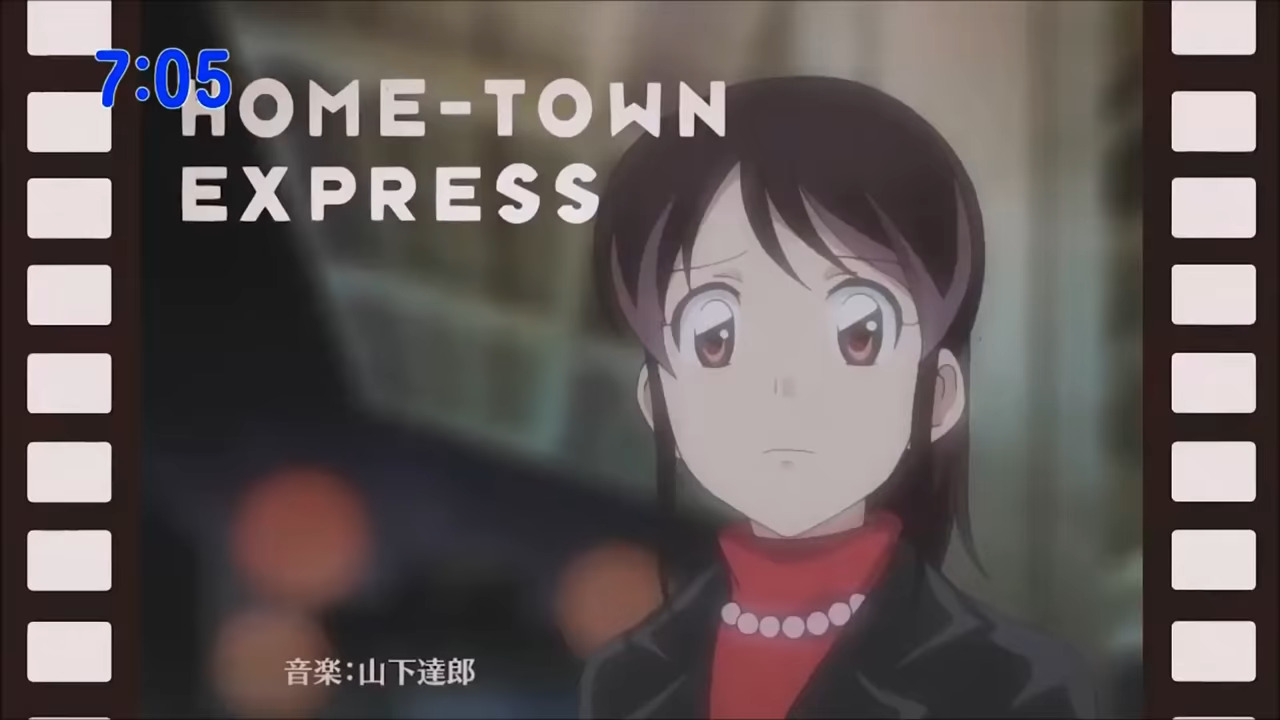
It’s not uncommon for children’s cartoons to offer something to the parents watching with their kids, yet when it came to Shinkansen Henkei Robo Shinkalion: THE ANIMATION, I had believed that there wasn’t much in it for adults beyond those who already have an appreciation for a more classic type of kids’ anime. Recently, however, I’ve come to realize that what Shinkalion offers its older viewers is a dip into nostalgia—not only because of its relatively old-fashioned narrative beats, but also literal callbacks to pop culture moments of yesteryear.

In a recent tweet, fellow mecha enthusiast Tom Aznable points out how Shinkalion actually features near shot-for-shot re-creations of late 1980s Christmas-themed commercials for Japan Railways, complete with 4:3 aspect ratio, a faux-CRT filter, and actual recordings of “Christmas Eve” by the renowned Yamashita Tatsuro. You can see side by side comparisons in the link above, as well as the full commercials below:

I was unfamiliar with that particular song, but it’s apparently considered a Christmas classic in Japan. And, like so many things Japanese, it just oozes nostalgia, and now it’s forever on my playlist. 

In the context of the anime itself, the protagonist Hayasugi Hayato is a supreme train otaku, and so he thinks of everything—including other characters’ romantic recollections—in relation to trains. But the show is clearly using these moments to trigger powerful memories in its older viewers. Shinkalion doesn’t even limit it to Christmas commercials, either. Given all this, it becomes clearer that the Evangelion episode of Shinkalion, where Hayato visits Tokyo-3 and Shinji pilots a Shinkalion version of EVA-01, is also meant to play into this nostalgia.

The way that Shinkalion taps into a past zeitgeist makes me further aware of the improbability of the series ever getting licensed in English. The series is already focused primarily on viewers in Japan by virtue of its purpose and subject material. The show wants you to buy bullet train toys from Takara Tomy and encourages you to ride the train more (not exactly unwelcome in the grand scheme of things), and without the merch and the accessibility to the shinkansen—or, for that matter, the familiarity of Japanese high-speed rail—it would remain a weird and foreign thing to most kids in the US and other English-primary countries. When you throw the 80s and 90s Japanese media references on there as well, it becomes an even more difficult sell. Yamashita Tatsuro might be gaining more of an international reputation than ever thanks to his role as the king of city pop, but it’s those commercials just aren’t going to hit nearly as hard as they did with Japanese viewers.

There will always be something lost in cultural translation, but there need to be a lot of moving parts for this to work out, including likely a licensing process involving Japan Railways. And while Shinkalion has managed to reach beyond Japan and to places like Hong Kong, Asia’s relationship with anime is very different from the rest of the world’s due to proximity. 

Still, I wouldn’t mind a Christmas miracle whereby Shinkalion gets licensed in some form—even a streaming-only release. There would likely be some music rights limitations that would alter the experience, as even the Japanese official Youtube versions of Shinkalion episodes had to replace “Christmas Eve” and “Cruel Angel’s Thesis,” but it would be a relatively small price to pay. As the line from the Japan Railways Christmas commercials puts it, “Getting to see you is the ultimate present.”

Sephiroth in Smash Is Uncharted Competitive Territory

Sephiroth has officially been released for Super Smash Bros. Ultimate, though many people had already gotten their hands on him thanks to the Sephiroth Challenge: a special boss fight with the new DLC character where the reward was early access. Having tried out the One-Winged Angel for a few days myself, I’d like to give my initial impressions of the character, and how I think he’ll pan out in more competitive play.

During this preview period, I’ve seen assessments of Sephiroth go anywhere from disappointingly mediocre to potential top tier. Based on personal experience, I can see why. Sephiroth seems to have qualities that are often death sentences for viability (large body easily prone to getting hit, slow and laggy attacks) but also ones that make for powerful characters (extremely large sword, high mobility, versatility, a built-in comeback factor). In other words, while Sephiroth is nowhere near as unorthodox as Steve from Minecraft, he still possesses a combination of qualities that have never really existed in Smash Bros. before. As #1 player in the world MKLeo puts it, he’s like Byleth (a similarly range-focused character), except Sephiroth trades attack speed for better movement. And in Smash, movement is generally king. 

The sheer size of Sephiroth’s Masamune changes everything. It goes without saying, but the sword is loooong. Cases where an opponent would otherwise be safe rolling away can still get them caught by the end of a sword swipe, and not even because of a particularly impressive read. Spacing both as and against Sephiroth is just different, especially if you factor in his other special moves, which are designed to scare opponents into making bad decisions. The ability to fake out with a Flare charge cancel, to get people to panic with Shadow Flare, or even catch someone slipping with a deadly Octoslash means that it’s easy for Sephiroth to fight on his terms.

That’s not to say Sephiroth’s aforementioned weaknesses are trivial. Like Mewtwo, he’s both tall and light, meaning it’s easy for him to take damage and die early. Sephiroth has issues with being smothered by quick and agile characters who can bait out his attacks and punish their endlag. His frame data is objectively lackluster, and his closest reliable option out of shield is a dismal neutral air with a frame-9 startup (though its utility on offense is much greater). His faster attacks also require a lot more precision, as they tend to be long but thin stabbing motions that don’t cover much space to the sides of the sword. However, Sephiroth in neutral generally looks to have an answer for everything, and it’s a matter of finding what works. I was playing online and losing games to a Fox—exactly the kind of character who can get in your face and stay there—but I managed to eventually win just by using my attacks differently. Down smash’s heavy shield damage can make defensive play unreliable, Scintilla’s ability to push back aggression, and up tilt’s generous scooping hitbox made charging in less free once I realized what to do.

On top of all this is Sephiroth’s One-Winged mode, which improves his stats across the board, as well as giving him super armor on smash attacks and a third jump. Activated when Sephiroth takes a certain amount of damage, it makes him scary in a manner akin to Limit Cloud, because the enhanced mobility makes possible things that would have been out of the question otherwise. Luckily for anyone facing him, he’s still light to the point that it won’t take much to KO him and remove his enhancements temporarily, but it can be like fighting (and using) a different character.

Speaking of Cloud, in comparison to his fated rival, Sephiroth is definitely not meant to be a beginner’s character. Whereas Cloud has extremely good mobility and hitboxes that are both safe and generous, Sephiroth can’t just throw things out willy nilly and hope for the best. Cloud can be played intelligently, but Sephiroth needs brains to function well if your opponent knows what to expect. He just has so many attacks with so many particular uses, it’s going to take a long while before even the best players know how to fully utilize everything he can do.

As for where I think Sephiroth will end up in terms of viability, I’m bullish on his future performance, and can see him at least in high tier. Slow attack speed is never a good thing, but imagine if you took Ganondorf and just gave him a sword as big as Sephiroth’s. It wouldn’t necessarily make Ganondorf a top tier, but it would open up possibilities on offense and defense in a big way. Thus, while Sephiroth has his fair share of pronounced flaws, he also possesses a unique combination of laggy yet powerful ranged attacks along with tricky movement and specials such that the drawbacks of the former can be mitigated by the latter with smart spacing. The very fact that MKLeo is interested in using Sephiroth might also very well give him a huge boost in visibility early on. 

Thoughts on HoloModels

Augmented reality is a funny thing to me because its appeal feels somehow both obvious and yet elusive. Whether it was participating in Pokémon Go at the height of the craze or seeing people on Twitter post videos of their iDOLM@STER characters occupying “real” spaces, I end up thinking “that’s really cool” and “but do I really want to blur that line?” simultaneously. 

I was asked this month, by Patreon request, to discuss HoloModels, which is an AR figures app by the company Gugenka. Essentially, rather than having physical PVC or resin kit models, you collect virtual ones that you can pose and “place” wherever you want. I had actually seen images of it without realizing what exactly I was looking at, thanks to retweets of the Lina Inverse HoloModel that have been filling my Twitter timeline. “Was it some video game? Maybe a fan project?” I thought.

Before trying out the app itself, my understanding of HoloModels led me to think that the advantage was basically like that of ebooks: the ability to keep a bunch of models without any of them taking up physical space. They can be placed and posed any way you want, so there’s also a certain degree of freedom for creativity. However, when I saw that HoloModels can be resized to pretty much any scale, I realized that the potential I had pictured was too limited.

The versatility of HoloModels means you can have life-size models, as if they’re less figures and more characters who have entered our world. Perhaps you can even pretend that they’re a friend or a lover. And even if you’re not into that sort of thing, you can still use them in a variety of different ways. You can use them in virtual dioramas or even as action figures after a fashion. What’s more, you can’t really “damage” them by accident. And of course, even this view is still probably a drop in the ocean of possibilities.

Because of the proximity of HoloModels to Virtual Youtubers—they’re essentially two ways of blurring fiction and reality together through anime aesthetics—I also had to see if there was any stronger connection between the two. It turns out that the default model you get when you first install HoloModels, Shinonome Megu, has since become a Virtual Youtuber with 40,000+ subscribers as of December 2020. I believe the HoloModels figure came first, based on comparing news articles announcing HoloModels with the oldest video on her channel, but if anyone has more information, feel free to share.

Am I interested in sticking with them? Not really. HoloModel figures are awfully pricey in my view, as less expensive characters run around 3,500 yen, and the Lina Inverse mentioned above is 5,000 yen. I might just be the wrong person to understand the true value of these AR characters—I’d still rather have a physical one, even if I can’t make it Godzilla-sized. That all said, if we compare HoloModels to another form of “virtual character collection,” i.e. mobile game gacha, the luck element is completely removed. That does make me wonder if that gambling high is part of why mobile game character lotteries work in the first place, but that’s another conversation for another day.

This post is sponsored by Ogiue Maniax patron Johnny Trovato. You can personally request topics through the Patreon or by tipping $30 via ko-fi.

Getter Robo Arc and the True Ishikawa Style?

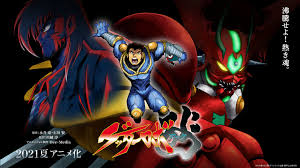
When I was first really getting into anime, it seemed as if the classic 1970s giant robot franchise Getter Robo was in the middle of some sustained renaissance. Whether it was 1999’s Change! Shin Getter Robo: Armageddon, 2000’s Shin Getter Robo vs. Neo Getter Robo, or 2005’s New Getter Robo, it felt as if another anime was always just around the corner. But then the well dried up (albeit not necessarily for other popular classic robots), and it’s been 16 years since. But finally, in 2021, we’ll be seeing a new entry: Getter Robo Arc, based on the manga by Nagai Go and Ishikawa Ken. Notably, this might also end up being the first fairly straightforward adaptation of a Getter Robo manga, and the first to try and really get close to Ishikawa’s art style.

The funny thing about the various Getter Robo anime is that there has never been a straight adaptation of any of the manga. You might be thinking of a long shounen fighting series ending up with a filler arc or three, but I’m not even talking about that. Rather, since the original inception of Getter Robo, the relationship between the many manga and anime have been an odd one. The first Getter Robo manga and the first Getter Robo anime debuted around the same time in 1974, but whereas the former depicted its heroes as virtual psychopaths, the latter portrayed them as relatively kid-friendly good guys. 1991’s Getter Robo Go took similar diverging paths with Ishikawa’s drawings being relatively unchanged and the anime adapting its character designs to a late 80s/early 90s look. 

The later works were not much different. Change! Shin Getter Robo: Armageddon and Shin Getter Robo vs. Neo Getter Robo both take elements from throughout the franchise’s history and try to show a more action-packed style reminiscent of Ishikawa’s art, but neither quite goes all the way, balancing 21st-century anime designs with a throwback feel. What’s more, the two aren’t even meant to be connected to each other. New Getter Robo is in a similar boat, being a reboot of sorts that brings some of the insane personalities from that original 1974 manga, but changing just about everything else. This trend is par for the course with Dynamic Pro properties, be it Devilman, Mazinger, Cutie Honey, or anything else. “Canon” and “faithfulness” are distant concepts in this arena.

However, that’s also what makes the initial images for the Getter Robo Arc anime stand out all the more. Both the promo image and the trailer seem to exude a roughness that immediately calls to mind Ishikawa’s aesthetic, where trying to create eye-pleasing shots comes second to pushing a kind of gritty intensity. It’s understandable that anime want to try to grab audiences with more appealing character designs, but here we have Gou, the guy on the promo image, feeling like he almost fell straight out of the manga and onto a poster. If the animators at Studio Bee can really pull off making the anime adaptation look Ishikawa as hell, I will give them all the props in the world.

PS: Kageyama Hironobu was a guest at Anime NYC 2018, and during the Lantis Matsuri concert he actually sang “HEATS,” the opening to Change! Shin Getter Robo: Armageddon. Now, the Getter Robo Arc anime is bringing the song back as “HEATS 2021,” and I have to wonder if Kageyama knew back then that he would be called upon to revive that old banger.

Sephiroth and Villainous Presence in Smash Bros.

Sephiroth has been announced as the latest DLC guest character in Super Smash Bros. Ultimate to great fanfare. I certainly didn’t expect him because I figured they would want to spread their 3rd party characters among as many companies and franchises as possible for the widest marketing reach—let alone having a second Final Fantasy VII character, even if there is a big remake currently.  Why Sephiroth?

The answer, I surmise, is that he fulfills an ongoing theme of having villains to contrast some of the biggest heroes in Ultimate. This is the game that added Ridley and King K. Rool to the roster, and K. Rool’s trailer even emphasizes the different rival pairings that exist in Smash. There’s a special place for the One-Winged Angel in the pantheon of video game villains, and he more than deserves a place among the other all-stars in Smash. Sephiroth is the first third-party villain in the game, and the first villain DLC.

But Sephiroth’s appearance makes me realize something: much to my chagrin, it’s highly unlikely that any antagonist or boss can get into Smash as a playable character without there first being a protagonist to contrast them. I would wager that, in another universe where Cloud had not managed to debut in Super Smash Bros. for 3DS & Wii U, he would have been the one to appear now instead of Sephiroth. It’s understandable why they would go for heroes before villains, given that the bad guys are usually not the most prominent mascots of their video games, and the good guys are usually the player characters. Even a generic hero like, well, Hero, takes precedence over Zoma or Dragonlord from the Dragon Quest series. 

There is a game that has leaned more toward villainy when it comes to its guest characters, though. Tekken 7 has Geese Howard but not Terry Bogard, Akuma but not Ryu, and Neegan but not whoever the protagonist of The Walking Dead is. That’s a very different sort of environment, of course, given that Tekken is a standalone world and not inherently a crossover like Smash is. Again, I see why Smash would not want standalone bosses to take up too much of the roster, but I’ve just always thought it would be a nice way to add some diversity without taking up two slots instead of one.

Of course, nothing is ever set in stone with Smash in terms of how or why new characters are chosen, but I think “villains second” just makes sense, even if I wish it didn’t. The only possible exception I could see is if said antagonist all but defines a certain video game’s identity. Which is to say, maybe Carmen Sandiego still has a shot…?

In any case, I’m looking forward to the Sephiroth gameplay reveal.

Attack on Expectations: Deca-Dence

Anime about game-like worlds have something of a stale reputation these days. The sheer ubiquity of virtual reality and RPG-inspired isekai anime results in many series taking relatively shallow treatments of their science fictional aspects. Obsession with game mechanics and/or power fantasy are par for the course. Amidst these trends, Deca-Dence is not only refreshing for its interesting worldbuilding and compelling characters, but it also feels like a genuinely innovative look as well as subversion of game-derived concepts within the context of a society built around them.

Deca-Dence is a tricky anime to review due to its many plot twists. It’s not the type of series that is “ruined” by knowing the big spoilers, as full knowledge of what’s really going on just invites more questions to ponder over, but I think it’s more knowing less so that the show can work its initial magic. 

Thus, the most I’ll say about the basic premise is this: Deca-Dence takes place in a world where humanity is confined to a mobile fortress called the Deca-Dence, which is key to their survival against mysterious monsters called the Gadol. Assisting them in their fight is a system reminiscent of the vertical maneuvering gear of Attack on Titan: backpacks that allow people to levitate, and harpoons capable of draining a vital fluid from them that can be used as a power source. The story focuses on a girl named Natsume, who loses both her father and her arm in humanity’s battle against the Gadol, and it’s the clash between her desire to become a front-line fighter and her self-perception as a relative nobody that gradually opens up the secrets of the world to her. Of all the people she gets to know, the most important is a man named Kaburagi, a former combatant who’s tired of living.

The term I use to describe Natsume and many of the other characters is “NPCs,” or non-player characters. I understand that the term might raise some eyebrows, as it’s commonly used by the alt-right to demean and diminish those who don’t follow their hate-filled ideologies, but here it’s meant in the context of characters who “matter less” within their world because they’re not supposed to be the ones going out and achieving glory. There’s a very clear divide in their society, with a group of extremely skilled warriors known as the “Power” at the very top, whose battle prowess seems all but unattainable for the common folk. It’s as if their world is structured to follow game-like notions of character importance, and Natsume is the one who inadvertently moves beyond her “station” as an NPC of sorts.

Deca-Dence is a satisfying robust science fiction series that both entertains and challenges the viewer. It’s a show that encourages you to think and imagine in the best way possible. I highly recommend it, and am considering writing a spoiler-heavy review just to go over some of the important and provocative ideas to come out of it.

Introducing the Hashikko Ensemble Playlist

Every month, I review the newest chapter of Kio Shimoku’s manga Hashikko Ensemble. Because it’s music-themed and a lot of real-world pieces play both major and minor (no pun intended) roles in the series, I usually include a list of whatever songs are referenced. 

I’ve decided to begin compiling as many of these songs as I can in a Youtube playlist so that everyone can get an understanding of what the characters are talking about, and what the songs they sing sound like. You can find it here:

https://www.youtube.com/watch?v=SHd9peF8XUw&list=PLFb_D_h-kVDDqmjIUJATecg42foU45IZ9

Not all songs featured in Hashikko Ensemble are on the playlist—did you know that children’s music isn’t allowed to be added to Youtube playlists anymore? But I think it’ll potentially enhance the reading experience.

PS: Spitz is awesome.

The Prince of All Rating Systems: The Vegeta Level

There are many areas in which we can judge anime and manga. We can talk about animation quality, narrative consistency, excitement factor, or even just emotional resonance. Recently, I’ve come up with a system that I think provides a new perspective on how we view titles—I call it the Vegeta Level.

Named after the Prince of All Saiyans from Dragon Ball, determining a work’s Vegeta Level starts with a simple question: “How many Vegetas are in this?” In other words, are there any characters who embody—in part or in whole—the qualities of Vegeta, and if so, how many of these characters are there? Vegeta qualities include but are not limited to: short, spiky hair, intense, arrogant, a rival status, current or former villain with a smidge of emotional development. Sometimes, there’s an intangible quality where you can’t quite say why they’re a Vegeta, but you can definitely feel it. 

A series with a relatively high Vegeta Level can have one extreme Vegeta, or it can have so many partial Vegetas that they add up to one or more whole Vegetas. The degree to which each Vegeta quality is present can also factor in. For reference, Vegeta himself is 10 out of 10 Vegetas.

The genesis of this idea actually came from the volleyball anime Haikyu! When I first started watching, one of my recurring thoughts was, “There sure are a lot of Vegeta-like characters in this show.” Hinata and Nishinoya are both short, spiky-haired hotheads with something to prove. Kageyama is a scowling and hyper-competitive “king.” Tsukishima has all the arrogance in the world. And then, as you expand to the other teams, the number of Vegetas only grows—see Bokuto to some extent, and especially Hoshiumi. There’s Vegeta-like energy in all of them.

Even though there’s a clear standard for this metric—Vegeta—there’s still room for subjectivity. In a sense, how you perceive a Vegeta is as much based on how you see Vegeta, whether you’ve actually read/watched Dragon Ball or not. Bakugo in My Hero Academia is very clearly a Vegeta, but how Vegeta is he? One could argue that only Vegeta should be a 10 out of 10, but Bakugo is so nasty and angry and has such a character arc that he might be considered just as Vegeta if not moreso.

So let’s work through an example. Dragon Ball is clearly at least Very Vegeta due to the man himself. Are there any other Vegetas? Technically, there are literal relatives of Vegeta in here, but this is more about personality and archetype. Of his kin, his dad King Vegeta is probably around an 8/10, and Future Trunks (but not modern-day Trunks) is more like a 6/10. Among antagonists/rivals, Tienshinhan, Cell, Piccolo, and Frieza are all fairly Vegeta—I’d say about 4/10, 5/10, 6/10, and 7/10 respectively. From that rough look, that’s 49 Vegeta points. Again, it’s not wholly objective, much like the star rating system in professional wrestling, so there’s room for argument.

So what use does the Vegeta Level have? Well, if you like Vegeta, it’s probably a great way to find a series that interests you. But also, Vegeta as a character is so embraced not just by fans but also shounen manga in general, and I think the presence of Vegeta-like characters are a way to give a series an extra edge without necessarily making it “edgy.” That being said, an all-Vegeta series would make for about the edgiest thing ever.

Does such a series exist? One friend suggested to me at least one series that could outstrip it: The Sopranos. According to him, practically every character in that show is a high degree of Vegeta. 

Food for thought: Could there theoretically be a work with a Vegeta Level that’s over 8000 or 9000?

Holicow: Ogiue Maniax Status Update for December 2020

On the other end of what I hope is the biggest and most important election of my lifetime, I feel a mix of joy and nerves. I also begin to wonder if there is a need for me to continue to bring politics into my writing here, only to realize the answer: of course there is. That being said, one of the goals of Ogiue Maniax has always been to encourage people to think through the lens of anime and manga, so I’ll strive to strike a better balance moving forward. Let’s just say that the last two months were more of an emergency call to action, and even then, it’s only one step in a long journey to a more just and equitable world.

Part of the last month or two has also been me realizing how many Japanese creators are being sucked in by right-wing conspiracy propaganda, which puts me at different degrees of empathy with Harry Potter fans, but I think I might leave that for a full blog post. Or not.

Last month marked 13 years since I began Ogiue Maniax, and it’s probably the heaviest anniversary post I’ve ever written, in no small part due to everything that has happened in 2020. COVID-19 literally changed the way I blog (even if the actual content might not be so different), and it feels strange to head into December—normally a time where I spend time away while reflecting on anime and manga as well as my personal life—while hyper-aware of the fact that things are simply Not Normal this year.

As 2020 comes to a close, I want to thank my Patreon sponsors, especially the following:

General:

Johnny Trovato

Ko Ransom

Diogo Prado

Alex

Dsy

Sue Hopkins fans:

Serxeid

Hato Kenjirou fans:

Elizabeth

Yajima Mirei fans:

Machi-Kurada

And while my Patreon rewards are such that I only include people above a certain pledge amount every month, I want to give a special shout-out to those who’ve supported me for a long time who choose not to have their names on public display. I really am grateful.

Blog highlights from November:

Gold Lightan Is Bananas

Go watch Gold Lightan. It is a ridiculous anime that few can match up with.

Pokémon Journeys, the Original Mewtwo, and Playing with Canon

Thoughts on the recent anime return of the OG Mewtwo from the first movie, Mewtwo Strikes Back

500 “Easy” Steps: Rivals of Aether

My review of the Smash Bros.-style game Rivals of Aether has turned out to be one of my most popular articles in recent memory.

Hashikko Ensemble

Chapter 34 shows both the grace and might of its student body.

Patreon-Sponsored

Let’s Make an Entire Show Out of Dance CG: D4DJ First Mix

My early thoughts on this anime about cute girls DJing.

Apartment 507

Love Live!, Nijigasaki’s Setsuna Yuki, and the President Archetype

Comparing the student council presidents of Love Live! past and present.

Closing

May we have a 2021 that is full of light and hope, and where we can all laugh and sing together again.

In the meantime, stay home for the holidays if you can. Let’s all protect one another.