February has been a turbulent month, as I’ve been paying close attention to the impeachment and its aftermath. But in times like these, I think the ability to find in the stories we love a joy that is both comforting and invigorating is important. Having this blog helps me in many ways, and I try to keep it positive yet critical.
In that respect, I’d like to thank my patrons, who help Ogiue Maniax keep going.
General:
Johnny Trovato
Ko Ransom
Diogo Prado
Alex
Sue Hopkins fans:
Serxeid
Hato Kenjirou fans:
Elizabeth
Yajima Mirei fans:
Machi-Kurada
In other news, I’ve started writing again for Apartment 507. It’s been about two years since my last article on there. I’ll include anything I write there in these monthly updates.
I was asked to write about these virtual youtubers, and so I did!
Closing
I know this isn’t anime-related, but please listen to Adam Schiff make his closing remarks at the impeachment trial. I think these words will stick in the public memory for a long, long time.
January 6, 2020 marked the end of an era as beloved Japanese wrestler Jyushin Thunder Liger retired. His achievements are many, from innovating the Shooting Star Press (now seen in wrestling matches all over the world) to being perhaps the greatest junior heavyweight ever. One thing that stands out to me in his long career is how insane it is that he managed to embrace his ridiculous gimmick, his outward identity as a wrestler, and elevate it to the point of world-wide recognition.
Jyushin Thunder Liger’s name and look is taken from a manga and anime by Nagai Go, creator of Mazinger Z, Devilman, and Cutie Honey. This by itself isn’t unusual. After all, the wrestling manga character Tiger Mask became a real-life wrestler as well. But Jyushin Liger the fictional work isn’t about wrestling or even athletics—it’s about a boy who can summon and fuse with a “bio-armor” to fight evil. The anime isn’t even considered a memorable classic, and yet, Jyushin Thunder Liger somehow made it not just work, but took it over. Now, when you say the words “Jyushin Liger,” you’re probably more likely to get someone who knows the wrestler than the source material. His entrance theme is just the theme song to the Jyushin Liger anime (and makes zero sense in the context of pro wrestling), but rather than being considered hokey, it brings out raucous cheers.
Imagine if a 90s American wrestler was saddled with a Street Sharks gimmick—not even a big property like Teenage Mutant Ninja Turtles—and still wrestled as a Street Shark thirty years later until his retirement brought literal tears to people’s faces. Picture this guy coming out to “They fight, they bite, chewin’ up evil with all their might!” to a standing ovation. That’s basically what Jyushin Thunder Liger accomplished. The closest real equivalent I can think of is the Undertaker, who has played some form of undead wrestling zombe lord (and briefly a American motorcycle rider in the early 2000s) for the majority of his career. Or maybe if RoboCop’s cameo in WCW saw him transition into a regular wrestler who consistently put on great matches.
So here’s to Jyushin Thunder Liger and his global legend. Now let’s see if any new wrestlers come out as Bang Dream! characters.
The Wonderland (Birthday Wonderland in Japanese) is a film packed with whimsy, imagination, and a tale of a young girl finding the strength to keep going. The movie is directed by Hara Keiichi (Miss Hokusai), and I really recommend it.
But there’s also something about the film that delights me on a much more personal level: it features not one, but two different voice actors who have played the Pokemon Mewtwo.
In the role of Hippocrates the Alchemist is Ichimura Masachika, who voiced Mewtwo in the anime film Mewtwo Strikes Back, Mewtwo Lives (aka Mewtwo Returns), and Super Smash Bros. Melee. He’s known for much more than anime—being the original Japanese Phantom of the Opera—but it’s his performance as the Genetic Pokemon that is nearest and dearest to me. He brings a similar gravitas to his Hippocrates, though The Wonderland also allows a more comedic side as well.
The antagonist of The Wonderland, Zan Gu, is played by Fujiwara Keiji—Mewtwo in Smash 4 and Super Smash Bros. Ultimate. He’s known for roles such as Maes Hughes in Fullmetal Alchemist and Holland in Eureka Seven. Zan Gu is actually more similar to Mewtwo, but Fujiwara doesn’t give the two the exact same vocal quality.
As an aside, if you want to hear both of them perform dialogue as Mewtwo, switch your copy of Melee and Ultimate to Japanese.
Having two Mewtwos is a rare distinction for any work, and it’s all the better that they give such stellar performances in a strong movie like The Wonderland. I’m not saying you should go see the film just for the acting, but they definitely make it even better.
Hot on the heels of Teasobi and Change!, another one of my current manga of choice has ended. In this case, it’s the quirky romance manga Oogami-san, Dada More Desu, or in English, Oogami-san is Letting More and More Out.
The story of Oogami-san follows Oogami Meiko, a teenage girl with an overactive and dirty imagination. She writes erotic fiction, constantly fantasizes, and spends significant portions of her day thinking about guy parts, all while keeping this side of her secret. She becomes curious about one of her classmates, Shinichirou Yaginuma, a quiet and distant guy, but she soon discovers that he has a secret: anyone who touches him blurts out whatever they’re thinking deep down. For Oogami, her true feelings come out as “Show me your dick.” That’s the start of their relationship.
It’s a pretty gimmicky romance manga at the start, but the early chapters are really carried by how fun and expressive Oogami is as the main character. Her and Yaginuma both have things they don’t want to share with others, and they sort of become mutual confidants. But as the two grow closer and even make other friends, the series goes into not judging books by their covers, bullying, overprotective parents (who have a genuine reason to be that way), jealousy, and other topics that give Oogami-san more weight—all without abandoning the ridiculousness of its base premise. It’s a ribald comedy with a touch of seriousness, where characters love and learn and one of them likes to talk about penises. A lot.
Oogami-san, Dada More Desu concluded in December, and the 7th and final collected volume came out in Japan on January 23. It’s the kind of bizarre love story that is right up my alley, and I think it’s definitely worth a read.
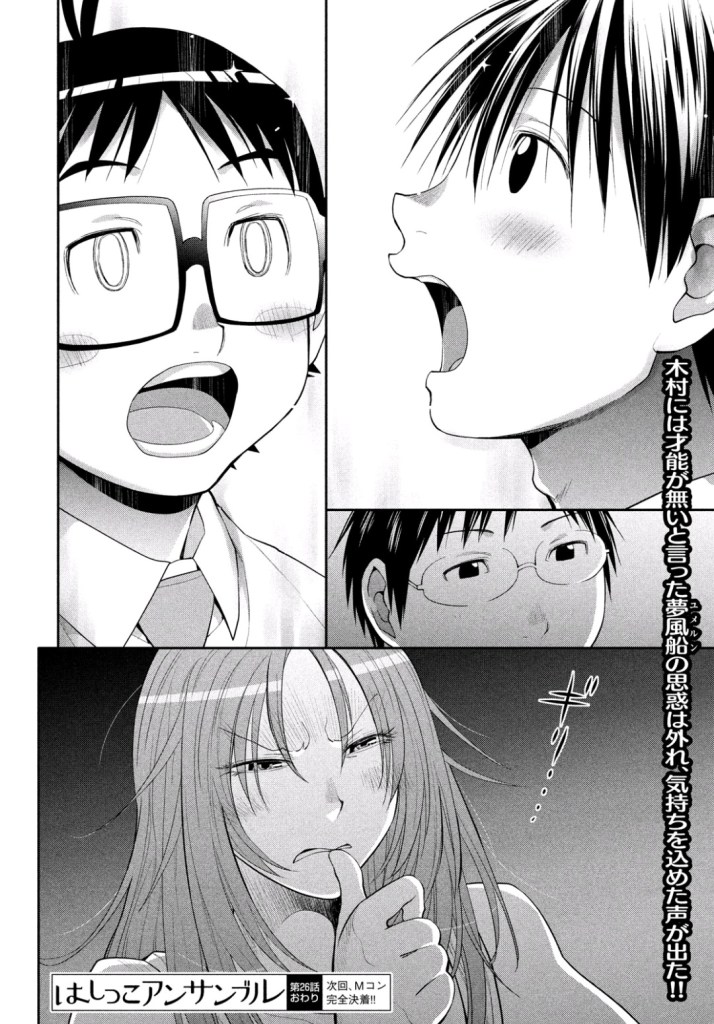
A new character flips everything upside down in Chapter 24 of Hashikko Ensemble.
Summary
Shion has sprained her wrist, and the Chorus Appreciation Society is forced to do something about it. Given a few options, they ultimately land on getting an alternate pianist to accompany them, though Akira expresses that he doesn’t think anyone could really replace her. Shion pulls a favor with her mom, and gets an old acquaintance/friend to take her place: Mashino Shuusuke, a guy who carries around a sun umbrella and who just has an aura that screams “elite.”
However, after just one song, Shuusuke finds the Hashikko boys to be fundamentally inadequate. He critiques each of their weaknesses one by one—and actually declares Jin to be the most hopeless of all! While the rest of the group is eager to prove Shuusuke wrong, Jin seems uncharacteristically glum.
Their Unique Problems
It’s interesting to see where each character’s singing flaws are, as pointed out by Shuusuke. It’s not easy to convey in comics, so the exposition is welcome. Also, it might be a hint at how the characters might develop over time.
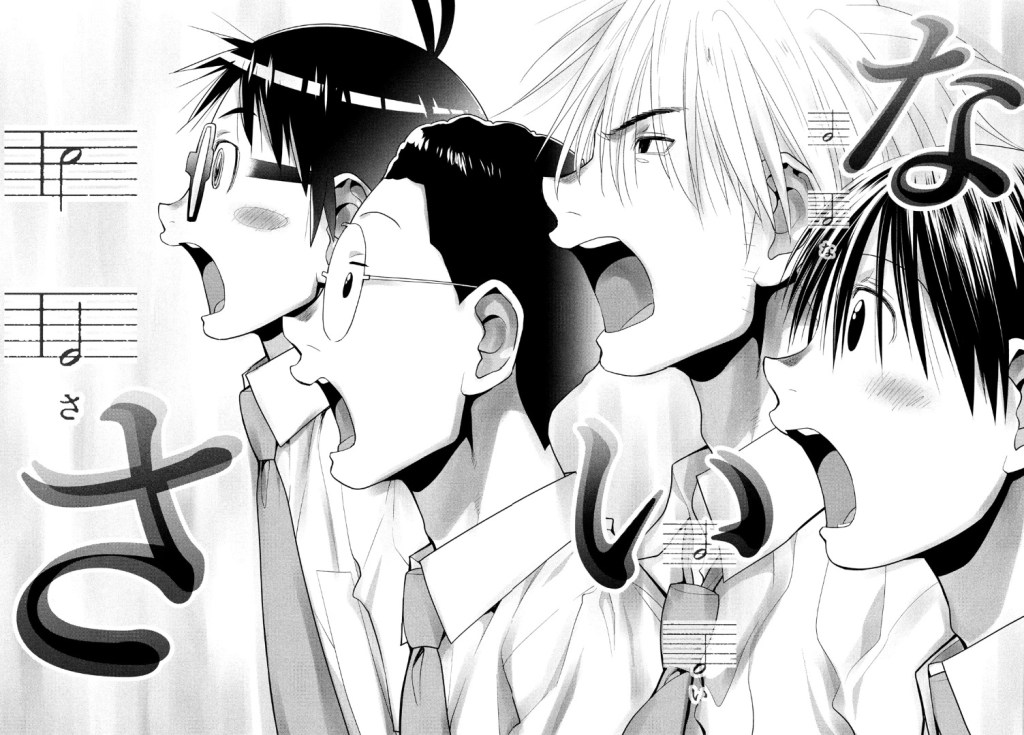
Akira is trying too consciously to sing low, and his enunciation is suffering. He’s pushing his vowels out at the expense of his consonants.
Kousei doesn’t sing with purpose. According to Shuusuke, Kousei comes across as someone who thinks passion and feeling can make up for that, but it can’t.
Shinji is a total beginner, so there’s not much to be done there. Shuusuke says this as if there’s nothing specific he could say to help, which makes Shinji all the angrier
Jin knows how to “sing,” but what comes out of him isn’t “music.” In terms of criticisms, this one hits the hardest.
A Hurdle for Jin
I find the introduction of Shuusuke to be one of my favorite story developments so far because it’s the first time that Jin has been challenged as a character. Up to this point, Jin has always been the fount of knowledge who knows more about sound and music than anyone else. To have that called into question, to have someone say that Jin’s singing is merely technically proficient, is a major change-up. Adding to this is the fact that Shuusuke is clearly a legitimate talent at the piano.
The only times in the past that Jin has looked even remotely that taken aback is when he mentions his mom. We have the sense that there’s something messy underlying his interest in music, and I have to wonder if Shuusuke’s comments are related in any way.
Shuusuke and Shion (and Akira?)
As implied by the chapter’s title page, there’s a history between Shuusuke and Shion dating back to their piano concert days (Shion, as we see, has always been herself). There’s a clear frustration he has over her choosing to go to a technical high school–my best guess is that he saw her as a rival, or at the very least, someone who’s wasting her talents. There might not necessarily be any romantic sparks (or at least not reciprocal ones), but the “childhood friend” history is a reliable, if not as common a trope as it used to be. Given Akira’s bit of blushing early in the chapter when he comments on Shion being irreplaceable, there might be some tension there.
Songs
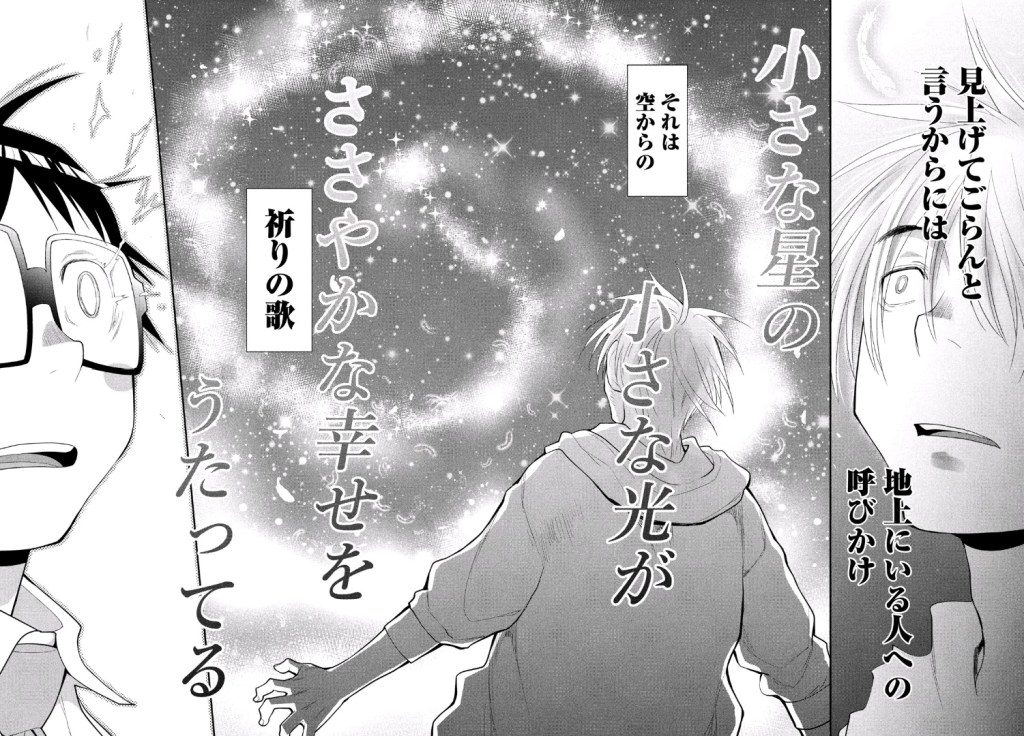
“Miagete Goran Yoru no Hoshi o” (Behold the Nighttime Stars) by Kyu Sakamoto make another appearance here.
Final Thoughts
In frustration, Shion says that it’s actually Shuusuke’s fault that things aren’t going well, and that they’re much better when she plays. It’s hard to tell if she’s just being stubborn or if there is some merit to her words, so I’m looking forward to seeing what the answer is in the end.
Since I last wrote about Virtual Youtubers close to two years ago, the scene has grown far beyond any one individual’s ability to keep track. One consequence of this, as I’ve come to learn, is that individual acts have started to form collectives that increase visibility for all. Two of the big ones are Nijisanji and Hololive, both of which utilize a less expensive approach called Live2D that is clearly less robust than whatever it is Kizuna A.I. has. I find the presence of groups like Nijisanji and Hololive to be curious intersections of how people interact with the internet in current times.
Virtual Youtubers (VTubers) are essentially one part Hatsune Miku, one part livestreamer, and one part idol–the result is a kind of weird unspoken contract between viewers and creators where the notion of “authenticity” is relative rather than being some kind of absolute. One of the complaints that streamers often receive, especially if they’re extremely over the top, is that it’s all an act, and that they’re just playing to the audience in order to get more eyeballs on them. People like streamers with whom they can feel some kind of genuine connection, and a layer of “fakeness” can be a turn-off in that respect. But with characters like Tsukino Mito (Nijisanji) or Haato Akai (Hololive), there’s an obvious understanding that what you’re seeing and getting just isn’t a “real person.” At the same time, there’s still a desire that these characters aren’t fully constructed, and that some of the actual individual behind the anime mask will peek through just a bit sometimes. Fujima Sakura (who isn’t in Nijisanji or Hololive) is a prime example of this, though in that case, the person behind the character (Sally Amaki) is already well known, as is the fact that Sakura as a VTuber is part of a greater project: 22/7.
I mentioned Hatsune Miku here (and in the previous post about VTubers) not just because she’s a cute anime girl mascot who people collectively imbue with a personality and history, but because part of her charm is that her voice doesn’t sound entirely realistic. There’s an artificial quality to her that adds to her appeal, and to some extent, I can see this being the case with Nijisanji and Hololive’s VTubers because Live2D isn’t super-smooth. There’s a kind of choppiness that can drag you out of the illusion pretty easily, so you have to kind of let it work its magic on you. Perhaps it’s closer to pro wrestling in that respect. In a way, the flaws even lend themselves to a greater sense of authenticity, in that these VTubers are not presenting a supremely polished (and arguably overproduced) product.
However, just the fact that Nijisanji and Hololive are these collectives adds another wrinkle. There’s this kind of understanding that cooperation is of mutual benefit to all those involved, but the fact that prospective VTubers basically earn the opportunity to enter these groups calls to mind the very nature of Youtube as a platform dependent on click-throughs and crossovers as a means to garner more attention. It’s not that different from something like Game Grumps, but the veneer of anime avatars makes VTubers a little more mysterious but also makes me wonder just where they’re all coming from. To what extent are they professionally honed products and to what extent are they amateur endeavors–and for that matter, does Youtube explode that difference?
It might not be such a bad thing that people can so easily become Virtual Youtubers these days. I myself have considered doing more Youtube in the past, but I’m just not a fan of putting my face out there for all to see. The way the members of Nijisanji and Hololive do it, on the other hand, provides an alternative for those who want to be out there without exposing too much of their identities. In a time when the difference between the online self and the offline self is all but disintegrated, doing this Virtual Youtuber thing can be an oasis of anonymity, albeit within a profit and attention-seeking environment.
This post was written based on a request by Patreon sponsor Johnny Trovato. If you’d like to request a topic, check out the Ogiue Maniax Patreon.
WARNING: THIS REVIEW DISCUSSES SPOILERS FOR WEATHERING WITH YOU AND MAGIC KNIGHT RAYEARTH.
Ever since Your Name, the fourth-highest grossing Japanese domestic film of all time, director Shinkai Makoto has gone from critical darling to household name. His latest movie, Weathering with You (aka Tenki no Ko), is a visually brilliant animated work that ends up feeling more like a transitional work—a stepping stone to this next project. As Weathering with You grapples with being the mainstream successor to Your Name, it also presents a vortex of ideas and themes that aren’t necessarily always cohesive but do leave a lasting impression of emotions and frustrations over how society treats its youth.
The story of Weathering with You focuses on Morishima Hodaka, a high schooler who runs away from home to Tokyo but ends up living on the streets, unable to find work, as the weather gets worse and worse by the day. A couple of chance encounters unites him with a girl named Hina, who he later discovers is a “sunny girl” whose prayers can call forth good weather. Hodaka gets the idea to turn Hina’s ability into a profitable venture, unaware that it could come at a price.
The pressure of being the follow-up to one of the biggest Japanese films of all time is all too real, and I could practically feel it in every name-brand sponsor that dots the Tokyo landscape in Weathering with You. Whether it’s Hodaka sitting at a McDonald’s only for Hina to give him the most lovingly animated Big Mac ever, or the many real shopping malls such as Mylord and Parco, this is a movie with real big sponsors who clearly had high expectations. It’s not a surprise, then, that Weathering with You is also a boy meets girl story with supernatural themes connected to the religion and culture of Japan. One big difference, however, is that the teens in Weathering with You feel much more “lost,” like they’re in a foreboding environment that they’re trying to scratch and claw against. There’s a certain sense of powerlessness that feels very sloppy and therefore very real in the process.
That powerlessness and frustration ties into what I believe will be of the most enduring debates about Weathering with You: whether its characters ultimately made the right decision, and how it ties into our current global crisis with respect to climate change.
Hina has the ability to bring about pleasant weather, but every time she prays, it takes a toll on her body. This is part of the “natural order” of sorts, that there will be people who can fix the weather at the expense of their lives. However, at the turning point of the film, Hodaka manages to rescue Hina and prevent her sacrifice, all while exclaiming that he wouldn’t be able to stand a world without her. In many films, this would be considered the heroic move, except we find out in an end-of-movie timeskip that Tokyo is half-submerged in water three years later. In a sense, Hodaka sacrificed an entire city for one girl, instead of the other way around.
There’s a part of me that wants to criticize Hodaka as being selfish. Right now, we live in a world where the actions of one person cannot truly change the losing fight we’re having with saving the Earth’s environment, and it’s tempting to wish we could magic it all away. However, the more I think about it, the more I find myself realizing that Hodaka and Hina aren’t supposed to be heroes. Sure, they’re the main characters of Weathering with You, but they’re just kids who are trying to do what’s right for them, who are struggling against the expectations their world places on them for being young. And while Hina could have solved the issue, is it right for adults to foist all that responsibility onto kids, and to have a system where one gets sacrificed to keep the weather at bay?
There’s a subplot involving a handgun in Weathering with You, and it can feel incongruous with the rest of the movie. Perhaps it ties into the above theme, placing this enormous amount of power into a kid’s hands, and the danger to himself and others that comes with it. At the same time, if that is what the film is saying, it’s not conveyed very cleanly, leading to some of the lack of cohesion. While Your Name is the obvious comparison, this sort of loose meandering reminds me at times of another Shinkai film: Children Who Chase Lost Voices from Deep Below.
After I saw Weathering with You, I made the joke that Zagato from the anime and manga Magic Knight Rayearth would love the film. He’s also a character willing to sacrifice the world for the one he loves—a world that puts all the burden of maintaining peace and order on the prayers of a single unfortunate soul. Hodaka and Zagato essentially make the same decision, but with the differences in setting (Tokyo vs. a faraway fantasy land) and role (protagonist vs. antagonist), I wonder if it changes how we perceive their decisions and their integrity.
The new Super Smash Bros. Ultimate character announcement did not exactly hit with a great bang. Byleth, the player avatar from Fire Emblem: Three Houses, is arguably even the most predictable choice possible. However, in spite of hype-addicted fans not getting their fix and my own neutral feelings towards Byleth, I find their gameplay reveal to be an interesting look into the developers’ latest attempt at capturing Fire Emblem‘s tactical gameplay in Smash.
Fire Emblem is a turn-based, fantasy-themed strategy RPG series where you control different characters with unique strengths and weaknesses. It’s a game that discourages charging in headfirst and instead emphasizes positional advantages and careful advancements. Because the games are not as action-packed as Smash, it has required a greater degree of interpretation to translate the Fire Emblem representatives. Marth (and by extension Lucina) has the highest walking speed in the series, allowing him to swiftly move in and out of enemy range. Robin is one of the slowest characters in the game, but has a mix of long-range magic and close-range sword attacks to try and trap the opponent in a bad spot. As mentioned by Sakurai in the Byleth gameplay video above, most of the Fire Emblem characters in Smash have Counter attacks in order to replicate the retaliations that happen in the original game’s combat sequences.
Byleth comes equipped with a multitude of different weapons, each of which are tied to a particular general direction. Upward attacks are done with a chain-like sword, side attacks utilize a spear with long reach, downward attacks are performed with a slow but powerful axe, and neutral attacks use a bow and arrows for fighting from far away. This plays into the multitude of weapons in Fire Emblem: Three Houses and their properties, such as accuracy, effective range, etc.
In turn, what I think Super Smash Bros. Ultimate is trying to capture by linking specific weapons to specific directions is the spirit of the positional and preparatory thinking that goes into playing Fire Emblem. Byleth is likely encouraged to fight at different distances depending on what the opponent’s priorities are. This applies to some extent with every Smash character, but with Byleth especially, it looks like there is no cure-all attack that can be used by default to cover multiple situations, such as Link’s neutral air or Mr. Game & Watch’s Fire trampoline.
Sakurai points out some of the examples of the weapons’ limitations. The spear has tremendous reach but is weak up close and has problems with vertical movement. The axe is cumbersome, but has many ways to foil evasive measures and low attacks. The bow has a point at which it must fire, forcing The long-range weapon into being a commitment if you want some serious power. He doesn’t say much about what the sword can’t do, but I imagine it will primarily function as an anti-air.
There are plenty of characters who have multiple weapons that are meant to attack at different angles, but in many of those cases, those moves are usually exclusively special moves. Because the directional theme is tied to Bayleth’s normals and specials, it highlights a different kind of tactical thinking. If you want your sword attacks to be effective, you have to be at a distance where the lance is a poor choice, for example. And you can’t make up for it like Mario could with a quick jab vs. a slower fireball because all of Bayleth’s forward-reaching attacks are lance-based. In other words, Bayleth’s vertical spacing is substantially different from their horizontal spacing, and the player has to adjust accordingly.
The more I delve into how Bayleth is designed, the more impressed I am with the thought and concept behind the character. The game could’ve given them a weapon-switching mechanic, for example, but associating a weapon with a direction means that understanding the right spacing for Bayleth also means understanding the right stage positioning as well. It hints at the same feeling as putting the right unit in the right spot in Fire Emblem and allowing the enemy to fall on your blade.
I find that my favorite manga tend to finish in groups, and now following Teasobi is the news that the rap battle-themed series Change! is done. This was clearly not the intended way to go out, as it basically leaves off with an “our fight goes on!”-style non-ending. Despite that disappointment, I think it’s a really worthwhile manga that does its subject justice.
Change! revolves around Kozono Shiori, a meek girl at an elite high school who also has a love of the art of the Japanese language. She discovers that a classmate of hers, Miki, has been sneaking out to a club (how scandalous!), only to find that it’s a hip hop club where rap battles are the main event. While she initially writes it off, Shiori (now MC Shiorin) realizes that rap resonates with her deep fondness for Japanese poetry, and enters a new world.
One of the main themes of Change! is that while Japanese rap could be seen as just an importing of American culture, it is just as much a part of Japanese (and international) culture as classical poetry. There are elements of the Japanese language, such as the combination of onyomi and kunyomi ways of pronouncing kanji, that make rapping in Japanese a unique experience. Shiori also draws comparison between rap battles and an old Japanese type of poetry competition called uta-awase. While this can come across as an attempt to justify rap’s existence, Shiori’s role in the story emphasizes the idea that the lyricism of rap can be enjoyed by those with an open mind and an appreciation for good wordplay. In this respect, she’s somewhat similar to Tupac, who could be inspired by things like Shakespeare and the music of Kate Bush.
The manga puts more emphasis on the artistry of rap and hip hop than how it grew from specific cultural circumstances, and there’s relatively little notion of its origins in African-American neighborhoods or its ability to give a voice to those who might not have one otherwise. Despite that, there’s a clear and genuine love for rap that permeates the series, and I can understand why a series that’s probably introducing a lot of people to the world of hip hop in the first place might not delve into deeper topics—especially because it ended before its time.
Speaking of, another sign that the manga was in trouble was that the digital versions of Change! started to get a new title: Waka no Ojou-sama Rap Hajimemashita, or A Japanese Poetry Princess Gets into Rap. Titles usually only get this when it seems like not enough people are even giving it a chance. See Edge of Tomorrow (aka Live, Die, Repeat) and Gundam Sousei (aka The Men Who Created Gundam) for examples.
There’s an episode preview in the first Genshiken anime where one of the characters talks about how all the best series get canceled early. Sometimes, I really believe it—because while manga can be an avenue for very unique and off-kilter comics, many ambitious series never get the chance to keep flourishing. Chances are slim, but I hope Change! can come back in some form (it would make for a great anime!). I wish the best of luck to Soda Masahito, Tomiyama Hiromiya, and lyrics supervisor Shinpeita on their future projects, and thank them for a fine piece of art.
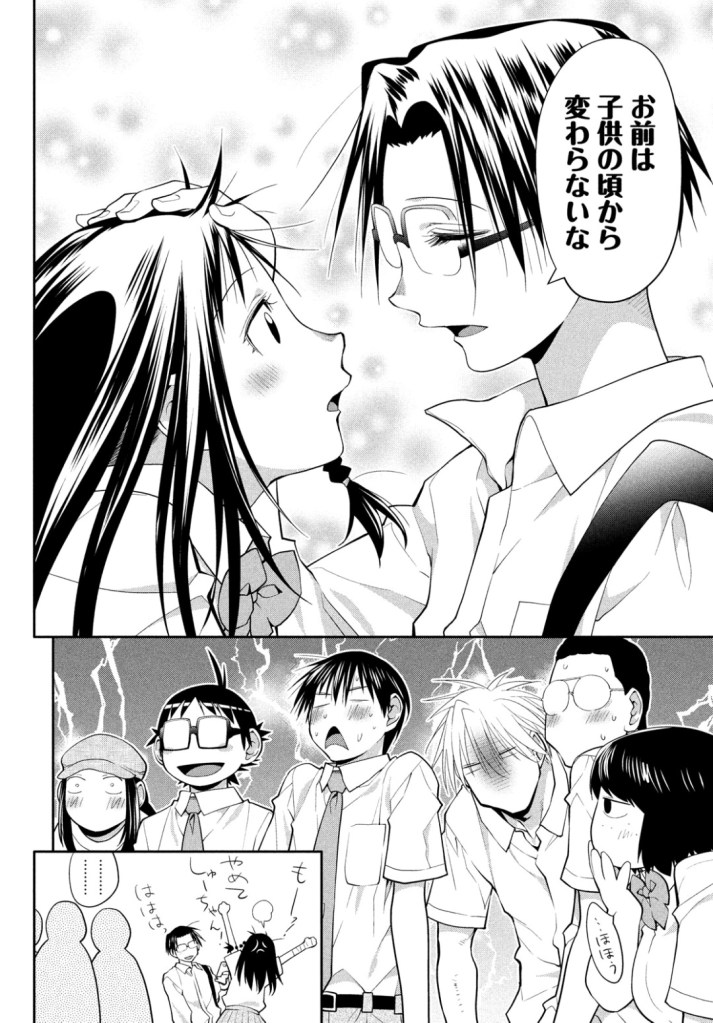
We don’t get much Genshiken news these days, but the Hashikko Ensemble official Twitter account recently tweeted about Yamamoto Nozomi, the voice actor for Ogiue Chika in Genshiken Nidaime, congratulating her on getting married. Accompanying the tweet is the drawing by Kio Shimoku of Ogiue in a wedding dress seen above.
Yamamoto is the second actor to play Ogiue, after Mizuhashi Kaori. Yamamoto’s other notable roles include Jogasaki Rika in The iDOLM@STER Cinderella Girls and Bouhatei Tetora in Joshiraku.
There’s also an interaction in the replies where Yamamoto thanks Kio, only for the account to mention that it’s not Kio but rather his manager (who she’s met before) handling social media. However, the Twitter account did have a message for Yamamoto from Kio:
“You did so, so much for the anime. When I found out you got married, I had to draw something. May you have many years of happiness!” (Kio)