Recent Thoughts on Love Live's Nijigasaki High School Idol Club

In the past, the third Love Live! multimedia project, “Nijigasaki High School Idol Club” (previously known as “Perfect DREAM Project”), had somewhat eluded me in terms of its appeal. Certainly, when it comes to Love Live! In general, I’m usually something of a late adopter—it’s usually the anime adaptations that bring me in, as opposed to the games, magazines, or even the songs. I’m also not so big a fan that I’ll follow every crumb of information, or try to pick favorites before I’ve had a chance to learn about the characters.

Two things have changed since then: the Love Live! School Idol Festival All Stars mobile game (hereafter LLSIFAS) came out, and I attended a delayed viewing of the “Love Live! Fest” concert featuring the girls from all three generations. Together, they’ve given me a better insight into how this third Love Live! Is supposed to work, and its concept of “more individualized school idols” has me curious.

As soon as the nine Nijigasaki girls came out on stage at “Love Live! Fest,” it was clear that the thinking behind them diverged from what went into their predecessors. Rather than appearing as a nine-member unit with matching outfits, each of the singers/voice actors dressed like their characters, who themselves all have very different concert wardrobes. So instead of, say, having all of μ’s in white for “Snow Halation,” it was a hodgepodge ranging from a Swedish dress to a fancy nightgown to a kind of Vocaloid-esque ensemble. Their styles were incongruous, and intentionally so. As explained by one of the members, the theme of the Nijigasaki High School Idol Club is to emphasize each girl’s uniqueness above all else. It’s quite a departure from previous Love Live! projects, which were all about nine girls working as one. 

Each of the Nijigasaki girls also has their own solo number (in addition to a couple of group songs), which is something that the members of μ’s and Aqours didn’t get until later. I think it actually helps convey what each of their personalities is like, as opposed to trying to figure out which girl is which when they’re all singing at the same time. Asaka Karin is supposed to have a more mature sex appeal, and it comes across in spades when she’s the only vocalist. Speaking of Karin, learning about her character was an experience. First, she came out and called herself the “sexy” one. Then, she called her fans “slaves.” Last, it showed her signature symbol: a high heel (hmm). It dawned on me that Karin (as well as the other eight girls) are likely all going for very different audiences from one another.

LLSIFAS somewhat departs from its mobile game predecessor by having more of an ongoing narrative in the story mode. In Chapter 1, you learn that the Nijigasaki High School Idol Club is in a sorry state and on the verge of being shut down. Your goal is to bring back the old members and recruit some new ones, and you basically learn about each of the characters along the way. I think this has been effective in helping me get a better sense of what each of them is all about, with the heavy amount of interaction and the clearer direction doing a good job of showing how the characters are when there’s an obstacle to overcome. Still, I wonder why the forces that control Love Live! as a whole decided to move in this direction for their third endeavor.

I’m not ready to fully embrace Nijigasaki because I find that a bit of resistance is for the best when approaching idol franchises, even the continuation of one I’m already a fan of. The original Love Live! won me over even as I was very skeptical of it, and it took some time for me to enjoy Love Live! Sunshine!!, but it happened eventually. I don’t need to pick a favorite Nijigasaki girl, I don’t need to enjoy every song, and I don’t need to go all-in from the start. That said, I’m looking forward to how the more focused format of an anime will tell their story, and how this idea of individuality will play out. And with a fourth Love Live! project on the way, the Nijigasaki idols will become “senpai” themselves.

Aikatsu as Absurd Idol Anime Turning Point?

Every so often, I think about a specific kind of comic absurdity I see in many idol anime. It’s one thing for characters to be having pillow fights, but it’s another for the heroines to be digging miles-long tunnels, shooting lasers, and scaling treacherous cliff sides with the greatest of ease. Of the franchises that fall under this umbrella, I’ve started to wonder if Aikatsu! is actually a significant contributing factor, bridging the silliness of actual idol media appearances with the impossibility of cartoons. I’m much more of an anime fan than I am an idol fan, so my knowledge and experience in regards to the latter is limited, so take what I say with a grain of salt.

I often see clips of idols on variety shows, as well as in their own video specials and the like. There’s a certain lightheartedness portrayed in these instances that creates the opportunity of laughs and gasps. It’s the kind of humor you see more in Love Live! or The iDOLM@STER, which initially tried to be a little more “down to Earth” with their characters and presentation, though are willing to stretch the boundaries of believability. The difference between those examples and what we see out of Aikatsu, Purichan, and Show by Rock! (not exactly idols per se, but a similar vibe) is that these three franchises venture into a very different reality where even everyday interactions are colored by the strangeness of their worlds.

Take for example the go-to mantra of Aikatsu!: “Ai-katsu!” Characters chant it while exercising, practicing, and engaging in pretty much any situation. Sure, it’s just short for “idol activity (aidoru katsudou),” but the way the phrase is treated as this perfectly routine thing everyone understands sets the stage for series after series where the humor is about challenging expectations of what’s normal. Whether it’s the aforementioned climbing, chopping down trees like Paul Bunyan, or visiting an idol school that’s also literally a gigantic cruise ship, the girls of Aikatsu! do what their flesh and blood counterparts cannot—not always because it’s harder for the latter, but sometimes because the laws of real-world physics do not permit them to do the same thing.

So why do I point at Aikatsu! as a possible origin point? It’s because the closest series to it when Aikatsu! first began was Pretty Rhythm, and that franchise was the predecessor for Purichan. Over the course of that transition from Pretty Rhythm to Purichan, the humor changed to something more akin to Aikatsu’s. A little more distantly relevant is the Precure franchise, but even the magical superpowers on display there aren’t quite the same as the at-times Looney Tunes-esque slapstick and accepted norms of Aikatsu!-esque series.

I’m not a deep fan of any of the series mentioned (with the possible exception of Love Live!), so there’s a lot more to potentially deve into. If there’s anything I’m missing or clearly mistaken about, don’t hesitate to let me know.

PS: Today is an idol shared birthday between Hoshimiya Ichigo from Aikatsu! and Sonoda Umi from Love Live! You know what they say: “Beware the idols of March.”

This post is sponsored by Ogiue Maniax patron Johnny Trovato. You can request topics through the Patreon or by tipping $30 via ko-fi.

Space Cases: Star Twinkle Precure

The Precure franchise always goes out of its way to convey a positive, inspiring message. 2018’s Hugtto! Precure is all about telling kids that they can do anything and be anything. 2007’s Yes! Pretty Cure 5 focuses on dreams and aspirations. The recently concluded Star Twinkle Precure, then, centers around curiosity about the cosmos and the creative power of imagination, and I think it does a splendid job of marrying its ideas together into an enjoyable and uplifting series.

When the twelve Star Princesses (greater beings based on the Zodiac who are responsible for maintaining the universe) are attacked by an intergalactic force known as the Notraiders, they turn themselves into Princess Star Color Pens and send themselves across the universe to prevent their power from being taken. Three aliens, a girl named Lala, a blob named Purunsu, and a fluffy fairy named Fuwa, are tasked with retrieving and restoring the princesses. They travel to Earth, where they encounter Hoshina Hikaru, a human girl who loves to draw and loves the stars. Hikaru and Lala soon discover that they can transform into warriors known as Precures to fight the Notraiders. Along the way, they make new friends and allies, among them Cure Soleil (Amamiya Elena) and Cure Selene (Kaguya Madoka), as they continue their fight to save the universe.

Star Twinkle Precure is one of the most consistently strong Precure anime I’ve ever seen, with my biggest criticism just being that it celebrates the quackery that is horoscopes. I know it’s popular, though.

The characters–whether or not they’re heroines or villains, stars of side characters–are generally compelling and develop in interesting ways over the course of the series while still maintaining the cores of their identities. This even includes Hikaru, Cure Star, when often times the main heroine in these team-based magical girl shows often end up feeling somewhat generic. The series is also paced well over its 49-episode run, with more self-contained episodes rarely wearing out their welcome, and more plot-oriented episodes successfully building on one another. The theme of space travel means a strong sense of wonder and discovery both internal and external, and as the series progresses, the concept of “imagination” is explored in interesting ways–especially in terms of the heroines’ more positive use of imagination vs. the villains’ “twisted” imaginations that prey upon fears and doubts. The animation also rarely falters, and the big fights during dramatic moments in the series are nothing to sneeze at.

One of the important messages woven into the anime is inclusivity. Not only is there the basic idea of discovering and appreciating aliens from outer space such as Lala, but Star Twinkle Precure is the first series to have a human, Earth-born Precure who is not fully Japanese. Elena is Half-Mexican, Half-Japanese, with darker skin than the rest of the main cast, and her biracial heritage is highlighted in multiple episodes. A few episodes are even dedicated to her or her family dealing with feeling different from other Japanese kids. The only downside is that the series doesn’t come out and say “racism” or “discrimination,” but the implication is there, and it is powerful. I hope Precure eventually finds the courage to bring controversial topics right to its viewers without being so vague, confident that kids are smart enough to understand.

Of the Precures themselves, I’m fond of Hikaru’s love of the unknown and her catchphrase, “Kirayaba…!” but I think my favorite might be Lala, aka Cure Milky. I think her transformed outfit is really great in the way it conveys the space alien motif (namely, the clear shoulder bubbles), but I also like her backstory, about how she comes from a planet where a lot of thinking and doing is done for its people by computers, and how she wants to overcome that. But really, all of the girls are great here, and there’s no wrong answer. I hardly wrote about Madoka, but her story about carrying the weight of her dad’s expectations of perfection is something a lot of kids could benefit from seeing.

Overall, Star Twinkle Precure is just an incredibly solid series that I think communicates its messages and themes extremely well. I think it’s great for both newcomers to Precure and longtime fans alike.

One last important note: the second ending is basically Precure vaporwave, and it is fantastic.

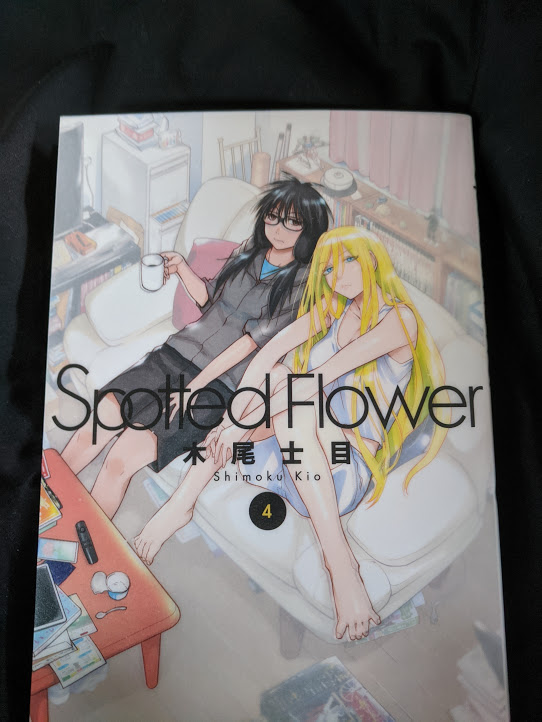
Friends with Consequences: Spotted Flower, Volume 4

Spotted Flower has always been a difficult series to suss out what the story is trying to say, if anything at all. What once began as a thinly veiled what-if pairing of two Genshiken characters has morphed into a crazy tale of adultery, inadequacy, and a cast of characters where monogamy is rare and polyamory is chaotic and unpredictable. Volume 4 continues this trend, spotlighting all the unusual relationships that have arisen. And while I haven’t consistently reviewed Spotted Flower over the years, this one has a lot of Ogiue—er, Ogino-sensei—so I have an extra reason to write about it.

Last year, I presented a panel at Otakon about Kio Shimoku’s works, and during my research, I came to realize that Genshiken is actually somewhat of an outlier in terms of his catalogue. Most manga Kio makes, including his debut professional manga, involves extremely messy relationships and a whole lot of emotional betrayal—and not in a fetishy way, either. So Spotted Flower is actually a kind of return to the older Kio, and the fact that it hits so hard is because the characters are Genshiken analogues.

Volume 4 has the husband (Not-Madarame) and wife (Not-Kasukabe) returning home with their newborn daughter, Saki. It’s not long after the husband had a one-night stand with Asaka-sensei (Not-Hato), so he’s on-edge the whole time, and literally still feeling it in the ass. The wife doesn’t suspect anything at first, especially because Asaka was very thorough in cleaning up, but the slightest hint of perfume on just one of the husband’s sweaters—as well as some pointed questions later—have her suspecting foul play. The rest of the volume involves the husband and wife reaching out to different friends to express their worries while those friends, in turn, grapple with their own complicated situations. Also, Endou (Asaka’s editor) discovers that Hato has a penis, learns about Asaka sleeping with their beloved senpai, and inadvertently spills the beans to Ogino and Not-Sue.

I think it’s important to lay down just how convoluted the web of relations is in this series. The husband is married to the wife, who just recently had their kid, but the husband slept with Asaka out of a sense of inferiority over the wife’s ex, Not-Kousaka. Asaka is in a relationship with Not-Yajima, who knew well in advance what Asaka was planning and was generally okay with it. Not-Kousaka always really wants to have a threesome, but can’t get any, and it’s probably why he’s no longer with the wife. Ogino is living with Not-Sue and is in a physical relationship with her, but also has a real thing going on with Not-Sasahara, whom she adores. Not-Sue is extremely jealous of Not-Sasahara, and balks at the idea of them in a threesome. Not-Ohno and assumed Not-Tanaka seem to be the only ones exclusive to each other. Whew! What a situation.

One of the biggest gut punches of Volume 4 is when Not-Sasahara explains in clear detail that Madarame’s worries over not matching up to Not-Kousaka are totally unfounded. Specifically, it turns out that the wife’s ex just straight-up left after seeing the baby—which means that he basically gave up, and confirms that the husband fucked up 10,000%. What’s amazing to me is that it’s easy to see where the husband is coming from, but just as easy to acknowledge that he’s garbage.

This also makes me wonder if something like this could’ve happened to the real Madarame and Kasukabe in Genshiken. Fans loved the idea of opposites attracting, but it wouldn’t have been out of the question for Madarame to feel like he could never match up to Kousaka. Madarame and Sue are on similar wavelengths, after all. However, there’s also a lot that’s different about Spotted Flower, and it feels as if this is maybe a symptom of how their world is, instead of the cause. Another notable change is that Endou (who is jokingly implied to be the Yoshitake of this series) never went to the same college as the rest of the cast.

During this volume, Ogino initially tries to suss the truth out of her editor boyfriend, and when he refuses to budge, she lays one hell of a deal out: in exchange for telling her what the husband spoke to him about, she will agree to a threesome with her and her blond girlfriend. The look on his face is one of deep, soul- and libido-igniting conflict, and the fact that he apparently doesn’t give in is testament to this character. Ironically, it probably makes Ogino like him even more. 

It can be difficult to figure out Kio’s intent, but there’s perhaps a clue in the extra story provided in this volume. The wife is talking about how she read Ogino’s new manga, which is more out and out BL. The husband responds, “Isn’t it good that she’s doing what she wants?” The wife follows up and says, “But I think her previous work was better.” Maybe Spotted Flower is just unchecked Kio Shimoku, for better or worse.

Given that Spotted Flower chapters come out at a snail’s pace, it’s wild how far the story has come. It’s really impossible to tell how things will resolve, but the way it portrays the differences between willing unorthodox relationships and those built on deception means things are probably going to get worse before they get better. The fact that a child is involved makes the sting that much more severe.

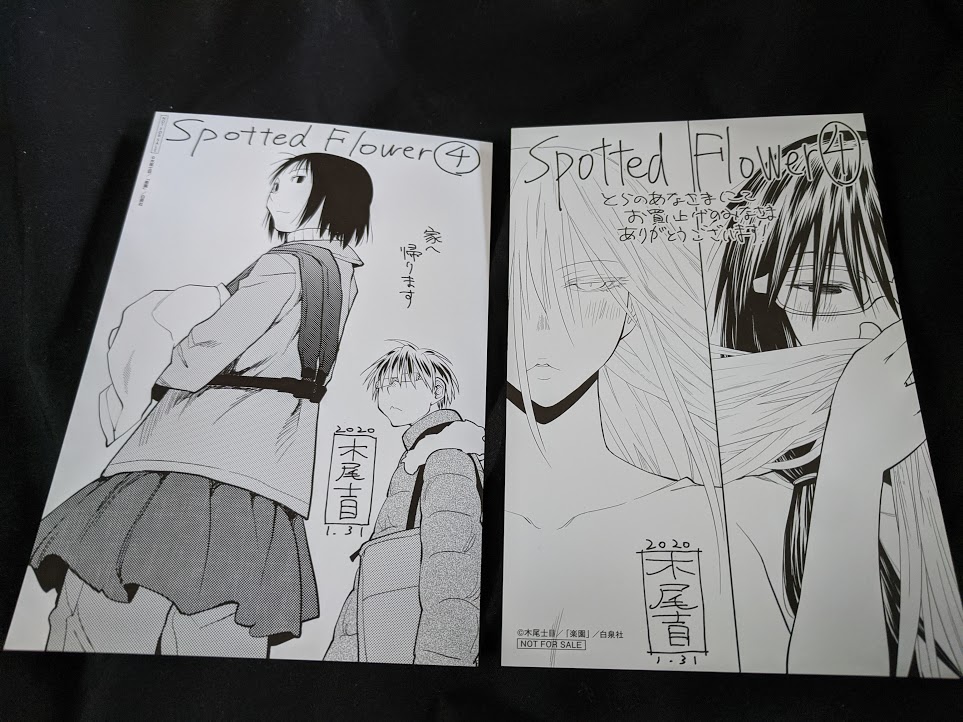
PS: I managed to get both a general purchase bonus, as well as a Toranoana store-exclusive one featuring Ogino and her blonde, Sue-esque roommate. Does it count as Ogiue merchandise when it’s technically not Ogiue?

Welco Metot Henex Tlevel: “Sonic the Hedgehog” Movie Review

I originally was on the fence about seeing the Sonic the Hedgehog movie. But the praise it received from those I trust to have loving but honest opinions about Sega convinced me. So in preparation, I basically went all-in on Sonic. I finally played (and beat) Sonic Mania, which I had put off for a long time. I filled my playlists with songs from Sonic and Sonic-adjacent sources. In a way, it was a homecoming for me, because my very first online community was actually a Sonic and NiGHTS fanfiction site. A part of me will always love the blue hedgehog.

One thing that struck me about the film is how, despite Sonic having a continued presence throughout the decades, Sonic the Hedgehog the movie is essentially a nostalgia film that nevertheless has appeal to kids today. It’s not set in the past (smartphones exist), and the way they portray Sonic as kind of naive and lonely fits better in today’s environment, but the overall buddy flick sensibility feels like it comes straight out of the 1990s, when Sonic was at his peak in terms of recognizability. Even though Jim Carrey isn’t portrayed with the classic girth of Robotnik, he comes across as how the character (described as having an immense IQ but the maturity of a child) could have been translated well to film even in the 90s. In fact, Jim Carrey probably could have played Robotnik back then as well.

Sonic the Hedgehog the movie is a surprisingly solid movie that feels faithful to the core spirit of Sonic as a “cool dude with attitude.” So much could have gone wrong, and the fact that it was inches away from being a total disaster makes it all the more miraculous. Most notably, the original design for Sonic in the movie was met with such widespread panning that they had to redo all the CG. And it matters a lot! That re-design basically was the difference between Sonic being an endearing character and one who induces nightmares.

The artists responsible for fixing Sonic’s look also got their studio shuttered before Christmas in the worst thank-you ever. If all the success this film has achieved doesn’t somehow go back into paying all of these employees who helped save this movie, then my opinion of it will sour immensely. But for now, I think Sonic the Hedgehog is worthy of praise.

It’s fitting that both Sonic the Hedgehog the movie and Sonic Mania are processed blasts of the 90s. Perhaps it took those three decades or so for the nostalgia to come around and make the Sonics everyone wanted into a reality once more.


Disney’s Red-Headed Robot Stepchild, aka Bring Fireball to the World, You Cowards

Fireball is a quirky series of CG-animated shorts starring a snarky and aloof robot girl named Drossel. It doesn’t look out of place among other Japanese animation, except it’s made by Walt Disney Japan. Since 2008, Fireball has gotten a new series every few years. However, not only has it never been translated officially into English, but mainstream Disney (Japan or otherwise) seems reluctant to acknowledge its existence.

Sure, Fireball gets some new merchandise every so often, and they don’t skimp on the quality. The Chogokin and Nendoroid Drossels capture the character well. There’s no crossover, though. A few years ago, I had the chance to visit Tokyo DisneySea in Japan for the first time, and I was looking forward to checking out any Fireball merchandise they might have. After all, even if you can’t get anything at Disneyland or Disney World, I assumed that the country where the show was made would at least have something at one of their signature theme parks. I was wrong.

In terms of properties less prominent in the US, there was Duffy the bear—a hit all across Asia—but I wanted the Hatsune Miku with a boatload of sass that is Drossel.

Fireball isn’t alone in this regard. It’s not look Kim Possible merch is abundant at the US parks, and the amazing Gargoyles TV series seems to get only a begrudging nod. But even those two cartoons are available on Disney Plus, while Fireball remains inaccessible. Maybe if people can stream the series —I would even accept a dub (I say, as I sense the monkey’s paw curl)—people would see the show’s greatness. Then, I can visit Tokyo’s Disney parks again someday and walk out with a Drossel keychain or something.

Hey, I’m keeping my expectations realistic.

Simon’s Rival?: Ogiue Maniax Status Update for March 2020

At the end of last year, I hoped that 2020 would turn out better. I’m starting to doubt whether that’ll happen. But before I get too somber, I’d like to thank the following Patreon supporters.

General:

Johnny Trovato

Ko Ransom

Diogo Prado

Alex

Sue Hopkins fans:

Serxeid

Hato Kenjirou fans:

Elizabeth

Yajima Mirei fans:

Machi-Kurada

The big news of the day is COVID-19, the new and highly contagious coronavirus. Even within the specific realm of Japanese culture (let alone the rest of the world), it’s causing schools to be closed, anime and music events to be canceled, and even the Tokyo Olympics might not be safe. Asia is in a panic, cases of the infection are cropping up all over the world, and here in the US, an utterly incompetent executive branch is more concerned with the stock market than people’s well-being.

I don’t intend to panic nor cause others to panic, but I hope that everyone, no matter who they are, take care of themselves. Don’t try to power through sick days. Get the help you need. Get a flu shot to reduce the chances of your flu-like symptoms actually being the flu.

Now, back to your regular scheduled Ogiue Maniax update.

Blog highlights from February:

Mewtwo vs. Mewtwo: Notable Voices in “The Wonderland”

Two of the voice actors who have played Mewtwo show up in the same movie! Also, The Wonderland is great, and you should check it out.

Talkin’ About Shaft: Oogami-san, Dada More Desu

The end of a cute and racy manga about a girl with an incredibly dirty imagination.

The Source of Life: “Ride Your Wave” Film Review

Yuasa Masaaki’s new film is great, and its message powerful.

Hashikko Ensemble

Chapter 25 reveals more about Jin’s family, and the fears and doubts he has about himself.

Patreon-Sponsored

Play the Anime in Your Living Room: Discovering Anime Board Games and Card Games

A request to write about anime-themed games turned into a discovery of some quite creative traditional games.

Apartment 507

I wrote a little bit about Jimbocho, the book town of Tokyo.

Closing

Economic impact is inevitable, but I’m curious as to whether COVID-19 will have any creative impact in terms of the anime and manga that will be made. How appropriate it is that the current season of Precure, Healin’ Good Precure, has a medicine and environmental theme.

What a Dream Boat: Hashikko Ensemble, Chapter 25

Another new character brings further insight into Jin’s history in Hashikko Ensemble Chapter 25.

Summary

The Hashimoto Tech Chorus Appreciation Society has arrived at M-Con, nervous about competing. Day One is just for observation, though, and they see Nishigafuchi (the school they visited previously) succeed. They’re also worried about Shuusuke not showing up after he tore down Jin so thoroughly, but luckily, he arrives. However, another figure appears as well: a girl named Shouji Yumerun, a classmate of Jin’s when they were kids, and when she looked very different.

Yumerun mentions becoming a pupil of Jin’s mom, and that this means Jin doesn’t have to worry about being talentless anymore—words meant to comfort, it seems, but which have the opposite effect. Jin begins to think about why it is he’s so unable to be naturally expressive, and how he gathers people who make up for this weakness. The chapter ends with him getting ready to ask Akira a question.

Jin’s Intuition

I’m actually surprised to discover that Jin sees himself as talentless, and that all of his singing ability comes from hard work and study, if only because he has come across as such a natural in previous chapters. In Naruto terms, he’s the Rock Lee everyone thinks is a Sasuke, and it makes him more relatable in some ways.

Another character Jin reminds me of is Mike from Monsters, Inc. Like Mike, Jin has the theory down but can only take it so far due to a lack of natural ability. The fact that Jin has such an eye for talent further reinforces this image while also adding an extra wrinkle to his character. He finds people with the raw potential he himself lacks, almost to an intuitive degree.

Yumerun

We get another new character in Yumerun, who drops some hints about Jin’s past and his relationship with his mom. Apparently, Jin and Yumerun were classmates, and he helped bring her into music. Now, she’s studying under Jin’s mom, and she thinks this means Jin doesn’t have to worry about being talentless anymore—implying perhaps that Jin felt pressure to succeed his mom, and that maybe Yumerun has a thing for him?

I’m struck by Yumerun’s words, particularly when she says to Jin, “You won’t be told anymore to stop escaping into the chorus just because you lack talent.” What I interpret this to mean is that Jin likes singing in a group because it better hides his deficiencies. Rather than just being a passion, it’s also a defense mechanism.

In the Mind But Not in the Heart

Every chapter review, I record all the music terms that crop up, partially because they’re in Japanese and not necessarily common knowledge even for fluent speakers. But it’s also because I have little to no musical knowledge or ability, so I feel the need to try and understand. The fact that Jin has a somewhat similar struggle makes these sections take on a new meaning of sorts. As someone not musically inclined, it’s hard for me to tell if these flaws of his are really that basic or if it’s the difference between being decent and being elite, though the fact that no one at Nishigafuchi said anything makes me think the latter.

In this instance, Yumerun brings up all the things Jin has trouble with: enunciating s, k, and z sounds; the nuances of syncopation;  and techniques for emotional expression. Apparently, he can understand it on paper, but has trouble doing it himself. Syncopation is “a shifting of the normal accent, usually by stressing the normally unaccented beats.”

Songs

No songs this month, but the fact that the previous storyline is officially known as the “Spitz arc” amuses me.

Final Thoughts

The Chorus as a place where people who lack in certain areas can support one another feels like the story of a team sports manga, as opposed to ones about individual competitors. Hashikko Ensemble might not have the attractive characters or the pizzazz to attract regular sports manga readers, but I wonder if this possible theme of “the sum being greater than the parts” might resonate still.

The Source of Life: “Ride Your Wave” Film Review

While I never pretend to be some kind of distanced critic of anime, I find it virtually impossible to approach director Yuasa Masaaki and producer Eunyoung Choi’s latest film, Ride Your Wave, with any kind of staunch objectivity. It’s a heartfelt story of love, loss, and learning to see yourself in a new light, and having watched it right at a point in life where its messages and emotions resonate with me deeply and cause my eyes to well up, I have basically nothing but praise for this movie.

Ride Your Wave (aka Kimi to, Nami o Noretara in Japanese) follows Hinako, a bright and energetic surfer girl who wants to live on her own by the ocean. After her apartment accidentally catches fire, she’s rescued by a handsome fireman named Minato, and the two start a loving relationship. However, after Minato loses his life rescuing people from some dangerous waters, Hinako becomes unable to even think about the ocean, let alone surf. But then she discovers that she can “see” Minato in any water source by singing their favorite song, and it drives her to re-discover her happiness and her inspiration to keep on living.

Love is about as common a topic in fiction as you can possibly get, but I feel it’s actually rare to see characters who come across as genuinely in love with each other. There’s a kind of “dramatic love” you often see, and there’s narratives revolving around characters finding their love, but you don’t often see the kind of love borne out of small, everyday gestures that you find in real life. Ride Your Wave’s depiction of Hinako and Minato is extremely powerful in this regard, and the tragedy hits ten times harder as a result.

But much like Pixar’s Up (a favorite of mine), that’s only the beginning of the story, and where Ride Your Wave takes its characters is uplifting while acknowledging the pain and tears. It all feels so raw and beautiful—the joy and the sorrow alike. In recent days, I’ve found myself dwelling on the fear that comes with the possibility of suddenly losing someone you hold dear, without any warning, and Ride Your Wave prompted me to confront how I might feel if thrown in that situation. I don’t think I’ve quite felt this way since I watched Miyazaki Hayao’s The Wind Rises, which also struck me at just the right time to basically electrify me to my core.

I will make one note about the aesthetic aspect of the film. Ever since founding his studio Science Saru, Yuasa Masaaki’s works have hit a kind of accessibility not as present in his older works, and Ride Your Wave furthers this trend. But rather than being a concession to mainstream sensibilities, it’s more a compromise that uses the loose and expressive aesthetics characteristic of Yuasa to tell an emotional story about love, loss, and finding yourself again. It’s identifiably Yuasa, but this is not just a film for animation buffs, or those who like a more daring artistic style.

Ride Your Wave had a one-day-only theater release through Fathom Events, and I hope it gets a wider release. It really deserves every accolade it can get. Now, if only I could get that song out of my head…

Play the Anime in Your Living Room: Discovering Anime Board Games and Card Games

When I think of anime and traditional games, e.g. card games and board games, the things that come to mind are Yu-Gi-Oh! or maybe something Pokemon-related. On the more hardcore end are games such as Weiss Schwarz, which allows you to build and cross over multiple series in a competitive TCG, or the digital card game Shadowverse, which carries an anime aesthetic.

What I never knew until very recently is the amount of anime and manga-themed games out there, as well as the degree to which they try to either faithfully capture the spirit of their source material or whatever idea it is they’re trying to convey.

The resource I found that gave me a bit of insight into how deep this rabbit hole goes is Hoobby.net’s Boardgamer section, which you can filter by “anime” or “manga.” Due to issues of accessibility and time, I haven’t had the chance to play any of them (and thus cannot actually give a real assessment), but I can appreciate their existence.

Some of the games focus on a broader theme from anime and manga. “Book Makers,” for instance, puts you in the role of readers of a shounen manga’s tournament arc, and you’re basically sending in reader surveys to determine which characters progress in the competition. Sadly, it seems like the game is out of print, or at least no longer has a functioning website. Perhaps the idea was too niche. Another game, “Light Novel Label,” has the player as a light novel editor fostering your authors.

Others are based on established properties, and it’s in that realm that the sheer variety of the games I found genuinely surprises me.

It’s one thing to have a simulated tactical board game based on Girls und Panzer. It’s a popular title and the competitive tank-battle motif plays perfectly into the format. Even the Love Live! board game isn’t terribly surprising, even if its concept of “make a sub-unit and gather more fans” is more of a stretch than GuP. Where it gets really wild is in examples like the Pop Team Epic card game and the Mayoiga: The Lost Village card game.

The Pop Team Epic card game, or more specifically the “Pop Team Epic KUSO [SHITTY] Card Game,” is actively designed to be hilarious but also kind of anti-fun–appropriate for such a trollish manga and anime series. In the instructions, it says, “Whoever remains is the winner. If all players are out, then Bandai Corporation is declared the winner.” The Lost Village’s card game seems to be a mystery/horror game where you play as five of the characters from the anime and try to survive your trauma, but anyone who’s seen that TV series knows that it does not lend itself well to a board game, and perhaps not even to an anime. The most important thing is that you can indeed play as the breakout “star” of the series, Hyouketsu no Judgeness.

Perhaps the most shocking game I found in terms of just existing is the board game for Genma Taisen, aka Harmageddon, from 1983. It’s not entirely out of left field, but I just never expected that anyone would have tried to distill that series into some kind of playable format, though the fact that it predates the Famicom might be a contributing factor.

A lot of the games don’t seem to have much longevity, which is tragic in its own way. Maybe someone will see one of the less beloved games and give it a second chance, and sparking some kind of second wind. Until then, they seem more like curios and conversation pieces.

This post is sponsored by Ogiue Maniax patron Johnny Trovato. You can request topics through the Ogiue Maniax Patreon or by tipping $30 via ko-fi.