Otakon 2019 Interview: Furuya Toru

This interview was conducted at Otakon 2019 in Washington, DC. Furuya Toru is the voice behind famous anime characters such as Amuro Ray (Gundam), Tuxedo Mask (Sailor Moon), and Seiya (Saint Seiya).

Ogiue Maniax: It’s a pleasure to meet you, Mr. Furuya. I have a few questions I’d like to get the answers to. First, you’re known for many famous roles, but one of your early major ones was Hoshi Hyuuma in Star of the Giants. What was it like working on the show with director Nagahama?

Furuya: That was an anime from almost fifty years ago, and back then I was a middle schooler, and back then, Nagahama-san wasn’t there at the recordings. So I actually don’t have too many memories with him, unfortunately.

Ogiue Maniax: I have another question about Star of the Giants. I’ve heard before that there is a famous episode where a pitch–a single pitch–takes the entire episode. I’ve had trouble finding out more about it. Do you recall this episode, and if so, do you remember what it was like to work on it?

Furuya: There wasn’t an episode where a single throw was one episode, but there was an episode where a single inning was one episode. The anime always did this thing where it would end at a really good place–the camera would stop at the ball right in the air, and many people would want to know what happened next. So I think that went on to be talked about as only one throw in that episode

Ogiue Maniax: I want to ask about one of your recent roles. One of my favorite roles you’ve done is Casshern in Casshern Sins.

Furuya: With regards to Casshern, back then, I was at a point in time where I was thinking that I’ve gotten old and there’s lots of new people in the industry, and I’m not gonna have many main character roles like before. But then, Casshern from Casshern Sins was an offer I got directly from the director of Casshern Sins, director Yamauchi, who I had worked with previously on Saint Seiya. I was very honored at the fact that I was able to do the main character, and it was a while since I played a main character for a TV series. Unfortunately, maybe it was the overall theme being a bit dark and heavy, but it did not receive as good a reception as we hoped for, but I really like Casshern Sins.

Ogiue Maniax: It’s a really excellent show.

Furuya: [In English] Thank you so much!

Ogiue Maniax: I want to ask you about another main character, one that’s more obscure: the main hero from the anime Groizer X. Did you know that the show is actually apparently quite beloved in Brazil?

Furuya: [In English] Really?! [in Japanese] I didn’t know at all. I’ve been to Brazil three times, and I  knew Saint Seiya was popular, but I never heard anything about Groizer X.

Ogiue Maniax: I read online that it was one of the first mecha shows to come to Brazil, so it influenced Brazil in terms of giant robot anime.

Furuya: I think the people there might not realize I did both Kaisaka Joe from Groizer X and Seiya from Saint Seiya.

Ogiue Maniax: My next question is going back to your experience with directors. Director Tomino is known for being a very interesting person. As someone who has worked with him a lot, do you have any favorite stories or memorable experiences with Director Tomino?

Furuya: This is going back to Gundam, but back then, Gundam was a very new and novel concept for a show. As the person who came up with it, I thought he was a genius. I also thought he was a very scary person, but he actually came to all of the recordings we had, and he didn’t give too many directions. But back then, I remember that there were a lot of new female voice actors in the field, and lots of them were having a hard time doing their roles. So Director Tomino would actually be very caring to explain exactly how he wanted some acts to be done. So that was memorable.

Ogiue Maniax: Speaking of female voice actors in Gundam, I was recently watching an anime with Inoue You [the voice of Sayla Mass], and to me, you and Inoue both are fantastic voice actors. Sadly, she passed away, so I wanted to know if you have any lasting impressions or memories of her.

Furuya: You-san was in the business since childhood, so I really looked up to her. She was also a really good cook. Back in the Gundam days, after recording, we would go over to her place to have curry that she cooked.

Ogiue Maniax: That’s wonderful. 

When I think about your performances, you’re very good at playing characters of all ages–young, old, different personalities. Do you have any advice for, say, new voice actors who are trying to achieve that versatility?

Furuya: For new people in the voice acting field, I would actually say they should want to experience many things because my personal experience when I get new roles to play is that I go back and do some research on what kind of role this is, what kind of world this is, and what character I’m doing. I would think long and hard about what kind of voice that character would have. I would go as far as to act the same movements as the characters would be making. So I’d actually do it kind of like a play, where I would actually move the same way and give a thought as to what the character would move like, or what the world is like. In that sense, my approach towards those roles is the versatility I have, and to new voice actors, I would suggest them to get many new experiences so they can give more educated thought on how a character may sound like.

Ogiue Maniax: If there’s one message you’d want people to take away from Gundam, what would it be?

Furuya:

Ogiue Maniax: Thank you very much!

Kyoto Animation: Ogiue Maniax Status Update for August 2019

What should have been a delightful month of convention goodness took a turn for the sorrowful due to the deaths and injuries inflicted upon Kyoto Animation. Recent news has mentioned that their server data was recovered intact and that most of their old series are archived elsewhere, granting a silver lining to an otherwise dark and cloudy July. It’s no replacement for the loss of so many lives, but it’s something.

In terms of the blog itself, I’m back from Otakon, and you can expect a couple of interviews with Japanese voice actors Furuya Toru and Inoue Kikuko, as well as an overall con report.

Thank you again to my sponsors on Patreon and ko-fi.

General:

Johnny Trovato

Ko Ransom

Diogo Prado

Alex

Sue Hopkins fans:

Serxeid

Hato Kenjirou fans:

Elizabeth

Yajima Mirei fans:

Machi-Kurada

Highlights from July:

In honor of Kyoto Animation, I’m spotlighting the two posts I wrote this past month related to them.

Thoughts on the Kyoto Animation Tragedy

Locking Horns: Sound! Euphonium – Our Promise: A Brand New Day Review

Another sad moment also hit when Geoff “iNcontrol” Robinson of StarCraft fame died suddenly at the age of 33. I never met him personally, but I felt it harder than I expected to.

Hashikko Ensemble

Chapter 18 is a breakthrough moment for the Chorus Appreciation Society.

Patreon-Sponsored

Takamachi Nanoha: Transcending Yet Beholden to Her Childhood

My thoughts on the heroine of Magical Girl Lyrical Nanoha.

Closing

On the upside, the new Smash Bros. character is out, and he’s a ton of fun. The randomness of some of his moves is causing a good deal of debate, and I’m considering writing something about him with respect to this minor controversy.

Also, EVO starts today, with Smash Bros. Ultimate as the Sunday main event! What a time we live in.

Bringing It All Together: Hashikko Ensemble, Chapter 18

Can Akira overcome himself and finally sing in front of an audience alongside his peers? That’s the big question of Chapter 18 of Hashikko Ensemble. 

Summary 

Still at Nishigafuchi High School’s elite Chorus Club, Jin has declared that the Hashimoto High School Chorus Appreciation Society will put on a small performance of their own in front of the other school’s members. Orihara is against it, having noticed that Akira didn’t sing during their prior practice. Still, Hashimoto ends up going along with it anyway.

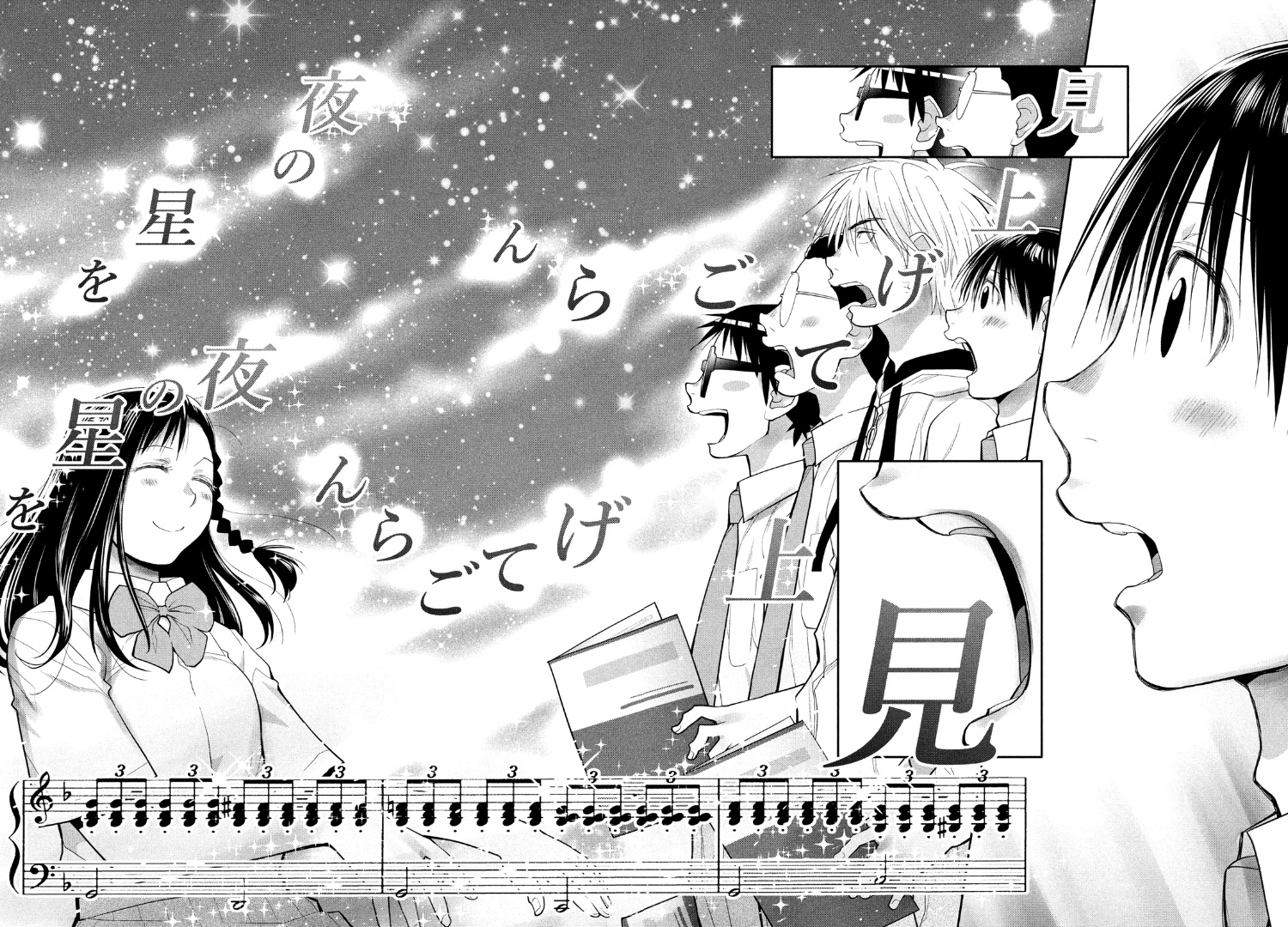
While there are clear strengths to the group, notably Jin’s singing and Shion’s piano-playing, it’s clear to the members of Nishigafuchi that they’re still not organized as an ensemble—it’s like four different people merely singing at the same time instead of together. Even then, it’s not really four, as Akira continues to stay quiet to the extent that Orihara takes over the entirety of the bass part. But as his club mates continue to sing, even Akira’s timidity begins to recede inch by inch, until he comes in at the very end, unifying the various sounds for a brief moment. Akira inadvertently matches the subject of their song, a star that’s small but manages to shine.

Akira Did It

As I read through this chapter, I really wanted to see Akira overcome his fear, but I genuinely didn’t know if he would. Page after page, they kept singing while Akira kept his mouth closed, and I found myself cheering for him to break through this wall. When it finally happened, I almost felt like I wanted to grab him by the shoulders, and yell, “You did it!!!”

Between suggesting Hashimoto sing in front of Nishigafuchi and encouraging Orihara to just do the bass part himself if need be, Jin is the main reason Akira is in a position to do more than lip sync. Putting him on the spot like that can seem somewhat mean, but I’d like to think that Jin notices Akira’s genuine desire to sing. Just having attention on Akira wouldn’t work, so it’s crucial that Akira be surrounded by his club mates putting their all into their performance—an open invitation to join them.

I believe Jin is clever and cunning enough for all this to be his plan. He can act naïve at times, and in certain ways he is, but there’s a sharp mind behind those eyes.

Culmination of Ideas

Near the end, when Akira finally joins in, Jin’s thinks about how everything is come together for their group. In doing so, he brings up a lot of the terms that have come up in previous chapters—high-pitched tones, low-pitched tones, overtones, and singer’s formant. It’s as if this chapter is there to bring together all these concepts, and to show that the Chorus Appreciation Society has managed a breakthrough. The rough direction that the series has been taking has tightened up.

I read a bit more about singer’s formant—the ability for a singer to sound louder than an accompanying orchestra despite that seeming impossible—and realized that a less technical explanation works in introducing the idea. Essentially, singer’s formant is what opera singers are trained to have, and Akira more or less has this quality to his voice without any sort of practice required. It’s his nine-tailed fox, one might say.

Four in Unison

An interesting thing about the art in this chapter is how it shows the characters at different angles in a way that emphasizes how uncomfortable Akira is, as well as how they’re all over the place as a group. The key angle, however, is when they’re facing left, as it gradually goes from being only able to see Jin and Shinji, to an imagine situation of all four silent, to eventually Akira joining in and completing the group. It’s not easy to convey the impact of a song through image and text alone, but I can really feel that unity and harmony (pun somewhat intended) in the spread above.

Songs

The only song this chapter is “Miagete Goran Yoru no Hoshi o” (Behold the Nighttime Stars) by Kyu Sakamoto. It’s the song they’re planning on singing for the MHK competition.

Final Thoughts

Akira seems to have finally found himself. Now I’m just wondering if his childhood friend Himari is eventually going to sing as well, or if she’s going to be outside the club forever.

I also continue to be entertained by Andou, the sadistic soprano. At the beginning of the chapter, she mentions wanting to here Hashimoto’s performance, but it’s clear that she’s motivated by a desire to see them flounder. To her, something like an out-of-tune band that knows how bad they’re doing is probably the ultimate pleasure. The core group of Hashikko Ensemble is plenty quirky, but this makes it seem like there’s a whole ocean of weirdoes out there.


Takamachi Nanoha: Transcending Yet Beholden to Her Childhood

When the character of Takamachi Nanoha first appeared, few could have predicted the strange arc she has taken over the past two decades. Originally a typically cute little sister character from the visual novel Triangle Hearts, the most unusual thing about her was that her siblings were secret ninjas. Since then, she’s turned into a world-busting techno-mage in her own Magical Girl Lyrical Nanoha franchise, grown into an adult with an adopted daughter, and become a lasting symbol of otaku-oriented magical girl appeal. But because she’s also clearly a lolicon icon, her legacy is a mixed one.

It’s clear that, on some level, Nanoha’s appeal transcends the age of her character at any given moment. Between her cheerful personally, her ability to make friends out of former enemies, and her massive laser weaponry, she’s basically a cross between Cardcaptor Sakura, Son Goku, and a Gundam. Even as she ages up, eventually into her twenties, this basic core of who she is stands the test of time. She well deserves love and admiration in that respect.

However, to deny her intentional appeal to a lolicon audience is to feign ignorance. You don’t have to be a lolicon to like Nanoha, but you can’t refute that the element is part of her design and presentation.

Years ago, I watched Magical Girl Lyrical Nanoha and Magical Girl Lyrical Nanoha A’s—the first two TV series, when Nanoha was still young. My memories are a bit hazy, but despite moments that made me uncomfortable, I felt I could come away with an overall enjoyable experience. Nanoha as a character shines through, as do so many others. She’s cool, she’s strong, and her magical staff Raising Heart will shoot someone into the stratosphere.

But when the remakes came out years later, I didn’t even want to touch them. It wasn’t the new character designs, which gave Nanoha and the rest the most massive eyes possible. That’s just a stylistic choice I could accept. Instead, where it soured me was in the transformation scenes. Magical girl transformations are a hallmark of the genre, and an opportunity to encapsulate the appeal of a show. The Nanoha movies used that opportunity to linger on their nude bodies for an uncomfortable amount of time, seeming at times more like a gravure video than an opportunity to see Nanoha power up. To be fair, it’s not entirely absent in the older works, but they really doubled down on it for the films for the worse.

Takamachi Nanoha has a strange legacy as a result of everything with which she’s associated. Say you’re a fan of Nanoha, and the reactions are bound to be mixed. Her character is timeless in some ways, but her image is inevitably tied to her young self and all it entails.

This post was made possible thanks to Johnny Trovato. If you’d like to request a topic or support Ogiue Maniax in general, check out the Patreon.

Pre-Otakon 2019 Hype Courtesy of the Speakeasy Podcast

Otakon 2019 is this weekend, and I recently appeared on the Reverse Thieve’s Pre-Otakon Speakeasy Podcast. We go into what panels we’re doing and what panels we’re looking forward to, so have a listen if you’re inclined and share your thoughts and expectations.

As for Ogiue Maniax’s panels, I have two this year.

Genshiken & Beyond: The Works of Kio Shimoku

Saturday, 7pm-8pm in Panel 7 (Room 146C)

Artist Kio Shimoku is best known for the manga Genshiken, but his career is filled with plenty of other fun, daring, and thought-provoking titles. Come and learn about Kio’s life, works, and artistic evolution!

Star-Crossed Alien Lovers…in Robots!

Sunday, 1245pm-145pm in Panel 5 (Room 151B)

When giant robots and romantic relationships collide, there’s bound to be chaos, drama, and more than a few messages about peace between peoples. See how some of the most iconic and fantastic mecha anime approach the perennial trope of star-crossed lovers!

See you in Washington DC!

iNcontrol, You Will Be Missed

On Sunday, Geoff “iNcontrol” Robinson passed away due to a sudden illness. A beloved figure in the StarCraft community, his gregarious nature and sense of humor did a lot to push and keep StarCraft in the limelight for many years.

The news hit me in a way I wasn’t entirely expecting. I enjoyed his work, but I haven’t been avidly following StarCraft for a few years now. Still, I remembered all the times I would stay up late to listen to a State of the Game podcast or leave a match on in the background just to hear the entertaining banter between him and the other casters, and I realized what an impression he had left on me. When I did check in on what he’d been doing as of late, it seemed like the world was open to him. He had so much potential left.

33 years old. Damn it, that’s much too young. While jokes are made in esports that anyone over 30 is a relic, iNcontrol always looked like the picture of health. To say his passing was unexpected is an understatement, and it saddens me in a profound way that I can’t fully describe or understand.

iNcontrol leaves behind a hell of a legacy. He was a major figure in the early days of non-Korean Brood War. He helped to bring esports to renewed prominence in the early days of Twitch streaming and being a positive force in his community. I can tell his impact because I find myself impacted by him, and my deepest condolences and respect for those near and dear to him.


Thoughts on the Kyoto Animation Tragedy

Over thirty people at Kyoto Animation (Suzumiya Haruhi, Sound! Euphonium, Free!) died tragically this past week, with more injured and missing, after a suspected arson attack on their main studio office. The news has gained international attention, reaching far beyond the world of anime. In certain respects, it’s worse than the infamous Tokyo subway sarin gas attack, and as far as I know, nothing even close to this has ever happened in the anime industry.

My heart goes out to the victims and their families. Last I saw, they haven’t yet been identified in full detail, only that they were mostly in their 20s and 30s. But regardless of their positions or levels of experience, these were people who helped support a studio famous for supporting its creators and having women in prominent positions in their staff. Losing these people means a blow to a place where people could apply their passion and be proud of what they do and where they work. This potentially also sets back the progress of women in the anime industry for years, as there was a lot of talent in that one building.

This really is unprecedented in the history of anime. There have been a number of incidents related to anime fans and places where fans shop, but a direct attack on creators of Japanese animation is so unexpected and new that it’s bound to have a ripple effect on the industry as a whole. Putting aside, the effect this will have on schedules and the like, this will likely affect aspects we haven’t even thought about. Similar to how 9/11 changed what it meant to fly in the United States, the relationship between animation studios and the public might just change permanently.

Right now, there are few details suspected arsonist who was caught and taken to the hospital, but the last thing I want to do is assume anything about the person or their motives. It’s all too easy to jump to conclusions about who would attack Kyoto Animation.

My hope is that this is not the end of Kyoto Animation. They produce good work while treating their employees like people, and I want them to come back, recover, and be stronger than ever.

Locking Horns: Sound! Euphonium – Our Promise: A Brand New Day Review

The anime TV series Sound! Euphonium is a satisfying work that deftly balances the human drama of relationships with the emotional charge of music, competition, and the different degrees to which its characters embrace those elements. After two seasons, the story ended in a fairly satisfying if open-ended place, and it’s interesting that the sequel film, Sound! Euphonium – Our Promise: A Brand New Day, would focus the entirety of the main character’s second year into a roughly two-hour movie. The result is that the film is primarily about how Kumiko and the other remaining members of the Ensemble Club have changed, but also where they still need to go.

WARNING: SOUND! EUPHONIUM TV SPOILERS AHEAD

Having reached third place at Nationals, the Ensemble Club of Kitauji High School—filled with players of tubas and contrabasses and (of course) euphoniums among other instruments—got a peek at the top and are eager to go higher. But with all the third-years graduating, the complexion of the club is bound to undergo a dramatic change. Kumiko, now a year older, is tasked with guiding the incoming first-years. While she’s come to understand what it means to be passionate about her own music-playing, being a mentor is an unfamiliar challenge for her, especially with some of the eclectic new students who have signed up. Perhaps the most significant of these is Kanade, whose social interactions seems Machiavellian at times.

By virtue of medium, A Brand New Day covers a lot of time in less than two hours, so it can often feel more like a series of vignettes. It eschews the slow burn and gradual character development of the TV series in favor of highlighting the most dramatic moments, and also using the crop of new first-years to show how much the core cast has changed, and also where they have room for growth. For example, both Kumiko and Kanade are euphonium players who try to go along with the flow, and who are afraid to step on others’ toes, but their similar behavior comes from different places, and Kumiko has learned to mitigate this side of her to some degree. Hazuki, who only started playing the tuba in her first year, is constantly with two new tuba players who have a lot more experience. Midori finds herself mentoring a younger fellow contrabass who, like her, is sensitive about his name. Reina mentions that the first-years all think they’re ready for competition but aren’t—somewhat ironic given that she was the freshman prodigy just a year ago. One of the messages of the film, and part of what makes it feel so transitional, is that experience, both in music and in life, are factors that can’t always be replaced by talent and genius alone.

There’s also a bit of romance sprinkled throughout the film, but the boy-girl situation Kumiko finds herself only serves to emphasize the heavy yuri vibes between her and Reina. The former is full of nerves and panic, while the latter is like watching someone put on a comfortable shirt. It makes me wonder what the source novels are like in regards to this subject.

Not all the characters are given much screen time, but that’s also because this film’s story runs concurrent with Liz and the Blue Bird. Another Sound! Euphonium film, it centers around Mizore and Nozomi, who were major parts of the second TV series. One more interesting thing is that the Japanese name of the film, Sound! Euphonium the Movie: Oath’s Finale, is very different from the official English title. I wonder if the word “finale” was thought to be too confusing, especially because the film is anything but a conclusion.

Sound! Euphonium – Our Promise: A Brand New Day is a welcome reunion with the musicians of Kitauji High School, but it comes across more like set-up for what’s to come. I’m looking forward to the next film to see how Kumiko and the others continue to grow.

NHK’s Precure Mega Poll: Vote for Your Favorites!

The Japanese television station NHK is doing a Precure Poll that asks about your all-time favorite shows, Precures, minor characters, and songs. While there have been polls in the past from other places, none of them quite have the reach of NHK, so this promises to be a massive one. They expect people outside of Japan to vote as well!

This poll includes all TV series and all movies, and the four categories are as follows: favorite work (pick 1), favorite Precure (pick 3), favorite other characters (pick 3), favorite songs (pick 3).

After each pick, you’re asked to fill out your reasons for choosing, your nickname, age, gender (only choices are male and female), and where you’re from. The last choice in the location drop-down is “outside Japan.”

I’ve already made my choices, as shown below:

Favorite work: Heartcatch Precure!

Favorite Precures: Cure Marine (Heartcatch Precure!), Cure Sword (Dokidoki! Precure), Cure Macherie (Hugtto! Precure)

Favorite other characters: Masuko Mika (Yes! Pretty Cure 5), Dark Precure (Heartcatch Precure!), Tachi Kyouko (Kirara’s manager, Go! Princess Precure)

Favorite songs: “Kono Sora no Mukou” (Dokidoki! Precure ending 1), “Kirakira Kawaii! Precure Dai Shuugou” (Pretty Cure All Stars DX opening), Pretty Cure 5 Full Throttle Go Go! (Yes! Pretty Cure 5 Go)

So happy voting, and remember: Heartcatch Precure! is the best, and so is Cure Marine.

World Shaking: Anime Expo 2019 Love Live! Sunshine!! Concert Review

For the past few years, I’ve been attending Anime Expo (AX) in a limited capacity, and it means I often don’t get to see everything I want to. In this respect, the AX Love Live! Sunshine!! concerts have been something I’ve wanted to see but regrettably kept on missing. But this time was different, and I finally, finally saw Aqours live. While it wasn’t my first time seeing a Japanese idols concert—I saw Morning Musume as part of a multi-act performance at Anime NYC—it was the very first time I had specifically sought out anything even resembling an idol group. It was an enlightening experience in terms of both performers and fans, and a unique experience thanks to a strange AX weekend filled with literal seismic activity.

The adventure that was attending LOVE LIVE! SUNSHINE!! Aqours World LoveLive! in LA ~BRAND NEW WAVE~ (how’s that for a mouthful?) began a couple of months before Anime Expo, when it came time to purchase tickets. I’m no stranger to being part of a massive online crowd trying to buy tickets for the same thing. However, difficulties I had never seen arose. After waiting in the queue, the ticket page would open, but every time I tried to select a ticket and check out, it would say that the ticket I selected was no longer available. This would happen no matter what I selected, be it general, VIP, or the mysterious balcony option that would appear and disappear randomly. I think the issue was that, as the site was trying to choose a ticket for me, it would somehow immediately get snatched up by someone loading the page a split second earlier. I can only assume all this was because of Love Live!’s sheer popularity, Los Angeles being a convenient location for fans in both the U.S. and Asia, and the Showclix website being not fully equipped to handle this level of demand.

In other words, I already had it in my head that an overwhelming amount of people wanted to see Aqours. I managed to get a general admission ticket, and then counted the days. There were two Aqours concerts at AX, but I wasn’t quite hardcore enough to attend both.

I flew to AX the day before the concert, and luckily the plane had free Wi-Fi, so I could see what was going on in the outside world. As the plane was getting ready to descend, I saw that Southern California had just experienced a roughly 6.5 magnitude earthquake—one of the strongest in a long time—and attendees on social media were talking about it, wondering if the tremors would keep coming.

Friday came, and after taking the time to rest my feet (the general admission ticket was standing only), I went to the Novo in downtown LA. The doors opened at 5:30pm and the concert started at 7:00pm, so there was plenty of time to kill. Some new information came out during that time—like the release date of the film Love Live! Sunshine!! Over the Rainbow, an accompanying trailer, and details about the Love Live! Sunshine!! x Shadowverse collaboration—but most of the lull was spent waiting in anticipation. Eventually, the crowd started pulling out the glow sticks and singing along with almost everything on the speakers as a way to pass the time.

Then, at last, out came Aqours to raucous applause, a trend that would continue throughout the concert. I had about as good a spot as possible without being in the VIP section, and I was pretty close to the of the speakers, but there were times when the un-mic’d crowd was louder than the singers.

One of the nine members, Komiya Arisa (aka Kurosawa Dia), could not make it to the concert due to health issues, so I had wondered what they would do in her stead. Would they change the choreography at all? Would they adjust the songs to have other people take her parts? They decided to basically just leave a gap where she would have been, and have a recording of Dia for her parts. I don’t know if this was the intent, but it gave the feeling that they wanted to convey her being there in spirit.

I’m not well-versed in all Aqours songs, especially not compared to that of μ’s from the original Love Live!, so I was surprised by the heavy bass that seemed to show up out of nowhere during one performance. After the song finished, however, a message came in over the loudspeakers: the concert was put on hold, and what I thought was “bass” was actually an earthquake. At first, I was confused, because we were on the 7th floor and I didn’t notice a thing. But then I looked up and saw a set of lights swinging back and forth, clear evidence that the voice wasn’t kidding.

Impressively, Aqours had danced through the earthquake, and to my untrained eyes, they didn’t miss a step. After a few minutes of waiting, the concert was deemed safe to continue, and they went straight into the next song with little issue. Given that Japan is no stranger to earthquakes, I wonder if this is familiar territory to them.

A little before the earthquake, a guy standing nearby handed me a spare glow stick, perhaps taking pity on my merch-less self or wanting to make sure we as an audience looked as good as possible. This was also my first time with an official Aqours “Blade”—one of at least three he had on him—and I had no idea that these things were so complicated. A Blade comes with nine colors (one for each girl), and adept fans have all of them memorized, quickly shifting to the proper one given the song and point in the performance. The only one I could figure out immediately was Yohane’s, thanks to the Yohane cosplayer in front of me with two lights permanently set to white. I actually looked up the color for my have Aqours, Matsuura Kanan (CV. Suwa Nanaka), and taking a hint from the aforementioned cosplayer, kept it on “emerald green” for most of the rest of the concert, making a few exceptions when I could figure out what to do. At one point, the guy who lended me his spare light got so into a song, he pulled out two additional generic glow sticks and accidentally elbowed me in the gut hard. He didn’t apologize, but I honestly think he was so entranced by Aqours that he didn’t even notice.

After a fun and exciting main performance, they followed with a whopping four-song encore, which included a song where the performers would encourage everyone to bring out their official Love Live! Sunshine!! towels and swing them around. It was about the most “buy our stuff” moment of the concert to me, but I didn’t mind all too much.

When all was said and done, my only regrets were my aching feet (I had to do a lot of standing that day, concert aside), and the fact that they didn’t perform “Happy Party Train,” the song led by Kanan. It turns out that they actually did “Happy Party Train” the second day, whereas we on the first day got “Koi ni Naritai Aquarium” and its focus on Watanabe You (CV: Saitou Shuka). I’m sure some You fans wish they could’ve switched places with me, so in the end it was simply luck of the draw. Also, seeing Suwa’s pouty face during the performance was a treat in itself.

If I have the opportunity next year, I’d be interested in seeing Aqours again. At the very least, it would give me a reason to use the Aqours Blade I purchased the next day. And even if I don’t attend, I’ll still have the memories of an earthquake concert. However, given that there’s a mega live event in January that will bring together the old and new school idols of Love Live!, maybe Anime Expo 2019 will do something special as well. And if it so happens that the girls of Nijigasaki or μ’s show up and render my Blade obsolete, then so be it. I’ll be glad to see them too.