I have watched a lot of anime, but I’m far less experienced with tokusatsu stuff. When Toei launched their official worldwide tokusatsu channel on Youtube a few months ago (despite a major hiccup where they accidentally banned themselves), I originally saw it as a way to legitimately watch more obscure giant robot anime such as Lightspeed Electroid Albegas and Space Emperor God Sigma. However, thanks to the sheer range of shows available—stuff leading back to even the black & white era of television—I thought it was high time I made a more concerted effort to watch tokusatsu and form my own opinions.
What I’ve come to notice is that I enjoy these series a lot more than the adapted tokusatsu works I’ve seen over the years in the US—Power Rangers, VR Troopers, Super-human Samurai Syber Squad, etc.—and I think I know why. When it comes to Japanese tokusatsu, there is a greater degree of earnestness that makes these shows more enjoyable overall. They might not have much of a budget, as shown by their threadbare special effects, but everything feels somehow more sincere.
Sure, the localized shows have their own merits, and there have been memorable storylines over the years that lend at least an air of seriousness and compelling storytelling to their worlds. In Power Rangers alone, there’s the original Green Ranger storyline from Mighty Morphin’ and the bond between Astronema and Ecliptor in Power Rangers in Space that revealed the two as more than just evil villains. However, they feel more like exceptions to the rule—-chances for otherwise very non-serious stories to reveal an edge.
With Japanese tokusatsu on the other hand, even the very first episodes feel like they’re working hard to get viewers emotionally invested. They’re also still ultimately kids’ shows as well, but their presentation is such that they expect the young viewers at home to enjoy drama and tension in their entertainment. When you hear the ending theme to Janperson, even if you don’t know Japanese, there’s a strange yet heartfelt sense of passion. It’s definitely cheesy, but it’s a convincing kind of cheesy. The difference is akin to the kind of pro wrestling that easily makes you suspend your disbelief versus the kind that takes you out of the magic.
Anyway, if anyone has recommendations, I’m all ears. A part of me wants to check out Space Ironmen Kyodainand Akumaizer 3 just because of Konata’s fiery karaoke from Lucky Star, but I’m down to keep exploring.
Kio Shimoku has historically been a very private person, not even revealing his face until 2018. Shockingly, the Genshiken author had his very first audio interview, and it was by a Virtual Youtuber to boot! Luis Cammy is apparently a big fan of Kio’s work, and talked with him for a whopping 80+ minutes.
Translating the whole thing would be a whole endeavor in itself, but you’ll find all the notes I’ve taken from the interview. There’s a lot of it that’s all-new information and insight into Kio’s creative history.
Note that Kio has a remarkably deep voice. Personally, he reminds me a bit of Kugayama from Genshiken.
Also, as a final disclaimer, it’s possible I misunderstood some of the things spoken about. If anyone has corrections, feel free to leave comments!
Introduction and Miscellaneous
Luis has been a fan of his work since Gonensei (“The Fifth Year”), an early Kio manga and dark sequel to his prior work, Yonensei (“The Fourth Year”).
As part of their collaboration, Luis sang a cover of the Kujibiki Unbalance opening, and Kio provided drawings of Luis cosplaying as Ritsuko Kübel Kettenkrad for a music video. The video
It’s meant to resemble late 1990s to early 2000s galge/dating sim intros. Luis looks like Saki from Genshiken/Ritsuko already, so it was a challenge to differentiate her.
Kio learned about VTubers from manga author gatherings. He doesn’t watch YouTubers much, let alone VTubers.
When asked if he knew how popular his work was at the time, Kio said he didn’t really look at comments online, but felt he rode the wave of the era.
The very beginning of Genshiken was Kio wanting to draw otaku as normal people. He want to madk what he himself wanted to read.
Luis mentions that otaku and their status have changed drastically since the days of Genshiken (when otaku were picked on and persecuted), like how there are light otaku now. Kio says his daughter is in middle school right now, and to her, she doesn’t get the whole otaku-as-negative thing. A group of popular kids in her class have Demon Slayer: Kimetsu no Yaiba merch. Kio responds, “Times have changed, huh?”
Luis talks about how even regular folks say they like her, and it’s like the wall between normies and otaku isn’t there. Madarame has become a popular representative of otaku (to the extent that he’s Kio’s visual stand-in for this interview).
Kio talks about how, in the very earliest planning stages, the first idea he sent to editorial was about the relationship between Madarame, Kousaka, and Saki. The love triangle was inspired by Ping-Pong Club, the nose-hair chapter in particular. That scene was thought up very early on, back when Genshiken was a mere chick. In a sense, Madarame and his romantic relationships were a part of Genshiken from the start.
Luis talks about her mahjong teacher, Saito Go (a professional player and mahjong VTuber), likes Genshiken. He especially remembers that scene with Madarame and Saki eating sushi together, and then not talking afterward on the train ride home.
Luis points out that Kio likes to use silent panels, which Kio agrees with. However, he thinks overdoing it with those types of panels isn’t good either. The nose-hair chapter ends in silence too. Luis says a lot of information can be conveyed in such panels. Kio says it can convey a sense of realism.
Luis points out that the recording was the day of Saki’s birthday!
When creating character profiles for the compiled manga volumes, Kio had to come up with birthdays. He actually used Gundam Horoscopes to think them up. [This has been mentioned in other sources before, like the Japan-only Genshiken Official Data Book.] Actually, it was sort of like a backwards horoscope, in that he picked a mobile suit that would fit Saki well, and decided the birthday based on that. Sasahara is a Ball.
Personal Questions and Family Life
Kio is into Gunpla. He got into it when he was a 6 thanks to his bigger brother. Plamo-Kyoshiro (the 1980s precursor to Gundam Build Fighters) was his “bible.” He would categorize himself as a plastic model otaku above all else. He still wants to continue it as a hobby, but he’s busy. In Plamo-Kyoshiro, the way they used cardboard boxes in the manga really sparked his imagination as a kid.
Luis asks if Kio’s daughter ever says, “Why is our home filling up with more [otaku] stuff?” Kio says that his workplace is different from his home, so it’s his workplace that gets filled up instead. Doesn’t think his daughter is an otaku, but can’t say for sure. Luis jokes about Kio’s daughter showing up on the live recording and telling him not to say so much. Kio mentions that she doesn’t know about this, so Luis responds that she could come in saying, “It sounds like you’re doing a broadcast with someone from Nijisanji.” Kio comments that she might actually know what VTubers are.
Kio’s daughter has always walked in while he’s drawing manga, so she’s been reading manga for a long time. Kio still reads current manga. Luis says that manga has become like a “communication tool” these days, like, “What? Do you know this title?” as a conversation starter.
Genshiken More In-Depth
Luis describes the first Genshiken as being about ancient otaku. She asks Kio, if there was a Genshiken Third Generation, would it have VTubers and stuff in it? What kinds of characters and what sort of content would it include?
Kio concurs that they’re ancient otaku. His thinking was, “If I try to draw something totally new, it’ll quickly date itself. But if I make them feel older, than it’ll age better.” He doesn’t consider himself to be on the cutting edge. Genshiken came from whatt he personally wanted to draw. As it continued, it progressed into fujoshi stuff.
As for VTubers, once they become old, maybe then they’d show up in Genshiken. Kio says that plenty of current manga have VTubers in them already.
Luis asks if Kio is happy to have ended Second Generation when he did, and Kio says yes. “It felt like, ‘That’s about where it should stop.’” He explains how the sequel started out as a one-shot, but he’s not good at doing extra stories and the like, so he kept on working on it. Kodansha editorial (the publisher of Genshiken) said he should do enough to fill one volume. It was originally supposed to be a short serialization.
Kio began with the thought of “How would Ogiue and the others continue the club?” and of course, it would end up with a bunch of fujoshi. But would it be all girls? What about guys? Hence, Hato.
Kio really went back and forth about whether or not to include a character like Hato. When he was drawing the manuscript, he kept having the feeling of “Is this really okay?” Coming up with the idea of Hato purposely using a more feminine voice is when he finally thought he could make it work. Fujoshi and otoko no ko (boys who dress convincingly as girls) are the main aspects of Second Generation. Kio didn’t want to put Hato through so much hardship, but as the story progressed, he felt that’s what should happen—though he did worry over it.
The original Genshiken was supposed to be in real time, and things moved quickly. But it stopped being that way during the Ogiue story at Karuizawa. At the time, Ogiue was a “problem child” when it came to drawing the manga, as he didn’t know if he could resolve her backstory. It’d be difficult to do that and still maintain the “real-time” thing, and he would’ve selfishly wanted to end the series in the Spring if it had stuck to being in real time. But it took multiple months to get through the Ogiue story.
The series was supposed to end at Volume 8, but then there were plans for the second special official doujinshi [the first one was included with Volume 6]. Because of that, they decided to continue the series up to Volume 9. The original Genshiken features Ogiue’s turmoil, and Second Generation features Hato’s turmoil.
Luis comments how there are the Ogiue fans, and then there are Hato fans. Kio responds, “The Ogiue fans really are somethingl…” and then trails off. [Ogiue Maniax note: I feel attacked.]
Spotted Flower
There are things that were hard to put into Genshiken, like sexual stuff. That’s where Spotted Flowercomes from. From here, the two jokingly pussyfoot around Spotted Flower’s similarities to Genshiken.
Luis talks about how Spotted Flower is a different world (tongue-in-cheek), but it has kind of a crossover feel. Kio responds that they’re ostensibly different characters. Luis replies that the series is like a “what-if” universe (if-sekai in Japanese).
Kio says it’s not supposed to be them, but through it, he can do what he couldn’t in Genshiken.
Luis says, “What-If Madarame has a ‘Why youuuu!’ feeling.” Kio laments the husband as well.
Spotted Flower was supposed to be just a few short pages for Rakuen: Le Paradis magazine. The resemblance to other characters was originally not planned, but is actually something he noticed after the fact. He didn’t explain the meaning of the title to them when he submitted it [madara means “spot” and saki means “bloom”], so they probably didn’t realize at first. So he figured, “Why not keep going?” and it developed along the way.
“And now there are four volumes,” says Luis..
Kio’s feelings: “It’s not a book that comes out often, but if it interests you, I’m grateful.”
It was one thing when it was just the husband and wife, but then he added the Hato-like character, and the Kousaka-like character, and so on. He still can’t really say for sure that it’s them.
Hashikko Ensemble and Kio’s Overall Career
Luis finds the Hashikko Ensemblemain character Akira cute. Kio says that he began with the idea that Akira would have that gap between his very deep voice and his shy personality.
Volume 5 of Hashikko Ensemble should be coming in September.
Kio says he’s been in the manga business for 25 years. Luis thinks all his works are great, in terms of information provided, emotion, and atmosphere all being wrapped up in them. “It’s no small stuff.” To Kio, he sees all the things she mentioned as his shortcomings Luis comments that she enjoys seeing Kio reflect on his work.
Kio is the type to regret not saying this or doing that. Luis remarks that this is a live broadcast—is Kio okay?
Kio doesn’t recognize his own voice when recording. Luis said she never thought of her voice as anything special but the fans would say it’s cute. Luis compares Akira’s voice to Kio’s. Kio never had any experience with singing or choruses, but figured, why not give Akira a deep voice like himself?
He thinks people who can come up with characters purely from imagination are amazing.
Hashikko Ensemble a story of the passion of youth, but Kio didn’t originally plan it that way. Like Genshiken, he wanted the story to be something ridiculous and fun, and landed on “chorus club high schoolers.”
Luis loves stories about the passion of youth (seishun), like Yowamushi Pedal and Big Windup. Kio replies that he’s never drawn manga in that vein—like Chihayafuru—but thought, “If I put all I had into it, could I draw one?” The characters in Genshiken are all pretty mellow. He wasn’t that good at drawing the kind of youthfulness that appears in Hashikko Ensemble, at first.
Luis makes the argument that the original Genshiken is a “passion of youth” story, because it’about figuring out what club to join and what to do? Like, Kugayama’s waffling on whether or not to draw, or Ogiue’s decision to go, “I guess I’m gonna draw.”
The kinds of “passion of youth” stories Kio enjoys are a little strange—not so much “hot-blooded stuff.” Luis describes Madarame as a hot-blooded otaku. As for being a passion of youth story, what about that story with Saki mentioning Madarame looks good in his new glasses?
Originally, Genshiken was supposed to be a club that doesn’t put anything out. One of the things that made Ogiue tricky is that she wanted to draw herself, so Kio had no choice but to make a story about her trying to get into Comic Festival [the Genshiken in-universe equivalent of Comic Market].
Doujinshi???
Luis says Genshiken is what made her want to attend Comic Market as part of a circle. She asks Kio if he ever participated as an artist. Kio says yes!
Kio released a doujinshi at Comic Market in 2003 (Luis points out that 2004 was the year of the first Genshiken anime, which Kio totally forgot about).
Kio did not use the name “Kio Shimoku” for Comic Market. He sold 200 books, which impresses Luis. For reference, Luis says that 100 is considered a lot, and she herself sold 50 copies of her own doujinshi at a Comitia [a major doujin event primarily dedicated to original, non-fan works].
The doujinshi was indeed pornographic, and an original work. It bears resemblance to Kujibiki Unbalance and Genshiken.
Luis talks about how big sister loves Kujibiki Unbalance, to the extent that she put out a pornographic doujinshi starring Ritsuko. Luis helped her a lot with it, including stapling it together.
“Putting out a Kujibiki Unbalance-esque doujinshi yourself is like actually being in Genshiken,” says Luis.
Kio also participated at Comic Market a second time—in 2010. It was a doujinshi based on a “certain space opera that uses Episodes,” flipping around the genders of the character roles involved. The inspiration was that with some wordplay, the title resembled the phrase “Sister Wars.” He drew what was supposed to just be a manuscript based on Episode 1, but it ended up being 350 pages. Kio wanted to draw up to six.
“Please complete it!” Luis says.
“But I wouldn’t be able to sell it!” Kio replies.
[Ogiue Maniax note: One of Ogiue’s characteristics is prolific output, just like Kio here.]
Luis asks if there’s anything he’s watched lately, old anime or new anime. Kio doesn’t have anything, and Luis says his free time to just sit down and watch without moving must have decreased. Kio agrees.
Kio wants to absorb more shows, but just doesn’t have the time.
Questions from Kio for Nijisanji
As future reference for manga, Kio asks if VTubers wear sensors to track movement. Luis responds that it uses 3D tracking. She quickly “corrects” that the animated figure you see is the real her.
Luis says that Kio’s participation in Comic Market makes his manga feel more real.
The two talk more about the Kujibiki Unbalance music video they collaborated on. Kio says it’s like a doujin-style fan work. Luis talks about how she has Genshiken and Kujibiki Unbalance merch. Luis has the Kujibiki Unbalance Ritsuko school swimsuit clear file drawn by the light novel artist, Yagumo Kengou. Kio mentions that the image was a request from him [Ogiue Maniax note: Not 100% sure about this last sentence].
Kio mentions that he gets some harsh comments, but others will say “That’s the kind of author he was all along!” But he doesn’t want to remember himself from the Gonensei era.
What an Interview!
There’s a lot to unpack in this interview. I hope to follow up with an analysis.
Also, I can’t believe there’s a Virtual Youtuber who’s into Genshiken, Kio Shimoku, and mahjong! It’s like someone designed a VTuber especially for me.
I guess the Ogiue Maniax VTuber pantheon is now Sugomori Tenkomori and Luis Cammy.
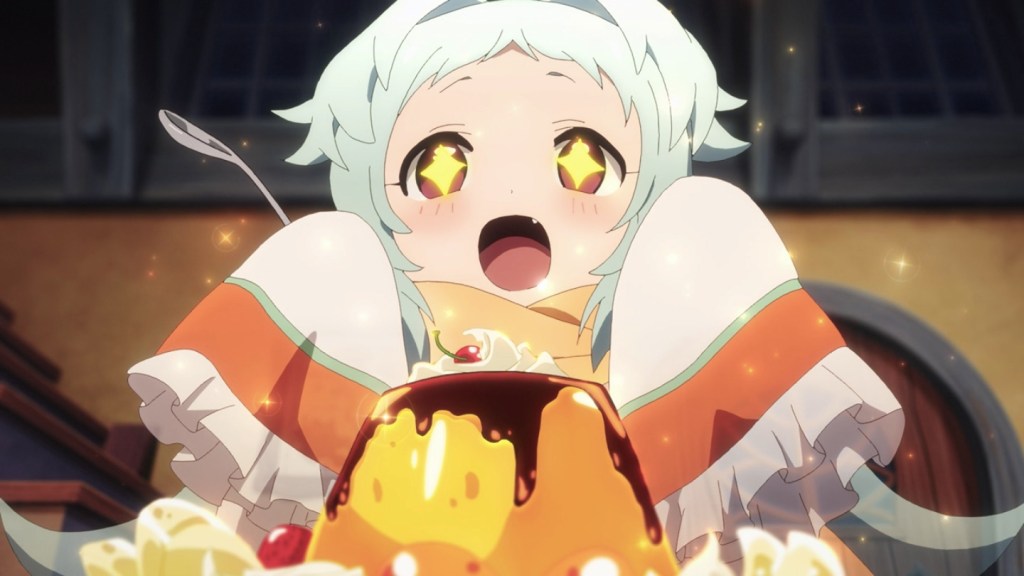
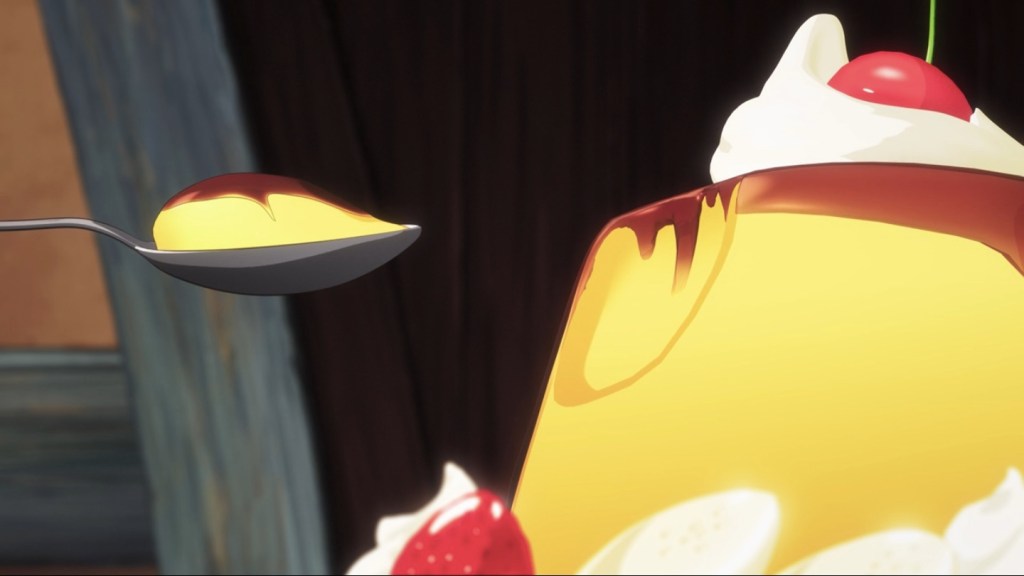
f you’ve watched even a small amount of anime, Japanese pudding is incredibly hard to miss, specifically in the form of a caramel custard flan generally known locally as purin. If I had to say why purin is so popular in anime, my guess would be that there are two reasons. First, its ubiquity in Japan means the food is familiar and comes in many forms, which allows it to traverse class and social status, allowing it to fit into a variety of narratives. Second, its jiggly consistency and unique appearance are ideal for both elaborately detailed animation as well as simpler and more limited animation.
Purin Across Strata
According to the website for Kakeien, a Japanese purin maker, the dessert came to Japan in the late Edo to early Meiji period. Since then, it’s become a staple of Japanese sweets, and depending on how it’s made, it can be a humble treat to decadent, high-class dessert, or somewhere in between. This also means that purin can show up in multiple situations and be a source of conflict, whether it be in the context of drama or (especially) humor.
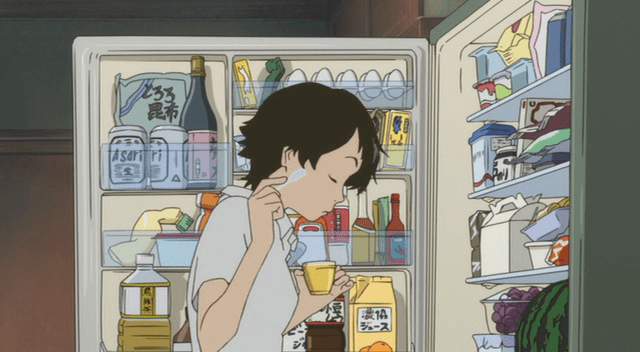
Pre-packaged versions can be found in the thousands of convenience stores all across Japan, making it a quick and easy snack. This is the purin seen above in The Girl Who Leapt Through Time, which becomes a prime target for time travel shenanigans so that its heroine, Makoto, can savor it over and over.
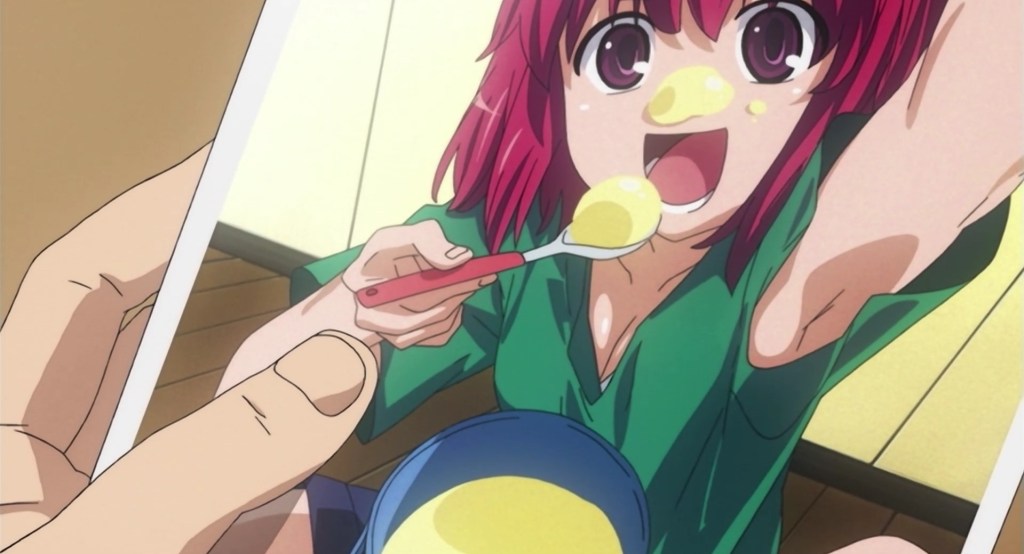
Purin can also be made at home for cheap, and this can lead to either mishaps or mildly absurd developments. Minori in Toradora! takes this to an extreme by making a gigantic and self-explanatory “bucket purin,” scaling the small and simple snack into an example of hilarious excess.
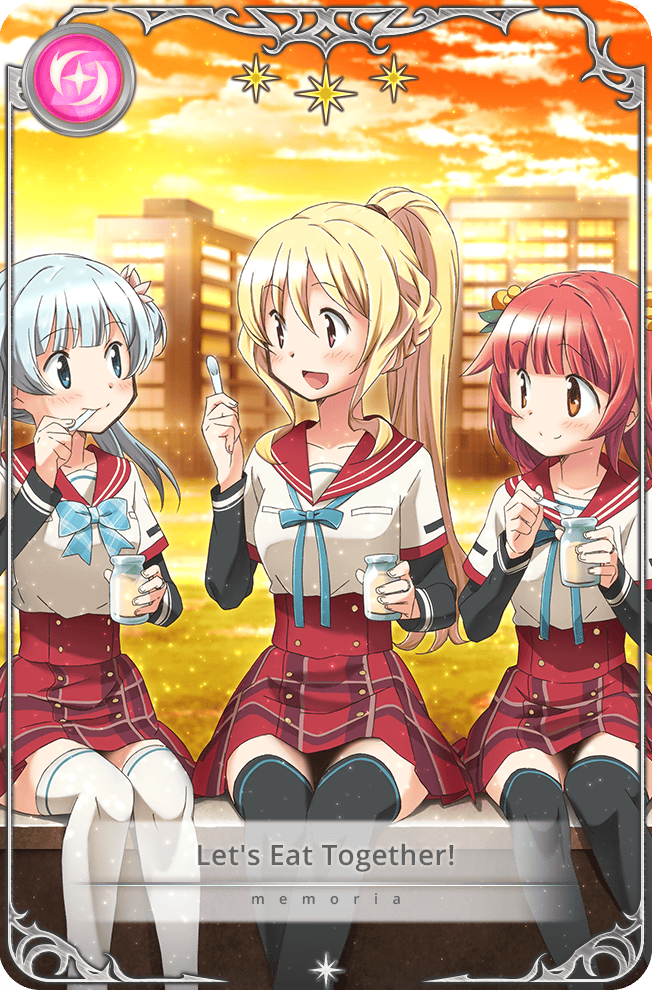
High-quality versions of purin can also exist, with expensive patisseries making them in limited quantities. In anime, this “premium” quality can create tension between characters, either by highlighting a class difference or by positioning the purin is an exceedingly rare treat. In Magia Record, Rena buys expensive purin as a reconciliation gift, but all the girls get stomach aches because Rena took too long to make up with her friend before giving it to her. Different “levels” of purin can signify a lot about characters and their places in their worlds.
Purin as the Animation Ideal
In addition to the cultural aspect, the very physical qualities of purin lend themselves to animators and visual artists. It usually has a very distinct contrast in color between the custard and the caramel topping. It wriggles to and fro under the slightest bit of force, and when you scoop a little up, the spoon slices through its pale yellow body, leaving its mark. There’s a three-dimensionality to purin that makes its distinct features all the more appealing.
The recent series Princess Connect: Re-Dive demonstrates the strength of purin as an object in animation. It has an entire episode dedicated to purin, entitled “Flowers in Eternal Darkness ~Cursed Pudding~.” Numerous renditions of purin show up this episode to comedic effect, and are mostly portrayed in very simple 2D animation where the two-tone contrast is a clear identifier of the snack. However, at the end of the episode, one of the characters makes a large deluxe pudding, its gelatinous makeup conveyed through the use of 3DCG. Whether you’re dedicated to the craft of animation or merely need it as a visual device, purin has a role to play.
In Short
This is mostly my conjecture, but to me, purin is everywhere in anime because it is everywhere in Japan—both literally and metaphorically. It can be found in stores of all kinds, and it can play the role of the humble snack or the rare treasure. Its physical appearance means that it can be rendered simply and easily, while its wiggly nature means the potential to creatively portray its qualities through motion is tremendous. In other words, writers and artists of all kinds can utilize purin to their own advantage, and they’ll know the viewers will instantly recognize the delicious treat.
This post is sponsored by Ogiue Maniax patron Johnny Trovato. You can request topics through the Patreon or by tipping $30 via ko-fi.
The coronavirus has made days feel like weeks and weeks like months. It’s been one year since the Kyoto Animation arson tragedy, and yet I could swear it was eternity ago. While COVID-19’s effects are far greater in scope, the tragedy of what happened to KyoAni still hits hard. It was a shining beacon of the anime industry in so many ways, from the quality of its output to the way it treated its workers.
Those who follow me on Twitter may have noticed that my icon since last summer has been Hazuki from Sound! Euphonium. She’s my favorite character in that series, to be sure, but the other reason I’ve left it unchanged is as a quiet memorial to Kyoto Animation. “Twitter identifier” is so insignificant in the grand scheme of things, but regardless of what anyone else thought or how they’d interpret my icon, I wanted to remember what happened.
There is going to be a memorial livestreamed on YouTube by Kyoto Animation on 7/18 at 10:30am JST. That would be 7/17 9:30pm EST/6:30pm PST, which you can find below.
Wave, Listen to Me! is a great manga and anime about a woman who unexpectedly becomes a radio host—a mature comedy that is about five genres away from author Samura Hiroaki’s most famous work, Blade of the Immortal. I recommend everyone check it out. For those who have recently finished the anime TV series, I’m here to point out that the song played in the finale has a special kind of relevance to the episode.
SPOILER WARNING, of course.
In episode 12, an earthquake hits Hokkaido, causing blackouts. As the characters look up at a starry night sky, a song plays: Kyu Sakamoto’s “Miagete goran, Yoru no Hoshi o” or “Behold the Nighttime Stars.” This song originally came out after the Great Kanto Earthquake of 1923, and it responded to the fact that the lack of light pollution made the stars more visible than normal. A common interpretation of the song’s lyrics is that the stars are also the souls of those who died in the disaster. In short, having “Miagete goran, Yoru no Hoshio” play was an active choice with a specific meaning to Japan.
Incidentally, I actually only learned about the song and its significance because I’ve been following Kio Shimoku’s current manga, Hashikko Ensemble. The tune has a central role in the narrative up to this point, and one of the characters goes as far as to explain everything I mentioned above. I find it a little funny that these two streams dovetailed so nicely together.
Both Wave, Listen to Me! and Hashikko Ensemble run in the magazine Monthly Afternoon, so maybe this synergy isn’t totally out of the question. Most likely, however, is that they’re both referencing the same major moment in Japanese history.
It feels like 100 years have passed since June and July. The world feels liable to change in the most drastic ways, but also to revert back to the same old ignorance. We’re all just individuals in the end, but I hope that we can enrich ourselves just as much as we help those around us. As COVID-19 spikes around the US, I want everyone, even those I vehemently disagree with, to have long, healthy, and fulfilling lives, and to remember that we’re in this together. It shouldn’t be “every man for himself” in this situation.
Thank you to my Patreon sponsors, who support me even as I deviate from the main topics of this blog at times.
General:
Johnny Trovato
Ko Ransom
Diogo Prado
Alex
Dsy (NEW PATRON!)
Sue Hopkins fans:
Serxeid
Hato Kenjirou fans:
Elizabeth
Yajima Mirei fans:
Machi-Kurada
I like to think that everyone who follows Ogiue Maniax knows my passion for anime and manga is genuine, even if there are times when more important things are at stake.
It basically turned into a post about JRPGs vs. WRPGs.
Apartment 507
The Demon Slayer: Kimetsu no Yaiba manga has finished. Could this mean one of the overall best anime adaptations ever is on its way?
Closing
A new anime season is upon us, but in this current situation, that means a lot of shows that went on hiatus due to coronavirus are coming back. I’m most stoked for Healin’ Good Precure, which is finally going to be streaming on Crunchyroll in the US. It’s time for Precure to claim its rightful place!
The Promised Neverland recently concluded in Weekly Shounen Jump, and it caps off a four-year run as perhaps my favorite dedicated shounen manga of the last twenty years. It both elevates and challenges the foundational Jump motto of “Friendship, Hard Work, and Victory” by pushing far past simple power fantasies and the thrill of adventure. It dives deep into the territory of political thought as it tells an intriguing story about kids trying to both survive and make a difference in their world.
This is not the first time I’ve praised The Promised Neverland. I’ve previously written about the significance of its main heroine, Emma, and the fact that the series criticizes the entrenched systems of injustice that stay in power by pitting people against one another. Now that the series has crossed the finish line, I feel that my positive opinions of the manga have been more than justified. The Promised Neverland is a series that dares to say something about the world, utilizing its world and its characters to challenge readers to imagine a better world.
The Promised Neverland places a female protagonist front and center, gives her the agency to make changes, and emphasizes the idea that we don’t have to perceive the world as some zero-sum game of absolute winners and losers—a world where the first thing we ask is how we can save as many people as we can, and not how many people we need to sacrifice to achieve a goal. Here and now in the year 2020—between COVID-19, Black Lives Matter, democratic protests in Hong Kong, and countless other human rights and safety issues—these are messages we need.
An opinion I keep seeing online is that The Promised Neverland was at its best in the first arc, when it was about orphans trying to outsmart their sinister and powerful mother figure in order to escape. And certainly, there was a kind of thrill to the “high stakes battle of wits” that defines the early manga. However, I am so glad that The Promised Neverland evolved past that point. It would have been all too easy for this manga to simply be about the nerve-racking excitement, but it became a genuine piece of thought-provoking science fiction—the kind that encourages readers to imagine a different world, one that looks at concepts of utopia and dystopia, and asks how one could turn into the other and vice versa.
There is another Shounen Jump series that I feel hits with a similar weight, though it’s a far different series in a lot of ways: Barefoot Gen, the story of two siblings who live through the bombing of Hiroshima and the pain of post–World War II Japan. No, The Promised Neverland is not couched in the trauma of directly experiencing a nuclear explosion, and its pain is abstracted through its fantastical setting, but it still looks deep into who we are as a collective people called humanity, and challenges us all to be better.
Exploring the tension of anthropomorphic animal society from the perspective of high school students, Itagaki Paru’s Beastars can at times feel like it’s encouraging a very dangerous view of the world. In a world where carnivores and herbivores co-exist peacefully and eating your fellow animal is illegal, the constant pressure faced by the timid wolf protagonist, Legoshi, for not embracing his violent, meat-eating ancestral nature seems to bleed into sexist alpha/beta nonsense territory. Yet, by the end of a first anime season filled with tumultuous and shocking developments, the message I took away was something far different and more nuanced than a simple animalistic nature vs. civilization dichotomy.
Warning: Beastars spoilers ahead
Legoshi is portrayed as shunning the spotlight. Although he’s in the drama club, Legoshi works as a meek behind-the-scenes stagehand, leaving the attention to others such as the club’s star actor, Louis the red deer. But what Louis notices is that Legoshi is clearly stronger and potentially more intimidating than he lets on. As a gray wolf, he possesses might that no herbivore can hope to match, and it incenses Louis that Legoshi can be such a pushover. When Louis gets hurt and a shuffling of roles causes Legoshi to appear in a play, a tiger clubmate named Bill tries to bring out Legoshi’s dormant ferocity.
However, Legoshi is afraid of his own carnivorous side. Not only was his good friend, Tem the alpaca, eaten by a carnivore, but Legoshi himself comes dangerously close to succumbing to his lupine instincts and devouring a female dwarf bunny named Haru—a girl he later develops strong feelings for. Legoshi does not want to be that kind of animal, which is why he looks up to Louis, who accomplishes things through grace and diplomacy. Even so, there’s no denying that Legoshi would be incredibly powerful if only he let himself be.
Part of what holds Legoshi back is a society that discourages carnivores from exerting dominance through force. Meals for them are made with high protein content, e.g. eggs, as a way to sate hunger, but the appeal of real flesh can be overwhelmingly difficult to endure. Throughout the series, Legoshi struggles to fight that desire for meat, which then blends in odd ways with his love/lust for Haru, further complicating things in his heart.
Towards the end of the series, Haru gets kidnapped by an organized crime group—a cadre of lions called the Shishigumi—with the intent to eat her. Having discovered previously that Louis is seeing Haru (though what Legoshi doesn’t know is that Haru is extremely promiscuous as a way for her to have some control over her life), Legoshi tries to bring Louis along. However, Louis declines, having already learned about the kidnapping and being told that he must stay quiet if he is to accomplish his goal of rising to the top of society and being able to effect widespread change. Legoshi storms the Shishigumi base without the red deer, and by fully tapping into his violent side, is able to rescue Haru.
At first, the lesson seems to be that Legoshi finally set aside his false persona of timidity for what was truly inside, but what happens afterwards communicates what I found to be the most important takeaway from Beastars: when it comes to instinct vs. reason, there is no universal answer.
Having saved Haru, Legoshi and her end up at a love hotel prepared to take their relationship to a physical level. Legoshi confesses that he was the one who tried to eat her, and Haru says she always suspected it was him but was still drawn towards Legoshi. However, just as they are on the verge of consummating their relationship, Legoshi’s mouth moves uncontrollably as if he’s going to eat her, and Haru’s body moves, as if on its own, to be eaten by him. Built into their genetics is a relationship of predator and prey, and sex between them isn’t “supposed” to happen. Even so, they’re genuinely in love with each other and they want to make it work, which means denying what their DNA is screaming at them to do. If Legoshi wants his heart’s desire, reason must prevail over instinct.
The underlying message I take away from Beastars is that the question of whether to follow or rebel against one’s animalistic nature is not an all-or-nothing proposition. There are times when it can be of great benefit, but other times when it can be a mistake or lead to disastrous outcomes. Moreover, whether or not doing so is a right choice will vary from individual to individual. Legoshi is not Louis. Legoshi is not Haru. They can naturally accomplish things he cannot and vice versa, but they’re also all capable of going out of their inherent comfort zones to do even more. It is the moderation of both reason and instinct relative to each other that allows us to flourish.
The manga and anime Beastarsby Itagaki Paru features an eclectic menagerie of personalities, but one that caught my attention is the panda character Gohin. The reason: the character is likely an elaborate reference to the classic Tezuka Osamu manga character Black Jack.
Gohin, like Black Jack, works as an unlicensed doctor, being called upon by those who cannot (for whatever reason) request more legitimate professional help. Both have a moral code, but it lies outside the normal boundaries of society. Even Gohin being a panda has hints of the Tezuka character: Black Jack’s skin on his face has two shades—the darker skin comes from a skin graft he received from his half-African best friend.
What seals the deal on Gohin being the Beastars Black Jack is that he’s voiced by Ohtsuka Akio, who has been the voice of Black Jack in numerous anime adaptations since the 1990s.
Basically, I can’t wait to see Gohin operate on himself while fighting off some dingos—albeit ones who walk on two legs and talk.
This blog is a reflection of myself, and my thoughts and feelings on anime and manga both for their own sakes and within the greater context of the world we share. So much has happened within this past week, let alone this past month, that I’m feeling overwhelmed. Between COVID-19 and the protests that have emerged in the United States, Japan, and Hong Kong in response to institutional injustice, I hope that everyone can stay safe as we fight for fundamental changes to transform the world into a place where power and authority are not used as tools of oppression.
Thank you to my Patreon sponsors this month. I appreciate your support, not just those listed below, but everyone who thinks Ogiue Maniax is worth something even in these times.
A thought about Steely Dan in JoJo’s Bizarre Adventure turns into an exploration of whiteness in America and its ties to the suburbs that dot the country.
Whether you choose to stay indoors or go out there to fight for justice, please stay safe. I will try to provide things worth reading, whether you want to engage more with the world around us or to stay within the realm of art. Just remember that the border between the two sides are porous and prone to mingling.