The Precarious Balance of Tradition and Progress: Sakura Quest

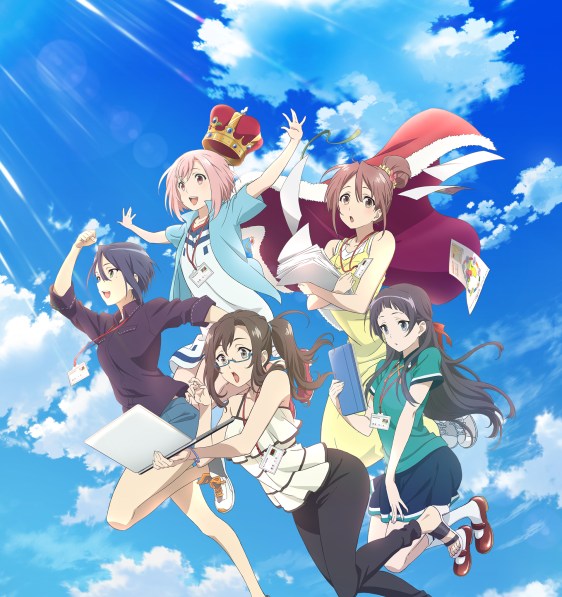
For years, the raison d’etre of the anime studio P.A. Works appeared to be creating intetesting settings as a pretense to showcase cute female characters. Whether it was True Tears, Hanasaku Iroha, Tari Tari,  or something else, they appeared to focus on personal relationships above all else. A more careful look, however, will reveal another major theme permeating many of their works: the declining population of rural Japan, and the complicated effects of tourism on this situation. Now, P.A. Works has doubled down on this idea in their new anime, Sakura Quest.

Koharu Yoshino is a young woman struggling to find work, when she’s been asked specifically by name to come work in the small, virtually forgotten town of Manoyama. Desperate for employment, she takes the offer, only to discover that it was a mistake. But the contract’s been signed, so now Yoshino—along with a group of other young women—are tasked with helping to revive Manoyama.

Much like one of their previous hits, Shirobako, the main cast of Sakura Quest is notably all adult-aged women as opposed to high school girls. When I interviewed P.A. Works at Otakon 2016, they expressed that they’d been wanting to do that as early as Hanasaku Iroha, but trends and the need to make a profit pushed them to stick with the reliable teenage formula. Now, with two series bucking that trend, it looks like they’re eager to challenge that status quo—at least in part.

The use of attractive girls to anchor Sakura Quest means that the series does not fully escape the market forces of young, attractive heroines, but in many ways it also does not pull its punches. Yoshino and the rest of the core cast, consisting of both those new to Manoyama and life-long residents, are confronted with difficult decisions that often leave their best plans only half-formed and arguably doomed to failure by the many considerations they must account for.

Central to this conflict is the contrast between valuing the traditions of Manoyama and its people, and when those traditions stifle the potential for the town to adapt and evolve. Trying to make tourism and local promotion work in a long-declining town is portrayed as a struggle where the gains are few and the solutions are rarely cut-and-dry, if available at all. The series is not necessarily a cynical one, but any progress comes in small steps.  This can be frustrating at times, but it grounds the show in more realistic expectations. After all, if the solution to the rural decline of Japan were easy, we’d probably have seen it by now. It also highlights the idea that, while gimmicks can boost tourism, this is a serious double-edged sword.

Sakura Quest is not one of those gripping anime that keeps you in suspense, or has you falling in love with the girls so hard that you feel compelled to buy their merchandise. It’s a pretty slow burn, and the characters will repeat their mistakes on more than one occasion. However, it’s a very satisfying work in its own way, as it challenges viewers to think about one of Japan’s major problems today, and the myriad factors that complicate it.

Save

Save

Changin’ My Life: Ogiue Maniax Status Update for October 2017

October is going to be a special month for me from this point forward.

That’s because something big has happened, something I once thought impossible: I got married.

Seriously.

I won’t go into too many details, but I’ll just say that my wife is a very special person to me, who’s stuck with me through thick and thin. This even includes my time abroad in the Netherlands. I actually met her thanks to Ogiue Maniax, though I wouldn’t recommend writing anime blogs as a way to find relationships.

So I want to give a very, very special thanks to my Patreon members this month, because your continued support lets me pursue this blog as a passion project.

General:

Johnny Trovato

Ko Ransom

Alex

Diogo Prado

Viga

Sue Hopkins fans:

Serxeid

Yoshitake Rika fans:

Elliot Page

Hato Kenjirou fans:

Elizabeth

Yajima Mirei fans:

Machi-Kurada


In other, non-matrimonial news, I recently did a series of manga recommendations on Twitter. Check out the thread!

Also, here are my favorite posts from last month:

Tomino Yoshiyuki’s “Big Picture”: WHy the Gundam Creator Can Be So Hit or Miss

Recently, I got to thinking about Tomino and all his eccentricities. Here’s my hypothesis on the “Tomino style.”

Fighting Evil By Moonlight – Heartcatch Precure!: The Novel

I reviewed the Heartcatch Precure! novel, which ostensibly focuses more on Cure Moonlight than the anime.

Beyond the Brokeback Pose: Don’t Meddle with My Daughter

A look at the idea of superheroine sexualization and fetishism as a kind of cultural export, through the lense of the manga Don’t Meddle with My Daughter. It actually got retweeted by the author!

Return to Genshiken

Return to Genshiken: Volume 5 – Pride and Fujo Justice

Part 5 of my Genshiken re-read. Ogiue starts her journey here, but it’s Sasahara who really grows.


Patreon-Sponsored

My Favorite Light Novel Anime

Self-explanatory, but a fun topic all the same.

Closing

Here’s to an exciting new life!

Save

Save

Save

Gattai Girls 7: Shinkon Gattai Godannar and Aoi Anna

Introduction: “Gattai Girls” is a series of posts dedicated to looking at giant robot anime featuring prominent female characters due to their relative rarity within that genre.

Here, “prominent” is primarily defined by two traits. First, the female character has to be either a main character (as opposed to a sidekick or support character), or she has to be in a role which distinguishes her. Second, the female character has to actually pilot a giant robot, preferrably the main giant robot of the series she’s in.

For example, Aim for the Top! would qualify because of Noriko (main character, pilots the most important mecha of her show), while Vision of Escaflowne would not, because Hitomi does not engage in any combat despite being a main character, nor would Full Metal Panic! because the most prominent robot pilot, Melissa Mao, is not prominent enough.


This Gattai Girls entry is a bit unusual because I’ve already posted a review of the series before. Moreover, with a series like Godannar, I’ve already written extensively about the the portrayal of female characters because it’s all but unavoidable. If the prevalent fanservice wasn’t enough, there’s the fact that over half of the cast is women. While I’ll inevitably retread some old territory, this time around I’m going to focus more heavily on the main heroine of the story, Aoi Anna.

Godannar follows 17-year-old Aoi Anna, who’s engaged to burly, veteran robot pilot Saruwatari Gou in a May-December romance. Years ago, he rescued her from a monster attack, and eventually their feelings blossomed into love. But while she’s no slouch herself when it comes to mecha—she’s a prodigy who’s dreamed of fighting in a robot since childhood—Gou forbids her from becoming a full-fledged defender of the Earth. The reason? That’s how he lost his previous lover and trusty co-pilot. Still, Anna and Gou are humanity’s greatest weapons, as their robots combine into the mighty robot, Godannar Twin Drive, the “marriage of god and soul.”

From a characterization and narrative perspective, Anna’s story stands out in a way capable of overshadowing even the infamous double decker cheesecake of Godannar. Romance traditionally takes a backseat in many giant robot series, and when it does show up, such as in Macross, the two sides are often from different worlds, either metaphorically or literally. In Godannar, however, not only are Anna and Gou equal partners, but they have to work together as a team both personally and professionally. The cockpit becomes a second home of sorts, as they iron out their differences and fight the enemy. The series literally has relationship plot and mecha action resolve simultaneously, as if the two sides are permanently fused together, and it’s glorious. In a way, this is the story about the power of love, but it’s less “love defeats everything automatically” and more “love opens them up to resolve problems they couldn’t otherwise.”

In a certain sense, this heavy emphasis on relationships plays into the stereotype of girls only caring about guys, and one might even feel that Anna’s character is directly tied to her connection with Gou. While I think there’s some truth to that, I also find that Godannar‘s direct focus on its main couple (as well as many other couples throughout the series) is a big part of its, and by extension Anna’s, appeal. It’s basically a story about newlyweds who are also co-workers, and having to navigate that tricky interpersonal landscape. Through it all, Anna’s inner strength stands out. When Gou first tells her to stop piloting for her own sake, her response is that they have a duty to take care of each other as husband and wife. At one point, she feels herself unable to fight as Gou’s equal, but is able to find the motivation within herself to not back down in the end. By the end, due to unfortunate circumstances, she’s actually the one having to do the lion’s share of the work, to make up for what Gou can no longer do. Her strength, perseverance, and caring make her one of my favorite characters ever.

I’ve already made mention of it a couple of times, but when it comes to how women are depicted in Godannar, the series heavily sexualizes on a level where few others can compare. To say otherwise would be disingenuous. When the girls, including Anna, are piloting their robots, they’re in ultra-form-fitting suits that leave less than nothing to the imagination. During combat, their breasts jiggle to and fro as if made from some alien substance. Even when they’re in regular clothing, the fabric hugs every curve as if holding on for dear life. The camera angles can also be extremely voyeuristic. Even if I wanted to say, “You should really just ignore all this,” that’s pretty much impossible whether you’re into heavy fanservice or not. There’s an incredibly good series with some strong, well-written characters both male and female there, but it requires either an acceptance or tolerance of just a non-stop barrage of sexual imagery.

One last aspect of the series I want to talk about is the interesting way it addresses the topic of gender roles. In the second season of Godannar, the enemy monsters begin to utilize a different tactic. Instead of just trying to out-muscle Earth’s giant robot forces, they also evolve to spread a virus that specifically targets hot-blooded, macho men—the very people who are supposed to excel at being mecha pilots. As the men become increasingly unable to fight, the women, led by Anna, have to take a stand. On the one hand, this plays into the idea that men are supposed to be strong and tough (though it should be noted that a more masculine girl gets hit by the disease while a more effeminate playboy guy does not). On the other, it brings up the notion that hyper-masculinity can become a weakness to be exploited.

Godannar is a contradictory anime. Its unrestrained sexualization of the female body makes it seem like a series all about pure objectification of women, but at the same time its female characters, notably its main heroine Anna, are fully realized characters who have goals and dreams and a desire to stand on their own feet. They’re fleshed out as human beings, but also practically the embodiment of “temptation of the flesh.” But if marriage is a union of separate yet compatible beings, then Godannar is an unlikely marriage of disparate elements that somehow, some way, work to make something beautiful.

Otakon 2017 Interview: Tomoki Kyoda (EUREKA SEVEN)

At Otakon 2017, I had the opportunity to interview Tomoki Kyoda—director of one of my favorite anime series ever, Eureka Seven. He was at the convention to promote the world premiere of the film EUREKA SEVEN HI-EVOLUTION, and I spoke to him the day before the showing.

Eureka Seven was originally created as a media mix project with video games and manga telling side stories or different, alternative narratives from the anime. How much of a say did you have in the spin offs?

With the spin offs, we would say, “We want so-and-so” for a concept. The various directors and mangaka we were working with would present their spin offs to us, and we would check over them.

My next question concerns Eureka herself. Her appearance changes throughout the series, especially when she gets covered in scars. It’s a very bold decision, I think—especially for anime. What was the thinking behind changing her appearance?

When we were doing the original story, Mr. Kenichi Yoshida and I were talking about what we could do to provide lots of inspiration and different paths the story could take. One of the inspirations that someone came up with was, “What about drastically changing her appearance?” So we actually took that and went with it.

What is it like working with creators Dai Sato, Shoji Kawamori, and Kenichi Yoshida? Do you have any interesting production stories to tell?

With regards to Mr. Sato and Mr. Yoshida, we were actually all born in the same year, so we all have an understanding of our pros and cons; what each of us do well and what each of us do not so well. But with regards to Mr. Kawamori, he is a person we look up to. He is a very interesting person, and his works are also very interesting. But then if you meet him in person… whoa. You’re going to notice that he’s more interesting than anything he’s actually done. So, if we start talking about Mr. Kawamori, we’re going to go past two hours like it was nothing, so let’s just leave it at that.

In revisiting Eureka Seven with the new movies, what feelings are you hoping to evoke in old fans and those who have never seen the series?

First of all, I’d like to say that, for old fans coming back to us, thank you very much. I hope they will actually be very accepting of this, since, even if we use some old footage, it doesn’t mean that we could do something just like the old version. In that sense, it’s in many ways a new movie. I hope they will be very accepting of it. With that being said, for new fans I hope they take it for what it is, and accept it for what it is, and that they will see what Renton and Eureka and Anemone have to do in order to live through that world. So the greater idea I have for everyone is acceptance, really. I hope everyone will accept EUREKA SEVEN HI-EVOLUTION for what it is.

Thank you very much!

My Favorite Light Novel Anime

Light novel anime adaptations get something of a bad rap, but there are plenty of gems in that sea. If I were to list all of the light novel anime I thought were good, I’d have a pretty hefty list—big enough that even I’m surprised by looking at it. Instead, I’ve narrowed it down to a few, with reasons why I enjoy them so much.

1. My Youth Romantic Comedy is Wrong, As I Expected (aka My Teen Romantic Comedy SNAFU)

I’ve written at length on more than one occasion about why I think so highly about Youth Romantic Comedy, but every time I think about it I come back with even more reasons. This time around, an aspect that sticks out to me is how the series positions its central love triangle with a kind of thoughtfulness one might not expect.

Even though they all have significantly different perspectives on life, the characters’ contrasting viewpoints allow them to accomplish tasks that each of them alone could not. This extends to their love triangle. Where usually girls in these series are interested in the same guy for the same reason, Yui and Yukino are drawn to different qualities in Hachiman. Yui sees him as a good person deep down inside (whether he realizes it or not), and Yukino sees Hachiman as someone on a similar, socialization-shunning wavelength.

It’s good stuff.

2. The Disappearance of Suzumiya Haruhi

In general, I’m pretty fond of the Suzumiya Haruhi anime, even if it’s not viewed with as much reverence as it once was. The story of a girl who might very well be god of the universe without realizing it hits a lot of interesting notes. However, I put the film The Disappearance of Suzumiya Haruhi on a whole other level. The powerful emotions swirling around the characters—especially Nagato—as well as the tough decisions they have to make, just sticks with me in a way that not even the series’ other high points can. The only significant flaw of the movie, in my opinion, is that it requires viewers to have all the background context of the series prior to watching, but I think it can still probably do fine stand-alone.

For more of my thoughts, check out my review.

3. Humanity Has Declined

I sometimes forget that this series is based on a light novel because of how witty its satire can be. Taking place in a world where humankind is no longer the dominant race on Earth—instead supplanted by a race of fairies—it often showcases the folly of humanity by having their mistakes repeated in fast-forward by the fairies, who are somehow brilliant and imbecilic at the same time. The fairies can easily fashion new and highly advanced forms of science and technology, but are extremely prone to group-think, bandwagoning, and lack of foresight. It’s all too fitting that we as a species would get outdone by more extreme versions of us.

This is another series I’ve written a review for, which you can find here.

4. Kino’s Journey

If there’s one thing more recent light novel anime tend to lack, it’s a strong sense of atmosphere. Sure, they’ll have complex environments and elaborate magic systems, but they don’t capture the sense of a world in flux the way that Kino’s Journey does. Kino is a “traveler,” an unusual profession where she travels from one land to the next, learning about what each distinct culture is like. It’s a quiet and contemplative series, but at times can swell with tension and action. I’ve written a little about Kino’s Journey before, but only one of the short films.

I’m really looking forward to the upcoming new anime.

5. Slayers

While light novel anime are sometimes thought of as a more recent phenomenon due to the increased influx over the past 10-15 years, in my opinion the true grandmaster of the light novel adaptation is Slayers. Black magician Lina Inverse fancies herself a hero, but she’s more an agent of destruction, feared for her lack of concern for collateral damage. As she continues to make allies, she finds herself having to fight for the fate of her world, but not without keeping her characteristic wit, fury, and hungers both literal and metaphorical.

It was one of my gateway anime, and one of the first series that I was proud to own. Its mixture of humor, adventure, and dramatic development at the right moments makes it forever a classic in my mind. It’s one of the defining series of the 90s, and while its age often shows, I think it still has potential for wide appeal to a current audience.

This post was sponsored by Johnny Trovato. If you’re interested in submitting topics for the blog, or just like my writing and want to support Ogiue Maniax, check out my Patreon.


Save

Save

Save

Save

Save

Save

Save

[APT507] School Idols vs. Pro Idols: The Hints of Sobering Reality in Love Live!

Something that’s stuck with me for a long time is the distinction that Love Live! makes between idols and school idols. I find that it hints at the harshness of the idol industry, though in a very, very indirect way. I wrote a short article on it over at Apartment 507, if you’re curious.

Save

Tomino Yoshiyuki’s “Big Picture”: Why the Gundam Creator Can Be So Hit or Miss

Director Tomino Yoshiyuki is a perplexing figure in the anime industry. He’s the creator of Gundam, which makes him a legend to a certain type and generation of anime fan. He’s been described as passionate and even frightening by those who’ve worked with the man. Also, because his anime range from legendary to seemingly non-sequitur nonsense, Tomino has a George Lucas-esque reputation, where people can’t tell if he’s a genius, a fool, or a one-hit wonder. While this might mark Tomino as an inconsistent director, I’ve recently come to the conclusion that a major factor in the effectiveness of his anime is length. Tomino is a creator who’s better with longer-format series than shorter works.

I think one of the roots of all this is the way he approaches setting up an anime. In a recent episode of the Anime World Order podcast on the Tomino-helmed mid-2000s animation Wings of Rean, the hosts referenced an interview included with the DVD release. When asked  about his approach to film by using a classic ramen analogy (do you start with the ramen itself or with the steam that suggests its presence?), Tomino says that he prefers to start right at the point the noodles reach the lips—and if the lips are sexy, all the better. This seems like a very roundabout answer that might not make sense at first glance, but it’s actually a very good description of how Tomino constructs narratives.

Take Reideen the Brave, Tomino’s first ever directorial work on a giant robot anime. Instead of calmly introducing the main characters, the villains, the stakes, and finally the wondrous robot (as was typical of even the best robot shows of the time), Reideen the Brave‘s first episode comes a mile a minute. The main character, Hibiki Akira, is playing soccer with his friends! Suddenly, DEATH AND DESTRUCTION AROUND THE WORLD AS LANDMARKS CRUMBLE. A voice calls for a hero to awaken. It speaks directly to Akira and tells him the AGE OF DEMONS has come about, and that he needs something called “Reideen!” A LIGHTNING BOLT HITS AKIRA.

Keep in mind that, including the opening, less than five minutes have passed.

I love this first episode because it really puts the viewers into the thick of things and leaves us to try and piece together everything going on. As I’ve watched more and more of Tomino’s works, this is clearly a trend, evident in shows from all across his history with anime, such as Space Runaway Ideon, Overman King Gainer, and Gundam: Reconguista in G. It’s the directorial equivalent of shoving someone into the deep end of the pool and asking them to make it to the surface, and when there’s enough intrigue laid out, it can become a fine motivator to stick with a series. However, this can be a double-edged sword, and the other side of that blade produces his more maligned works, like Garzey’s Wing and Wings of Rean. If that rush of information isn’t compelling enough, or doesn’t leave enough meat to sink one’s teeth into, it becomes a poor framework to build on.

My belief is that Tomino is a “big picture, big philosophy” creator who tries to show fragments of a world to give it a sense of scope and significance. By doing this, he tries to actively challenge viewers to think about the real world. The issue is that the “little picture” often escapes him. This is perhaps why creating convincing romances is one of his weaknesses—the development of relationships is a very intimate and local thing. He does fine with established romances, and he’s great at placing a romance within the greater context of a world in motion, but the actual motions of love burgeoning between two people seems to escape him. Instead, he goes for instant love: newtype psychic explosions and the like.

When Tomino has enough room to really lay something out, like in Ideon or Mobile Suit Gundam (even though those two series originally had their runs cut short), the blanks he establishes in the beginning can be slowly fleshed out and given dimension by him or whatever staff he has. Turn A Gundam is probably the best example. It was allowed to run its full length without being cut down at the knees like those other earlier anime, and the result is just a sprawling story where emotions and human actions ripple through outer space.

However, it always seems as if Tomino tries to make “big picture” anime even when time is much more limited, and this is why the shorter works end up feeling so inscrutable. Longer works can breathe, but there’s literally not enough time to fully expand on the forces that Tomino is trying to convey in his works. I don’t think it’s a coincidence that the five-minute Ring of Gundam is so incredibly obtuse, even compared to the infamy of Garzey’s Wing. Something like Reconguista in G falls in the middle. There’s a lot of rushing from one moment to the next, but also plenty of indicators of how the world has changed since the era of the old Gundam anime, and the unceremonious death of one of the series’ main antagonists works satisfyingly well given the groundwork laid out by those episodes. It’s just that individual character actions often go unexplained.

Tomino Yoshiyuki will continue to be a divisive creator because certain elements considered to be fundamental to good storytelling are things he either can’t do or doesn’t care for. However, his desire to convey big ideas,  challenge viewers politically, and make them put in work while watching his anime is something to admire. This approach is poorly served in shorter works, because Tomino doesn’t try to compromise, but if given enough room he produces some of anime’s greatest.

Save

Save

Anno, Evangelion, and the Fleeting Intersection of Creators and Trends

The story of Neon Genesis Evangelion is partly one of a creator who tapped into the zeitgeist of his viewers, who then began to travel along a path divergent from the very people that called themselves his fans. Anno Hideaki is not an isolated incident. Any time a creator makes a sequel and it’s considered to do more harm to the series than good by some (J.K. Rowling and Harry Potter, Tomino Yoshiyuki and Gundam), there’s a sense that ideas and sensibilities did not align as well as they could have.

Of course, fans are individuals too. What one might call the general fan reaction to something is akin to an aggregate or a median of all of the different values that exist, and one might even argue that there’s no such thing as a singular “audience” or “fandom.” However, I think that’s a significant contributing factor to why it’s so hard for so many characters to achieve great success more than once, why there are so many flashes in the pan. Even when they’re attempting to chase their audience and please them, it doesn’t necessarily work out as they might hope. How likely is it for one person to tap into the collective feelings of a group, and do so consistently over a period of years?

Love ’em or hate ’em, this I think this situation is why production by committee/audience testing exists. If you want lightning to strike twice, why not try to find out as much information as possible? Why not try to approach the group mindset with a smaller group of your own? It’s safer and arguably more reliable.

The issue with this approach is that it’s more likely to discourage risk and experimentation. This doesn’t mean it can’t ever result in strong works, but the Mr. Plinkett review of the current state of the Star Wars franchise explains it well. Disney knows exactly what the fans love about their beloved far, far away galaxy, and will keep tapping that well for as long as they find if feasible. These can be favorite characters, changing trends in how people perceive media (gender and racial diversity), or something else, but rarely would a work like this try to challenge or anger its audience.

This, I believe, is the danger zone that Anno saw all those years ago as fan response to Evangelion became one that encouraged an objectification and consumption of its characters. That conversation is more complex than this post is going to get into (and keep in mind that I’m not necessarily against either side), but it keeps me thinking about the divergence of creators and fans.

Fighting Evil By Moonlight – Heartcatch Precure!: The Novel

Heartcatch Precure! is, to date, the strongest entry in the Precure magical girl franchise. It’s a series that works incredibly well in an episode-by-episode basis but also in terms of long-term narrative. This success comes from successfully building upon itself, and one of the anime’s high points in this regard is the story of Tsukikage Yuri, aka Cure Moonlight, a veteran Precure whose defeat triggers the start of Heartcatch Precure! A recurring character, Yuri’s arc of forgiveness and redemption is one of the most satisfying and inspiring moments of the series.

Yuri is more of a strong supporting character than a main protagonist in the anime, which leaves a lot of questions to be answered. For example, how did she become a Precure? Fortunately, Yuri is actually the star of the Heartcatch Precure! novel spinoff, which retells the story of the TV series from her perspective. Simply titled Heartcatch Precure!: The Novel, this book adaptation takes a somewhat more mature alternative view of the story already familiar to fans.

The novel is divided into four large chapters: how Yuri first became Cure Moonlight and how she lost her powers, the arrival of Tsubomi and Erika (the heroines of the anime), Yuri’s return, and the finale. By far the most “new” content is in the first. Here, we get to see a younger Yuri in junior high, her friendship with Erika’s sister Momoka, how she meets her fairy Cologne, and her interactions with Tsubomi’s grandmother Kaoruko, the former Cure Flower who ends up training Yuri. One of the main focuses of Yuri’s path to becoming a Precure is the way in which Kaoruko tries to drill into Yuri that she needs to be at the top of her game. There’s also a great amount of attention spent on Dark Precure and her thoughts and feelings. As Yuri’s “shadow,” it’s only appropriate that the novel delve into her story as well.

The other three chapters don’t hold up quite as well. While they still do a fine job of telling the story of Heartcatch Precure!, they have this problem of rushing to the Yuri-centric scenes so as to refocus the narrative back on her. The consequence of this pace is that huge swathes of the novel feel like recaps, such as quickly introducing Cure Sunshine without much fanfare. At other points, however, because the core narrative is still about Tsubomi, the retelling of the anime’s events still draw much more attention to her than Yuri. The actual material is still quite satisfying, and the major moments resonate emotionally, but at many points it starts to feel less like a true Cure Moonlight novel. The points at which the novel does emphasize Yuri usually come from her conversations with Kaoruko, as well as any moment where she’s trying to use her experiences to teach or warn the new Precures.

It’s unclear if this novel is meant to be read by people who have already seen the anime, but there is a recurring trend where it quickly and nonchalantly drops information that was gradually revealed in the TV series, such as the true identities of certain characters. This isn’t even about “retelling” parts of the anime; one of the late spoilers in the series (the identity of a Tuxedo Mask-esque figure) is revealed in the first chapter, before Tsubomi ever shows up.

The story also occasionally deviates from the anime’s events in small ways, making it uncertain whether or not the novel is canon. For example, in the final battle against the main villain, Dune, he explains his origins and why he carries such hatred in his heart. This didn’t happen in the anime at all, and the lack of development for Dune is one of the anime’s few weak points. The climactic punch is replaced by an embrace because the running gag throughout the series, where Tsubomi uses a hip attack and calls it a “butt punch,” never occurs in the novel. It also expands on the epilogue of the anime, refocusing back on Yuri at the very end.

Given its length (over 300 pages in Japanese), the lack of furigana to help younger readers, and the complete absence of images aside from the cover, Heartcatch Precure!: The Novel skews older than the target young elementary school audience of the anime. While it’s an open secret that teenagers and adults watch Precure too, this book appears to be a specific targeting of that more mature audience. While the novel might feel a bit much like supplementary material, it’s still an enjoyable read that carries all of the strengths of Heartcatch Precure!, particularly its thoughtfulness in characterization and character development.

[APT507] The Best Shounen Superhero: Why It’s Easy to Love Deku from My Hero Academia

Main characters in shounen fighting series tend to get written off as generic and boring, but I find Midoriya from My Hero Academia to be a strong exception. I’ve written a post on Apartment 507 exploring why I think he’s so effective.