It feels like I blinked and now a new anime season is upon us. There are plenty of shows that are catching my eye, including 86: Eighty Six, SSSS.Dynazenon, NOMAD: Megalo Box 2, and of course, Thunderbolt Fantasy Season 3. I hope everyone is doing well, and in a place where they have something that can provide them joy and comfort in trying times, whether it’s anime, manga, or something else entirely.
COVID-19 vaccines are in full swing at the moment, and while I’m not sure I should be the one to say it, everyone should get vaccinated when they can, and continue to practice safety measures like wearing face masks. I look forward to the day we can comfortably see our loved ones and maybe even attend an anime convention or two without fear.
Something more personal, and less anime-related. I hope you’ll read it.
Apartment 507
I tried out Joy Sound Karaoke on the Nintendo Switch, and it’s a decent way to get in your karaoke fix.
Hashikko Ensemble
Chapter 38 features Jin’s mom, and she is ammmmazing.
Closing
I hope that we remember that pitting the poor and minorities against one another is exactly what powerful bigots want. It keeps us divided and unable to see the systemic problems that keep people oppressed. Do not let the racism foisted upon us control our lives. Do not misdirect your anger.
A new chapter shows Jin’s mom, Reika, in all her glory. But before I dive into the review, a few important pieces of news:
First, Volume 6 of Hashikko Ensemble is currently on sale in Japan. This volume doesn’t appear to have any limited edition extras, which is good for my wallet.
Second, Kio Shimoku is finally on Twitter! Follow him @kioshimoku1. In addition to posting art on occasion, he also tweets stories about his life both past and present. For example, did you know his family only had Betamax instead of VHS growing up, and he used the money from winning the Afternoon Four Seasons Award in college to buy a VCR? I’m thinking of making occasional posts summarizing interesting tweets from Kio.
Third, today is Ogiue’s birthday! Happy birthday to the best girl ever.
Now, on to Chapter 38!
Summary
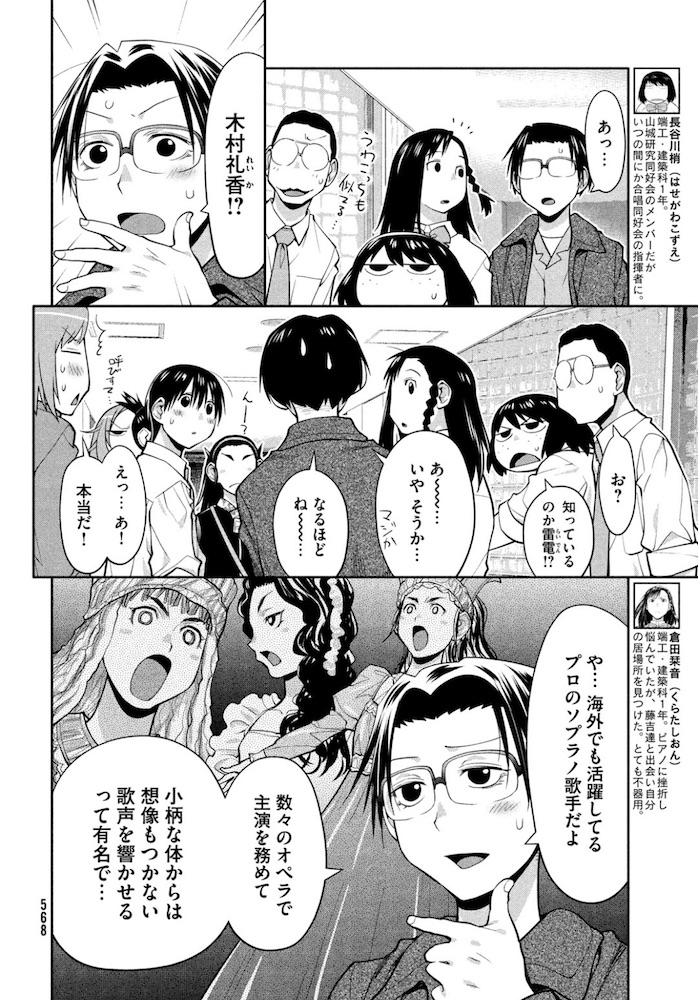
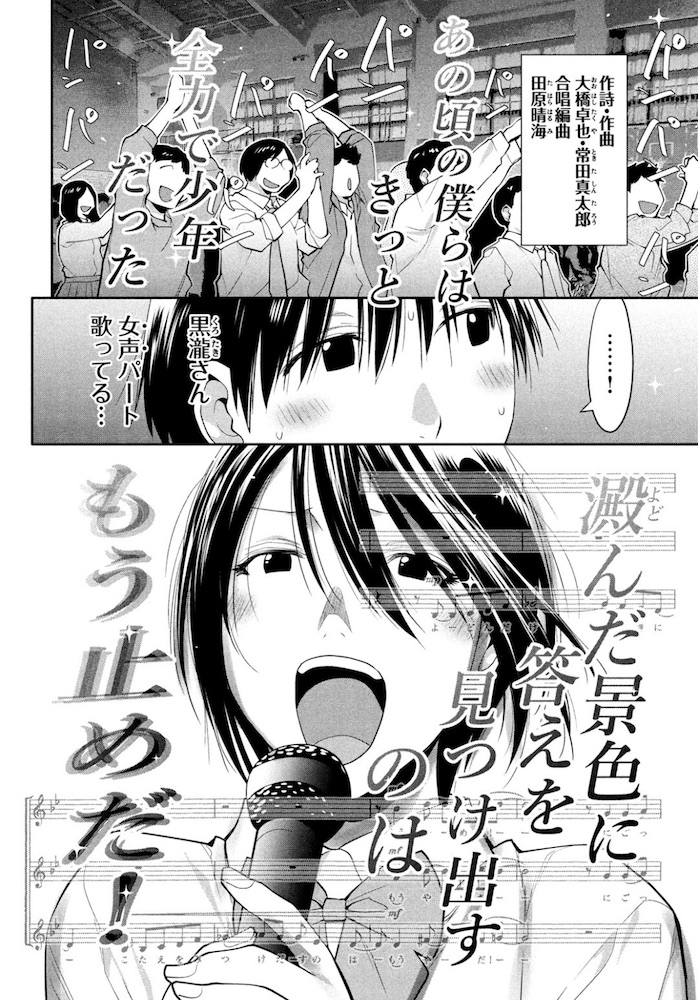
Despite a fantastic performance by Mai and her group, Noi Majo, the Chorus Appreciation Society beats them and moves on to the finals of the School Culture Festival tournament. Stepping away from the stage to take a break, Jin’s mom (with Yumerun) finally arrives at the high school. Shuusuke immediately recognizes her as the world-famous soprano, Kimura Reika, who has sung in operas across the globe. She’s also infamous for her selfish attitude that has earned her the nickname “Breaker”—a portmanteau of burei (rude) and Reika. The members see a lot of her qualities in Jin.
Jin is bothered by his mom’s attitude, feeling that she allows her immense talent to be her excuse for poor behavior. Jin tells a story from middle school, about Reika agreeing to sing with his boys’ and girls’ choir—only to never come to practice until the very last day, put on an astounding performance at rehearsal, recognize Yumerun’s ability, and then skip out on the actual day of the recital in order to perform for an Italian conductor.
While Reika explains that she 1) called to cancel rather than bail without warning 2) ended up making way for Yumerun’s rise 3) didn’t want to take away from a performance that was supposed to focus on the kids, Jin still can’t accept how much she inconveniences others because music is something people create together. Reika responds that music is about self-expression and the passion of the moment, and points out that there are no “chorus majors” at any music colleges, showing how important individuals are in the field. But when she questions the usefulness and motives of Jin joining a technical high school just to form this group, Akira comes to his defense to talk about how much discovering singing thanks to Jin has helped him change and grow. Reika then decides on a deal: if they can win the entire competition, then she will let Jin go to a music college. Jin seems more confused than pleased.
Giga Drill
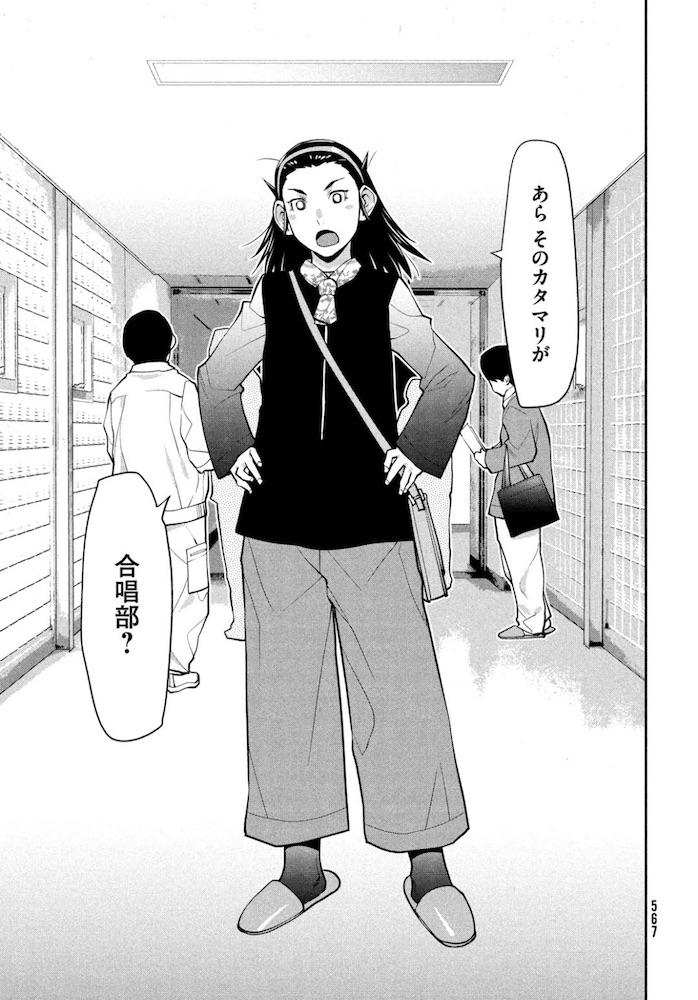
Reika was introduced two chapters ago, but her “true” debut (i.e. meeting Akira and the others) exceeds my expectations in nearly every way. This manga has great moms, and I don’t mean it in that way.
In my Chapter 36 review, I mentioned how I had originally imagined Reika as much more strict and demanding, but everything about her screams the opposite. She’s like pure “id,” doing whatever she wants whenever she wants. And while she seems to have this in common with her son, the finer details of their respective approaches and philosophies regarding music do reveal a profound divide between the two.
Jin sees music as a product of effort, and cooperation; Reika sees it as spontaneous artistic expression. Whereas Jin has broken down music scientifically in order to master its ins and outs, Reika utilizes intuition and natural sense. There’s a part in the flashback where Jin thinks, after hearing his mom sing with the group during rehearsal, “Why couldn’t I have inherited that talent?” To put it in Naruto terms, it’s sort of like if Neji had a Rock Lee for a kid.
(Though, incidentally, Rock Lee’s actual situation in Boruto is the opposite of Reika’s. His son, Metal Lee, is a born genius. But I digress…)
I really love this conflict in the Kimura family because it’s simple on the surface yet has so many layers in terms of the characters’ respective personalities and views of the world. Neither of their respective views on music are necessarily wrong, but they’re clearly a product of what does and doesn’t come naturally to them. Yet, while Jin is trying to make up for what he lacks and doesn’t have that innate understanding of song, his ability to thoroughly analyze and break down music can be considered a talent in and of itself. Jin’s forcefulness doesn’t fall far from the tree, further highlighting the ways Kimura is influenced by his mom both consciously and subconsciously.
I also am beginning to wonder if I should reevaluate my thoughts that Jin might be somewhere on the autism spectrum. It’s not been stated outright at all, but Jin’s personal admission to not being able to interpret song lyrics without outside help, his scientific breakdown of music, as well as his seeming ignorance about social mores all seemed to point in that direction. However, now that we’ve seen Reika on full display, there’s a chance that he’s comparing himself to the ridiculous standard set by his world-renowned operatic soprano mother. Of course, there’s a chance he could be neuroatypical and also have to deal with a genius mother, so the jury’s still out.
Romance Odds and Ends
While Reika dominated the chapter, Akira does get some small moments. When seeing Mai perform, he’s in awe of her ability to sing both boy’s and girl’s roles. He even blushes a little, but he seems to blush all the time. And when Akira begins to defend Jin in front of Reika, Shion can be seen enthralled by Akira’s passion, giving him more courage as well. I don’t know how that love web is going to end up, but I hope they’ll all be happy.
Songs
Noi Majo: “Zenryoku Shounen” (“All-Out Boy)” by Sukima Switch
Electrical First-Years: “Moonlight Densetsu” (aka the Sailor Moon opening)
Greatest M ~Mahjong Tournament of Eminent Figures~ is a manga about Helen Keller playing Japanese mahjong co-written by one of the creators of Kakegurui. No, seriously.
If that’s not enough, it’s actually about Helen Keller competing against other famous historical figures in order to determine who will become the next God, as the current Almighty has decided to retire and needs a successor. The solution, provided by other deities: use a test of luck, i.e. gambling, to determine who is best suited for the role. Also, contrary to mainstream conceptions, He is actually a She, and basically acts like a Japanese idol—it’s unclear if that last bit of irony is intentional.
Over-the-top mahjong manga is not all that uncommon. Saki is about yuri and ridiculous mahjong feats. Mudazumo Naki Kaikaku: The Legend of Koizumi is about superpowered politicians instead of superpowered lesbians playing the game. Greatest M is no exception, and indeed bears considerable resemblance to Mudazumo in many ways. But while the essence is very similar, this particular manga presents its players’ abilities as only seemingly magical. No one’s bending reality to cheat—they’re just so impressive that it looks that way.
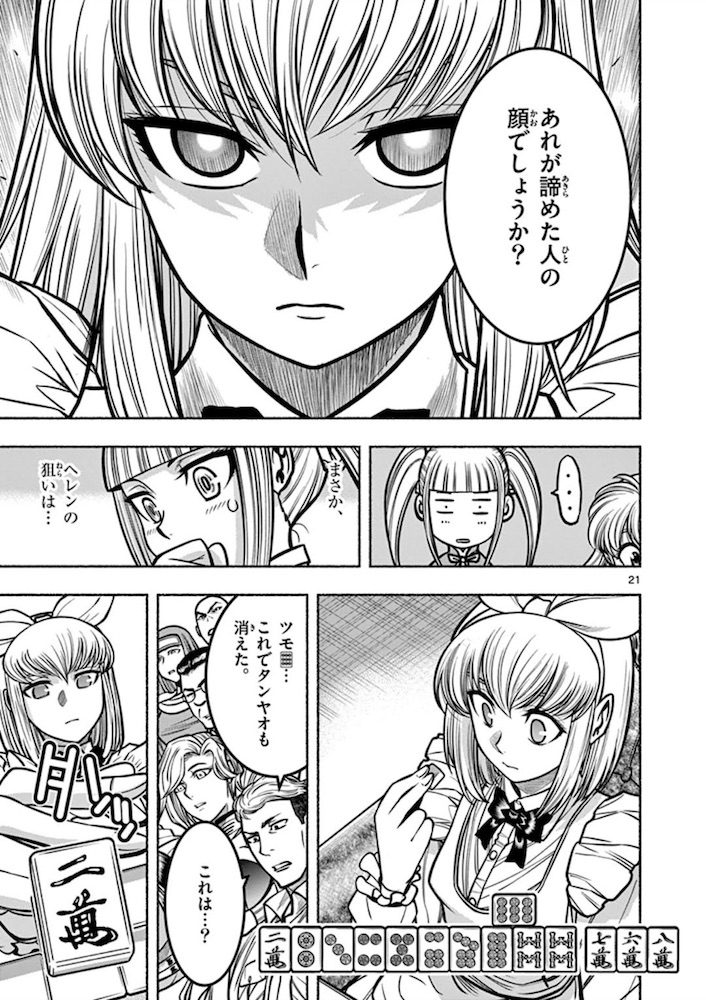
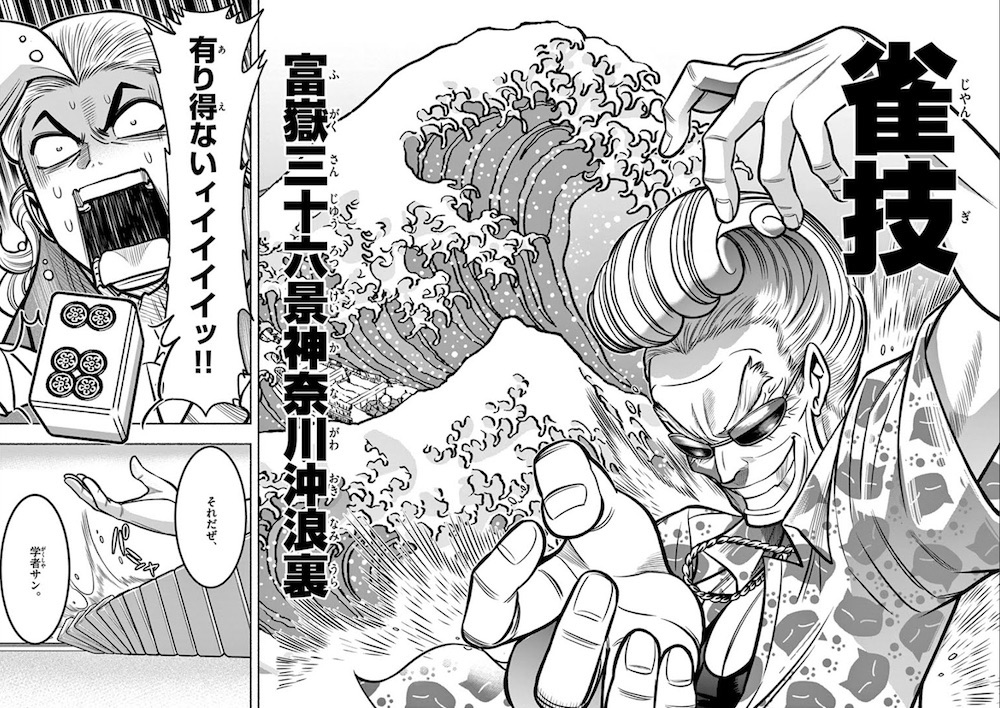
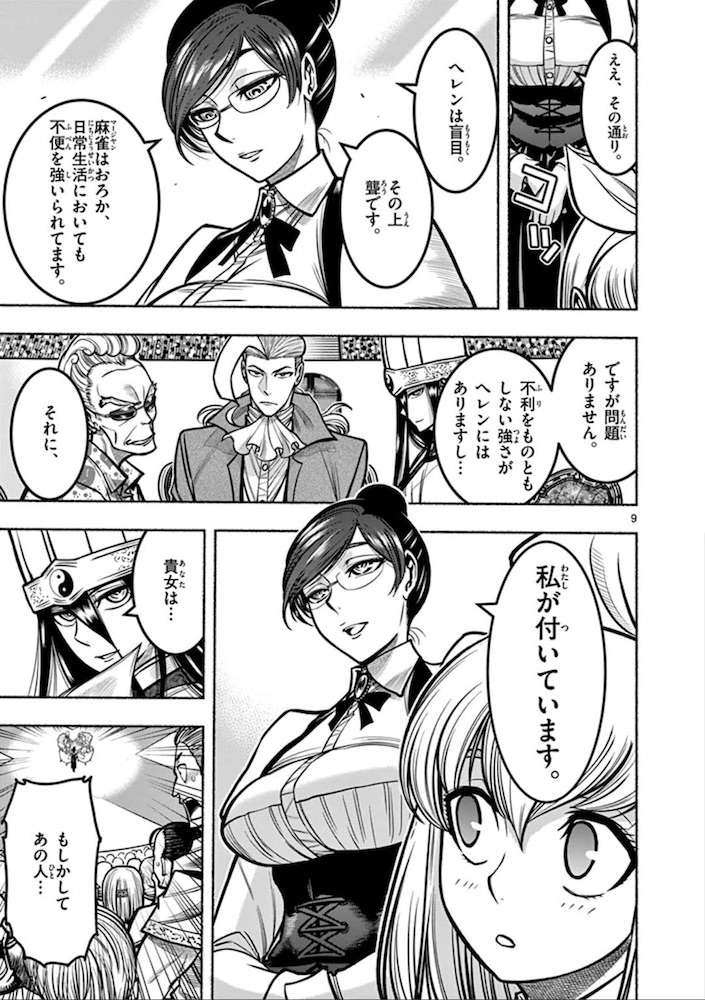
For example, one of Helen’s opponents is the Japanese artist Katsushika Hokusai (famous for “The Great Wave Over Kanagawa”), and while it seems like he can see what every tile is going to be, it’s actually because he’s such a master of capturing everything in a single moment that his observational skills allow him to metaphorically “freeze” time. As for Helen herself, her life spent both deaf and blind makes her skilled at navigating tricky table situations, owing to the strength she possesses to move forward in total darkness.
I should mention that I’m merely assuming that Helen Keller is the main heroine of the story because she’s on the cover of Volume 1, and it’s been promoted on Japanese manga news sites as the series featuring Helen Keller playing mahjong. Given the tournament format of the story, it might very well be Zhuge Liang who goes ahead. Because Helen would be the most intriguing protagonist, my hopes are that she remains in the spotlight, not least of which is because the manga’s portrayal of Helen’s teacher Anne Sullivan is absolutely perfect.
Greatest M is a fun manga and I like the not-too-serious matching of wits and deception that comes part and parcel with a manga that depicts both theatrical competition and the game of mahjong. I’m not sure how those with disabilities might regard Helen Keller’s portrayal—both in terms of her being a cute anime girl and how her blindness and deafness is depicted in the series. Nothing seems especially offensive to me as of yet, but it is curious to see her drawn like a blind girl you’d see in an older visual novel. Also, while the first volume is a wild ride, I’m not certain that this series can maintain its momentum before the gimmick runs a little dry. I’m going to keep up with it in the hopes that it goes somewhere interesting, even if it doesn’t include Super Saiyan Hitler as a final boss.
Here we are: roughly a year since coronavirus basically forced the world to change course. I seriously could not have imagined all that has happened since, and it feels like ten years have passed in the span of one. I’m losing my grip on time a bit, but this makes me wonder if doing these monthly blog updates actually helps in some way. I can see the days and weeks go by.
In happier news, the Blocker Corps IV Machine Blaster crowdfund to digitally archive the series was successful! I talked about it in a post to drum up support, and it actually didn’t make it until literally the 11th hour by crossing the finish line with only 11 minutes left in the all-or-nothing campaign. It’s not going to be on anyone’s list of best anime ever, but knowing I helped to keep an anime alive makes me feel good.
After all, I know what it’s like to have the support of others. Thank you to March’s Patreon sponsors:
My favorite anime convention might not survive another year due to the Coronavirus. Consider supporting them!
Hashikko Ensemble
Chapter 37 has the most intense musical performance yet.
Closing
The 2021 New York International Children’s Film Festival starts this Friday! Unlike previous years, it’s a virtual festival this time around, and the $40 two-week all-acesss pass is an incredibly good deal. If you live in the US, it might be worth checking out.
Also, how about that Pyra and Mythra in Smash Bros. Ultimate, huh? I’m thinking about writing something in regards to fanservice in character designs, hopefully providing a nuanced perspective.
Stay safe, get vaccinated. I wish you good health.
An electrifying performance dazzles the audience in this chapter of Hashikko Ensemble.
Summary
Hot off another victory, the Chorus Appreciation Society moves on to the semifinals of the school’s Cultural Festival music competition. This time, having experienced some kind of epiphany, Kousei reacts to Shion with a powerful blush, leading everyone to respond with a mix of confusion and curiosity. A heart-to-heart of sorts with Yukina helps him see what he wants, and at the moment, it’s to sing with Shion.
While the remaining groups are impressive in their own right, the Society’s fierce rendition of the song “Etupirka” bowls everyone over. However, Jin’s mom fails to see this performance too, as she and Yumerun are stuck in traffic.
Yukina’s Maturity and Kousei
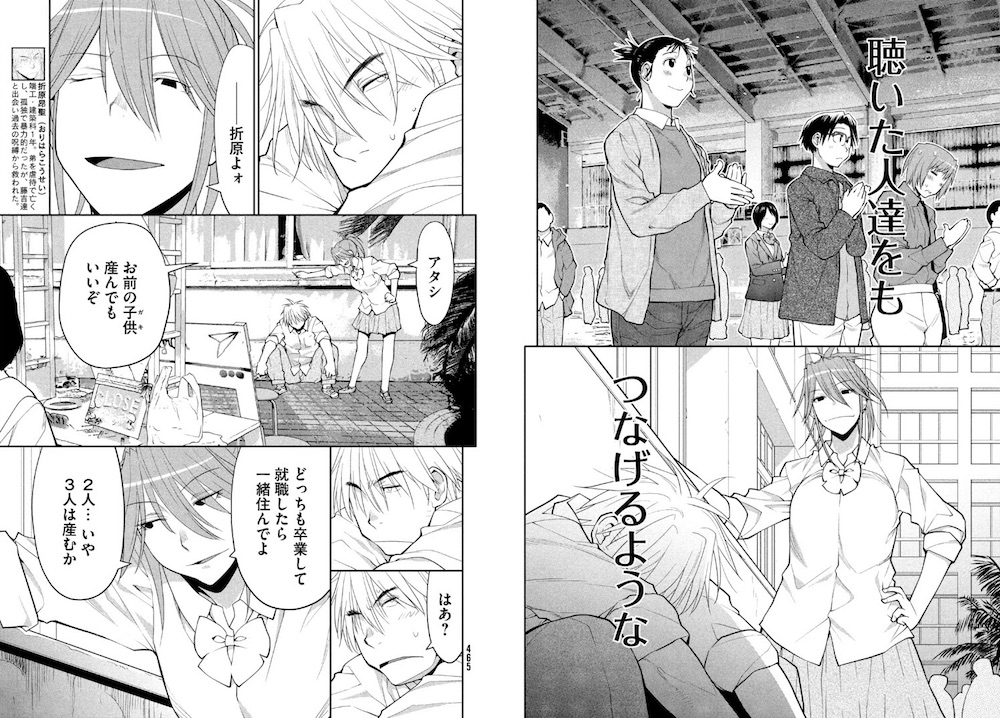
After Kousei heads outside by himself, Yukina comes up to him and drops some heavy statements in a surprisingly casual way by discussing a possible future with Kousei, including who would work and how many kids they would have (two or three!). Kousei doesn’t seem bothered in any way by this conversation, though his response is “Right now, I’m having plenty of fun singing with her”—a rejection, at leat for the time being.
This whole conversation is full of unexpected words and responses, and while I don’t know if “realistic” is the right word, the dialogue between Kousei and Yukina has a kind of depth and dimensionality to it because of how they seem to be thinking about the concept of time relative to their wants and desires. Kousei essentially has a choice between the rough-and-tumble girl who’s more like him or the classy girl who’s his complete opposite, and his feelings about it are rooted in the possibility of stepping into a world he long thought cut off from him due to his upbringing. But Yukina takes the long view, and appears to be thinking, “Even though Kousei’s all about the cute girl now, there’s always a chance he’ll come back around eventually.” I find Yukina’s particular brand of maturity interesting, like she’s somewhere between Saki and Keiko in Genshiken.
Kousei’s “Right now” is an interesting choice of words. What I think it implies is that, rather than being about love and seeing oneself with someone for a long time, it’s about Kousei figuring out his emotions in the moment. Does he value the ability to connect with Shion through song more than the inherent mutual understanding he shares with Yukina? The way Shion seems to instantly know what Kousei has on his mind when he hesitates to communicate what he wants out of her piano-playing for the next song, it speaks to a potential deeper connection through music. But whether that bond goes beyond music is something I’m looking forward to seeing.
ETUPIRKA! ETUPIRKA! ETUPIRKA!
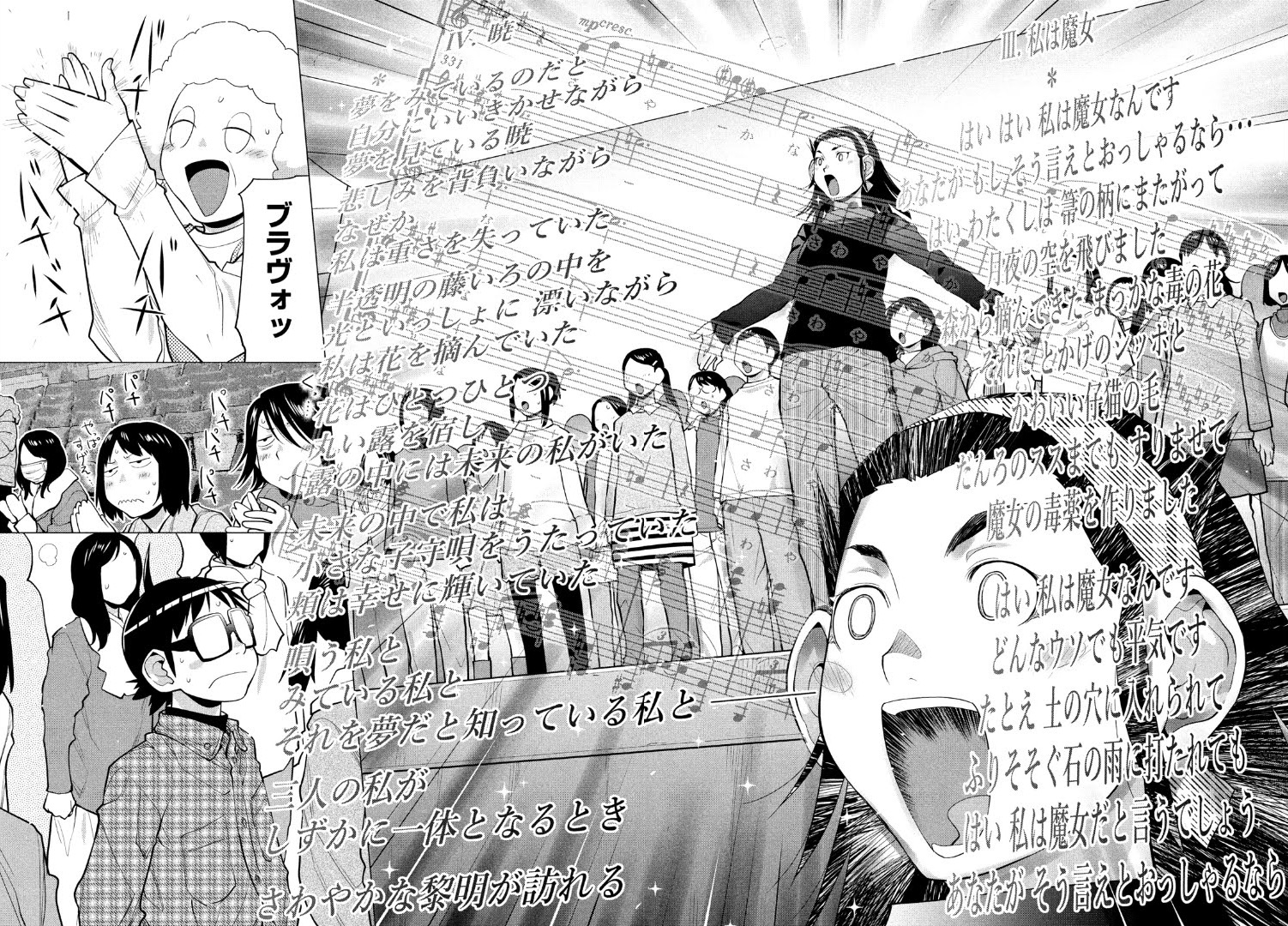
Just like in the last chapter, we have an amazingly drawn scene of a Chorus Appreciation Society performance. What stands out to me about their “Etupirka” is that even if you don’t know what the song actually sounds like, Kio’s artwork conveys its sheer intensity. It’s not just the trembling line effects throughout the performance, but the way the characters are drawn with such dynamism even while they’re standing still, as well as the choice to use that initial extreme angle to depict Shion’s piano-playing (as seen in the top image) makes it seem like the ground is trembling. It borders on a more exaggerated representation that one might find in an action-packed shounen manga that uses music as its gimmick the way Yakitate!! Japan and Food Wars: Shokugeki no Soma approach food.
(And if you want to hear a performance of “Etupirka,” it’s in the “Songs” section below.)
Hanyama’s “Tone Deafness” Isn’t
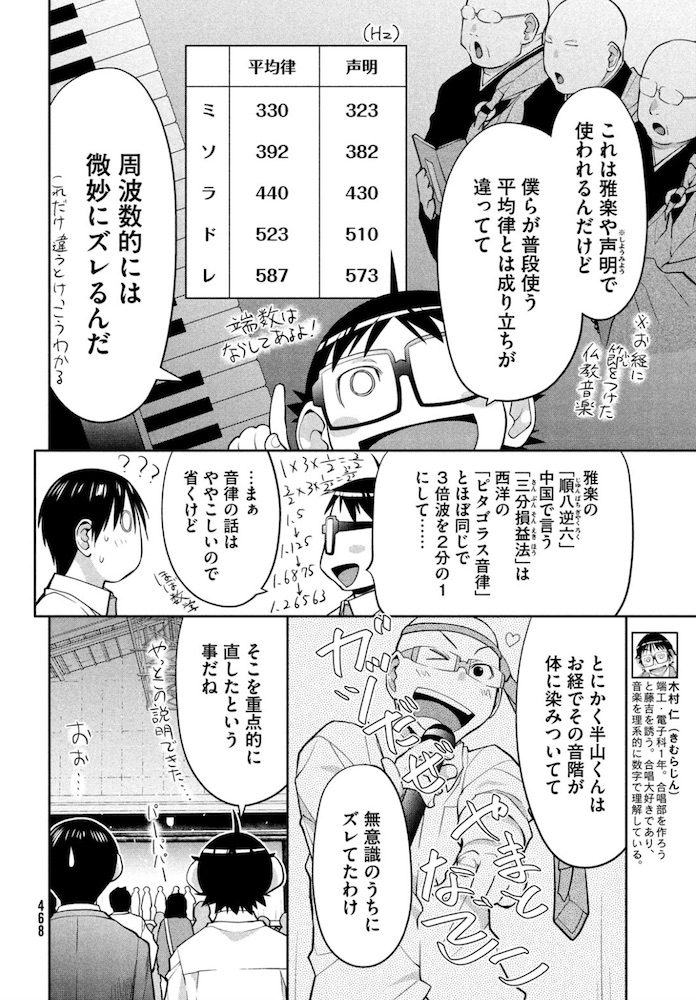
At one point, the subject of Hanyama’s inability to sing on-key comes up, and Jin reveals that what everyone assumed to be a case of being tone deaf is actually something else entirely. He recounts having tested Hanyama, and it turns out that the guy unconsciously sings on a scale different from the traditional Western music scales due to his family running a Buddhist temple. Instead, Hanyama sings according to what the Japanese calll junpachi gyakuroku(“upward eight, lower six”) or sanpun son’eki ho, which is also known as the Chinese 12-tone musical scale—which coincidentally is also the same as Pythagorean tuning. It results in the kind of music you get from Buddhist chants (shoumyou) and Japanese imperial court music (gagaku).
If this is all Greek to you, you’re not alone. Akira in the manga is completely baffled by everything Jin says, and so am I. But the gist of it—as much as I can understand, anyway—is that Hanyama has internalized that particular understanding of music, and it makes his attempts to sing more conventional popular songs go awry. Even if I don’t fully grasp everything, I find that pretty fascinating, and I’m glad Hashikko Ensemble goes into it, however briefly.
Songs
Half Monks: “Guts Daze!!” by Ulfuls. This is the song in a flashback to Hanyama’s singing in the competition while they’re explaining the quirks of his musical sense.
Electrical First-Years A Capella Group: “Racing into the Night” by YOASOBI
This is noted as being a Vocaloid song performed using six voices. While there’s no available equivalent online, there are Vocaloid covers of this song.
Wind Instrument Club: “The Galaxy Express 999” by Godiego
Chorus Appreciation Society: “Etupirka” composed by Hirose Ryouhei
Final Thoughts
Though we only got brief glimpses of them this chapter, I quite enjoyed the presence of both Akira and Jin’s mom. I’m still entertained by Akira’s mom and her delight over her son having friends, and I’m further anticipating the arrival of Jin’s mom at the school. I do get the feeling nothing Jin does will impress her, and I wonder if Yumerun will have any role to play in terms of bridging their strained mother-son relationship.
Also, Volume 6 of Hashikko Ensemble comes out next month! I wonder what store-exclusive bonuses we’ll get this time.
A review of the comedy manga Nichijou: My Ordinary Life by Arawi Keiichi has been long overdue. I’ve referenced the series off and on since 2011 when the anime debuted, but it’s only in the past year that I finally completed my Nichijou manga collection. Thus, while it’s a few years later than I would’ve preferred, I’m here to lay down my final verdict:
It’s so goddamn funny.
Well, that took a load off. Until next time!
In all seriousness, reading through all of Nichijou had me laughing uncontrollably on multiple occasions, interspersed between joyful chuckles and lip-puckering smiles. Plenty of anime and manga are wacky, subdued, over-the-top, subversive, and heartful, but rarely do they find themselves packaged in such a perfect package. The main joke of the series is its title—the series is indeed the exploration of the everyday lives of its characters, but their personalities, experiences, and interactions are simultaneously so mundane and bizarre that they play with your expectations at all turns. When you expect them to go zany, you’re hit with a reality check. When you expect something subtle, they might deliver something so hyper-subtle that it loops back around to absurd.
The core characters of Nichijou come in two groups. The first is a trio of high school friends: the energetic but somewhat dim Yuuko, the powerful closet fujoshi Mio, and the intelligent master troll Mai. The second is a robot named Nano who wishes to have the conspicuous wind-up key removed from her back so she can better pass for a normal girl, and her creator, a child genius called “Professor” who is as immature as she is brilliant. In both cases, the bonds between these characters are equal parts caring support and mind-bending frustration, and it only gets more extreme in both respects as the series continues.
About the closest thing that comes to mind in terms of humor is actually the old webcomic Perry Bible Fellowship in the way that both series are capable of delivering humor and anti-humor with laser-like precision, and you don’t necessarily know which one you’re going to get. One big difference with Nichijou is that it tries to build a fairly consistent world for its comedy to build upon, and this only gets more elaborate as the series goes on. Three of my favorite examples are as follows:
There’s a dog who shows up whenever someone is in a sorry situation whose only purpose is to lay its paw on the hapless individual as a show of pity. At some point during the series, it’s revealed that the dog doesn’t show up out of nowhere—it has an owner who is always extremely confused whenever his pet seems to suddenly start running away with a sense of purpose.
Mio’s sister, Yoshino, and Mai are both known for their pranks. For most of the series, they don’t really interact, and their forms of humor are similar yet different—Yoshino’s trolling is all about teasing, whereas Mai’s is about defying expectations. Their jokes sometimes cross paths, such as when an attempt to share sides for lunch results in a “Sucks to be you!” sign in Mio’s bentou, and Mai reveals her bentou container to have nothing more than a pre-packaged energy jelly drink (which she then starts to squeeze onto Yuuko’s rice). When Yoshino and Mai finally interact for an extended period, it’s like a glorious clash of the titans.
One of the side characters in the story invents a fake sport named go/soccer so he can start a club and slack off in its clubroom. However, he later discovers that go/soccer actually exists (thanks to a new student who was his middle school’s MVP), and that one of the high school’s teachers was a champion back in his youth. But rather than go/soccer being something in the vein of chess boxing—a combination sport that involves taking alternating rounds between the chess and boxing—go/soccer is completely inscrutable in every facet imaginable, like a serious version of Calvinball from Calvin & Hobbes.
One last thing worth talking about is how the manga compares to the anime that introduced so many (including myself) to Nichijou. There are the more obvious things: the manga continues past where the anime left off, and some of the jokes in the anime come from another series by the author: Helvetica Standard. The most major change, however, comes from the fact that the Nichijou anime was done by Kyoto Animation, whose excellent animation is gorgeous and polished in just about every scene. Ironically, that can sometimes work against the humor of the series, and this can be seen in moments of the manga where the slightly crude art style makes the same joke three times funnier. That being said, I hope that KyoAni can someday come back to animate the rest, despite the tragic setback they’ve faced.
Nichijou: My Ordinary Life is only 10 volumes long, and it’s so very worth reading. I know I’m extremely late in getting this review out, and that it might be a distant memory for many anime and manga fans, but for those who have yet to discover this magnificent gut-busting manga, there’s a real gem waiting.
Otakon, the largest American anime convention on the east coast, is in trouble. Due to the ongoing pandemic stifling last year’s event and the nonprofit nature of its parent organization, Otakon is at risk of shutting down for good. In order to fight off this unfortunate possibility, Otakorp is now, for the first time ever, accepting donations online.
I make no effort to hide the fact that Otakon is by far my favorite anime convention. I’ve been an attendee since before I started Ogiue Maniax all the way back in 2007, and I’ve gone as press (and occasionally even a panelist) every year since. Writing con reports and conducting interviews with great Otakon guests have become staples of this blog and my experience as an anime fan. Donating to Otakon has been one of the easiest decisions I ever made.
What I love so much about Otakon is that it never feels as commercialized compared to some of the professionally run anime conventions that are so common these days. I can expect interesting guests from Japan, including those who might not be as well known to the mainstream anime fan, and it’s always a pleasure to pick their brains for industry insight. I also love the fan panel culture that has grown out of Otakon, where every year is full of genuinely enthusiastic presenters, both new and seasoned, who encourage their audience to explore a little further and think a little deeper about anime, manga, and fandom. And it’s also been a great place to connect to many of the fellow fans I’ve met online.
In honor of Otakon and in hopes of it continuing on, I’ve decided to list some of the great interviews I’ve done at the convention over the years. I hope they can at least show you why it’s a cultural touchstone worth saving.
We are on the other side of a terrifying four years, and I am glad to be here with you. Though we don’t know what the future holds, I feel somewhat optimistic.
However, we still have COVID-19 killing thousands of people a day, so I hope for the safety of you and everyone you hold dear. Also, I hope this is obvious, but please do not attend any anime conventions while we’re in the middle of a pandemic. Seriously, don’t. Stay home, and enjoy anime from the comfort of your TV or computer. The new anime season is in full swing, and Valentine’s Day is around the corner, which means plenty of talk about giri and honmei chocolates.
Thank you to the following Patreon sponsors for their support in the month of February:
How does this gymnastics-themed anime handle its “older” protagonist?
Hashikko Ensemble
Chapter 36 is the long-awaited debut of Jin’s mom! Spoilers: She probably got teen pregnant.
Closing
If you’ve got a favorite anime of the season so far, I’m all ears. I’ve been enjoying the return to form that is Show by Rock!! Stars! and the strange and irreverent Back Arrow.
Everyone gets hit by a Minmay Attack in Hashikko Ensemble, Chapter 36.
Summary
The next round is on, and the Chorus Appreciation Society takes the stage once again. Before that, though, Kozue asks Kousei why he doesn’t try to cheer Shion up after his rejection of her, and he replies that they’re just from different worlds: a safe rich girl vs. a delinquent with a lot of baggage.
This time, it’s “Do You Remember Love?” from the anime film Macross: Do You Remember Love. Akira and the others deliver a powerful performance that doesn’t just wow the audience, it seems to actually bond the members (and those close to them) together in a way that only music can. As they finish, Kousei seems to have Shion on his mind as he thinks, “Maybe our worlds aren’t so far apart after all.”
Elsewhere, Yumerun is pacing frantically, when finally the person she’s waiting for arrives: Jin’s mother, Kimura Reika, who turns out to be a highly eccentric 31-year-old soprano. The chapter ends as the two head out to Hashimoto Tech (Reika reluctantly so) in order to see Jin and the others sing.
Darkness and Light
Hashikko Ensemble is a series that’s high on levity, but the glimpses of darkness are astoundingly brutal. As Kousei is talking about his past, the first image shown is what appears to be a first-person perspective of one of his abusers (his mom’s lover, I think) rearing for a punch. This then transitions into Kousei throwing a punch at someone on the street in a fight. There’s a lot of trauma in his life, and the manga conveys a link between the violence inflicted on him and his rough attitude.
That’s also what makes the portrayal of the society’s “Do You Remember Love?” all the more powerful. You can see in Kousei all this internalized fear, anger, and self-loathing, and it seems to just wash away as he sings. During the performance, Yukina (the arm wrestling champ who has a thing for Kousei) suddenly begins to cry during his performance, and she isn’t sure why. The way I see it, what she’s sensing is how strongly Kousei’s feelings are reaching out to Shion, and she’s realizing they’re not for her. Only in song is Kousei able to be honest.
I Love You So
I’m not well-versed in music, let alone the sheer breadth of what’s thus far been presented in Hashikko Ensemble. Many times, what this means is that outside of seeing the lyrics on the pages, I don’t always fully internalize what the songs are conveying in a chapter. This is not the case with “Do You Remember Love?”—it’s a song I know all too well, and it’s a staple of my karaoke sessions. In other words, I can really “feel” this chapter in ways that I haven’t been able to before.
“Do You Remember Love?” is indeed a love song, but it’s also about reaching out to others and connecting. “I hear you calling out to me.” “I’m no longer alone, because you’re here.” Characters make mention of how well Akira and Kousei are harmonizing, as if they’re on the same page emotionally; most likely, it’s because they’re both singing to Shion.
Questions are asked throughout the chorus of the song: “Do you remember when our eyes met?” “Do you remember when we held hands?” And while these lyrics are more romantic, their juxtaposition against Kousei’s traumatic memories makes me think that he’s actually, in a sense, remembering what it’s like to love The contrast between the beauty of the song and the violence of Kousei’s past is very fitting for a song played during the climactic battle of the Macross movie.
Jin’s Mom Is a Surprise
Kimura Reika is very different from what I pictured. When Jin described her in previous chapters, I was expecting an older strict woman—perhaps an unforgiving taskmaster with many years of experience and even a few wrinkles. In contrast, we get this weirdly aggressive and intense ball of energy who’s similar enough to Jin that you can see the familial relation, but also different to the point that you wouldn’t mistake the two. During her introduction, Yumerun asks why in the world Reika isn’t wearing her contacts, and she responds that she forgot them but also thinks it’s too much of a hassle to go back to retrieve them. When asked why she won’t just wear glasses, Reika claims that when she has them on, it makes her feel like her voice won’t fly out properly. That’s the sort of person Jin has to deal with in his home life.
And I have to point out the elephant in the room: Assuming that Reika is Jin’s biological mother, it also means she got teen pregnant! This isn’t the first time that the author, Kio Shimoku, has explored that topic (see his two-volume baby-raising manga Jigopuri), but I’m still surprised to see it pop up here. Just what kind of life has Reika gone through?
Songs
It’s noted that most of the groups only prepared one or two songs for the competition, so there are a number of repeats from previous chapters.
Basso Masters: “Daichi Kinshou” (Hymn of the Earth) from the cantata “Tsuchi no Uta” (Song of the Land)
Team “Promise” (a bunch of otaku): “Yakusoku” (Promise) from The iDOLM@STER
Yukio feat. Mayomyon: “Shibuya at 5 o’clock” by Suzuki Masuyuki and Kikuchi Momoko (You might recognize Suzuki as the singer of the opening to Kaguya-sama: Love Is War)
Noi Majo (Kurotaki Mai’s quartet): “Hakujitsu” (“White Day”) by King Gnu
Chorus Appreciation Society: “Do You Remember Love?”
You can find the above songs, along with previous references, in my Hashikko Ensemble Youtube playlist.
Final Thoughts
I’m really looking forward to seeing more of Jin’s mom. I feel like we’ve only scratched the surface of what she’s really like.
Mai’s group, Noi Majo, has moved on in the competition as well. I wonder if the groups will end up against each other.
The manga Chainsaw Man by Fujimoto Tatsuki recently concluded “Part 1” of its story, and having heard fans both real and virtual praise the series up and down, I decided to marathon through it. Count me as a convert, as I think it’s one of the best things to come out of Shounen Jump in recent years. The narrative turns are compelling and the characters are charming in their foolishness.
However, there’s a large twist in the series that brings to mind a trope that sparked discussion around superhero comics back in the early 2000s: Women in Refrigerators. Originally coined by Gail Simone (who was still a critic and not a writer of comics at the time), it refers to when characters close to the hero—often a lover or companion—is killed in service of making the villain appear more nefarious. While not automatically bad, its overuse reduces female characters to discardable pawns. Manga, especially male-oriented titles, can have their own instances of fridged women, but Chainsaw Man seems to lean fully into the concept in ways I’ve never seen before.
The protagonist of Chainsaw Man is Denji, a lonely guy who doesn’t think life is worth living, but is given a second chance when a demon he befriends known as the Chainsaw Devil offers him a chance at the normal existence he’s always wanted. Denji’s discovered by a beautiful female government agent named Makima, who recruits Denji to fight demons as Chainsaw Man. In addition to being a target of Denji’s immature affections, Makima provides him with companions, including a female fiend (half-human, half-devil) with blood-based abilities named Power. Over time, the bond between the two of them grows, and they make a great if chaotic team—like two violent Monkey D. Luffys with bad attitudes but good hearts. Eventually, though, Makima reveals that her motives for recruiting Denji were anything but pure. In an act of cruelty designed to cow Denji and leave him in despair, Makima murders Power in front of Denji with little warning, Power even having been carrying a birthday cake for Denji in anticipation of a celebration. Death of named characters in Chainsaw Man is not uncommon, but Power’s death hits especially hard.
It is undoubtedly a moment where a female character is killed so as to create a psychological impact on the male hero, but what Chainsaw Man also reveals this to have been Makima’s plan from day one. As Makima explains, Denji inadvertently entered a contract with the Chainsaw Devil where Denji is meant to receive a normal life in exchange for their fusing together, and the only way to deny him that basic happiness is to manipulate his life. As such, Makima purposely gave Denji friendships so that she could snatch them away and keep him under her thumb. Unlike many superhero instances of Women in Refrigerators, this is not tacked on as a way to raise the stakes, but is core to the overall story and the truth of Chainsaw Man’s world. The trope isn’t just kind of there thoughtlessly—it’s front and center, and fully exposed.
To be accurate, Power isn’t completely gone, as her blood-control powers allow her to exist within Denji, and his motivation transforms into finding a way to bring her back. At the climax of the story, Denji also delivers a fatal blow to Makima using a chainsaw made from Power’s blood. Narratively, it’s explained that Power’s blood can prevent Makima from regenerating—Makima’s actually powered by a devil just like Denji, and has come back from death over 20 times—but there’s also a great symbolism in having Power get her payback in essence. Power is neither fully alive or fully dead, and while reducing her physical existence does potentially play into the idea that her role in the story is subordinate to Denji’s, the manga does such a strong job of portraying their relationship as that of equals (albeit two incredibly idiotic equals). The result is that Power looms large over Chainsaw Man as it enters Part 2, and is still one of the most important characters in the manga. She’s also consistently the most popular character in the series among English and Japanese fans.
Part 1 of the manga actually ends with a woman in a refrigerator. After defeating Makima and keeping her from regenerating, he tries to figure out a way to keep her from coming back from the dead. His solution: chop her up, store her in the fridge, and slowly cook and eat her entire body as a way to deny Makima her wish, which is to be eaten by the devil Chainsaw Man due to certain unique properties that Chainsaw Man possesses. Denji actively engages in cannibalism as himself and not his transformed state to prevent this from happening. He also chooses this gruesome route because he sees it not as an act of malice but a perverse way of wanting to be “together.” I don’t believe that this is the author of Chainsaw Man intentionally calling out the trope, but it’s hard to ignore, and it still winds up with a woman being literally fridged in service of a greater goal.
Chainsaw Man is a manga that can come across as brainlessly violent and gross, but it’s proven itself to be the product of extreme thoughtfulness. Even though its characters are often brash and simple, the story itself is not, and the handling of its own Women in Refrigerators does not feel like it detracts from the series other than making readers angry that Makima dare kill the best character. Power’s influence on the series continues to loom large, and it helps avoid the feeling that being fridged trivializes her character, and keeps Chainsaw Man as a whole from being subsumed by the wastefulness of the trope. In an Obi-Wan Kenobi sort of way, striking Power down makes her more powerful than we can possibly imagine.