OGIUE MANIAX

Anime & Manga Blog | 50% Anime Analysis, 50% Ogi

Yowamushi Pedal: Brains, Heart, and Body

yowamushipedal-firstyears

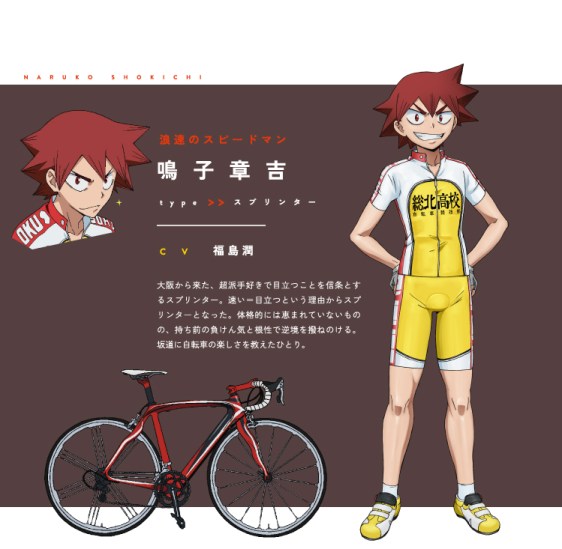
As a sports manga and anime with an enormous cast, Yowamushi Pedal is home to a variety of characters designed to contrast with each other in terms of personality and approach to competitive bicycle racing. This certainly applies to the first-years when the series begins, as all-rounder Imaizumi Shunsuke, speedy Naruko Shoukichi, and high-cadence protagonist Onoda Sakamichi are all differ from one another significantly. In looking more closely at these three characters, however, I find that they resemble professional fighting game player Laugh’s theory of the Three Fighting Game Player Archetypes. My aim here is to elaborate why I believe this to be the case, and which archetypes apply to these three.

As described by the video above from Core-A gaming, the three categories of players are brains, heart, and body. While this distinction is not exclusive to fighting games or even gaming or competition in general, I find that Yowamushi Pedal with its theme of cycling has a lot of parallels with fighting games. Although fighting games are typically 1-on-1 matches and bicycle racing is shown to be a team sport on the biggest stages, the emphasis on how a human being competes through the use and fine-tuning of their equipment is a point of commonality. At one point, a character in Yowamushi Pedal even talks about how, unlike other sports, you don’t need to be the biggest or the strongest because what matters is how you work with your bike. Replace that with “joystick” or “controller,” and the similarities start to become clearer.

In the training camp arc of Yowamushi Pedal, where the characters compete to see who will represent Sohoku High School in the Inter-High National Tournament, club captain Kinjou purposely messes with the first-years’ bicycles in order to challenge them to work on their major weaknesses. In doing so, he reveals the archetypes that Imaizumi, Naruko, and Onoda embody.

imaizumi-shunsuke-full-1565241

Imaizumi is a “brains” type, or someone who relies on superior knowledge and study to win. When Kinjou removes his ability to shift gears, it initially throwsImaizumi for a complete loop. Just as a brains-based fighting game player knows frame data like the back of their hand, Imaizumi had up to that point relied on his optimal knowledge of gear shifting to tackle any level of slope while cycling. Although he eventually overcomes this flaw during the training camp, his sheer joy when he’s finally able to reunite with his cherished gear shifters shows just how much the “heady” part of bicycle racing factors into Imaizumi’s approach to the sport.

naruko-shoukichi-full-1565240

Naruko, then, is a “heart” type, who prefers to “feel” things out. In fighting game terms, this is someone who is confident they can outmaneuver you in unorthodox situations and “mind game” you. His advice to Onoda to surprise Imaizumi with a technique in a previous race, as well as his own “Sprint Climb” maneuver, are indicative of a similar quality. At the training camp, Kinjou removes his lower handle bars, thus limiting Naruko’s ability to adapt and be as creative as he’d like. Unable to do things “in the moment” as a result, Naruko is forced to work around it.

onoda-sakamichi-full-1565236

That leaves Onoda as the “body” type. While this might not make sense given how Onoda is the “heart” of the team, that’s a different kind of conception of heart as a spiritual center. Instead, the reason why Onoda is a “body” cyclist is because of the fact that his high cadence is the linchpin of his riding style. Just as a “body” type in fighting games always has things like technical precision and perfectly executed high-damage combos to fall back on, Onoda’s ingrained ability to raise and lower his cadence like the pedals are an extension of his body lets him overcome situations where he might be “strategically” beaten. And just like the other two, when his ability to freely pedal as quickly or as slowly as he’d like is interfered with, he starts off feeling utterly helpless.

Imaizumi the brains, Naruko the heart, and Onoda the body. Together, they create a complete being, which is perhaps why they work so well together. What about the other characters, then? I’ll leave you to figure them out.

If you liked this post, consider becoming a sponsor of Ogiue Maniax through Patreon. You can get rewards for higher pledges, including a chance to request topics for the blog.

Giver of Thanks: Ogiue Maniax Status Update for November 2016

November is anniversary month for Ogiue Maniax, but I’ll be saving that for its own dedicated post (if I remember, that is. Someone please remind me!).

A big thanks to this month’s Patreon sponsors. You might not understand how much I appreciate your help, but I’ll explain at the end:

General:

Johnny Trovato

Ko Ransom

Alex

Diogo Prado

Yoshitake Rika fans:

Elliot Page

Hato Kenjirou fans:

Elizabeth

Yajima Mirei fans:

Machi-Kurada

Before going into an overview of my favorite posts of the month, I want to talk a bit about my appreciation to my readers for being curious as to what I have to say. As I go through life, I meet more and more anime and manga fans of different tastes and philosophies, but often I feel it can be difficult to engage in conversations about the nitty-gritty of anime and manga as ways to explore thought, society, emotion, and more. Talk about anime and manga floats at the surface, or, if it delves deeper, is often connected to value judgments or inside looks at the mechanics of industries. I know my audience isn’t especially large, but I am grateful that the topics I’m interested in at least pique your curiosity.

That being said, I know I’m really bad at responding to comments on a frequent basis, and I intend to work harder at fostering actual conversation on Ogiue Maniax. Also, because I’ve been more review-heavy as of late, I’m wondering if this is steering away from the strengths of the blog.

As for this month’s post highlights…

First, at long last, is a final review of one of my favorite manga in recent memory: Mogusa-san. If you love food manga, this is right up your alley.

Second, out of the many films I watched over October, Miss Hokusai has to be the one I enjoyed the most. ALso, check out Kizumonogatari Part II and Shin Godzilla.

Third, I took a different approach to covering New York Comic Con this year, and have been writing response essays to things that caught my attention. If you like giant robot toys, check out my thoughts on Soul of Chogokin Voltron and Megazord.

Lastly, I wrote a bit about Star Ocean EX, and just how 2003 it is.

I’m not sure what I’ll have in store for November, but I’m thinking of devoting a significant chunk to talking about some of my favorite recent characters.

Third Time’s the Charm?: Kimi xxxru Koto Nakare, Chapter 6

kiminakare6-hayatoshingo Whenever I read a chapter of Kimi Nakare, it always feels like the next chapter might be the end of the story. Chapter 6 not only follows this, but the vibe is stronger than ever.

Summary

In spite of whatever hopes might be lingering, WARP’s days as an idol group are numbered. As a final farewell to their fans, their manager has arranged one last massive meet ‘n’ great with the fans.

Not long after, Hayato and fellow WARP member Shingo are having a bath time discussion about their futures. While Hayato believes himself to be ill-suited to the idol path, especially because his initial motivation was just so he could meet Nobuko, Shingo responds that Hayato’s attitude (and idiotic qualities) are what make him a natural idol.

In a flashback to Shingo’s high school days, we see a conflicted Shingo unsure of whether the idol path is for him, not least of which is because his hospitalized father is very much against it. Shingo ends up bumping into a girl at the hospital who turns out to be a fan of idols. Accidentally revealing that he’s an idol from the same agency as her favorite, Shingo listens to her story of how idols helped her to keep living in spite of her illness, which strengthens Shingo’s determination to continue his idol career no matter the odds.

The next day, Hayato is discussing the upcoming meet ‘n’ great with Nobuko and Natsumi. When Nobuko promises that she’ll defend him from all of the fangirls, Hayato confesses his feelings for her once more—this time in front of the whole class!

Urgency

kiminakare6-3rdconfession

As I briefly mentioned in the introduction, Kimi Nakare often feels like it’s moving at a breakneck pace in terms of typical romance manga developments. It’s one thing to have a confession in Chapter 1, but it’s another to have three confessions in six chapters. Not only that, but each of them raise the stakes more and more, because now it’s not even a secret among close friends anymore. While I could see the class not taking it seriously, especially because Nobuko has made a running gag out of her on-screen obsession with Hayato, I think they’re going to realize what’s going on sooner or later.

The sense of urgency isn’t limited to just the main romance, either. Just the fact that a scandal has already dissolved Hayato’s idol group and put him on a slightly different path is the kind of development that would usually occur late into a manga’s life. In some ways, it feels like early Kimi ni Todoke, where every time you think the story would move one way, it would swerve in the other direction, and usually for the better. Can Kimi Nakare keep up this pace? It’s something I welcome, and while I hope the series does well, I also hope that it wouldn’t fall into the trap of becoming increasingly meandering if it reaches major success.

The Side Cast is Growing on Me

kiminakare6-hospital

In my review of Chapter 5, I mentioned that the side characters aren’t nearly as interesting as Hayato and Nobuko. While I still stand by that statement, I think the other characters are starting to come into their own. I actually previously had trouble keeping track of all the guys in WARP, but now I have a firmer grasp of Shingo as a character. We’ve yet to see more characters on Nobuko’s side of the story, so I’m curious as to what might be in store there.

The Irony of the Natural Idol

After reading Shingo’s comments to Hayato about he’s a natural-born idol, it made me think about how idols are presented to the world, and in turn how idols are presented in Kimi Nakare. Idols, male or female, often project an image of both innocence and sensuality, and this quality is central to the story of this manga. There’s the scandal with WARP member Jirou and his having a girlfriend, but there’s also the idea that the idol business has a dark side. In the real world, idols are often controlled day-in and day-out by their agencies, and it’s what leads to the criticism that idols are just a way to make money off of gullible fans. For me, I think that it can be healthy as long as there’s a tacit understanding that it’s a shared fantasy, something akin to pro wrestling.

If Hayato is a natural idol, it means that he achieves that innocent sensuality without effort, through both appearance and attitude, and it’s exactly that kind of demeanor that you’d expect to get subsumed by the idol engine. To be in the right spot, he has to be just strong enough to never stop being himself, but also just “dumb” enough to stay naive. It’s a precarious position that is preserved in part by his love for Nobuko. That, of course, is also the other irony, that what makes him a natural idol is also what is liable to get him kicked out of the business.

One might also say that his masturbation scene in Chapter 4 represents that combination of innocence and sensuality perfectly. Here is this handsome yet goofy guy who just can’t hold back his very real passion for the girl of his dreams. Her being not beautiful by conventional standards only adds to that rather special moment of characterization.

Last Thoughts

Idols are all well and good, but I want to see more of Nobuko!

If you liked this post, consider becoming a sponsor of Ogiue Maniax through Patreon. You can get rewards for higher pledges, including a chance to request topics for the blog.

Mogusa-san: The Joy of Superhuman Eating 

mogusasan-unajuu-small

I love to eat. Just thinking about all the varieties of cuisine out there in the world, with dishes for the rich and the poor, gives me pure joy. That’s why one of my favorite manga over the past few years has been a food-themed series called Mogusa-san. The simple story of a cute and gluttonous girl who has mastered the art of stealth eating, I’ve already written two posts praising the series up and down. I recently picked up the most recent volumes and was surprising to learn that Mogusa-san as I originally knew it had come to an end. Volume 10 actually marks the conclusion to Mogusa-san, but it turns out that there’s already a sequel (more on that later). In any case, this gives the perfect opportunity to write an overall review of the manga.

Mogusa-san follows Mogusa Minori, a seemingly normal girl with a seemingly normal appetite. However, one day her classmate Koguchi Torao notices something odd: while Mogusa appears to be writing in class, she’s in fact snacking on a pretzel stick. The reason no one notices is that her pantomime is so convincing that most people assume she’s just using a normal pen. It turns out that Mogusa’s appetite is near-insatiable, and that she sustains herself by eating constantly, hiding her food in plain sight. After Koguchi reveals that he’s aware of her secret, the two of them become “food buddies,” visiting snack shops and other food establishments to bask both in the quantity and quality of various foods.

mogusasan-popsicles-small

Generally speaking, there are two different types of food manga. There are the series that bask in portraying the simple joy of eating and drinking, such as Sweetness and Lightning. These works portray characters with wide-eyed expressions as food brings them true joy, resulting in “food responses” that are intense but not especially over-the-top. Then there are the manga that make eating and drinking the most powerfully dramatic and sensual experiences possible. These are the Yakitate!! Japan-type series, where tasting and creating foods becomes a religious experience fueled by impossibly superhuman abilities. One thing I love about Mogusa-san is that it possesses elements of both worlds.

When Mogusa has to engage in covertly satisfying her never-ending munchies, the series emphasizes the physical limits that Mogusa pushes in pursuit of eating. Whether it’s eating a stick of dango in 1/60 of a second, hiding candy inside the corners of her jaws in case of emergencies, she always has a trick (or a pastry) up her sleeve. However, when she’s allowed to just eat without feeling any sense of shame, especially when she’s with Koguchi, the look on her face as she bites into a succulent piece of meat or slurp some delicious ramen carries the same joy as a tamer degree of food manga. While Mogusa’s expressions are near-orgasmic at times, they’re not “actually orgasmic” as one would find in Food Wars!

mogusasan-kabayakitarou-small

While the concept might seem like it overstays its welcome, and a part of me expected that might be the case, Mogusa-san actually provides both enough narrative development and a sufficiently robust supporting cast that the series never gets tiresome. Koguchi and Mogusa bond over the course of the ten volumes in a beautiful way. Characters like Taira Chigumi (Mogusa’s opposite in that she has developed ways to hide the fact that she has the palate of a 10-year-old) and Tabe-chan (a professional competitive eater who considers Mogusa her life-long rival) add a surprising amount of variety to the theme of eating. Because these characters grow as well, Mogusa-san shows itself to be remarkably heartfelt while still remaining true to its core themes. Although there’s clearly a decent amount of experimentation in order to keep the concept in motion, the entire manga ends in an extremely satisfying way that leaves little room for disappointment.

mogusasan2-splash

So where does that leave the sequel? For whatever reason, it was decided that Mogusa-san would take on a new form, and it has now been replaced by a new series called Mogusa-san wa Shokuyoku to Tatakau (“Mogusa-san Fights With Her Appetite”). Taking place after a short timeskip, Mogusa is now a college student in Tokyo, and because she no longer has her family to support her regularly, she’s trying her best to refrain from eating all the time. The result is that Mogusa-san desperately tries to stick to “only” three meals a day that, while enormous in quantity for the average human being, are clearly signs of Mogusa trying to practice willpower and diligence when viewed in the context of the previous series.

One of the two most notable changes in this new setting is that Koguchi is no longer the perspective character, and readers are instead more privy to Mogusa’s own inner thoughts. The other big change is that there appears to be less of the shounen-esque “wacky stealth eating,” giving the sequel a somewhat mellower feel. A part of me definitely misses the old style, but I am quite curious about how college life is going to treat Mogusa.

You’ll know in just one chapter if you’re going to like Mogusa-san. For me, I think it took about four pages. It’s just a food manga that has never let me down, and I’m more than happy to keep reading it with the awareness that Mogusa Minori is a kindred spirit.

If you liked this post, consider becoming a sponsor of Ogiue Maniax through Patreon. You can get rewards for higher pledges, including a chance to request topics for the blog.
I’m Pleasantly Surprised that Hidamari Sketch Hasn’t Ended

hidamarisketch-vol8

Though I’ve been away from the series for a while, I recently read Volume 8 of the Hidamari Sketch manga. Rreleased in the US as Sunshine Sketch, it covers Sae and Hiro’s transition to college and the arrival of a new girl named Matsuri. With graduation and all that it typically entails in anime and manga, I expected this volume to be the last, so color me surprised when I found out that the series is still continuing.

Fan favorite K-On! had a similar change, but while I loved the move to college for K-On! and the transition into a new environment, I also know I’m the exception. It’s very telling that the series didn’t continue much longer after that. If I try to look at it from an unbiased perspective, it was perhaps too sudden a change in terms of how time seems to flow (or not flow, as the case may be) in K-On! Prior to graduation, Azusa is the only major underclassman in that series who was also a club member, and the rest were all of the same age. As a result, when they go to college, the focus shifts sharply away from their familiar and beloved high school setting, while the girls who remained in high school don’t have quite the group dynamic that readers loved over the years (even if Ui deservedly got more of a spotlight).

I don’t think Hidamari Sketch will have that problem, or at least not quite so much. When the series began, it was already about senpai and kouhai, whether that’s Sae and Hiro in contrast to Yuno and Miyako, or how later characters both older and younger are introduced. There is a greater sense of the forward progression through high school, even if Hidamari Sketch is moe slice of life comedy at its most mellow. Also, because it’s only a part of the cast moving on (not to mention that Sae, Hiro, and probably even Natsume still show up), the transition also doesn’t feel quite as jarring.

I’m looking forward to reading more, and I’m especially looking forward to Miyako as a terrifying high school senior.

If you liked this post, consider becoming a sponsor of Ogiue Maniax through Patreon. You can get rewards for higher pledges, including a chance to request topics for the blog.
Time for New York Comic Con!: Ogiue Maniax Status Update for October 2016

Every year I’m amazed that the people who run New York Comic Con manage to make it work. New York City is a notoriously difficult place to hold a convention, but it keeps growing. I hope that the recently announced Anime NYC will have similar success.

I’ll be heading to New York Comic Con this year for a couple of days, though given how gigantic the crowd is it’s likely I’ll end up never bumping into anyone I know. In terms of what I plan to attend I’m playing it sort of by ear this time around, but you’re likely to catch me at some European comics panels.

As mentioned last month, I’ll be seeing Kizumonogatari Part II in theaters! I happened to pick up the book recently, but I’m going to wait until the movies finish before I read it. I also updated Love Live! School Idol Festival to the newest version which its fancy overhaul and Aqours additions. One thing I like about it is that I can use my stickers to Idolize, instead of hoping in vain for duplicates. I finally got around to upgrading one of my Hanayo cards. Did you know that I’m quite fond of argyle patterns?

hanayo_pure_sr248_t

As always, I’d like to thank to all those who support me via Patreon:

General:

Johnny Trovato

Ko Ransom

Alex

Diogo Prado

Sasahara Keiko fans:

Kristopher Hostead

Yoshitake Rika fans:

Elliot Page

Hato Kenjirou fans:

Elizabeth

Yajima Mirei fans:

Machi-Kurada

It’s been a review-heavy month for me, partially because a number of series are ending, but also because I’ve finally gotten around to finishing a bunch of shows I had on the back burner. I’m aware that series which are more than a season or two old tend to fade from people’s memories, but I think it’s important to not get too distracted trying to keep up with the Anime Joneses, as it were.

Love Live! Sunshine!!

Thunderbolt Fantasy

Kiznaiver

Yona of the Dawn

Ojamajo Doremi (final season + retrospective)

Kimi Nakare didn’t get a new chapter in August, which is why there was no review. It’s back, though, so expect to see something for October.

I also want to draw attention to this month’s sponsored Patreon post, where I discuss my favorite RPGs of all time. As someone who is fairly familiar but not neck-deep in the world of Role Playing Games, the list might seem a bit sparse. If you want to see me write about a particular topic, consider sponsoring me on Patreon. I have a reward tier specifically for guaranteed requests.I want to end off on a question for my readers: What do you think of the balance between talking about older series and newer series? What about manga vs. anime? I was mostly anime-heavy this month, and I’m curious as to how many of my readers are more on the anime side, and who favors manga more.So with that, a poll!

I don’t know how much this’ll change things, but I wanted to see for myself what is favorite among readers of Ogiue Maniax.

The Fujoshi Files 161: Maria

Name: N/A
Alias: Maria (マリア)
Relationship Status: Single
Origin: Girls Saurus DX

Information:
The president of the Manga Study Club at her high school, Maria draws a BL manga of one of her fellow schoolmates, Chiryuu Shingo, which becomes popular throughout the school. Chiryuu, who is reluctant to be with women due to a case of gynophobia, is considered an ideal subject for yaoi.

Maria is of the belief that if she ever so much touches a man she will lose her ability to draw pure, uncorrupted BL. This very nearly comes true when Chiryuu accidentally kisses her.

Fujoshi Level:
Maria is considered the center of the Manga Study Club and its most important member because of her imagination.

[Apartment 507] New Manga “Youkai Massage”

youkaimassage-1

There’s a new manga written by High Score Girl‘s Oshikiri Rensuke that combines two of my favorite things: Japanese comics and massage. And no, not in a dirty way. Go to Apartment 507 to see my thoughts on the announcement.

Farewell Genshiken: Ogiue Maniax Status Update for September 2016

September is the start of a new, post-Genshiken world.

Though the loss is great, I know I have my patrons to back me up. Thanks to all of you who continue to support me on Patreon:

General:

Johnny Trovato

Ko Ransom

Alex

Diogo Prado

Sasahara Keiko fans:

Kristopher Hostead

Yoshitake Rika fans:

Elliot Page

Hato Kenjirou fans:

Elizabeth

Yajima Mirei fans:

Machi-Kurada

In terms of blog content from this past month, first and foremost is my final chapter review of Genshiken Nidaime. I hope it’s been a great ride for you.

According to last month’s poll, a lot of you would like me to go back and take a look at the original Genshiken as well. I’m eager to oblige, but I probably won’t start for a little while, at least a month or two. In the meantime, I guess I can get my Kio fix with some Spotted Flower.

Other post highlights include an Otakon 2016 convention report, as well as interviews with artist LeSean Thomas and anime studio P.A. Works. The LeSean Thomas interview has been doing extremely well for the blog, and it makes me very aware of how niche the anime audience in comparison to even other nerd subcultures in the US. The last time that happened was when I reported on the Nostalgia Critic and Angry Video Game Nerd appearing in an anime, which got me the most hits in a single day ever.

I also wrote about Yukitheater, sort of. Sadly I couldn’t get the program to work, but if you want a kind of trip back to early 2000s anime fandom but in a modern lens, this virtual theater program might be worth something to you.

The last post I want to mention is one that had been ruminating in my mind for a long time, which is about how characters are rendered attractive or charismatic. Basically, I think that, through visual design and personality and a bunch of other small factors, there are two primary ways by which people become drawn to characters: a magnetic “pull” and a forceful “push.” Am I on the right track? Tell me what you think.

Following up on another point from the previous status update, I’ve begun watching Super Dimensional Cavalry Southern Cross in order to finally update Gattai Girls. Are there any other series you’d like to see me tackle?

Until next time! The second Kizumonogatari movie is showing in October, which is also the month of New York Comic Con. Exciting times.

Baltimore’s Last Stand: Otakon 2016

Otakon, the east coast’s largest anime convention, has been a mainstay of Baltimore summers since 1999. With the 2017 move to Washington DC, however, 2016 may very well be the last Otakon Baltimore ever sees. The awareness of this turning point among attendees felt almost palpable, and not just because the blazing heat and heavy humidity made everything feel ten pounds heavier. Watching con-goers on Sunday discuss the end of Otakon in Baltimore with an air of finality made it feel like it really was the end, even if it’s more of a new beginning.

Music and the Matsuri

otakon2016-matsuri

Every year, I try to attend at least one Otakon concert, usually that of an artist I’m interested in from hearing their music in anime. This time, it was MICHI, who sang the opening to one of my favorite shows of the year, Dagashi Kashi. Unfortunately, both of the panels I was involved with ran during her concert time, so I unfortunately could not go. What’s more, her concert was the half-time show at the Masquerade, which is an event I generally avoid. The upside of all this is that I got to meet her in person at the autograph session.

I did check out the Otakon Matsuri, a first for me. Taking place every year on the Thursdays before Otakon weekend, in the past I simply had neither the time nor the energy to go. This time, however, they had as music guests Lotus Juice and Hirata Shihoko from the Persona game series. Because a friend of mine loves Persona and made it a mission to attend their performance, I tagged along and was treated to a lively concert. Despite a number of technical difficulties likely owing to the severe heat not playing nice with Lotus Juice’s Macbook, they really made it a memorable experience. Lotus Juice, who was born in Japan but actually grew up in New Jersey, actually performed not only Persona and anime-related music, but even threw in a Japanese version of a Tupac song. Unfortunately, I don’t know Tupac well enough to recognize it, so if anyone in the comments knows, feel free to chime in!

Guests and Industry Panels

This year’s guest list was sparser compared to previous Otakons, possibly because of next year’s move to DC. Notably, Otakon mainstay Maruyama Masao (founder of anime studios MADHouse and MAPPA) was not able to appear, and it felt like Otakon was missing his insight. The guests that did come, however, were able to provide a great deal of insight into the anime industry and their creative processes.

Akane Kazuki and Escaflowne

Akane Kazuki, director of Escaflowne, Heat Guy J, and Code Geass: Akito the Exiled, was in attendance because of the new Blu-ray release of Escaflowne and the English premiere of Akito the Exiled. Akane is a Studio Sunrise man, so just like Takamatsu Shinji and Park Romi last year, so at a press conference I had to ask him what this experience was like working with Gundam creator Tomino Yoshiyuki. Akane mentioned that he actually went to Sunrise straight out of college because it was where Tomino was working. However, the very first time he arrived at Sunrise for work, he found Tomino was scolding his staff. Akane also described Tomino as someone who thought about anime from morning to night, and that he gave the impression that such a devotion was necessary to succeed in the world of Japanese animation.

He also talked about his work on Escaflowne, how it was his first work where he had full directorial control, and about the changes he made to the heroine, Kanzaki Hitomi. When Akane first came onto the project, Hitomi was going to be a quiet, long-haired girl, but he and character designer Teru Nobuyuki pushed to have her become the strong-willed, short-haired girl we know her as now. Later on in the conference, he described that period as one where a lot of female characters were the same, and he worked on Hitomi with the idea of, is this the kind of character that actual girls themselves can get behind?

Industry Panels

The Japanese industry panels I attended included P.A. Works of Shirobako and Hanasaku Iroha fame’s, as well as Under the Dog producer Morimoto Koji’s. At the P.A. Works panel, they didn’t really take questions from the audience, but they went through why they decided to make their new series, a robot anime called Kuromukuro, because it was uncharted territory for their studio. They also asked the audience themselves about the idea that Americans prefer action-oriented anime with strong heroes, but I found that an audience predisposed to coming to a P.A. Works industry panel likely wouldn’t have the same tastes.

As for Morimoto, I asked him questions related to his involvement with giant robot anime. First, I asked him about whether or not he has any input on how series are represented story-wise in the Super Robot Wars video games, to which he responded that they mostly leave it up to the game studio Banpresto. Second, I asked him about what goes into adapting or reviving old mecha franchises. Here, the answer was that it really depends on the series, and how much they’re trying to draw in the old, nostalgic audience, or create a new one.

As for the American side of things, I attended the Discotek panel and the tail end of the Vertical Inc panel. The main takeaways (at least for me) is that the glorious anime Charge Man Ken is now licensed by Discotek, and that two of Vertical’s best-selling titles are two of my favorites, Nichijou and Mysterious Girlfriend X. As someone who kept putting Mysterious Girlfriend X on their surveys every year, this fills me with pride and joy.

For more guest coverage, check out my interviews with  LeSean Thomas and the staff at P.A. Works.

Fan Panels

One of Otakon’s claims to fame is its strong collection of fan panels. Presenting a diverse range of topics, it’s one of my personal highlights every year. This time around, however, I felt that a lot of the panels I attended weren’t quite as strong, though I don’t think this is really the fault of the con itself or even the presenters. There will be some panelists who are stronger than others, and I, as someone who did a couple of panels, have plenty of areas where I need to improve.

It’s also good that Otakon occasionally goes for untested presenters, because if they stick with only the ones they know, it gives less of a chance for newer panelists to show what they’re capable of. In many cases, there appeared to be a lack of preparation and oversight on actually planning and researching the presentations. That doesn’t mean that any presenter who didn’t bring their A-game doesn’t deserve to come back, but I hope that we all look to the next time with the hopes of being even better.

Anime of Green Gables

Featured Panelist Viga’s panel all about the popularity of Anne of Green Gables in Japan was quite informative. As someone who’s watched both the 1970s Anne of Green Gables anime and the 2000s Before Green Gables prequel, I learned a lot, especially in regards to how it got to Japan. I didn’t know, for example, that Japanese fans take pilgrimages to Prince Edward Island fairly regularly. I thought the panel had a generally good structure, but felt a bit disorganized in places. While I at first wondered who the panel was for, I think it turned out to be existing fans of Anne of Green Gables who might not be as familiar with the anime.

Gen Urobuchi: Magical Girls, Riders, and Puppets, Oh My!

Because the title of this panel mentioned puppets, I was hoping to see some Thunderbolt Fantasy action. Unfortunately, it got cut out of the presentation, which I find a bit strange because plenty of episodes had been out by then. On top of that, there was an entire special about the making of the show, which would have given them plenty of material to work with.

The Bravest Robots: Sunrise’s Brave Series

An overview of the Yuusha giant robot franchise of the 1990s, this panel was run by Patz Prime from Space Opera Satellite, with whom I’d previously done a podcast review of Brave Police J-Decker. As someone who’s more familiar with Brave Robots than most, even I learned quite a bit from it. I was particularly fascinated by the transition by the sponsoring company Takara from Transformers to Brave Exkaiser, the first series, and how the panel wove a narrative of the continuous fight between the animators, Sunrise, and Takara. Maybe next time the panel might have time to mention Baan Gaan.

1999: The Otaku Time Machine

George from Land of Obscusion ran this panel, which went over some of the major and minor anime and video games to come out in the year 1999. For me, it was in many ways a review of my adolescence, but I’m also well aware that many anime fans in attendance likely would have been born before 1999. It’s still kind of crazy for me to think about. All I’ll say to this is thumbs up for showing the Japanese Medabots opening, thumbs down for not showing the Japanese Digimon opening.

My Panels

This year, I presented at two panels: “Such Dog. Much Anime. Wow” with Kate from Reverse Thieves, and “Greater Uglier Manga.” The former was a panel about dogs across anime, including popular series such as Naruto, genre legends such as Ginga Nagareboshi Gin, and old historical works such as Norakuro. If you came to the panel, I’d like to thank you for being such a great audience, and I hope to get better at communicating for next year.

Greater Uglier Manga was the sequel to last year’s Great Ugly Manga, with the twist that it was now 18+. The point wasn’t to fill the panel with pornography, but to extend the range of images that could be shown. Unfortunately, the panel began with a serious hiccup due to technical difficulties, and we spent the first 15 minutes troubleshooting. Ultimately, thanks to Daryl Surat from Anime World Order, we figured out that it had to do with the switchers they were using for the panel room and were able to start. Unfortunately, I ended up speeding through the presentation and finishing early, which means I have to work on my pacing better. My co-panelist had a better handle on time, I think. Lesson learned!

By the way, I really do like Kurosaki Rendou‘s work, and I hope that, if you attended the panel, that you might find them fascinating too.

Shopping and Sites

Dealer’s Room

otakon2016-dealersroom

This will be the last time we see this incarnation of the Otakon Dealer’s Room for a long time. That being said, I do want to point out that they once again allowed attendees to travel between the buildings of the Baltimore Convention Center by cutting across Liberty Street. In recent years, this was restricted, and in my opinion it really hurt the accessibility of the Dealer’s Room and Artist’s Alley.

My two biggest purchases of the convention at the Dealer’s Room were finding all of Brigadoon: Marin & Melan (a great series that deserves more love) and getting the Nozomi from Rolling Girls Nendoroid. As shown in the photo below, I posed her the best way I know how: drinking [soda] and driving.

(Don’t try this at home, kids).

If you were wondering, the sidecar can hold another Nendoroid, and I have just the right riding partner in mind.

The real highlight of the Dealer’s Room for me this year, however, had to bee the Good Smile Booth. While I did not obtain the aforementioned Nendoroid there, I was pleasantly surprised to discover that they were selling blank Nendoroid faces for $1 each, along with tables where you could sit down to decorate them. Apparently those faces are a convention exclusive, so I bought a bunch and turned one into a potential Ogiue for the future.

Some day…some day….

Artist’s Alley

One of the strongest titles at Otakon 2016’s Artist’s Alley had to be Pokemon Go and Overwatch. While Pokemon in general tends to be pretty beloved among Otakon artists and attendees, the three factions of Pokemon Go, Team Valor, Team Mystic, and Team Instinct, made for easy ammo for creators. As for Overwatch, I believe its popularity among artists to be a testament to its highly appealing and charismatic character designs. However, overall the artwork was quite diverse, and hardly anything was truly dominant.

Relevant to me personally, I bought an amazing image of Rice Goddess Hanayo from Love Live! wearing glasses. The Demeter outfit or the specs alone would have been enough, but together the combination was unbeatable.

otakon2016-paworks-kissuisou

otakon2016-paworks-diesel

otakon2016-paworks-minko

otakon2016-paworks-kuromukuro

otakon2016-paworks2

The real highlight of the Artist’s Alley, however, had to be the P.A. Works 15th Anniversary exhibit. Showing detailed character design sheets, background art, and more from P.A. Works shows, it made me even more conscious of the two arms of P.A. Works: the attractive girls who engage in adolescent drama and discovery, and the exploration of beautiful scenery and environments.

Food & Drink

otakon2016-nandos

Seeing as this was likely our last time in Baltimore for years to come, my friends and I decided to hit up many of our favorite places and turn Otakon weekend into a feeding frenzy. We went back to Abbey Burger Bistro, where I tried their Australian Red Deer burger. We stopped by Piedigrotta Bakery, the original home of tiramisu. We had to sample the luscious crab cakes from Flash Crab Cake Co. For the return trip home, fried chicken from Royal Farms was a must.

Two places I had never tried were Portuguese chicken chain Nando’s and a local Afghan restaurant Maiwand Grill. Though not exclusive to Baltimore, Nando’s was truly a highlight. Having sample a whole variety of their dishes, including their default chicken, chicken liver, macho peas, Portuguese rice, and natas (egg custards that were the predecessor to Hong Kong’s famous dan tahts), everything was a home run. Maiwand Grill had great portions at really affordable prices, and both their yogurt drink and Afghan ice cream were amazing. The yogurt drink was no-nonsense pure yogurt flavor, and the ice cream had both dates and figs in it (two of my favorite fruits).

Overall

Otakon 2016 was fairly low-key by the standards set by previous conventions, and for that reason it really did feel like a transition into something new and exciting. A part of me wants to come back to Baltimore someday, but another part of me looks forward to seeing what Washington DC has to offer.

Also, I hope no one pulls an Eden of the East near the White House.

As with every year, I leave off with a selection of cosplay photos.

If you liked this post, consider becoming a sponsor of Ogiue Maniax through Patreon. You can get rewards for higher pledges, including a chance to request topics for the blog.